AMERICAN ACADEMY OF PEDIATRICS
P
OLICYS
TATEMENTOrganizational Principles to Guide and Define the Child Health Care System and/or Improve the Health of All Children
Committee on Infectious Diseases
Smallpox Vaccine
ABSTRACT. After an extensive worldwide eradication program, the last nonlaboratory case of smallpox oc-curred in 1977 in Somalia. In 1972, routine smallpox immunization was discontinued in the United States, and since 1983, vaccine production has been halted. Stockpiled vaccine has been used only for laboratory researchers working on orthopoxviruses. In recent years, there has been concern that smallpox virus stocks may be in the hands of bioterrorists, and this concern has been heightened by the terrorist attack on the World Trade Center and the Pentagon on September 11, 2001. Because most of the population is considered to be nonimmune, there is debate as to whether smallpox immunization should be resumed. This statement reviews the current status of smallpox vaccine, the adverse effects that were associated with smallpox vaccine in the past, and the major proposals for vaccine use. The statement provides the rationale for a policy based on the so-called ring vaccination strategy recommended by the Centers for Disease Control and Prevention, in which cases of small-pox are rapidly identified, infected individuals are iso-lated, and contacts of the infected individuals as well as their contacts are immunized immediately.
ABBREVIATIONS. HIV, human immunodeficiency virus; CDC, Centers for Disease Control and Prevention; VIG, vaccinia im-mune globulin; AAP, American Academy of Pediatrics.
SMALLPOX: THE DISEASE
S
mallpox is a highly contagious infection caused by the DNA virus variola, a member of the genus Orthopoxvirus. As recently as 1967, mil-lions of smallpox cases per year were reported in Asia and Africa. The last known nonlaboratory case of smallpox occurred in 1977 in Somalia and signaled the end of a successful worldwide, decade-long erad-ication effort. The United States discontinued routine childhood immunization against smallpox in 1972 and routine immunization of health care profession-als in 1976. In 1980, the World Health Organization declared that smallpox had been eradicated success-fully worldwide.Smallpox is spread most efficiently in droplets or aerosols from the oropharynx of infected individu-als. Smallpox also can be spread by direct contact with infected lesions or with clothing or bed linens contaminated with the virus. After an incubation
period of 7 to 17 days (mean: 12 days), the period of infectivity begins as an enanthema and a rash char-acterized by maculae progressing to papules, vesi-cles, and pustules all in the same stage, developing first on the face and extremities. Patients remain contagious until the scabs have been shed. Most patients are sick enough during the prodromal pe-riod to be confined to bed by the time the rash develops. For this reason, household contacts, hospi-tal workers, and other health care professionals are the most likely individuals to develop secondary cases.
OUTCOME, TREATMENT, AND PROTECTION
Case fatality rates of 30% or higher were observed during epidemics of smallpox. Death, when it oc-curred, was usually a result of viral toxemia associ-ated with circulating immune complexes. The more discrete and sparse the lesions, the better the prog-nosis.
Four forms of smallpox are recognized. In addition to typical smallpox (more than 90% of cases), there are 2 forms of variola major, hemorrhagic (character-ized by hemorrhage into skin lesions and dissemi-nated intravascular coagulation) and malignant or flat type (in which skin lesions do not progress to the pustular stage but remain flat and soft). Each variant occurred in 5% of cases and was associated with a 90% to 100% mortality rate. Variola minor, or alastrim, is associated with a longer incubation pe-riod, a milder prodromal pepe-riod, fewer skin lesions, and a lower mortality rate than variola major or typical smallpox.1
In the absence of preexisting immunity, a favor-able prognosis is less likely for infants, the elderly, and pregnant women. Immunodeficiency, whether from immunosuppressive therapy or from human immunodeficiency virus (HIV) infection, is likely to have a negative impact on prognosis.
Secondary bacterial infections of the skin, eyes, and respiratory tract can develop and lead to septi-cemia and disseminated bacterial disease. Laryngeal lesions can lead to edema and airway obstruction. Encephalitis also may complicate smallpox.
Protection from infection was provided in the past by immunizing all children beginning at 1 year of age. An individual’s concentration of neutralizing antibodies declines significantly over a 5- to 10-year
period, and people who were immunized as infants or children before 1972 are unlikely to remain fully protected against disease, but protection against death afforded by antibodies and cell-mediated im-munity may persist for 30 years.
There is no known effective antiviral agent to treat smallpox, although there is speculation that cidofo-vir may offer some benefit. Infected patients should receive supportive care, including hydration and treatment of secondary bacterial infections, when ap-propriate. Contacts of infected persons should be immunized against smallpox within 3 to 4 days after exposure. This postexposure immunization provides substantial protection against disease and especially against a fatal outcome.
CURRENT CONCERN ABOUT SMALLPOX
Stocks of smallpox virus were retained in govern-ment-run laboratories in the United States and the former Soviet Union. There are reports that, before the dissolution of the Soviet Union, smallpox was being developed as a weapon of biological war-fare.2,3In addition, decreasing financial support for
Russian government laboratories in recent years led to concern that the virus and the expertise to prop-agate a large amount of smallpox virus may have fallen into non-Russian hands. The rapidity with which smallpox could spread in the US population has led to concern that this agent would present a particularly potent threat if it were used as an agent of bioterrorism.4,5At this time, there are no validated
estimates of the chance of smallpox being introduced into the US population, but many bioterrorism ex-perts consider it to be quite unlikely.
SMALLPOX VACCINE
Smallpox vaccine is associated with the early his-tory of immunization. In 1798, Edward Jenner re-ported that inoculation with cowpox virus protected people from smallpox. The only smallpox vaccine currently available in the United States is a live-virus preparation. The vaccine does not contain variola but contains a related virus, vaccinia, which is distinct from the cowpox virus used by Jenner for immuni-zation. The current vaccine is inoculated into the deltoid area or lateral area of the lower leg using a bifurcated needle with a series of jabs that force a drop of the material beneath the epidermis. Success-ful immunization is evident by development of a pustular lesion at the site. Infection with vaccinia
virus stimulates an immune response that cross-re-acts with variola and protects the vaccine recipient.
Smallpox vaccine was last used in the general pop-ulation in the United States in 1971. At that time, the risk of serious adverse effects from immunization was judged to be greater than the risk of exposure to smallpox, the last nonlaboratory US case of which occurred in 1949.6In 1983, distribution of the vaccine
to civilian populations was discontinued, and vac-cine production was stopped. Since 1990, when im-munization of military personnel ended, smallpox immunization has been recommended only for lab-oratory workers at risk of exposure to orthopoxvi-ruses and for researchers using vaccinia virus. Re-sponse teams from the Centers for Disease Control and Prevention (CDC) with special expertise in smallpox management were immunized in 2001.7
The vaccine also has been given to adult volunteers specifically for the purpose of determining whether stored vaccine and diluted vaccine retain immuno-genicity.8,9
EFFECTS AND RISKS OF IMMUNIZATION TO PREVENT SMALLPOX
Immunization causes a local infection that is pru-ritic and uncomfortable. Fever, malaise, and regional lymphadenitis often occur about a week after immu-nization. The site of immunization develops a papule that matures into a pustule and then a scab that separates by about the third week after immuniza-tion. Reimmunization typically causes a milder le-sion that develops more quickly. Occale-sionally, satel-lite or distant pustules develop when a vaccine recipient scratches the pustule and autoinoculates the virus at another site.
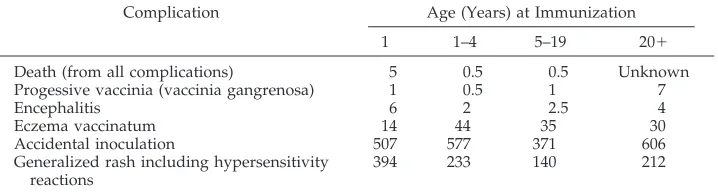
A major reason not to initiate universal immuni-zation in the absence of actual cases of smallpox, besides the limited availability of vaccine, is the risk of serious complications of immunization. Severe complications of immunization include death, post-vaccinal encephalitis, progressive vaccinia, eczema vaccinatum, generalized rash, and accidental inocu-lation to the face, eye, or other sites (see Table 1). Smallpox vaccine has been known for decades to produce significant adverse effects, especially in im-munocompromised persons. In patients with chronic skin conditions, smallpox vaccine can cause a severe, sometimes fatal dermatologic involvement termed “eczema vaccinatum.” The list of conditions that place patients at risk of eczema vaccinatum is long
TABLE 1. Risks of Death and Complications From Smallpox Immunization (per Million Vaccine Recipients)*
Complication Age (Years) at Immunization
1 1–4 5–19 20⫹
Death (from all complications) 5 0.5 0.5 Unknown Progessive vaccinia (vaccinia gangrenosa) 1 0.5 1 7
Encephalitis 6 2 2.5 4
Eczema vaccinatum 14 44 35 30
Accidental inoculation 507 577 371 606
Generalized rash including hypersensitivity reactions
394 233 140 212
and includes most disorders that disrupt epidermal integrity. Atopic dermatitis is the most common dis-order associated with severe eczema vaccinatum, and people with this disorder may be susceptible even if the skin disorder is in remission. Even unim-munized susceptible individuals can have such reac-tions if the virus spreads to them from those who have been immunized.
Studies from the 1960s indicate an overall rate of complications of 1254 per million primary immu-nized individuals.6,10 –12In the past, vaccinia immune
globulin (VIG) was used to treat and decrease the severity of many of these complications, but only about 600 doses of VIG currently are available. Using 1968 US data, at least 40 individuals per million immunized developed significant and potentially life-threatening complications for which VIG would be used. With the increase in the number of people who are immunosuppressed in 2002, the current VIG supply is inadequate.
Smallpox vaccine is not recommended for people with eczema or other exfoliative skin disorders, for pregnant women, or for people with immunodefi-ciencies, whether primary or secondary. Atopic der-matitis, a genetically based immune abnormality, oc-curs within the first 5 years of life and affects 15% of the population.13
Before its discontinuation, universal smallpox im-munization was recommended in the United States for children 1 to 2 years of age. Reimmunization was recommended every 5 years and annually for people working in endemic areas. The current recommen-dation for those individuals at high risk because of occupational exposure is immunization every 3 years. People with multiple immunizations during childhood probably have longer-lasting immunity, but the degree of protection for those immunized before 1972 is unknown.
VACCINE: CURRENT STATUS
Currently, smallpox vaccine is stocked in a lyoph-ilized (freeze-dried) state by the CDC.14
Approxi-mately 15 million doses are available in the United States for immunizing military personnel and for controlling a possible outbreak, but this amount is not sufficient for the entire US population. Studies conducted in 2001 suggest that the vaccine may be diluted at least 1:5 to 1:10 and still provide a satis-factory response.7,8Additionally, a previously
unac-counted-for stock of approximately 85 million doses of concentrated smallpox vaccine put aside by Aven-tis Pasteur (Swiftwater, PA) is still biologically ac-tive.15In addition, the US government has contracted
for delivery of approximately 200 million doses of tissue culture-derived vaccinia vaccine, which is cur-rently in production but has not gone through the evaluation steps for approval by the US Food and Drug Administration.
In the event of a known bioterrorist release of smallpox virus, vaccine would be administered to exposed individuals. If vaccine is given within 3 to 4 days of exposure, immunity can develop before the disease occurs, and this would be expected to pre-vent or ameliorate the severity of disease.
Postexpo-sure immunization is recommended for persons who have had face-to-face, household contact with or have been in proximity to a person who has active smallpox skin lesions, persons who have been in-volved in the care of such an individual, and persons exposed in any way to laboratory specimens or bed-ding from an infected patient. Such a plan (referred to as a “ring vaccination” program) would allow the most effective use of available stocks of vaccine while exposing a minimal number of individuals to the risks of immunization.
Variola virus as an agent of bioterrorism has been discussed widely, but the difficulty of introducing the virus into the population and the limited effects of doing so have persuaded most public health au-thorities that the chances of a smallpox outbreak are very small. Because of the known adverse effects of smallpox immunization (see preceding section and Table 1), the large number of immunocompromised people in the population, and the currently limited supplies of vaccine and VIG, all stockpiled vaccine is considered an investigational agent and is available for use by public health authorities only.
PROPOSED STRATEGIES FOR IMMUNIZATION
The major proposed strategies for smallpox immu-nization in the face of a bioterrorism threat include mass immunization, voluntary immunization, and ring vaccination or “surveillance and containment.” The proponents of mass immunization claim it to be the strategy that would most effectively prevent spread of disease. They also postulate that a bioter-rorist would be unlikely to introduce variola into a well-immunized population. Those who favor vol-untary immunization feel that each individual should be allowed to weigh the pros and cons of immunization and act according to his or her own analysis.16 Unfortunately, much of the population is
not familiar with the problems and complications of vaccinia immunization. The ring vaccination strategy is discussed below, along with reasons why the American Academy of Pediatrics (AAP) considers this the best approach at present.
RECOMMENDED STRATEGY: RING VACCINATION (SURVEILLANCE AND CONTAINMENT)
The AAP supports the current CDC recommenda-tion of the strategy known as ring vaccinarecommenda-tion, also referred to as surveillance and containment. Using this approach, if smallpox were introduced in an act of terrorism, infected patients would be isolated. Contacts of infected individuals as well as their con-tacts would then be identified and immunized by specially trained teams of health care professionals. This strategy can control a localized outbreak with minimal exposure of vulnerable populations to the complications of immunization. The ring strategy is based on the knowledge that vaccination can prevent or ameliorate disease severity if given within 3 to 4 days of initial exposure and can decrease symptoms if given within the first week of exposure.
contracting the disease and form a buffer of immune individuals to prevent the spread of disease. This strategy would be more desirable than a preevent mass immunization campaign for the following rea-sons17:
1. Focused contact tracing and immunization com-bined with extensive surveillance and isolation of cases was the strategy used to eradicate smallpox in the successful worldwide program in the 1960s and 1970s.
2. In a universal immunization campaign, the num-ber of adverse events would be expected to be higher than in the past because of the number of persons with contraindications, some of which might be undiagnosed or unrecognized at the time of immunization or exposure to individuals who have recently been immunized (eg, undiag-nosed immunosuppressive disorders such as HIV infection or receiving cytotoxic or immunosup-pressive agents for cancer, transplantation, or au-toimmune or inflammatory disorders). Severe vaccinia infections may occur in such vulnerable individuals and in persons with skin conditions, including atopic dermatitis, if they come in close contact with immunized immunocompetent per-sons who are shedding vaccinia virus.
3. In the past, individuals with complications of im-munization were treated with VIG. Current sup-plies of VIG are not sufficient to treat the number of patients expected to experience adverse effects with a universal immunization campaign. 4. In the past, immunization focused on young
chil-dren. Senescence of the immune system could make the elderly more susceptible to vaccine-re-lated complications, but there is little information available regarding the immune response and complication rate in older individuals. There is some experimental evidence to suggest that they may have a higher rate of certain complications from smallpox immunization.18
5. Current supplies of smallpox vaccine would be exhausted quickly if a universal campaign were initiated, potentially leaving no vaccine for use if smallpox cases occurred.
6. Mass preevent immunization would require large numbers of health care and public health profes-sionals to perform immunization and to monitor for and deal with the high number of adverse events.
7. Should an outbreak of smallpox occur, initiation of mass immunization may lead to improper reli-ance on this strategy to control the outbreak with less focus on other essential outbreak control mea-sures, such as careful surveillance, contact tracing, and isolation of cases. If an outbreak occurred in a locale where there had not been preemptive im-munization, there could be inadequate supplies of vaccine for areas with the greatest need, and that potentially could prolong the epidemic instead of controlling it.
The AAP supports the opinion of the CDC’s Ad-visory Committee on Immunization Practices that it
is desirable to have patients with smallpox cared for by persons who have been immunized. Thus, na-tional, state-based, and local teams of health care professionals who already have been immunized will be trained in all aspects of smallpox investiga-tion and care and will be available to go immediately to the site of a suspected or proven smallpox case. With teams available in every state, approximately 10 000 to 20 000 carefully screened individuals will receive smallpox vaccine.
For the general population, the ring vaccination strategy is recommended for managing those ex-posed to smallpox. The development of safer vac-cines or substantial evidence that a bioterrorism threat is more likely than currently believed should lead to a reevaluation of this policy, including the possibility of a postattack expansion of the ring of vaccine recipients.
RECOMMENDATIONS
1. At present, the AAP supports the ring vaccination approach to contain smallpox cases that might develop as a result of bioterrorism.
2. Ongoing reassessment of the risk of smallpox as a bioterrorism agent is critical; any change in that assessment should be shared with public health authorities.
3. Ongoing attempts to develop a safer and more effective smallpox vaccine should continue and should be supported. Smallpox vaccines, includ-ing those presently available and those developed in the future, should be evaluated for safety and immunogenicity in children as well as adults. 4. Health care professionals throughout the country
should be educated regarding identification of smallpox.
5. The CDC and regional and local public health authorities should have a plan in place to respond immediately to a suspected or confirmed case of smallpox.
6. The public should be educated that the concept of ring vaccination means that some individuals will be immunized according to a mandatory (no non-medical exemptions) protocol and that quarantine may have to be used (including, possibly, separat-ing family members).
7. The public should be educated about the possible serious adverse effects of smallpox immunization, especially for children, because surveillance stud-ies demonstrate that they have a higher incidence of adverse effects.
Committee on Infectious Diseases, 2001–2002
Jon S. Abramson, MD, Chairperson Carol J. Baker, MD
Thomas N. Saari, MD Leonard B. Weiner, MD
Ex Officio
Larry K. Pickering, MD
Red BookEditor
Liaisons
Lance Chilton, MD
AAP Practice Action Group Marc Fischer, MD
Centers for Disease Control and Prevention Joanne Embree, MD
Canadian Paediatric Society Martin C. Mahoney, MD
American Academy of Family Physicians Dikoe Makhene, MD
National Institutes of Health Walter A. Orenstein, MD
Centers for Disease Control and Prevention Douglas Pratt, MD
Food and Drug Administration Jeffrey R. Starke, MD
American Thoracic Society
Consultant
Edgar O. Ledbetter, MD
Staff
Martha Cook, MS
*Lead authors
REFERENCES
1. Koplan JP, Foster SO. Smallpox: clinical types, causes of death, and treatment.J Infect Dis.1979;140:440 – 441
2. Alibek K.Biohazard: The Chilling True Story of the Largest Covert Biological Weapons Program in the World—Told From the Inside by the Man Who Ran It.New York, NY: Random House; 1999
3. Henderson DA, Inglesby TV, Bartlett JG, et al. Smallpox as a biological
weapon: medical and public health management. JAMA. 1999;281: 2127–2137
4. O’Toole T. Smallpox: an attack scenario. Emerg Infect Dis. 1999;5: 540 –546
5. Meltzer MI, Damon I, LeDuc JW, Millar JD. Modeling potential re-sponses to smallpox as a bioterrorist weapon.Emerg Infect Dis.2001;7: 959 –969
6. Fauci AS. Smallpox vaccination policy—the need for dialogue.N Engl J Med.2002;346:1319 –1320
7. Breman JG, Henderson DA. Diagnosis and management of smallpox. N Engl J Med.2002;346:1300 –1308
8. Frey SE, Newman FK, Cruz J, et al. Dose-related effects of smallpox vaccine.N Engl J Med.2002;346:1275–1280
9. Frey SE, Couch RB, Tacket CO, et al. Clinical responses to undiluted and diluted smallpox vaccine.N Engl J Med.2002;346:1265–1274
10. Lane JM, Ruben FL, Neff JM, Millar JD. Complications of smallpox vaccination, 1968.N Engl J Med.1969;281:1201–1208
11. Lane JM, Ruben FL, Neff JM, Millar JD. Complications of smallpox vaccination, 1968: results of ten statewide surveys.J Infect Dis.1970;122: 303–309
12. Lane JM, Millar JD. Risks of smallpox vaccination complications in the United States.Am J Epidemiol.1971;93:238 –240
13. Rudikoff D, Lebwohl M. Atopic dermatitis.Lancet.1998;351:1715–1721 14. Centers for Disease Control and Prevention. Vaccinia (smallpox) vaccine: recommendations of the Advisory Committee on Immuniza-tion Practices (ACIP), 2001.MMWR Morb Mortal Wkly Rep. 2001;50(RR-10):1–25
15. Pear R. A nation challenged: the bioterrorism threat. Frozen smallpox vaccine is still potent, officials say.The New York Times. March 30, 2002:A8
16. Bicknell WJ. The case for voluntary smallpox vaccination.N Engl J Med. 2002;346:1323–1325
17. Centers for Disease Control and Prevention, Public Health Emergency Preparedness and Response. Interim smallpox response plan and guidelines. Atlanta, GA: Centers for Disease Control and Prevention; November 2001. Available at: http://www.bt.cdc. gov/DocumentsApp/ Smallpox/RPG/index. asp. Accessed July 18, 2002
18. Koplan JP, Marton KI. Smallpox vaccination revisited. Some observa-tions on the biology of vaccinia.Am J Trop Med Hyg.1975;24:656 – 663
All policy statements from the American Academy of
DOI: 10.1542/peds.110.4.841
2002;110;841
Pediatrics
Committee on Infectious Diseases
Smallpox Vaccine
Services
Updated Information &
http://pediatrics.aappublications.org/content/110/4/841
including high resolution figures, can be found at:
References
http://pediatrics.aappublications.org/content/110/4/841#BIBL
This article cites 15 articles, 1 of which you can access for free at:
Subspecialty Collections
sub
http://www.aappublications.org/cgi/collection/vaccine:immunization_
Vaccine/Immunization
b
http://www.aappublications.org/cgi/collection/infectious_diseases_su
Infectious Disease
following collection(s):
This article, along with others on similar topics, appears in the
Permissions & Licensing
http://www.aappublications.org/site/misc/Permissions.xhtml
in its entirety can be found online at:
Information about reproducing this article in parts (figures, tables) or
Reprints
http://www.aappublications.org/site/misc/reprints.xhtml
DOI: 10.1542/peds.110.4.841
2002;110;841
Pediatrics
Committee on Infectious Diseases
Smallpox Vaccine
http://pediatrics.aappublications.org/content/110/4/841
located on the World Wide Web at:
The online version of this article, along with updated information and services, is
by the American Academy of Pediatrics. All rights reserved. Print ISSN: 1073-0397.