Moving Object Detection for Real-Time
Traffic Surveillance using Genetic Algorithm
Bachu Srnivas#1, M. Shivaranjani#2,
N. Udaykumar
#3,N. Anuroop Reddy
#4#1
Associate Professor, Department of ECE, GNITC, Hyderabad, T.S, India
#2,34,
B.Tech IVth Year Student,Associate Professor, Department of ECE, GNITC, Hyderabad, T.S, India
Abstract Video surveillance, most commonly called CCTV (Closed-circuit television), is an industry that is more than 30years old and one that has had its share of technology changes. To meet the requirements include: Better image quality, Reduction in costs, Size and scalability etc., video surveillance has experienced a number of technology shifts. We present a moving object detection method for real-time traffic surveillance applications. The proposed method is a combination of a genetic dynamic saliency map (GDSM), which is an improved version of dynamic saliency map (DSM) and background subtraction. The experimental results show the effectiveness of the proposed method in detecting moving objects. Recent developments in vision systems such as distributed smart cameras have encouraged researchers to develop advanced computer vision applications suitable to embedded platforms. In the embedded surveillance system, where memory and computing resources are limited, simple and efficient computer vision algorithms are required.
Keywords — Traffic surveillance, Genetic algorithm, Dynamic saliency map.
I. INTRODUCTION
Moving item discovery in image sequences [11, 12] is key in application areas, for example, robotized visual observation, human-PC connection, content-based video compression, and automatic traffic monitoring. Particularly, vehicle discovery with stationary camera is a critical issue in movement administration, which is basic for the estimation of activity parameters, for example, vehicle check, speed, and stream [5-8]. As of late, foundation displaying is a normally utilized strategy to recognize moving items with settled camera. Be that as it may, exact discovery could be troublesome because of the potential changeability, for example, shadows thrown by moving items, non stationary foundation forms, and cover. Far reaching displaying of spatiotemporal data inside the video grouping is a key issue to powerfully section moving articles in the scene. Transient data is principal to deal with non stationary foundation forms. Direct procedures or likelihood circulations can be utilized to portray foundation changes from late perceptions [9, 10]. In, the current history of pixel power is displayed by a blend of Gaussians, and the Gaussian blend is adaptively refreshed for each site to manage progression in foundation forms. Shading co
event between continuous casings has likewise been proposed to show dynamic components of non stationary items. On the other hand, spatial data is imperative to comprehend the structure of the scene. Gradient or edge highlights help enhance the unwavering quality of question discovery. In, spatial co event of picture varieties at neighbouring squares is utilized to improve the discovery affectability. Spatial shading dispersion has additionally been proposed for frontal area question discovery.
The organization of the paper as follows:
The related works of research are discussed in section II. In section III describes the problems related to the video surveliance. Section IV deals with the methodlogy of real-time video surveliance using genetic algorithm. Results and dicussions are explained in step by step manner in the section V. Finally, the summary and conclusions were incorporated in section VI.
II. RELATED WORK
Y. Wang et al. [1] introduced an approach of moving vehicle location and cast shadow evacuation for video based activity checking. In view of contingent irregular field, spatial and transient conditions in activity scenes are detailed under a probabilistic discriminative system, where relevant requirements amid the recognition procedure can be adaptively balanced as far as information subordinate neighbourhood association. Computationally effective calculation has been created to segregate moving cast shadows and handle non stationary foundation forms for ongoing vehicle recognition in video streams. Exploratory outcomes demonstrate that the proposed approach viably wires relevant conditions and powerfully identifies moving vehicles under substantial shadows even in gray scale video.
Recognition of moving article is a testing undertaking. Following is required in larger amount applications that require the area and state of question in each edge. In this review, I portrayed Foundation subtraction with alpha, factual technique, Eigen foundation Subtraction and Worldly edge differencing to recognize moving item. I likewise portrayed following technique in light of point following, piece following and outline following
B. Rinner and W. Wolf et al. [3] introduced a ccirculated shrewd cameras (DSCs) are continuous conveyed installed frameworks that perform PC vision utilizing different cameras. This new approach has risen on account of a juncture of synchronous advances in four key orders: PC vision, picture sensors, inserted registering, and sensor systems. Preparing pictures in a system of appropriated savvy cameras presents a few complexities. Notwithstanding, we trust that the issues DSCs fathom are significantly more critical than the difficulties of planning and building a disseminated video framework. We contend that dispersed shrewd cameras speak to key segments for future inserted PC vision frameworks and that keen cameras will turn into an empowering innovation for some new applications. We compress shrewd camera innovation and applications, talk about momentum inclines, and recognize essential research challenges.
R. Cucchiara, C. Grana, M. Piccardi, and A. Prati et al. [4 ] have discussed on moving visual items. Many ways to deal with moving item discovery for activity checking and video reconnaissance proposed in the writing depend on foundation concealment strategies. The most effective method to accurately and productively refresh the foundation model and how to manage shadows are two of the all the more recognizing and testing elements of such methodologies. This work displays a broadly useful strategy for division of moving visual items (MVOs) in light of a protest level characterization in MVOs, apparitions and shadows. Foundation concealment needs a foundation model to be evaluated and refreshed: we utilize movement and shadow data to specifically avoid from the foundation show MVOs and their shadows, while holding phantoms. The shading data (in the HSV shading space) is misused to shadow concealment and, therefore, to improve both MVOs division and foundation refresh.
III.PROBLEM IDENTIFICATION
There were some problems which have been identified from the previous works while researching about the topic. Those are:
i. Foreground object detection ii. Vehicle Classification iii. Low Accuracy
The genetic algorithm based moving detection for real-time video surveillance or traffic surveillance is the solution fo the above difficulties. This method was discussed in section IV.
IV.METHODOLOGY
Moving object detection extracts moving objects of interest such as vehicles and pedestrians in video sequences with a static or dynamic background. In real-time traffic surveillance systems, moving object detection based on images obtained from fixed CCTV cameras involves many challenging problems including the following: 1) unexpected number of multiple moving objects; 2) size variation and poorly textured objects; 3) rapid change in illumination conditions; and 4) shadows and multiple occlusions.
Detecting moving objects has been widely applied in computer vision, so it attracts intensive attention from researchers in the area of image processing. However, because the surroundings in the real-world videos are often quite articulated or even non-rigid, moving object detection is still a challenging problem that needs to be further addressed. As indicated there are mainly three factors that make it more difficult to detect moving objects from videos.
(1) The presence of complex background, e.g., dynamic background with swaying trees,
(2) Camera motion, e.g., tripod vibration,
(3) Requiring prior knowledge, e.g., training data for modelling the background.
Furthermore, most existing moving object detection algorithms are not intelligent or robust enough for that they need user interaction or experiential parameter tuning. Generally, motion detection methods can be categorized into three approaches, namely temporal-based, spatial-temporal-based, and combined approach. For moving object detection, motion cues are the most reliable information, so a mass of moving object detection methods are designed based on temporal information, such as frame difference and background subtraction. Frame difference is simple and can fast extracts moving objects, but it is difficult to get the entire contour of the moving targets and easily affected by the perturbations of the background. Background subtraction, which removes the background model from the input images, is a common approach to detect moving objects and has been widely used in practical applications. Over the recent past, a multitude of algorithms for background modeling have been developed, such as GMM (Gaussian Mixture Model), MRF (Markov Random Field) and BBM (Bayesian background model). However, background modeling methods require extensive computational time to estimate the background, and it is sensitive to illumination changes. What is more, in order to model the background, the prior knowledge such as the training data is required. The spatial-based object detection is principally applied in the domain of object detection in static images and the results are usually undesirable as the lack of temporal information.
interesting (salient) objects. Recording the eye motion of observers with eye-trackers has given some insight into why people look at certain areas in an image. There is ongoing research in developing computational models of visual saliency to mimic the HVS’s behaviour. Some visual saliency models are inspired by cognitive findings, some are computational, and others a combination of both. An excellent review of saliency models is given. High level information such as sky, faces, and humans has been used as indicators to identify visually salient regions. However such specific high level information is restrictive and not available in all images. Therefore many bottom-up methods use low level features for salient region detection. The general approach is to use color, texture, and frequency components to obtain a saliency map that highlights salient regions and suppress uninteresting regions. Saliency maps have been used for a wide range of applications namely object detection, image and video summarization,
video surveillance, registration and segmentation of medical images, object tracking, matching pedestrians from disjoint camera views, and image retargeting. Many of the saliency methods do not suppress false positives that occur due to highly textured regions in images.
In this paper, we present an object detection algorithm suitable to embedded surveillance applications. The proposed method is a combination of genetic dynamic saliency map (GDSM) and background subtraction. GDSM is based on dynamic saliency map (DSM) [3], and requires less computation, has higher object detection accuracy, and is more robust to noise and environment variations. The performance improvement of GDSM over the conventional DSM is due to optimization of the weights using a Genetic algorithm, while uniform weights are used in the original DSM when creating a saliency map.
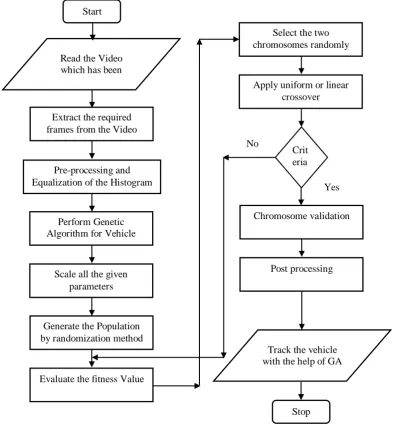
Figure 1: Flowchart of the Methodology However, GDSM fails to detect objects especially
when they stop unexpectedly in the middle of the road.
Therefore, we combine GDSM with background subtraction (BS) to detect moving objects more Start
Read the Video which has been
captured
Extract the required frames from the Video
Pre-processing and Equalization of the Histogram
Perform Genetic Algorithm for Vehicle
detection
Scale all the given parameters
Generate the Population by randomization method
Evaluate the fitness Value
Stop Track the vehicle with the help of GA
Select the two chromosomes randomly
Apply uniform or linear crossover
Chromosome validation
Post processing Crit eria
accurately. BS helps detect tighter object boundaries and surrounding areas. Among the various BS methods, we adopt running Gaussian averaging that is known to be fast and simple.
The idea of the methodology is, first to reduce the computational cost while supporting a variable number of moving objects that interact, we propose that an object is deleted when a death event is detected and an object is added when a birth event is detected.
The methodology of genetic algorithm based moving object detection for real-time traffic surveillance is shown in figure 1.
Read the Video which has been captured. Upload the video from the system in .mp4 format. The Function strictly supports the .mp4 format, which we are using the given methodology. Extract the required frames from the video. There are lot of frames in the video as the video itself is a collection of frames, so in this step, extraction of each of the frame is done.
The extraction procedure is finished by Gaussian strategy. Pre-preparing of the picture which has been divided by the Gaussian technique. Pre-processing includes thinning of the image, canny edge detection and conversion of image into gray scale image. First of all the image gets converted to Gray scale image. By using Canny Edge detection technique, the edges of the frames of the image are detected by dotted lines. Now the image undergoes thinning process. The process of Thinning involves the drawing of an outline on the image and it is compared to the previous main image. If the outlines of the image match, then it indicates that there is no movement in the image, whereas if the frames mismatch, then it indicates that there is some movement in the image. Equalization of the histogram. The histogram is drawn by considering a threshold value of the image as 0.5.According to it, the region where the object is placed is always denser, and rest of the background is rarer as compared to the denser region.
Perform Genetic Algorithm for Vehicle detection. A genetic algorithm (GA) is a method for solving both constrained and unconstrained optimization problems based on a natural selection process. The algorithm repeatedly modifies a population of individual solutions to get best result. It generates solutions to optimization problems using techniques inspired by natural evolution, such as inheritance, mutation, selection and crossover.
Initialize the parameters of genetic algorithm. Parameter scaling includes the process of defining the characteristics i.e., how many chromosomes should be taken into consideration, how many times it should be illustrated, and the number of genes which are to be taken. Initialize the chromosome generation by randomization method. The population is generated as defined previously in the algorithm. In the Post-Processing, the best frame solution is obtained. Track the vehicle with the help of genetic algorithm. With
the help of Genetic Algorithm the Vehicle has been tracked which is shown in the green colored box. Advantages:
Computation load is greatly reduced since we need not process each pixel
More accurate and stable features are obtained compared to a single pixel.
It is very Efficient and robustness.
V. RESULTS AND DISCUSSIONS
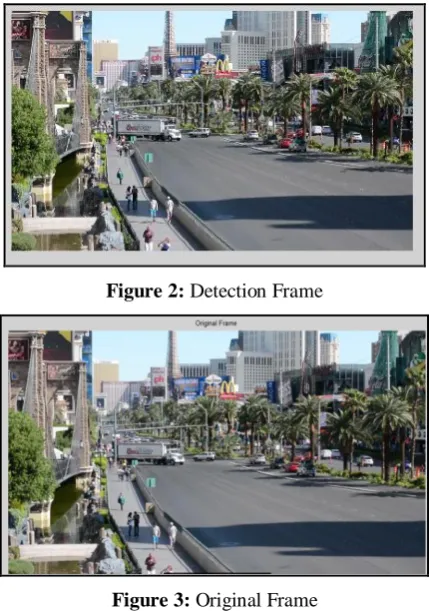
After selection of video we should give the frame number from where the detection should start. In the figure 2 we can see that the detection has started.
Figure 2: Detection Frame
Figure 3: Original Frame
In figure 3 we can see that the original frame detection has started.
Figure 5: Foreground Extracted Frame In figure 5 we can see that the foreground extracted frame. From the figure 4, it detects the small object that is moving.
Figure 6: Label Frame
In figure 6 we can see the label frame on the particular object that is moving.
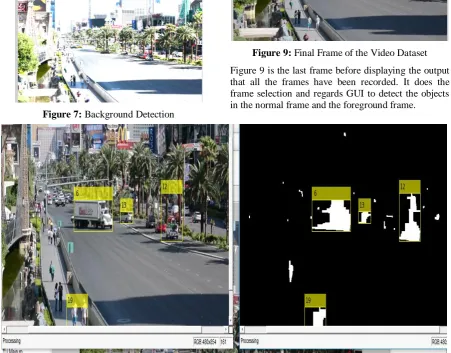
Figure 7: Background Detection
In figure 7 we can see that the background detection process started detecting the constant objects and moving objects.
Figure 8: Moving objects Identification From figure 8 we see the selected frame that the objects are moving.
Figure 9: Final Frame of the Video Dataset Figure 9 is the last frame before displaying the output that all the frames have been recorded. It does the frame selection and regards GUI to detect the objects in the normal frame and the foreground frame.
Figure 10 is the final output we can see the two frames displaying that detecting the moving objects. It detects the small object that is moving. This is generally used in the traffic surveillances to detect the speed of the object.
Applications
The human visual system (HVS) has a remarkable ability to understand a scene and focus on the most Interesting (salient) objects. Recording the eye motion of observers with eye-trackers has given some insight into why people look at certain areas in an image. There is ongoing research in developing computational models of visual saliency to mimic the HVS’s behaviour. Some visual saliency models are inspired by cognitive findings, some are computational, and others a combination of both. An excellent review of saliency models is given . High level information such as sky, faces, and humans has been used as indicators to identify visually salient regions
Object detection
Image and video summarization Video surveillance
Registration and segmentation of medical images
Object tracking
VI.CONCLUSION
In this paper, we proposed an improved object detection method based on a genetic dynamic saliency map and background subtraction. The proposed object detection method is fast, simple, and with good performance. Thus, it is suitable for embedded systems. The proposed method is practical to handle shadow and occlusion problems efficiently. This technique is exceptionally valuable in recognizing an expansive number of vehicles, and it likewise diminished the preparing time, which was a noteworthy issue in the past works. In a further report, various components of a deformable 3-D vehicle display procured from the KVBs of the proposed strategy might be utilized to make strides characterization execution.
REFERENCES
[1] Y. Wang, ―Real-time moving vehicle detection with cast shadow removal in video based on conditional random field,‖ IEEE Trans. Circuits Syst. Video Technol., vol. 19, no. 3, pp. 437–441, 2009.
[2] K. A. Joshi and D. G. Thakore, ―A survey on moving object detection and tracking in video surveillance system,‖ Int. J. Soft Comput. Eng. (IJSCE), vol. 2, no. 3, pp. 44–48, 2012. [3] J.-W. Woo, W. Lee, and M. Lee, ―A traffic surveillance
system using dynamic saliency map and svm boosting,‖ Int. J. Contr. Auton. Syst., vol. 8, no. 5, pp. 948–956, 2010. [4] B. Rinner and W. Wolf, ―An introduction to distributed
smart cameras,‖ Proc. IEEE, vol. 96, no. 10, pp. 1565–1575, 2008.
[5] M. Piccardi, ―Background subtraction techniques: A review,‖ in IEEE Int. Conf. Syst., Man and Cybern, 2004, vol. 4, pp. 3099–3104.
[6] I. S. Kim, H. S. Choi, K. M. Yi, J. Y. Choi, and S. G. Kong, ―Intelligent visual surveillance—A survey,‖ Int. J. Contr. Auton. Syst., vol. 8, no. 5, pp. 926–939, 2010.
[7] R. Cucchiara, C. Grana, M. Piccardi, and A. Prati, ―Detecting moving objects, ghosts, and shadows in video streams,‖ IEEE Trans. Patt. Anal. Mach. Intell., vol. 25, no. 10, pp. 1337–1342, 2003.
[8] P.-L. St-Charles, G.-A. Bilodeau, and R.Bergevin, ―Flexible background subtraction with self-balanced local sensitivity,‖ in IEEE Conf. Comput. Vision and Pattern Recogn. Workshop (CVPRW), 2014, pp. 414–419.
[9] N. Paragios and R. Deriche, ―Geodesic active contours and level sets for the detection and tracking of moving objects,‖ IEEE Trans. Patt. Anal. Mach. Intell., vol. 22, no. 3, pp. 266–280, 2000.
[10] D. E. Goldberg, Genetic Algorithms in Search, Optimization and Machine Learning. Reading, MA, USA: Addion-Wesley, 1989.
[11] Bachu, Srinivas, and K. Manjunatha Chari, A review on motion estimation in video compression, Signal Processing And Communication Engineering Systems (SPACES), 2015 International Conference on. IEEE, 2015.
[12] Srinivas Bachu and K. Manjunathachari, Adaptive Order Search and Tangent Weighted Trade off for H.264 in Motion Estimation, Elsevier Journal: JKSU–Computer and Information Sciences. August 2016.
DOI: 10.1016/j.jksuci.2016.07.002
AUTHORS
Srinivas Bachu, Research Scholar from
GITAM University Hyderabad, and
received M.Tech degree from JNT
University, Hyderabad, has 12 years of teaching experience. At present he is working as an Associate Professor, Department of
ECE at Guru Nanak Institutions Technical
Campus (Autonomous), Telangana. He is the
Life Member of ISTE, AMIE, and IAENG. He published 3 Text Books and 15 Research Papers at Refereed International
Conferences & Journals. He is one of the Editorial Board and
Reviewer Board Member in five International Journals. His areas of research interest are Signal, Image and Video Processing.
Marri Shivaranjani, Pursuing IV Year B.Tech in the specialization of from Guru
Nanak Institutions Technical Campus
(GNITC), Hyderabad. She has undergone training on RFID based security systems in Guru Nank Institutions (GNI), Hyderabad. Her areas of interest are Signal, Image and Video Processing.
Nandhigama Udaykumar, Pursuing IV Year B.Tech in the specialization of
Electronics and Communication
Engineering from Guru Nanak Institutions Technical Campus (GNITC), Hyderabad. He has undergone training on RFID based security systems in Electronics Corporation of India Limited (ECIL), Hyderabad. He has undergone training on Ground Telemetry in DRDL, Hyderabad. His areas of interest are Signal, Image and Video Processing.
Nimmala Anuroop Reddy, Pursuing IV Year B.Tech in the specialization of
Electronics and Communication