2016 | VOLUME 12 |257 © ARCHIVES OF BUDO | SCIENCE OF MARTIAL ARTS
Body composition and selected anthropometric
traits of elite Polish female judokas in relation to
the performance of right-dominant, left-dominant,
or symmetrical judo techniques in vertical posture
(
tachi waza
)
Małgorzata Socha
1ABCD,
Kazimierz Witkowski
2BDE, Wiesława Jonak
1B,
Krzysztof Andrzej Sobiech
1DE1 Department of Human Biology, University School of Physical Education, Wroclaw, Poland 2 Department of Martial Arts, University School of Physical Education, Wroclaw, Poland
Received: 19 August 2016; Accepted:12 September 2016;Published online:30 September 2016
AoBID: 11322
Abstract
Background & Study Aim: Judo is a sport with a complex structure of short and “intense movements”. A judo competitor must possess high levels of strength, agility, and technical and endurance skills. The study aim is the relationship the body composition, the degree of symmetrization of muscle mass of the limbs, skinfolds and hand grip strength with respect to the preferred side of attacks in vertical posture (tachi waza) during judo matches.
Material & Methods: Twenty-five female members of the Polish national judo team (20.2 ±3.1 years) and 34 non-training wom-en (20.1 ±0.8 years) participated in the study. Depwom-ending on the preferwom-ence of attack direction during combat the judokas in vertical posture were divided into right-dominant, left-dominant, and symmetrical. All subjects were right-handed. Anthropometric measurements and body composition (BIA method) components were compared.
Results: The female judokas featured a higher BMI, intracellular water, upper limb circumferences, and thinner tri-ceps, abdominal and calf skinfolds than the control. The thicker suprailiac skinfold in judokas can be associ-ated with the necessity to maintain body stability during judo bouts. In control an asymmetry (right-left) in the circumferences of the forearm (0.4 cm), thigh (0.3 cm) and thickness of the abdominal (0.6 mm), triceps (–0.4 mm) and suprailliac skinfolds (–0.9 mm) was noted. In the right-dominant an asymmetry in the fore-arm circumference (0.4 cm) and suprailliac skinfold was found (1.9 mm). The left-dominant featured only an asymmetry in the thickness suprailliac skinfold (3.2 mm). No morphological asymmetry was observed among the symmetrical judokas. Dynamic asymmetry of hand grip strength was observed in control and only right-dominant judokas (2.1 kg).
Conclusions: In the right-handed judokas preferred direction of attacks removes morphological and dynamic signs of
asym-metry. The estimation of the degree of symmetrization of the body build and body motor functions can be used in the process of judo training management.
Key words: anthropometry • attack directions • body balance disturbation tolerance skills • combat sports • hand strength
Copyright: © 2016 the Authors. Published by Archives of Budo
Conflict of interest: The authors of this study declare that they have no conflicts of interest.
Ethical approval: The study was approved by the Bioethics Committee of the University School of Physical Education in Wroclaw
(Poland) with the date 08.10.2014.
Provenance & peer review: Not commissioned; externally peer reviewed
Authors’ Contribution: A Study Design
B Data Collection
C Statistical Analysis
D Manuscript Preparation
IntroductIon
Judo is a sport with a complex structure of “short and intense movements” (in the sense of distance and the time of exposition during combat in ver-tical posture; tachi waza) of different parts of the body, alternating among three categories: pre-paring an attack, offensive, defensive [1]. During judo fighting in horizontal posture (ne waz) the time of movements exposition and also muscular confusion are even more challenging in the not only a physiological sense. These two categories of stimuli (alternately fighting in the vertical pos-ture and horizontal pospos-ture) determine the fun-damental adaptive changes in judo athletes in the many years of training [2-6].
A judo competitor must possess high levels of strength, agility, and technical and endurance skills [7-11]. Results of numerous studies indi-cate relationships between morphological traits, motor skills and successful performance in judo competitions [12-14]. Judokas feature lower body fat and greater muscle mass. Studies also show that reduced subcutaneous adipose tissue has a positive impact on the development of judokas’ motor skills [14, 15-22]. The exception can be the amount of hip fat, which is greater in judo com-petitors than in others [23].
The mastery of body postural control techniques (tachi waza) in order to maintain or restore body balance is a significant component of judo prac-tice [24-26]. During a judo fighting the compet-itors change their body posture along the long axis but also in response to the force exerted by the opponent [26-28]. The opponent’s actions are never completely predictable thus a judoka’s skill-ful adjustment of body posture to ensure stabil-ity is accomplished through the use of forces of attack, defense and opponent’s efforts to maintain body balance [29] (in fact: body balance disturba-tion tolerance skills [25]).
High significance in effective judo performance is attached to symmetry of motor functions, which in judo competitors is greatly augmented [30, 31]. It was proven that one-sided body posture sig-nificantly diminishes a judoka’s defense capacity against the opponent’s attacks from the other side
of the body [32]. Symmetrization requires bal-ancing motor abilities on both sides of the body, whereas transferring a movement technique from one body side to the other increases judoists’ technical and tactical capabilities as well as per-formance effectiveness [32]. On the other hand, a marked asymmetry in function and stability is not only a hindrance in attaining success in judo, but may also lead to numerous injuries [31]. The existing functional system in asymmet-ric sports stimulates bone and muscle growth and increases limb circumferences on the dom-inant body side [33]. Functional asymmetry has affects differences in strength (dynamic asym-metry) and body build (morphological asymme-try) [33]. The morphological asymmetry of upper and lower limb circumferences was examined by Stefaniak [34], and in his studied group of men and women the asymmetry revealed the domi-nance of the right side. A similar right-domi-nant dynamic asymmetry in judoists, measured by hand grip strength, was found by Detanico et al. [10] and Kurt et al. [35]. Some authors posit that lateralization understood as functional dominance, i.e. preferred performance of various sports skills, can be acquired in the process of development of motor skills during judo train-ing [32, 36] .
On the other hand, according to Sterkowicz et al. [37] handedness and footedness are signifi-cantly correlated with the choice of preferred attack sides during judo combat. Dopico et al. [36] claim there is no relationship between the preferred use of the upper or lower limb while performing simple and complex motor actions (motor dominance) and executing judo techniques to the right side, to the left side or symmetrically (functional dominance). Most results of stud-ies on morphological and dynamic asymmetry in combat sports athletes reveal relationships with the athletes’ self-declared or test-measured later-alization [e.g. 34]. There has been no data on the effects of functional dominance acquired during specialist training, related to the athlete’s prefer-ence of the side of attack, on manifestations of morphological asymmetry. In fact, judo perfor-mance can be more correlated with the direction Source of support: Departmental sources
Author’s address: Małorzata Socha, Department of Human Biology, University School of Physical Education, Paderewskiego 35, 51-612 Wroclaw, Poland; e-mail: [email protected]
Muscle confusion – noun the act
of using several different exercises for a single muscle so that it cannot adapt to a predictable workout and is therefore forced to work harder [49].
Tachi-waza – judo throwing
techniques executed from a standing position. These include
te-waza (hand techniques), koshi-waza (hip techniques), and ashi-waza (foot and leg techniques)
[48], including also sub classification sutemi-waza (rear-fall and side-(rear-fall judo throws; synonym – “dedication throws”).
Ne-waza (prone techniques),
a related concept is that of katame-waza (grappling techniques) – judo techniques executed from a horizontal posture: osaekomi-waza (pinning techniques), shime-waza (strangle technique), kansetsu-waza (joint holds).
Body composition – athlete’s
predisposition in terms of the proportion of active mass and inactive mass in the body.
Body balance disturbation tolerance skills – the ability to
maintain the vertical posture in circumstances of the fall hazard [25]
Technique– noun a way of
performing an action [49]
Symmetry of movements – the
range and level of symmetry technique training (the process of levelling the abilities of oth legs) also serve as a test which evaluates the coordination abilities [46].
The ability of movements symmetrisation – is an ability of
transmission (transfer) technique of movements from one side of the body or one part of the body to the other [47].
Randori: a match controlled by
of judo technique execution than with a judo-ka’s right- or left-handedness [36]. Franchini et al. [14] pointed to the necessity of research on relationships between anthropometric traits and techniques used by athletes in competitive conditions.
The study aim is the relationship the body com-position, the degree of symmetrization of mus-cle mass of the limbs, skinfolds and hand grip strength with respect to the preferred side of attacks in vertical posture (tachi waza) during judo matches.
MaterIalandMethods
Participants
The study group consisted of 25 members of the Polish national women’s judo team, aged 20.17 ±3.12 years. The subjects’ mean train-ing experience was 9.5 years. In the pre-com-petitive season the competitors trained offensive judo techniques for 2 hours, 6 times a week. The control group comprised 34 female stu-dents of physiotherapy aged 20.08 ±0.84 years, who did not practice any competitive sports. All participants declared to be right-handed (writ-ing, eating) and self-estimated their right- or left-dominance (functional dominance) in per-forming their most frequently used judo tech-niques. Following Dopico et al. [36] and Adam et al. [38], the subjects were divided into three groups, depending on the side of their preferred direction of attacks: 1) right-dominant (on the right side, with the right leg, with the right arm); 2) left-dominant (on the left side, with the left leg, with the left arm); and 3) symmet-rical (combining two techniques). The subjects were instructed about the testing procedure and expressed their written consent (those under the age of 18 submitted their parents’ or guardians’ written consent) to participate in the experiment. Procedures
The anthropometric measurements were taken in the morning, and not directly before the competi-tive season, due to the possibility of judo compet-itors to use some body mass regulation methods in order to become classified into specific weight categories. The following traits were measured: body height, body mass, waist circumference, hip circumference, four limb circumferences (arm, forearm, thigh, calf ) and six skinfolds (triceps,
subscapular, rib, suprailiac, abdominal, calf). The
limb circumferences (to the nearest 0.5 cm) and skinfold thickness (to the nearest 0.2 mm) were measured on both sides of the body. The body mass index (BMI) [kg/m2] and waist hip ratio
(WHR) were calculated.
Bioelectrical impedance analysis (BMI) was used to estimate the following body components (tet-rapolar STA/BIA RJL analyzer, Akern 101/S, Italy): body fat (BF) [kg; %], fat free mass (FFM) [kg, %], total body water (TBW) [l; %], intracel-lular water (ICW) [l], extracelintracel-lular water (ECW) [l] and body cell mass (BCM) [kg, %]. Right and left hand-grip strength (static strength of forearm muscles) was measured with a Takei hand dyna-mometer (to the nearest 0.5 kg). All measure-ments were carried out according to commonly accepted anthropometric standards.
The baseline characteristics were the results of anthropometric measurements for the control group of non-training women. Quotient coeffi-cients for the analyzed measures were calculated following the formula B / P x 100, where: B value of anthropometric measurements in the group of judokas; p value of measurements in the control group, and expressed in percent values.
Statistical analysis
All the statistical calculations were made using
Statistica 10.0. Differences between two samples
of independent variables (group of judokas vs con-trol group) were checked with Student’s t-test for independent samples or with Mann-Whitney U-test, depending on the group size and data distribution. Differences between two samples of dependent variables (right-side and left-side measurements in the groups) were checked with Student’s t-test or with the Wilcoxon signed-rank test, depending on group size and data distribu-tion. The level of statistical significance was set at p<0.05 and p<0.01. In order to assess the direction and intensity of changes in the anthropometric measurements the method of comparative profiles method was used, which permitted description of a single or multiple characteristics in relation to a baseline characteristic [39].
results
differences were revealed in body fat (as mated by the BIA) and fat distribution (as esti-mated with the circumference measurements and WHR).
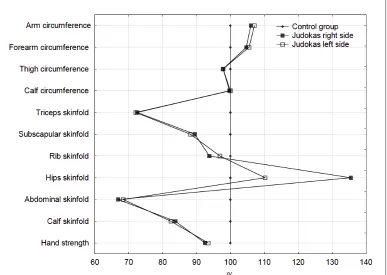
In comparison with the control group the female judoists had significantly greater arm and forearm circumferences on both limbs; however, no sig-nificant differences were found in the circumfer-ences of the legs between the groups (Table 2). Out of the six skinfold thickness measurements, four revealed statistically significant differences between the two groups. The judokas had thin-ner triceps, abdominal and calf skinfolds, measured on both sides of the body. The thickness of the
suprailiac skinfold was, however, greater in the
judokas (statistically significant on the right side). The hand grip strength measurements revealed no significant differences between the group of judokas and the control group (Table 1, Figure 1). In the control group morphological asymmetry expressed by the differences in limb circumfer-ences was in agreement with the women’s declared lateral motor asymmetry. Statistically significant differences were noted between the circumfer-ences of the forearms and the thighs. In each case,
the asymmetry was right-sided (Tables 2 and 3). In the judokas, statistically significant differences were only found between the forearm circumfer-ences, with a marked right-dominance (Table 2). As for the distribution of subcutaneous fat, expressed by skinfold thickness measurements, a statistically significant morphological asym-metry was only revealed for the triceps,
suprail-iac and abdominal skinfolds in the control group,
and only for the suprailiac skinfold in the group of judokas (Table 2 and 3). In the case of the
suprailiac skinfold the direction of
morpholog-ical asymmetry was different in both groups of women: left-dominant in the control group, and right-dominant in the group of judokas (Table 2). The comparison of hand grip strength measure-ments indicated a marked dynamic asymmetry with right-side dominance in the non-training women (statistically significant), and no statisti-cally significant changes in the group of judokas (Tables 2 and 3).
The vast majority (72%) of right-handed judo-kas represented a right-side functional dominance while performing basic judo techniques. Left-side
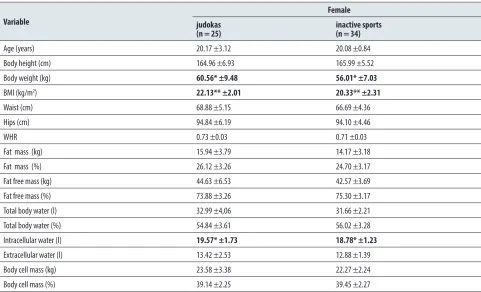
Table 1. Body composition and anthropometric measurements (means and ± standard deviation) in female judokas and inactive sports.
Variable
Female judokas
(n = 25) inactive sports (n = 34)
Age (years) 20.17 ±3.12 20.08 ±0.84 Body height (cm) 164.96 ±6.93 165.99 ±5.52 Body weight (kg) 60.56* ±9.48 56.01* ±7.03
BMI (kg/m2) 22.13** ±2.01 20.33** ±2.31 Waist (cm) 68.88 ±5.15 66.69 ±4.36 Hips (cm) 94.84 ±6.19 94.10 ±4.46 WHR 0.73 ±0.03 0.71 ±0.03 Fat mass (kg) 15.94 ±3.79 14.17 ±3.18 Fat mass (%) 26.12 ±3.26 24.70 ±3.17 Fat free mass (kg) 44.63 ±6.53 42.57 ±3.69 Fat free mass (%) 73.88 ±3.26 75.30 ±3.17 Total body water (l) 32.99 ±4,06 31.66 ±2.21 Total body water (%) 54.84 ±3.61 56.02 ±3.28 Intracellular water (l) 19.57* ±1.73 18.78* ±1.23
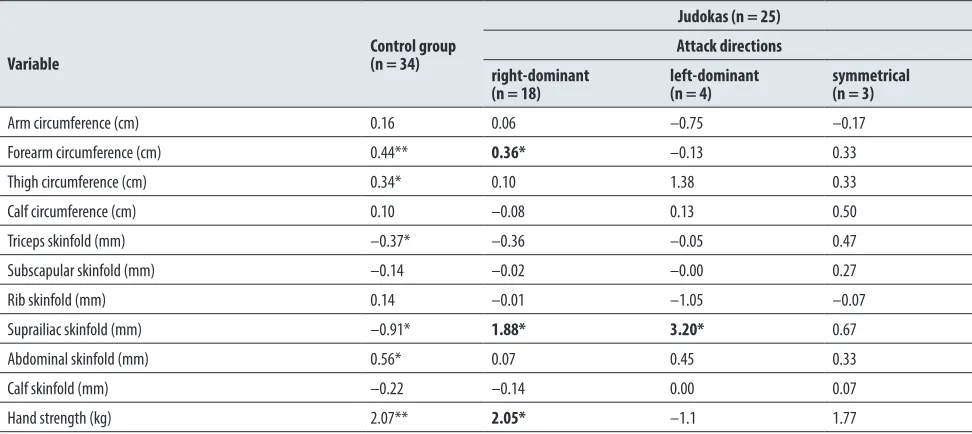
functional dominance was only observed in 16% of the right-dominant judokas. Whereas 12% of the examined judokas declared the symmetrical use of techniques during judo randori and com-petition. The right-dominant female judokas fea-tured a right-dominant morphological asymmetry in the forearm circumferences, like in the control group (Table 3).
The judokas who preferred left-side attacks and symmetrical attacks displayed no morpholog-ical asymmetry in limb circumferences, i.e. no statistically significant differences between the right and the left sides of the body were found. However, it may be noted a change in direc-tion of asymmetry, with a predominance of left upper limb in right-dominant and symmetrical judo athletes compared with the control group. Marked symmetrisation in skinfold thickness can be noted in the female judokas – the most signif-icant in the symmetrical group – in comparison with the control group. A significant morphologi-cal asymmetry can be noted in the suprailiac skin-fold thickness. Unlike in the control group, this skinfold on the right side was significantly thicker than on the left side of right-dominant and left-dominant judokas. The symmetrical judokas did not feature any asymmetry of the suprailliac skin-fold thickness (Table 3).
Only in the judokas who preferred attacks on the right side, was the dynamic asymmetry of hand grip strength – like in the control group – in agreement with the declared lateral motor asym-metry. The female left-dominant or symmetrical judokas revealed no statistically significant dif-ferences between the right and the left hand grip strength. The judokas preferring attacks on the left side showed a shift in the asymmetry in favor of the left hand (Table 3).
dIscussIon
One of the objectives of the present research was estimation of total body fat and fat distribution in young professional female judokas. Judo specific training loads do cause changes in the practitio-ners’ body composition. Body mass and body com-position regulation are important tasks during judo training, which is strictly associated with classifica-tion of judo athletes into different weight categories [14, 40, 41]. Most often, due to increases in muscle mass and decreases in fat mass during sport train-ing, slight changes in athletes’ body mass take place with significant changes in their body composition [33]. The noted increases in body mass and BMI in the examined athletes as compared with the control group result from subtle changes in proportions of body components (body fat and fat free mass).
The larger intracellular water volume observed in the judokas is the evidence of their greater muscle mass. This was also confirmed by Silva et al. [42], who showed that reduced ICW (intracellular water) increased the risk of losing grip strength in elite judokas. Similarly greater arm and forearm cir-cumferences in the examined female judokas indi-cate higher muscularity of their upper limbs. An increased muscle mass of the arms in elite judokas was also noted by Drid et al. [43]. This is a confir-mation of observations of other authors that prop-erly conducted judo training leading to successful
performance is strongly correlated with the devel-opment of muscle mass and shows no correlations with an increase in general fatness [14-19]. Also fat distribution, measured with waist circumferences and WHR (waist hip ratio), showed no signifi-cant differences between the two groups of women. There were, however, differences in the distribu-tion of subcutaneous fat estimated with skinfold thickness measurements. In five out of six exam-ined skinfolds their thickness was lower (statisti-cally significant for the arm, abdominal and calf
skinfols) in the judokas than in the control group. Table 2. Anthropometrical measurements on the left and the right body sides female judokas and inactive (means and ± standard deviation).
Variable Body said
Female
p
between judokas and inactive sports judokas
(n = 25) inactive sports (n = 34)
Arm circumference (cm) right 26.90 ±2.03 25.37 ±1.87 <0.01 left 27.00 ±1.92 25.21 ±1.90 <0.01
Forearm circumference (cm)
right 23.66 ±1.46 22.60 ±0.99 <0.01 left 23.38 ±1.52 22.16 ±1.09 <0.01 p * **
Thigh circumference (cm)
right 54.88 ±3.81 56.09 ±3.38 left 54.55 ±3.80 55.75 ±3.43
p *
Calf circumference (cm) right 35.06 ±2.74 35.15 ±1.93 left 35.04 ±2.70 35.04 ±1.81
Triceps skinfold (mm)
right 11.37 ±2.78 15.68 ±6.08 <0.01 left 11.58 ±3.07 16.05 ±6.03 <0.01
p *
Subscapular skinfold (mm) right 9.74 ±1.86 10.88 ±3.15 left 9.72 ±2.05 11.02 ±3.06
Rib skinfold (mm) right 9.83 ±3.17 10.48 ±4.23 left 10.02 ±3.13 10.34 ±3.54
Suprailiac skinfold (mm)
right 15.82 ±5.63 11.67 ±4.21 <0.01 left 13.87 ±4.21 12.58 ±4.35
p ** *
Abdominal skinfold (mm)
right 11.11 ±3.04 16.62 ±5.44 <0.01 left 10.98 ±3.54 16.06 ±6.34 <0.01
p *
Calf skinfold (mm) right 5.16 ±1.27 6.16 ±1.90 <0.05 left 5.26 ±1.42 6.38 ±1.81 <0.05
Hand grip strength (kg)
right 25.58 ±4.47 27.65 ±4.18 left 23.91 ±3.48 25.58 ±4.08
p **
Only the thickness of the suprailiac skinfold was statistically greater in the judokas. Similar results were obtained by Hasegawa et al. [23]. The greater adiposity of the hip area in the judokas can be used to maintain body balance on the tatami (mats). Despite the observed differences in the circum-ferences of the upper limbs between the group of judokas and the control group no differences in hand grip strength between both groups were noted. The lack of these differences was also observed by Dias et al. [44]. According to their study, male judoists were not stronger than the controls but more resistant to fatigue. This can be related to the specificity of judo training, in particular, to longer hand grip maintenance [44]. The other task of this study was to examine whether the motor functions of the limbs and the trunk affect the symmetrisation of limb muscu-larity and distribution of subcutaneous fat during performing basic judo techniques. Studies show that judo competitors train their dominant body side [37], as evidenced by the greater strength in their dominant extremities [10, 34].
On the other hand, the symmetrisation of body build and mastery of techniques of maintaining body balance are required to ensure body stabil-ity during the opponent’s attacks [29]. Dopico et al. [36] studied relationships between motor
dominance and functional dominance in judo practitioners. They noted that the vast majority of judokas (66-86%) were right-dominant while performing specific judo techniques. This was also confirmed by the present study in which 72% of handed female judokas preferred right-side attacks during judo throws. The remaining 28% of the female judokas declared their prefer-ence of attacks on the left side or symmetrically. Sterkowicz et al. [37] also pointed to a strong correlation between motor dominance and pre-ferred side of attacks in judo throws. According to Dopico et al. [36] the probability of sport success does not have to be associated with the standard classification of judokas into right- and left-handed. They claim that a greater probability of success is related to the effective performance of judo techniques on the left side of the body (functional dominance).
Adam et al. [32] proved that judokas often attacked on the right side, however, the effective-ness of their left-side attacks is greater, regard-less of their respective weight category. Left-side attack, symmetrisation and variability of combat techniques greatly improve the chances of suc-cessful performance in judo competitions [37]. This is why judo training should be directed towards improvement of functional dominance [36]. Our study results show that such training is conducive to better symmetrisation of body
Table. 3. The average value of the difference measurements performed on the right and left body sides (among judokas in relation to judo throwing
techniques)
Variable Control group(n = 34)
Judokas (n = 25) Attack directions right-dominant
(n = 18) left-dominant (n = 4) symmetrical (n = 3)
Arm circumference (cm) 0.16 0.06 –0.75 –0.17 Forearm circumference (cm) 0.44** 0.36* –0.13 0.33 Thigh circumference (cm) 0.34* 0.10 1.38 0.33 Calf circumference (cm) 0.10 –0.08 0.13 0.50 Triceps skinfold (mm) –0.37* –0.36 –0.05 0.47 Subscapular skinfold (mm) –0.14 –0.02 –0.00 0.27 Rib skinfold (mm) 0.14 –0.01 –1.05 –0.07 Suprailiac skinfold (mm) –0.91* 1.88* 3.20* 0.67 Abdominal skinfold (mm) 0.56* 0.07 0.45 0.33 Calf skinfold (mm) –0.22 –0.14 0.00 0.07 Hand strength (kg) 2.07** 2.05* –1.1 1.77
build, which can greatly improve body balance during a judo throw and help avoid injuries [31]. The observed improved symmetry of motor func-tions, expressed by the measurement of hand grip strength in right-handed female judokas prefer-ring attacks on the left side or both sides can be a manifestation of their more versatile mastery of judo techniques. A greater symmetry in arm and leg movements in elite judokas as compared with non-training controls was described by Mikheev et al. [30].
Correlations between the strength accuracy of the limbs and morphological asymmetry in male and female judokas was also examined by Stefaniak [34]. He showed that smaller asymme-try of thigh circumferences was associated with a higher degree of strength accuracy of the legs, but not of the arms. An analysis of profiles of judo techniques preferred by left-handed com-petitors revealed a more balanced distribution that the profiles of right-handed competitors. The effectiveness of judo throws to the left or with the left side of the body is similar or higher than the effectiveness of throws performed on the other side [32]. The actions of left-handed judo-kas are less predictable, and the efficiency of their attacks and control over the opponent’s actions are greater [30, 37, 45]. Therefore athletes with bilateral dominance should have a tactical advan-tage over their opponents and greater chances of successful performance [37].
The present study examined the impact of pre-ferred side of attacks during judo fight in ver-tical posture on the symmetrisation of selected body build and body function traits in female judo competitors. The most frequently noted judokas are right-handed individuals preferring attacks on the right side. Thus competitors preferring the left or symmetrical direction of attacks during
a judo fight in vertical posture constitute a visible minority among elite Polish female judokas. In the future we intend to carry out similar studies among male judokas and also include left-handed competitors, which may be difficult due the low number of such individuals among judo compet-itors in general. Lateralization (handedness and footedness) can be estimated with commonly used tests. The estimation of functional asym-metry (side of attacks in judo) should be based an analysis of the most frequently used techniques in judo training.
conclusIons
The present study shows that elite female judo-kas (members of the Polish national women’s team) features comparable general fatness and fat distribution to the control group. The judo-kas have greater muscle mass of the limbs and fatness of the hips, which can affect maintain-ing body balance durmaintain-ing judo throws. The results of the study indicate that functional dominance, understood as the preferred side of attacks dur-ing the performance of basic judo techniques, in right-handed female judo competitors, removes the morphological asymmetry of the circumfer-ences of the limbs and of the majority of skinfolds as well as the dynamic asymmetry of hand grip strength. The study confirms the research results of those authors who state that the probability of sport success does not have to be associated with the standard classification of judo practitio-ner into right- and left-handed, but is rather more related to the type of applied sport techniques. The assessment of the degree of symmetrization of body build and body motor functions can be helpful in the process of control of judo training, and also in relation to successful performance in judo competitions.
references
1. Kalina RM. Teoria sportów walki. Warszawa: COS; 2000 [in Polish]
2. Jagiełło W. Wieloletni trening judoków. Warszawa: COS; 2000 [in Polish]
3. Jagiełło W. Teoretiko-metodiczeskije osnowy sistemy mnogoletniej fiziczeskoj podgotowki junych dzjudistow. Warszawa – Kiev: Studia i monografie nr 88 Akademia Wychowania Fizycznego Józefa Piłsudskiego; Nacionalnyj Uniwesitet Fiziczeskowo Wospitania i Sporta Ukrainy; 2002 [in Russian] 4. Laskowski R. Obciążenia treningowe a wydolność
fizyczna kobiet trenujących judo. Akademia
Wychowania Fizycznego i Sportu. Gdańsk: Wydawnictwo Uczelniane AWFiS; 2007 [in Polish] 5. Sikorski W. Nauka praktyce judo. Warszawa:
Polski Związek judo 2010 [in Polish] 6. Jagiełło W, Wolska B, Sawczyn S et al. The
sim-ilarity of training experience and morphofunc-tional traits as prediction criteria of the sports level in subsequent stages of long-term women’s judo training. Arch Budo 2014; 10: 201-210 7. Jagiełło W, Kalina RM, Tkaczuk W. Age
peculiari-ties of speed and endurance development in young judo athletes. Biol Sport 2001; 18(4): 281-295
8. Jagiełło W, Kalina RM, Tkaczuk W. Development of strength abilities in children and youth Biology of Sport 2004; 21(4): 351-368
9. Jagiełło W, Kalina RM. Properties of Motor Development in Young Judokas. J Hum Kinet 2007; 17: 113-120
10. Detanico D, Budal Arins F, Dal Pupo J et al. Strength parameters in judo athletes: an approach using hand dominance and weight categories. Hum Mov 2012; 13: 330-336
and those who do not practise sport. Arch Budo Sci Martial Art Extreme Sport 2015; 11: 41-46 12. Krstulovic S, Sekulic D, Sertic H. Anthropological
determinants of success in young judoists. Coll Antropol 2005; 29: 697-703
13. Sterkowicz-Przybycien K, Franchini E. Demographic profile of combat sports ath-letes: a comparative analysis between genders and competitive achievement in London 2012. Arch Budo 2013; 9: 149-159
14. Franchini E, Sterkowicz-Przybycien K, Takito MY. Anthropometrical profile of judo athletes: comparative analysis between weight categories. Int J Morphol 2014; 32: 36-42
15. Claessens A, Beunen G, Wellens R et al. Somatotype and body structure of world top judoists. J Sports Med Phys Fitness 1987; 27: 105-113
16. Little NG. Physical performance attributes of junior and senior women, juvenile, junior and senior men judokas. J Sports Med Phys Fitness 1991; 31: 510-520
17. Nakajima T, Wakayama H, Iida E et al. The Relationship between body fat and basic physical fitness for female athletes (part 2). National Judo Conference International Research Symposium Annals, United States Olympic Training Center, Colorado Springs: 1998
18. Franchini E, Brito CJ, Artioli GG. Weight loss in combat sports: physiological, psychologi-cal and performance effects. J Int Soc Sports 2012; 9: 52-57
19. Elipkhanov S, Nemtsev O. Morphological fea-tures in female judoka of different grades. Rev Bras Cineantropom Desempenho Hum 2013; 15: 587-593
20. Jagiełło W. Differentiation of the body build in judo competitors of the men’s Polish national team. Arch Budo 2013; 2: 117–125
21. Pujszo R, Kuźmińska A, Przybylski G et al. The differences in chosen spirometric values of young judo competitors against of the control group as one of the patterns to the improvement the health of the young generation. Ido Mov Culture. J Martial Arts Anthrop 2013; 13: 16-24 22. Mala L, Maly T, Zahalka F et al. Differences in
the morphological and physiological character-istics of senior and junior elite Czech judo ath-letes. Arch Budo 2015; 11: 217-226 23. Hasegawa M, Takeuchi H, Yuasa K. The
distri-bution pattern of skinfold thickness in college female judo players. Research Journal of Physical Education Chukyo University 1994; 35: 87-92
24. Pujszo R, Smaruj M, Błach W. The Crampton’s index and body postural control of judo com-petitors. Journal of Combat Sports and Martial Arts 2012; 1: 27-33
25. Kalina RM, Jagiełło W, Barczyński BJ. The method to evaluate the body balance disturba-tion tolerance skills – validadisturba-tion procedure of the “Rotational Test”. Arch Budo 2013; 9: 59-69 26. Witkowski K, Maśliński J, Remiarz A. Static and
dynamic balance in 14-15 year old boys training judo and in their non-active peers. Arch Budo 2014; 10: 323-331
27. Paillard T, Montoya R, Dupui P. Influence of postural regulation in male judokas’ direction of falls. Percept Mot Skills 2005; 101: 885-890 28. Sogabe A, Sasaki T, Sakamoto M et al. Analysis
of patterns of response to Kuzushi in eight direc-tions based on plantar pressure and reaction movement, Arch Budo 2008; 4: 70-77 29. Margnes E, Paillard T. Teaching balance for judo
practitioners. Ido Mov Culture J Martial Arts Anthrop 2011; 11: 42-46
30. Mikheev M, Mohr C, Afanasiev S et al. Motor control and cerebral hemispheric specialization in highly qualified judo wrestlers. Neuropsychologia 2002; 40: 1209–1219
31. Stradijot F, Pittorru GM, Pinna M. The func-tional evaluation of lower limb symmetry in a group of young elite judo and wrestling ath-letes. Isokinet Exerc Sci 2012; 20: 13-16 32. Adam M, Laskowski R, Smaruj M. Directions
and ways of executing judo throws during judo contests as a control criterion of an individu-al’s training versatility. Balt J Health Phys Act 2012; 4: 238-249
33. Wolański N. Rozwój biologiczny człowieka. Podstawy auksologii, gerontologii i promocji zdrowia. Warszawa: Wydawnictwo Naukowe PWN; 2012 [in Polish]
34. Stefaniak T. Dokładność odtwarzania zadanej siły prze zawodników sportów walki [Precision in accuracy of the set power by combat sports ath-letes]. Wrocław: Studia i Monografie Akademii Wychowania Fizycznego nr 90; 2008 [in Polish] 35. Kurt C, Kobaş I, Ayas S et al. The body compo-sition and some conditional features of women judoists of the Turkish national team. FU Phys Ed Sport 2010; 8: 133-139
36. Dopico X, Iglesias-Soler E, Carballeira E et al. The relationship between motoric dominance and functional dominance while executing judo techniques: a study on laterality. Arch Budo 2014; 10: 307-314
37. Sterkowicz S, Lech G, Blecharz J. Effects of laterality on the technical/tactical behavior in view of the results of judo fights. Arch Budo 2010; 6: 173-177
38. Adam M, Smaruj M, Laskowski R. A graphic method of registering a judo fight. Sport Wyczynowy 2005; 5/6: 33-43 [in Polish] 39. Socha M. Corelations between selected fatness
indices and total body fat estimated by means of the impedance method. Anthropol Rev 1999; 62: 25-34
40. Burdukiewicz A, Pietraszewska J, Andrzejewska J et al. Morphological differentiation and body composition in female judokas and female weight-lifters in relation to the performed sport disci-pline. Arch Budo 2010; 6: 111-115
41. Stachoń A, Pietraszewska J, Burdukiewicz A et al. The diversity of body composition, body pro-portions and strength abilities of female judo-kas in different weight categories. Arch Budo 2014; 10: 37-46
42. Silva AM, Fields DA, Heymsfield SB et al. Relationship between changes in total-body water and fluid distribution with maximal fore-arm strength in elite judo athletes. J Strength Cond Res 2011; 25: 2488-2495
43. Drid P, Casals C, Mekic A et al. Fitness and anthropometric profiles of international vs. national judo medallists in half-heavyweight category. J Strength Cond Res 2015; 29(8): 2115-2121
44. Dias AJ, Wentz M, Külkamp W et al. Is the handgrip strength performance better in judokas than in non-judokas? Sci Sport 2012; 27: 9–14 45. Franchini E, Sterkowicz S, Meira CM et al.
Technical variation in a sample of high judo players. Percept Mot Skills 2008; 106: 859-869 46. Starosta W, Bergier J. O wzorcach techniki
sportowej w piłce nożnej na przykładzie symet-rii ruchów. Kultura Fizyczna 1991; 9-10: 15-17 [in Polish]
47. Starosta W. Motoryczne zdolności koordyna-cyjne (znaczenie, struktura, uwarunkowania, kształtowanie [Motor coordination abilities (sig-nificance, structure, condition, development)]. Warszawa: Instytut Sportu. 2nd edition; 2003 [in Polish]
48. Budō. The Martial Ways of Japan. Nippon Budokan Foundation; 2009
49. Dictionary of Sport and Exercise Science. Over 5,000 Terms Clearly Defined. London: A & B Black; 2006
Cite this article as: Socha M, Witkowski K, Jonak W et al. Body composition and selected anthropometric traits of elite Polish female judokas in relation to the performance