| | |249 © ARCHIVES OF BUDO | SCIENCE OF MARTIAL ARTS
Counter movement jump performance between older
adults with and without regular tai chi exercise training
Jung-Chun Chi
1BD, Chen-Fu Huang
1ADE, Thomas W. Kernozek
2CD, Yao-Yi Hsieh
1BD1
Department of Physical Education, National Taiwan Normal University, Taipei, Taiwan
2
Department of Health Professions, Physical Therapy Program, University of Wisconsin-La Crosse, La Crosse, Wisconsin
Source of support:
“Aim for the Top University Plan” of the National Taiwan Normal University
and the Ministry of Education, Taiwan, R.O.C.
Received:
03 January 2013;
Accepted:
07 November 2013;
Published online:
29 November 2013
ICID:
1078408
Abstract:
Background
Martial arts, especially tai chi and other systems of health exercises can significantly stimulate all dimensions of the positive health. The aim of the study was the effect of tai chi exercise on maximal counter movement jump (CMJ) in older adults.Material & Methods:
Tai chi group (n =17; age: 72.1 ± 4.3 yrs) and healthy older adults (n=17; age: 73.5 ± 5.5 yrs) were recruited in this study. Jump height, vertical velocity of the body center of mass (COM), and peak power output were an-alyzed by using a force plate (1000Hz) during the performance of a maximal effort CMJ.Results:
Tai chi subjects had greater performance than healthy elderly group in jump height (14.35±4.07cm vs. 11.18±3.41cm), peak power output (29.72 ± 3.82 vs. 25.52 ± 4.04 watts/BW), vertical velocity of the body COM at takeoff (Vtake-off) (1.68 ± 0.20 vs. 1.49 ± 0.22 m/sec).Conclusions:
Older adults participated in tai chi exercise training had better performance in a maximal effort CMJ. These enhancements may decrease limitations of daily functional performance and reduce fall risk.Key words: center of mass • fall prevention • kinematics • lower extremity • martial arts • muscle power
Author’s address: Chen-Fu Huang, Department of Physical Education, National Taiwan Normal University, No. 88, Sec. 4, Tingzhou Rd., Wenshan Dist., Taipei City 116, Taiwan (R.O.C.); e-mail: [email protected]
Authors’ Contribution: A Study Design
B Data Collection
C Statistical Analysis
D Manuscript Preparation
E Funds Collection
& Study Aim:
Positive health – a concept of health related to the quality of life and to the capability possessed by an individual. This term relates more to the development, than to the simple coping skills. In the physiological context it may be perceived as a state which is characterized by: A) the absence of the disease; b) low level of the severity of risk factors of the civilization diseases; c) an adequate capacity of adaptive mechanisms responsible for the control of the external environment, the physical effort in particular [31].
I
ntroductIonAge-related decline in muscle function, including muscle strength and muscle power, increases the diffi-culty in the performance of daily functional activities in older adults. The rate of decline in muscle power after the age of 65 years has been reported to be higher than the overall reduction in muscular strength [1]. As a result, this overall decrease in muscle power may have a greater impact on functional performance of daily activities than the reduction in muscle strength [2-4]. Reduced muscle power has been cited as one of the primary factors that may impair mobility and maintain
independence of older adults [5-7]. Results of previous studies have also reported increased frailty, a reduction in postural control and increased rate of falls in adults of increased age [3,8,9].
Regular exercise is essential for older adults in order to maintain muscle function. Tai-chi exercise, a tra-ditional Chinese martial art, is a very popular and accepted exercise modality in both eastern and west-ern countries. Many studies have reported that engag-ing in tai chi exercise may enhance strength [10-13], flexibility [14], and balance [15-17]. Tai chi exercise
programs for older adults have been often designed to combine strength, flexibility and balance training [8,18]. Furthermore, the moderate intensity of tai chi exercise [19] is possible for older adults. In our opin-ion, tai chi exercise may be suitable for older adults to engage in terms of physical enhancement, training intensity, and the forms of body movements required. In addition, tai chi exercise can be performed just about anywhere and with little specialized equipment.
The countermovement jump (CMJ), a test of physi-cal performance, is a dynamic weight bearing move-ment skill that utilizes multiple muscles and joints of the lower extremities. This assessment could be used to estimate muscle strength and power perfor-mance in older adults [20,21]. Both components of muscle power, muscle force and contraction veloc-ity, can be observed during a maximal CMJ [22,23]. Investigations [22,23] have suggested that the CMJ, can detect significant functional limitations in muscle strength and power of older adults during this coordi-nated motor skill. Muscle power production through pre-stretch enhancement during this weight-bearing skill in older adults may be highly relevant to their functional performance capabilities.
Although there are many studies that have examined tai chi exercise’s influence on the specific functional tasks such as gait [24] and balance [25,26] in older adults, to our knowledge, there appears to be no eval-uation of maximal performace effort using a CMJ in older adults that regularly perform tai chi exercise. Previous study suggested that it may be of interest to examine CMJ performance in older adults that have regularly performed regular tai chi exercise [23]. Many studies have reported that muscle strength of lower limbs could be enhanced through tai chi train-ing [10-13,27,28]. However, these studies have largely examined isometric or isokinetic strength of single lower extremity joints [10-13]. These strength assess-ments do not address muscle power output during a dynamic, multijoint, weightbearing task such as required in the CMJ.
The aim of the study was the effect of tai chi exer-cise on the maximal counter movement jump (CMJ) performance in older adults. We compared between regular tai chi elderly performers and healthy elderly adults during maximal CMJ to determine the if there were changes in muscular strength and power of the lower extremities with tai chi exercise. We hypoth-esized that long-term tai chi exercise group would have a greater CMJ performance than the healthy older adult group.
M
aterIalandMethodsSeventeen older adults who were regular tai chi exer-cise performers (TC older adult group: included 10 males and 7 females; average age: 72.12 ± 4.31 yrs; average height: 159 ± 6.74 cm; average weight: 57.76 ± 6.89 kg) and 17 older adults without regular and systematic physical training (healthy older adult group: included 11 males and 6 females; average age: 73.5 ± 5.51 yrs; average height: 164.38 ± 8.77 cm; average weight: 61.16 ± 9.93 kg) were recruited. All subjects of TC older adult group regularly performed traditional Yang Tai Chi exercise (108 forms) at least 5 times per week for more than two years. TC exer-cise sessions consisted of approximately 10-min TC warm-up, 25-min of main TC exercise, and 5-min of cool-down. Participants who were currently suffer-ing from motor or neuropsychological disorders were not included in this investigation. All subjects had adequate warm-up prior to testing in the laboratory. This research was approved by the local institutional review board and all volunteers signed a written con-sent form prior to testing.
A Kistler 9281 force plate (Kistler Instrumente AG, Winterhur, Switzerland, 90 cm in length, 60 cm in width) interfaced with a computer was used to record the ground reaction forces (GRF) at 1000Hz while the subjects performed 3 maximal effort CMJs. Each trial was recorded from the beginning of the move-ment until contact with the force plate after the flight phase of the jump.
Subjects were asked to place and keep their hands at their hips while performing the maximal effort CMJ. Each subject was instructed to start in an upright posi-tion, rapidly squat down to about 90 degrees of knee flexion and immediately perform a maximal jump into the air (Figure 1). They were asked to land back on the force plate during all performance trials. The down-ward depth and speed in which all subjects performed the CMJ was self-selected by the performer. For safety, an experienced research assistant stood alongside each subject while performing the test. One of three trials with the greatest time in the air was selected for further analysis. The vertical ground reaction force (VGRF) from the force platform was used to calculate the verti-cal velocity of the body center of mass (COM) accord-ing to the followaccord-ing equation.
Where Vc is the vertical velocity of COM, F is the vertical force measured by the platform, m is the body mass of the subject and g is the acceleration due to
gravity (9.81 m s-2), t
0 is the beginning of the CMJ,
the instant that the VGRF was less that 10 N below body weight and decreased during the countermove-ment phase of the CMJ. Power of the lower extremi-ties was continuously calculated during the CMJ as the instantaneous product of VGRF and Vc [23]. The position of COM was obtained by integrating instan-taneous velocity during the CMJ.
The CMJ was divided into two phases: the movement phase and the jump phase. The counter-movement phase was defined as the time interval from starting position to the point associated with the lowest position of COM. The jump phase was defined as the time interval from the lowest position of COM to the take-off from the force platform (Figure 1). Consequently, the duration of countermovement and jump phase was calculated by the time interval based on these two events, and the displacement of COM during phase was determined by change in vertical position of COM. The VGRF and power were nor-malized by each subjects’ body weight. Based on the vertical velocity at the instant of off (i.e. take-off vertical velocity) and projectile motion principles, we calculated the jump height.
Independent t-tests were used to examine differ-ences between the two groups (TC and non-TC
participants) for each dependent variable. Statistical analyses were performed using SPSS 12.0 statistical software (SPSS Inc., Chicago, IL, USA). Alpha was set to .05 for all statistical tests.
r
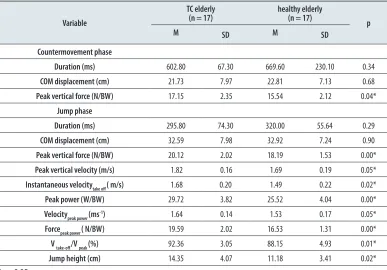
esultsTable 1 depicts the data for each group during the performance of the maximal CMJ. At the lowest position of COM during the countermovement phase, TC group exhibited 9.4% greater verti-cal ground reaction force (VGRF) than healthy older adult group, while the duration and displace-ment of COM during this phase were not differ-ent (p > .05). During jump phase, the two groups also exhibited no difference in duration and dis-placement of COM (p > .05). Compared to the healthy older adult group, TC group exhibited a greater jump height, peak vertical velocity (Vpeak ), take-off vertical velocity (Vtake-off), peak VGRF, and peak power (p < .05). Since peak power is obtained the greatest production of vertical force and the corresponding instantaneous vertical velocity, we showed that both components of peak power, VGRF and vertical velocity, were greater in TC exercise group. Finally, compared to the healthy older adult group, TC group exhibited a greater ratio of Vtake-off / Vpeak (p < .05).
Figure 1. The CMJ was divided into two phases: the countermovement phase (from a to b) and jumping phase (from b to
d
IscussIonThese findings support our hypothesis that the TC exercise group would have greater performance during a maximal CMJ, including jump height, the VGRF at the lowest position of COM during the counter-movement phase and peak VGRF, peak power, force and velocity components of peak power, Vpeak, Vtake-off, ratio of Vtake-off / Vpeak during jumping phase.
The ground reaction force variables obtained represent the ability of neuromuscular system to develop strength and power in the lower extremities during a maximal effort CMJ [21]. In the present study, TC older adults had greater peak VGRF in the CMJ during the coun-termovement and jumping phases compared to the healthy older adults who did not regularly participate in TC exercise training. These results reveal that older adults that regularly participate in TC exercise appear to have a better neuromuscular capacity to produce muscle strength and power during a maximal CMJ. It is well known that muscle strength and power tends to decrease with ageing. Skelton et al. [1] reported a decline in muscle strength of 1.2~2% per year after the age of 65 years. In our study, those who performed regular and long-term TC exercise may have enhanced or maintained muscle strength and power. This may reduce some of the age related limitations of associated with functional activities.
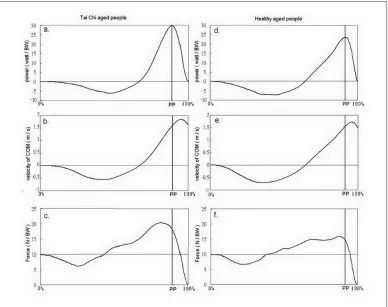
De Vito et al. [29] estimated the maximal power of sedentary women aged 50-75 years through two types of vertical jumps: squat jumps (SJ) and coun-termovement jumps (CMJ). They reported that maximal muscle power decreased significantly with aging. In their study, another main finding was that the instantaneous vertical velocity associated with the maximal power was negatively and significantly related to these older adults while the magnitude of VGRF was not related to age. In our investi-gation, the TC exercise group developed signifi-cantly greater peak power during a maximal effort CMJ than the healthy older adult group (Figure 2a and Figure 2d). This increase in peak power may due to the effect of regular long-term tradi-tional Yang’s Tai Chi exercise. An increase in peak power in older adults has also been observed after both a 36-week multi-component training [22] and a 12 week of low intensity conditioning exer-cise programs [30] in other investigations. In a fur-ther examination of the VGRF and instantaneous velocity components at the instant of peak power, there appears to be a significant increase in the instantaneous velocity with no change in VGRF at the instant of peak power in either of these inves-tigations (about 4.1 % and 13% change, respec-tively). The most novel part of our investigation was that the TC elderly group when compared to
Table 1. Variables of the tai chi (TC) training group and the healthy elder group during the maximal CMJ
Variable
TC elderly
(n = 17) healthy elderly(n = 17) p
M SD M SD
Countermovement phase
Duration (ms) 602.80 67.30 669.60 230.10 0.34
COM displacement (cm) 21.73 7.97 22.81 7.13 0.68
Peak vertical force (N/BW) 17.15 2.35 15.54 2.12 0.04*
Jump phase
Duration (ms) 295.80 74.30 320.00 55.64 0.29
COM displacement (cm) 32.59 7.98 32.92 7.24 0.90
Peak vertical force (N/BW) 20.12 2.02 18.19 1.53 0.00*
Peak vertical velocity (m/s) 1.82 0.16 1.69 0.19 0.05*
Instantaneous velocitytake off ( m/s) 1.68 0.20 1.49 0.22 0.02*
Peak power (W/BW) 29.72 3.82 25.52 4.04 0.00*
Velocitypeak power (ms-1) 1.64 0.14 1.53 0.17 0.05*
Forcepeak power ( N/BW) 19.59 2.02 16.53 1.31 0.00*
V take-off /V peak (%) 92.36 3.05 88.15 4.93 0.01*
Jump height (cm) 14.35 4.07 11.18 3.41 0.02*
*p < 0.05
the healthy older adult group had a greater VGRF and instantaneous velocity at the instant of peak power (Table 1). This may have been due to the reg-ular participation (greater than 2 years) in Tai Chi exercise of the TC participants in our investigation.
The velocity variables, Vpeak-power, Vpeak, and Vtake-off, were greater in TC exercise group compared to the healthy older adults in this study. These results dem-onstrated that the movement velocity was enhanced in the TC exercise group. These changes influenced the power output and resulting vertical jump per-formance. The TC exercise group showed a greater ratio of Vtake-off / Vpeak compared to the healthy older adult group. Vpeak occurred during the last portion of CMJ prior to take-off (Figure 2b and Figure 2e). The decreases in instantaneous velocity from the Vpeak to Vtake-off time interval may represent the group’s abil-ity of accelerate their center of mass through their lower extremities. A higher ratio of Vtake-off / Vpeak in the TC exercise group may be a reflection of bet-ter muscle capacity prior to take-off. Caserotti et al. [23] reported that the ankle plantar flexors may be responsible for these findings. Previous investi-gations have reported increases in ankle muscular
strength in tai chi training groups [27,28]. However, we are not sure if the higher ratio of Vtake-off and Vpeak observed in the TC exercise group in our study could be attributed to stronger plantar flexors. Therefore, further investigation using kinematics and EMG measures may be useful in further examining this hypothesis.
Besides jump height, the TC exercise group showed many performance increases in our measurements. The specific movements, such as one-leg deep squat, two-leg deep squat and jumping, are required in 108-forms of traditional Yang’s Tai Chi exercise. Many of these movement forms appear to provide an exercise training stimulus for many muscle groups in a weight bearing situation that improve the per-formance of a CMJ.
c
onclusIonsThe older adults who participated in regular TC exercise exhibited greater performance (includ-ing greater peak VGRF, peak power, peak vertical velocity, take-off velocity, and jump height) during a maximal CMJ compared to a group of healthy older
Figure 2. Left column (a, b, c) and right column (d, e, f) are the typical power (watt/body weight), instantaneous velocity
of COM (m/s), and vertical ground reaction force (N/BW) of a Tai Chi and healthy older adult, respectively. The CMJ was normalized as 100% from the start to the take-off. The instant of peak power was denoted at the vertical line shown at PP.
adults. Both the VGRF and instantaneous velocity at time of peak power was enhanced in our TC exer-cise group. The TC exerexer-cise group exhibited a better capacity to maintain a higher peak vertical veloc-ity of COM prior to take-off. These performance enhancements may influence the functional perfor-mance of elderly individuals.
a
cknowledgeMentsThis work is particularly supported by “Aim for the Top University Plan” of the National Taiwan Normal University and the Ministry of Education, Taiwan, R.O.C.
r
eferences1. Skelton DA, Greig CA, Davies JM et al. Strength, power, and related functional ability of healthy peo-ple aged 65-89 years. Age Ageing1994; 23: 371-377 2. Bassy EJ. Measurement of muscle strength and
power. Muscle Nerve1997; 20(5): 44-46 3. Bassy EJ, Fiatarone MA, O’Neill EF et al. Leg
exten-sion power and function performance in very old men and women. Clin Sci 1992; 82: 321-327 4. Rantannen T, Era P, Heileleinen E. Maximal
isomet-ric strength and mobility among 75-year-old men and women. Age Ageing 1994; 23: 132-137 5. Foldvari M, Clark M, Laviolette LC et al.
Association of muscle power with functional status in community-dwelling elderly women. J Gerontol A-Biol 2000; 55(4): 192-199
6. Rantanen T, Avela J. Leg extension power and walk-ing speed in very old people livwalk-ing independently. J Gerontology 1997; 52A(4): 225-231
7. Suzuki T, Bean JF, Fielding RA. Muscle power of the ankle flexors predicts functional performance in community dwelling older women. J Am Geriatr Soc 2001; 49: 1161–1167
8. Fielding RA, LeBrasseur NK, Cuoco A et al. High-velocity resistance training increases skeletal muscle peak power in older women. J Am Geriatr Soc 2002; 50(4): 655–662
9. Skelton DA, Kennedy J, Rutherford OM. Explosive power and asymmetry in leg muscle function in fre-quent fallers and nonfallers aged over 65. Age age-ing 2002; 31(2): 119–125
10. Christou EA, Yang Y, Rosengren KS. Taiji training improves knee extensor strength and force control in older adults. J Gerontol A Biol Sci Med Sci 2003; 58(8): 763-766
11. Lan C, Lai JS, Chen SY et al. 12-month Tai Chi training in the elderly: Its effect on health fitness. Med Sci Sports Exerc, 1998 30(3): 345-351
12. Jacobson BH, Chen HC, Cashel C et al. The effect of Tai Chi Chuan training on balance, kinesthetic sense, and strength. Percept Mot Skills 1997; 84(1): 27-33 13. Qin L, Choy W, Leung K et al. Beneficial effects of regular Tai Chi exercise on musculoskeletal system. J Bone Miner Metab 2005; 23: 186-190 14. Jones AY, Dean E, Scudds RJ. Effectiveness of a
community-based Tai Chi program and implica-tions for public health initiatives. Arch Phys Med Rehab 2005; 86(4): 619-625
15. Lin YC, Wong AM, Chou SW et al. The effects of Tai Chi Chuan on postural stability in the elderly: preliminary report. Chang Gung Med J 2000; 23(4): 197-204
16. Schaller KJ. Tai Chi Chih: an exercise option for older adults. J Gerontol Nurs 1996; 22(10): 12-17 17. Wong AM, Lin YC, Chou SW et al. Coordination
exercise and postural stability in elderly people: Effect of Tai Chi Chuan. Arch Phys Med Rehabil 2001; 82(5): 608-612
18. Izquierdo M, Häkkinen K, Ibañez J et al. Effects of strength training on muscle power and serum hor-mones in middle-aged and older men. J Appl Physiol 2001; 90: 1497–1507
19. Li JX, Hong Y, Chan KM. Tai Chi: physiological characteristics and beneficial effects on health. Br J Sports Med 2001; 35: 148-156
20. Bosco C, Cardinate M, Tsarpela O et al. The influ-ence of whole body vibration on jumping perfor-mance. Biol Sport1998; 15: 157-164
21. Liu Y, Peng CH, Wei SH et al. Active leg stiffness and energy stored in the muscles during maximal counter movement jump in the aged. J Electromyogr Kines2006;16(4): 342-351
22. Caserotti P, Aagaard P, Puggaard L. Changes in power and force generation during coupled eccen-tric-concentric versus concentric muscle contraction
with training and aging. Eur J Appl Physiol 2008; 103(2): 151-61
23. Caserotti P, Aagaard P, Simonsen EB et al. Contraction- specific differences in maximal muscle power during stretch-shortening cycle movements in elderly males and females. Eur J Appl Physiol 2001; 84(3): 206-212
24. Hass CJ, Gregor RJ, Waddell DE et al. The influence of Tai Chi training on the center of pressure trajec-tory during gait initiation in older adults. Arch Phys Med Rehabil 2004; 85: 1593-1598
25. Gatts SK, Woollacott MH. How Tai Chi improves balance: Biomechanics of recovery to a walking slip in impaired seniors. Gait posture 2007; 25: 205-214 26. Li FH, Harmer P, Fisher J et al. Tai Chi: improving functional balance and predicting subsequent falls in older persons. Med Sci Sports Exerc 2004; 36(12): 2046-2052
27. Li JX, Xu DQ, Hong Y. Changes in muscle strength, endurance, and reaction of the lower extremities with Tai Chi intervention. J Biomech 2009; 42: 967–971 28. Xu DQ, Hong Y, Li JX. Tai Chi exercise and muscle strength and endurance in older people. Med Sport Sci 2008; 52: 20-29
29. De VG, Bernardi M, Forte R et al. Determinants of maximal instantaneous muscle power in women aged 50-75 years. Eur J Appl Physiol Occup Physiol 1998; 78(1): 59–64
30. De VG, Bernardi M, Forte R et al. Effects of a low-intensity conditioning programme on VO2max and maximal instantaneous peak power in elderly women. Eur J Appl Physiol Occup Physiol 1999; 80(3): 227–232
31. Kuński H. Trening zdrowotny osób dorosłych. Poradnik lekarza i trenera. Agencja Wydawnicza Medsportpress. Warszawa 2002 [in Polish]
Cite this article as: Chi JC, Huang CF, Kernozek TW et al. Counter movement jump performance between older adults with and without regular tai chi exercise training Arch Budo 2013; 4: 249-254