Page 493
READING AND LIBRARIES IN THE CONTEMPORARY ACADEMIC INFORMATION ENVIRONMENT
Rositsa Krusteva
University of Library Studies and Information Technologies, bul. Tsarigradsko shose 119, Sofia, Bulgaria
Abstract
This article outlines the new approach to studying the reading process and readers’ habits and preferences in academic environment. It is focused on the in-depth reading but the readers target audience sample comprises students enrolled in the two departments of the University of Library Studies and Information Technologies (ULSIT). Objective of the study are their preferences to traditional or e-form of reading the teaching materials. The results from the study of the students attitudes and habits to traditional and e-reading in ULSIT, Bulgaria, can be used for improvement of the enrichment of the teaching materials collections available at the academic libraries.
Key words: reading, traditional books, e-books, academic environment
INTRODUCTION
Hardly anyone would argue that reading is the foundation of the culture of the civilization and written records. Nevertheless, the emergence of a lot of other information and knowledge sources due to the technological and technical innovations, today reading still remains the key factor for personal development, as it ensures the basis of the fundamental knowledge (Krasteva, R. 2012).
Research of the history of reading concerns a number of sciences and scientific branches – psychology, sociology, linguistics, neurolinguistics, education, etc. During the recent years study of reading becomes the more and the more subject of interdisciplinary studies. Studies of reading have a key role in the common program of the cognitive science, as it generally deals with the assimilation of the language and understanding of the discourse and the text, which, in turn, are considered one of the leading cognitive processes, a model for intelligent behaviour, subject to analysis and computer modeling (Chamak, Br. 1999). Cognitive studies of reading can be conditionally divided into two large domains: micro and macro. The first one extends the tradition of the psychological research on reading and deals, however on a new mathematical, computerized and neurophysiological level, with the visual recognition of letters, decoding processes, readability, recognition of words and elements in the text. The second one – the macro domain - deals with the analysis and modeling of the overall processes of understanding meta cognitive styles and strategies, with readers’ development and readers’ behavior.
Depending on the purpose of the activity, on the way of reading the text, the form of the text, the reading context, etc. now it is possible different reading styles to be described. Primarily from the methodological point of view the differentiation is into in-depth reading, also known as a comprehensive, detailed or explorative reading, for which all the information of the text is important for the reader; and selective reading, also referred to as searching, scanning, orientating, or shallow reading, i.e. reading, looking for a specific piece of information in the text.
Both the in-depth and selective reading can take place both in the traditional environment (reading a book) and reading texts in e-form, however their ratio is different.
There are a number of arguments and contra arguments supporting either the traditional or the e-reading.
Page 494
For the traditional reading of a book or other printed materials more natural is the in-depth reading, whereas for the e-reading and online reading often is employed the selective, orientating reading (Williams, P& I Rowlands 2007).
Lehrer suggests that: “The arguments in the direction replacement of the printed book and its reading by electronic devices and various "touch screens", "surfing" are just a part of the mistake of modern globalism apologists – the smooth extrapolation of the trends into the future. Access, connection speed and total connectivity are not quite as smooth, good are presented. They also have a reverse, dark side: the speed and easiness make readers lazy – they pile up multiple e-books in the memory of their devices, without approaching them later at all. The easy access leads to feeding up and affects the prestige of the book“ (Lehrer, J 2010). The total victory of Internet and digital communication is a fact which is currently challenged – we've seen so many fashions to come and go, but the books are what remains.
The arguments supporting e-reading are also a lot. Here are some of them:
E-reading saves paper for the costly books production; creates an opportunity for the use of references and creation of hypertext; saves time of the user to search information or facilitates the quick references, promoted data access, etc.
There is a large body of studies that analyse the reading of teaching material (serious reading) in electronic and traditional (hard copy) form. In 1992, Dylan published a study describing the differences, pros and cons of documents available in each of the two forms (Dillon, A., 1992). A similar study, published by Noyce and Garland – scientists from the University of Bristol, however, came to the conclusion that reading materials in the traditional form is not equivalent to reading them in an e-form (Noves, J K Garland &. 2008). The study outlines specific cognitive aspects such as understanding the text, speed of reading, and memorizing the read text, taking into account that these aspects are better expressed when text is read traditionally. The process of remembering the contents one has read is subject of the research of Ackerman and Goldsmith, who reach the conclusion that the better memorizing is the traditional reading of the print form (Ackerman, R M 2011 & Goldsmith). These results are replicated by a study conducted in the United States (Woody W D Daniel & CBaker & 2010). The results suggest that: Despite the ensured easy access to additional contents ensured by the e-books, hyperlinks and other functions, the students are more inclined to use the special features of the print books rather than of the e-books." A study of Chinese scientists (Wu, Ming-der & Shih-chuan Chen 2011), with volunteers from the National University of Taiwan reveals that students have different preferences to the two forms of reading. If the e-reading is in the form of e-book, the students prefer it.
The reading preferences of students from Canada and the United States are described by Barry Cull, who suggests that: Actually for their academic reading students prefer the text books, whereas in general they prefer the easiness of the digitalized e-texts (Cull, B 2011). Similar are the results for the opinions and preferences of the Chinese students. At the same time the study notes different preferences of the students depending on their gender: 73% of the females prefer the traditional form of reading compared to only 51% of the males (Ziming L& X Huang 2008).
The purpose of this article is to outline the readers’ practices in the conditions of globalization. For the purpose of preciseness of the study its scope is the so called in-depth, serious reading. The readers’ audience studied comprises students and subject of the study are their preferences to traditional and e-reading of the teaching materials.
SCOPE AND LIMITATIONS OF THE STUDY
Page 495
inquiry form had been designed to online research of students’ behaviour concerning their academic reading: preferences – print vs. online. The research took place in universities in 27 countries including ULSIT, Bulgaria.
For the purposes of this article we outline and discuss the summarized responses of the respondents to two items: “For me it is much easier to remember the information and data related to the training when I read print materials” and the contrary statement “It is much easier teaching materials to be read in e-form than in printed e-form”. The respondents reply to a 5-position scale, Likert-type, expressing the to what extent they agree or disagree with the statement.
Data are processed with the Statistical Package for the Social Sciences (SPSS).
We expected statistically significant difference between the responses given by the students from the two faculties – FISD and FLSCHD.
RESEARCH METHODS
Statistical methods applied: descriptive statistics, ANOVA and MANOVA, correlation analysis.
VARIABLES STUDIED
Responses to the first statement “For me it is much easier to remember the information and data related to the training when I read print materials” are summarized in Table 1.
For me it is much easier to remember the information and data related to the training when I read print materials
Statements N %
Completely disagree 11 4,7
Disagree 23 9,8
Neither agree, nor disagree 46 19,7
Agree 101 43,2
Completely agree 53 22,6
Number of respondents 234 100
Page 496
N M S F Sig.
Factor
Faculty FLSCHD 135 0,80 ,976 4,977 ,008
FIS 64 0,34 1,211 ,327 ,568
Gender Females 188 ,73 1,010 1,452 ,229
Males 46 ,52 1,295 1,452 ,229 Year Bachelor programme, 1st year 47 ,74 ,896 1,302 ,264 Bachelor programme, 2nd year 59 ,88 1,115 ,098 ,754 Bachelor programme, 3rd year 43 ,67 ,944 2,373 ,125 Bachelor programme, 4th year 48 ,60 1,216 1,334 ,391 Master programme 33 ,36 1,168
Doctoral programme 4 1,25 ,500
Age groups 19 – 23 y. 98 ,65 1,122 1,286 ,276 24 – 30 y. 69 ,54 1,132 ,162 ,688 31 – 40 y. 45 ,91 ,925 1,661 ,176
41 – 50 y. 21 ,95 ,865
Visual impairments Yes 27 ,81 1,001 ,397 ,529
No 207 ,68 1,082 ,397 ,529
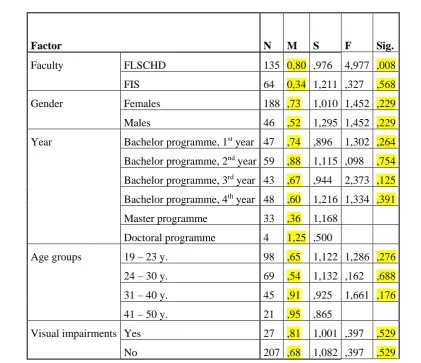
Table 2. Reading printed materials as factor for better memorizing the information
Table 2 outlines the studied variables in the responses to the first statement - “For me it is much easier to remember the information and data related to the training when I read print materials“. Applied method is ANOVA.
Significant difference exists for the replies of the respondents in the two faculties of the ULSIT – the Faculty of Library Studies and Cultural Heritage Departments (FLSCHD) and the Faculty of Information Sciences Departments (FIS). Factor, promoting the better information memorizing for the students at the departments of FLSCHD is reading printed materials. This fact is supported by the distribution of the replies of the respondents in the different courses, delivered by the faculty.
Statistical difference is found also in gender – women have more preferences to the traditional reading compared to men.
Interesting difference in the opinions is outlined for the students of the different years and programmes. Print materials are preferred most by the students first year. This preference declines gradually with each next year, whereas it decreases by more than 50% among master programme students. This fact can be explained with the use mainly of printed materials in schools (textbooks, notebooks, and other traditional printed materials). Gradually in the course of higher education and training in bachelor’s and master’s programmes young people accustom to e-form resources.
Page 497
Inquiry gives respondents also the option to express more information. e.g. their opinions as free text. A lot of the respondents as detailed in Table. 2, agree with the statement that information is better memorized when read in printed form. The rest support the opinion that what is important is not the form but the contents. In a number of cases is stated also the quality of the teaching. Reason e-materials not to be used shared by the respondents is concentration and the health consequences for the vision.
N M S F Sig.
Factor
Faculty FLSCHD 135 -,32 ,096 3,908 ,021
FIS 64 ,14 ,139
Gender Females 188 -,22 1,099 ,495 ,482
Males 46 -,09 1,262
Year Bachelor programme, 1st year 47 -,30 1,82 1,193 ,528 Bachelor programme, 2nd year 59 -,10 1,170
Bachelor programme, 3rd year 43 -,16 1,090 Bachelor programme, 4th year 48 -,29 1,184 Master programme 33 ,00 1,146 Doctoral programme 4 -1,00 ,816
Visual impairments Yes 27 -,22 1,398 ,021 ,884
No 207 -,19 1,101
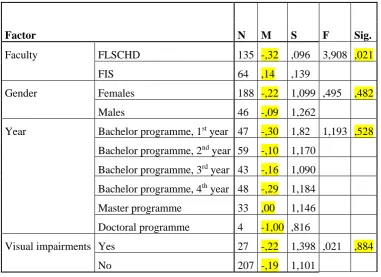
Table 3. Convenience of the e-reading
The results for item 1 of the inquiry form are supported by the data for statement 2 – It is much easier teaching materials to be read in e-form than in printed form (ref. to Table 3).
Table 4 outlines the correlation between the two statements. The correlation is high negative (r= ,-47). The correlation is high also for item 2 – preferences to the teaching materials in e-form and item 5 of the inquiry – I prefer to print the teaching materials received online (r=,-46) .
The preference to printed materials is supported also by the high correlation (r=,66) between statements 1 and 5.
№ Statements 1 2 5
1 For me it is much easier to remember the information and data related to the
training when I read print materials * ,-47
** ,66**
2 It is much easier teaching materials to be read in e-form than in printed form * ,-46** 5 I prefer to print the teaching materials received online * ** Significance 0.01.
Page 498 DISCUSSION
The hypothesis of the research is supported – there is statistically significant difference in the responses of the students from the two faculties – FLSCHD and FISD of ULSIT. The preferences to reading training materials in e-form completely naturally and logically are higher among the students from FIS as in view to their choice of course they prefer the new IT and are supposed to process them better and be able better to focus their attention on the convenience of the e-text.
Statistical processing revealed something of interest – gender differentiation of the preferences to reading e-text and printed text, whereas the preferences to the traditional form is higher among women. Similar conclusion is reported in a Chinese study (Ziming L & X Huang 2008).
Explanation about these gender preferences can relate to the conclusions replicated in a number of studies – that women have better verbal abilities in a number of forms of language use: verbal fluency, ability for verbal analogues and categorization of the words in sense, language comprehension, grammar and lexical skills, reading and understanding the read text (Stoyanov, З 2014). In this line it is completely natural women to be more sensitive to change of the form of reading.
Humanity has gone a long way in the transition from scroll to code as the forms for text information presentation. Increasing of the volume of information and the need for its better perception is a factor for establishment of the code as a more convenient form for comprehension and remembering the contents of the text. The architectonics of the code itself predisposes to this – "breaking" the large volume of information into smaller physical volumes (pages) that contributes to better perceptions and orientation in the text
The information presented in electronic form, including teaching materials that students receive for their preparation for the academic subjects, are often in the form of a scroll. Perception and learning poses difficulties especially when it is in a large volume. It is possible this fact to be the reason for preferences to the traditional (paper) form, offering the convenience of the code. This opportunity is offered also by the e-book that is increasingly going into our everyday lives. Maybe it in particular will turn to be the intersection between the inherited human experience and the convenience of the new technologies, which only the future can confirm.
The results from the research reveal another interesting fact as well – the clear trend towards a preference of students at the Faculty of information technology of ULSIT to teaching materials in e-form. This can be explained given their interests and their choice of specialty, oriented to the new (electronic) technologies. The world is becoming increasingly technologized but young people increasingly attracted and even addicted to the new technologies. Natural and contingent upon the advancing changes is the trend the number of students who prefer the e-form to increase. In this regard, the libraries (in particular – the academic, university libraries) shall reconsider their strategy to complete their collections for this considerable group of users.
According to the National Statistical Institute of the Republic of Bulgaria the scientific books issued in e-form in 2015 (National Statistical Institute) are 28 - a very modest number compared to the proposed for completion of the libraries of World Scientific (World Scientific 2016).
The convenience of the proposed form and the lower price of e-books promote their increasing spread and the preferences to them. In this line when foreign publications are completed in the areas of computer science, electronics, etc., academic libraries are supposed to pay attention to the eBooks that are available.
Page 499 REFERENCES
Ackerman, R& M Goldsmith (2011), „Metacognitive regulation of text learning: On screen versus on paper“, Journal of Experimental Psychology, Vol. 17, Issue 1, pp. 18-32. DOI: 10.1037/a0022086. Chamak, Br (1999), „The Emergence of Cognitive Science in France: A Comparison with the USA“ , Social Studies and Science, Vol. 29, N 5, 1999, pp. 643 – 684.
Cull, B (2011), „Reading revolutions: Online digital text and implications for reading in academe“, First Monday, Volume 16, Number 6 - 6 June 2011, viewed 21 January 2016, <http://firstmonday.org/ojs/index.php/fm/article/view/3340/2985>
Dillon, A (1992), „Reading from paper versus screens: a critical review of the empirical literature“, Ergonomics, Vol. 35, issue 10, pp. 1297-1326, viewed 21 January 2016, <http://www.tandfonline.com/doi/abs/10.1080/00140139208967394>
Johnson, Sh, еt al. (2013), Key problems related to expansion of the e-resources collections: Guidelines to libraries [Translation in Bulgarian Rumenlina Vasileva] Sofia, Za bukvite – O pismenah, 44 p., viewed 01 March 2016, <http://www.ifla.org/files/assets/acquisition-collection-development/publications/electronic-resource-guide-bl.pdf> (Bulgarian)
Krasteva, R (2012), A look on the triad reading, text, readers: a contemporary aspect, Proceedings from the conference Days of the book and copyrights held at ULSIT, 23rd – 25th April , Sofia, About letters – About text, p.. 93–97 (Bulgarian).
Kyosev, А (2013), The discussions concerning reading. Sofia, Ciela, p. 78. (Bulgarian)
Lehrer, J (2010), „The Future of Reading“, viewed 05 January 2016, < http://www.wired.com/2010/09/the-future-of-reading-2/ >
National Statistical Institute of Bulgaria (2016): [Official website]. viewed 11 March 2016, < http://www.nsi.bg/>
Noves, JM & KJ Garland (2008), „Computer- vs. paper-based tasks: Are they equivalent?“, Ergonomics, Vol. 51, Issue 9, pp. 1352-1375, DOI: 10.1080/00140130802170387.
Stoyanov, З (2014), Gender psychophysiology. Варна, University publishing house of the Medical Universityv - Varna, 190 p. (Bulgarian).
Williams, P & Rowlands, I (2007), „Information Behaviour of the Researcher of the Future“; Work Package II: The Literature on Young People and Their Information Behaviour, CIBER, UCL, London, vieved 11 March 2016 <www.ucl.ac.uk/slais/research/ciber/downloads/GG% 20Work%20Package%20II.pdf>
Wu, Ming-der& Shih-chuan Chen (2007),“ Graduate students' usage of and attitudes towards e-books: experiences from Taiwan“, Program: electronic library and information systems. Vol. 45, Issue 3, pp. 294-307. DOI: 10.1108/00330331111151601.
Ziming L & X Huang (2008), „Gender differences in the online reading environment“, Journal of Documentation, Vol. 64, N 4, pp. 616–626. viewed 21 January 2016, <http://www.emeraldinsight.com/journals.htm?articleid=1738049&show=html>