STUDENT MISCONCEPTIONS IN THE 21ST CENTURY. CHEMISTRY RELATED CONCEPTIONS OF GREEK SENIOR HIGH SCHOOL STUDENTS
Hector Katsikis1, Eirini Savvidou2, Agoritsa Schizodimou2, Pericles D. Akrivos2, Georgia Keloglou3 1
Gymnasio of Kassandra, 630 77 Kassandra, Greece 2
Aristotle University of Thessaloniki, Department of Chemistry, P.O.B. 135, 541 24 Thessaloniki, Greece
3
University of Edinbourgh, Department of Education
Abstract
Within the complex and ever-changing Greek educational system, Science is taught to secondary school students throughout their six years of study, the first three (Gymnasio, junior-high school) being part of the compulsory educational program. The syllabus consists of several discrete spiral steps ensuring that certain aspects are addressed more than once. The first grade of Lykeio (senior high school) is the last year during which general studies are provided, and is therefore packed with all the possible chemical information considered appropriate for students at this age. In the present study an effort is placed towards the recording of student misconceptions concerning a spectrum of basic chemical concepts. The investigation was carried out by evaluating questionnaires composed mainly of closed type questions, which were distributed to second and third grade of Lykeio in a number of schools in Northern Greece, incorporating all types of schools existing.
Keywords: chemistry, secondary school, science curriculum, misconceptions
1. INTRODUCTION
Atomic theory or the nature of matter is a principal concept in science and science education. This has, however, been complicated by the difficulty students have in understanding the concept and the subsequent construction of many alternative models. This difficulty is related to the abstract nature of the microscopic world of atoms and has emerged as an important field in the science education studies (Park & Light 2009). Chemical bonding is a main topic in teaching Chemistry in the secondary schools and in this respect is also prone to adaptation of various types of alternative conceptions shared among students worldwide (Taber et al, 2012). Its correct understanding, however, is of key importance in the understanding a lot of other chemical concepts since bond breaking and forming is essential to any chemical reaction. Students at the Lykeio in the Greek educational system fall within the age range which is worldwide assumed to be in the developmental phase appropriate for relating macro-scale phenomena to submicro-scale structures and properties.
However, the existence of several studies which identify problems in teaching and in bypassing student alternative models regarding the particulate nature of mater indicates that the field of teaching efficiently the principles of atomic theory to students at this level is far from being settled (Berry 1986; Gillespie 1991; Shiland 1995; Tsaparlis 1997). One of the main obstacles in introducing the current scientific point of view to the students is related to a firmly formed and held perception they have developed about the continuous nature of matter (Griffiths & Preston 1992). Several studies carried out worldwide have proved or simply suggest that students’ misconceptions in this field are related to a variety of factors such as incorrect teaching, inability to perform formal operations, lack of prerequisite knowledge, and absence of the relevant concepts in long-term memory. Understanding the basic principles of the particulate nature of matter has been considered as vital with regard to future ability to understand further chemical phenomena and therefore a criterion for the possibility of following a chemical course at a College or University (Kind 2004). Almost 30 years ago (Butts & Smith, 1987) it has been proved that ionic bonding is understood in principle but only related to a couple of pre-ionized atoms which interchange some electrons. Such a conception may be further supported by diagrams or presentations present in textbooks as well as by the teachers when they do
not focus on the three dimensional array of ions formed by neighboring atom pairs as the initial approach describes. Ball and stick diagrams especially help to retain misconceptions where the ions appear to be connected to each other in a form typical for covalent bonds. The widespread idea of matter continuity also affects the general understanding of chemical bonding (Griffiths & Preston, 1992) producing mental models where the atoms or ions are in contact with each other.
In view of the above a study concerning the level of apprehension of the atomic models and properties and bond formation by Greek students at the Lykeio level would add to the material already published on the topic and would contribute to a better understanding of the origin of their misconceptions, therefore helping the committees that will have in the near future the task of reconstructing the science curriculum for the secondary school education level.
2. CHEMICAL EDUCATION
The demands of everyday life have grown to a high degree of complexion and are heavily relying on objects and items and further related to processes which involve many of the recent technological and scientific advances. It is therefore essential for the future citizens to be scientifically literate and this can be accomplished by properly organized and supervised teaching of science topics throughout the secondary school educational program. In this respect the quotation of Isaak Asimov that “science can be introduced to children well or poorly. If poorly, children can be turned away from science; they can develop a lifelong antipathy; they will be in a far worse condition than if they had never been introduced to science at all” must be taken seriously into consideration. Unfortunately Chemistry plays a major role in the formulation of the current cultural environment through the numerous modern materials with pre-determined properties which it can synthesize. Unfortunately too several of the chemical compounds used in the syntheses of the above materials present some potential hazards if treated without the appropriate concern and it has often happened that some unintentional leak in a storage area or within a production line has led to extensive poisoning of people and their environment with notable examples the cases in Minimata, Japan (1956), Sevezo, Italy (1976) and Bhopal, India (1984). Such disasters naturally attract publicity worldwide and given the general ignorance of the people in the information media the idea is advanced that “chemicals” are some sort of substances one should avoid at any cost, overlooking the simple reality that every material existing is chemical in nature since it is composed of some chemical elements interacting between themselves through the formation of chemical bonds. Such beliefs are transmitted directly and easily to young people and start forming a solid background of misconceptions which is extremely difficult to overthrow at a later age no matter how descent and intense and good quality teaching about chemical principles they will encounter (Nussbaum & Novick 1982; Novak 1988; Bodner 1991; Birk & Kurtz 1999). Supporting material to this body of misconceptions and the consequent aggravation of the hostile character of Chemistry is provided continuously through references to “chemical-free” materials where, of course, the exact scientific meaning of several terms is neglected due to ignorance or indifference of the speaker and is substituted by the meaning of the same or even similarly sounding terms of everyday talk (Gilbert et al.1982). It is therefore an additional task to the teacher of Chemistry at the secondary school to try overcoming the above flood of information and introduce the young students to the essential part of Chemistry which, contrary to their beliefs (Young & Granfield 1998; Aalsvoort 2004) is directly related to everyday life and culture in many ways through its applications in numerous other “useful sciences and technologies”. Student misconceptions still exist and persist and in cases are even introduced into their body of beliefs through the way textbooks are written or teachers choose to discuss several chemical topics (Driver et al 1994).
3. DESCRIPTION OF THE STUDY
This is a study carried out through distributing questionnaires where mainly multiple choice but also true-or-false questions were included (Daniel Tan & Treagust, 1999) as well as a single point where the students were required to present the electronic structure of an element. The questionnaires were distributed to students during a teaching hour and the required period of time was granted for their
answers to be given. They were informed that this would not count in as a regular test and their participation was on completely voluntary basis. The questionnaires were collected by members of the working group or were forwarded to them by the teachers supervising the test and were examined separately by each one. The sample was limited by omitting the answering sheets which revealed inconsistencies or were obviously completed at random or included additional material not required or expected as answers. Regrettably in doing so we had to exclude about 15% of the total number of questionnaires; for each sheet excluded the opinion of the majority of the working group was considered. This observation however points at the existence of a considerable degree of socialization within the classroom since this 15% of the students could just not take the test like the rest in their classes. A total of 1613 answering sheets were included in the final set which was subjected to the following evaluation. Partitioning of the sample into sub-groups was initially carried out since the aim of the study includes the determination of possible differences between girls and boys as well as students in urban and rural areas. The former is a classification and a distinction practically performed in every analogous study (Cousins 2007; Zeyer & Wolf 2010) while the latter gains importance since recent studies have revealed a stratification in both attendance and grades achieved of science classes in post-16 year old students with respect to their socio-economic status (Gorard & See, 2009). Furthermore since the atomic model is discussed briefly at the Gymnasio grades but is given a full consideration at the first grade of Lykeio and since it constitutes a central point in understanding chemical principles we also examined the effect of long-term memory on the assimilation of chemical knowledge by addressing the questionnaire to second and third grade Lykeio students. The sample on which the study was carried out therefore, comprises of 187 “special schools” (musical, ecclesiastical etc) and 1426 of “general schools”, the latter partitioned into 309 from rural areas, 455 from small size urban centres and 622 from a “metropolitan centre”, i.e. the city of Thessaloniki. In other terms, the sample contains 887 girls and 726 boys or 1069 grade B and 544 grade C students.
4. RESULTS AND DISCUSSION 4.1 Atomic structure
The opening question was only outwardly related to the atomic model, it may rather be seen as an attempt to evaluate the ability of the students at the senior high-school grades (i.e. 16 to 18 years of age) to perform a simple mathematical operation in the form of working with powers of ten which is something required for further studies in science. The question was put in the following form. “The diameter of a given atom is 1.10-10 m. Supposing that atoms can be placed in a row in contact with each other how many will be needed to form a line with 1 m length?” and the four answers provided were 1.106, 1.109, 1.1010 and 6.022.1023. An interesting observation is that, like all the other questions, there is a number of students, in this case 9.3% who do not even attempt to provide an answer. A percentage which seems unreasonably high (larger than 15%) was not able to work out the mathematics needed while the irrelevant to the mathematics involved but related in a way to the atom and its world answer of the Avogradro’s number. If we may relate this to a combination of ignorance and creativity, it seems that girls and students in rural areas are more creative than boys and students in urban areas respectively. This leaves 1066 right answers (66.1%) with boys and grade B students clearly more efficient than girls and grade C students with 68.7% over 64.0% and 67.1% over 64.1% of their populations giving the right answer.
A pair of questions was devised in order to investigate the apprehension of the role played by the sub-atomic particles in the structure of an atom. In the first the identification of the nature of a chemical species symbolized as A+ and in the second a straightforward question about which is considered as the sole characteristic number for an atom were required. In this case very few students did not attempt to provide an answer (roughly 1%) revealing a high degree of confidence in the answer they choose. Cation A+ was identified as element A missing a valence electron by 29.7% of the students while another 40.9 % understood that there was a missing electron but failed to identify it as a valence electron. The rest, amounting to almost 38% seem to not have understood the basic facts about the composition of the atoms, providing the simplistic interpretation of a positive charge or even a proton
attracted to atom A in order to form species A+. The results directly relate to the organization of the textbook. Indeed, in chapter 1 of Lykeio grade A book, the cation is defined as an atom missing an electron while the aufbau principle is introduced in section 2.3 without any attempt to revisit the ionization procedure and define the missing electron as a valence electron.
In the following question, the sole characteristic of an atom A was identified as its atomic number by slightly more than half of the studied population (52.5%) while 21.4% of them were probably deceived by the similarity in the sounding of the term atomicity. Since only 2.5% did not choose any of the provided answers, it seems that about ¼ of the students are not able to understand the principles of atomic theory. In a closely related question the students were asked to determine the atomic number, number of neutrons, number of electrons, mass number and number of protons for two isotopes, namely 28
14Aand 35
17B. The set of five numbers given was taken as a single response and therefore even a single mistake in the set was considered as mistaken answer. However the answer to the question was considered as two sub-sets of answers due to the higher complexity of the situation in the second isotope where one cannot accidentally interchange the number of protons for that of the neutrons. Further supporting our belief that the two isotopes are presenting different stages of difficulty is the percentage of right answers which is 43.6% for A and only 26.9% for B. In both sections of the question the C grade students are clearly doing better than those in the B grade while students in urban schools appear to do much better and those of special schools considerably worse than the rest.
Understanding the symbolic language of Chemistry is essential for the students to get the right idea about the facts and topics discussed in a Chemistry course and this was put to test by a question where the symbol of phosphorus was introduced and the nature of the symbol P4 was required in a set of true-false statements. At this stage the students have not been introduced into valency and therefore they are expected to know of only one kind of any atom’s oxide. The offered answers were the following: • Ρ4 is a molecule consisting of phosphorus atoms
• Ρ4 can disintegrate whereupon it will produce phosphorus atoms • Ρ4 upon reaction with oxygen will produce various products • Ρ4 upon reaction with oxygen will produce only phosphorus oxide • Ρ4 is a new element and does not correspond to phosphorus.
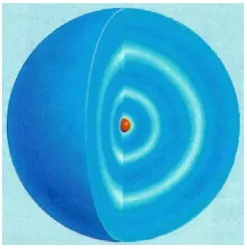
The first two answers are essentially identical, however in the second the idea of a reaction in order to dissociate the molecule is evident and maybe it requires a different mental approach by the students. That Ρ4 is a molecule consisting of phosphorus atoms is true for 53.4% of the studentsbut only 31.9% think that upon disintegration it will produce only phosphorus atoms. This is probably a misinterpretation of the concept of reaction which is supposed to give at least two products in the typical notion of A + B → C + D. This assumption is partly supported by the following provided answer which was chosen by 26.2% of the students. Once another reactant is introduced in the form of oxygen the line of thought is directed to the point of combining it with the existing infrastructure and 33.6% of the total sample determine phosphorus oxide as the sole product. Interestingly enough, only a mere 5.1% responded with the full set of true statements while a 4.7% did not provide any answer. The Bohr atomic model is introduced to a great extent in the textbook and although it is firmly stated that it has been replaced by more accurate models there is no other model discussed. In addition to this there are several pictorial representations of the model a few of them misleading in the sense that they provide schemes with thin solid lines to account for the model stable orbits while the space in between bears a color distinctively different from the plain background of the page (Figure 1). If at some later point the students are introduced to the concept of electron density they can relate it to the above schemes confirming their belief that electrons are moving in cyclic/spherical orbits which are in touch with each other; further metaphors used by the teachers at this point by using the structure of onion help to solidify the above misinterpretation (Justi & Gilbert 2002, Adbo & Taber 2009). This was not the main point in the present research but rather an attempt to investigate to what extent the Bohr
atomic model is presented as a starting point model of the atomic structure. The question put forward in the form of several true-false statements concerning the specific model.
Figure 1. Presentation of the Bohr atomic model in the textbook with the following legend: Bohr atomic model. In contrast to the unstable Rutherford model the electrons move in specific (allowed)
orbits. The perception of allowed orbit and consequently the electronic shell is based on the ideas of Bohr.
The response to the questions related to the atomic model is as follows. A total of 18.8% believe the Bohr atomic model is the only accurate description of the atom. Boys (21.9%), grade C students (20.0%) and rural area students (21.7%) are champions of this idea. The circular orbits of the electrons are much more attractive and 51.6% believe in them while a 24.0% have advanced to some sort of 3D visualization and believe in spherical orbits (Gokelez & Dumon, 2005). In analogous high percentages there are also recorded beliefs like the solid spherical nature of the atoms (28.8%) and their onion-like structure (37.4%) most probably originating from the common metaphor used by teachers worldwide in order to describe the succession of the electron bearing shells. Given the above considerations regarding the textbook content and teaching process used it seems interesting to note that 27.1% of the students appear to remember that the Bohr model is not accurate and an unexpected 32.7% that it has been replaced by a more accurate one. Given that 7.6% of the questionnaires were blank at this point, it confusing that about 5.0% of the students simultaneously accepts and denies the validity of the model (i.e. indicated as true both provided statements) while only 9.7% provided the full set of correct statements.
Concluding this part of the study are three questions related to the topic of periodicity introduced also at this level with considerable emphasis being placed in the memorization of a group of “rules” which are constructed so that they can describe accurately the build-up of the electronic structure of the twenty first elements of the periodic table of the elements. Based on this periodicity some important atomic properties are discussed and their variation within the part of the periodic table that can be accessed in this way is also presented to the students. Atomic radius is one of these properties and in a brief statement within the text it is dictated that “along a period it becomes smaller on moving to the right”. In a question presented two elements are given, namely 3Li and 5Β and the atomic diameter of the former is set to 1.45.10-10 m. The answers provided for the atomic diameter of the latter atom are: equal to, slightly larger, double or slightly smaller than the given one. The right answer is described in the textbook and should be the slightly smaller. The two elements given can be easily identified as belonging to the second period. A primitive perception for anyone lacking personal experiences and proper instructions or teaching would be that all atoms should be identical to each other regardless of their constitution and this is exactly what a tenth of the students replied. It is no wonder however that the majority (48.2%) adopt the simplistic approach that “more means bigger” and they formulate their reply in an analogous way stating that the heavier atom should be larger too. Given the above the percentage of 18.7% that gave the right answer must be considered as a firm indication that the content of the textbook has found appreciation by the students. In view of the results obtained C grade students
seem to do a little better than grade B ones (21.7 against 17.2%) while girls are certainly apprehending the aspect better than boys (percentages being 21.47 and 15.42%).
Understanding of the periodic table in terms of similar properties of elements placed in it was monitored by a direct multiple choice question in the form: “Given that element A belongs to the 3rd group and 4th period of the periodic table which of the following elements is expected to have chemical properties similar to it?” . The provided body of answers included elements belonging to the 4th group and 3rd period, the 3rd group and 5th period, the 5th group and 4th period and the 4th group and 4th period respectively. Although the element presented and the ones to chose from are clearly outside the limits set by the textbook and the education program a significant percentage of students (52.4%) worked out the answer in the form of groups and periods irrespective of the atomic numbers involved but failed to describe the actual electronic structure of the two elements, in a subsequent question, as only 10.0% presented the right answer for the given element and 6.6% for the one predicted based on chemical similarity. The rigidity of the old-fashioned approach to periodicity is expressed in the 73.5% of students who did not even consider working on an answer in the latter question.
4.2 Molecules and bonding
Simple molecules form the backbone of the approach to the essential part of chemistry, that is the probability and the extent of interactions between atoms. To the long-studied question of what exists between the two oxygen nuclei in the dioxygen molecule, the most common misconception concerning air (Horton, 2007) received 12.2% and the initial atomistic proposal that “there exist only atoms and void” received another 10.0%. Slightly more than 1/3 (35.3%) of the students understand that the electrons of the atoms lie between the two nuclei and considering that only 4.0% did not respond to the question leaves a puzzling majority of 40.0% who believe that the two nuclei are separated by their valence electrons. This is certainly an outcome of the supraficial manner of the introduction, in the textbook, of the “electronic structures” of simple molecules like dinitrogen, water, ammonia and carbon dioxide. The typical dot representation of the valence electrons is presented without any comment on the nature and the assumptions of the Lewis formulation of the chemical bond. The direct transfer of the pictorial representation of the molecules, i.e. a model, to the submicroscale level of the molecules in fact introduces the current misconception. In our belief, this could easily be set right by introducing a brief description of the Lewis structure basics even in the form of an appendix at the end of the appropriate section. It is understood at this point that the idea of nothing existing between the two nuclei may originate from an effort put forward by the teachers in order to avoid another common misconception, that of the chemical bond representing “something like glue”. The “glue” in fact appears as an accepted fact for 20.3% of the students when asked about what is happening between two bonded oxygen atoms. The continuity of matter idea prevails (36.3%) in the form of the statement that the outer electrons of the two atoms are in touch with each other and an even more extremistic view, that is that the nuclei are in touch with each other is adopted by 10.1% of the students leaving only about 1/3 (32.3%) to understand the existence of coulombic interactions. The need to explain the basics of the Lewis structure formulation is further exemplified, in our belief, in the observation that 25% of the students who considered the valence electrons as touching in the previous question insisted in their alternative description of the bonding by checking the same answer in the present question.
The transfer between the macroscopic and the submicroscopic domains is particularly difficult and further obstacles in this process are presented by the use of common words and phrases with distinctively different meanings in science and everyday life. Therefore, to a question about which are the properties of a molecule of a common household material, like sugar, one expects to receive answers relating to the macroscopic properties of the material (Schmidt, 1999; Horton, 2007). The high-school textbooks usually contribute to this by generalizations or oversimplifications or even by omitting necessary lenghty introductions. For example, in many school books it is stated, related to either the atom or the molecule that it consists “the smaller particle that retains the properties of the material” it refers to. Failure to describe the properties as chemical provides grounds for building or
retaining alternative descriptions for compounds and phenomena. Therefore our findings that the molecule of the material termed “sugar” corresponds to the tiniest grain of sugar (28.1%), possesses the characteristic white color (26.3%) or its sweet taste (45.4%) are by no means unexpected. However, the majority was claimed (54.7%) by the belief that upon dissolving of a sugar molecule in water it changes its state to liquid. This is clearly a universal alternative conception based on the failure to identify chemical changes and distinguish them from physical ones and it is mainly a concern about the construction of the chemistry curriculum that sustains this conception thus far (ages 16-18).
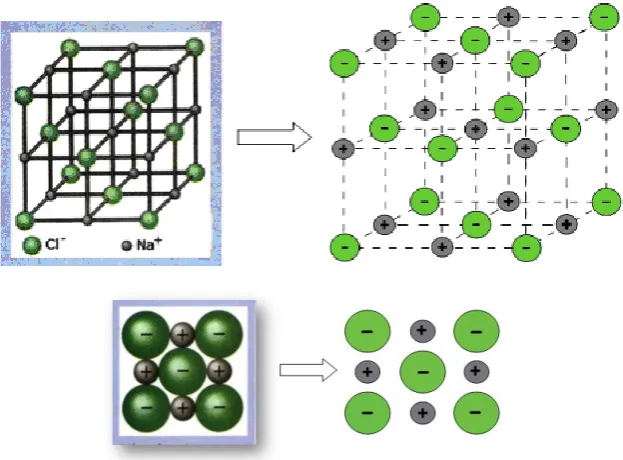
The ionic bond is a continuous problem in both its presentation by the teacher and its assimilation by the students. The covalent bond which is generally considered earlier is presented on a worldwide scale by the typical ball and stick model. Unfortunately, as depicted in Figure 2, the modeling of the ionic bonding in a typically ionic compound looks extremely similar making it difficult to the students to identify the constituents of a “cubic solid” as ions. Even more so, the adoption of touching spheres further helps retaining the conceptions of matter continuity. Both drawings on the left side of Figure 2 are taken from Lykeio grade A textbook.
Figure 2. Complete crystal lattice (above) and a slice of a lattice (below) as presented in the school textbook. On the right side some simple proposals to amend these misleading presentations are given.
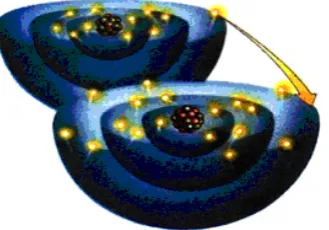
To a question about the constitution of solid sodium chloride, a total of 30.2% of the students believe there exist discrete NaCl molecules either isolated or in some sort of interaction between themselves. The 67.8 % percentage believing in ionic entities would be very encouraging in case it was not divided among single ion pairs (43.2 %), interacting ion pairs (16%) and three dimensional arrays (13.5%). The conception that there exist discrete non-interacting ion pairs is not uncommon (Taber, 1997) and is propagated again by the textbook where a very clear presentation is given for the electron transfer from Na to Cl, which may be paedagogigaly right but is followed by a misleading legend where it is not clarified that this is a model concerning a single pair of ions and that one is expected to understand that this “process” is carried throughout the crystal. Intrestingly enough, a 6.9% of the students did not attempt to give an answer to this question.
Figure 3. School textbook diagram with the legend: Symbolic presentation of the formation of the ionic compound NaCl from Na and Cl through electron transfer.
4.3 General assessment of chemical knowledge assimilation
The assessment of the questionnaires collected provided some information about the overall assimilation of chemical knowledge by the students. The simple statistics used for the initial step are summarized in Table 1. The factors that were expected to affect the average mark achieved by the students (on a typical 0-20 scale used in Greek high-schools) were sex, long term memory utilization and general socio-economic background. As a measure for the latter the residence area of the student was used to discern rural from urban areas and further small urban areas from a large city. Within the city of Thessaloniki (with a total population approaching 1.2 million) we expected to find differences between the Experimental schools run under the auspicies of the Universities, the Private schools and the normal public schools.
The overall mean value of chemical knowledge assimilation appears to be rather poor as it reaches just about 33,4 %. It is rather discouraging, with regard to the efforts taken during the last three decades at least to modify and modernize the Greek educational system especially when we compare this gross result with analogous studies carried out during the above period. Although these studies were performed on much smaller student populations and on more concentrated target schools, the common factor remains that the integration of topics like atomic structure and chemical bonding into the chemical background of Greek students lies within the 25 – 34% margins with a notable exception of reaching 40% when related to common household chemicals.
Table 1. Descriptive statistics for the student population included in the study. School type Sample Average Standard deviation
Urban schools 455 6.03 2.58 Metropolitan schools 409 6.48 2.56 Rural area schools 270 6.21 2.87 Special schools 226 6.52 2.55 Experimental schools 134 8.79 2.84 Private schools 119 6.64 2.36
Girls 891 6.57 2.72
Boys 722 6.79 2.64
Grade B 1073 6.67 2.56
Grade C 540 6.65 2.92
Total 1613 6.67 2.69
Another notable feature of the data obtained is the large standard deviations especially considering the mean values to which they are related to. This is a clear indication of a wide diffusion of students likely to undertake science degrees among the mostly indifferent to science. In the Greek educational system students of the last two grades of senior high-school are introduced into different “directions” termed as theoretical, technical and positive, the last one corresponding to those aiming at following science in their future studies. Unfortunately, although instructed to do so, only 322 students checked the “positive direction” box in their questionnaire, while more than 500 did not check any of the provided boxes. A further complication arises from the fact that the students are allowed to change their direction on going from the second to the third grade and therefore, grade C students following for example the technical direction may have attended the positive direction course in the previous year. A better understanding of chemical aspects is nonetheless realized for the above 322 students for which the average mark achieved was 7.08 with a standard deviation of 3.21. The above mentioned complication related to the direction change possibility renders it more difficult to verify effects of long term memory since the results observed for grade B and grade C students appear almost identical. Boys are generally thought of as having a greater tendency than girls to follow science and this may be reflected in their slightly better results although some post-hoc studies revealed that at a 95% probability level these results were not statistically significant. A striking feature of the results is that there was not observed a generally expected tendency for better results on moving from the less privileged to the more elite schools, that is from rural areas to small cities and then to public and private schools of the large city. Experimental schools stand out in this respect in accordance with the intensive teaching and continuous evaluation curriculae adopted, however private schools do not differ significantly form public schools of the large city or the special schools. Rural areas follow but interestingly enough there appears to exist a further partition within this category since units positioned relatively close to the large city appeared to behave much worse than the corresponding ones close to small cities, a clear indication of the well-established urbanism movement in Greece and the expected tendency of young people from small towns to seek a better future in the form of passing the exams to enter an undergraduate course in a large city University.
5. CONCLUSIONS
The present study is by no means final or conclusive regarding the processes that lead to misinterpretations or misconceptions held by Greek senior high school students. The results presented in this study refer mainly to the topics related to atomic model and structure and bond formation. From the observations so far it seems that the textbook organization and presentation is the major factor followed by the inability of the teachers to introduce the young students to the essence of the topics considered. As a result the traditional memorization process which helps substantially in the high grade race, promoted by both household and educational system for a long period now, produce a scattering of knowledge with the boys having a small advantage over girls and students from urban areas over the corresponding from rural areas. Long term memory does not appear to play a major role in the assimilation of chemical knowledge, which is relatively low and ranges within the narrow margins provided by previous local studies carried out during the last three decades.
REFERENCES
1. Aalsvoort, JV 2004, ‘Logical positivism as a tool to analyse the problem of chemistry's lack of relevance in secondary school chemical education’, International Journal of Science Education, vol. 26, no.9, pp. 1151-1168.
2. Adbo, K & Taber, KS 2009, ‘Learners’ Mental Models of the Particle Nature of Matter: A study of 16 year old Swedish science students’, International Journal of Science Education, vol. 31, no.6, pp. 757-786.
3. Berry, KO 1986, ‘What should we teach them in high school?’, Journal of Chemical Education, vol. 63, no. 8, pp. 697.
4. Birk, JP & Kurtz, MJ 1999, ‘Effect of Experience on Retention and Elimination of Misconceptions about Molecular Structure and Bonding’, Journal of Chemical Education, vol. 76, no.1, pp. 124-128.
5. Bodner, GM 1991, ‘I have found you an argument: The conceptual knowledge of beginning chemistry graduate students’, Journal of Chemical Education, vol. 68, no.5, pp. 385-388.
6. Butts, B & Smith, R 1987, ‘HSC chemistry students’ understanding of the structure and properties of molecular and ionic compounds’, Research in Science Education, 17, pp.192–201.
7. Cousins, A 2007, ‘Gender Inclusivity in Secondary Chemistry: A study of male and female participation in secondary school chemistry’, International Journal of Science Education, vol. 29, no. 6, pp. 711-730.
8. Daniel Tan, K-C. & Treagust, DF 1999, ‘Evaluating students’ understanding of chemical bonding’, School Science Review, vol. 81, pp.75-83.
9. Driver, R, Squires, A, Rushworth, P & Wood-Robinson, V 1994, Making Sense of Secondary Science: Research into children's ideas, New York: Routledge.
10. Gilbert, JK Osborne, RJ & Fensham, PJ 1982, ‘Children's science and its consequences for teaching’, Science & Education, vol. 66, no.4, pp. 623-633.
11. Gillespie, RJ 1991, ‘What is wrong with the general chemistry course?’, Journal of Chemical Education, vol. 68, no.3, pp. 192-194.
12. Gokelez, A & Dumon, A 2005, ‘Atom and molecule: upper secondary school French students’ representations in long-term memory’, Chemistry Education Research and Practice, vol. 6, no. 3, pp. 119-135.
13. Gorard, S & See, BH 2009, ‘The impact of socio-economic status on participation and attainment in science’, Studies in Science Education, vol. 45, no.1, pp. 93-129.
14. Griffiths, AK & Preston, KR 1992, ‘Grade-12 students' misconceptions relating to fundamental characteristics of atoms and molecules’, Journal of Research in Science Teaching., vol. 29, no.6, pp. 611-628.
15. Horton, C 2007, ‘Student Alternative Conceptions in Chemistry’, California Journal of Science Education., 7, no. 2, pp. 1-78.
16. Justi, RS & Gilbert, JK 2002, ‘Modelling teachers’ views on the nature of modelling, and implications for the education of modellers’, International Journal of Science Education, vol. 24, no.4, pp. 369–387.
17. Kind, V 2004, Beyond Appearances: Students’ misconceptions about basic chemical ideas, 2nd Edition, School of Education, Durham University, UK.
18. Novak, JD 1988, ‘Learning Science and the Science of Learning’, Studies in Science Education,, vol. 15, no.1, pp. 77-101.
19. Nussbaum, J & Novick, S 1982, ‘Alternative frameworks, conceptual conflict and accommodation: Toward a principled teaching strategy’, Instructional Science, vol. 11, no.3, pp. 183-200.
20. Park, EJ & Light, G 2009, ‘Identifying Atomic Structure as a Threshold Concept: Student mental models and troublesomness’, International Journal of Science Education, vol. 31, no.2, pp. 233-258.
21. Shiland, TW 1995, ‘What's the Use of All This Theory? The Role of Quantum Mechanics in High School Chemistry Textbooks’, Journal of Chemical Education, vol. 72, no. 3, pp. 215-219.
22. Schmidt, HJ 1997, ‘Students’ Misconceptions - Looking for a Pattern’, Science Education, vol. 81, pp. 123-135.
23. Taber, KS 1997, ‘Student understanding of ionic bonding: Molecular versus electrostatic framework?’, School Science Review, vol. 78, pp. 85–95.
24. Taber, KS 2002, Chemical Misconceptions: Prevention, Diagnosis, and Cure: Volume I: Theoretical Background, The Royal Society of Chemistry, London.
25. Taber, KS Tsaparlis, G & Nakiboglu, C 2012, ‘Student Conceptions of Ionic Bonding: Patterns of thinking across three European contexts’, International Journal of Science Education, 34, no. 18, pp.2843-2873.
26. Tsaparlis, G 1997, ‘Atomic and Molecular Structure in Chemical Education: A Critical Analysis from Various Perspectives of Science Education’, Journal of Chemical Education, vol. 74, no.8, pp. 922-925.
27. Young, M & Granfield, K 1998, ‘Science in Post-Compulsory Education: Towards a Framework for a Curriculum of the Future’, Studies in Science Education, vol. 32, no.1, pp. 1-20.
28. Zeyer, A & Wolf, S 2010, ‘Is There a Relationship between Brain Type, Sex and Motivation to Learn Science?’, International Journal of Science Education, vol. 32, no.16, pp. 2217-2233.