VIDEO ON DEMAND TECHNOLOGY AS A TEACHING METHOD IN PROBLEM-ORIENTED E-LEARNING
Dragana Glušac, Dijana Karuović, Zlatibor Veljković, Dušanka Milanov
University of Novi Sad, Technical Faculty Mihajlo Pupin, Djure Djakovica bb, Zrenjanin, Serbia
Abstract
This paper presents the principle of connectivist learning style and problem-oriented e-learning, as a part of regular teaching process. Learning style describes the way of thinking, processing and understanding of information. Since perception of the external information is various for different people, there is no dominant learning style. Student’s style depends on age, learning circumstances, as well as learning needs. However, active role of student in teaching is a postulate of modern approach in teaching process and in e-learning. Active teaching by its definition presents a teaching process organized in such way that student actively participates in forming the knowledge system, by exploring and solving problem situations. Connectivism, alternative learning theory of the digital age, recently has been included in literature sources, and it places the student in the center of educational process with problem-oriented situations.
Key words: E-learning, problem-oriented, video on demand
1. POTENTIAL OF E-LEARNING
Electronic learning or e-learning is a relatively new concept and is still differently defined in literature sources, especially in pedagogical practice. The letter „e“ has been accepted as a prefix for activities based on electronic infrastructure, giving them a modern technological meaning. It stands as a metaphor to describe the affiliation to information and communications technologies, so expressions such as „e-government“, „e-health“, „e-learning“ became accepted in Serbian language as well. However, „e“can also stand for „evolving“, „enhanced“, „extended”.
As much as e-learning is innovation in teaching for students, it is even more for teachers, principals, instructors, couches, administrators, technical and assistive staff – thus for whole educational institutions. Current pupils in elementary and secondary schools and colleges are often called “the digital generation”. They are born after the so-called informational revolution. They grew up and acquired habits, knowledge, skills and attitudes in an era of fast, multimedia, nonlinear information, 3D interface, touch display, in virtual reality environment, and parallel worlds. We can say that teachers are the “guests” in their age, having hard time to adjust. Teaching limited to school benches, walls and frontal position of teacher completely stands out from things interesting for children today that can be the potential motivational triggers for their class activity. That can lead to their slow but certain alienation from school and values of real, true learning and knowledge.
Enormous motivational potential contained in the one “e” letter is exactly the power that teachers and schools can use to change the circumstances and use it as an advantage. Introducing e-learning in teaching is not merely the question of will but becomes a pedagogical duty, since uncontrolled use of new technology can lead to a different kind of danger – misconception. Large numbers of children, who spend most of the day in front of computer, accept contents from the Internet in uncritical way as real and truthful and lose the connection with the real world. Typical example is aggressive computer games, where younger children become unconscious of danger, cruelty and hurting others. This is where lies maybe the strongest argument for necessity of strong teacher influence on forming the educational values by changing teaching methodology, and accepting and integrating e-learning in everyday teaching process.
Use of computer in teaching overcomes the obstacles in communication and has a big influence on students’ motivation and maintaining attention in class. Combination of good and irreplaceable
heritage of traditional teaching and modern methodical shaping of teaching (and extracurricular) activities is a complex process that demands extremely high commitment of all management structures in educational process. Besides educational function, school also has its role in youth upbringing, and modern social tendencies impose subjects such as environmental awareness, interculturalism, tolerance and sustainable development.
Besides its technical aspect, e-learning is primarily a methodical question. Methodic is, by definition, a didactic discipline that studies the legality of a concrete school subject. It is clearly a multidisciplinary science, both theoretical and practical. Content of a school subject based on certain science facts or on art, is shaped into one subject and methodically processed. Basic methodic question – “How?” is answered with shapes, methods and methodical actions. Its character is multidisciplinary because it corresponds with the knowledge from technical and computer science, mathematics, psychology, pedagogy and didactics, but also philosophy, sociology, logic, ethics. It offers teachers appropriate knowledge, skills and ability needed for successful realization of teaching and reaching defined goals and tasks. Methodic is a theoretical science that, correlating to other corresponding sciences, researches, generalizes and systematizes the most valuable experiences of teaching practice and on that base indicates the possibility of its further improvement. On the other hand, it is also a practical (applied) science because the results of its theoretical studies applies and verifies in the immediate classroom practice.
By studying methods of teaching a particular subject, teacher acquires professional competencies that ensure quality performance of professional teaching activities. Teacher should know how to transform learning content into digital form and communicate with students in some of the “e” ways. That is why the methodic of every natural, technical, social and humanistic subject should be enriched with skills and abilities from e-learning domain.
In relatively short time there have been certain changes in educational paradigm of all school subjects. Unavoidably, need for applying e-learning in every teaching module is more and more visible. In our educational reality that seems very uneven, it is randomly applied, without clear methodical systematization or models for using different methodic procedures.
In terms of teaching, e-learning is completely methodical question aimed at pedagogical adaptation of science knowledge and successful realization of teaching programs by integrating ICT in teaching for effective processing of teaching content. Domain of e-learning is extremely voluminous and cannot be generalized. It does not exclude the teacher, on the contrary, it enriches and qualitatively improves level of his work.
Methodological models based on e-learning can be applied in courses of social, natural, technical and even artistic character.
2. CONNECTIVISM
Connectivism, alternative learning theory of the digital age, has been mentioned for the first time in literature sources in 2004. and it places the student in the center of educational process. Principles of connectivism are:
• Learning and knowledge are based on opinion diversity,
• Learning is a process of connecting multiple sources of information, • Maintaining those relations is necessary for continuation of learning,
• Basic skill is noticing the connections between different domains, ideas and concepts, • Possibility of adopting new knowledge is more important than current knowledge, • Purpose of educational activities is adopting correct and up-to-date information,
• Learning process means making decisions – because of constant changes it is important to know what to choose to learn and differentiate important from less important information,
• Collaboration and cooperation in learning, as well as team work that enables electronic communication and collaboration, giving students the possibility to practice tolerant collaboration and gather life experiences from working in groups.
Connectivism underlines the skills students need to be successful in this digital age where ability to learn what we are going to need tomorrow is much more important that what we now today (Siemens, 2004).
Knowledge can be described as system that encompasses widely comprehended entities and relations among those entities. Connectivism is a thesis that knowledge is distributed through grid of relations among entities, and learning is the ability to network. To all the learning theories knowledge is equal, central notion, but connectivism is different in a way it does not observe knowledge as a material good that can be acquired, but is built and developed and formed through creating connections between entities. Connectivism includes e-learning, another dimension of connection that can multiply the number of possible connections and that cannot be ignored. It is present also among students, teachers and educational institutions, as well as in whole environment. Students establish these connections spontaneously, and educational institutions are somewhat behind them.
3. PROBLEM-ORIENTED LEARNING
Besides the mentioned learning approaches that are more aimed to gathering information, learning process is the most successful when shaped through problem solving. From great number of information in our environment, it is bigger probability that the ones that enable student to fulfill his needs and solve problems he is faced will be noticed and used.
During learning, students gain certain level of knowledge, skills and capabilities that Bloom defines in the scope of taxonomy of educational goals (knowledge, understanding, application, analysis, synthesis and evaluation), which is still widely accepted. These goals describe several levels of knowledge, intellectual capabilities and skills that can be classified in three levels (Kolb, 1976):
1. Syntax level – level where teacher demands knowledge and understanding from students.
2. Semantic level – teacher develops student capabilities for analysis and synthesis of processes on example of new situations, based on knowledge from syntax level. Students are required to select needed knowledge and to decide which methods and instruments will be used in these situations.
3. Pragmatic level – teachers ask from students to apply knowledge in concrete situation and evaluate the solution they offer.
Learning by solving problems positively influences the selection of useful information, facts memorizing and generalization of strategies for discovering the solution, as well as skills development through finding and memorizing ways to solve the problem. When stating a problem, student should be given the chance to explore, exchange opinion with other students, thus managing the whole process. Individual devotion leads to knowledge that would be, in a classical model, presented by teachers and passively received by students. Characteristics of problem-oriented teaching enable its efficient application in other models of teaching:
1. Active and productive position of student in process of solving problems,
2. Transfer of meditative capabilities, skills and knowledge,
3. Advancement of different tendencies and student interests,
4. Forming and growth of inner student motivation,
5. Strengthening of student consciousness about their capabilities,
6. Self-actualization of students,
7. Development of positive competitiveness with students,
8. Development of student character: persistence, resourcefulness, flexibility…
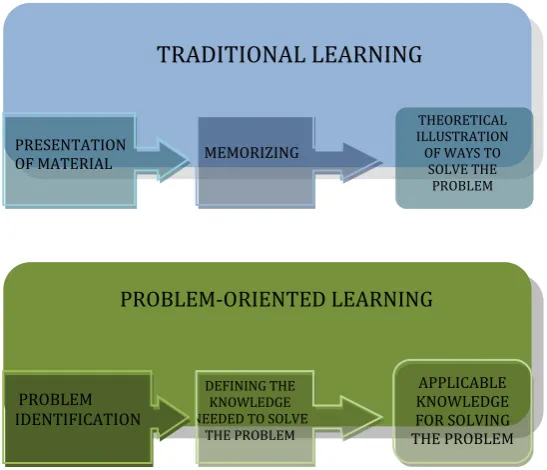
Figure 1. Traditional and problem-oriented learning
Where is the contribution of e-learning in problem-oriented teaching? In relation to traditional methods, learning by solving problems in computer assisted teaching reflects in the following features:
1. Structuring problems with algorithm,
2. Ease of defining the necessity of input information, operational steps and form of output solution,
3. Increased efficiency in diagnosing the key points in problem solving,
4. Speed in finding facts and other entities in local databases or the Internet, needed to solve the problem,
5. Visualization of problem situation,
6. Simulation of problem solving process,
7. Quick exchange of information inside the team,
8. Efficient application of „step by step“ method, „black box“ method, and other cybernetic teaching methods to evaluate the solution,
9. More effective supervision of teachers.
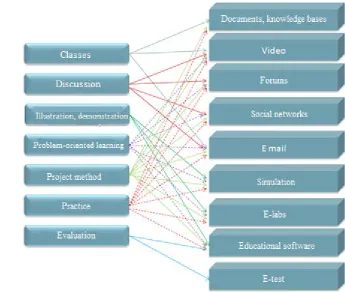
Methodical procedures which will carry out these principles directly into teaching process are: • Problem solving,
• Working in real time, • Brainstorming,
TRADITIONAL LEARNING
PRESENTATION
OF MATERIAL MEMORIZING
THEORETICAL ILLUSTRATION OF WAYS TO
SOLVE THE PROBLEM
PROBLEM-ORIENTED LEARNING
PROBLEM IDENTIFICATION
DEFINING THE KNOWLEDGE NEEDED TO SOLVE
THE PROBLEM
APPLICABLE KNOWLEDGE FOR SOLVING THE PROBLEM
• Discusion groups, • Puzzles,
• Contests, quizes, • Role-playing, • Team work.
Figure 2. Teaching methods in e-learning derived from Turapova and Turapov
Goals and tasks of teaching that are globally (strategic) and operationally established are basic criteria for selection and application of teaching methods and procedures, because the modern teaching model is goal-oriented and based on students’ personal experience. Every teaching method “confirms its values by correlating to other teaching methods” (Prodanovic, 1974). The presence of correlative relationship of one method such as video on demand reveals real dimensions of its application in teaching. It means that the optimal efficiency of every applied method is restricted by dimension of its correlative didactic relationships. If in every teaching situation there are multiple meaningful related methods, the effect of teaching is noticed and better, results of such work are more valuable and function of methods more complete and effective. When discovering the most functional correlative relationship to other methods in certain situation, teacher simultaneously develops the most secure support for modern organization of teaching.
4. VIDEO ON DEMAND AS A PROBLEM-ORIENTED TEACHING METHOD IN E-LEARNING
Using different solutions and methods of e-learning which distance learning makes possible, pupils apply their knowledge achieved during educational cycle on solving concrete tasks and also through interaction with their teachers.
Video on demand technology means broadcasting of pre-recorded video. Cameras of high resolution record video signal from interactive blackboard which enables transforming of digital pen trace to digital form. Synchronized recording of audio, video and writing material enables creation of multimedia content which is the nearest form of individual learning with tutor. Students can hear the teacher’s voice and follow the way of solving the task. Advantage of digital writing is the fact that, compared to recording of classical writing, there is no visual blockage with hand and the text “writes itself”.
Figure 3. Video on demand
On-demand streaming system functions like this: created multimedia content is firstly transferred into appropriate form for Internet distribution; sound must be encoded in the form that supports streaming functionality - AAC format was selected; video format must also support streaming functionality so it is encoded with H.264 code; both channels are then connected in MP4 container for storing streaming material. Material created in such a way is put on dedicated server and it is broadcasted on user's request.
Another reason for choosing the mentioned formats is that they can be presented on mobile devices of new generation which do not support presentation of streaming material via Adobe Flash technology. Adobe Flash has begun losing primacy on mobile video streaming when HTML5 was launched because the biggest producers of mobile devices decided not to embed support for adobe Flash. Apple iPhone, Microsoft Phone 7, Google Android are the systems which do not have support for Flash Video. Therefore, the selected format made possible mobile learning and it expand the group of potential users.
The advantage of streaming presentation is that it is possible to load a small part of material (1-2 seconds) and present it. During presentation the next part of the material is loaded at the back and it is presented afterwards forming a circle buffer. Users are presented material without pauses with minimum system burdening because it is necessary to store only 1-2 seconds of material in advance on the user's computer. In this way it is possible to present lots of materials such as lectures, seminars, media conferences, speeches, etc. On the other hand, it is not necessary to load the whole video material so we need only little time at the beginning of presentation.
5. CONCLUSION
E-learning is an innovative approach in distribution of open, flexible, well designed, multimedial, oriented towards student, time or space unlimited, interactive and for learning simplified educational environment, with resources of information and communications technologies. E-learning does not deny the existing methods of learning; it supplements and enriches them. It does not diminish the importance of teacher role; it promotes it. E-learning has its foundation in psychology and pedagogy and it is possible to determine didactical, logical and methodical base of purpose, outcome and goals of learning. Fundamental meaning is reaching educational goals by satisfying individual needs. From students‘ aspect advantages of e-learning can be systematized as high student motivation and memorizing of teaching materials by establishing conectivist relations; visuality, multimedia and interactivity are elements that significantly influence increase in student motivation for working in class. Perception of learning material that is, in students‘ mind, similar to game, leads to bigger and longer level of maintaining attention, and better memorizing of content processed that way. Conectivist theory includes e-learning, another dimension of connection that multiplies the number of possible relations and that cannot be ignored. It is present among students, teachers, educational institutions and the whole world. Students spontaneously establish these kinds of relations while educational institutions remain far behind. Video on demand technology is one of the many possibilities provided by e-learning and is directed towards intensification of teaching effects and acquiring goals and outcomes of courses.
REFERENCES
Alonso F., Lopez G., Manrique D., Vines J., (2005.), An instructional model for web-based e-learning education with a blended learning process approach, British Journal of Educational Technology, Vol 36 No 2
Anderson J., Communication Research: Issues and Methods (Mcgraw-Hill Series in Mass Communication), Mcgraw-Hill College, 1986.
Antonijević R., (2011),Proces i efekti problemski orijentisanog intelektualnog vaspitanja, Pedagogija,, vol. 66
Bjekić D., 2013, Nastavne metode učenja na daljinu i kreiranje Onlajn, Kurseva, Pomorski fakultet, Kotor, Crna Gora
Kolb, D. A. (1976). The Learning Style Inventory: Technical Manual, Boston, Ma.: McBer.
Komenski, J. A. (1967): Velika didaktika, Beograd, Zavod za izdavanje udžbenika Socijalističke Republike Srbije, Beograd.
Linhart J., Däbriz E., 1960.,Das Lernen in entwicklungspsychologisher Sicht, Berlin
Prodanović, T. i Ničković, R. (1974): Didaktika. Beograd: Zavod za udžbenike i nastavna sredstva. Sarasin, Lynne Celli. (1999) Learning Style Perspectives, Impact inthe Classroom. Madison, WI: Atwood Publishing
Saylor, Michael (2012). The Mobile Wave: How Mobile Intelligence Will Change Everything. Perseus Books/Vanguard Press. p. 86.
Siemens G., (2004.), Connectivism:A Learning Theory for the Digital Age, E-learning Space
Tarpy and Mayer, 1978, Foundations and learning memory, Scott Foresman
Turapova, D. & Turapov, G. (2005). Didactical Issues of E-learning – Problems and Future Trendes, International Conference on Computer Systems and Technologies – CompSysTech'2005, IV.12-1/IV/12-5