
ISSN: 2231-5381
http://www.ijettjournal.org
Page 702Design, Analysis &Implementation of Negative
High Voltage DC Power Supply Using Voltage
Multiplier Circuits.
Priyen S. Patel* & D.B. Dave
Institute of Technology, Nirma University, Ahmedabad, India
Abstract — Voltage multipliers are widely used in many
high-voltage and low-current applications where input high-voltage stability is not the major concern. Some application like microwave tubes requires negative high voltage for their safe operation. In this paper the design aspects of multiplier circuits are taken in account on the basis of analysis and simulation results. Simulation is done using PSIM Software and Implementation is done on basis of simulation results and theoretical calculation.
Keywords -- Voltage Multiplier, High Voltage DC power Supply,
Voltage Doubler, Voltage Tripler, and Voltage Quadruple.
I.
I
NTRODUCTIONA voltage multiplier is an electrical circuit that converts AC electrical power from a lower voltage to a higher DC voltage and less current, using a network of capacitors and diodes. In industrial as well in research area high voltage DC Power Supplies are widely used for testing purpose.
Apart from this some applications are require negative voltage for safe and better performance. The Voltage Multiplier circuits are based on Cockcroft-Walton (C-W) principle for increasing voltage level instead of using conventional transformer rectifier assembly. In this paper the voltage doublers circuits, voltage quadruple circuits are constructed for achieving -70kV, 50mA output.
Voltage Multipliers are constructed using capacitors and diodes and are primarily used where high voltages and low current is required. The output voltage is several times the input voltage and is used where the load has high input impedance and is constant or where the input voltage stability is not the major issue. The voltage multipliers are classified according to the ratio of output voltage to input voltage, they are known as Voltage Doubler, Tripler, and Quadruple etc. For increasing and decreasing voltage conventional transformer can be used which can step up or down the AC voltage and current which can be rectified using diodes or
thyristors or other semiconductor devices and further can be filtered using capacitors. But here the problem is the weight of transformer, as the voltage which is to be stepped up increases the insulation level of the transformer increases and hence it becomes bulky. Apart from this the rectification process is carried out using rectifier grade diodes which are slow and filtering is done using high value capacitors which are heavy in weight.
So to mitigate all the above mentioned problems the voltage multiplier circuits can be used where load current is less and voltage is high. Negative voltage can be achieved by inversing the diode direction.
II.
P
RINCIPLE OFV
OLTAGEM
ULTIPLIERC
IRCUIT1. Voltage Doubler
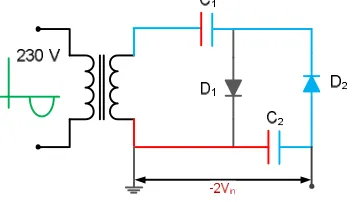
In voltage doubler circuit fig. 1 shown below gives a brief idea about the principle of negative voltage doubler where the diodes are rectifier grade diodes and the capacitor diode assembly acts like half wave rectifier. In the circuit during positive half cycle of input voltage first diode is forward biased and second one is reverse biased. Therefore the flow of current charges the capacitor to negative peak value and capacitor C1 is charged through diode D1 to –Vin.
ISSN: 2231-5381
http://www.ijettjournal.org
Page 703Similarly in the fig. 2 shown below circuit during negative half cycle of input voltage hence first diode is reverse biased and second one is in forward biased. Therefore the potential of capacitor C1 adds with that of the source, thus charging C2 to –2Vin through D2.
Figure. 2 Voltage Doubler in negative alternation
2. Voltage Quadruple
The principle of voltage quadruple is same as voltage doubler, the only difference is number of stages is 2 in quadruple circuit. For positive and negative input voltage the direction of current flow is shown in figures below where in positive alternation potential of capacitor C1 drops to 0 V and allow C3 to be charged through D3 to –2Vin. And in negative alternation potential of C1 rises to –2Vin, also charging C4 to -2Vin. The output voltage (the sum of voltages under C2 and C4) raises till -4Vin as in figure 3.
Figure 3 Voltage quadruple in positive alternation
Figure 4 Voltage quadruple in negative alternation
In reality more cycles are required for C4 to reach the full
voltage. Each additional stage of two diodes and two capacitors increases the output voltage by twice the peak AC supply voltage.
III.
D
ESIGN SPECIFICATIONOutput voltage requirement, needed to test the system at -70 kV, 50 mA deciding the rating of transformer is the primary task.
1. Transformer Specification
The first stage of the power supply is transformer which is basically is an isolation transformer used when it is desired to produce such high voltages. The role of isolation transformer in this circuit is step up the voltage and to isolate the low voltage side from high voltage side.
So, primary task to design a voltage double is to decide the voltage rating of secondary winding transformer. The output voltage of a quadruple is given by:
2 ×N× Vmax = 70kV (1)
Where,
N = no. of stages
Vmax = peak output voltage
Vmax = 17.5 kV
Vrms = Vmax ÷1.414 = 12 kV
KVA rating of Supply = 70KV × 50mA = 3.5 KVA
Assuming efficiency of voltage multiplier as 75 percent.
KVA rating of tr. = KVA rating of power supply / 0.75 KVA rating of transformer = 3.5KVA / 0.75
= 4.6KVA ≈ 5KVA
So the step up transformer is rated for 230V/12 KV, 5KVA.
2. Capacitor Specification
The value of capacitors used is inversely proportional to the frequency of input signal. So, the capacitors are rated for 2Vmax . For voltage quadruple circuits: 2× Vmax = 35kV.
Noptimum = (Vmax × f × c) ÷ I (2)
C = (Noptimum × I) ÷ (Vmax × f) (3)
ISSN: 2231-5381
http://www.ijettjournal.org
Page 704 C = (4 × 50 × 10 ) ÷ (17.5 × 10 × 50)C= 0.22 micro farad. Therefore 35kV, 0.32
microfarad capacitor is used.
3. Diode Specification
The maximum reverse voltage across a diode is called peak inverse voltage and the reverse voltage seen by each diode is 2×Vm, so it’s a general practice to select a device with PIV rating of 2 × Vmax .When this value of voltage is less than
specified value, a small current called leakage current flows through the device. When this voltage exceeds the limit, the device may fail.
From the 230V /12KV transformer Peak output will come up to 12 × 1.414kV = 16.96kV, so twice of it will give nearly 35 kV. So we have taken diode of 40 kV for safety purpose and also for extending the range, as such rating diodes was unavailable so it has been connected two power diodes of 20 kV to make it equivalent to 40kV. Each is having a reverse blocking resistance in the range of mega ohms.
So, the leakage current flowing through each diodes is of the order of =100uA. Thus, resistor while designing of Static Equalizing Circuit for voltage quadruple,
Therefore R = V/I (4)
= (20 × 103) ÷ (100 × 10-6) = 200MΩ
Power rating = I2 × R (5)
= (100 × 10-6)2 × (200 × 106)
= 2 W
4. Calculation of Output Voltage
For design of multiplier circuit, it is very essential to calculate the voltage regulation and percentage ripple.
After considering above values the output voltage of Voltage Quadruple Circuit can describe as
Vout = (2 × N × Vmax)− ∆V− δV (6)
Where,
Vout = output voltage of N stage voltage multiplier
N = no. of stages (it is no. of capacitor divided by 2)
Vmax = maximum or peak input voltage
∆V = resultant drop across the capacitors
δV = ripples voltage (peak to peak)
Now,
Resultant voltage drop across capacitors when load is
connected is given by following equation
∆V =
× × (2 × n ) ÷ 3 + (n ÷ 2)−(n ÷ 6) (7)
So, at 50mAmp Voltage drop in the multiplier circuit is given
as:
∆V = (50 × 10-3) ÷ (50 × 0.25 × 10-6) × (7)
= 28000 V
Ripple voltage (peak to peak) given by
δ
V =
× ×( )× ×
(8)
So, at 50mAmp δV = 6000V
Now, Regulation of Voltage = ∆V/ 2 Vmax (9)
= 28000 / 2 × 17500
= 0.8 percent
Percentage Ripple = δV / 2 Vmax (10)
= 0.171 percent
When load is not connected, in that case δV and ∆V both are
zero thus the above equation get reduce to,
Vout = 2 × N ×Vmax (11)
Vout = 2 × 2 × 1.414 × 12 = 67.87KV
Thus, by choosing appropriate values, power supply is made
which is also work negative supply can provide by reversing
diode direction. As diode direction is reversed output supply is
-67.87kV and used for testing purpose in microwave tubes.
IV.
S
IMULATIONR
ESULTSISSN: 2231-5381
http://www.ijettjournal.org
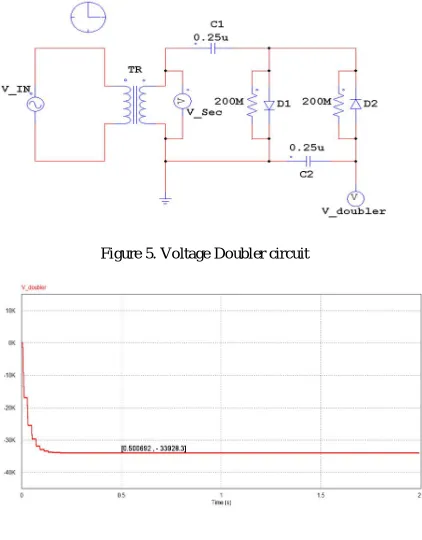
Page 705 Figure 5. Voltage Doubler circuitFigure 6. Output voltage of doubler Scale: X axis 1 unit=0.5 sec; Y axis 1 unit=10KV
Figure 7. Voltage Quadruple circuit without load
Figure 8. Output Voltage of Quadruple without load
[X axis: 1div=0.5 sec Y axis: 1div=20KV]
It is shown that as number of stages increase more cycles are required for C4 to reach the full voltage compared to C2 in
voltage doubler . Each additional stage of two diodes and two capacitors increases the output voltage by twice the peak AC supply voltage with same input voltage from figure 6 and figure 8.
Now when load is connected to system voltage drop and ripple factor introduce in output voltage.
Figure 9. Voltage Quadruple circuit with 25MΩ load
Figure 10(a). Output voltage of quadruple [X axis: 1div=0.2 sec Y axis: 1div=20K V]
ISSN: 2231-5381
http://www.ijettjournal.org
Page 706V.
H
ARDWARER
ESULTSA prototype of the negative voltage quadruple has been developed in order to verify the simulation results. The prototype is developed completely using two stage of multiplier circuit. Multiple voltage level can be achieved by varying input voltage and using doubler and quadruple circuit. At high voltage for safe operation negative voltage is provided to load.
To measure high voltage VD 100 probe is used. It can measure up to 100kV .10kV in VD100 correspond to 1V in CRO. Figure 11 and 12 shows -50KV output without load and at 25Mohm, 200W load. Table 1 shows comparison of simulation results, theoretical calculation, and hardware result compare [3] of output voltage at no load.
Figure 11. Voltage Quadruple circuit without load
[X axis: 1div=5 msec; Y axis: 1div= 1V]
Figure 12. Voltage Quadruple circuit with 25MΩ load (DC coupling) [X axis: 1div=5 mess; Y axis: 1div=1 V]
Figure 12. Voltage Quadruple circuit with 25MΩ load (AC coupling) [X axis: 1div=5 msec; Y axis: 1div=1 V]
TABLE I. Comparison of Output voltage
VI.
S
UMMARY ANDC
ONCLUSIONThe following conclusions are drawn from the above study: The simulation results are carried out with PSIM are found to be matching with theoretical calculations and also with hardware results .Voltage Multipliers can deliver large voltages without changing the input transformer voltage. These systems are less bulky than conventional transformer rectifier sets. Different voltages can be taken at different stages without changing the input voltage. This kind of system is reliable, less complicated and light in weight.
3. ACKNOWLEDGEMENT
The authors would like to thank Institute of Technology, Nirma University for their support and encouragement.
4. REFERENCES
[1] Kwa-Sur Tam, And Eric Bloodworth , “Automated Topological Generation and Analysis of Voltage Multiplier Circuits”, ieee transactions on circuits and systems, vol. 31, no. 3, march 1990.
[2] Kuffel, E. and M. Abdullah, 1984. High Voltage Engineering, Pergamon Press, Oxford.
[3] Saifali Dalakoti,"Design simulation and development of auxiliary power supply for standalone AMPS testing and IPPS development for LHCD system",Technical Training Program ,Institute for Plasma Research,Bhat, Gandhinagar ,2010
[4] Naidu, M.S. and V. Kamaraju, “ High Voltage Engineering”, Third Edition, McGraw- Hill Company Ltd, 2004.
[5] Koki Ogura, Enhui Chu, Manabu Ishitobi, Mantaro Nakamura and Mutsuo Nakaoka, Inductor Snubber-Assisted Series Resonant ZCS-PFM High Frequency Inverter Link DC-DC Converter with Voltage Multiplier , IEEE 2002
[6] Ioannis C. Kobougias and Emmanuel C. Tatakis ,” Optimal Design of a Half Wave Cockroft-Walton Voltage Multiplier with Different Capacitances per Stage”, 13th International Power Electronics and Motion Control Conference,2008.
[7] D.L.Waidelich,H.A.K.Taskin,"Analyses of the Voltage-Tripling and – Quadrupling Rectifier circuits”, Journals & Magazines, Volume: 33, p.p:449-457, July 1945.
No. I/P
Voltage (V)
O/P Theoretical
(KV)
O/P Simulation
(KV)
O/P Practical
(KV)
1 50 14.75 -14.7 -15
2 70 20.65 -20.71 -20
3 90 26.33 -26.63 -26
4 150 44.26 -44.38 -43
![Figure 12. Voltage Quadruple circuit with 25MΩ load (AC coupling) [X axis: 1div=5 msec; Y axis: 1div=1 V]](https://thumb-us.123doks.com/thumbv2/123dok_us/8644777.1725385/5.595.51.540.417.693/figure-voltage-quadruple-circuit-m-load-coupling-axis.webp)
