BOSNIAN JOURNAL OF BASIC MEDICAL SCIENCES 2010; 10 (2): 153-157
&
Abstract
Hepatitis C virus (HCV) usually evades the host’s immune system and persists as a chronic infection. Intravenous drug users (IVDU) represent the majority of patients infected with HCV. Combined therapy of chronic hepatitis C (CHC) with peginterferon α-a and ribavirin can be successful even when pa-tients continue the intravenous drug use. In this study, we compared the characteristics of age, gender, genotype, and stage of fi brosis and the therapy outcome among IVDU and patients with no history of drug use. Th e study included patients diagnosed with chronic hepatitis C, evaluated and treated at the Clinic for infectious diseases in Nis from to . HCV RNA was detected by a polymerase chain reaction and the determination of genotypes was undertaken. Liver biopsies were examined histopatho-logicaly. Patients received a combined treatment of peginterferon alfa-a and ribavirin. Th erapy effi ciency was evaluated based on the achievement of the sustained virological response (SVR). A comparison of characteristics was performed with the use of Mann–Whitney U test, chi-square (χ) test and logistic
regression. IVDU were signifi cantly younger than patients in the control group. Prevalence of stage fi brosis was signifi cantly higher among IVDU. Th e therapy outcome is infl uenced by the patient’s age and HCV genotypes. Each year added to one patient decreased the therapy effi ciency by ., while geno-types and experienced a therapy which was . times more effi cient than in other cases. IVDU rep-resent a specifi c population diff erent from non-using patients. However, they can be treated eff ectively if an adequate patient-doctor relationship is established.
KEY WORDS: chronic hepatitis C, intravenous drug users, therapy, genotype, age
CHARACTERISTICS OF
CHRONIC HEPATITIS C
AMONG INTRAVENOUS
DRUG USERS:
A COMPARATIVE ANALYSIS
Maja Jovanović1, Branislav Jovanović1, Milena Potić2*,
Ljiljana Konstantinović1, Miodrag Vrbić1,
Biljana Radovanović-Dinić3, Velimir Kostić1
1 Clinic for infectious diseases, University of Niš Clinics Centre, Zoran Djindjić Boulevard , Niš, Serbia
2 Faculty of Medicine, University of Niš, Institute of Biomedical Research, Zoran Djindjić Boulevard , nedostaje adresa, Niš, Serbia
3 Clinic for Gastroenterology and Hepatology, University of Niš Clinics Centre, Zoran Djindjić Boulevard , Niš, Serbia
BOSNIAN JOURNAL OF BASIC MEDICAL SCIENCES 2010; 10 (2): 154-157
Introduction
Hepatitis C virus (HCV) is a blood-borne, hepato-tropic, positive-strand RNA virus, which belongs to the Flaviviridae family. It is classifi ed into genotypes (–) and more than subtypes. It is considered to be one of the most successful of all persistent hu-man viruses. Th ere are numerous ways HCV escapes clearance by the host’s immune system: suppressive eff ects of viral proteins on CD+ T cells, activation of regulatory T-cells that suppress HCV-specific CD+-lymphocytes, and mutation in genes encoding viral coat proteins, which avoids detection by antibodies (). Owing to that, HCV persists as a chronic infection in up to of infected individuals, undermining vi-rus–specifi c immunity while leaving the host’s immu-nity to other infectious agents intact (). Chronic hepa-titis C (CHC) is a major cause of cirrhosis, liver failure and hepatocellular carcinoma. In Western countries, it is a leading indication for liver transplantation (). Due to the improved blood transfusion safety and better healthcare conditions, injection drug use has became the main mode of viral transmission and ac-counts for more than of prevalent cases in Europe (). Intravenous drug users (IVDU) are frequently en-gaged in risky behaviour, favouring an extensive HCV spread. In addition, there is compelling evidence that morphine, and its synthetic product heroine, nega-tively aff ect both the immune system and hepatocytes. Morphine modulates the immune system either di-rectly, by binding to µ-opioid receptors present on im-mune cells (T lymphocytes, B-lymphocytes, NK cells, monocytcs, macrophages), or indirectly, within the central nervous system. Opioids activate the descend-ing pathways of the hypothalamic-pituitary-adrenal axis and the sympathetic nervous system. Activation of the hypothalamic-pituitary-adrenal axis starts the production of immunosuppressive glucocorticoids in the periphery, while the activation of the sympathetic nervous system triggers the release of noradrenalin. Both noradrenalin and glucocorticoids act on leuko-cytes and negatively modulate immune capability (). Morphine, through interference with p signalling pathways, inhibits intrahepatic IFN-α expression. Th is is associated with the increased susceptibility of naive hepatic cells to HCV infection. Down-regulation of IFN-α–mediated innate immunity also favours HCV replication in hepatic cells. Opioids can also ham-per the current IFN-α–based anti-HCV therapy (). A combined therapy of CHC with peginter-feron α-a and ribavirin can be successful even
when patients continue intravenous drug use, or if they are on the daily methadone regime. Metha-done treatment extenuates risky behaviour and it is not a contraindication for CHC therapy (). There may be differences in the virological evo-lution, immune response, therapy outcome and other characteristics between patients who ac-quired HCV through ongoing drug use with con-taminated needles, compared to the immune re-sponse in patients with no history of drug use. The aim of this study was to assess char-acteristics of CHC and the therapy out-come between IVDU and non-using patients.
Materials and Methods
Th e study included patients diagnosed with chronic hepatitis C, evaluated and treated at the Clinic for in-fectious diseases in Nis from to . Among them, there were men and women. Based on the intravenous substance abuse, patients were di-vided into the experimental and control group. The experimental group included patients with a substan-tial history of past or present use of drugs through injection, while the control group consisted of pa-tients who reported never using drugs intravenous-ly. The average age of the patients was , in the experimental group and , in the control group. All participants displayed an elevated transaminase
BOSNIAN JOURNAL OF BASIC MEDICAL SCIENCES 2010; 10 (2): 155-157
(SVR). SVR was confirmed by undetectable serum HCV-RNA months after the completion of treatment.
Statistical methods. Th e Mann-Whitney U test was used to compare values of noncategorical parameters (age, time until therapy begun). The Chi square test or Fisher exact test were used to compare categorical parameters between groups. Logistic regression analy-sis was performed to determine whether covariates (IVDU, gender, age, time until therapy commenced) significantly associated successful therapy. OR val-ues with confidence intervals were presented. Th e analyses were carried out using SPSS . for Win-dows, Microsoft Excel and STATCALC computer statistical packages. Signifi cance levels were set at p<,.
Results
Characteristics of IVDU and control group were compared. IVDU were significantly younger than pa-tients in the control group (, ± ,; , ± , years of age), and the time until therapy had started was shorter (,±,; ,±, years of age). Treatment was successful in a signifi cant number of patients of the ex-perimental group (,:,) (Table .). Prevalence of stage fi brosis was signifi cantly higher among IVDU (,:,). In the control group, patients were with-out fi brosis (,) and stage IV fi brosis was present in patients (,) which was signifi cantly higher com-pared to IVDU where there were no patients without fi brosis and no patients with stage IV fi brosis (Table .). The differences of gender structure, presence of co infections, and number of copies at the
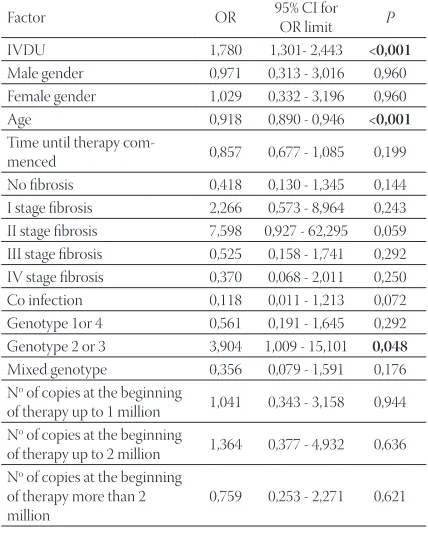
begin-ing of therapy between the control and experimen-tal group were not statisticaly significant (Table .). IVDU patients were more likely associated with suc-cessful therapy (OR=,) than patients of the con-trol group (Table .). Patients with HCV genotypes or were more likely associated with successful therapy than the others. The chance for the success-ful therapy decreased by , for every year of age. Multivariate logistic regression analysis isolated pa-tient’s age and genotypes and as factors that af-fect therapy outcome (Table .). Each year added to one patient decreased the therapy efficiency by ,, while genotypes and experienced a therapy which was . times more efficient than in other cases.
Baseline characteristic
Groups
P
Experimental (N=31)
Control (N=38) Gender
male 25 (80,6) 23 (60,5) 0,071 female 6 (19,4) 15 (39,5)
age (years) 33,4±4,2 46,2±9,8 <0,001
Time until therapy
begun (years) 2,9±1,3 4,3±2,6 0,009 Co infection 2 (6,4) 1 (2,7) 0,580 Genotype
1or 4 14 (45,2) 24 (63,2) 0,211 2 or 3 11 (35,5) 12 (31,6) 0,932 mixed 6 (19,4) 2 (5,3) 0,150 Effi cient therapy 29 (93,5) 20 (52,6) <0,001
Relapse - 2 (5,3) 0,498 No of copies at the beginning of therapy
Up to 1 million 12 (38,7) 12 (36,4) 0,715 1 to 2 million 9 (29,0) 7 (21,2) 0,452 More than 2 million 10 (32,3) 14 (42,4) 0,886
Stage of liver fi brosis
Groups
P
Experimental (N=31)
Control (N=38)
No fi brosis - 16 (42,1) <0,001
I stage 13 (41,9) 4 (10,5) 0,006
II stage 9 (29,0) 6 (15,8) 0,301 III stage 9 (29,0) 6 (15,8) 0,301 IV stage - 6 (15,8) 0,029
Factor OR 95% CI for OR˝limit P Age 0,919 0,896 - 0,942 <0,001
Genotype 2 or 3 2,081 1,198 - 7,931 0,037 Constant of regression 21,681 0,011 Factor OR 95% CI for
OR limit P IVDU 1,780 1,301- 2,443 <0,001
Male gender 0,971 0,313 - 3,016 0,960 Female gender 1,029 0,332 - 3,196 0,960 Age 0,918 0,890 - 0,946 <0,001
Time until therapy
com-menced 0,857 0,677 - 1,085 0,199 No fi brosis 0,418 0,130 - 1,345 0,144 I stage fi brosis 2,266 0,573 - 8,964 0,243 II stage fi brosis 7,598 0,927 - 62,295 0,059 III stage fi brosis 0,525 0,158 - 1,741 0,292 IV stage fi brosis 0,370 0,068 - 2,011 0,250 Co infection 0,118 0,011 - 1,213 0,072 Genotype 1or 4 0,561 0,191 - 1,645 0,292 Genotype 2 or 3 3,904 1,009 - 15,101 0,048
Mixed genotype 0,356 0,079 - 1,591 0,176 No of copies at the beginning
of therapy up to 1 million 1,041 0,343 - 3,158 0,944 No of copies at the beginning
of therapy up to 2 million 1,364 0,377 - 4,932 0,636 No of copies at the beginning
of therapy more than 2 million
0,759 0,253 - 2,271 0,621 TABLE 1. Comparison of CHC patients’ baseline characteristics in the
control and experimental group
TABLE 2. Th e degree of fi brosis in the control and experimental group
TABLE 4. Odds ratio values for assessment of successful therapy (mul-tivariate logistic regression)
BOSNIAN JOURNAL OF BASIC MEDICAL SCIENCES 2010; 10 (2): 156-157Discussion
With the worldwide population of IVDU between and . million, the problem has become a prevalent global concern, unrestricted by a country’s level of de-velopment or location (). According to the literature, of IVDU are infected with HCV (). Since the ma-jority of HCV infected individuals will develop chronic infection, IVDU is a persistent reservoir for transmis-sion to other users and the non-using community. Treatment of chronic hepatitis C in patients with drug addiction requires the cooperation of special-ists for Hepatology, addiction and psychiatry. The response might be improved significantly if patients take over of the medication during of the treatment time. The therapeutic outcome can be achieved by improving compliance, reducing side ef-fects and by an interdisciplinary case management (). This study compared characteristics of HCV infec-tion among IVDU and non-using patients. Geno-type is the most frequent among both IVDU and patients of the control group. In the control group, it represents more than half of all infections. The prevalence of HCV genotypes in our hospital gener-ally follows the European genotype pattern. Similar results are found in studies in Italy, Western Tur-key, Greece and Slovenia (, , and ). How-ever, a study in Poland showed that genotype con-stituted the majority of HCV infections in IVDU (). IVDU were significantly younger than non-using pa-tients, with higher rates of stage I fi brosis and a better therapy outcome. Experimental models showed that the repeated administration of morphine interferes with hepatic antioxidant defence, especially through modulation of glutathione synthesis and catabolism pathways. Th is pro-oxidant property would be respon-sible for induction of apoptosis in hepatocytes (). The presence of stage IV fibrosis among non-using patients of the control group can be explained by the asymptomatic development of HCV infection. Th e viral genotype, low viral load, age of or less and the stage of liver disease represent the most powerful predictive factors of SVR according to several studies (, and ). Our fi ndings that Genotypes and have a twice better therapy outcome are not only con-sistent, but higher than the results of the multicentric study performed in Germany in , where more than of the patients with genotypes and had SVR (). The IVDU in our study showed a better therapy
BOSNIAN JOURNAL OF BASIC MEDICAL SCIENCES 2010; 10 (2): 157-157
Conclusion
IVDU represents an independent group of CHC patients with an age range and a stage of fi brosis diff erent from the non-using patients. Th e therapy outcome of Genotypes and is better than in other cases. Since every year added to a patient decreases therapy effi ciency, the patient’s age should be taken into account in everyday clinical practice when predicting SVR and the therapy outcome. Despite the risks of non-compliance and side eff ects, IVDU can be treated successfully. Increasing the education on HCV and its treatment of both patients and physicians is important for future results. Any comprehensive approach to control an HCV epidemic must include a strategy that addresses this group. Eff ectively engaging marginalized individuals in HCV treatment is crucial for lowering the future HCV-related disease burden.
List of Abbreviations
HCV – Hepatitis C virus IVDU – Intravenous drug users CHC – Chronic hepatitis C
SVR – Sustained virological response PCR – Polymerase chain reaction
References
() Ishii S., Koziel M.J. Immune responses during acute and chronic infection with hepatitis C virus. Cl. immunol. ; ():-.
() Bowen G.D., Walker M.C. Adaptive immune responses in acute and chronic hepatitis C virus infection. Nature. ; :-. () Diepolder H.M. New insights into the immunopathogenesis of
chronic hepatitis C. Antivir. Res. ; :-.
() Esteban J.I., Sauleda S., Quer J. Th e changing epidemiology of hepatitis C virus infection in Europe. J. Hepatol. ; :-. () Sacerdote P. Opioids and the immune system. Palliative Med.
; :-.
() Yuan L., Li Y., Jin-Song P, et al. Morphine inhibits intrahepatic IFN-α and enhances complete Hepatitis C virus replication. J. In-fect. Dis. ; :-.
() Jovanović M., Konstantinović Lj., Kostić V, et al. Effi ciency of a combined peginterferon alpha-a and ribavirin therapy in intra-venous opiate substances abusers with chronic hepatitis C. Vo-jnosanit. Pregl. ; ():-.
() United Nations Offi ce on Drugs and Crime Vienna. World drug report . United Nations, New York, .
() Schaefer M., Heinz A., Backmund M. Treatment of chronic hepatitis C in patients with drug dependence: time to change the rules? Addiction. ; ():-.
() Sereno S., Perinelli P., Laghi V. Changes in the prevalence of hep-atitis C virus genotype among Italian injection drug users-Rela-tion to period of injecusers-Rela-tion started. J. Clin. Virol. ; :-. () Altuglu I., Soyler I., Ozacar T., Erensoy S. Distribution of hepatitis
C virus genotypes in patients with chronic hepatitis C infection in Western Turkey. Int. J. Infect. Dis. ; :-.
() Katsoulidou A., Sypsa V., Tassopoulos N.C, et al. Molecular epi-demiology of hepatitis C virus (HCV) in Greece: temporal trends in HCV genotype-specifi c incidence and molecular characteriza-tion of genotype isolates. J. Viral Hepatitis. ; :–. () Seme K., Vrhovac M., Močilnik T, et al. Hepatitis C Virus
Geno-types in , Patients in Slovenia, –. J. Med. Virol. ; :–.
() Chlabicz S., Flisiak R., Kowalczuk O. Changing HCV genotypes distribution in Poland-Relation to source and time of infection. J. Clin. Virol. ; :-.
() Payabvash S., A Beheshtian A., Hassanzadeh Salmasi A, et al Chronic morphine treatment induces oxidant and apoptotic damage in the mice liver. Life Sci. ; (): -. () Hadziyannis S.J., Sette Jr H., Morgan T.R, et al. Peginterferon a-a
and ribavirin combination therapy in chronic hepatitis C. Ann. Intern. Med. ; :–.
() Hosogaya S., Ozaki Y., Enomoto N., Akahane Y. Analysis of prog-nostic factors in therapeutic responses to interferon in patients with chronic hepatitis C. Transl. Res. ; ():-. () Mata-Marín A.J., Fuentes-Allen L.H., Gaytán-Martínez J, et al.
APRI as a predictor of early viral response in chronic hepatitis C patients. World J. Gastroenterol. ; ():–. () Witthöft Th ., Möller B., Wiedmann K.H, et al. Safety, tolerability
and effi cacy of peginterferon alpha-a and ribavirin in chronic hepatitis C in clinical practice: Th e German Open Safety Trial. J. Viral Hepatitis. ; :–.
() Schulte B., Schütt S., Jochen Brack J, et al. Successful treatment of chronic hepatitis C virus infection in severely opioid-dependent patients under heroin maintenance. Drug. Alcohol. Depen. ; Article in Press, Corrected Proof.
() Deuffi c-Burban S., Poynard T., Valleron A.J. Quantifi cation of fi brosis progression in patients with chronic hepatitis C using a Markov model. J. Viral Hepatitis. ; :–.
() Massard J., Ratziu V., Th abut D, et al. Natural history and predic-tors of disease severity in chronic hepatitis C. J. Hepatol. ; :–.
() Elefsiniotis S.I., Pavlidis C., Ketikoglou I, et al. Patient’s age modi-fi es the impact of the proposed predictors of sustained virological response in chronic hepatitis C patients treated with PEG-inter-feron plus ribavirin. Eur. J. Intern. Med. ; : –. () Grebely J., Genoway A.K., D. Raff a D.J, et al. Barriers associated
with the treatment of hepatitis C virus infection among illicit drug users. Drug Alcohol Depen. ; :-.