Impact Factor (PIF): 2.675
Global Journal of Advanced Engineering Technologies and Sciences
PERFORMANCE ANALYSIS OF GENETIC OPERATORS ON TEST
FUNCTIONS OF SINGLE OBJECTIVE OPTIMIZATION PROBLEMS
Deepika Pathak
1, Dr. Sharad Gangele
2 1Research Scholar,
2Prof,
1,Department of Computer Science and Application, RKDF University, Bhopal
2Department of Computer Science, RKDF Universtiy, Bhopal
ABSTRACT
Multi Clustered Parallel Genetic Algorithm is a type of multi population based genetic algorithm which gives equal importance to low fit individuals. It has been applied to 0/1 knapsack problem and found to perform well compared to the Standard Genetic Algorithm. This paper investigates the working rule of multi grouped parallel hereditary calculation for the standard test capacities for the single target enhancement issues and contrasted and the standard hereditary calculation. The execution is contrasted and the standard hereditary calculation, the standard test elements of single target streamlining issues are utilized and the outcome demonstrates that proposed technique performs better with meeting speed.
Keyword: - Multi
Clustered, Genetic Algorithm,
INTRODUCTION
On the thoughts of hereditary qualities and common advancement, Genetic Algorithms (GA) (Holland 1992) is the stochastic inquiry calculations. "Survival of the fittest", the Darwin's hypothesis is connected in the pursuit space to coordinate towards the inquiry procedure from the randomized instatement to a more planned heading in the hunt space, which is vast. During the time spent seeking an answer in the hunt space, various hereditary administrators are connected to help the procedure of examination.
This paper focus on both standard genetic algorithm and multi clustered parallel genetic algorithm. Multi clustered parallel genetic algorithm works under the principle of “Birds of the same feather flock together”. Based on the type of the application the standard selection mechanisms like roulette wheel selection, tournament selection and rank based selection mechanisms are used in standard genetic algorithm. All these standard selection mechanisms aim to select high fit individuals in different proportion to perform genetic operations like crossover and mutation. The low fit people are given less opportunity to perform hereditary operations hence the differing qualities of the populace is lessened. In any case, if the shot is given to the low fit people, they may create great chromosomes in the further eras. This reality is given more significance in the multi bunched parallel hereditary calculation.
In Multi Clustered Parallel Genetic Algorithm (MCPGA), the underlying populace are assembled into different gatherings in light of the wellness esteem. People in each gathering mate with each other to create great chromosomes. In a gathering, assuming any chromosome comes up with better fitness value, it leaves the group and combines with the group which has the similar fitness value. The selection mechanisms followed in MCPGA insists on recombination within the same group thus providing equal chances for mating to the group with lower fitness value. This allows the multi clustered parallel genetic algorithm to maintain the diversity of individuals in the population.
The performance of the MCPGA is proved by applying the standard test functions of single objective optimization problem for implementation. The same test functions are implemented with standard genetic algorithm and the results are compared in terms of convergence velocity and the profit obtained.
LITERATURE REVIEW
Due to its faster convergence, Multi population Genetic Algorithms (MGA) are popular, since each group evolves independent of each other. MGAs reduce the number of generations to find the best optimal solution or the near optimal solution. It is also more defiant to premature convergence.
In [Petty et al, 1987], after each generation migration takes place and a copy of the best individual in each group is transferred to the neighbour group. 5 sub-population was used by Grosso in 1985 and the individuals were exchanged with fixed migration rate. Chaotic migration strategy [Chen et al, 2004] was implemented in MGA which employs the asynchronous migration of individuals during its parallel evolution.
Impact Factor (PIF): 2.675
MATERIALS AND METHODS
Multi Clustered Parallel Genetic Algorithm
Multi Clustered Parallel Genetic Algorithm (MCPGA)[Vishnu Raja and MuraliBhaskaran, 2012] is proposed with a target to decrease the choice weight of the worldwide hunt space. Keeping in mind the end goal to enhance the execution of the GA, the calculation is tuned in such a way the whole populace is separated into a few subpopulations and executed at the same time. For powerful gathering of the populace, positioning of chromosome is finished.
METHODOLOGY
At first the GA is begun with an arrangement of populaces created by irregular as its underlying populace. In MCPGA, in light of the wellness assessment the whole populace is separated into a few sub populaces called bunches. Introductory groups are shaped aimlessly. The people display in a group can mate with each other to create new posterity. Parent determination systems, the hereditary administrators (hybrid and change) are connected inside the gathering. The posterity created from each gathering will have distinctive wellness esteems. In the following emphasis, again positioning of chromosome is done after the wellness assessment. Also, the calculation proceeds till the end condition is fulfilled. The people move to different bunches in light of the wellness estimation of every person.
The important property that makes the Multi Clustered Parallel Genetic Algorithm works better is the parallel implementation of multi population individuals. The parallel implementation of genetic operators like crossover and mutation in each group is done to improve the performance of the algorithm. In each generation, the worst individuals also gain the profit and migrate with the groups. This movement between the gatherings encourages the most exceedingly bad individual to pick up the wellness esteem after hybrid and change procedure to hold the individual survival in the opposition. At the point when a shot is given, now and again even the most noticeably awful people can contribute towards the last arrangement. The pseudo code of MCPGA is given underneath:
The pseudo code of Multi Clustered Parallel Genetic Algorithm is given below
1. [ Initialization ]
Generate the initial population by random. 2. [ Fitness Evaluation ]
Calculate the fitness value of each individual in the population.
3. [ Grouping ]
Sort the individuals based on the fitness function.
Based on the fitness value arrange the population into groups. 4. [ Breeding]
Each group will have individual population. For each group perform the following steps Select the parents from the population using selection mechanisms.
Mate the parents to produce new offsprings. Mutate the new offsprings.
Calculate the fitness of offspring. Replace the offspring to the same group. 5. [Migration]
Combine the groups into a single population. Calculate the fitness value for all the individuals. Sort the individuals based on the fitness value. 6. [ Termination ]
Repeat the process from step -3 till the termination condition is reached. Select the best solution from the current population.
Impact Factor (PIF): 2.675
BENEFITS OF MCPGA
From the process of MCPGA, notable benefits are observed.
The selection pressure is reduced. All the individuals in the population of a cluster are given chance to mate with each other in the same group.
Since the groups are formed based on the fitness value. It is not necessary to worry about the mate between the worst individuals, if they produce best individuals they migrate with some other cluster.
The convergence is quicker compared to the single population GA. It is very simple to use.
It can be applied to any problems of any domain.
SINGLE OBJECTIVE OPTIMIZATION TEST FUNCTIONS
In Computational science, the optimization is to find the best solution to a problem. The objective chosen in this paper is a set of test functions of single objective optimization problems. These test capacities are for the most part utilized for assessing the execution of the developmental calculations. The essential thought for the assessment of the calculation is to recognize the issues where the execution is better. This will plan the test set for which the calculation ought to be assessed. The sufficient test set was planned by Eiben and Back. This test set has all around portrayed test works that enable us to acquire and sum up beyond what many would consider possible. A capacity F(x) is multi demonstrate in the event that it has at least two neighborhood optima [Back, 1996]. A component of p factors is divisible on the off chance that it can be changed as a total of elements of only one variable. Separable functions are optimized for each variable where as the non separable functions are more difficult to optimize as the accurate search a direction depends on one or more genes. The optimization problem is more difficult if the function F(x) is an multi model function. The search process must be able to avoid the regions around local minima in order to approximate, as far as possible, the global optimum. The most complex case appears when the local optima are randomly distributed in the search space.
The goal of any optimization function is to find the best possible solutions x* from a set X according to a set of criteria F = {f1, f2, . . .fn}. These criteria are called objective functions expressed in the form of mathematical functions. An objective function is a mathematical function f : D С Rn → R subject to additional constraints. The
set D is referred to as the set of feasible points in a search space. In the case of optimizing a single criterion f, an optimum is either its maximum or minimum. The global optimization problems are often defined as minimization problems, however, these problems can be easily converted to maximization problems by negating f. A general global optimum problem can be defined as follows:
The true optimal solution of an optimization problem may be a set of x* ∈ D of all optimal points in D, rather than a single minimum or maximum value in some cases. There could be different, even an interminable number of ideal arrangements, contingent upon the area of the pursuit space. The undertaking of any great worldwide advancement calculation is to discover internationally ideal or if nothing else problematic arrangements. The objective functions could be characterized as continuous, discontinuous, linear, non-linear, convex, non-convex, unimodal, multimodal, separable and non-separable.
Following are the test functions taken up for the experimentation. Ackleys Function
Sphere Function Rosenbrock function Matyas Function Booths Function
Ackleys Function
Ackley is a Continuous, Differentiable, Non-Separable, Scalable, Multimodal function which was first proposed by Ackley and the generalized figure was given by Back. The function has an exponential term that covers its surface with numerous local minima. The function definition is as follows:
Impact Factor (PIF): 2.675
x=f({−1.479252,−0.739807}, 1.479252,−0.739807}), f(x∗) = −3.917275.
Sphere Function
Sphere function is a Continuous, Differentiable, Separable, Scalable, Multimodal function and has been used in the development of the theory of evolutionary strategies. De jong used sphere function as a test function for the evaluation of genetic algorithms.
subject to 0 ≤ xi ≤ 10. The global minima is located x* = f(0, … , 0), f(x*) = 0.
Rosenbrock function
Rosenbrock function is a Continuous, Differentiable, Non-Separable, Scalable, Unimodal function. is a non-convex function used as a performance test problem for optimization algorithms introduced by Howard H. Rosenbrock.
subject to −30 ≤ xi ≤ 30. The global minima is located at x* = f(1, .. . . , 1),
f(x*)=0.
Matyas Function
Matyas function is a Continuous, Differentiable, Non-Separable, Non-Scalable, Unimodal function and has no local minima except the global one. This function is used as a test function in order to evaluate the performance of optimization algorithms.
subject to −10 ≤ xi ≤ 10. The global minimum is located at x* = f(0, 0),
f(x*)=0.
Booths Function
Booths function is a Continuous, Differentiable, Non-separable, Non-Scalable, Unimodal function. This function has several numbers of global minima.
subject to −10 ≤ xi ≤ 10. The global minimum is located at x* = f(1, 3),
f(x*) = 0.
RESULTSAND DISCUSSION
Experimental Setup
The chromosomes are represented in the form of double vector. The optimal parameters [10] for MCPGA are
No of Individuals: 200
Selection Mechanism: Tournament Selection Crossover Type: Uniform Crossover
Crossover Rate: 0.90
Mutation Type: Flip Bit Mutation Mutation Rate: 0.20
Group Size: 4
Impact Factor (PIF): 2.675
Fixed number of generations Variable number of generations
The simulations of SGA are done in Matlab and the simulations of MCPGA in Java. Each Test functions were subjected to 15 continuous executions for both SGA and MCPGA and the optimal value and the number of generations taken for the convergence are noted.
Comparison of SGA and MCPGA
The experiments were carried out for continuous 25 executions. The fitness value and the corresponding generations taken to obtain the fitness value for the first 15 executions were shown in the graph.
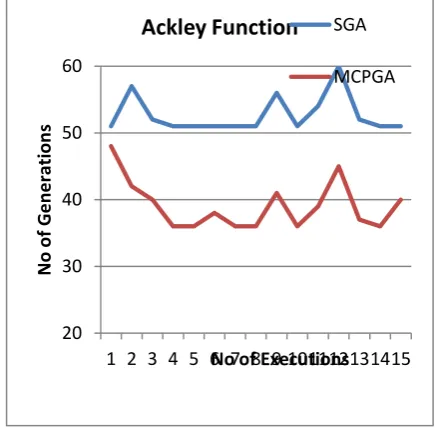
Figure 1 and 2 shows the fitness value obtained and the number of generations taken in each execution for Ackley Function.
Figure 1: Comparison of Fitness value for Ackley Function.
Figure 2: Comparison of Convergence velocity for Ackley Function.
Figure 3 and 4 shows the fitness value obtained and the number of generations taken in each execution for Sphere Function.
0 0.05 0.1 0.15 0.2 0.25 0.3 0.35 0.4 0.45
1 2 3 4 5 6 7 8 9 10 11 12 13 14 15
Fi
tn
e
ss Val
u
e
No of Executions
Ackley Function
SGAMCPGA
20 30 40 50 60
1 2 3 4 5 6 7 8 9 10 11 12 13 14 15
N
o
o
f Ge
n
e
ration
s
No of Executions
Ackley Function
SGAImpact Factor (PIF): 2.675
Figure 3: Comparison of Fitness value for Sphere Function.
Figure 4: Comparison of Convergence velocity for Sphere Function.
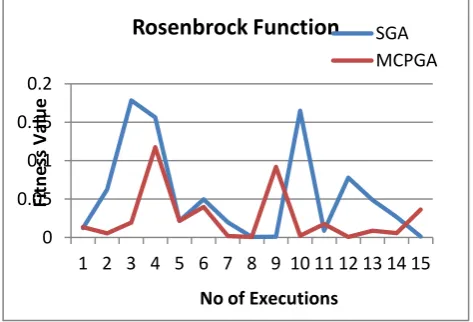
Figure 5 and 6 shows the fitness value obtained and the number of generations taken in each execution for Rosenbrock Function.
Figure 5: Comparison of Fitness value for Rosenbrock Function.
0 0.2 0.4 0.6 0.8 1
1 2 3 4 5 6 7 8 9 10 11 12 13 14 15
Fi
tn
e
ss Val
u
e
No of Executions
Sphere Function
SGA MCPGA
0 50 100 150 200 250
1 2 3 4 5 6 7 8 9 10 11 12 13 14 15
N
o
o
f Ge
n
e
ration
s
No of Executions
Sphere Function
SGAMCPGA
0 0.05 0.1 0.15 0.2
1 2 3 4 5 6 7 8 9 10 11 12 13 14 15
Fi
tn
e
ss Val
u
e
No of Executions
Rosenbrock Function
SGAImpact Factor (PIF): 2.675
Figure 6: Comparison of Convergence velocity for Rosenbrock Function.
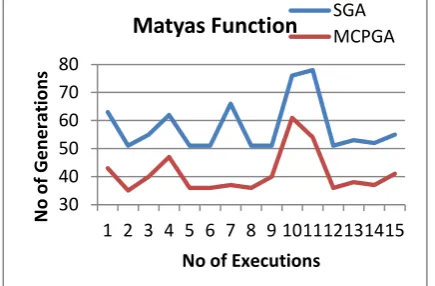
Figure 7 and 8 shows the fitness value obtained and the number of generations taken in each execution for Matyas Function.
Figure 7: Comparison of Fitness value for Matyas Function.
Figure 8: Comparison of Convergence velocity for Matyas Function.
On implementing the above mentioned single objective test functions, it is clear that MCPGA converges faster than the standard genetic algorithm. Due to its independent nature the functions behave differently in terms of the fitness value obtained and the number of generations taken for convergence.
Ackley function almost shows a smooth regular value for MCPGA. The sphere function on implementing in MCPGA gave much more optimised fitness value than SGA. In SGA, the sphere function did not converge to the global optima beyond the limited value.
The figures 5 and 6 of Rosenbrock function show that the values are grouped nearer to the global optimal value. It is identified that there are some high peaks for SGA which is not found for MCPGA. The Matyas function which
0 10 20 30 40 50 60 70
1 2 3 4 5 6 7 8 9 10 11 12 13 14 15
Ge
n
e
ration
s
No of Executions
Rosenbrock Function
SGAMCPGA
0 0.2 0.4 0.6 0.8 1 1.2
1 2 3 4 5 6 7 8 9 10 11 12 13 14 15
Fi
tn
e
ss Val
u
e
No of Executions
Matyas Function
SGA MCPGA30 40 50 60 70 80
1 2 3 4 5 6 7 8 9 10 11 12 13 14 15
N
o
o
f Ge
n
e
ration
s
No of Executions
Impact Factor (PIF): 2.675
belongs to the same genere shows the similar characteristics. MCPGA was able to converge faster compared to SGA. Booths Function converged efficiently for SGA, but it is found some variations in few iterations. But MCPGA converged uniformly in a better manner.
CONCLUSION
The results clearly shows that multi population based Multi Clustered Parallel Genetic Algorithm performs well when compared with Standard Genetic Algorithm in terms of producing the good chromosomes with best fitness value in less convergence. The test functions which come under Multi Objective optimization problems are currently under study. The MCPGA offers a good synchronized method for solution to any practical problems with the desirable quality of giving importance to low fit individuals.
REFERENCES
I. Petty.C.B, Leuze.M.R and Grefenstette.J.J., 1987,A Parallel genetic algorithm, in: proceedings of the second international conference on Genetic Algorithms, pp. 155-161.
II. Whitley.D and Keith.J., 1988, Genitor: A Different genetic algorithm, in Proceedings of the Rocky Mountain conference on Artificial Intelligence, pp 118-130.
III. Rebaudengo.M and Reordo.M.S., 1993, An Experimental Analysis of the effects of Migration in parallel genetic algorithms, in: Proceedings of Euromicro workshop on parallel and Distributed Processings, pp.232-238.
IV. Grosso.P.B., 1985, Computer simulations of genetic adaptation: parallel subcomponent interaction in a multilocus model. The University of Michigan.
V. Booker,L.B., 1982, Intelligent behaviour as an adaptation to the task environment. Doctoral Dissertation, University of Michigan.
VI. Back.T., 1996, Evolutional Algorithms in Theory and Practice, Oxford University Press.
VII. Chen.X, Gui.W and Chen.L., 2004, A Multi population based GA on chaotic migration strategy and its applications to inventory programming, in : Proceedings of the 5th world congress of Intelligent control and Automation, pp 2159-2162.
VIII. Power.D, Ryan.C and Azad.M.A., 2005, Promoting diversity using migration strategies in distributed genetic algorithms, in: Proceedings of the IEEE Congress on Evolutionary Computation, Vol.1, pp.1831-1838.
IX. Vishnu Raja.P and MuraliBhaskaran.V., 2012 ‘Impact of Population Size and Mutation Rate on Multi Clustered Parallel Genetic Algorithm’, International Journal of Modern Engineering Research (IJMER), vol.2, no. 3, pp-1096-1098.
X. Vishnu Raja P. and MuraliBhaskaran .V., 2012 ‘Performance Analysis of Multi Clustered Parallel Genetic Algorithm with Gray Value’, American Journal of Applied Sciences (AJAS), Impact Factor : 1.4, vol. 9, no. 8, pp. 1268-1272.