Chinese Supervisory Board and Audit Committee -
The Comparison of Two Cases
Pao-Chen Lee
Kainan University, Taoyuan City, Taiwan
Abstract
Chinese listed companies adopt first a Supervisory Board (SB) and then the independent directors in a Board of Directors (BoD). Specially, the Audit Committee (AC) of BoD and the SB are both in charged with monitoring functions in China. It may present that dual monitoring roles of SBs and ACs simultaneously operate in one organization in China. What are the processes and relationships between Chinese SBs and ACs? China expects that the establishment of ACs after SBs will improve the internal supervisory mechanism of Corporate Governance. Particular attention is paid to the challenges that both roles are facing in compositions, operational processes of coexistence and the likely linkages to their relationships. This paper compares two experimental cases with and without ACs in China by interviewing the SBs and ACs chairmen and members with scarce resources. A matrix of two cases studies’ results on the main features is summarized and the findings are given to improve effective supervisory functions in China. This research results propose that China may build up a suitable internal supervisory mechanism to Chinese unique model by integrating all of the supervisory institutions in one entity and raising the rank position to strengthen the functional processes and interactive relationships among the related parties. Chinese supervision in practical operations needs greater consideration of the organizational and institutional relationships and overcoming operational challenges of functional processes call for further researches.Keywords
Supervisory Board, Audit Committee, Corporate Governance1. Introduction
The People’s Republic of China was founded in 1949 with the planned economy. Since 1978, China initiated the reform and opening-up policy, to the end of 2016, there are more than 70% of state-owned enterprises (SOEs) have been renovated to the competitive commercial category as private enterprises, only less than 30% SOEs remained and categorized as public infrastructures (Cheng, 2012; GLGA, 2017). The goal of this new measure is to transfer control and management of SOEs to corporation systems in the end of 2017; and to establish a majority of external directors in the board of directors (BoD) in 2020 (OSC, 2017). The other reforms that accompany the changes of categorization and mixed ownership are strengthening the supervisory mechanism such like supervisory board (SB), BoD, implementing market-based manager compensation, and increasing accountability toward state owned assets to reduce corruption. There is nothing about altering internal measures for SOEs in order to ensure that these firms
* Corresponding author:
[email protected] (Pao-Chen Lee) Published online at http://journal.sapub.org/ijfa
Copyright©2019The Author(s).PublishedbyScientific&AcademicPublishing This work is licensed under the Creative Commons Attribution International License (CC BY). http://creativecommons.org/licenses/by/4.0/
become more competitive or efficient (Hsu, 2017). Due to non-state owned interests in the joint ventures, demand emerged for the verification of capital contributions and audits of annual financial statements and income tax returns by registered non-government-employed Chinese certified public accountants (Xiao et al., 2000). There is inevitably to further strengthen the supervisory mechanism accompanying with the ownership conversion for the contradiction between the ownership and the management grounded on the agency theory. At the progress of supervision, the supervisory concept and independent monitoring knowledge in China was virtually non-existent under the planned economy before the 1980s, when the State both owned and ran enterprises. Since 1998, the SOE’s inspection commissioner’s system progressed to outsourcing board of supervisor’s system of the large SOEs, which were set up with the original intention for the transitional arrangements and with the subtraction members of the supervisors, has now been normalized and evolved into the enterprise’s supervisory board (SB) system (Zong, 2008). The progress of full-scale economic reforms, with the separation of ownership and management of enterprises, led to agency problems in business firms. Independent monitoring is thus called for, in order to alleviate these problems.
became the first piece of Chinese legislation specifying that every listed company establish a SB to supervise the company’s financial activities and the conduct of its directors. In 2002, China announced the regulation of the Code of CG for Listed Companies (CSRC and SETC 2002: Section 52), encouraging listed companies to set up an Audit Committee voluntarily, although its installation is not mandatory. In practice, the willingness to install the AC has increased from 1% (12) in 2000 to 99.86% (2106) in 2010 among listed companies (Lee, 2015, page 2, Table 1). In China, under the equivalent regulation, the establishment of an AC is voluntary rather than mandatory. In practice, the willingness to install the AC has increased and given that almost all Chinese companies have introduced ACs into their governance structures since 2010, it is indeed a peculiar system of implementing a singular mechanism of the AC on top of the dual supervisory mechanism of the SB. Given that the SB in the Chinese system has similar duties to that of the AC in the Anglo-American system, it is unclear how these two bodies will operate together and interacts with each other and whether this will result in the duplication of supervision. The issue in this article may be summarized as follows: What are the processes and relationships between Chinese SBs and ACs? Particular attention is paid to the challenges that both roles are facing in compositions, operational processes of coexistence and the likely linkages to their relationships.
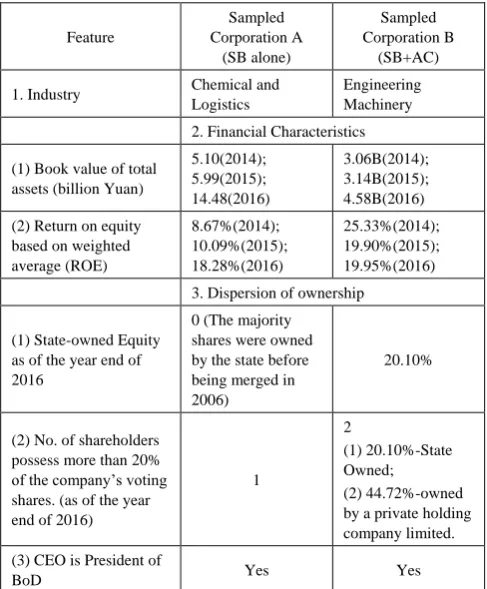
Table 1. Background of the Sampled Corporations (Source: Author)
Feature
Sampled Corporation A
(SB alone)
Sampled Corporation B
(SB+AC)
1. Industry Chemical and
Logistics
Engineering Machinery
2. Financial Characteristics
(1) Book value of total assets (billion Yuan)
5.10(2014); 5.99(2015); 14.48(2016)
3.06B(2014); 3.14B(2015); 4.58B(2016)
(2) Return on equity based on weighted average (ROE)
8.67%(2014); 10.09%(2015); 18.28%(2016)
25.33%(2014); 19.90%(2015); 19.95%(2016)
3. Dispersion of ownership
(1) State-owned Equity as of the year end of 2016
0 (The majority shares were owned by the state before being merged in 2006)
20.10%
(2) No. of shareholders possess more than 20% of the company’s voting shares. (as of the year end of 2016)
1
2
(1) 20.10%-State Owned;
(2) 44.72%-owned by a private holding company limited.
(3) CEO is President of
BoD Yes Yes
The remainder of this article is organized as follows: Section ‘‘Literature and Regulation’’ discusses literature
studies and regulation; the section ‘‘Research Methodology’’ describes research design, and the ‘‘Empirical Studies’’ section presents the empirical findings and section ‘‘Conclusion’’ concludes with the assessment of the finding as well as proposals for future research on the subject matter.
2. Literature and Regulation
Literature
Corporate failures (Christensen, Kent, Routledge & Stewart, 2015) and increasing business risks (KPMG, 2015) impel the establishment of supervisory mechanism such as Audit Committees (AC) were introduced to form in the board in 1940 (US SEC), as a mechanism to solve the agency problem arising from the separation of the firm’s agents of managements from its owners of capitals (Fama & Jensen, 1983; Rossouw, Van der Walt & Malan, 2002). The AC is expected to provide assurance on compliance aspects; improve accountability (Brennan & Solomon, 2008) in terms of financial, control, risk, and audit matters (Marx, 2009) and to serve as an advisor (Magrane & Malthus, 2010). The effect of an AC may not proved only by its mere existence (Lisic, Neal, Zhang & Zhang, 2016; Sommer, 1991). The expectation to ACs was remarked as ‘the financial watchdog of the shareholders specifically, and all stakeholders at large’ (Marx, 2009:31). Many ACs could be ‘toothless tigers’ (Lublin & Macdonald, 1998) and only form for window-dressing purposes. More Expectations to the ACs have evolved as a corporate governance structure (Lin, Xiao & Tang, 2008; Narayanaswamy, Raghunandan & Rama, 2015).
reduced frequencies of internal control problems. In addition, Iyer, Bamber, and Griffin (2013) find that professional accounting certification and AC experience are valued positively by the BoD when designating an AC member as a financial expert. Typical measures to improve a board of directors’ independence include increasing the number of outside non-executive directors, separating the roles of the CEO and the chair, limiting the number of board interlocks and establishing oversight board committees. Qin (2007) examines the relationship between corporate performance and the characteristics of the SB. He suggests that the SB functions effectively in China and that improving SB functions could result in better corporate performance. Ding, Wu, Li, and Jia (2010) report that China’s CG system implements both American and German style mechanisms, but the SB, a typical feature of German style governance, is generally considered dysfunctional. One specific proposal for improving the SB system advanced in Wei and Jiang (2010) is to create public supervisors and creditor supervisors. As a result, board systems appear to evolve and converge around the globe (Bezemer et al., 2007; Chhaochharia and Grinstein, 2007; Valenti, 2008). Block and Gerstner (2016) stressed that another important monitoring task is the supervision of executive actions, where effectiveness depends on (1) independence from management, (2) information access and (3) overcoming operational challenges. For future research, Stuart and Zaman (2014) suggest: (1) greater consideration of the organizational and institutional contexts; (2) explicit theorization of the processes associated with operation; (3) complementing extant research methods with field studies; and (4) investigation of unintended as well as expected consequences of supervisions.
In summary, China has entered a period of unprecedented transformation, within which business operations have become more complex. China’s internal supervisory structure involves a unique interaction between two mechanisms of ACs and SBs, and the function’s effectiveness, operations and co-ordination between these two governance elements represent important subjects for research. The supervisory characteristics of the composition including independence and expertise, and the operation including size and diligence are a prerequisite for the effective exercise of monitoring functions. It is a period of rapid innovation as well as that of trial and error in the evolution of businesses and business processes. The relevant studies all suggest that China must enhance supervisory mechanisms in its listed companies and the development of the capital market by refining the basic principles of law as well as by learning from the best reform practices of domestic and overseas CG.
Regulation
AC. The term ‘‘AC’’ means—a committee (or equivalent body) established by and among the BoD of an issuer for the purpose of overseeing the accounting and financial reporting processes of the issuer and audits of the financial
statements of the issuer. (U.S. Securities Exchange Act of 1934 #3 (a)(58); SOX Section 404, 2002)
These definitions state that the AC is a sub-committee of the BoD and confine the definition mainly to the composition and the key responsibilities of ACs. The composition of the AC particularly regard to the participation of independent directors with professional abilities to perform the key responsibilities of financial reporting, audit, and internal control. In a nutshell, the AC tends to emphasize the two attributes of its composition, namely independence and financial expertise, as well as its responsibility over operations. It is the duty of the Audit Committee to ascertain that the Company maintains adequate procedures and control systems to manage the financial, operational and risks to which the company are exposed, to prevent fraud and to oversee the integrity of the Company's financial reporting (FRC-UK, 2016). According to Section 52 of the Code of CG for Listed Companies in China, the BoD of a listed company may establish an AC. China’s “Rules for Listed Companies Governance” set out five main duties of CG for the AC: 1. Provide suggestions for engaging or changing the external audit firm (CPA); 2. Supervising the Internal Audit system and its implementation; 3. Be responsible for the internal and external auditing communication; 4. Verify and reveal the financial information of the company; 5. Check the internal control system.
SB. According to the German regulations on CG, the SB (Aufsichtsrat) oversees and advises the BoD (Executive Board, Vorstand), and also has control over fundamental and important decisions. According to Paragraph 1 of Article 111 of the German Company Act (Aktiengesetz; AktG), the SB has the right and responsibility to oversee (u berwachen) the operations of the company (Chen, 2007, p. 154). The supervisory board reviews the management by inspecting the books1, reviewing the annual report2, issuing and overseeing the work of an external auditor3, analyzing the information provided by the management board4 and reporting to the general meeting5. In addition, the supervisory board also has standing for court actions against the management6. The characteristic of the existing German system of CG indicates that the SB plays the role of overseeing the operations and finance of the company. In addition to the appointment and removal of directors, the most important right and responsibility of the SB is to oversee the operations of the directors (Yang, 2004, p. 102). In the Chinese system of CG, there are two institutions participating in the Shareholders Assembly Meeting: the BoD which is responsible for making important day-to-day managerial decisions, the removal of
1
Section 111 para. 2 sent. 1 & 2 AktG. 2
Section 171 para. 1 sent. 1 AktG. 3
Sections 111 para. 2 sent. 3, 170 para. 1 & 2, 171 para. 1 AktG, No. 7.2.2
GCGC. 4
Section 90 para. 1 AktG. 5
Sections 118 para. 3 sent. 1, 124 para. 3 sent. 1, 171 para. 2 AktG. 6
managers, and the execution of day-to-day operations, whereas the SB is responsible for the supervision of the company’s finance, the violation of laws, regulations, or company constitution by the directors and managers in their execution of their duties to the company (Yang, 2004). According to Article 126 in China’s Corporate Law, the SB in a Chinese company is the internal supervisory unit responsible for supervising the directors and managers’ behaviour. Corporate Law also stipulates the system of the SB and guides it on behalf of the shareholders to supervise the organization of internal power, exercised by the BoD and the layers of management of the company. In both the German and the Chinese systems, it is the right and responsibility of the SB to oversee the conduct of the BoD. In the German system, the SB has a rank position above the BoD, whereas in the Chinese system, the SB has the equal rank position as the BoD. This structural difference might have some impact on the supervisory effectiveness, the powers, and roles of the SB in both systems. The duties of SB as stipulated in Corporate Law include: 1. Reviewing the financial affairs of the company; 2. Monitoring the performance of directors and senior officers; removal of directors or senior officers in the case of violation of laws, administrative regulations or articles of association; 3. Requiring rectification from directors or senior officers if they cause harm to company interests; 4. Proposing interim shareholder meetings; convening shareholder meetings when the board of directors does not do so as required by law; 5. Submitting proposals at the shareholders meeting; 6. Filing suit against directors or senior officers if they harm the company while performing their duties in violation of laws, administrative regulations or the articles of association; 7. Exercising other authorities set out in the articles of association.
First, the Chinese Security Regulatory Commission (CSRC) mandated that both the SBs and the ACs were responsible for financial supervision, and both have the same financial supervisory function of overseeing the authenticity and reasonableness of the disclosure of the company’s accounting information. Second, both are responsible for safeguarding against questionable conduct of the Directors, and related transactions of senior managers. The duties of the AC and the SB as stipulated in Corporate Law and the Code of CG for Listed Companies in China are essentially similar; both try to monitor within the company’s functions on the same issue, identified as supervising financial reporting, auditing, internal control and compliance. However, organizationally they are not affiliated to each other, as the AC is under the jurisdiction of the BoD, while the SB is parallel to the BoD. This can cause confusion in their respective responsibilities if there is lack of clarification or co-ordination, and it may appear that many institutions are supervising but no unit actually performing that function. Clarification the defects of performing monitoring functions in China or co-ordination includes defining the duties, functions and position between SBs and ACs in the organization, but such clarification measures are still
outstanding. Therefore, this paper endeavors to investigate on compositions, operational processes and relationships with the coexistence of two monitoring institutions.
3. Research Methodology
Design
This article aims to answer the research question by interviewing two experimental case studies in China and referring to the work of Block and Gerstner, Gendron, Be´dard, Turley and Zaman, Spira, and others. As these researchers performed only limited research on internal processes, they have called for more research to be carried out. Semi-structured interviews provided participants with an opportunity to reveal any important matters relating to the studied phenomena, which were not adequately covered by the guiding questions (Myers, 2011). Thus, the semi-structured interviews with the SB and AC chairman and members will help identify the compositions, operation processes and their relationships of both supervisory institutions rooted in their practical experiences, in response to calls by the relevant researchers to unravel the black box of the monitoring system, as this cannot be achieved through quantitative methods. A qualitative design is therefore properly used in this study (Denzin & Lincoln, 2011). Generally, the qualitative method will compare two cases to discover the compositions, processes and relationships from both sides of SBs and ACs inside viewpoints on understanding SB/AC motive force and revealing the contexts of supervisory functions in both sampled companies. As well as the qualitative method will analyze the responses from three interviewees of each case to identify operational processes and the interactions of their relationships on the understanding of the SB and AC concrete practices of implementation. The researchers who interpreted the participants’ multiple subjective views, acted as constructivists to develop themes (Creswell, 2007). The researchers’ paradigm accordingly influenced the qualitative research approach chosen to address the research objectives (Creswell, 2007; Fouché & Schurink, 2011).
Sample Target
Two case studies were conducted, corporation A with SB alone, and corporation B with SB plus AC, three members of each case were interviewed. Empirical data was primarily collected through semi‐structured interviews, which were validated (Creswell, 2007; Yin, 2013) by reviewing company documents (e.g. annual financial statements). Case A (SB alone):
experienced auditor and has been a member of the SB for five years. Another member has been a member of the SB for fifteen years, a representative of state owned stocks previously and employee owned stocks now. All three have no financial expertise.
Case B (SB+AC):
The sampled company of engineering machinery Co., Ltd. listed in the Shanghai Stock Exchange (SSE) with three interviewees, one General Secretary of BoD; one AC member and one SB Chairman were interviewed. There are four SB members and three AC members in case B. Three supervisors are all employees, and the Chairman is also in charge of the legal department. The second supervisor has the certificate of public accountant in charge of the accounting department. The third supervisor is employed as a mechanic. The fourth supervisor was not interviewed, but is independent and is CPA certified. Overall, two out of four supervisors have financial expertise. Among the interviewed members of the AC, one is an employee and shareholder in charge of the finance department; one is an independent director in the economics profession. Another independent director is a professor without a financial background. Overall, one of the AC’s three members has financial expertise.
The interviews were conducted after the introduction of the General Secretary of the BoD, as he is in charge and the coordinator of the BoD and the SB, including ACs and its related parties. Three interviewees of each case were questioned about the process of typical supervisory functions and the extent to which the company’s SB and AC fulfilled its mandate in practice in China, to make data collection more systematic for each interviewee, it was intended to keep the interview fairly conversational and situational. The data were then analyzed and consolidated to generate conclusions.
Conversation Analysis
The research participants were selected according to their ability to provide information about the phenomena being studied (Saldaña, 2011). All interviews were video recorded and transcribed. Semi-structure interviews were used to allow the interviewee to express their points of views for mutual understanding related to the AC’s relationships (Rubin and Rubin, 1995). The interview transcripts were analyzed through qualitative procedures (Miles and Huberman, 1994). Afterwards, for each corporation, a conceptual matrix was prepared, summarizing the main themes discussed by the interviewees, before re-examining the interview material to gain a better understanding of the answers surrounding implementation in motive force, difficulties, process and relationships (Gendron and Bedard, 2006) and future expectations in China. To further ensure the validity of the interviews, the analysis ensured the interviewees’ answers within the same corporation converged (Gendron et al., 2004). The two case studies’ conceptual matrices provide a database in preparing an
outline on the findings of the paper.
Technique
Data analysis of interview transcripts was processed in four steps as follows:
1. To develop a coding scheme;
2. To modify the scheme when new themes emerged from the data;
3. To develop a conceptual matrix to summarize the main themes; and
4. To examine the relationships that might exist among these themes.
After the initial coding, this process was repeated after importation into the Atlas.ti computer assisted qualitative analysis software. Similar descriptive codes were grouped together and assigned to specific descriptive categories (Babbie, 2010; Saldaña, 2011). The interrelationships among these categories were then explored (Saldaña, 2011) with common themes identified to contextualize the activities. “The analysis has selected feelings, problems, and so on according to some explicit decision rules and has clustered discrete but similar items” (Miles and Huberman, 1994: 178). This study clarified similar variables along with two investigated case studies in order to summarize the findings. The trustworthiness of the findings was increased by comparing the coding report to an experienced independent co‐coder’s report (Lincoln & Guba, 1999). However, this research also aims to construct theoretical generalizations rather than statistical generalization (Ryan et al. 2002: 149) pertaining to SBs and ACs operations and co-ordination of the dynamic relationship with each other and other parties. Actually, “Case studies can provide ways of thinking about problems” (Scapens, 1990: 279). Hence, this study uses case study and interview in order to examine the difficulties involved in processes and relationships to evaluate the benefits of both applications and point out findings for improving the effectiveness of supervisory functions.
4. Empirical Studies
(I) Backgrounds of two cases
(II) Features of two cases
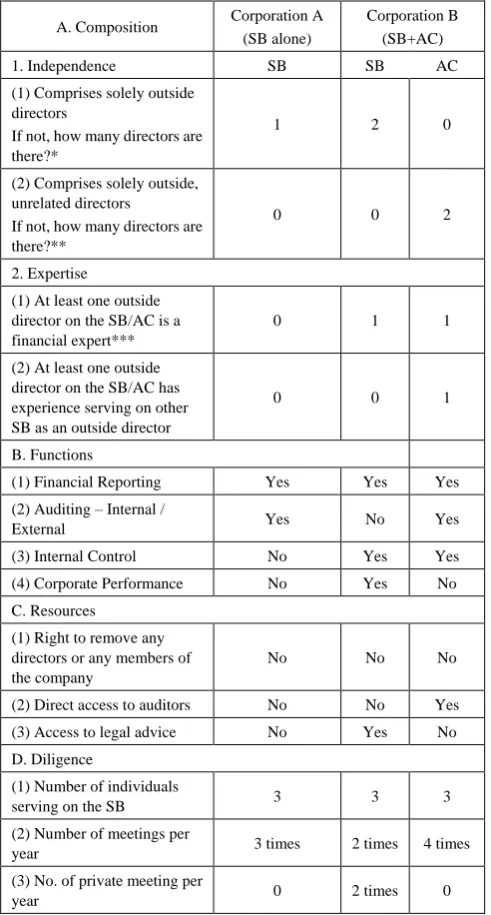
The Table 2 is based on the data provided by the sampled companies and financial statements.
Table 2. SB and AC Features of the Sampled Corporations (Source: Author)
A. Composition Corporation A
(SB alone)
Corporation B (SB+AC)
1. Independence SB SB AC
(1) Comprises solely outside directors
If not, how many directors are there?*
1 2 0
(2) Comprises solely outside, unrelated directors If not, how many directors are there?**
0 0 2
2. Expertise
(1) At least one outside director on the SB/AC is a financial expert***
0 1 1
(2) At least one outside director on the SB/AC has experience serving on other SB as an outside director
0 0 1
B. Functions
(1) Financial Reporting Yes Yes Yes
(2) Auditing – Internal /
External Yes No Yes
(3) Internal Control No Yes Yes
(4) Corporate Performance No Yes No
C. Resources
(1) Right to remove any directors or any members of the company
No No No
(2) Direct access to auditors No No Yes
(3) Access to legal advice No Yes No
D. Diligence
(1) Number of individuals
serving on the SB 3 3 3
(2) Number of meetings per
year 3 times 2 times 4 times
(3) No. of private meeting per
year 0 2 times 0
*An external director is a director who is not “an officer or employee of the corporation or any of its affiliates”.
**An unrelated director “is a director who is independent of management and is free from any business or other relationship which could, or could reasonably be perceived to, materially interfere with the director’s ability to act with a view to the best interests of the corporation, other than interests and relationships arising from shareholding”.
***A member is classified as a financial expert when she or he holds a professional certification in accounting or in financial analysis, or when she or he has experience in finance or accounting.
Case A (SB alone):
(A) Composition: (1) Independence: This case has one outside supervisor who is not an officer or employee of the corporation or any of its affiliates in the SB; yet none of
the SB members of the company is independent, i.e. the SB comprises zero unrelated outsiders as members. (2) Expertise: This case has no financial expertise exists within the SB.
(B) Functions: this case’s SB is responsible for financial reporting and the internal and external auditing functions without involvement Internal Control and Corporate Performance.
(C) Resources: Formal oversight responsibilities without powers to remove any directors or any members of the company neither direct access to auditors and legal advice.
(D) Diligence: Three members serve and hold over three meeting times per year in this SB. Apart from formal meetings each year, no private meeting occurs in this SB. Case B (SB + AC):
(A) Composition: (1) Independence: All 3 AC members are external directors; two are not officers or employees of the corporation or any of its affiliates. This case has none of the members of the SB is independent, i.e. the SB comprises zero outside and unrelated members. (2) Expertise: This case has 1 member in the SB; 1 director in AC with financial expertise. One outside director in AC of this case has experience serving on other AC as an outside director.
(B) Functions: this case’s SB is responsible for financial reporting; internal control and corporate performance without involvement the internal and external auditing functions. This case’s AC is responsible for financial reporting; internal control and the internal and external auditing without involvement corporate performance. The function overlaps between the SB and the AC in this case including two aspects of financial reporting and internal control.
(C) Resources: (1) Both of the SB and the AC in this case have no right to remove any directors or any members of the company; (2) Only the AC but not the SB of this case can use the resources of the internal and external auditors. Only the SB but not the AC of this case can direct access to legal advice.
(D) Diligence: (1) 3 directors serve in the AC and 3 supervisors in the SB of this case. (2) Over 2 meeting times per year by the SB and 4 times per year by the AC of this case. Apart from formal meetings each year, 2 private meetings occur in the SB and 0 in the AC.
(III) Findings of Two Cases’ Comparison:
both compositions of independence (A.1) and expertise (A.2) and both monitoring processes (B) and their relationships (C) between the SB and the AC in terms of their organizations and functions from the interviews and considerations relating to the study of the regulations and literature are summarized herein:
Compositions: A.1 Independence:
1. The problem of insider control and lack of external independent supervisors: the independence of members of the SB needs to be strengthened by instituting regulations which take into account the interests of the stakeholders of the company, by preventing the members being influenced by insiders, and setting the appropriate of external independent supervisors.
2. The problem of high concentration of shareholdings and lack of independent supervisors: protecting the interests of small and medium shareholders need to be enhanced by stipulating that SB members should be independent supervisors. This would offer a check and balance against the high concentration of shareholdings in listed companies in China.
3. Problems of voting system and lack of independence: greater attention should also be given to the voting system for the election of shareholders representing supervisors, in order to increase the effective voting power of small shareholders and expand the opportunity for their voice to be heard in the SB. 4. Current Chinese regulation only requests that a
majority of AC members are independent. In Case B, two thirds of the AC members are independent, yet Mr. Xu concluded: “I think it would be more in line with the consideration of the independence of the AC if all members would be independent directors.”
Compositions: A.2 Expertise:
1. The requirements for professional expertise among SB members need to be regulated and enforced. Currently the Chinese Company Act requires SBs to examine the company’s finance, but has no requirement for financial or accounting expertise in the membership; this has resulted in boards lacking the competence needed to meet their responsibilities. Hence the Chinese Company Act should be improved by specifying requirements for financial or accounting expertise in the SB.
2. The problem of dual positions of supervisors: restrictions on the number of supervisory positions a person may concurrently occupy would help ensure that each individual’s efforts are concentrated in supervising the company effectively.
3. The party member employee: Due to the existence of company supervisors with political party status but who lack accounting, financial, legal or auditing
expertise, there is a need to reduce the membership based on political party connections.
Both SB Chairmen stress the importance of compliance. Both Chairmen are also legal experts. Mr. Chao views compliance as a foundation, by which management can maintain a tight connection between management and supervision. This may explain why Chinese regulations specifically points out the legal requirement for the composition of the SB: the Code of CG for Listed Companies in China.
Operational Processes
1. There is a need for the rights and responsibilities of members of the SB to be enhanced and their operational procedures to be streamlined. As things stand, members have been unable to properly exercise their supervisory duties due to the lack of a clear definition regarding their authority on executive management. The foundation of effective supervision also lies in having rights of access to information. Having independent and unobstructed rights to supervise and review is crucial in assuring the reliability of the supervisory system. Some crucial areas where existing regulations in the Chinese Company Act should be revised include the following: a. The SB’s powers with respect to the right to propose the appointment and removal of members of the BoD should be increased, subject to approval by shareholders in a general meeting. b. The ability of the shareholders to impose effective
sanctions on SB should be increased, for example through additional regulations on accountability and removal of the collective or individual members whose ineffective oversight or misconduct can cause serious losses to the shareholders.
c. Greater attention should be given to the operational procedures of supervision, for example regarding the standards for audits and the principles of operation for the supervision, such as the annual supervision plan, review methodologies, and the frequency and content of regular actions. 2. The lower limit on the size of a SB is set at three
members by the Chinese Company Act, but the upper limit is set by the company. Hence, there should be a greater role for the General Meetings of Shareholders to determine the size of the board according to the needs of the company’s business.
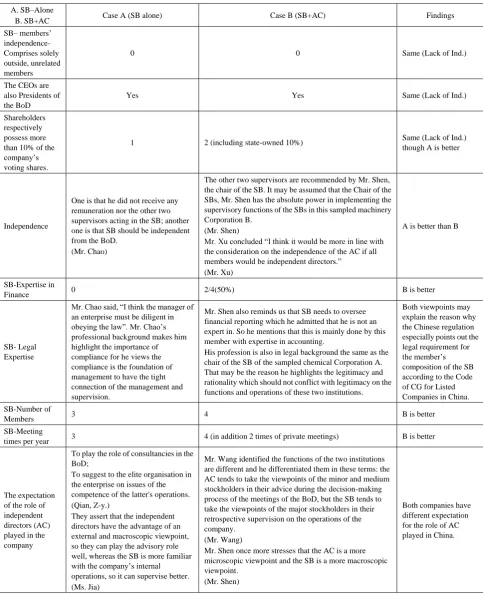
Table 3. Matrix of the Comparison of Case A (system A – SB alone) and Case B (System B – SBs plus ACs) in China (Source: Author)
A. SB–Alone
B. SB+AC Case A (SB alone) Case B (SB+AC) Findings
SB– members’ independence- Comprises solely outside, unrelated members
0 0 Same (Lack of Ind.)
The CEOs are also Presidents of the BoD
Yes Yes Same (Lack of Ind.)
Shareholders respectively possess more than 10% of the company’s voting shares.
1 2 (including state-owned 10%) Same (Lack of Ind.)
though A is better
Independence
One is that he did not receive any remuneration nor the other two supervisors acting in the SB; another one is that SB should be independent from the BoD.
(Mr. Chao)
The other two supervisors are recommended by Mr. Shen, the chair of the SB. It may be assumed that the Chair of the SBs, Mr. Shen has the absolute power in implementing the supervisory functions of the SBs in this sampled machinery Corporation B.
(Mr. Shen)
Mr. Xu concluded “I think it would be more in line with the consideration on the independence of the AC if all members would be independent directors.”
(Mr. Xu)
A is better than B
SB-Expertise in
Finance 0 2/4(50%) B is better
SB- Legal Expertise
Mr. Chao said, “I think the manager of an enterprise must be diligent in obeying the law”. Mr. Chao’s professional background makes him highlight the importance of compliance for he views the compliance is the foundation of management to have the tight connection of the management and supervision.
Mr. Shen also reminds us that SB needs to oversee financial reporting which he admitted that he is not an expert in. So he mentions that this is mainly done by this member with expertise in accounting.
His profession is also in legal background the same as the chair of the SB of the sampled chemical Corporation A. That may be the reason he highlights the legitimacy and rationality which should not conflict with legitimacy on the functions and operations of these two institutions.
Both viewpoints may explain the reason why the Chinese regulation especially points out the legal requirement for the member’s composition of the SB according to the Code of CG for Listed Companies in China. SB-Number of
Members 3 4 B is better
SB-Meeting
times per year 3 4 (in addition 2 times of private meetings) B is better
The expectation of the role of independent directors (AC) played in the company
To play the role of consultancies in the BoD;
To suggest to the elite organisation in the enterprise on issues of the competence of the latter's operations. (Qian, Z-y.)
They assert that the independent directors have the advantage of an external and macroscopic viewpoint, so they can play the advisory role well, whereas the SB is more familiar with the company’s internal operations, so it can supervise better. (Ms. Jia)
Mr. Wang identified the functions of the two institutions are different and he differentiated them in these terms: the AC tends to take the viewpoints of the minor and medium stockholders in their advice during the decision-making process of the meetings of the BoD, but the SB tends to take the viewpoints of the major stockholders in their retrospective supervision on the operations of the company.
(Mr. Wang)
Mr. Shen once more stresses that the AC is a more microscopic viewpoint and the SB is a more macroscopic viewpoint.
(Mr. Shen)
A. SB–Alone
B. SB+AC Case A (SB alone) Case B (SB+AC) Findings
Problems and difficulties of implementing supervisory boards
Case A, both supervisors also identify the weakness as the following: The SB members are “part-timers”, their focus is on their paid works, so they cannot fully dedicate to their supervisory roles.
Independence will be impacted whenever the subject of supervision is the member’s main department, there will be conflict of interest and independence is lost.
Case B, Mr. Wang said the operation of SB is simple and does not operate much since its formation. A meeting of the SB is usually about half an hour without investigating deeply into any problem. He indicates the improvements needed as follows:
It is not a dedicated role of supervisors. Improvement is needed to improve the level of participation. Its
membership should be a dedicated position. Currently, it is overseen by stakeholders, and it is difficult to realise its supervisory function. There is need to enhance professional competence, especially for the stakeholder members, who might not be able to understand financial reports. There is justifiable consideration behind having stakeholder members elected by the union, but there is the issue of independence. Then the supervisory culture of the enterprise needs to be improved, and an environment conducive to proper supervision needs to be formed. Mr. Shen asserts that the weakness of the SB, the financial and management professions of the members of the SB need to be improved to the international standard. Mr. Xu said because the SB has not functioned as expected with three reasons:
Because of the different operations in different countries of direct reporting line among China and the other countries. In China, the BoD does not require the prior approval of the SB for its operations is not like French. He therefore thinks such a difference in corporate structure may have affected the effectiveness of the CG functions. The members of the SB might be wary that they would be shunned by the management and the colleagues if they try too hard. Without the backing of the proper cultural environment, they are powerless in supervision.
The members of the SB mostly take on the role on a part-time basis, so they are reluctant in involving in the actual processes of supervision, so they probably do not really understand the process of supervision, and ended up reviewing the final reports only.
The co-ordination of SB & AC in terms of function and organization is required.
The motivation of setting up ACs is identified.
Motivation for establishing AC
He points out that the existence of the AC in the organisation to reflect the high concern and determination of the top management in implementing the supervisory functions. He intends to take the government’s encouragement by installing ACs because he stresses once more to strengthen the supervisory functions by installing dual supervisory systems at the same time.
(Mr. Chao)
Both supervisors recognise the strength of adopting two institutions simultaneously as the following: This suits the Chinese context and can cater for the spirits of both the Three Old Institutions and the Three New Institutions.
The SB can perform its supervisory function (they are formed by internal staffs and more familiar with the functions).
The AC’s organisational structure can comply with the international supervisory mechanism. (Ms. Bao and Ms. Jia)
Mr. Wang expects the installing of AC can enhance the professional level and independence to compensate the weakness of the SB. He mentioned another reason for his company to install AC. His company has been transformed from full state-owned company to a
semi-state-owned-and-semi-private enterprise, and he recognises it is now under the system of market economy, so he highlights that it is necessary to introduce the AC to fit in the international practice but suit to the specific culture of China with the SB simultaneously. Mr. Shen also expects to utilise the resource of the AC consists of independent directors to bring in new ideas and the benefits of external links to enhance the company. Mr. Xu said the focuses on the installation of AC by starting with the formation of a culture and mindset conducive to its proper operation to distil the sense of importance in the auditing functions and willingness of the colleagues in cooperating with auditing departments in enabling their proper operations.
A. SB–Alone
B. SB+AC Case A (SB alone) Case B (SB+AC) Findings
The
co-ordination of two institutions in implementing supervisory functions.
The operation after forming ACs, they said, “it remains to be seen how these institutions should work together.”
(Ms. Jia and Ms. Bao)
Mr. Shen points out two areas for improvement of co-ordination of two institutions in implementing supervisory functions:
The interaction between the two institutions should collect more regularly the operational information of the company.
Improvements are needed in the understanding of day-to-day operations. Enhancement in this understanding can further pinpoint the source of problems.
Mr. Shen sums up the points to further enhance or perfect supervisory effectiveness and function of SB, first the quality of the members needs to be improved. Secondly, more attentions are needed on the understanding of the process of the operations of the SB. Thirdly, the viewpoint of the SB is somewhat macroscopic; efforts might be needed to deepen and refine its view to be able to identify problems in advance and act as a problem prevention mechanism.
(Mr. Shen)
Mr. Xu identified the ways to improve the implementation of supervisory functions, by improving the level of supervision on the processes and the level of support the company gives to supervision. He views that it is important to instil the mindset throughout the organisation of the importance of supervision and to improve the quality of the auditing staffs and also to correct the current problem that the members do not really strive to perform properly as this is not their main roles in the company. (Mr. Xu)
Case B Mr. Shen highlights that “improvements are needed in the understanding of day-to-day operations. Enhancement in this understanding can further pinpoint the source of problems.
The process of implementation the supervisory functions between two institutions
By attending the meetings of the BoD to listen to their proposals and resolutions.
He also calls for the meeting of the SB once a season over the minimum number of 1 time in every year required by law after the meetings of the BoD.
Besides attending or calling the meetings, he also keeps regular contacts with relevant departments to supervise, therefore, involves physically visiting the relevant departments to investigate on-site. (Mr. Chao)
(1)read the data before each meeting of the BoD to ensure all data on the financial report are correct, (2) audit before submission all quarterly, biannual and annual reports and all other data that need to be submitted, (3) first contact the relevant department before discussing it in our meetings; (4) attend the meetings of the BoD, during which we also make suggestions and ask questions.
(Ms. Bao and Ms. Jia)
Mr. Wang said the operation of SB is simple and does not operate much since its formation. A meeting of the SB is usually about half an hour without investigating deeply into any problem. Currently, The SB supervises mainly by reviewing the reports as the same data available for the BoD before their meetings such as the audit report, the BoD’ report, financial report, and the assessment of the performance of the higher management, followed by oral enquiries if necessary. Then the meetings of SB are held after the meetings of the BoD rather than before. Mr. Wang identified the areas for improvement in the current supervisory system by the following points: (Mr. Wang)
Furthermore, he points out the key functions of supervising the SB (1) the resolutions by the BoD after the General Assembly Meeting; (2) Supervising of the making of major decisions by the BoD; (3) Supervising the compliance level of legitimacy of the conducts of the BoD and the higher management, supervised by the members of the SB. (Mr. Shen)
He points this is because the SB mainly supervises the BoD, and the BoD is the main decision-making institution. So he attends every meeting of the BoD.
(Mr. Shen)
A. SB–Alone
B. SB+AC Case A (SB alone) Case B (SB+AC) Findings
The weakness are identified as the following: It is not a dedicated role of supervisors. Improvement is needed to improve the level of participation. Its
membership should be a dedicated position. Currently, it is overseen by stakeholders, and it is difficult to realise its supervisory function.
There is need to enhance professional competence, especially for the stakeholder members, who might not be able to understand financial reports.
There is justifiable consideration behind having stakeholder members elected by the union, but there is the issue of independence.
Then the supervisory culture of the enterprise needs to be improved, and an environment conducive to proper supervision needs to be formed.
(Mr. Wang)
Mr. Shen asserts that the weakness of the SB, the financial and management professions of the members of the SB need to be improved to the international standard. because the SB has not functioned as expected with three reasons:
Because of the different operations in different countries of direct reporting line among China and the other countries. In China, the BoD does not require the prior approval of the SB for its operations is not like French. He therefore thinks such a difference in corporate structure may have affected the effectiveness of the CG functions.
The members of the SB might be wary that they would be shunned by the management and the colleagues if they try too hard. Without the backing of the proper cultural environment, they are powerless in supervision. The members of the SB mostly take on the role on a part-time basis, so they are reluctant in involving themselves in the actual processes of supervision, and probably do not really understand the process of supervision, and ended up reviewing the final reports only. (Mr. Xu)
Mr. Wang expects the installation of AC to enhance professionalism and independence to compensate for the weakness of the SB. He mentioned another reason for his company to install AC. His company has been transformed from full state-owned company to a
semi-state-owned-and-semi-private enterprise, and he recognises it is now under the system of market economy, so the highlights that it is necessary to introduce the AC to fit in the international practice but suit to the specific culture of China with the SB simultaneously. (Mr. Wang)
He also expects to utilise the resource of the AC consists of independent directors to bring in new ideas and the benefits of external links to enhance the company.
(Mr. Shen)
Mr. Xu said the focuses on the installation of AC by starting with the formation of a culture and mindset conducive to its proper operation to distil the sense of importance in the auditing functions and willingness of the colleagues in cooperating with auditing departments in enabling their proper operations.
Relationships
Organizations: Companies after implementing ACs may face issues of co-coordinating them with SBs. Mr. Shih thinks that ACs are stronger than SBs, and he also referred to some scholars’ suggestion of “abolishing” SBs. But Mr. Xu asserted that a vertically integrated system would be a better idea. Opinions on the co-ordination of the two supervisory institutions differ among the interviewees and the scholars. Understanding the co-ordination between SBs and ACs therefore should be set as further research objective to research the linkage in the hierarchy on the preference for the interaction linkage between the SB and the AC and related parties. Both listed companies have higher expectations of the effective performance of AC as part of the internal supervisory mechanism and both may have lost their confidence in the effectiveness of SB in China, and therefore, they do not expect that SB can lead AC in improving the effective performance of supervision in the future. Integration is based on the belief that it can be beneficial in reducing lack of independence, the most serious problem impacting upon the effective performance of supervision of CG in China, and can also solve hierarchical reporting problems of the internal supervisory mechanism of all the institutions in one organization. In this way, integration may bring about a positive co-ordination of their functions, to reduce costs and improve the effectiveness of the internal supervisory mechanism. Integrating all in one of combining AC, SB and Internal Audit in one entity; or promoting the AC; or establishing a vertical link allowing AC report to SB directly which may be the best preference to improve the effectiveness of monitoring functions between these two different institutions of internal supervisory mechanism calls for further researches.
Functions: Given the phenomena of functional overlapping and missing operations, it becomes pertinent to redefine their functions on the basis of division of work in order to promote mutual co-ordination between the SB and the AC. Their functions should be complementary. The two institutions have different requirements for members’ independence, professional literacy and working time. These different characteristics should be considered when allocating their functions because the members’ independence and professional knowledge structure will undoubtedly influence the quality of their monitoring function, while the members’ working time and meeting frequency will influence their participation in, and dedication to, monitoring progress. Both responses indicate an expectation of co-ordinating both institutions’ functions as much as it reflects the request for establishing an independent control system to strengthen oversight functions, save oversight costs, enable the supervisors and members of the ACs to execute oversight tasks by avoiding the potential problem of independence, and empower them against the directors and senior managers by establishing a protection system regarding their promotion in status.
5. Conclusions
Appendices Interview Transcripts
Case A (SB alone):
The general secretary of the BoD is co-ordinated the individual interview meetings with members of the SB. Mr. Qian introduced his company to the author before progressing into the individual interview, as transcribed below.
A.1 Interview with Secretary of the BoD of the sampled Co., Ltd., Hangzhou. [Video recording in possession of author]
A.1.1. What are the roles of the independent directors in your company?
The independent directors play the role of consultancies in the BoD. They have the responsibility of professional supervision. First, they have the right to suggest to the elite organization in the enterprise on issues of the competence of the latter's operations. Secondly, they can indicate the level of operations of the elite organization in comparison with its rivals. Since independent directors are external to the organization, it is possible to expect them to play the role of supervising the supervisors internal to the organization.
The conversation with Mr. Qian provides a background on this company’s cultural integration from being state- owned to being privately owned, and from the spirit of a party run enterprise to that of a private enterprise. His personal viewpoints on the role of the independent directors naturally lead to curiosity regarding the implementation of supervisory functions in this case. The first interviewee, the Chair of the SB is then introduced as follows:
A.2. Interview with Mr. Zhao, Chair of the SB of the Sampled Co., Ltd., Hangzhou. [Video recording in possession of author]
A.2.1. What are your opinions on the supervisory system since its introduction in 1993?
It is very important to have an independent supervisory system. It is especially so for our company. Since its flotation, the expectation from our investors has grown steadily as we improve the execution of the supervisory system in our company year on year. There is first the SB and then the independent directors in the Chinese system. Since I first served on the SB, I have been neither a stockholder nor a beneficiary of the company. I do not receive supervisory fees on top of my salary for my post company. The other members of the SB are employees, and they do not receive any payment in addition to their respective salary except an annual traffic expense of RMB 5,000. It is stressed that the BoD and the SB should operate independently. It is the responsibility of the SB to independently supervise the BoD, so it should not be led by the latter. Though my speciality is in law (rather than finance or accounting), there are several finance and accounting professionals in the auditing department of the company, and all public financial reports and information have all been audited by the external auditor before their submission. The external audits are provided by
the Tianjian Accounting Ltd. A.2.2. How does the SB operate?
The SB holds the internal supervisory meeting before the meeting of BoD. I personally review the managerial report of the BoD before their meeting. I attend about 6 to 8 meetings every year. These include the meetings of both the BoD and the SB. The main purpose of attending the meetings of the BoD is to listen to their proposals and resolutions. I call for the meeting of the SB once a season. The minimum number of such meetings every year required by law is two, and these are usually held after the meetings of the BoD in other companies. I also keep regular contacts with relevant departments because problems cannot all be identified by merely reviewing financial data, as demonstrated by the Enron scandal. To supervise, therefore, involves physically visiting relevant department such as the financial and auditing departments to investigate on site. The auditing department is utilised heavily. The auditing of the financial reports is solely handled by the external auditor, whereas the main responsibility of the auditing department is to alert the SB of potential problems and perform necessary investigation. This is because the supervisory function of the SB should act as the radar system in the company that can detect problem in advance to prevent its occurrence and damages to the company. It is important to allow flexibility in the power of management within the confine of the law, but the SB should, like a radar system, sound the alarm and request control whenever the boundary is crossed. In short, the SB should perform its function of prevention.
A.2.3. What are the foci of the SB’s supervision over the financial reports, auditing reports and internal control?
These are truthfulness, the analysis of the rationality of data, and the proper operations of the SB. The reports of the SB are signed by the Chair of the SB before its submission.
A.2.4. What is your view on acting as a member of the SB?
It is a matter of organizational culture. The culture of our company stress “sincerity, innovation and development,” so we are not afraid to identify problems. As our MD says, “it is our wisdom to identify problems, it is our attitude to face problems, it is our virtue to acknowledge problems, and it is our responsibility to solve problems.” By the end of this month, he is to hold a meeting asking every department to identify problems. This enterprise cannot develop if problems are not identified. Even though the company has been around for a long time and the SB has been installed for quite a while, the purpose that the MD appoints me to serve on the SB is to identify problems to prevent these causing damages to the company.
A.2.5. Why do you want to install the AC?
A.2.6. Once the AC is installed, will there be organizational or functional overlap with the SB?
There will not be any organizational overlap, as the AC is under the BoD whereas the SB is a peer of the BoD. The installation of the AC will only let the auditing function be valued more and make the operations more transparent, thus making it easier to identify problems, by utilizing the supervision of the public departments. Furthermore, as our enterprise grows and expands, there has to be an auditing department in each company and it is definitely necessary to have an AC in the umbrella company. As to the issue of functional overlap, the focus of the AC is on internal audit, whereas that of the SB is on the BoD.
A.2.7. Do you think there is any space for improvement in the current supervisory mechanism?
This is the focus of the government. There are cases of falsification all over the world. False reporting should be severely punished.
A.3. Interview with Mr. Bao, and Ms. Jia, two members of the SB of the Sampled Co., Ltd., Hangzhou. [Video recording in possession of author]
A.3.1. As your company is forming the AC, there will soon be both the SB and the AC in your company. Do you think these two institutions will have similar or identical characteristics?
Bao: (The adoption of these two institutions is) adapted to the Chinese context, the functions and powers of these two institutions are different, and these will be clearly stated in the constitution of the company.
A.3.2. Do you think it is necessary to form the AC? Jia: Judging from the specifications in the regulations, I feel there will be overlaps between the responsibilities and powers of the AC and the SB, but I personally think that the members that form these institutions will be different. The members of the SB are internal representatives of employees, so they know about the situation of internal management better. The members of the AC are external independent directors, who have more involvement with external roles, and consequently have a better, more macroscopic view of the external environment, but they may not be as familiar with internal operations as the SB members. Thus, the existence of the AC can enhance the SB’s understanding of the external economic and supervisory environment. Therefore, I think the two institutions can be complementary to each other and work together to improve the supervisory mechanism.
A.3.3. In your opinion, once the AC is formed, how should the functions of the two institutions be distributed in practice?
Due to the different types of members forming the two institutions, the SB that is formed by internal staff should be responsible for the supervision of internal matters, whereas the AC that is formed by external independent directors could engage in the collection of external development
related data for the development of the supervisory function. External independent directors engage in investigation only under special circumstances. Thus one works from without, one from within, with proper communication between them; the two institutions can complement each other in the supervision of the company.
A.3.4. The AC and the SB are at different positions in the organizational structure. How should these two institutions interact with each other?
The BoD, leading the whole management team, is responsible of the practical running of the business. The AC is under the BoD, and is responsible of assisting the BoD to confirm with laws and regulations. It can supervise before a decision/resolution is made by the BoD. It can also supervise during the operations, such as overseeing if the management is operating according to the decision/resolution of the BoD, or if the reporting confirm to the requirements of the laws and regulations. The SB is of equal rank with the BoD. It remains to be seen how these two institutions should interact with each other in organisation.
A.3.5. What is the SB’s role in regards to supervising the financial report, the audit report and internal control?
There are many regulations about the financial report, the audit report and internal control of a listed company. It is essential to comply with the regulations. We have to keep up with the pace of innovation in order to progress.
A.3.6. How does the SB of your company work?
Jia: According to the responsibilities specified in the Company Act and the company’s constitution, we must read the data before each meeting of the BoD to ensure all data on the financial report are correct. We also audit before submission all quarterly, biannual and annual reports and all other data that need to be submitted. In case of any problem, we will first contact the relevant department before discussing it in our meetings. We meet at least three or four times. Each meeting lasts at least three hours. We check if the data reflects the actual situation of the company, make resolutions, and then submit the findings. In addition to holding SB meetings, we also attend the meetings of the BoD, during which we also make suggestions and ask questions.
A.3.7. What do you think are the strengths and weaknesses of the current SB of your company?
been the Three Old Institutions and the Three New Institutions in the Chinese system. The Three New Institutions are the General Assembly Meeting, the BoD and the SB, whereas the Three Old Institutions in state-owned enterprises are Party Officers’ Committee, the Union and the Stakeholders’ Representatives’ Committee. Now there is the problem of bridging the Three Old Institutions and the Three New Institutions. The elected representatives are responsible to the stockholders and the stakeholders; they are supposed to take their responsibilities seriously even though there is no additional financial reward for taking up these responsibilities. Hence, the strength is that the SB members are elected. Whoever does not perform well will not be elected again next time. First, this suits the Chinese context and can cater for the spirits of both the Three Old Institutions and the Three New Institutions. Secondly, as it is mandatory to have the SB, it can perform its supervisory function. Furthermore, now that the company is to form the AC, so its organisational structure can comply with the international supervisory mechanism. The weakness is that all the SB members are “part-timers”. Their focus is on their paid works, so they cannot fully dedicate to their supervisory roles. After all, there are limits to one’s energy. If the supervisory role is a full-time paid position, the performance of the supervisory function can be expected to be better. Moreover, whenever the subject of supervision is the member’s main department, there will be conflict of interest and independence is lost. For instance, Ms. Jia is responsible of internal audit department, so she loses his supervisory independence whenever the SB needs to supervise the internal audit department.
A.3.8. How do you think the supervisory function will be improved?
Once the AC is formed with independent directors in addition to the SB, the independent directors have the advantage of having an external and macroscopic viewpoint, so they can play the advisory role well, whereas the SB is more familiar with the company’s internal operations, so it can supervise better. The co-operation between them will enhance the supervisory function.
A.3.9. How do you think can the supervisory function be executed in the current Chinese context?
It is about the Three Old Institutions and the Three New Institutions. In the days of the state owned enterprises, the supervisory function was not realised in practice. After enterprise renovation, state owned enterprises are restructured to become private enterprises or even listed companies. The Three new Institutions are formed in addition to the Three Old Institutions. The BoD focuses on the development of the enterprise. The SB focuses the supervisory function. The existence of the SB itself makes a difference. Its existence represents the emphasis on the supervisory function. The SB has to perform its expected supervisory function in supervising the BoD and the higher management in any case. Furthermore, if the position of the SB in the organisational structure can enable it to perform its
functions, its independence can help it perform better. Moreover, if it can evaluate operations during the audit process, this involvement can avoid the sense of powerless to correct existing problems that comes with retrospective audit. If the problem of having dedicated positions can be rectified, the supervisory personals can then dedicate more of their energy in the work of supervision. Experts can be appointed to help wherever there is lack of expertise. The dedication of the supervisory position and the enhancement of professional competence will be conducive to the performance of the supervisory mechanism.
A.3.10. What is the motivation behind the forming of the AC?
It is the emphasis on legitimacy. It is necessary to operate according to the regulations. It is obvious that such operations are good for the company.
A.3.11. How, after its formation, should the AC interact with the internal audit department?
The positions in the internal audit department are dedicated paid positions. The AC is led by the independent directors, whereas the SB is independent to the BoD. Once the AC is formed, hierarchically, the internal audit department will work under the AC; functionally, it remains to be seen how these institutions should work together.
Case B (SB + AC):
The general secretary of the BoD arranged the interview between author and interviewees. Before conducting the interviews with the supervisors and the members of the AC, Mr. Wang was interviewed as follows:
B.1.1. Please describe the AC of your company.
It works under the BoD. According to the constitutions of the company, it audits the operations of the whole company and the performance of the higher management. Its goal on financial audit is the same as that of the SB.
B.1.2. Since the goals of the AC and the SB are the same, is there overlap between their functions? Has there been any consideration on the cost of supervision? How do they share the workload of supervision?