© 2018 IJSRST | Volume 4 | Issue 2 | Print ISSN: 2395-6011 | Online ISSN: 2395-602X Themed Section: Science and Technology
Influence of the Topical Application Acetone Solution of Vitamin A (Retinol)
to the Fifth Instar Larvae of the Silkworm,
Bombyx mori
(L) (Race : PM x
CSR2) on the Economic Parameters
Manali R. Shinde1, Shrutika L. Salunkhe2, Shubhangi S. Pawar3, Vitthalrao B. Khyade4*
Department of Zoology, Shardabai Pawar Mahila Mahavidyalaya, Shardanagar; Tal. Baramati, Dist. Pune, Maharastra, India
ABSTRACT
The attempt concerned with efficient topical application of acetone solution of Vitamin A (retinol) to the fifth instar larvae of multivoltine silkworm, Bombyx mori (L) (Race: PM x CSR2) and assessment of economic parameters. The experimentatio was carried at laboratory level. The ten microliters of one milligram per liter strength acetone solution of retinol was topically applied to the individual fifth instar larvae of multivoltine cross breed race of silkworm, Bombyx mori ( L ) ( PM x CSR2) variously at 48, 54, 60 and 66 hours after the fourth moult. Topical application of acetone solution of retinol was found variously reflected into prolongation of larval age (14 - 39 %); improvement in the tissue somatic index (TSI) of silk glands (3.06 - 3.343); cocoon shell ratio (2.790 - 3.177) and denier scale of silk filament (p< 0.01). Topical application of acetone solution of retinol, thus chiefly lengthen the larval age in silkworm, Bombyx mori (L). Time required for eating and amount of mulberry leaves eaten had both been increased and they were practically reflected into the improvement in the quality of cocoon and the silk filament. Diterpenoid nature of retinol and delay in the spinning among the larvae, recipient of retinol in the attempt indicate the possibility of insect juvenoid activity of retinol in silkworm, Bombyx mori (L). Efficient utilization of retinol, the diterpenoid through acetone solvent for topical application to the fifth instared larvae of silkworm, Bombyx mori (L) may open a new biotechnological avenue in the sericulture industries.
Keywords : Retinol, TSI, Shell Ratio, Denier Scale of Silk Filament.
I.
INTRODUCTION
Vitamins are the organic compounds required by
organism a a vital nutrient in limited amounts.
Supplementation of vitamins serve to orchestrate
the metabolism. The larvae of silkworm, Bombyx
mori (L) deserve appreciation for synthesis of silk
for it’s metamorphosis. Sericultural practices are
serving a lot to provide the silk fibre. The silkworm,
Bombyx mori
(L) exert a significant influence on
the concept of insect metamorphosis through it’s
simple life cycle and efficient utilization of the
nutrients from the mulberry,
Morus alba
(L).
Interplay of juvenile hormone and moulting
Agui, 1981 ). Juvenoids are well known in
prolonging the larval life in the insect and have long
been tried for qualitative improvement of silk
( Ratnasen, 1988; Granier and Granier,1983 and
Mamatha et al, 1999 ). There is considerable
evidence that juvenile hormone mimics occur in
plants, which occasionally leads to economically
important consequences in the insect development
( Slama, 1979 ). Juvenile hormone active
compounds are found in many higher plants,
exogenous application through suitable solvents of
which exhibited potent activity in the insects
( Prabhu and John, 1975 ). Efficient use of available
system, the principle of quality improvement made
man to use juvenoids for pest control as well as for
the silk yield. Use of juvenoids (synthetic, plant
derived and animal derived ) in the rearing of
silkworm larvae had positive influence, especially
in the silk yield ( Ching et al, 1972; Nihmura et al,
1972 ; Muroga et al, 1975; Kamada and Shimada,
1988 ; Rajashekhargouda, 1991 ; Vitthalrao et al,
2002, 2003 and Vitthalrao, 2004 )
Retinoic acid and insect juvenile hormone (JH) are
structurally
related
terpenoids,
which
are
widespread in nature and are involved in much
more biological activities including morphogenesis ,
embryogenesis and cellular differentiation. The
retinol is a diterpenoid, a terpenoid derived from a
diterpene, which include the compounds with C20
skeleton of the parent diterpene, which has been
rearranged or modified by the removal of one or
more skeletal atoms ( generally, methyl groups)
( The retinoids deserve important role in the
process of morphogenesis and in immune response
in the insects like R. prolixus, suggesting that the
molecular mechanism recognize the terpenoid
backbone as one of the important structural
determinant
in
insects
(
CHEBI:
23849
http://www.ebi.ac.uk/chebi/searchId.do?chebiId=C
HEBI:23849 ) Angelica Nakamura, et al , 2007).
Terpenoid hormones seems to act as the
morphogens
throughout
the
metazoan.
The
regulatory activities of terpenoid hormones range
from
controlling
metamorphosis
in
insects
( Riddiford and Ashburner, 1990) and to determine
the germ cell fate in the mammalians (Bowels, et
al , 2006). In the metamorphosis, the interplay of
the juvenile hormone and ecdysone serve to
orchestrate the progression from one instar to the
next, with ecdyosteroid regulating the onset and
timing of the moult and JH determining whether the
moult would be larval - larval or larval - pupal
(Gilbert, et al , 1996; Mamatha, et al , 2005).
Phytophagous insects like silkworm,
Bombyx mori
(L) derive their juvenoid nutrients through the plant
material available for them (Khyade, et al , 2007).
Retinol like vitamin nutrients may either be
synthesized by the insect tissue or derived from the
plant material. Nutrition with vitamins is playing
important role in the improvement of growth and
development in silkworm,
Bombyx mori
(L).
II.
METHODS AND MATERIAL
All the facilities at the Sericulture Farm of
Agriculture Development Trust, Baramati were
utilized for the experimentations. The entire
attempt was divided into the parts, which include:
Rearing of the silkworm larvae; Topical
application of retinol through the acetone
solution to the fifth instar larvae; Analysis of
parameters (Larval, cocoon and silk filament) and
Statistical analysis of the data. The larvae of
silkworm belongs to polyvoltine cross breed ( PM
x CSR
2) race were reared in the laboratory
through standard methods ( Krishnaswami
et al,
1978 ). The vitamin A , retinol was procured from
through dealer. One mg of retinol was dissolved
in the acetone and the stock solution of one ppm
was prepared. Soon after fourth moult, the fifth
instared larvae were grouped into one control
group; one acetone treated group and four
experimental groups, each with hundred
individuals. Ten microliters of acetone solution
of retinol was used for topical application to the
individual larva in each group separately (Table -
1). The experimental group: “A” received the
topical application of retinol at 48 hours after the
fourth moult. The experimental group: “B”
received the topical application of retinol at 48
and 54 hours after the fourth moult. The
experimental group: “C” received the topical
application of retinol at 48; 54 and 60 hours after
the fourth moult. And the experimental group:
“D” received the topical application of retinol at
48; 54; 60 and 66 hours after the fourth moult.
The tender mulberry leaves were soaked
separately in each stock solution of digoxin ( at
the rate of 100 gm leaves in 400 ml stock solution )
for half an hour. Topical application was followed
by feeding the larvae with tender mulberry leaves.
The schedule of feeding was 100 gms of mulberry
leaves for each time ( 48, 54, 60, 66 hours after
the fourth moult ) for each group of 100 larvae.
Acetone treated control and untreated control
groups of larvae were also maintained.
Daily larval weight was recorded. For the purpose
to calculate tissue somatic index ( TSI ) of silk
glands, ten larvae from each group were selected
at random on the fifth day, anesthetized,
dissected and silk glands were separated. The silk
glands were bottled and weighed on electronic
balance. The weight of silk glands was divided by
weight of larva. The quotient thus obtained was
multiplied by 100. Weight of silk glands and
larval body weight, thus, were accounted for the
calculation of tissue somatic index ( TSI ) of silk
glands.
the mean, standard deviation, percent variation
and student “t” - test ( Norman and Bailey, 1955).
The data collected belongs to three successive
trials.
III.
RESULTS AND DISCUSSION
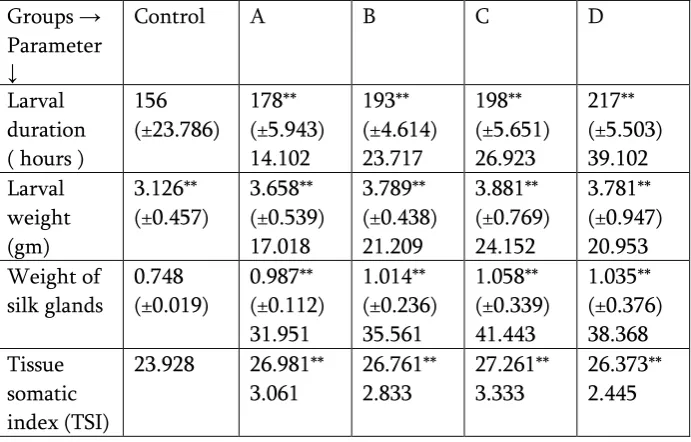
The larval parameters get reflects on the quality of the cocoon and silk fibre. Extension of fifth instar larval period was observed in groups of larvae topically applied with one ppm acetone solution of retinol. The extension of fifth instar larval period was 14 - 39 % in all the treated groups of larvae. Maximum increase in the larval duration was recorded in larvae received four times ( at 48, 54, 60 and 66 hours after the fourth moult) the topical application of retinol. Corresponding to the extension in the larval duration, an increase in the larval growth by the body weight (17-24%) was observed in all the treated groups. Tissue somatic index ( TSI ) signify the percentage of tissue in entire body. Tissue somatic index ( TSI ) of the silk glands of treated larvae in the percent study was found significantly increased. Treating the larvae with one ppm retinol solution through acetone at 48, 54, 60 and 66 hours after fourth moult was found variously reflected into most significant improvement in the TSI of silk glands ( table 2).
The economic parameter in sericulture is the Cocoon spinned by the mature fifth instar larvae of silkworm, Bombyx mori (L). Cocoon is the most important aspect in sericulture as it is used for reeling the commercial silk fibre. Cocoon weight, shell weight and thereby the shell ratio were found influenced by the topical application of acetone solution of retinol to the fifth instar larvae of silkworm, Bombyx mori (L). The range of percent increase in the cocoon weight and shell weight in the experimental (treated) groups was 42.911 to 50.268 and 66.565 to 77.243 respectively. Shell ratio of the cocoons was found improved in the corresponding groups of treatment. Most significant ( p < 0.001 ) shell ratio belonged to cocoons harvested from the group of larvae treated with one ppm
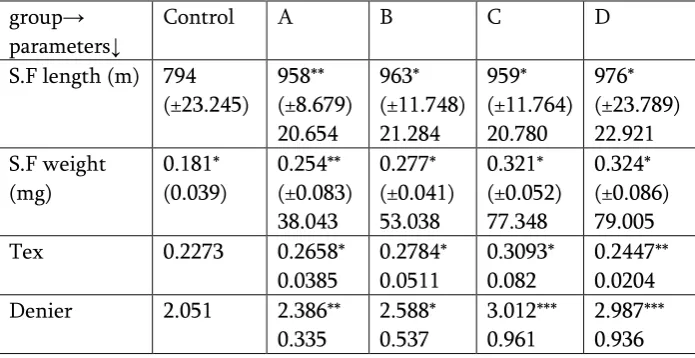
acetone solution of retinol at 48 hours after the fourth moult. Silk filament is sole aim in sericulture. Length and weight of entire silk filament are the qualitative measurements to be accounted for the Tex and Denier scale. Both the parameters ( Tex and Denier ) of silk filament were found influenced through treating the larvae with retinol solution ( one ppm ). The retinol through acetone was found resulted into fortified silk filament, with reference to Tex and Denier scale. The silk reeled from the cocoons belong to the group C and D ( Table 4 ) were exhibited most significant improvement.
acetone for rearing of silkworm larvae is much more easy method. Use of vitamins like retinol may open a
new avenue in sericulture for the qualitative cocoon and silk filament.
Table 1 : Schedule of topical application of acetone solution ( ten microliteres of one ppm ) of retinol to the fifth instar larvae of silkworm, Bombyx mori (L).
Hours after IV moult→ group↓
48 54 60 66
Control - - - -
A + - - -
B + + - -
C + + + -
D + + + +
+ indicates topical application of ten microliters of one ppm solution of acetone to individual larvae of silkworm, Bombyx mori (L).
- Indicates No Treatment.
Table 2 : Effect of Retinol on the larval parameters of silkworm, Bombyx mori (L) ( Race : PM x CSR2 ).
Groups → Parameter ↓
Control A B C D
Larval duration ( hours )
156 (±23.786)
178** (±5.943) 14.102
193** (±4.614) 23.717
198** (±5.651) 26.923
217** (±5.503) 39.102 Larval
weight (gm)
3.126** (±0.457)
3.658** (±0.539) 17.018
3.789** (±0.438) 21.209
3.881** (±0.769) 24.152
3.781** (±0.947) 20.953 Weight of
silk glands
0.748 (±0.019)
0.987** (±0.112) 31.951
1.014** (±0.236) 35.561
1.058** (±0.339) 41.443
1.035** (±0.376) 38.368 Tissue
somatic index (TSI)
23.928 26.981** 3.061
26.761** 2.833
27.261** 3.333
26.373** 2.445
Each figure is the mean of the three replications.
Figure with ± sign in the bracket is standard deviation.
Figure below the standard deviation is the increase for calculated parameter and percent increase for the others over the control.
Table 3 : effect of Retinol on the cocoon parameters of silkworm, Bombyx mori (L) ( Race : PM x CSR2 ).
groups→ parameters↓
Control A B C D
Cocoon weight (gm) 1.856** (±0.273) 2.671** (±0.445) 43.911 2.694** (±0.786) 45.150 2.716** (±0.643) 46.336 2.789** (±0.671) 50.269 Shell weight (mg) 0.329 (±0.078) 0.548*** (±0.102) 66.565 0.553** (±0.181) 68.085 0.571* (±0.187) 73.556 0.583* (±0.105) 77.203 Pupal weight (mg) 1.527 (±0.093) 2.123** (±0.864) 39.030 2.141** (±0.786) 40.209 2.145* (±0.654) 40.471 2.206* (±0.467) 44.466 Shell ratio 17.726 20.516***
2.790 20.527** 2.801 21.023* 3.297 20.903* 3.177
Each figure is the mean of the three replications.
Figure with ± sign in the bracket is standard deviation.
Figure below the standard deviation is the increase for calculated parameter and percent increase for the others over the control.
* - P < 0.05 ** - P < 0.005 *** - P < 0.01
Table 4 : Effect of Retinol on the silk filament parameters in silkworm, Bombyx mori (L) ( Race : PM x CSR2 )
group→ parameters↓
Control A B C D
S.F length (m) 794 (±23.245) 958** (±8.679) 20.654 963* (±11.748) 21.284 959* (±11.764) 20.780 976* (±23.789) 22.921 S.F weight (mg) 0.181* (0.039) 0.254** (±0.083) 38.043 0.277* (±0.041) 53.038 0.321* (±0.052) 77.348 0.324* (±0.086) 79.005
Tex 0.2273 0.2658*
0.0385 0.2784* 0.0511 0.3093* 0.082 0.2447** 0.0204
Denier 2.051 2.386**
0.335 2.588* 0.537 3.012*** 0.961 2.987*** 0.936
Each figure is the mean of the three replications.
Figure with ± sign in the bracket is standard deviation.
Figure below the standard deviation is the increase for calculated parameter and percent increase for the others over the control.
IV.
Acknowledgement
Authors are highly grateful to Agriculture Development Trust, Shardanagar (Baramati) for valuable help, providing facilities at the sericulture unit of Malegaon sheti farm & laboratory facilities at Shardabai Pawar Mahila College to carry out the experimentations.
V.
CONCLUSION
The proposed payment system combines the Iris recognition with the visual cryptography by which customer data privacy can be obtained and prevents theft through phishing attack [8]. This method provides best for legitimate user identification. This method can also be implemented in computers using external iris recognition devices.
VI.
REFERENCES
[1]. Angelica Nakamura; Renata Stiebler; Marcelo R Fantappié; Eliane Fialho; Hatisaburo Masuda and Marcus F Oliveira (2007). Effects of retinoids and
juvenoids on moult and on phenoloxidase activity in the blood-sucking insect, Rhodnius prolixus (L). Acta
Trop. 2007 Jul 1;: 17686447 Cit:1
http://lib.bioinfo.pl/paper:17686447.
[2]. Riddiford, L. M. and Ashburner, M. (1990). Role of Juvenile hormone in larval development and metamorphosis in Drosophila melanogaster (L). Comparative Endocrinology. 82: 172-183.
[3]. Bowles, J. ; Knight, D. ; Wihlem, D. ; Richman, J. ; Mamiya, S. ; Yashiro, K. ; Chawengsaksphak, K. ; Wilson, M. J. ; Rossant, J. ; Hamada, H. and Koopman, P. (2006). Retinoid signaling determines germ cell fate in mice. Science 312: 596 - 600.
[4]. Ying, H. Wang ; Guirong Wang and Gerold A. LeBlanc (2006). Cloning and characterization of the retinoid X receptor from a primitive crustacean, Daphnia magna (L). General and Comparative Endocrinology. 150: 309 - 318. www.sciencedirect.com and www.elsevier.com/Locate/ygcen
[5]. Akai, H. and Kobayashi, M. (1971). Introduction of prolonged larval instar by juvenile hormone in Bombyxmori(L) ( Lepidoptera : bombycidae ). Appl. Entemol. Zool, 6: 1938 - 1939.
[7]. Ching, F.C; Mukakeshi, S. and Tamura,S. (1972). Giant cocoon formation in the silkworm, Bombyxmori (L) treated with methyloneoxyphenyl derivatives. Agar. Biol. Chem. 36: 692-694.
[8]. Granier and Granier (1938). Fenoxycarb, a fairly new growth regulator: A review of its effects on insects. Ann. Appl. Biol. 122: 369-403.
[9]. Kamada, A. and Shimada, S. (1988). Effects of methoprene on growth profile of larval organs of silkworm, Bombyxmori (L). Jornal of sericulture science, Jpn. 48 (2): 129-136.
[10]. Khyade V.B. (2004). Influence of juvenoids on silkworm, Bombyxmori (L). Ph.D thesis, Shivaji University, Kolhapur. ( Maharashtra, India ).
[11]. Kiguchi, K. and Augi, N. (1981). Ecdysteroid level and development events during larval moulting in silkworm, Bombyxmori (L). insect physiol. 26: 805-813.
[12]. Krishnaswami, S.; Narimhan, N.; Suryanarayana, S.K and Kumararaja, S. (1978). Manual on sericulture, vol. 2: silkworm rearing, FAO publication, agricultural services bulletin no. 15.
[13]. Mamatha, D.N; Nagalalakhamma, K.; Vijay, P. and RajeshwaraRao, A.M. (1999). Impact of selected juvenile hormone mimics on organic constituents of silkworm, Bombyxmori (L). proceedings of NSTS- 99: 185-186.
[14]. Muroga , A.; Nakajima, M.; Aomori,S.; Ozawa, Y. and Nihmura, M. (1975). Utilization of synthetic juvenile hormone analogue for the silkworm rearing on the mulberry leaves. J. Sreic. Sci. Jpn. 44: 267-273. [15]. Nihmura, M.; Aomori,S.; Mori, K. and Matusui, M.
(1972). Utilization of synthetic compounds with juvenile hormone activity for silkworm rearing. Agri. Biol. Chem. 36: 882-889.
[16]. Normn, T.J and Bailey, (1995). Stastical methods in biology.
[17]. Prabhu, V.K.K; John, M. (1975). Juvenomimetic activity in some plants. Experinential,31: 913-914. [18]. Rajashekhargouda, R. (1991). Studies on methods to
increase silk yield of Bombyxmori (L) ( Lepidoptera : bombycidae ). Ph.D thesis, Tamil Nadu University, Coimbtore, India.
[19]. RatnaSen, (1988). How does juvenile hormone analogue cause more silk yield. Indian silk: 21-22. [20]. Riddiford , L.M (1985). Hormone action at Cellular and
Molecular actions of juvenile hormone: general considerations for premetamorpic actions. Adv. Insect physiol., 24: 213-214.
[21]. Sehnal, F. and Rambold, H. (1985). Brain stimulation of juvenile hormone production in insect larvae. Experimentation 41: 684-685.
[22]. Slama, K. (1971). Insect juvenile hormone analogues ann. Rev. biochem. 40: 1079-1102.
[23]. Slama, K.; Wimmer, Z. and Romanuk, M. (1978).
Juvenile hormone activity of some
glycosidicjuvenogens. Hopperstyler’s Physiol. Chem. 359: 1407-1412.
[24]. Slama, K. (1985). Pharmacology of insect juvenile hormones. In: Biochemistry and pharmacology ( Eds G.A Kerkutand L.I Gilbert ), vol. 11: 357-394. Pergamon Press, New York.
[25]. Vitthalrao B. Khyade; Patil, S.B; Khyade,, S.V and Bhavane, G.P (2002). Influence of acetone maceratives of Vitisvinifera on the larval parameters of silkworm Bombyxmori (L). Indian journal of comparative animal physiology vol. 20: 14-18.
[26]. Vitthalrao B. Khyade; Patil, S.B; Khyade, S.V and Bhavane, G.P (2003). Influence of acetone macerative of Vitisvinifera on the economic parameters of silkworm Bombyx mori (L). Indian journal of comparative animal physiology. Vol. 21: 28-32. [27]. Wimmer, Z. and Romanauk, M. (1981). The synthesis
of biologically active 2-(4- hydroxyl benzyl)-1- cyclohexanol derivation. Coll. Czech. Chem. Commun. 46: 2573-2586.
[28]. Anjang, Tan ; Hiromasa, Tanaka; Toshiki Tamura and Takahiro Shiotsuki (2005). Precocious metamorphosis in transgenic silkworms overexpressing juvenile hormone esterase. Proc. Natl. Acad. Sci. USA Aug 16,
2005; 102(33): 11751 - 11756.