Relationship Between Managerial
Competencies Of Owners /Managers Of
Emerging Technology Firms And Business
Performance: A Conceptual Framework Of
Internet Cafés Performance In South Africa
Patient Rambe, Central University of Technology, South Africa Naledi Makhalemele, Central University of Technology, South Africa
ABSTRACT
Despite the growing literature on the impact of entrepreneurial traits of managers/owners on the performance of small firms in developed economies, little is known about the contribution of managerial competencies (MC) of these managers/owners to the success of their firms. Since entrepreneurial literature attributes the failure of most emerging businesses (i.e. in their first three years of existence) to the paucity of MC among managers/owners of emerging businesses, an investigation into the effects of these competencies on the performance of small emerging internet businesses is critical to locating the strategic levers that potentially optimise the growth and sustainability of these businesses in emerging economies. This theoretical study, therefore, examines the relationship between managerial competencies of owners/ managers and the performance of emerging internet firms in South Africa. Extant literature and researchers’ reflective experiences were used to develop a conceptual model on the relationship between managerial competencies of managers/owners of small internet cafés and the performance of their firms. The model suggests that an assortment of managerial competencies (human capital requirements, resources and individual capabilities) is critical to the improved performance of small internet businesses. The thesis of this paper is that understanding the appropriate constitution of managerial competencies ideal for emerging technology firms, organisational context of emerging technology firms including the broader business environment would positively impact small internet business performance.
Keywords: Management Competencies; Emerging Internet Businesses; Firm Performance; Human Capital Abilities; Organisational Environment
1. INTRODUCTION
anagerial competencies (MC), which describe a set of skills, related knowledge and attributes that allow an individual such as a manager/owner of a small scale business to perform a task or an activity within a specific function or a job (Nirachon et al., 2007), are considered a critical factor that contributes to the performance and the survival of small scale businesses. In fact, there is a growing body of literature that has proven a positive relationship between managerial competencies and performance (Mitchelmore and Rowley, 2010; Crook et al., 2011; Mahembe, 2011). For instance, competencies, which are constitutive of knowledge (i.e. extent to which information is developed or learned through experience, study or investigation), skills (which are a result of repeatedly applying knowledge or an ability) and abilities (i.e. innate potential to perform mental and physical actions or tasks), are considered to contribute directly to individual and organizational performance (Mahembe, 2011). A pilot study conducted by the Small Business Policy Branch Industry Canada in
2008 found that there appears to be a link between firm performance (FP) and management competencies (MC). In spite of the growing literature on MC, most of the competencies have been studied in isolation and with little effort to recognise their mutual relationships with specific aspects of performance such as profit, growth and efficiency (Markman, 2007; Mitchelmore & Rowley, 2010). Even where the extant literature confirms a positive relationship between managerial competencies and performance, what remains unclear is whether the size of the business, nature of the business and associated industry in which the business is located mediates this relationship. More so, many of the studies on the MC-FP relationship tend to emerge from advanced economies (Dragoni et al., 2009; Sánchez, 2011; Brancatisano, Jurriëns & Verburg, 2012) and little is known about the relationship in emerging economies. Even in advanced economies where this relationship has been examined in depth, the emphasis has been on firms in the industrial sector and knowledge based organisations (Krajcovicova, Caganova, & Cambal, 2012; Königová, Urbancová & Fejfar, 2013). As such, the under-exploration of this relationship in emerging economies such as South Africa provides an impetus for its investigation to unravel the dynamics of this complex puzzle.
This theoretical study, therefore, examines the influence of managerial competencies of managers/owners of small, micro and medium enterprises (SMMEs) (especially internet cafés) in the Mangaung region (Free State province, South Africa) on the performance of their firms. Understanding the relationship between managerial competencies of managers/owners and the performance of their emerging technology businesses (i.e. Internet cafés) is important to organisation success given the attribution of the failure of SMMEs in their first three years of existence to the lack of managerial competencies (i.e. lack of experience, education and training, financial literacy and managerial skills of managers/owners) (Franco & Haase, 2009). More so, possession of a particular set of human capital competencies such as education level, work experience, business start-up experience, training and skills and technical know-how (Dyke, Fischer & Rueber, 1992) contribute to the development of an appropriate entrepreneurial profile, which in turn affects the entrepreneur’s decision to expand the business and succeed (Xiang, 2009).
1.1 Problem Background
1.1.1 Contribution of Technology-Based SMMEs to the Knowledge Economy and Economic Growth
Emerging technology businesses such Internet cafés are considered the main gateway to information and the knowledge economy by most developing countries in Africa. Digitization of information, [through the Internet networks accessed via internet cafés], also promotes access to knowledge and information in a faster and cheaper way because the production and geographical challenges are limited if the appropriate infrastructure is available (Molawa, 2009). However, Sey and Fellows (2009) observes that in developing economies where acute resource constraints persist and where shared access is the dominant mode of access to information and communication technologies (ICTs), it is unsurprising that governments, non‐governmental institutions and business entrepreneurs have invested significant amounts of human and financial resources in internet cafés, telecentres, public libraries, and other forms of public access. Despite this contribution of internet cafés to broadening information access and fostering digital literacy in the developing world, multiple challenges continue to hamper the viability of these internet businesses such as limited knowledge, confidence and experience with ICTs by users-thus dampening demand for internet services. Acknowledging the rural-urban divide in access to ICTs, Calandro, Gillwald, Deen-Swarray and Stork (2012) observe that in rural South Africa, micro-browsing via handheld devices has become a necessity for most internet users because there is little personal Internet access, public access points are located far from their localities, and Internet cafés are generally expensive.
informal due to weak managerial capacities as well as complicated processes of transitioning to the formal sector (Dzansi & Ndjike, 2014).
1.1.2 Employment Generation
Internet cafés also present great employment opportunities for the bulk of South Africans who cannot be absorbed into mainstream employment. Langmia (2006) observes that technologies such as internet cafés contribute to the creation of new jobs by entrepreneurs that improve the economic life style of many entrepreneurs and citizens. Other literature present a mixed position that while internet cafés can create new local jobs, they can also promote migrations as the local population applies for distant jobs online (Johnson, Pejovic, Belding & van Stam, 2011). Although the ICT dilemma is often expressed in terms of fears about the elimination of jobs by replacing workers with machines and automated production process, for [internet cafés] the argument is about creating jobs by improving ICT services, productivity and stimulating overall demand for services (Benner, 2003). In terms of internet uses, Hyde-Clarke (2006) offers an interesting dynamic on internet-based social practices by reporting that users/entrepreneurs in the more affluent area of Johannesburg mainly used the Internet to expand existing business activities, while users in the poorer areas tended to use it to search for employment or to attempt to establish business contacts.
To extend the discourse on internet cafés, a broader exposé of the role of SMMEs in general is more befitting to understand the intricacies of their contribution to employment generation. Apart from promoting economic growth, SMMEs also contribute directly to employment generation as they employ close to three quarters of the employed population in South Africa (Nieman & Niewenheizeh, 2009). They elaborate that SMMEs (including those in the emerging technology sector) contribute 43% of the total value of salaries and wages paid in South Africa and employ 55% of all formal private sector employees in the country (Nieman & Nieuwenhuizen, 2009). Year 2009 estimates show that 74% of South Africans active in the economy were employed in SMMEs (The Business Place, 2009). These encouraging statistics, therefore, clearly buttress Du Toit et al’s (2009) claim that SMMEs provide jobs needed by the growing population in a precarious national economy characterised by retrenchments or shedding of employment by large corporations, which are struggling to recover from the economic recession of 2009-2010.
While the economic recession is often blamed wholesale for the shrinking of the South African job market, a possible counter explanation for the dwindling of the employment base of South Africa firms is the limited flexibility and poor application of management competencies necessary for the thriving and growth of such firms. Janjua, Naeem and Kayani (2012) argue that notwithstanding the overwhelming support for competence based management, the question arises regarding the complex practical application of competencies in organizational practices of firms. More specifically, the paucity and poor application of managerial skills, knowledge and attributes often explicates the failure of new venture start-ups or the mortality of established firms-thus contributing to declining employment figures. Lack of managerial competencies, experience, skills and abilities, poorly thought out business plans including adverse economic conditions and resource starvation, have been found to be the main contributors to the failure new firms (Nieman & Nieuwenhuizen, 2009), which leads to plummeting of important job opportunities.
1.1.3 Poverty Alleviation
From an economic perspective, poverty captures a disempowered state precipitated by a lack of access to and inability to afford basic human needs such as food, clothing, health, education, shelter and other lifesaving social amenities. Thus, poverty denotes a state of need, of not having access to necessities of life that support actual dwelling. It constitutes a state of helplessness (Adereti & Ajayi, 2004). In South Africa, a country considered to have one of the highest Gini co-efficient in the world (Bosch, Rossouw, Claassens & du Plessis, 2010), with one of its cities (i.e. Cape Town) rated as among the most unequal cities in the world, understanding the relationship between poverty eradication and the expansion of small technology businesses is unquestionably critical.
Internet kiosks, cybercafés, or multipurpose community telecentres are conceived to promote expanded access to the internet in poor areas (Rogers & Shukla, 2001), enhance economic progress and political empowerment for disadvantaged communities through providing opportunities for ordinary people to obtain access to information and communication (Furuholt & Kristiansen, 2007). The success of the internet café businesses in poor countries has been attributed to inter alia, “reasonably priced access to the Internet […] the chance to socialise with fellow users and to pick up new knowledge and ideas on computer usage” (Furuholt & Kristiansen, 2007). As such, internet cafés just like other SMMEs, ideally contribute to poverty eradication as they combine the resources of societies efficiently to produce goods and services for the society in which they operate (Du Toit et al., 2009). Yet this complex process of resource conversion necessitates a complex assortment of managerial competencies, skills, abilities and experience without which SMMEs productivity and growth will be compromised.
1.2 Problem Statement
The problem is that SMMEs in South Africa fails to survive in their first 3 years of existence, and entrepreneurship literature (Agbobli, 2013; Global Entrepreneurship Monitor (GEM) Reports, 2009, 2011, 2013) suggests that the low survival and high failure rates of SMMEs in South Africa are attributed to the lack of managerial competencies or poor managerial competencies of the managers/owners of those SMMEs (FNB & Endeavour, 2010; Herrington, Kew, Simrie & Turton, 2011). The SMMEs in the technology sector such as internet cafés are no exception, given the often low managerial experience and low educational attainments of their managers/owners. The low managerial competencies of managers/owners of internet firms should be conceived in light of the peculiarities of the South African circumstances, which in Molawa’s (2009) view, include high levels of functional illiteracy, shortages of managerial skills, high poverty and unemployment levels including low levels of infrastructure to upgrade the level of Internet connectivity.
2. LITERATURE REVIEW
2.1 Managerial Competencies: Definition and Typologies
The precise definition of managerial competencies is heavily contested. In the context of SMMEs, managerial competencies are defined as sets of knowledge, skills, behaviours and attitudes that can contribute to personal effectiveness of managers/owners of small businesses (Hellriegel, Jackson, Solcum and Staude, 2008). While it is undisputable that successful management of SMMEs requires managers/owners of SMMEs to possess a wide range of competencies, there is a general lack of consensus among the authors on components of managerial competencies as well as their classifications. A useful point of departure is Robotham and Jubb (1996) who provide a generic distinction between two types of competencies:
(i) Soft competencies, which refer to traits such as creativity and sensitivity and comprise personal qualities that lie behind behaviours.
(ii) Hard competencies, such as the ability to be well organised.
2550) talks about soft and hard competencies as well. He explains that personality traits are soft, while hard competencies tend to be job-specific abilities.
The aforementioned dichotomy is analogous to Boyatzis' (1982) classification, which captures two interrelated sets of managerial competencies - technical and generic. While technical managerial competencies consist of having the knowledge and skills that enable the manager to give an effective performance in specific areas of management, generic managerial competencies refer to manager's capability of self-regulation and self-control at work (Kanungo & Misra, 1992; Wickramasinghe & De Zoyza, 2009). Cockerill, Hunt and Schroder (1995 cited in Robotham & Jubb, 1996) differentiate threshold from high performance competencies - the former are units of behaviour which are used by job holders but are not considered to be associated with superior performance, while the latter competencies are behaviours that are associated with individuals who perform their duties at a superior level.
Although management competencies are considered very crucial for the growth and the survival of a business venture, Hellriegel and Wood (2003) point out that in South Africa; it is a lack of education and training that has reduced management capacity in SMMEs. Education and training foster the development of management competencies, without which emerging firms are bound to fail or cannot survive. For this reason, lack of education and training on business management issues is considered to be one of the prime reasons for the high failure rate of SMMEs (especially the new established) and low level of entrepreneurial creation (Herrington & Wood, 2003).
2.2 Performance
The performance of an organisation or business enterprise relates to the efficiency and effectiveness with which it carries out its tasks in the process of providing products and services (Naude, 2007). The performance of SMMEs is of utmost interest to all developing countries (Olutunla and Obamuyi, 2008) because of the critical role played by these small businesses in the economic development of these countries.
Barreira (2004) admit that there is no consensus on appropriate measures of SMME performance, and prior research had focused on variables for which information was easy to gather. It has also been argued that growth is a more accurate and easily accessible performance indicator than any other accounting measures and hence superior to indicators of financial performance (Barreira, 2004). Yet the performance of a business can be assessed from several dimensions such as efficiency, growth and profit. For the purpose of this study, profitability means the amount or size of gross profit (before tax) while growth relates to increases in sales and employment figures of the business (Madhoushi et al., 2011). The business performance, however, is the variable or phenomenon with multiple aspects that are difficult to quantify (Sanchez & Marin, 2005). Although studies have examined performance of SMMEs in relationship to managerial competencies (Young & Dulewicz, 2004; Carmeli & Josman, 2006; Nirachon et al., 2007), what remains unknown is which managerial factors and combinations influence the performance of emerging technology businesses such as internet cafes, the focus of this study.
2.3 Relationship between Managerial Competencies and Firm Performance
Managerial competence is considered a key factor contributing to the performance and survival of any organisation. It has been proven that firm performance and managerial competencies are interrelated (Boyatzis, 2006). Since competencies are the building blocks of work performance (Martin & Staines, 1994), the current study postulates that there is a positive relationship between managerial competencies and firm performance. Such hypothesis dovetails with claims that managerial competencies are positively associated with performance across a variety of organisational and industry settings (Tucker & McCarthy, 2001). Notwithstanding the pervasiveness of these positive relationships across diverse industrial contexts, what remains speculative is whether such a configuration of relations obtains in the emerging technology businesses such as internet cafes, as well.
Cambal, 2012; Tahmasb, Niknafs & Mirvaziri, 2014). For instance, Krajcovicova et al., (2012) highlight that the adoption of competency approach to organisational success is not quite a simple, straightforward process but rather necessitates changes in employee skills, attitudes and behaviour, with the aim of improving performance across the organisation. In examining the competency-performance relationship, Xiang (2014) laments that researchers tend to assume that entrepreneurial competency (of which managerial competency is one of its components) differentiates entrepreneurs from non-entrepreneurs without empirically examining and testing if this assumption holds true.
The managerial competence-performance relationship has also been investigated from a Human Capital theoretical perspective. The Human Capital Theory proposed by Schultz (1961) points out that knowledge, skills and competencies are forms of capital. Schultz compares the acquisition of knowledge and skills to acquiring the means of production. His study found that a high score in the managerial capacity index is positively associated with both strategic planning practices (i.e. planning sophistication and ability to communicate business intentions) and high firm performance and growth. By extension, Lefebvre and Lefebvre (2002) report that innovative capabilities of the management team (e.g. ability to undertake research and development, knowledge intensity and unique know-how) are strongly associated with export performance and firm growth. Yet how strategic competences of a firm (e.g. managerial competencies) impact on the performance of small scale firms especially those in the technology sector remain unexplored in mainstream entrepreneurial literature.
Other critical considerations in the managerial competence-performance matrix are the educational attainments and experiences of the manager/owner of the new venture start up. Researchers show that relative profits tend to be high when an entrepreneur has more education and experience in their line of business than when they possess lower education and experience. For instance, Hormiga et al. (2011) report that managerial competencies as measured by educational levels, managerial experience, start-up experience and knowledge of the industry positively impact on the performance of SMEs. Education seems to provide the knowledge base, analytical and problem-solving skills necessary to deal more effectively with the demands of entrepreneurship. Intellectual capital, therefore, is critical to the effective execution of management processes and to the creation of sustained competitive advantage for the entrepreneurship venture through innovation.
3. METHODOLOGY
This paper adopts a theoretical stance. A research is theoretical when “it aims to increase the understanding of phenomena and the relationships among key components of phenomena and to accomplish these goals, researchers develop and test models reflecting the properties of the phenomena, the relationships among various aspects of the phenomena, and the relevant external factors” (Van Scotter & Culligan, 2003). The rationale for this paper is to unravel the complex relationship between managerial competencies and firm performance albeit other intervening organisational and environmental variables. Since the key differentiating factor in theoretical research is its preoccupation with explaining and predicting phenomenon (Mouton & Marais, 1990) the aim of this research is to explain that the realisation of a positive relationship between managerial competency-firm performance is a function of the constitution of managerial competencies themselves (e.g. innovative capabilities of managers/owners, their human capital abilities such as education, managerial experience, background training) as much as it is a product of organisational considerations (e.g. job-related factors, organisational rule and values, firm’s competitive strategy, organisational culture) and environmental variables (e.g. the specific industry the firm is located, level of formal organisation of the sector, the level of government regulation).
3.1. Observation and Discussion
market expansion strategies and other after services internet users may need. Skills needed would include great inter-personal skills to attract and retain internet users, general communication skills such as courtesy, patience and other basic technical skills (e.g. trouble shooting such as checking internet connections, document recovery, rebooting, anti-virus installations and updates, opening or cleaning corrupted flash-drives and upgrading the processing speed and capacity of desktop computers). Attributes of managers/owners of small internet businesses could include great work ethics (punctuality, patience, good temperament and urgency when treating customers), agility and ability to multi task in the face of competing tasks and work activities. However, it is acknowledged that SMES are often incapable of achieving competitive advantage and optimal performance due to the inability of their managers/owners to exhibit the requisite managerial competences that can help increase their organisational performances (Sanda, Sackey & Fältholm, 2011). Since the managers/owners of emerging internet business often lack higher levels of professional training and education, it not inconceivable to assume that they may be unaware of the kinds and appropriate mix of managerial competencies that would trigger effective performance of their businesses. The limited consciousness about the managerial competencies of owner managers of small technology businesses finds expression in the duplication of functions between these “executives” and their subordinates (Munene, Bbosa, & Obonyo, 2003; Sanda et al., 2011). Such duplications of functions and responsibilities suggest not only the lack of consciousness of skills and competencies by managers but also point to the need for alternative typologies of managerial competencies if small businesses are to perform at their optimal levels.
One alternative typology of managerial competencies finds expression in the resource based theory. Consistent with resource-based theory (Rangone, 1999; Barney, 1991), managerial competencies encapsulate a wide array of managers/owners traits such as innovation capabilities and market management capabilities. This theory is considered an organisational approach to understanding managerial competencies as innovation and market management are conspicuously organisational capacities dependent on its internal resources (e.g. efficient and automated production systems, reduced product life cycles, strong financial base, research and development) and strong organisational culture and policies. For small emerging technology firms, this encompasses, innovative acquisitions and introduction of new software, new web technology applications, provision of other emerging technologies (Voice over IP, live video streaming and social media platforms) could gainfully increase and diversify the volume of internet services, broaden market share and improve the performance of internet cafés.
A variant of the resource based theory is the Human Capital Theory (Schultz, 1961) that underpins a constellation of technical knowledge, technological skills, and competencies that are critical to the success of internet-based firms. For emerging technology firm managers/owners, technical knowledge of various software (e.g. antivirus protection, basic and advanced Microsoft packages, PDF conversion, scanning and copying software, other web based software such as live video streaming) would be pre-requisite considerations. Technological skills need would be web browsing skills, document processing and conversion, basic trouble shooting skills and basic software and hardware maintenance. Precisely, the human capital theory places emphasis on organisational staff’s capacity to adapt to “disequilibrium” or changing situations in their world of work (Acemoglu & Autor, 2011). Managers/owners of small emerging technology firms’ capacity to adapt to changes in the business environment such as growing competition from rivals, shifting uses of software by customers and changing preferences of various software/ websites by customers depends on a combination of factors. These include their capacity to engage in market research (e.g. through trend analysis), their ability to forecast consumer behaviour, and the quality of their schooling. There is a sense in which such traits reflect both individual traits as well as organisational capacities. Human capital increases the manager/owner of internet business’ productivity though possibly differentially in different tasks, organizations, and situations as much as it constitutes a stock of individual knowledge or skills (Acemoglu & Autor, 2011).
customers on bookings and log on durations. Goal setting may relate to the establishment of a mission statement and organisational goals, strategies and the implementation of these strategies. Communication can involve the articulation and clarification of business goals by managers/owners of internet businesses to their employees, clients and sponsors, dissemination of information on their human resource strategy, product development strategy, marketing strategy to employees, clients and sponsors, among other considerations. The application of technical knowledge on various issues of software, hardware and service development will also be critical to business survival.
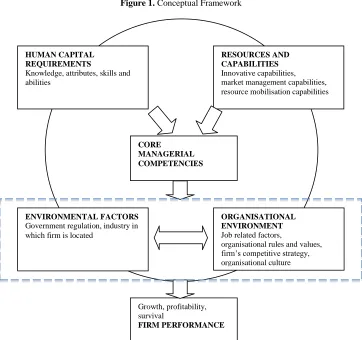
Although there is a general view that the influence of managerial competencies on firm performance is very critical, Laguna, Wiechetek and Talik (2012) observe that competencies have been studied in isolation and with little effort to recognise their mutual relationships. To this end, the relation between broader groups of competencies and their relations with business success is yet to be empirically tested (Markman, 2007; Mitchelmore & Rowley, 2010). As such, the specific and general competencies may need to be tested to understand their relationships as well as explain their influence on performance of internet businesses. In our model, we postulated that core competencies are a complex amalgam of human capital requirements (knowledge, attributes, skills and abilities) and resources and capabilities (innovative capabilities, market management capabilities, resource mobilisation capabilities) (see Figure 1).
Figure 1. Conceptual Framework
Relationship between managerial competencies and firm performance
3.2. Evaluation of contribution
To better understand the constitutive elements of MC, the paper argued that neither the UNIDO’s (2002) narrative on managerial competencies, the resource based theory nor human capital theory provides a comprehensive, complete account of these components. On the contrary, a constellation of managerial competencies namely, strategic resources and capabilities (e.g. innovation capabilities, service provision capabilities and market oriented capabilities), human capital requirements (i.e. technical knowledge, managerial training and appropriate entrepreneurial education) and competencies (knowledge, skills and abilities) would be necessary to provide a holistic picture on MC. Kabagambe, Ogutu & Munyoki (2012) argues that for SMEs that are often synonymous with resource poverty (i.e. physical, financial or managerial resources), poor performance, in part, is aggravated by their failure to identify, prioritize and develop competencies requisite for their sustained business capability. As such, the recognition of appropriate combinations of competencies at individual and organisational levels is critical to improved organisational performance particularly in the contemporary age where technological change and ever shifting consumer tastes for computer software are key levers of competitive advantage over rivals. The characterisation of core competencies as both individual and organisational traits overcomes the duality in typologies of competencies – where competencies are either conceived as resources that organisations can gainfully exploit to maximise organisational value or revered internal capacities that individuals possess that make them indispensable to the improved performance and survival of organisations. Such duality is aptly captured in Viitala’s (2005) claim that the integrated elements of competency models emphasise technical competencies, leadership competencies, social competencies, and intrapersonal competencies - which are expressions of individual trait-based approach to competencies.
HUMAN CAPITAL REQUIREMENTS
Knowledge, attributes, skills and abilities
RESOURCES AND CAPABILITIES Innovative capabilities, market management capabilities, resource mobilisation capabilities
CORE MANAGERIAL
COMPETENCIES
ORGANISATIONAL ENVIRONMENT Job related factors,
organisational rules and values, firm’s competitive strategy, organisational culture ENVIRONMENTAL FACTORS
Government regulation, industry in which firm is located
Growth, profitability, survival
Conceiving managerial competencies to be embodiments of organisational-wide resources and capabilities over and above human capital requirements allows organisations to consider their internal strengths, core values and systemic, financial and technological endowments as a basis for their strategic positioning and improved performance without over depending on the traits (capabilities, capacities, skills) of key individuals (an individual traits-based approach). This is critical given that competencies models are being dominated more by an individual approach compared to an organizational approach (Hondeghem & Vandermeulan, 2000) thus negating organisational considerations, which are instrumental in ensuring optimal performance. The appreciation and exploitation of other non-human resources that organisations have in addition to its human resource complements will enable the organisation to optimise performance through 1. Redeployment of these resources to organisational tasks, activities and processes which are critical to optimising productivity, 2. Identification of core competencies that organisations can draw on to outwit their rivals or use as a basis for seeking partnerships with other partners or stakeholders.
The paper also argued that the MC-PE relationship does not operate in a vacuum but is rather mediated by multiple organisations factors (e.g. firm’s strategic IT competencies, competitive service and marketing strategies, job performance related factors) whose interaction contingently influence organisational performance (growth, profitability, sustainability). Sanjo and Adeniyi (2012) observe that organisational performance is a function of individual satisfaction (including salary increments, job security, and welfare packages), the organisational environment (which comprises internal and external factors), its socio-cultural composition involving the culture of the people to which the organisation is located, business and government rules and regulations. This understanding perfectly dovetails with our view that micro-organisational considerations (e.g. job related factors, including organisational rules and values), macro level considerations (the small internet business’ competitive strategy and organisational culture) and environmental factors (e.g. government regulation, industry in which firm is located) are all deeply implicated in organisational performance and improved organisational effectiveness. We argue that the managerial competencies of the managers/owners of emerging internet firms are underpinned by their capacity to influence and adapt to changing job-related factors (multi-tasking expected of internet café employees, complex technology-enhanced task structure, job commitment, skilling and re-skilling) and competitive strategy of the organisation (such as pricing strategy, internet customers profiling, market segmentation strategy, financial strategy).
Lastly, the paper proposed that other environmental considerations (e.g. the physical location of the firm, the industry that the firm is located, the extent of government regulation, international influences such as position of the firm as a franchise of a larger international IT corporation) also mediate the MC-PE relationship. Succinctly put, the constitutive elements of MC, their individual interactions directly influence business performance while mediating influences of organisational and environmental factors play a moderating role in the MC-PE relationship.
4. CONCLUSION
The low survival and high failure rates of small firms (SMMEs) in South Africa including those in the emerging technology sector were articulated as major millstones around the necks of both policy makers and managers/owners of SMMEs alike. The lack of managerial competencies was identified as one of the major barriers to small technology businesses’ performance (i.e. profitability, growth, survival and long term sustainability). In tandem with this, the theoretical study provided multiple studies on the critical role of managerial competencies in the successful performance of small businesses. The theoretical paper first presented the personal and organisational dimensions of managerial competencies (drawing on the human capital theory, resource based theory, UNIDO’s (2002) categorization of competencies) including the different ways they are categorised in mainstream literature. These typologies were used to develop a holistic theoretical framework on the managerial competencies-performance relationship that transcended the individualist and organisational approaches to managerial competencies-which constitute simplistic, incomplete characterisations of managerial competencies.
service pricing strategies, marketing strategies) and organisational culture. In consonance with this, environmental factors include government regulation of the technology sector and industry in which firm is located. The interaction of managerial competencies of managers/owners with organisational and environmental variables influences, directs and determines the successful performance of the emerging technology firms. The overall argument of the paper is that the MC-PE relation is not a direct one, but is rather mediated by a constellation of organisational and environmental factors, whose contingencies have multiple implications for business growth, profitability and survival.
AUTHOR INFORMATION
Dr Patient Rambe holds a PhD in Educational Technology from the University of Cape Town, South Africa. He holds the position of Senior Researcher in the Department of Business Support Studies at the Central University of Technology in South Africa. Dr Rambe is a Convener of the Masters and Doctoral Programme Stream at the same university. He previously served as a Postdoctoral Research Fellow and Assistant Director in the Office of International Academic Projects at the University of the Free State, South Africa. His recent co-authored book is entitled: Leveraging Educational Quality in Southern African educational systems: A practitioners’ perspective.
Miss Naledi Makhalemele is a Masters of Business Administration candidate at the Central University of Technology in South Africa. Her current research focuses on the impact of a wide range of managerial competences on the performance of small businesses in emerging economies.
REFERENCES
Abor, J. & Quartey. P. (2010). Issues in SME Development in Ghana and South Africa. International Research Journal of Finance and Economics. Issue 39, Available at http://www.eurojournals.com/irjfe_39_15.pdf Acemoglu, D. & D. Autor (2011). Lectures in Labour Economics, manuscript, MIT.
http://economics.mit.edu/files/4689
Adereti, F.O. & Ajayi, A.O. (2004). Agricultural and non-agricultural income generating activities of rural women of different socio-economic status for poverty reduction in Osun State, Nigeria. Journal of Rural
Development 2, 13-21.
Agbobli, E.K. (2013). The influence of entrepreneurial and market orientations on small scale agricultural enterprises in the Vryburg region. PhD Thesis. Central University of Technology.
Barney, J.B. (1991). Firm Resources and Sustained Competitive Advantage. Journal of Management, 99-120. Barreira, J.C. (2004). The Influence of Business Knowledge and work experience as antecedents to entrepreneurial
success. PhD Thesis. Faculty of Economic and Management Sciences. University of Pretoria, 2004. C. Benner. (2003). Digital development and disruption in South Africa: Balancing growth and equity in national ICT
policies. Perspective on Global Development and Technology, 2(4), 1-24.
Bosch, A. Rossouw, J. Claassens, T. & du Plessis, B. (2010). A Second look at measuring inequality in South Africa: A modified Gini coefficient. School of Development Studies. Working Paper No 58, September 2010, 1-16.
Brancatisano, G., Jurriëns, J., & Verburg, R. (2012). A competence-based approach for small and medium-sized enterprises for selecting suitable international market-entry strategies, 137-155.
https://www.han.nl/onderzoek/kennismaken/business-development-and-co-creation/publicaties/han-business-publications-8/HAN_HBP8_08.pdf
Boyatzis, R. E. (1982). The Competent Manager. Wiley, New York, NY.
Boyatzis, R.E. (2006). Using Tipping Points of Emotional Intelligence and Cognitive Competencies to Predict Financial Performance of Leaders. Psicothema, 18(1), 124-131.
Calandro, E., Gillwald, A., Deen-Swarray, M., & Stork, C. (2012). Mobile usage at the base of the pyramid in South Africa.” International Bank for Reconstruction and Development / The World Bank, 1-74.
Carmeli, A. & Josman, Z. (2006). The relationship among intelligence, task performance, and organizational citizenship behaviors. Human Performance, 19(4), 403–419.
Du Toit, G.S., Erasmus, B.J. & Strydom, J.W. (2009). Introduction to Business Management. 7th Edition. Oxford, Southern Africa, 2009.
Dyke, L.S., Fischer, E.M. & Reuber, A.R. (1992). An inter-industry examination of the impact of owner experience on firm performance. Journal of Small Business Management, 30(4), 72-87.
Dzansi, D.Y. & Ndjike, R. (2014). Understanding the Transition from Informal to Formal Business: A Conceptual Framework. Mediterranean Journal of Social Sciences, 5(20), 664-670.
First National Bank (FNB) and Endeavour South Africa. (2010). The Entrepreneurial Dialogues: State of Entrepreneurship in South Africa. First National Bank, Endeavour South Africa in association with the Gordon Institute of Business Science.
Franco, F. & Haase, H. (2009). Failure factors in small and medium-sized enterprises, qualitative study from an attributional perspective. International Entrepreneurship Management Journal, 6(4), 628-641. Furuholt, B. & Kristiansen, S. (2007). Internet Cafés in Asia and Africa – Venues for Education and Learning?
Journal of Community Informatics. 3(2), 1-16.
Hellriegel, D., Jackson, S.E., Slocum, J., Staude, G., Amos, T., Klopper, H.B., Louw, L., & Oosthuizen, T. (2008). Management. Third South African Edition, Cape Town: Oxford University Press, 2008.
Herrington, M. & Wood, E. (2003) Global Entrepreneurship Monitor, South African Report 2003. Accessed from:http://www.gbs.nct.ac.za/gbswebb/userfiles/gemsouthafrica2000pdf
Herrington, M., Kew, J., & Kew, P. (2009). Tracking entrepreneurship in South Africa: A Gem perspective. Graduate School of Business, University of Cape Town.
Herrington, M., Kew, J., Simrie, M., & Turton, N. (2011). The Global Entrepreneurship Monitor South Africa Report. The UCT Centre for Innovation and Entrepreneurship. University of Cape Town.
Herrington, M. & Kew, J. (2013). GEM 2013 South African Report: Twenty years of Democracy. UCT Development Unit for New Enterprise, University of Cape Town, South Africa.
Herrington, M., Kew, J., Simrie, M., & Turton, N. (2011). The Global Entrepreneurship Monitor South Africa Report. The UCT Centre for Innovation and Entrepreneurship. University of Cape Town.
Hyde-Clark, N. (2006). The Urban Digital Divide: A Comparative Analysis of Internet cafes in Johannesburg. Review of African Political Economy, 33(107), 150-156.
Hondeghem, A., & Vandermeulen, F. (2000). Competency management in the Flemish and Dutch civil service. International Journal of Public Sector Management, 13(4), 342 – 353.
Hormiga, E., Batista-Canino, R.M., & Sanchez-Medina, A. (2011). The role of intellectual capital in the success of new ventures. International Entrepreneurship and Management Journal, 7, 71-92.
Janjua, S., Naeem, M. & Kayani. F. (2012). The Competence Classification Framework: A Classification Model for Developing Employees. Interdisciplinary Journal of Contemporary Research in Business, 4(1), 396-404. Johnson, D.L., Pejovic, V., Belding, E.M., & van Stam, G. (2011). Traffic Characterization and Internet Usage in
Rural Africa. 2011.http://www.cs.ucsb.edu/~davidj/Files/www11.pdf
Kabagambe, L.B. Ogutu, M., & Munyoki, J.M. (2012). Firm competencies and export performance: A study of small and medium manufacturing exporters in Uganda. European Scientific Journal, 8(12), 48-67. Kanungo. R.N. & Misra, S. (1992). Managerial Resourcefulness: A Reconceptualization of Management Skills.
Human Relations, 45, 1311-1332.
Königová, M., Urbancová, H., & Fejfar, J. (2012). Identification of Managerial Competencies in Knowledge-based Organizations. Journal of Competitiveness. 4(Issue 1), 129-142.
Kesper, A. (2001). Making a living in the city: Small and success of Small Enterprises in the Johannesburg Inner City. Paper presented at the Urban Futures Conference, 10-17 July, Johannesburg, 2001
King, A.W. & Zeithaml. C.P. (2001). Competencies and firm performance: Examining the causal ambiguity paradox. Strategic Management Journal, 22, 75–99.
Kochadai. M. (2012). The concept of entrepreneurial competency, competency model and review of earlier studies.” Chapter 11 http://shodhganga.inflibnet.ac.in/bitstream/10603/5303/9/10_chapter%202.pdf.
Krajcovicova, K., Caganova, D., & Cambal, M. (2012). Key managerial competencies and competency models in industrial enterprises. Annals of DAAAM for 2012 and Proceedings of the 23rd International DAAAM Symposium, 23(1), 1119-1122.
Laguna, M., Wiechetek, M., & Talik, W. (2012). The competencies of managers an d their business success, Central European Business Review, 1(3), 7-13.
Langmia, K. (2005). The role of ICT in the economic development of Africa: The case of South Africa.
(IJEDICT), 2(Issue 4), 144-156.
Lefebvre, E. & Lefebvre L.A. (2002). Determinant of export performance and behaviour: A longitudinal study of manufacturing SMEs in Kleinknecht.” Econometric Explorations of Survey Data, 5(1), 281-309.
Luiz, J. (2012). Small Business Development Entrepreneurship and Expanding the Business Sector in a Developing Economy: The case of South Africa. The Journal of Applied Business Research, 18(2), 265-268.
Madhoushi, M., Ghanbari, A., & Zabihzadeh, M. (in press). Effect of size, type and percentage of fibers on density and withdrawal strength of fasteners in natural fiber-plastic composites made through dry process. Journal of Forest and Wood Products
Mahembe, E. (2011). Literature Review on Small and Medium Enterprises’ Access to Credit and Support in South Africa. National Credit Regulator (NCR), Underhill Corporate Solutions (UCS), December 2011. Markman, G. (2007). Entrepreneur’s competencies. In The psychology of entrepreneurship (pp. 67-92). J.R Baum,
M. Frese and R.A. Baron, Mahwah, London: Lawrence Erlbaum Assoc. 2007.
Martin, G. & Staines, H. (1994). Managerial competencies in small firms. Journal of Management Development, 13(7), 23-34.
Mitchelmore, S. & Rowley, J. (2010). Entrepreneurial competencies: A literature review and development agenda. International Journal of Entrepreneurial Behaviour and Research, 16, 92-111.
Molawa. S. (2009). The “first” and “third world” in Africa: knowledge access, challenges and current technological innovations in Africa. First International Conference on African Digital Libraries and Archives (ICADLA-1) (pp. 1-14), Addis Ababa, Ethiopia, 1st-3rd July 2009.
Mouton, J. & Marais, H. (1990). Basic Concepts in the Methodology of the Social Sciences. Pretoria: Human Sciences Research Council.
Munene, J.C., Bbosa, R. & Obonyo, F. (2003). Operant competence management framework for enhancing competence management and development in organizations in Africa, Paper presented in American Management Conference, OH
Naude, D. (2007). The degree of organizational performance measurement in SMEs. A focus on ICT enterprises. Unpublished PhD Thesis Dissertation. UNISA.
Nieman, G. & Neuwenhuizen, C. (2009). Entrepreneurship: A South African Perspective. Pretoria: Van Schaik and Juta. 2009.
Nirachon, C., Mohmad-Yazam, S. & Faridahwati, M.S. (2007). Determinants of managerial competencies in the public health sector. Proceedings of the International Conference in Penang, Malaysia, 2007 (pp. 233 -241), Asian Academy of Management and School of Management, Universiti Sains Malaysia, Penang, 2007.
Olutunla, G.T. & Obamuyi, T.M. (2008). An empirical analysis of factors associated with the profitability of Small and medium - enterprises in Nigeria. African Journal of Business Management 2, (X), pp. 195-200. A. Rangone, A. (1999). A Resource-Based Approach to Strategy Analysis in Small-Medium Sized Enterprises.
Small Business Economics, 12, 233-248.
Robotham, D. & Jubb, R. (1996). “Competences: measuring the unmeasurable.” Management Development Review, 9(5), 25-29.
Rogers, E.M. & Shukla, P. (2001). The role of Telecenters in development communication and the digital divide. Journal of Development Communication, 2(12), 26-31.
Sanda, A., Sackey, J. & Fältholm, Y. (2011). Managerial Competence and Non-Performance of Small Firms in a Developing Economy, International Journal of Contemporary Business Studies, 2(3), 6-24.
Sánchez, J. (2012). The influence of entrepreneurial competencies on small firm performance. Revista Latinoamericana de Psicología, 44(2), 165-177.
Sanjo, O.M. & Adeniyi, A.W. (2012). Determinants of organizational effectiveness in the Nigerian communication sector. European Journal of Business and Management, 4(13), 68-78.
Schultz, T. (1961). Investment in human capital. American Economic Review, 51(1), 1-17.
Sey, A. & Felllows, M. (2009). Literature Review on the Impact of Public Access to Information and
Communication Technologies. Global Impact Study and the Centre for Information and Society, University of Washington, pp. 1-27.
Tahmasb, A., Niknafs, A., & Mirvaziri, H. (2014). The evaluation of managerial competence based on the
classification of imbalanced data in the field of data mining. Reef Resources Assessment and Management Technical Paper, 40(2), 117-122
http://www.reciprocity.co.za/documents/Reciprocity_BoPFactSheet_BusinessPlace.pdf
Tucker, M.L. and McCarthy. A. (2001). Presentation Self-efficacy: Increasing Communication Skills Through Service-learning. Journal of Managerial Issues, 13(2), 227-244.
United Nations Industrial Development Organization (UNIDO). “UNIDO Competencies.” http://www.unido.org 2002.P.351, 2002.
Viitala, R. (2005). Perceived development needs of managers compared to an integrated management competency model. Journal of Workplace Learning, 17 (7), 436 - 451
Van Scotter, J. R. and Culligan, P. E. (2003). The value of theoretical research and applied research for the hospitality industry. Cornell Hotel and Restaurant Administration Quarterly, 14-27.
Wickramasinghe, V. and De Zoyza, N. (2009). An assessment of managerial competency needs: empirical evidence from a Sri Lankan telecommunication service provider. The International Journal of Human Resource Management, 20(12), 2547-2567.
Xiang. L. (2009). Entrepreneurial Competencies as an Entrepreneurial Distinctive: An Examination of the Competency Approach in Defining Entrepreneurs. Singapore Management University, 2009.