R E S E A R C H
Open Access
Improved Bevirimat resistance prediction by
combination of structural and sequence-based
classifiers
J Nikolaj Dybowski
1, Mona Riemenschneider
2, Sascha Hauke
3, Martin Pyka
4, Jens Verheyen
5, Daniel Hoffmann
1and
Dominik Heider
1** Correspondence: Dominik. [email protected]
1Department of Bioinformatics,
Center of Medical Biotechnology, University of Duisburg-Essen, Universitaetsstr. 2, 45117 Essen, Germany
Full list of author information is available at the end of the article
Abstract
Background:Maturation inhibitors such as Bevirimat are a new class of antiretroviral drugs that hamper the cleavage of HIV-1 proteins into their functional active forms. They bind to these preproteins and inhibit their cleavage by the HIV-1 protease, resulting in non-functional virus particles. Nevertheless, there exist mutations in this region leading to resistance against Bevirimat. Highly specific and accurate tools to predict resistance to maturation inhibitors can help to identify patients, who might benefit from the usage of these new drugs.
Results:We tested several methods to improve Bevirimat resistance prediction in HIV-1. It turned out that combining structural and sequence-based information in classifier ensembles led to accurate and reliable predictions. Moreover, we were able to identify the most crucial regions for Bevirimat resistance computationally, which are in line with experimental results from other studies.
Conclusions:Our analysis demonstrated the use of machine learning techniques to predict HIV-1 resistance against maturation inhibitors such as Bevirimat. New maturation inhibitors are already under development and might enlarge the arsenal of antiretroviral drugs in the future. Thus, accurate prediction tools are very useful to enable a personalized therapy.
Background
HIV and Bevirimat
Bevirimat (BVM) belongs to a new class of antiretroviral drugs inhibiting the maturation of HIV-1 particles to infectious virions. BVM prevents the final cleavage of precursor protein p25 to p24 and p2. In electron microscopy, these immature particles failed to build a capsid composed of a nucleocapsid (p7) and RNA surrounded by a cone-shaped core assembled from p24 proteins [1]. In selection experiments with BVM mutations at Gag cleavage site p24/p2 BVM resistance emerged and was conferred in phenotypic resistance tests. In contrast, especially natural polymorphisms in theQVT-motif of p2 hampered the effective suppression of viral replication in clinical phase II trails, which also increased the measured resistance factors in cell culture experiments. It was recently shown by Kelleret al.that BVM stabilizes the immature Gag lattice and thus, prevents cleavage [2].
Machine learning techniques are widely used to predict drug resistance in HIV-1. For instance, Beerenwinkelet al.used support vector machines [3] and decision trees [4] to predict drug resistance of HIV-1 against several protease and reverse transcriptase inhibitors. Other groups also employed artificial neural networks [5,6], rule-based sys-tems [7] and random forests [8,9].
In our recent publication, we demonstrated the use of machine learning techniques for the prediction of Bevirimat resistance from genotype [10]. We tested artificial neural net-works, support vector machines, rule-based systems and random forests [11] trained on p2 sequences derived from resistant and susceptible virus strains and applied different descriptor sets. Descriptors map the amino acid symbols onto numerical values represent-ing physico-chemical properties of the amino acids. Due to the fact that the p2 sequences have insertions and deletions and thus differ in their length, they were preprocessed to ful-fill the constraints given by machine learning approaches, i.e. a fixed input dimension of the data. We used a multiple sequence alignment to align and subsequently encode the sequences with five different descriptors, namely the hydrophobicity scale of Kyte and Doolittle [12], molecular weight, isoelectric point, pKa and HIV-1 cleavage probability [13]. Finally, all models were trained using the encoded protein sequences and evaluated using 100-fold leave-one-out cross-validation. The random forest models trained on hydrophobicity-encoded p2 sequences performed best (AUC = 0.927 ± 0.001) with regard to Wilcoxon signed-rank tests on the AUC distributions. Moreover, earlier studies [14] have shown that RFs are highly stable and robust in comparison with other classifiers. RFs also provide an importance estimation for the variables in the data set. The importance of each variable, i.e. sequence position in p2, can be assessed to gain a possible biological implications on resistance mechanisms.
Classifier Ensembles
Material and methods
Data
In this study we used the data aggregated by Heider et al.[10], consisting of p2 sequences of viruses with assay-determined resistance factors. These data were collected from several studies that have investigated polymorphisms in the p2 region by phenoty-pic BVM resistance assays. The cut-off value of the resistance factor used to define the classes“resistant to BVM”and“susceptible to BVM”was set according to Heideret al.
[10]. Duplicate sequences in each of the classes were removed prior to analysis. The final dataset consisted of 43 p2 sequences of HIV-1 strains with susceptibility or inter-mediate resistance to BVM and 112 sequences of resistant strains. The lengths of the p2 sequences in the data set are 20.77 ± 0.43. The p2 sequences have a very low sequence identity/similarity. Only six positions within the peptides are conserved, namely 359-361 and 365-367. Position 357 shows only small similarity, whereas position 358 and 362 show higher similarity among the sequences. All other positions, especially in the N-terminal part, are highly diverse. The highly conserved regions are marked with an asterisk in the wildtype sequence:
GHKARVLAEAMSQVTNSATIM .:***: ***
Machine Learning Performance evaluation
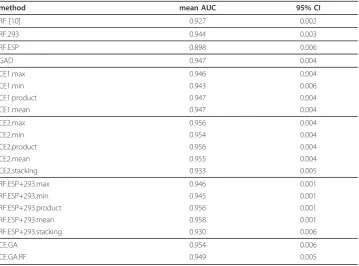
All models used in this study were evaluated with 10-fold leave-one-out cross-validation. As performance measurement we used the area under the Receiver Operating Charac-teristics curve (AUC) [24], i.e. the integral under the ROC curves. ROC curves are built by calculating sensitivity and specificity for every possible cutoff between the positive (here susceptible) and negative (here resistant) samples. ROC curves were drawn with R-package ROCR [25]. Table 1 gives an overview of the areas under the curves (AUCs). After counting true positivesTP, false positivesFP, false negativesFNand true negatives
TN, sensitivity, specificity and accuracy are calculated according to the standard defini-tions reported below for the sake of completeness:
sensitivity= TP
TP+FN (1)
specificity= TN
TN+FP (2)
accuracy= TP+TN
TP+TN+FP+FN (3)
Models were compared based on their resulting AUC distributions from the 10-fold leave-one-out cross-validation runs using Wilcoxon signed-rank tests [26,27]. The null hypothesis was that there are no differences between the compared classifiers. 95% confidence intervals of the AUC were calculated by t-testing.
Descriptor Encoding
interpolation [30], resulting in 531 numerically encoded datasets. The feature length was set to 21, representing the most common sequence length found in the dataset.
Evolutionary Optimization of Descriptors
Individuals were represented as vectors of twenty numerical values (genes), encoding the proteinogenic amino acids. The mutation probability for each gene was 0.01. Recombi-nation was applied with a probability of 0.1. RecombiRecombi-nation partners were chosen according to the fitness proportionate selection operator. The fitness of an individual was given by its BVM resistance classification performance (AUC). The GA was run thrice for 1000 generations.
Random Forests
The randomForest package [31] of R [32] was used to build all RF models used in this study. Each RF consisted of 500 decision trees that were combined by majority voting. Feature importance was assessed using the built-in function of the randomForest pack-age and estimated by thesum of all decreases in Gini impurity, which has been shown to be more robust compared to themean decrease in accuracy[33].
Classifier Ensembles
Classifier ensembles CE1 and CE2 were constructed from the set of 531 single classi-fiers based on the different descriptors in the AAindex database. All single classiclassi-fiers with an AUC of > 0.93 and > 0.94 were included into CE1 and CE2, respectively. The votes of the single classifiers within CE1 and CE2 were combined by applying simple methods such as min, max, product and mean to reach a final decision. In addition, the classifier ensembles were stacked using a random forest model trained on the out-comes of the single classifiers.
Table 1 Area under the curve
method mean AUC 95% CI
RF [10] 0.927 0.002
RF.293 0.944 0.003
RF.ESP 0.898 0.006
GAD 0.947 0.004
CE1.max 0.946 0.004
CE1.min 0.943 0.006
CE1.product 0.947 0.004
CE1.mean 0.947 0.004
CE2.max 0.956 0.004
CE2.min 0.954 0.004
CE2.product 0.956 0.004
CE2.mean 0.955 0.004
CE2.stacking 0.933 0.005
RF.ESP+293.max 0.946 0.001
RF.ESP+293.min 0.945 0.001
RF.ESP+293.product 0.956 0.001
RF.ESP+293.mean 0.958 0.001
RF.ESP+293.stacking 0.930 0.006
CE.GA 0.954 0.006
CE.GA.RF 0.949 0.005
The evolutionary optimization of classifier ensembles was similar to that of a descriptor set, described earlier. The fitness of an ensemble was represented by the resulting perfor-mance of that ensemble on the BVM resistance prediction (represented by the AUC). An individual consisted of a set of unique classifiers. Possible classifiers included artificial neural networks, support vector machines [34], k-nearest neighbors, decision trees and random forests. The minimum and maximum number of classifiers within an ensemble was set to 2 and 10, respectively. Mutations, e.g. insertions or deletions of classifiers, as well as changes to parameters in the specific machine-learning methods, were set to occur at a rate of 0.2. Each of the 100 generations comprised 15 individuals. The resulting classi-fier ensemble was termed CE.GA. In addition, a second ensemble including only RF mod-els was created applying the same parameters and termed CE.GA.RF.
Structural classification
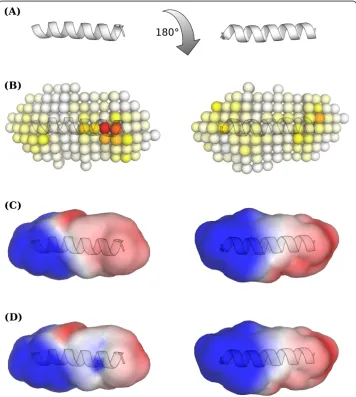
Homology models of all p2 sequences were built based on the NMR structure of the p2a -helix [35] using Modeller 9.8 [36]. The electrostatic hull, representing the discretized elec-trostatic potential(r) above the solvent-accessible surface was calculated as described in the original publications [9]. The resulting hull, calculated for each p2 model consisted of 200(r)-values at a distance of approximately 0.6 nm above the solvent-accessible surface. Electrostatic potential vectors of the form ((r1),...,(r200)) were then used to train initial
RF models. To cope with the unfavorable ratio of samples (n = 155) and features (p = 200) [37], a feature selection scheme was applied. The most important features, i.e.(r), as estimated by the RF internal importance analysis [11], were averaged over ten RF models and sorted in descending order. In an iterative manner, RF models were then built using feature subsets, starting with the most important and adding one additional feature per round. In each round the AUC was calculated.
Results and Discussion
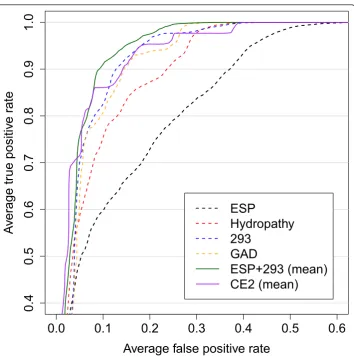
The prediction qualities in form of the mean AUCs and 95% confidence intervals (CI) are shown in Table 1. ROC curves are shown in Figure 1. The best single classifier RF.293 (random forest trained with descriptor 293 [38]) reached anAUC =0.944 ± 0.003 for the prediction of Bevirimat resistance from p2 sequences and thus outperformed our recently published model that uses the hydrophobicity scale of Kyte and Doolittle [12] as descriptor
(AUC =0.927 ± 0.001) with regard to the Wilcoxon signed-rank test. The best descriptor resulting from the genetic algorithm optimization reaches a fitness (i.e. AUC value) of 0.947 ± 0.002 and, thus, is only slightly better than the best descriptor 293. The optimized descriptor values representing the proteinogenic aminoacids are shown in Table 2. We then calculated the pairwise correlation of the novel descriptor GAD (genetic algorithm descriptor) with all other descriptors in the AAindex database [29]. It turned out that the highest correlation(R2= 0.384) could be found with descriptor 452, i.e. the hydropathy scale of Naderi-Manesh et al.[39]. However, the RF trained on this hydropathy scale reached only an AUC of 0.928 ± 0.003, which is comparable to results obtained from the RF trained on the hydropathy scale of Kyte and Doolittle [12] in our recent publication [10]. Surprisingly, the GAD descriptor grouped the amino acids into pairs, except for ala-nine, cysteine, aspartic acid and serine. These groups represent a certain kind of similarity in the context of the novel descriptor.
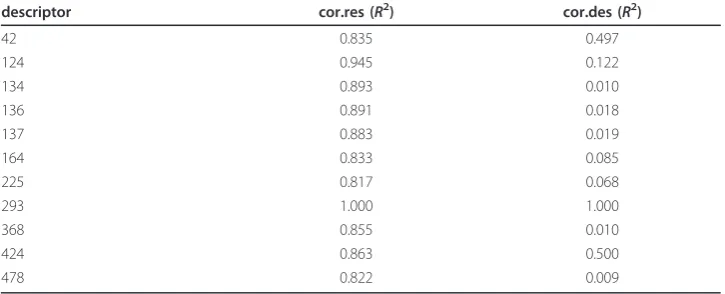
single RFs reaching an averageAUC> 0.93, resulting in 112 classifiers. The ensemble CE2 was built on a subset of CE1, namely those classifiers reaching an averageAUC> 0.94 (11 classifiers). We then analyzed the correlation of the best classifier (293) with the other 10 classifiers in CE2 in two different ways. First, we calculated the correlation
Average false positive rate
A
ver
age tr
ue pos
iti
ve
r
ate
0.0
0.1
0.2
0.3
0.4
0.5
0.6
0.4
0.5
0.6
0.7
0.8
0.9
1.0
ESP
Hydropathy
293
GAD
ESP+293 (mean)
CE2 (mean)
Figure 1ROC curves. Performance comparison of single descriptor classifiers (dashed lines) and fused classifiers (solid lines). The hydropathy scale classifier was used in the original study [10]. The combined classifiers CE2 and ESP+293 achieve an AUC higher than any of the single descriptor classifiers (compare Table 1). Despite the inferiority of ESP as a single classifier, fusion with 293 results in the best overall performance.
Table 2 GAD values
amino acid value amino acid value
A 0.0956 L 0.8577
R 0.8571 K 0.2695
N 0.9697 M 0.6212
D 0.1930 F 0.7062
C 0.2472 P 0.7154
Q 0.7865 S 0.5001
E 0.5843 T 0.2675
G 0.8036 W 0.4322
H 0.9811 Y 0.3246
I 0.3265 V 0.4513
(cor.res) based on the votes for each protein sequence in the dataset, and second the correlation based on the 20 descriptor values (cor.des) for the 20 amino acids. The results are shown in Table 3. CE1 reaches AUC values of 0.946 ± 0.002, 0.943 ± 0.003, 0.947 ± 0.002 and 0.947 ± 0.002 for the fusion methods max, min product and mean, respectively. Obviously, a combination of these 112 RFs did not improve the prediction performance compared to RF.293. In contrast, CE2 outperformed CE1, as well as RF.293. The AUC values are 0.956 ± 0.002, 0.954 ± 0.002, 0.956 ± 0.002 and 0.955 ± 0.002 for max, min product and mean, respectively. Stacking of single classifiers of CE2 leads to a significant drop in prediction performance (AUC= 0.933 ± 0.002). This phenomenon has already been described by Dzeroski and Zenko [40], who demon-strated empirically on several machine learning methods and thirty datasets that stack-ing performs only comparable or even worse than pickstack-ing the best sstack-ingle classifier. Nevertheless, stacking is controversely discussed as it sometimes lead to a better pre-diction performance. Ting and Witten [41] suggested the use of linear classifiers as fusion method for better generalization. This is in line with other findings that fusion with a non-linear random forest is inferior to the linear fusion with mean. The classi-fier ensembles built on the genetic algorithm procedure, CE.GA and CE.GA.RF reached AUC values of 0.954 ± 0.003 and 0.949 ± 0.002, respectively. Surprisingly, the homogeneous CE.GA.RF performs worse compared to CE2. We assume that the genetic algorithm was probably caught in a local maximum in the energy landscape, and thus, produced a suboptimal ensemble.
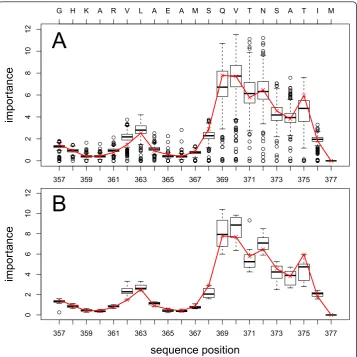
The most important features for the successful classification of the single RFs highlight sequence positions in the C-terminal end of the p2 sequence, specifically at sequence posi-tions 369-376 (Figure 2). These findings are in agreement with our recently published results [10]. In the wild type sequence this region corresponds to the motifQVTNSATI. However, the analysis of the complete set of descriptors showed that the importance of positions 369-372 is in strong agreement with the findings of van Baelenet al.who identi-fied theQVTmotif at positions 369-371 as important [42]. In contrast, results obtained with the hydrophobicity scale as descriptor, are only in partial agreement with the experi-mental results [10]. Thus, we recommend to analyze the importance measurement for all available descriptors simultaneously to get reliable estimations. Positions 363 and 364, although being identified as crucial [43] for the resistance to BVM, only showed a slightly
Table 3 Correlation analyses
descriptor cor.res (R2) cor.des (R2)
42 0.835 0.497
124 0.945 0.122
134 0.893 0.010
136 0.891 0.018
137 0.883 0.019
164 0.833 0.085
225 0.817 0.068
293 1.000 1.000
368 0.855 0.010
424 0.863 0.500
478 0.822 0.009
higher importance compared to the surrounding positions. This could be due to the nat-ure of our dataset as already discussed in our recent study [10].
In order to test the predictive performance of a structural classifier, we calculated the electrostatic potential resulting from p2 sequences as proposed by Dybowskiet al.[9]. This structural classifier based on the electrostatic potential (RF.ESP) reached an AUC of 0.810 ± 0.008. A subsequent model based on the results of a feature selection described in Materials and Methods yielded an AUC 0.898 ± 0.006 using the 32 most important variables according to the RF importance measure. There are different expla-nations for the inferiority of this structural classifier: (A) At least some of the drug resis-tance mechanisms witnessed here are not driven by charge. In comparison, a sequence classifier based on the amino acid net charge descriptor reached an AUC of 0.625 ± 0.000. (B) Inaccurate modeling due to limited sequence length. The influence of neigh-boring residues (primary or tertiary structure) to the electrostatic potential is neglected. (C) Errors in the template structure. Worthylakeet al.suggested that the alpha helix formed by the p2 sequence is less stable [44], in contrast to the p2 structure of Morellet
et al.[35]. The stability of the p2 alpha helix might be overestimated because of a high
● ● ● ● ● ● ● ● ● ● ● ● ● ● ● ● ● ● ● ● ● ● ● ● ● ● ● ● ● ● ● ● ● ●● ● ● ● ● ● ● ● ● ● ● ● ● ● ● ● ● ● ● ● ● ● ● ● ● ● ● ● ● ● ● ● ● ● ● ● ● ● ● ● ● ● ● ● ● ● ● ● ● ● ● ● ● ● ● ● ● ● ● ● ● ● ● ● ● ● ● ● ● ● ● ● ● ● ● ● ● ● ● ● ● ● ● ● ● ● ● ● ● ● ● ● ● ● ● ● ● ● ● ● ● ● ● ● ● ● ● ● ● ● ● ● ● ● ● ● ● ● ● ● ● ● ● ● ● ● ● ● ● ● ● ● ● ● ● ● ● ● ● ● ● ● ● ● ● ● ● ● ● ● ● ● ● ● ● ● ● ● ● ● ● ● ● ● ● ● ● ● ● ● ● ● ● ● ● ● ● ● ● ● ● ● ● ● ● ● ● ● ● ● ● ● ● ● ● ● ● ● ● ● ● ● ● ● ● ● ● ● ● ● ● ● ● ● ● ● ● ● ● ● ● ● ● ● ● ● ● ● ● ● ● ● ● ● ● ● ● ● ● ● ● ● ● ● ● ● ● ● ● ● ● ● ● ● ● ● ● ● ● ● ● ● ● ● ● ● ● ● ● ● ● ● ● ● ● ● ● ● ● ● ● ● ● ● ● ● ● ● ● ● ● ● ● ● ● ● ● ● ● ● ● ● ● ● ● ● ● ● ● ● ● ● ● ● ● ● ● ● ● ● ● ● ● ● ● ● ● ● ● ● ● ● ● ● ● ● ● ● ● ● ● ● ● ● ● ● ● ● ● ● ●
357 359 361 363 365 367 369 371 373 375 377
02468
10
12
impor
tance
G H K A R V L A E A M S Q V T N S A T I M
A
●
●
357 359 361 363 365 367 369 371 373 375 377
02468 10 12
sequence position
impor
tance
B
trifluoroethanol concentration used in the experiments. A wrong template structure might ultimately lead to unnatural side-chain placement. At least the second point also applies to the sequence-based classifiers.
The electrostatics classifier also identified the most important positions mainly in the C-terminal part of the p2 structure, with the potential near positions 373 and 374 being the most important for the classification process (Figure 3). Thus, the ESP classifier is only in partial agreement with the sequence-based classifiers, which iden-tified positions 369-372 as being most important. As already demonstrated by Dybowski et al.[9] for co-receptor tropism prediction, the combination of structural and sequence-based classifiers can improve prediction performance significantly. Thus, we tested two scenarios, namely RF.ESP combined with hydropathy scale according to Dybowski et al. [9], and a combination of RF.293 with RF.ESP.
Combining the ESP- and hydrophobicity-based classifiers produced a slightly improved performance using the product fusion method (AUC = 0.94 ± 0.001). However, a significant increase in AUC was achieved while combining the RF.ESP and RF.293 classifiers applying either the mean or product fusion methods (AUC 0.958 ± 0.001 and 0.956 ± 0.001, respectively).
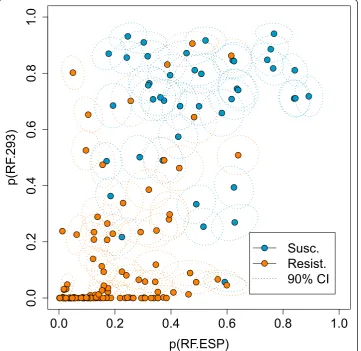
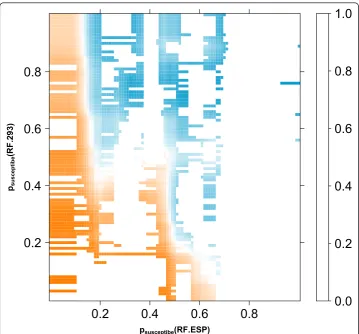
In Figure 4 the class probabilities according to the two previously described RFs (RF. ESP and RF.293) are plotted for all p2 sequences in the dataset. The figure suggests that the two computational models are in part discordant, as the distribution of both classes, resistant and susceptible, extends into the upper left and lower right corners. This explains the improvement in prediction performance by combining the two RFs. However, stacking leads again to drop in performance (AUC 0.930 ± 0.006). In Figure 5, the potential inputs and the outputs for the second-level learning RF are shown. Obviously, stacking leads to overfitting in some regions, represented by white islands in the prediction landscape in Figure 5, and thus, to a worse generalization ability, reflected in a drop of prediction performance.
● ● ● ● ● ● ● ● ● ● ● ● ● ● ● ● ● ● ● ● ● ● ● ● ● ● ● ● ● ● ● ● ● ● ● ● ● ● ● ● ● ● ● ●
0.0
0.2
0.4
0.6
0.8
1.0
0.0
0.2
0.4
0.6
0.8
1.0
p(RF.ESP)
p(
RF
.293
)
● ● ● ● ● ● ● ● ● ● ● ● ● ● ● ● ● ● ● ● ● ● ● ● ● ● ● ● ● ● ●● ● ● ● ● ● ● ● ● ● ● ● ●● ● ● ● ● ● ●● ●● ● ● ● ● ● ● ● ● ● ● ● ● ● ● ● ● ● ● ●●● ● ● ● ● ● ●●● ● ● ●● ●● ● ● ● ● ● ● ●● ● ● ● ● ● ● ● ● ● ● ● ● ● ● ● ● ●Susc.
Resist.
90% CI
Conclusions
HIV-1 drug resistance is a major obstacle in achieving sustained suppression of viral replication in chronically infected patients. The emergence of drug resistance as well as more and more individualized antiretroviral treatment regimens lead to the need for developing new antiretroviral agents for routine clinical practice. BVM was the first drug of the new class of maturation-inhibitors of HIV-1 entering clinical trials. Baseline BVM resistance of about 30% in treatment-naïve HIV-1 isolates and of about 50% in protease inhibitor resistant HIV-1 isolates [45] hampered the usage of BVM in routine antiretro-viral therapy regimens [46]. Nevertheless, new drugs of this new class targeting the p24/ p2 junction, e.g. Vivecon (MPC-9055), are already under development and might enlarge the arsenal of antiretroviral drugs in the future. Therefore, highly specific and accurate tools to predict resistance to maturation inhibitors can help to identify patients who might benefit from the usage of these new drugs.
In the current study, we applied several techniques to improve Bevirimat resistance pre-diction from p2 sequences of HIV-1. Based on our recently published results, we were able to improve resistance prediction with well chosen descriptors and classifier ensem-bles. It turned out that combining structural and sequence information can lead to improved prediction performance, as already discussed by Dybowskiet al.[9] for co-receptor usage prediction of HIV-1. Combining well chosen sequence-based descriptors
psusceptibe(RF.ESP) psusceptibe
(RF.293
)
0.2
0.4
0.6
0.8
0.2
0.4
0.6
0.8
0.0
0.2
0.4
0.6
0.8
1.0
does also lead to better prediction performance with no significant differences compared to the combined structure-sequence classifiers. However, it is not useful to combine plenty of classifiers as it can lead to a drop in prediction performance as demonstrated for the CE1. As already shown in other studies, combining classifiers via stacking seems to be useless to improve prediction performance.
Acknowledgements
This work was supported by the Deutsche Forschungsgemeinschaft (SFB/Transregio 60).
Author details
1Department of Bioinformatics, Center of Medical Biotechnology, University of Duisburg-Essen, Universitaetsstr. 2,
45117 Essen, Germany.2Leibniz Institute for Arteriosclerosis Research, University of Münster, Domagkstr. 3, 48149 Münster, Germany.3CASED, Technische Universität Darmstadt, Mornewegstr. 32, 64293 Darmstadt, Germany. 4Department of Psychiatry, University of Marburg, Rudolf-Bultmann-Str. 8, 35039 Marburg, Germany.5Institute of
Virology, University of Cologne, Fuerst-Pueckler-Str. 56, 50935 Cologne, Germany.
Authors’contributions
DH* and JND have jointly carried out computational analyses, interpreted results and drafted the manuscript. MR, SH and MP have contributed software frameworks. JV and DH have revised the manuscript.
All authors read and approved the final manuscript.
Competing interests
The authors declare that they have no competing interests.
Received: 15 June 2011 Accepted: 14 November 2011 Published: 14 November 2011
References
1. Salzwedel K, Martin D, Sakalian M:Maturation inhibitors: a new therapeutic class targets the virus structure.AIDS Rev
2007,9:162-172.
2. Keller PW, Adamson CS, Heymann JB, Freed EO, Steven AC:HIV-1 maturation inhibitor bevirimat stabilizes the immature Gag lattice.J Virol2011,85(4):1420-1428.
3. Beerenwinkel N, Schmidt B, Walter H, Kaiser R, Lengauer T, Hoffmann D, Korn K, Selbig J:Geno2pheno: Interpreting Genotypic HIV Drug Resistance Tests.IEEE Intelligent Systems2001,16:35-41.
4. Beerenwinkel N, Schmidt B, Walter H, Kaiser R, Lengauer T, Hoffmann D, Korn K, Selbig J:Diversity and complexity of HIV-1 drug resistance: a bioinformatics approach to predicting phenotype from genotype.Proc Natl Acad Sci USA
2002,99(12):8271-8276.
5. Draghici S, Potter RB:Predicting HIV drug resistance with neural networks.Bioinformatics2003,19:98-107. 6. Rhee SY, Taylor J, Wadhera G, Ben-Hur A, Brutlag DL, Shafer RW:Genotypic predictors of human immunodeficiency
virus type 1 drug resistance.Proc Natl Acad Sci USA2006,103(46):17355-17360.
7. Kierczak M, Ginalski K, Dramiński M, Koronacki J, Rudnicki W, Komorowski J:A Rough Set-Based Model of HIV-1 Reverse Transcriptase Resistome.Bioinform Biol Insights2009,3:109-127.
8. Murray RJ, Lewis FI, Miller MD, Brown AJ:Genetic basis of variation in tenofovir drug susceptibility in HIV-1.AIDS
2008,22(10):1113-23.
9. Dybowski JN, Heider D, Hoffmann D:Prediction of co-receptor usage of HIV-1 from genotype.PLoS Comput Biol
2010,6(4):e1000743.
10. Heider D, Verheyen J, Hoffmann D:Predicting Bevirimat resistance of HIV-1 from genotype.BMC Bioinformatics2010, 11:37.
11. Breiman L:Random Forests.Machine Learning2001,45:5-32.
12. Kyte J, Doolittle R:A simple method for displaying the hydropathic character of a protein.J Mol Biol1982, 157:105-132.
13. Chou KC, Tomasselli AG, Reardon IM, Heinrikson RL:Predicting human immunodeficiency virus protease cleavage sites in proteins by a discriminant function method.Proteins1996,24:51-72.
14. Svetnik V, Liaw A, Tong C, Culberson JC, Sheridan RP, Feuston BP:Random forest: a classification and regression tool for compound classification and QSAR modeling.J Chem Inf Comput Sci2003,43:1947-1958.
15. Nanni L, Lumini A:Using ensembles of classifiers for predicting HIV protease cleavage sites in proteins.Amino Acids
2009,36:409-416.
16. Wong C, Li Y, Lee C, Huang CH:Ensemble learning algorithms for classification of mtDNA into haplogroups.
Briefings in bioinformatics2010,12:1-9.
17. Wolpert D:Stacked generalization.Neural Networks1992,5:241-260.
18. Kuncheva LI, Jain LC:Designing Classifier Fusion Systems by Genetic Algorithms.IEEE Transactions on Evolutionary Computation2000,4(4):327-336.
19. Gabrys B, Ruta D:Genetic algorithms in classifier fusion.Applied Soft Computing2006,6(4):337-347.
20. Nanni L, Lumini A:A genetic approach for building different alphabets for peptide and protein classification.BMC bioinformatics2008,9:45.
21. Gronwald W, Hohm T, Hoffmann D:Evolutionary Pareto-optimization of stably folding peptides.BMC Bioinformatics
2008,9:109.
23. Pyka M, Heider D, Hauke S, Kircher T, Jansen A:Dynamic causal modeling with genetic algorithms.J Neurosci Methods2011,194(2):402-406.
24. Fawcett T:An introduction to ROC analysis.Pattern Recognition Letters2006,27:861-874.
25. Sing T, Sander O, Beerenwinkel N, Lengauer T:ROCR: visualizing classifier performance in R.Bioinformatics2005, 21(20):3940-3941.
26. Wilcoxon F:Individual comparisons by ranking methods.Biometrics1945,1:80-83.
27. Demsar J:Statistical comparisons of classifiers over multiple data sets.Journal of Machine Learning Research2006, 7:1-30.
28. Heider D, Hoffmann D:Interpol: An R package for preprocessing of protein sequences.BioData Mining2011,4:16. 29. Kawashima S, Pokarowski P, Pokarowska M, Kolinski A, Katayama T, Kanehisa M:AAindex: amino acid index database,
progress report 2008.Nucleic Acids Res2008,36(Database issue):D202-D205.
30. Heider D, Verheyen J, Hoffmann D:Machine learning on normalized protein sequences.BMC Research Notes2011, 4:94.
31. Liaw A, Wiener M:Classification and Regression by randomForest.R News2002,2(3):18-22.
32. R Development Core Team:R: A Language and Environment for Statistical ComputingR Foundation for Statistical Computing, Vienna, Austria; 2006, ISBN 3-900051-07-0.
33. Calle ML, Urrea V:Letter to the Editor: Stability of Random Forest importance measures.Briefings in bioinformatics
2010,12:86-89.
34. Karatzoglou A, Smola A, Hornik K, Zeileis A:kernlab - An S4 Package for Kernel Methods in R.Journal of Statistical Software2004,11(9):1-20.
35. Morellet N, Druillennec S, Lenoir C, Bouaziz S, Roques B:Helical structure determined by NMR of the HIV-1 (345-392) Gag sequence, surrounding p2: Implications for particle assembly and RNA packaging.Protein Science2004, 14:375-386.
36. Sali A, Blundell TL:Comparative protein modelling by satisfaction of spatial restraints.J Mol Biol1993, 234(3):779-815.
37. Heidema AG, Boer JMA, Nagelkerke N, Mariman ECM, van der ADL, Feskens EJM:The challenge for genetic epidemiologists: how to analyze large numbers of SNPs in relation to complex diseases.BMC Genet2006,7:23. 38. Qian N, Sejnowski TJ:Predicting the secondary structure of globular proteins using neural network models.Journal
of molecular biology1988,202(4):865-84.
39. Naderi-Manesh H, Sadeghi M, Arab S, Movahedi AAM:Prediction of protein surface accessibility with information theory.Proteins2001,42:452-459.
40. Džeroski S,Ženko B:Is Combining Classifiers with Stacking Better than Selecting the Best One?Machine Learning
2004,54(3):255-273.
41. Ting KM, Witten IH:Stacked Generalization: when does it work?International Joint Conference on Artificial Intelligence
1997.
42. van Baelen K, Salzwedel K, Rondelez E, Eygen VV, Vos SD, Verheyen A, Steegen K, Verlinden Y, Allaway GP, Stuyver LJ: Susceptibility of human immunodeficiency virus type 1 to the maturation inhibitor bevirimat is modulated by baseline polymorphisms in Gag spacer peptide 1.Antimicrob Agents Chemother2009,53:2185-2188.
43. Zhou J, Chen CH, Aiken C:Human immunodeficiency virus type 1 resistance to the small molecule maturation inhibitor 3-O-(3’,3’-dimethylsuccinyl)-betulinic acid is conferred by a variety of single amino acid substitutions at the CA-SP1 cleavage site in Gag.J Virol2006,80(24):12095-101.
44. Worthylake DK, Wang H, Yoo S, Sundquist WI, Hill CP:Structures of the HIV-1 capsid protein dimerization domain at 2.6 A resolution.Acta Crystallogr D Biol Crystallogr1999,55(Pt 1):85-92.
45. Verheyen J, Verhofstede C, Knops E, Vandekerckhove L, Fun A, Brunen D, Dauwe K, Wensing A, Pfister H, Kaiser R, Nijhuis M:High prevalence of bevirimat resistance mutations in protease inhibitor-resistant HIV isolates.AIDS2010, 24(5):669-673.
46. Wainberg MA, Albert J:Can the further clinical development of bevirimat be justified?AIDS2010,24:773-774. doi:10.1186/1756-0381-4-26
Cite this article as:Dybowskiet al.:Improved Bevirimat resistance prediction by combination of structural and sequence-based classifiers.BioData Mining20114:26.
Submit your next manuscript to BioMed Central and take full advantage of:
• Convenient online submission
• Thorough peer review
• No space constraints or color figure charges
• Immediate publication on acceptance
• Inclusion in PubMed, CAS, Scopus and Google Scholar
• Research which is freely available for redistribution