R E S E A R C H A R T I C L E
Open Access
Methods for teaching evidence-based
practice: a scoping review
Camilla Marie Larsen
1,2,4*, Anne Seneca Terkelsen
1, Anne-Marie Fiala Carlsen
3and Hanne Kaae Kristensen
1,5Abstract
Background:
This scoping review aims to gather and map inspiration, ideas and recommendations for teaching
evidence-based practice across Professional Bachelor Degree healthcare programmes by mapping literature describing
evidence-based practice teaching methods for undergraduate healthcare students including the steps suggested by the
Sicily Statement.
Methods:
A computer-assisted literature search using PubMed, Cinahl, PsycINFO, and OpenGrey covering health,
education and grey literature was performed. Literature published before 2010 was excluded. Students should be
attending either a Professional Bachelor
’
s degree or a Bachelor
’
s degree programme. Full-text articles were screened by
pairs of reviewers and data extracted regarding: study characteristics and key methods of teaching evidence-based
practice. Study characteristics were described narratively. Thematic analysis identified key methods for teaching
evidence-based practice, while full-text revisions identified the use of the Sicily Statement
’
s five steps and context.
Results:
The database search identified 2220 records. One hundred ninety-two records were eligible for full-text
assessment and 81 studies were included. Studies were conducted from 2010 to 2018. Approximately half of the studies
were undertaken in the USA. Study designs were primarily qualitative and participants mainly nursing students. Seven key
methods for teaching evidence-based practice were identified. Research courses and workshops, Collaboration with
clinical practice and IT technology were the key methods most frequently identified. Journal clubs and Embedded
librarians were referred to the least. The majority of the methods included 2
–
4 of the Sicily Statement
’
s five steps, while
few methods referred to all five steps.
Conclusions:
This scoping review has provided an extensive overview of literature describing methods for teaching EBP
regarding undergraduate healthcare students. The two key methods Research courses and workshops and Collaboration
with clinical practice are advantageous methods for teaching undergraduate healthcare students evidence-based
practice; incorporating many of the Sicily Statement
’
s five steps. Unlike the Research courses and workshop methods, the
last step of evaluation is carried out partly or entirely in a clinical context. Journal clubs and Embedded librarians should
be further investigated as methods to reinforce existing methods of teaching. Future research should focus on methods
for teaching EBP that incorporate as many of the five steps of teaching and conducting EBP as possible.
Keywords:
Teaching methods, Undergraduate healthcare students, Evidence-based practice, The Sicily statement
Background
Dizon et al. state that healthcare can be inefficient,
inef-fective and/or dangerous when it is not based on current
best evidence [1,
2]. Therefore, to ensure the quality of
healthcare, it is important to implement evidence-based
practice (EBP) in all health professional curricula, so that
future health professionals learn the fundamentals of
re-search and the application of evidence in practice [2].
Several definitions of EBP have been suggested in recent
years. The scientific evidence was initially developed
within medicine, but as many health professionals have
embraced an evidence-based way of practice the Sicily
Statement [3] suggested that the original term
“
evidence-based medicine
”
should be expanded to
“
evidence-based
© The Author(s). 2019Open AccessThis article is distributed under the terms of the Creative Commons Attribution 4.0 International License (http://creativecommons.org/licenses/by/4.0/), which permits unrestricted use, distribution, and reproduction in any medium, provided you give appropriate credit to the original author(s) and the source, provide a link to the Creative Commons license, and indicate if changes were made. The Creative Commons Public Domain Dedication waiver (http://creativecommons.org/publicdomain/zero/1.0/) applies to the data made available in this article, unless otherwise stated.
* Correspondence:[email protected];[email protected]
1
Health Sciences Research Centre, UCL University College, Niels Bohrs Allé 1, 5230 Odense M, Denmark
2Department of Physiotherapy, UCL University College, Niels Bohrs Allé 1,
5230 Odense M, Denmark
practice”
in order to reflect a common approach to EBP
across all health professions.
The Sicily Statement gives a clear definition of EBP
to-gether with a description of the minimum level of
edu-cational requirements and skills required to practice in
an evidence-based manner. This makes the underlying
processes of EBP more transparent and distinguishes
be-tween the process and outcome of EBP [3].
In order to fulfil the minimum requirements of
teaching and conducting EBP, the Sicily Statement
puts forward a five-step model: (I) asking a clinical
question; (II) collecting the most relevant evidence;
(III) critically appraising the evidence; (IV)
integrat-ing the evidence with one’s clinical expertise, patient
preferences and values to make a practice decision;
and (V) evaluating the change or outcome [4].
Internationally, EBP skills are essential requirements in
clinical practice among both medical doctors as well as
among other health professionals. Healthcare students
are mainly taught the first three steps of the Sicily
State-ment’s five-step model. The last two steps are rarely
taught, and students and graduates thus lack
competen-cies in applying their knowledge in the clinical setting
during or after graduation [5,
6].
In terms of healthcare policy and ambitions in Denmark,
it was decided in 2015 that Professional Bachelor Degree
healthcare students were to contribute to the development
of an evidence-based way of working, a faster
implementa-tion of new knowledge in practice, and to the development
of greater patient involvement and patient safety in the
Da-nish healthcare system [7]. The Professional Bachelor’s
de-gree is awarded after 180–270 ECTS and includes a period
of work placement of at least 30 ECTS. The programmes
are applied programmes. They are development-based and
combine theoretical studies with a practical approach.
Ex-amples of professional bachelor degree holders are nurses.
The Danish title is Professionsbachelor and the English title
is Bachelor [8]. In Denmark the University College
institu-tions solely provide professional bachelor degree
educa-tions. Master degrees are awarded at the Universities.
Based on the Sicily Statement students should be able to
reflect, ask questions, gather knowledge, critically
ap-praise, apply and evaluate various kinds of knowledge at
the end of their course. The aim is that all Professional
Bachelor Degree healthcare students across disciplines of
nursing, physiotherapy, occupational therapy, radiography,
and biomedical laboratory science develop common EBP
qualifications in order to contribute towards the
develop-ment of evidence-based healthcare [9]. In order to ensure
shared prerequisites and mutual understanding of the EBP
concepts before entering theoretical or clinical
inter-professional education, further knowledge about how to
teach EBP across disciplines is required [9]. By teaching
the fundamental principles of EBP, students will develop
their EBP skills and ability to put them into practice in
their studies and as future graduates.
Previously, some systematic reviews were conducted
summarising
various
educational
interventions
or
strategies for teaching EBP to undergraduate
health-care students [2,
10–12].
In a review from 2014, Young and colleagues stated
that multifaceted interventions integrated into clinical
practice contributed to the greatest improvements in
EBP knowledge, skills, and attitudes [2]. In line with this,
Kyriakoulis et al. suggested that a combination of
inter-ventions, such as lectures, tutorials, workshops,
confer-ences, journal clubs, and online sessions was best suited
for teaching EBP to undergraduate healthcare students
[10]. However, the majority of the articles in both
re-views synthesized information from interventions or
strategies aimed at medical students at various
educa-tional levels. Only a few articles elicited information
about educational interventions and strategies aimed at
undergraduate healthcare students in the disciplines of
nursing, physiotherapy, occupational therapy,
radiog-raphy, and/or biomedical laboratory science. However,
two recent reviews have specifically addressed EBP
teaching for undergraduate nursing students [11,
12]. A
systematic review investigated the effectiveness of
spe-cific educational methods and found an effect on student
knowledge, attitudes, and skills but could not draw a
conclusion as to the advisability of one of the methods
[11]. A literature review sought to identify knowledge
experiences on teaching strategies from qualitative
stud-ies in nursing EBP education to enhance knowledge and
skills and points to a limited focus on the use of EBP
teaching strategies. Additionally, the study points to the
need for more qualitative research investigating
inter-active and clinically integrated teaching strategies.
Des-pite both reviews being well-informing, a broad scope
when mapping updated EBP teaching methods and
strat-egies across healthcare bachelor educations will further
qualify future interdisciplinary practices [11,
12].
In order to implement the most effective ways of
teaching EBP across healthcare undergraduate students,
an investigation of existing literature on the subject
needs to be undertaken. For identifying, mapping and
discussing key characteristics in the literature a scoping
review is the better choice [13].
Aim, objectives and review question
The primary question of the scoping review is:
“Which
EBP teaching methods, including The Sicily Statement’s
steps of teaching and conducting EBP, have been
re-ported in the literature with respect to undergraduate
healthcare students in classrooms and clinical practice?”
Definitions
Classroom is defined as a room where classes are taught
in a school, college or university [14].
Clinical practice refers to the agreed-upon and
cus-tomary means of delivering healthcare by doctors, nurses
and other health professionals [15].
Methods
To ensure a systematic methodology, The Joanna Briggs
Institute Reviewers’
Manual - Methodology for JBI
Scop-ing Reviews has been used throughout the scopScop-ing
re-view process [16,
17].
Inclusion criteria
Participants
Literature which included undergraduate healthcare
stu-dents in the disciplines of nursing, physiotherapy,
occu-pational therapy, radiography, and biomedical laboratory
science was selected to ensure applicability and
rele-vance to similar scientific disciplines at other institutions
of higher education. The undergraduate students should
be attending either a Professional Bachelor’s degree or a
Bachelor’s degree programme.
Concept
Methods for teaching EBP including The Sicily
State-ment’s steps of teaching and conducting EBP was the
main concept to be investigated in the review. That is;
literature describing either recommendations of EBP
teaching methods, evaluations of EBP teaching methods,
teacher and/or student perceptions of EBP teaching and
learning methods, or qualifications obtained when
learn-ing the principles of EBP.
Context
Literature describing methods for teaching EBP
con-ducted in a classroom setting, in clinical practice as part
of the education, or in a combination of classroom and
clinical practice was included in the review.
Exclusion criteria
In the period up to 2010, the Bachelor Degree healthcare
ed-ucations began to conform to European requirements
regard-ing evidence-informed and evidence-based education [18].
A maximum time frame (2010–2018) was applied,
deter-mined by the amount of available literature/research studies
and requirements of updated teaching strategies [19,
20].
Therefore, literature published before 2010 was excluded.
Literature including undergraduate students in other
health disciplines such as medicine or dentistry was not
reviewed as the structure of their education is based on
another paradigm. Nor was literature including
partici-pants such as graduates, RN-to-BSN students, and
trained health personnel accepted for inclusion as they
were considered as postgraduates, not comparable to
undergraduate students. With the primary aim of
gather-ing ideas and inspiration for teachgather-ing EBP, literature that
focused on issues other than methods for teaching EBP
was excluded, as well as literature in languages other
than English, Danish, Norwegian, or Swedish.
Search strategy
To identify literature relevant to our research question,
the databases MEDLINE via PubMed, CINAHL Complete,
and PsycINFO (both via EBSCO) were systematically
searched. These databases cover both health and
educa-tion and are available to the primary local target audience
of this scoping review. Because of time limitations only
the multidisciplinary European database, OpenGrey, was
searched in the attempt to find unpublished literature.
The searches were conducted May 9th, 2018.
As recommended in The Joanna Briggs Institute
Re-viewers’
Manual [16,
17], the search was conducted in
three steps in collaboration with a research librarian.
Step 1: The databases PubMed, covering the field of
biomedicine and CINAHL, covering nursing and allied
health literature were searched using the keywords:
‘
teaching methods
’
,
‘
teaching
’
,
‘
learning methods
’
,
‘
learning
’
,
‘
teaching strategies
’
,
‘
learning strategies
’
,
‘
undergraduate
’
,
‘
undergraduate education
’
,
‘
student
’
,
‘
biomedical laboratory
scientist
’
,
‘
medical laboratory scientist
’
,
‘
medical laboratory
technologist
’
,
‘
medical laboratory technologists
’
,
‘
radiographer
’
,
‘
occupational therapist
’
,
‘
physiotherapist
’
,
‘
nurse
’
, and
‘
evidence-based practice
’
.
Step 2: Through an analysis of text words in titles and
abstracts of the studies found in PubMed and Cinahl,
new keywords, which would improve the search, were
identified. These were
‘
allied health
’
, health students
’
,
and
‘
nursing
’
. All identified keywords were then
included in the search as a systematic block search in
PubMed, Cinahl, and PsycINFO, covering literature in
the behavioural and social sciences, and OpenGrey,
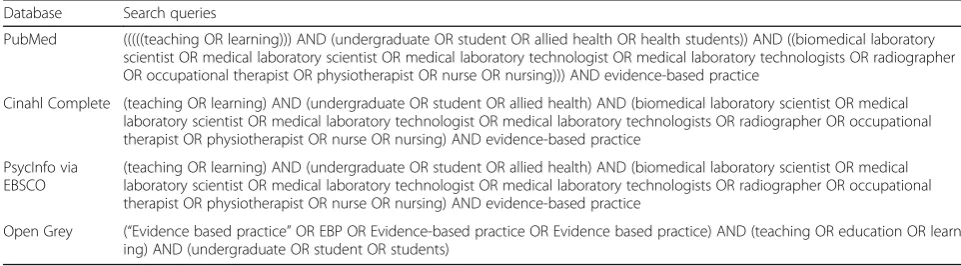
covering grey literature in Europe. Table
1
provides a
list of the specific search queries used in all databases.
Step 3: The reference lists of identified studies were
searched for additional studies.
Study selection
records before 01.01.2010, two reviewers independently
screened titles and abstracts of the remaining articles for
relevance in relation to the research question and the
in-clusion and exin-clusion criteria. Afterwards, all full-text
arti-cles
were
further
checked
for
relevance
by
two
independent reviewers. Any inconsistencies between the
two reviewers regarding study selection for final inclusion
were resolved by discussion with a third reviewer.
Data collection
Data from the included articles were extracted using two
data extraction tools as recommended in The Joanna
Briggs Institute Reviewers’
Manual [16,
17]. The first
data extraction tool comprised study characteristics,
while the other data extraction tool comprised methods
for teaching EBP.
Prior to the process of extracting data from the
in-cluded articles, a pilot test using the data extraction
tools was conducted by one reviewer assessing nine
arti-cles. To ensure agreement between reviewers, a second
reviewer checked the same articles. Any disagreements
about the content or use of the data extraction tools
were discussed and resolved.
One reviewer then extracted relevant data from all
in-cluded articles to the data extraction tools. Two other
reviewers split the same articles among them and
ex-tracted data using the same data extraction tools. As a
final step, the first reviewer went through all extracted
data from all of the included articles with each of the
other reviewers to ensure comparability and
complete-ness in the final data extraction tools.
Synthesis and analysis of results
The data extraction tools formed the basis of the final
presentation of the results in two tables consisting of
“Study characteristics”
and
“Key methods for teaching
EBP, the Sicily Statement’s five steps of teaching and
conducting EBP and context”. Study characteristics
in-cluded author, year of publication, title, journal, country
of origin, study design, study participants, methods for
teaching EBP, and main study findings. The key methods
for teaching EBP were identified through a thematic
ana-lysis. All full text articles were read and every teaching
method found was listed. Through a revision of all
teaching methods listed, seven themes were found that
described the most prominent teaching methods, which
were named
“Key methods for teaching EBP”. All
methods were then divided into one of the key methods
for teaching EBP. In some articles, more than one
teach-ing method was described. In that case, the teachteach-ing
method most frequently described was selected and
categorised under the relevant key method. Through
full-text revision the Sicily Statement’s steps of teaching
and conducting EBP and the context (classroom, clinical
practice or a combination of both) in which the teaching
took place was found. To further clarify the content of
the two tables all results listed were described
narra-tively. All tabulated data, except for the key methods for
teaching EBP identified in Table
3, have been cited
dir-ectly from the articles.
Results
Literature search
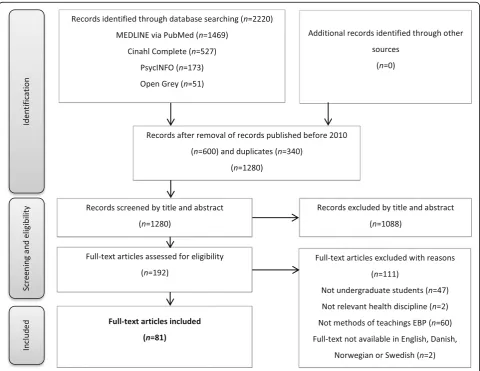
The database search returned 2220 records: PubMed
(
n
= 1469), Cinahl (
n
= 527), PsycINFO (
n
= 173), and
OpenGrey (
n
= 51) (Fig.
1). Records published before
01.01.2010 and duplicates were removed, which left
1280 records to be screened by title and abstract. Based
on relevance, 1088 records were excluded and 192
re-cords were found eligible for full-text assessment. In
ac-cordance with the inclusion and exclusion criteria, 111
articles were excluded. The excluded articles concerned
study participants other than undergraduate healthcare
students
(graduates,
RN-to-BSN
students,
trained
health personnel), study participants from other
health-care disciplines (medicine, dentistry, midwifery), issues
other than methods for teaching EBP (simulation
teach-ing, community health nursteach-ing, EBP beliefs, etc.), and
full-text articles not available in English, Danish,
Nor-wegian, and Swedish (French, Chinese). In agreement
with the other reviewers, 81 studies were finally
in-cluded in the scoping review.
Table 1
Specific search queries, all databases
Database Search queries
PubMed (((((teaching OR learning))) AND (undergraduate OR student OR allied health OR health students)) AND ((biomedical laboratory
scientist OR medical laboratory scientist OR medical laboratory technologist OR medical laboratory technologists OR radiographer OR occupational therapist OR physiotherapist OR nurse OR nursing))) AND evidence-based practice
Cinahl Complete (teaching OR learning) AND (undergraduate OR student OR allied health) AND (biomedical laboratory scientist OR medical laboratory scientist OR medical laboratory technologist OR medical laboratory technologists OR radiographer OR occupational therapist OR physiotherapist OR nurse OR nursing) AND evidence-based practice
PsycInfo via EBSCO
(teaching OR learning) AND (undergraduate OR student OR allied health) AND (biomedical laboratory scientist OR medical laboratory scientist OR medical laboratory technologist OR medical laboratory technologists OR radiographer OR occupational therapist OR physiotherapist OR nurse OR nursing) AND evidence-based practice
Open Grey (“Evidence based practice”OR EBP OR Evidence-based practice OR Evidence based practice) AND (teaching OR education OR
Study characteristics
Study characteristics are presented in Table
2. All
studies were spread across the years 2010–2018.
Al-most half of the studies (
n
= 40) were conducted in
the USA, followed by Canada (
n
= 8), Norway (
n
=
7), Australia (
n
= 6), England (
n
= 6), Sweden (
n
=
3), China (
n
= 2), Finland (
n
= 2), Spain (
n
= 2),
Greece (
n
= 1), Iran (
n
= 1), Lebanon (
n
= 1),
Scotland (
n
= 1), and Taiwan (
n
= 1). The study
de-signs were primarily qualitative (
n
= 55), while 23 of
the studies were quantitative, and three of the
stud-ies used a mixed method. The majority of the
partic-ipants were nursing students (
n
= 72), followed by a
combination of nursing students and students from
other healthcare disciplines (
n
= 5), nursing and
physiotherapy students (
n
= 1), physiotherapy
stu-dents and stustu-dents from other healthcare disciplines
(
n
= 1), occupational and physiotherapy students
(
n
= 1), and physiotherapy students only (
n
= 1).
Key methods for teaching EBP, the Sicily Statement
’
s five
steps of teaching and conducting EBP and context
Table
3
presents the key methods for teaching EBP, the
Sicily Statement’s five steps of teaching and conducting
EBP, and the context. Seven key methods for teaching
EBP were identified: Thirty-two studies described
“Re-search courses and workshops”.
“Collaboration with
clinical practice”
was identified 14 times followed by
“IT
technology”
(
n
= 8),
“Assignments”
(
n
= 5),
“Participation
in research projects”
(
n
= 5),
“Journal clubs”
(
n
= 2), and
“Embedded librarians”
(
n
= 2). In addition, 13 studies
de-scribed various theories of teaching and learning. These
are not elaborated on as the theme is not considered
within the objective of this scoping review.
In Table
3
the vast majority of the studies (
n
= 69)
re-ferred to one or more of the Sicily Statement’s five steps
of teaching and conducting EBP. Eleven studies referred
to all five steps. Thirty-one studies referred to three or
four steps, while 17 studies referred to two of the steps,
Table
2
Study
characteristics
(
N
=
81)
First
autho
r
Y
e
ar
Title
Jour
nal
Count
ry
Design
Participants
Met
hods
for
teac
hing
EBP
Main
study
finding
s
Aglen
[
21
]
2
0
1
6
Pedag
ogical
st
rategies
to
teac
h
bachel
or
students
EB
P:
A
system
atic
review
Nurse
Ed
ucation
Tod
ay
Norw
ay
Qual
itative
Nursing
students
The
ories
of
disc
retion,
know
ledge
trans
fer
an
d
cog
nitive
maturity
de
velopm
ent
Nursi
ng
students
strug
gle
to
see
the
releva
nce
of
evide
nce
for
nurs
ing
pract
ice.
Befor
e
being
introduced
to
info
rmation
literacy
and
research
topic
s,
student
s
nee
d
insight
into
know
ledge
transf
er
and
their
own
episte
mic
ass
umpt
ions.
Knowle
dge
transf
er
related
to
clinical
problems
shoul
d
be
the
learning
situa
tions
prioritised
whe
n
teach
ing
EBP
at
bachel
or
le
vel.
André
[
22
]
20
16
Embe
dding
eviden
ce-based
prac
tice
among
nurs
ing
undergradu
ates:
Resu
lts
from
a
pilot
study
Nurse
Ed
ucation
in
Practic
e
Norw
ay
Qual
itative
Nursing
students
Inf
ormation
abou
t
volu
ntary
part
icipation
in
tw
o
different
clinic
al
research
proje
cts,
ed
ucation
progr
amm
e
rel
ated
to
EBP,
particip
ation
in
clinical
research
projec
ts,
instructions
and
education
in
an
alysing
and
discussing
fin
dings
Improve
ment
in
skil
ls
and
knowle
dge
during
the
study.
Stud
ents
stated
that
EB
P
might
have
an
inf
luence
on
increasing
the
qua
lity
of
nurs
ing
pract
ice.
Balak
as
[
23
]
2
0
1
0
Teach
ing
research
an
d
evide
nce-based
prac
tice
using
a
se
rvice
learn
ing
app
roach
Jour
nal
of
Nursing
Educ
ation
USA
Qual
itative
Nursing
students
A
research
cou
rse
from
a
trad
itional
form
at
to
one
of
evi
dence
app
raisal
an
d
syn
thesi
s,
wh
ich
inc
orporat
ed
service
le
arning
an
d
collaborative
learning
Researc
h
courses
taught
from
an
EBP
perspective
can
provide
mot
ivation
for
students
to
incorporat
e
res
earch
into
their
pract
ice.
Berve
n
[
24
]
20
10
Student
s
col
laborate
with
nurs
es
from
a
nurs
ing
home
to
get
an
evide
nce
based
pract
ice...
Fourth
Europe
an
Nursing
Congre
ss
Jour
nal
of
Clinical
Nursing
Norw
ay
Qual
itative
Nursing
students
Grou
ps
of
st
udents
coop
erate
d
with
prof
essionals
at
Lø
våsen
teac
hing
nursing
home
in
iden
tifying
clinical
issues
that
cou
ld
be
feas
ible
to
inve
stiga
te
an
d
de
velop
up
to
date,
state-of
-art
guide
-line
s
in
relation
to
model
for
EB
P
Student
s
have
develo
ped
an
unde
rstandi
ng
that
the
proces
s
of
EBP
shoul
d
be
utilise
d
in
clinical
prac
tice.
Blaz
eck
[
25
]
20
11
Build
ing
EBP
into
the
foun
dations
of
pract
ice
Nurse
Ed
ucator
USA
Qual
itative
Nursing
students
Ass
ignme
nt
inc
luding
choo
sing
releva
nt
top
ic
an
d
se
arching
releva
nt
databases
The
didac
tic
instruction
of
the
conc
epts
of
searc
h
an
d
the
term
inolog
y
of
se
arch
,
collaborating
with
a
medical
librarian
in
the
teach
ing
and
the
design
of
the
assignm
ent,
the
grading
rubric
for
the
st
udent
s,
and
the
quality
cont
rol
vis
ual
corr
ection
tool
for
our
multiple
raters
,
has
led
to
success
Bloom
[
26
]
2
0
1
3
Levelling
EBP
cont
ent
for
unde
rgraduate
nurs
ing
students
Jour
nal
of
professional
nurs
ing
USA
Qual
itative
Nursing
students
3
undergraduate
research
cou
rses
de
signed
to
prepare
the
grad
uate
to
ident
ify,
loc
ate,
read
and
critically
app
raise
eviden
ce
at
the
indi
vidual
st
udy,
system
atic
revi
ew,
an
d
clinical
practic
e
The
foundat
ion
achieved
by
baccalaureate
graduat
es
stand
them
in
good
stead
as
the
y
pursue
their
clinical
an
d
aca
demic
car
Table
2
Study
characteristics
(
N
=
81)
(Continued)
First autho r Y e ar Title Jour nal Count ry Design Participants Met hods for teac hing EBP Main study finding s gui deline levels Boyd [ 27 ] 20 15 Usin g Deb ates to Teach EBP in Large O n line Courses Jour nal of Nursing Educ ation USA Qual itative Nursing students Interac tive de bates to te ach EB P skills in an online grad uate cou rse Student s remain highl y eng aged wh ile pract icing critical thinki ng, team work , leadership, de legation, comm unication skil ls, and peer eva luation through partic ipation in a se ries of faculty-facilitat ed online de bates. Brow n [ 28 ] 20 15 The iPad: tab let technol ogy to support nurs ing and midwi fery student learning: an evaluation in pract ice Comp uters, Inf ormatics, Nursi ng USA Quant itative Nursing students Use of iPads iPads rep ortedl y improve d student effic iency and time managemen t, wh ile im proving their abi lity to pro vide pat ient ed ucation . Student s who used iPads for the purpose of format ive self-assessme nt app reciate d the immedi ate feedback an d opport unity to de-velop clinical sk ills. Cable-Williams [29
] 20 14 An educational innovat ion to fos ter evide nce-info rmed pract ice Jour nal of Nursing educ ation and Practice Canad a Qual itative Nursing students Thre ading the conce pt of evi dence-inf ormed practic e an d releva nt be st practic e gui delines through theo ry cou rses inc luding their use as exp ected el ements in clinic al pla cem ents The resul ts of research are inf ormin g clien t care an d a critical app roach to professional pract ice among nursing students.
Callaghan [30
Table
2
Study
characteristics
(
N
=
81)
(Continued)
First
autho
r
Y
e
ar
Title
Jour
nal
Count
ry
Design
Participants
Met
hods
for
teac
hing
EBP
Main
study
finding
s
app
roach
to
integrate
evide
nce-based
teac
hing
in
an
unde
rgraduate
wom
en
’
s
health
course
based
nursing
at
[
1
]
fos
tering
unde
rgraduate
nursing
st
udents
’
EB
P
compe
tencies
,
an
d
[
2
]
ident
ifying
gap
s
in
the
lite
rature
to
direct
fu
ture
wom
en
’
s
heal
th
research
and
assessment
tool
for
EB
P.
Dew
ar
[
35
]
20
12
The
EBP
course
as
an
opport
unity
for
writing
Nurse
Ed
ucator
USA
Qual
itative
Nursing
students
Wri
ting
workshops
The
worksho
p
app
roach
provi
de
s
students
with
a
“
saf
e
”
place
to
exp
lore
their
assum
ptions,
learn
from
pe
ers,
an
d
make
a
leap
forward
along
the
ir
person
al
learning
curve
as
writers.
Doyle
[
36
]
2
0
1
6
Info
rmation
Literacy
in
a
Digita
l
Era
:
Unde
rstandi
ng
the
Impac
t
of
Mob
ile
Info
rmation
for
Unde
rgraduate
Nursing
Student
s
Book
chap
ter
in:
Nursing
Info
rmatics
2016
:
eHeal
th
for
All:
Every
Level
Coll
aboration
–
From
Proj
ect
to
Realization
Canad
a
Qual
itative
Nursing
students
Use
of
mobile
info
rmation
res
ources
Nursi
ng
students
mainly
ass
essed
mob
ile
resourc
es
to
support
cl
inical
learn
ing,
and
specific
ally
for
tas
k-oriented
inf
ormation
such
as
dru
g
medi
cation
or
patien
t
cond
itions/
diagno
ses.
Researc
hers
recom
men
d
a
para-digm
shif
t
whereb
y
educ
ators
emphas
ise
in-format
ion
literacy
in
a
way
that
support
s
eviden
ce-ba
sed
qua
lity
care.
Eales- Reynol
ds
[
37
]
20
12
A
study
of
the
devel
opment
of
critical
thinki
ng
sk
ills
Nurse
Ed
ucation
Tod
ay
Aus
tralia
Qual
itative
Nursing
students
and
st
udent
s
from
other
healthc
are
discipl
ines
A
novel
we
b
2.
0-based
tool
–
the
We
b
Resou
rce
Apprais
al
Proc
ess
(WRA
P)
To
ens
ure
that
pract
ice
devel
opment
s
are
based
on
authorit
ative
evide
nce,
students
need
to
de
velop
critical
thinki
ng
skil
ls
which
may
be
facilitat
ed
by
tools
such
as
the
WRAP
.
Elsborg
Fos
s
[
38
]
20
14
A
model
(C
MBP)
for
collaboratio
n
b
e
tween
univ
ersity
col
lege
and
nurs
ing
pract
ice
to
prom
ote
research
utiliz
ation
in
student
s
’
clinical
placements:
a
pilot
study
Nurse
Ed
ucation
in
Practic
e
Norw
ay
Quant
itative
Nursing
students
CM
BP
(The
Coll
aboration
Mod
el
of
Best
Pract
ice)
The
CMBP
ha
s
a
potent
ial
to
be
a
useful
mod
el
for
teach
ing
RNs
’
an
d
students
EBP.
Howe
ver,
fu
rther
refinem
ent
of
the
mod
el
is
neede
d.
Epstei
n
[
39
]
20
11
Teach
ing
Stat
istics
to
Unde
rgraduate
Nursing
Student
s:
An
Integ
rative
Review
to
Inf
orm
our
Pedag
ogy
Internat
ional
Jour
nal
of
Nursi
ng
Ed
ucation
Scholarship
USA
Qual
itative
Nursing
students
Lea
rning
strategies:
Sch
ematic
links
betwee
n
st
atistics
an
d
every
day
nurs
ing
prac
tice.
Tec
hnolo
gical
Strat
egies:
use
of
data
analysis
softw
are
(Exc
el,
SPSS
etc.)
+
use
of
the
Intern
et.
Group
learning
activ
ities:
Sm
all
group/
work
shop
activities.
Support:
st
udent,
faculty,
−
and
lab
oratory
support
It
was
foun
d
that
there
is
limite
d-to-no
evi
-dence
conc
erning
the
pedagogy
of
statistics.
Erichs
en
[
40
]
20
18
Kunnskap
sba
sert
praksis
i
sykeple
ierutdanninge
n
Sykep
leien
Fors
kning
nr.
12,016
Norw
ay
Qual
itative
Nursing
students
Des
cription
of
le
arning-activ
ities
includ
ing
all
step
s
in
teac
hing
and
cond
ucting
Syste
matic
training
in
EBP
in
coop
eration
with
the
pract
ice
field
can
ha
ve
a
po
sitive
impact
on
students
’
learning.
Table
2
Study
characteristics
(
N
=
81)
(Continued)
First
autho
r
Y
e
ar
Title
Jour
nal
Count
ry
Design
Participants
Met
hods
for
teac
hing
EBP
Main
study
finding
s
EB
P
internat
ional
and
Norw
egian
research
with
differ
ent
study
designs
is
neces
sary
to
increase
the
know
ledge.
Florin
[
41
]
2
0
1
2
Educational
support
for
research
utiliz
ation
and
capability belief
sregarding
evide
nce-based
prac
tice
skills:
a
nation
al
survey
of
se
nior
nurs
ing
students
Jour
nal
of
AdvancedNursing
Sw
eden
Quant
itative
Nursing
students
Ed
ucation
al
support
for
res
earch
utilisation
and
cap
ability
belief
s
reg
arding
EB
P
skills
Student
s
repo
rted
high
capability
belief
s
regarding
evi
dence-based
pract
ice
skil
ls,
but
large
differenc
es
were
fou
nd
betwee
n
uni-versitie
s
for:
stating
a
searchable
que
stion,
seeking
out
releva
nt
know
ledge
and
critically
appraising
and
compi
ling
best
know
ledge
.
Fribe
rg
[
42
]
20
13
Changi
ng
Essay
Writing
in
Undergradua
te
Nursi
ng
Ed
ucation
Throu
gh
Ac
tion
Researc
h:
A
Swed
ish
Examp
le
Nursi
ng
Ed
ucation
Persp
ective
s
Sw
eden
Qual
itative
Nursing
students
Work
shops
and
literature
revi
ew
Actio
n
research
was
fou
nd
to
be
a
rel
evant
proced
ure
for
chang
ing
way
s
of
work
ing
with
literature-based,
bach
elor
degre
e
essays.
Gray
[
43
]
2
0
1
0
Researc
h
odyssey:
The
evolut
ion
of
a
research
partnership
be
tween
bacc
alaureatenursing
students
an
d
pract
icing
nurs
es
Nurse
ed
ucation
Tod
ay
USA
Quant
itative
Nursing
students
A
research
partn
ership
be
tween
bac
calaureate
nurs
ing
st
udent
s
and
nurses
in
two
acut
e
car
e
hospi
tals
The
research
partn
ership
proje
ct
faci
litated
student
learning
and
an
app
recia
tion
of
the
research
proc
ess.
Hande
[
44
]
2
0
1
7
Leveling
Evide
nce-based
Pract
ice
Acro
ss
the
Nurs-ing
Cur
riculum
The
Jour
nal
for
Nurse
Pract
itioner
s
-JNP
USA
Qual
itative
Nursing
students
The
arti
cle
desc
ribes
evol
ving
EB
P
compe
tencies
related
to
BS
N,
MSN
,
an
d
DSN
level
.BSN
le
vel:Team-based
learning,
se
minars,
sm
all
group
activ
ities,
iden
tification
of
clinic
al
problems
,
literature
se
arch,
appraisal
of
lite
rature,
evi
dence-based
projec
t
ad-dre
ssing
a
se
lected
clinical
probl
em
for
the
pur
poses
of
im
proving
clinical
outcom
es
Seam
less
transit
ion
for
the
devel
opment
of
EBP
com
peten
cies
for
nurs
es
at
each
level
of
education
requi
res
thought
,
strat
egicall
y
placed
objec
tives
and
learning
activities
to
be
wove
n
into
the
curriculum
and
courses.
Collaborati
on
among
facu
lty
from
each
educational
le
vel
must
occur.
Teac
hing-learning
method
s
mu
st
be
appro
priate
and
engaging
at
each
level.
Teach
ing-learning
method
s
m
u
st
challen
ge
the
student
to
apply
and
produ
ce
sch
olarly
wo
rk
for
dissemi
nation
Henoc
h
[
45
]
20
14
Nursi
ng
st
udent
s
’
exper
iences
of
involvement
in
clinical
research:
an
exploratory
study
Nurse
Ed
ucation
in
Practic
e
Sw
eden
Quant
itative
Nursing
students
Stud
ents
involved
as
data
col
lectors
in
a
research
proje
ct
Participation
as
dat
a
col
lectors
in
res
earch
has
the
po
tential
to
increase
intere
st
in
nursing
research
among
students.
Hick
man
[
46
]
20
14
EVITEA
CH:
A
study
explori
ng
ways
to
optim
ise
the
uptake
of
EBP
to
undergradu
ate
nurs
es
Nurse
Ed
ucation
in
Practic
e
Aus
tralia
Mixe
d
method
Nursing
students
EV
ITACH
to
explore
st
rategies
to
increase
undergraduate
nurs
ing
st
udent
’
s
eng
ageme
nt
with
EBP
and
to
enhanc
e
their
knowle
dge
ut
ilisation
and
trans
lation
cap
abilities
There
is
little
robust
eviden
ce
to
guide
the
most
effect
ive
way
to
build
know
le
dge
utilisation
and
translationa
l
skil
ls.
Eff
ectively
engaging
undergraduate
nurs
ing
st
udents
in
know
ledge
translation
an
d
utilisat
ion
subjects
could
ha
ve
imme
diate
and
long
term
be
nefits
for
nursing
as
a
profes
sion
an
Table
2
Study
characteristics
(
N
=
81)
(Continued)
First autho r Y e ar Title Jour nal Count ry Design Participants Met hods for teac hing EBP Main study finding s patien t outcom es. Jakubec [ 47 ] 20 13 Student s Con necting Critical App raisal to EPB: A Teaching-Lea rning Ac -tivity for Researc h Literacy Jour nal of Nursing Educ ation Canad a Qual itative Nursing students The Re search in Pract ice Chall eng e including iden tifying research probl ems in pract ice, se arching the literature, an d criti cally evaluating eviden ce Student s valu e how the activ ity highl ighte d the releva nce of research lite racy for their pract ice.Jalali-Nia [48
] 20 11 Effect of eviden ce-ba sed educ ation on Irani an nurs ing students ’ know -ledge and attitud e Nursi ng an d Hea lth Scien ces Iran Quant itative Nursing students Evi dence-based appro ach inc l. The principles of EB P an d PICO . The interven tion an d the cont rol groups, res pectively, were tau ght throu gh an eviden ce-ba sed an d tradit ional app roach Significant differ ence be tween the ave rage scores for attit ude of the groups. No statistic al signific ant differ ence be tween the average sc ores of know ledge. Janke [ 49 ] 2 0 1 2 Prom oting information literacy throu gh collaborative service learning in an undergradu ate res earch course Nurse Ed ucation Tod ay Canad a Qual itative Nursing students Service learning projec t whe re st udents worked in groups, and under the gui dance of a nurs ing instructor and librarian, to an swer a question pose d b y prac tice-based part ners Evaluation of the pro ject indi cated that altho ugh the projec t was chal lenging and labour intens ive students felt the y learned import ant skil ls for their future prac tice. Jelsness -Jørg ensen [ 50 ] 20 14 Does a 3-wee k critical research app raisal cou rse affect how students per-ceive the ir app raisal skills and the releva nce of re-searc h for clinical prac-tice? A repeated cros s-sectional survey Nurse Ed ucation Tod ay Norw ay Quant itative Nursing students and st udent s from other healthc are discipl ines A 3-wee k critical research ap-prai sal course Teach ing students ’ pract ical cri tical appraisal skills im proved their view of the releva nce of research for pat ients, future work as well as their ow n critical appraisal skil ls.
Johnson [51
Table
2
Study
characteristics
(
N
=
81)
(Continued)
First
autho
r
Y
e
ar
Title
Jour
nal
Count
ry
Design
Participants
Met
hods
for
teac
hing
EBP
Main
study
finding
s
col
laboration
and
part
icipation.
Varying
teac
hing
modalities
are
em
ployed
to
eng
age
st
udents
and
reinforce
le
arning.
The
students
are
usin
g
the
Melny
k
et
al.
mod
el
as
a
frame
work;
ask
a
clinic
al
question
usin
g
the
PIC
OT
criteria,
de
velop
st
rategies
to
search,
appraise
res
earch,
use
evide
nce
to
inf
orm
clinic
al
decision-making,
de
sign
a
change,
an
d
disse
minate
the
evi
dence
demons
trati
ng
the
achievement
of
cou
rse
learning
outcom
es.
Kiekkas
[
54
]
20
15
Nursi
ng
st
udent
s
’
attitud
es
toward
statist
ics:
Effect
of
a
biostatistics
course
an
d
asso
ciation
with
exami
natio
n
performance
Nurse
Ed
ucation
Tod
ay
Gree
ce
Quant
itative
Nursing
students
Bios
tatistics
cou
rse
Student
s
’
attitudes
tow
ard
statistics
can
be
improve
d
throu
gh
appro
priate
biostatistics
course
s,
wh
ile
posi
tive
attitud
es
contrib
ute
to
highe
r
course
achievement
s
and
possibly
to
im
proved
statistic
al
skills
in
later
profes
sional
life.
Kyriak
oulis
[
10
]
20
16
Educational
strategies
for
teac
hing
EB
P
to
undergradu
ate
heal
th
students:
system
atic
review
Jour
nal
of
Educational
Evaluation
for
Health
Profe
ssion
s
USA
Quant
itative
Nursing
students
and
st
udent
s
from
other
healthc
are
discipl
ines
Lect
ures,
tutori
als,
wo
rkshops,
conf
erenc
es,
jour
nal
cl
ubs,
an
d
online
session
s
or
com
bination
of
the
se
Multifac
eted
app
roach
may
be
be
st
sui
ted
whe
n
te
aching
EBM
to
health
student
s.
Leach
[
55
]
2
0
1
6
The
impac
t
o
f
research
educ
ation
on
student
nurs
e
attitud
e,
ki
ll
and
uptake
of
evide
nce
Jour
nal
of
Clinical
Nursing
Aus
tralia
Quant
itative
Nursing
students
Re
search
ed
ucation
progr
amm
e
delivered
as
two
ei
ght-we
ek
cou
rses
in
the
thir
d
year
of
ed
ucation
Researc
h
education
may
have
a
significan
t
effect
on
nursing
student
s
’
research
skil
ls
and
use
of
EBP,
and
minim
ise
barri
ers
to
EBP
post-e
ducation.
Lewis
[
56
]
20
16
Diminis
hing
Effect
Sizes
with
Repe
ated
Expo
sure
to
EB
P
Training
in
Ent
ry-Level
H
ealth
Prof
essional
Student
s:
A
Lo
ngitudinal
Study
Physi
otherapy
Canad
a
Canad
a
Quant
itative
Physi
otherapy
student
s
an
d
student
s
from
other
heal
thcare
discipl
ines
Tw
o
sequent
ial
EBP
cou
rses.
1.
EBP
course
was
aim
ed
at
de
veloping
foundation
al
know
ledge
of
and
skil
ls
in
the
five
steps
in
EB
P.
2.
EBP
cou
rse
design
ed
to
teac
h
st
udents
to
app
ly
the
steps
Knowle
dge
and
rel
evance
chang
ed
mos
t
meaning
full
y
(i.e.,
showe
d
the
larges
t
effect
size)
for
part
icipants
with
minim
al
prior
exposu
re
to
training.
Change
s
in
particip
ants
’
confid
ence
an
d
attitud
es
may
require
a
longer
time
frame
and
repeated
train
ing
exposu
re.
Liou
[
57
]
20
13
Innovat
ive
strat
egies
for
teach
ing
nurs
ing
research
in
Taiwan
Nursi
ng
Re
search
Taiwan
Quant
itative
Nursing
students
Inn
ovative
Teac
hing
Strat
egie
s
for
a
research
cou
rse
including
team
work,
lab
oratory
sessio
ns
on
how
to
searc
h
for
published
res
earch
articles,
exp
erimen
ts
an
d
min
i
research
proje
cts
(exp
erime
ntal
group).Didactic
le
cture,
text
book
readings,
This
study
confirme
d
that
usin
g
inno
vative
teach
ing
strat
egies
in
nurs
ing
research
course
s
enhanc
es
student
interest
and
enthus
iasm
about
Table
2
Study
characteristics
(
N
=
81)
(Continued)
First
autho
r
Y
e
ar
Title
Jour
nal
Count
ry
Design
Participants
Met
hods
for
teac
hing
EBP
Main
study
finding
s
manage
rs
in
the
clinical
age
ncies
semest
er
of
the
ir
bacc
alaureate
de
gree
progr
amme
to
synthe
sise
and
use
the
know
ledge,
skil
ls,
an
d
attitud
es
that
prom
ote
patien
t
safe
ty
and
optim
al
out
comes
Oja
[
72
]
2
0
1
1
Usin
g
probl
em-based
learning
(PBL
)
in
the
clinical
setting
to
im-prove
nurs
ing
st
udents
’
critical
thinki
ng:
an
evi-den
ce
revi
ew
Jour
nal
of
Nursing
Educ
ation
USA
Qual
itative
Nursing
students
PB
L
The
studies
revi
ewed
indi
cate
a
p
o
sitive
relationship
betw
een
PBL
and
improve
d
critical
thinki
ng
in
nurs
ing
students.
Penn
ington
[
73
]
20
10
EBP
part
nersh
ips:
build
ing
bridge
s
betw
een
education
and
pract
ice
Nursi
ng
Mana
ge
ment
USA
Qual
itative
Nursing
students
Team
ing
nursing
student
s
with
st
aff
nurs
es
working
on
EB
P
projec
ts
Student
s
we
re
able
to
learn
how
evi
dence
is
utilised
in
the
practice
setting
s.
Phelps
[
74
]
2
0
1
5
Intro
ducing
Info
rmation
Literacy
Comp
etency
Standards
for
Nu
rsing
Nurse
ed
ucator
USA
Qual
itative
Nursin
g
students
Inf
ormation
Literacy
Comp
etency
Standards
for
Hig
her
Ed
ucation
(ILCS
HE)
Nursi
ng
librarians
are
the
Info
rmation
Literacy
exper
ts
who
help
to
integrate
the
se
skills
into
nursing
educ
ation
Philli
ps
[
75
]
20
14
Creati
ve
classro
om
strat
egies
for
teac
hing
nurs
ing
research
Nurse
Ed
ucator
USA
Qual
itative
Nursing
students
Kale
idoscop
es
for
disc
ussion
of
perspectives,
cros
sword
puzzles
to
reinforce
term
inolog
y,
scave
nger
hunt
to
relate
conce
pts
to
the
real
world
,
cook
ie
experim
ent
to
ha
ve
an
overv
iew
of
the
res
earch
process
and
paradigms
,
indi
vidual
react
ion
time,
an
d
a
music
activ
ity
to
reinforce
element
s
of
design
and
sampling
Student
feed
back
was
posi
tive.
These
strategies
help
faculty
com
mun
icate
import
ant
conc
epts
of
nurs
ing
res
earch
in
a
way
that
is
meaning
ful
and
fun
.
Pierce
[
76
]
20
16
The
e-Post
er
Conf
erenc
e:
An
Online
Nu
rsing
Re-searc
h
Course
Lea
rning
Acti
vity
Jour
nal
of
Nursing
Educ
ation
USA
Qual
itative
Nursing
students
e-p
oster
conf
erenc
e
From
all
accounts,
the
confe
rence
was
rate
d
as
posi
tive,
providing
nursing
students
with
opportunitie
s
to
(a)
view
studies
an
d
proje
cts
from
a
wid
er
nurs
ing
scie
nce
audie
nce,
(b)
foster
the
devel
opment
of
import
ant
evaluation
and
comm
unicat
ion
skills,
and
(c)
be
expose
d
to
eviden
ce
that
cou
ld
be
translated
into
their
practic
e.
Putnam
[
77
]
20
11
Conqu
ering
EBP
usi
ng
an
embe
dded
librarian
and
online
searc
h
tool
Jour
nal
of
Nursing
USA
Qual
itative
Nursing
students
Em
bedded
librarians
+
onl
ine
searc
h
too
ls
to
assist
st
udents
in
the
developm
ent
an
d
maste
ry
of
effect
ive
se
arch
techni
ques
Embedd
ed
librarians
and
onl
ine
searc
h
too
ls
are
useful
to
students
as
they
de
velop
information
lite
racy
skills
related
to
se
arching
for
and
screening
information.
Usi
ng
the
se
strategies
for
format
ive
and
sum
mative
assignm
ents
all
ows
st
udent
s
to
de
velop
addit
ional
inf
ormation
literacy
skills
needed
to
integ
rate,
an
alyse,
app
ly,
an
d
prese
nt
information.
Rain
es
[
78
]
2
0
1
6
A
collaborative
strat
egy
Worl
dviews
o
n
evide
nce-USA
Qual
itative
Nursing
students
A
teach
ing
strat
egy
wh
ich
The
teach
ing
strat
egy
pre
sents
a
win-w
Table
2
Study
characteristics
(
N
=
81)
(Continued)
First
autho
r
Y
e
ar
Title
Jour
nal
Count
ry
Design
Participants
Met
hods
for
teac
hing
EBP
Main
study
finding
s
clinic
al
question,
appraise
syst
emat
ic
revi
ews
an
d
othe
r
lite
rature
,
4
.
Faculty
consult
st
udents
incl.
Intr
oduction
to
PIC
O,
5.
Student
s
write
abs
tracts
and
make
power
point
and
post
er
Ruza
fa-Marti
nez
[
86
]
20
16
Effect
ivenes
s
of
an
EBP
course
on
the
EBP
compe
tence
of
undergradu
ate
nurs
ing
students:
A
quasi-exper
iment
al
study
Nurse
Ed
ucation
Tod
ay
Spain
Quant
itative
Nursing
students
A
15-we
ek
cou
rse
design
ed
to
teach
EBP
compe
tence
Unde
rgraduate
nursing
student
s
exp
erience
positive
chang