116
STUDIES ON THE BIOLUBRICANT PROPERTIES OF
MORINGA
OLEIFERA
SEED OIL: CORRELATING VISCOSITY AND FATTY ACID
COMPOSITION
Louis M. Nwokocha*; Toyib B. Aremu
Chemistry Department, University of Ibadan, Ibadan, Nigeria *Corresponding author ; E-mail: [email protected]
Received: 9th January 2017 Revised: 29th June 2017 Accepted: 4th July 2017
ABSTRACT This study examined the characteristics of Moringa oleifera seed oil as a biolubricant. The study covered the physicochemical and rheological characteristics of the seed oil. The seed yielded 37.9% oil with the following physicochemical properties: peroxide value (1.655 meq kg-1), saponification value (154.5 mg KOH g-1), and acid value (9.724 mg KOH g-1).The rheological characteristics of M. oleifera oil showed the oil was solid at 10.1oC and exhibited flow properties typical of vegetable oils in the temperature range 30 to 70oC however it exhibited thermal instability at 90oC as indicated by the entirely shear thinning properties of the oil attributed to polymerization of the oil to gum. The oil had oleic acid (72.73%) as the principal fatty acid. The high viscosity of M. oleifera oil (0.06078 Pas, 30oC) correlates with its high percentage of long chain fatty acids (C ≥16 = 99.86%), and the high oleic acid composition indicates a potential for application as a biolubricant.
Keywords:Moringa oleifera oil, biolubricant, physicochemical, rheological, fatty acid composition
INTRODUCTION
There has been growing interest in the use of vegetable oils as lubricants and hydraulic fluids due to the toxicity and environmental issues arising from conventional petroleum-based fluids. Biolubricant is an alternative lubricant different from mineral oil lubricant as it is prepared from non-conventional energy resources and is nontoxic, biodegradable and eco-friendly. Several vegetable oils have been applied as biolubricant and additives including canola, rapeseed, castor and palm (Hsien, 2015). Vegetable oils with high oleic contents are considered to be the best alternative to substitute conventional mineral oil-based lubricating oils and synthetic esters (Singh & Chhibber, 2013).
117 commodity which has had enormous attention as the ‘natural nutrition of the tropics’ (Anwar et al., 2007).
There have been several reports in literature on extraction and characterization of M. oleifera seed oil. Extraction methods reported included mechanical press (Anwar et al., 2006; Eman & Muhamad, 2016), solvent extraction (Anwar & Bhanger, 2003; Abdulkarim et al. 2005; Anwar et al., 2006) and enzymatic extraction (Abdulkarim et al. 2005; Latif et al., 2011), the yield and physicochemical properties of the oil varied with method of extraction. M. oleifera seed oil has been reported to have high degree of unsaturation with oleic acid (67.8 - 85%) as the most prominent fatty acid (Tsaknis et al., 1999; Abdulkarim et al. 2005; Anwar et al., 2006; Nzikou et al., 2009). Studies on the viscosity of the oil as a function of temperature (Nzikou et al., 2009) and melting behavior (Mohammed et al., 2003; Abdulkarim et al. 2005; Nzikou et al., 2009) of the oil have been reported. Abdulkarim et al. (2007) who investigated the frying stability of M. oleifera seed oil observed it was more stable than canola oil, soybean oil, and palm oil when used in frying. The rheological properties of M. oleifera seed oil
have not been well studied especially over a wide range of temperatures. In this work, we studied the rheological properties of M. oleifera seed oil using steady shear to investigate the changes in viscosity with temperature and oscillatory shear to determine the changes in mechanical properties with temperature. The rheological characteristics were related to the fatty acid composition of the oil.
MATERIALS AND METHODS
Extraction of Oil
Dried pods were collected from M. oleifera trees growing on a farmland on the campus of the University of Ibadan. The seeds were removed from the pods, dehulled and the resulting kernels dried in air at ambient temperature. The dried kernels were then blended using an electric blender. The weight of the pulverized flour was measured (838.87 g), packed in a soxhlet extractor and extracted with hexane for twenty four hours. The M. oleifera seed oil was then concentrated by distillation to remove the hexane.The yield was calculated as in Eq. 1.
(Eq.1)
Physicochemical Tests
Saponification value
Ethanolic potassium hydroxide (0.5N) was pipetted into a conical flask containing 2.0 g of the oil. The content of the flask was refluxed for 45 min, cooled to
room temperature, after which it was titrated with hydrochloric acid (0.5N) using phenolphthalein as indicator. A blank was subjected to the same condition. The saponification value was calculated as in Eq. 2.
100(%) X
g seed pulverized
of Weight
g extracted oil
of Weight
118
(Eq.2)
Where Vb= Titre for the blank (ml), Vs=
Titre for the sample (ml) , C = concentration of HCl (0.5N), 56.1= equivalent weight of KOH, W= Weight of oil in gram (2 g)
Peroxide value
Oil (0.5 g) was added into a boiling tube, glacial acetic acid/chloroform mixture (20 ml; 2:1 volume/volume (v/v)) was added, the boiling tube was placed in boiling water for 1 min after which its content was poured into a conical flask containing KI
solution (20 ml; 5 %). The boiling tube was rinsed twice with distilled water (25 ml) and content added into the conical flask. The liberated iodine was titrated with sodium thiosulphate (0.002N) solution until the amber colour lightens when 1 ml of 1% starch solution was added as indicator. The resulting blue colour was titrated to a colourless end point. A blank was subjected to the same condition. Peroxide value of the oil sample was calculated as in Eq. 3.
Where, Vb = Titre for blank; Vs = Titre for
sample; W = Weight of oil in gram.
Acid value
The number of mg of potassium hydroxide required to neutralize the free acids in 1g of the sample was determined by
placing 0.5 g of the oil in a conical flask containing mixture of ether and ethanol (50 ml; 95% v/v). The resulting solution was titrated with 0.1N ethanolic potassium hydroxide solution using phenolphthalein as indicator. The acid value was expressed as mg KOH g-1 and calculated as in Eq. 4.
W
C
V
value
Acid
s
56
.
1
(Eq. 4)Where, Vs = Titre for KOH used; C=
concentration of KOH (0.1N); 56.1=
equivalent weight of KOH; W = Weight of oil in gram (1 g).
) 3 ( 1000
) ( ) / (
1
Eq W
kg g titrant
of normality V
V kg meq value
Peroxide s b
W C V V g KOH mg value tion
119
Rheological Studies
The rheological measurements were carried out on a Controlled Stress Rheometer (AR 500, TA Instruments Ltd, USA) with cone and plate geometry (40 mm, 2o steel cone and 53μm gap) as reported in Nwokocha & Olorunsola (2016). The oil was placed on the Peltier plate by means of a spatula spoon, the gap was set and the excess oil trimmed off. The sample
was allowed to equilibrate for 30 s at a given temperature before measurement.
Effect of shear rate and temperature on apparent viscosity
The effect of shear rate was determined by performing a stepped flow procedure in the shear rate range 1.0 s-1 to 1000 s-1 at different temperatures, 10 - 90oC. The flow characteristics were determined according to following shear stress-shear rate rheological models (Eqs. 5-9):
Herschel-Bulkley (
n
Y
) (Eq. 5)
Power Law (
n
) (Eq. 6)
Bingham (
Y ) (Eq. 7)
Newtonian (
) (Eq.8)
Casson ( 0.5 0.5 ( )0.5
Y ) (Eq.9)
Where
= shear stress (Pa); = viscosity(Pas);
= shear rate (s-1); Y = yield stress (Pa) and n = rate index.
Oscillation studies
Oscillation stress sweep was carried out on the oil at 10oC at frequency of 1 Hz in order to locate the linear viscoelastic region. A temperature sweep was carried out at temperature 70oC to 0oC at frequency of
1Hz and oscillation stress 0.1 Pa (oscillation stress in the linear viscoelastic region).
Fatty acid composition
120 min and the upper phase (hexane layer) containing the fatty acid methyl esters was recovered and analyzed by gas chromatography (Varian Chromopack, Model- CP3380, USA). 0.2 ml of the methylated sample was injected into the capillary column (VF-1ms, 30m 0.25mm 0.25µm; Part number CP8912) in the splitless mode, (injection temperature 260oC, detector temperature 260oC), the carrier gas was nitrogen (flow rate 30 ml/min) and flowed through the air drier at 571oC, coolable oven at 100oC which
increases with time and the Front FID at 260oC. Fatty acids were identified by comparing with the retention times of FAME with a standard 37 component FAME mixture (Resket). The components eluting from the column were detected by flame ionization detector whose signal output was captured and recorded in computer with Totalchrom software data system. Three replicate GC analyses were performed and the result was expressed as as percentage of the sum of all fatty acids in the sample as indicated in Eq. 10.
) 10 . (
% Eq
areas peak acid fatty total
area peak acid Fatty acid
Fatty
RESULTS AND DISCUSSION
Physicochemical Properties
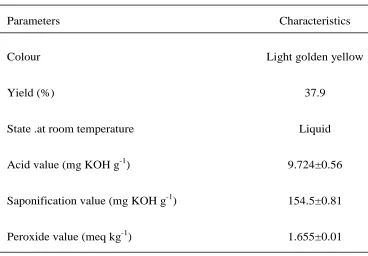
The physicochemical properties of M. oleifera oil are presented in Table 1. The
121
Table 1. Physicochemical properties of Moringa oleifera seed oil
Parameters Characteristics
Colour Light golden yellow
Yield (%) 37.9
State .at room temperature Liquid
Acid value (mg KOH g-1) 9.724±0.56
Saponification value (mg KOH g-1) 154.5±0.81
Peroxide value (meq kg-1) 1.655±0.01
Mean ± standard deviation (n=3)
The acid value obtained for the M. oleifera seed oil (9.724±0.56 mg KOH/g) is higher than (3.8±0.28 mg KOH/g) reported by Ogbunugafor et al. (2011). The oil is less corrosive than pawpaw (47.12 mg KOH/g) and orange (51.4 mg KOH/g) seed oils (Audu et al., 2013). The acid value is outside the range (0.00-3.00 mg KOH/g) recommended for cooking oil (Oderinde et al., 2009).
The peroxide assay is a predominant test for oxidative rancidity in oils and fats. A high peroxide value for any oil shows that the oil has less resistance to lipolytic hydrolysis and oxidation. The peroxide value of M. oleifera seed oil (1.655±0.01 meq kg-1) is low and indicates less susceptibility to oxidation (Ezeh et al.,
2012). The saponification value (154.5 mg KOH/g) is lower than 164.09 -171.9 mg KOH/g (Ogbunugafor et al., 2011; Orhevba et al., 2013) but higher than 143.76 mg KOH/g reported for African pear oil. The oil could be good for soap making. Saponification value is inversely proportional to the mean molecular weight of the glycerides in the oil (Ikhuoria & Maliki, 2007).
Rheological Properties
122
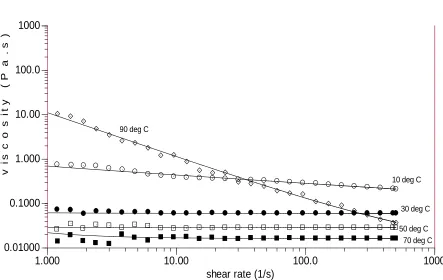
Figure 1.
Viscosity- shear rate curves of
Moringa oleifera
oil at different temperatures fitted to
several rheological models
1.000 10.00 100.0 1000
shear rate (1/s) 0.01000
0.1000 1.000 10.00 100.0 1000
v
is
c
o
s
it
y
(
P
a
.
s
)
90 deg C
10 deg C
30 deg C
123
Table 2. Parameters of the flow curves of Moringa oleifera seed oil fitted to various shear stress-shear rate rheological models
Model Parameter 10oC 30oC 50oC 70oC 90oC
Herschel-Bulkley σy η n s.e 0.03131 0.6682 0.8153 2.498 1.198E-3 0.06078 0.9977 0.430597 4.191E-3 0.02894 0.9995 0.8651 5.757E-3 0.01634 1.001 1.182 11.05 0.05649 0.7956 78.9488
Power law η
n s.e 0.6718 0.8145 2.526 0.06082 0.9976 0.439333 0.02911 0.9986 0.8070 0.01659 0.9983 1.285 11.37 0.04627 107.203
Bingham σy
η s.e 1.945 0.2194 24.53 0.01011 0.05995 0.467213 1.839E-4 0.02887 0.8290 5.483E-3 0.01641 1.184 11.22 0.01642 80.2825
Newtonian η
s.e 0.2258 29.72 0.05995 0.562186 0.02887 0.8291 0.01641 1.336 0.05302 557.709
Casson σy
η s.e 0.8723 0.1801 12.39 8.185E-4 0.05919 1.01729 5.675E-7 0.02888 0.8489 3.168E-5 3.433E-4 280.7 10.68 1.958E-3 82.2773 σy = shear stress (Pa), η= viscosity (Pas), n = rate index (dimensionless), s.e = standard error.
The flow curve at 10oC and 90oC were different from the other curves as they were essentially shear thinning or Non-Newtonian flow. From Table 2, it can be seen that there was a decrease in viscosity as temperature increased from 10oC to 70oC. This is because an increase in temperature results in an addition of thermal energy to a system which will increase the vibrational energy of the molecules and thereby weaken the inter- and intra-molecular associations resulting in ready flow. This is in agreement with results observed with other oils (Stanciu, 2012; Nwokocha & Olorunsola, 2016). However the change in viscosity at 90oC was unusual, instead of viscosity decreasing, it rather increased. The
124 induced polymerization of unsaturated carbons in the oil to a resinous mass. The reactivity and polymerization of unsaturated carbon in oil forming long chains of molecules has being remarked (Srivastava & Sahai, 2013). All the shear stress-shear rate rheological models failed to describe the flow characteristics of M. oleifera oil at 90oC. The Casson model also failed to describe the rheological properties of the oil at 70oC as seen from the high values of the standard errors of estimates which are more than 20. The high yield stress (11.05 Pa) and the shear thinning characteristic indicated by the low value of the rate index (0.7956), support the observed transformation of the oil. The instability of the M. oleifera oil at
90oC is a limitation to its suitability as biolubricant at temperatures ≥ 90o
C. Nzikou et al., (2009) studying the effect of temperature (5 - 45oC) on the viscosity of M. oleifera seed oil observed a similar decrease in viscosity as temperature increased, and at 30oC, the viscosity of the oil was 0.04527 Pas for Blye and Dyer (chloroform) extraction method and 0.04815 Pas for soxhlet (petroleum ether) extraction method.
Figure 2 shows the oscillation stress sweep used to obtain the linear viscoelastic region. Oscillation stress of 0.1 Pa which fell within the linear viscoelastic region- a region where the material properties of the oil were not affected by the applied stress was used for temperature sweep.
125
Figure 2. Elastic modulus (G), loss modulus (G ) versus oscillation stress at 1Hz, 10oC.
0.01000 0.1000 1.000 10.00 100.0 osc. stress (Pa)
0.1000 1.000 10.00 100.0 1000 10000
G
'
(
P
a
)
0.1000 1.000 10.00 100.0 1000 10000
G
''
(
P
a
126
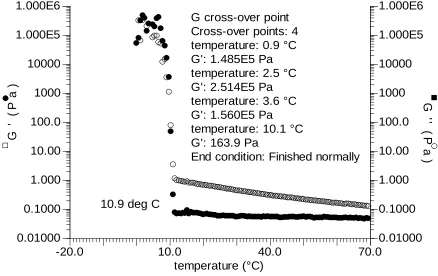
Figure 3. Temperature sweep showing elastic modulus (G′), loss modulus (G″) versus temperature at frequency of 1Hz, oscillation stress of 0.1 Pa
-20.0 10.0 40.0 70.0
temperature (°C) 0.01000
0.1000 1.000 10.00 100.0 1000 10000 1.000E5 1.000E6
G
'
(
P
a
)
0.01000 0.1000 1.000 10.00 100.0 1000 10000 1.000E5 1.000E6
G
''
(
P
a
)
10.9 deg C
G cross-over point Cross-over points: 4 temperature: 0.9 °C G': 1.485E5 Pa temperature: 2.5 °C G': 2.514E5 Pa temperature: 3.6 °C G': 1.560E5 Pa temperature: 10.1 °C G': 163.9 Pa
End condition: Finished normally
Figure 3 shows the elastic modulus (G′), loss modulus (G″) versus temperature for M. oleifera oil at frequency of 1 Hz and oscillation stress of 0.1 Pa. As temperature decreased from 70oC, the distance between G′ and G″ became wider but G″ > G′ indicating the viscous nature of the oil. At 10.9oC there was a sharp change in the values of the moduli with the separation becoming narrower indicating increased association between oil molecules and an approach to transition. However a crossover occurred at 10.1oC (G′ = G″ = 163.9 Pa). Thus 10.1oC could be taken as the melting point of the oil. Above 10.1oC the oil was liquid-like (G″ > G′) but below this temperature the oil was solid-like (G′ > G″). This explains the flow characteristics of M.
127 melting point of 28oC for the oil. In a study by Nzikou et al., (2009) using DSC, they observed three different melting transitions which they attributed to the existence of different crystal forms in the oil they associated this to different degrees of saturation/unsaturation of the fatty acids. They also observed that the melting point depended on the method of extraction and scan speed in the DSC. At a scan rate 10oC/min over a range (-50o to 50oC) they obtained the following melting transition temperatures: (petroleum ether extracted: 10.64oC, -6.71oC, -31.54oC) and (chloroform extracted: 11.13oC, -6.23oC, -33.52oC). The first transition in a cooling
cycle for solvent extracted oil (10.64oC) is close to 10.1oC which we obtained by rheometry.
Fatty acid Composition
The fatty acid profile of M. oleifera seed oil is shown in Table 3.
The major fatty acids in order of abundance were oleic acid (72.73%), palmitic acid (7.25%), linoleic acid (5.75%) and stearic acid (4.63%). Oleic acid is the principal fatty acid in M.oleifera seed oil and this agrees with values (67.8 - 85%) in the literature (Tsaknis et al., 1999; Abdulkarim et al., 2005; Anwar et al., 2006)
.
Table 3.Fatty acids present in Moringa oleifera seed oil
Peak Name Fatty Acid Present Retention Time Fatty acid (%)
C14:0 Myristic acid 37.228 0.14
C16:0 Palmitic acid 41.005 7.25
C16:1 Palmitoleic acid 41.757 1.50
C18:0 Stearic acid 44.925 4.63
C18:1n9c Oleic acid 45.672 72.73
C18:2n6c Linoleic acid 45.761 5.75
C18:3n6 Ɣ-Linolenic acid 48.846 0.51
C20:0 Arachidic acid 49.327 2.26
C18:3n3 Linolenic acid 50.235 1.46
C20:4n6 Arachidonic acid 55.311 3.47
C24:0 Lignoceric acid 63.86 0.30
128
Table 4. Classification of the fatty acids in Moringa oleifera seed oil
Saturated Fatty Acid, SFA (%) 14.58
Unsaturated Fatty Acid, UFA (%) 85.42
Monounsaturated Fatty Acid, MUFA (%) 74.23
Polyunsaturated Fatty Acid, PUFA (n≥2) (%) 11.19
Fatty Acid (C ≥16) (%) 99.86
Table 4 shows the classification of the fatty acids in M. oleifera seed oil. The oil contained 85.42% unsaturated fatty acids (UFA) of which 74.23% were monounsaturated (MUFA). M. oleifera seed oil contained principally long chain fatty acids with C ≥ 16 of 99.86%. The thermal instability of the M. oleifera oil at high temperatures has been attributed to the thermal polymerization of the UFA.
Biolubricant Characteristics
The biolubricancy of a vegetable oil is determined by its viscosity and the type of fatty acids it contains. The ability of the vegetable oil to create and maintain a lubrication film between two moving metal surfaces is much dependent on the viscosity of the oil itself (Kittiwake).
The M. oleifera oil had a viscosity of 0.06078 Pas at 30oC. This is in the range of viscosities of vegetable oils like canola, rapeseed and sunflower applied as biolubricants (Fasina & Colley, 2008; Diamante & Lan, 2014). This viscosity is higher than 4.5 x 10⁻² Pas reported for D. microcarpum (C ≥ 15 =79.41%), 5.6 x10⁻² Pas for A. africana (C ≥ 15 = 96%)
(Nwokocha & Olorunsola, 2016). It has been reported that vegetable oils with high oleic contents are best oils as biolubricant (Singh & Chhibber, 2013). The oleic acid content of M. oleifera seed oil (72.73%) is high indicating a potential for application as a biolubricant. M. oleifera oil is a triacylglycerol with long fatty acid chains and polar groups which make it amphiphilic in character, and therefore allows it to be an excellent choice as lubricant and functional fluid. The polar ester groups in the oils possess more sites to react and adsorb with metal surfaces to provide boundary lubrication effects (Hsien, 2015). Boyde & Randley (2013) have stated that these triacylglycerol molecules in vegetable oils orient themselves with the polar end at the solid surface making a closed packed monomolecular or multimolecular layer resulting in a surface film that provides desirable qualities in a lubricant. Another advantage of long chain triacylglycerol is the very low volatility due to the high molecular weight of the triglyceride molecule and excellent viscosity properties.
129 temperatures (~10oC) as the oil solidifies and forms fatty crystals and therefore would not form continuous film on metal surface. Also at temperatures ~90oC the oil also fails because it polymerizes to a resinous mass. For environmental safety, M. oleifera oil can be used as biolubricant in machinery that loses oil directly into the environment during use like Chain saw, and in machinery used in any sensitive areas, such as in or near water (Hsien, 2015).
CONCLUSION
Moringa oleifera gave a high oil yield (37.9%), a quantity high for commercial exploitation. The oil has a melting point of 10.1oC and is essentially Newtonian at 30- 70oC with viscosity decreasing from 0.06078 - 0.01634 Pas with increasing temperature. It exhibited thermal instability at 90oC polymerizing to gel-like material with strong shear thinning property. The major fatty acid in M. oleifera oil was oleic acid. The characteristics of the oil make it a candidate for biolubricant.
ACKNOWLEDGEMENT
One of the authors, L.M. Nwokocha, thanks the Director, CWSP, Glyndwr University, Wrexham, UK, for the use of the Controlled Stress Rheometer.
REFERENCES
Abdulkarim, S. M., Long, K., Lai, O. M., Muhammad, S. K. S. & Ghazali, H. M. (2005). Some physicochemical properties of Moringa oleifera seed oil extracted using solvent and aqueous enzymatic methods. Food Chemistry 93: 253–263.
Abdulkarim, S. M., Long, K., Lai, O. M., Muhammad, S. K. S. & Ghazali, H. M. (2007). Frying quality and stability of high-oleic Moringa oleifera seed oil in comparison with other vegetable oils. Food Chemistry 105(4): 1382-1389.
Anwar, F., Ashraf, M. & Bhanger, M.I. (2005). Interprovenance variation in the composition of Moringa oleifera oil seeds from Pakistan. Journal of American Oil Chemists Society 82: 45–51.
Anwar, F. & Bhanger, M.I. (2003). Analytical characterization of Moringa oleifera seed oil grown in temperate regions of Pakistan. Journal of Agricultural and Food Chemistry 51(22): 6558-63.
Anwar, F., Latif, S., Ashrat, M. & Gilani, A.H. (2007). Moringa oleifera: A food plant with multiple medicinal uses. Phytotherapy Research 21: 17-25.
130 Audu, T. O. K., Aluyor, E. O., Egualeona, S.
& Momoh, S. S. (2013). Extraction and characterization of Chrysophyllum albidum and Luffa cylindrica seed oils. Petroleum Technology Journal: An International Journal 3(1): 1-7
Boyde, S. & Randley, S.J. (2013). Chapter 3 Esters. Synthetics, mineral oils and biobased lubricants: Chemistry and Technology. Rudnick, L.R. (Ed.), (pp 62-63), 2nd Edition, CRC Press,Taylor and Francis, Oxford, United Kingdom.
Diamante, L.M. & Lan, T. (2014). Absolute viscosities of vegetable oils at different temperatures and shear rate range of 64.5 to 4835 s−1. Journal of Food Processing 2014: 1-6.
Eman, N.A. & Muhamad, K.N.S. (2016). Comparison of Moringa oleifera seeds oil characterization produced chemically and mechanically. International Conference on Chemical Engineering and Bioprocess Engineering IOP Publishing IOP Conf. Series: Earth and Environmental Science 36: 012063
Ezeh, I.E., Umoren, S.A., Essien, E.E. & Udoh, A.P. (2012). Studies on the utilization of Hura crepitans L. seed oil in the preparation of alkyd resin. Industrial Crops and Products 36: 94-99.
Fasina, O.O. & Colley, Z. (2008). Viscosity and specific heat of vegetable oils as a function of temperature: 35°C to 180°C. International Journal of Food Properties 11: 738–746.
Hsien, L.Y. W. (2015). Chapter 2 Utilization of vegetable oil as bio-lubricant and additive toward green lubrication in machines. Springer Briefs in Green Chemistry for Sustainability, (pp1-17), Springer Publishing, New York, USA.
Ikhuoria, E.U. & Maliki, M. (2007). Characterization of avocardo pea (Persea americana) and African pea (Dicryodes edulis) extracts. African Journal of Biotechnology 6(7): 950-952.
Kittiwake, P. Viscosity: A lubricant’s most important characteristic. Parker Kittiwake.
www.kittiwake.com/sites/default/files/ 2%20-%20Viscosity%20Dec12_0.pdf (Sourced 18-8-2016).
Latif, S., Anwar, F., Hussain, A. I. & Shahid, M. (2011), Aqueous enzymatic process for oil and protein extraction from Moringa oleifera seed. European Journal of Lipid Science and Technology 113: 1012–1018.
131 Putra Malaysia Press, Serdang Press, Selangor, Malaysia.
Nzikou, J.M., Matos, L., Moussounga, J.E., Ndangu, C.B., Kimbonguila, A., Silou, T., Linder, M., & Desobry, S. (2009). Characterization of Moringa oleifera seed oil variety Congo-Brazzaviile. Journal of Food Technology 7(3): 59-65.
Nwokocha, L.M. & Olorunsola, F.T. (2016). Rheological characteristics and fatty acid compositions of Afzelia africana and Detarium microcarpum seed oils. Journal of Cereals and Oilseeds 7(4): 34-43.
Oderinde, R. A., Ajayi, I. A. & Adewuyi, A.
(2009). Characterization of seed and seed oil of Hura crepitan and the kinetics of degradation of the oil during heating. Electronic Journal of Environmental Agriculture and Food Chemistry 8(3): 201-208.
Ogbunugafor, H. A., Eneh, F. U., Ozumba, A.N., Igwo-Ezikpe, M.N., Okpuzor, J., Igwilo, I.O., Adenekan, S.O. & Onyekwelu, O.A. (2011).
Physicochemical and antioxidant properties of Moringa oleifera seed oil. Pakistan Journal of Nutrition 10 (5): 409-414.
Orhevba, B. A., Sunmonu, M. O. & Iwunze, H. I. (2013). Extraction and
characterization of Moringa oleifera seed oil. Research and Reviews: Journal of Food and Dairy Technology, 1(1): 22-27
Paquot, C. (1979). IUPAC. Standard methods for the analysis of oils, fats and derivatives. C. Paquot (Ed.), 6th ed., (pp 96-98), Pergamon Press, Oxford, United Kingdom.
Singh, C.P. & Chhibber, V.K. (2013). Chemical modification in Karanja oil for biolubricant industrial applications. Journal of Drug Delivery and Therapeutics 3: 117-122.
Srivastava, A. & Sahai, P. (2013). Vegetable oils as lube basestocks: A review. African Journal of Biotechnology12(9): 880-891.
Stanciu, I. (2012). A new viscosity-temperature relationship for vegetable oil. Journal of Petroleum Technology and Alternative Fuels 3(2): 19-23.