Density Peaking by Parallel Flow Shear Driven Instability
∗
)
Yusuke KOSUGA
1,2), Sanae-I. ITOH
2,3)and Kimitaka ITOH
3,4)1)Institute for Advanced Study, Kyushu University, Fukuoka 812-8581, Japan 2)Research Institute for Applied Mechanics, Kyushu University, Fukuoka 816-8580, Japan
3)Research Center for Plasma Turbulence, Kyushu University, Fukuoka 816-8580, Japan 4)National Institute for Fusion Science, Toki 509-5202, Japan
(Received 25 November 2014/Accepted 16 February 2015)
A theory to describe coupled dynamics of drift waves and D’Angelo modes is presented. The coupled dynamics is formulated by calculating fluctuation energy evolution. When drift waves dominate, turbulence production is due to release of free energy in density profile. Drift waves in turn exert Reynolds stress to drive secondary axial flows. When parallel flow shear is strong, D’Angelo modes dominate. Turbulent production occurs from release of free energy in parallel flow shear. D’Angelo modes can generate a secondary structure in density profile and can peak density profile. It is shown that when D’Angelo modes are unstable, they necessarily contribute to an inward particle flux, that compete against an outward, down-gradient flux. Net inward, up-gradient particle flux can result for strong flow shear, which can lead to density peaking in plasmas. Application to laboratory and astrophysical plasmas is discussed.
c
2015 The Japan Society of Plasma Science and Nuclear Fusion Research
Keywords: drift wave, D’Angelo mode, transport, up-gradient transport, residual stress DOI: 10.1585/pfr.10.3401024
1. Introduction
Structural formation in turbulent plasmas is one of fundamental problems in plasma physics [1, 2]. A well-known example is the formation of zonal flows [3]. Pri-marily, turbulence is driven by free energy stored in den-sity or pressure gradient [4]. Once excited, drift wave tur-bulence generate zonal flow by exerting Reynolds stress. More recently, it is discussed that a different type of sec-ondary flow structure, i.e. flows along magnetic fields, can emerge from drift wave turbulence [5]. In this case, drift wave turbulence with broken parallel symmetry can exert residual stress to drive flows [6]. Flows in turn impact dy-namics of turbulence. For example, flows can stabilize the background turbulence. Flows themselves also can serve as a source for turbulence. As a consequence, turbulent plasmas are characterized by multiple driving free energy and by multiple secondary structures. Their feedback and cross coupling are key to understand dynamics of turbulent plasmas.
As a specific example of turbulent plasmas with cou-pled free energy source and secondary structures, here we focus on the coupling of gradient in density and flows along magnetic field lines. Indeed, flows along magnetic field is ubiquitous and can be found in many systems. For example, there are toroidal flows in magnetically confined plasmas [5]. The toroidal rotation can be driven either by external torque exerted from neutral beam injection or by
author’s e-mail: [email protected]
∗)This article is based on the invited presentation at the 24th International
Toki Conference (ITC24).
intrinsic torque exerted by drift wave turbulence with bro-ken parallel symmetry. Another example of flows along magnetic field can be found in the earth’s magnetosphere [7]. In this case, flows along the dipole magnetic filed of the earth can drive several phenomena. In the polar mag-netic cusp region, the parallel flows drive turbulent fluctu-ation and can impact anomalous electron pitch angle scat-tering [7]. In addition to these, astrophysical jets can also flows along magnetic field. Magnetic field aligned with flows themselves play an important role in collimating the jet structure [8]. Thus, flows along magnetic fields play a key role to understand phenomenology in several systems, including laboratory, space, and astrophysical plasmas.
Impact of parallel flows on turbulence dynamics has been studied in basic experiments. In the presence of parallel flow shear, parallel compression for ion acoustic waves increases and the phase velocity of ion acoustic in-creases. As a consequence, the shear modified ion acous-tic waves (SMIA) are less Landau-damped and are easier to be destabilized [9–11]. The coupling of SMIA to drift wave type instability has also been studied [12]. When the parallel flow shear increases further, the parallel compres-sion can be negative to drive fluid like, Kelvin-Helmholtz (KH) type instability. The instability is called a D’Angelo mode [14] and the recent experiment [13] reveals the cou-pling of D’Angelo modes and drift waves. Importantly, that experiment measures transport flux and identifies cou-pled density and parallel flow transport. In short, it was reported that: i.) density gradient driven turbulence leads to outward particle flux and exert Reynolds forcing to drive
c
inversion of axial flows. ii.) parallel flow shear can also act as a source for turbulence. When turbulence is driven by parallel flow shear, particle flux can be up-gradient to peak the density profile.
From theoretical perspective, coupling of drift waves and parallel flow shear driven KH was studied by D’Angelo [14]. In that study, a detailed feature of instabil-ity was discussed. Later the effect of magnetic field shear was addressed [15]. Stabilizing effect of parallel flows on underlying turbulence is tested numerically [16–18]. For the impact on transport, application to toroidal momentum transport and heat transport was studied [19]. However, the effect of parallel flow shear driven instability on parti-cle transport has not been understood well. For example, the observed density peaking behavior cannot be addressed by existing theories.
In this paper, we present a theory to describe the cou-pled dynamics of drift waves and D’Angelo modes. We use a simplified fluid model for collisional drift wave insta-bility and parallel flow shear driven D’Angelo mode. The coupled dynamics of drift waves and D’Angelo modes is formulated in terms of fluctuation energy balance evolu-tion. The fluctuation energy evolution is determined by the balance between collisional dissipation and fluctuation production. When drift waves dominate, the production of fluctuation energy is due to the release of free energy in density gradient. Flows along magnetic field can be driven as a secondary structure. When D’Angelo modes dominate, fluctuation energy is produced by releasing free energy in parallel flow shear. As a secondary structure, peaked density profile can be generated. A simplified quasilinear calculation implies that when D’Angelo modes are unstable, inward particle flux is possible.
The remaining of the paper is organized as follows. In section 2, a simplified fluid model for collisional drift waves and D’Angelo modes is presented. In section 3, fea-ture of linear instability is summarized. Instability diagram is presented. The coupled dynamics of drift waves and D’Angelo modes is analyzed in terms of fluctuation energy balance in section 4. In section 5, the form of transport flux is discussed by using quasilinear calculation. Section 6 is summary and discussion.
2. Model
Here we describe a model used to analyze coupled dy-namics of drift waves and D’Angelo modes. The model is given by:
d dtρ
2 s∇2⊥
eφ Te =−
D∇2
eφ Te −
ne n0
, (1a)
d dt
ne n0 =−
D∇2
eφ Te −
ne n0
− ∇v, (1b) d
dtv=−c
2 s∇
ne
n0. (1c)
Here, d/dt =∂t+(c/B)ˆz× ∇φis the total time derivative
withE×Badvection,ρs is the ion sound Larmor radius,
φis electrostatic potential,D =v2the/νeis the parallel
dif-fusivity of electrons,vtheis electron thermal velocity,νeis
electron collision frequency,neis the electron density,n0
is a reference density,vis the parallel velocity of ions. For notation,and⊥denote the direction parallel and perpen-dicular to the magnetic field, respectively. The correspon-dence↔zand⊥↔(r, θ)↔(x,y) is understood hereafter. The model describes coupled dynamics of drift waves and D’Angelo modes. Up to coupling to ion parallel flows, the model reduces to Hasegawa-Wakatani model for colli-sional drift wave turbulence [20]. The phase shift for elec-tron density is caused by elecelec-tron collision. By including coupling to ion parallel flows, we introduce another source of free energy, i.e. parallel flow shear.
3. Linear Analysis
Here we describe linear mode analysis to elucidate the instability dynamics described by the model. By lineariz-ing the equations and by Fourier analyzlineariz-ing, we obtain dis-persion relation as:
ρ2 sk2⊥ ik2
D
ω= −(ω−ω∗e)ω+(c
2
sk2 −cskρskyvz ) (ω+ik2
D)ω−c2sk2
.
(2) Hereω∗e ≡ρsky(cs/Ln) is the electron drift frequency and L−n1 = −n /n0 is the electron density scale length. The
bracket... is used to denote mean quantities.
In order to elucidate instability caused by parallel flow shear, here we focus on adiabatic electron limitk2Dω. In this limit, the dispersion relation reduces to:
(1+k⊥2ρ2s)ω2−ω∗eω−k2c2s
1−ky
k
vz ωci
=0. (3)
From this relation, we can see that parallel flow shear mod-ifies parallel compressibility of ion acoustic waves. When
Fig. 1 Instability diagram. (a) Instability diagram withkLn =1/50 and (b) Instability diagram withkyρs =0.8. In both cases, blue is
without coupling to drift waves, green is original work by D’Angelo, and red is this work. Above the red curve, D’Angelo modes can be unstable and fluctuations are supported by D’Angelo modes. Below the curve, D’Angelo modes are stable and drift waves are supporting fluctuation.
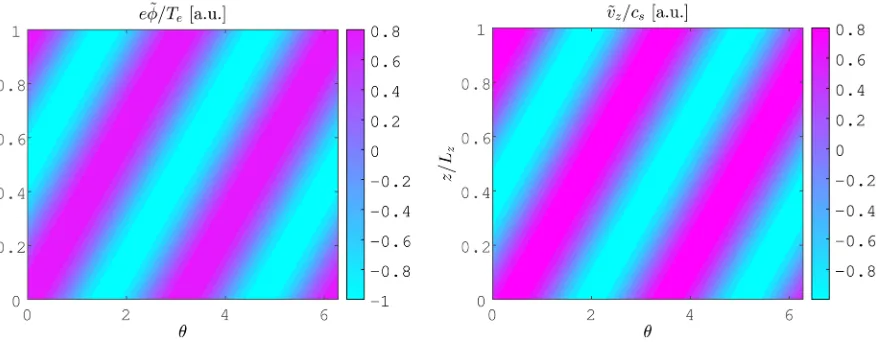
Fig. 2 Contour plot for unstable D’Angelo modes at a radial location. Surface of the cylinder is opened into 2d plane (θ,z). (a) potential fluctuation contour. (b) parallel velocity fluctuation contour. Both are plotted forvz < 0. Due to necessary condition for instability, only modes withkyk<0 can be unstable. As a result, fluctuation has a fixed pitch, as shown in the figure.
free energy in parallel flow shear. The unstable ion acous-tic waves are coupled to drift wave branchω∗. The cou-pling to drift waves introduces stabilizing effect on unsta-ble ion acoustic waves [14].
The above discussion can be summarized into insta-bility diagram, as shown in Fig. 1. The diagram is evalu-ated by solving Eq. 3 for marginal condition. The marginal condition is:
kcsρskθvz =k2c2s+ ω2
∗e
4(1+k2
⊥ρ2s)
. (4)
The relation is plotted in Fig. 1 for: (a) kLn = 1/50 and (b)kyρs = 0.8. In both figures, different colors de-scribe marginal condition for: ion acoustic waves without drift wave coupling (blue), the original D’Angelo modes (green), and the marginal condition for the model
pre-sented here (red). As we can see from the graph, the drift wave coupling is stabilizing for flow shear driven modes. Compared to the original work, the model in this paper in-cludes ion finite inertia. As a result, drift wave frequency reduces fromω∗etoω∗e/(1+ρ2sk⊥2). Thus stabilizing
ef-fect from drift waves is reduced. Above the red curve, D’Angelo modes are unstable and can support turbulent fluctuation. Below the curve, D’Angelo modes are stable and collisional drift waves support turbulent fluctuation.
fluc-tuation has a pattern as shown in Fig. 2. Here, potential is plotted in (θ,z) plane. The pattern of parallel velocity fluctuation is also plotted. In terms of phase, the parallel velocity fluctuation is shifted byδ = tan−1(γ/ωr) π/4.
This is a relation such that the velocity fluctuation drives anomalous loss of parallel momentum transport.
4. Turbulence Energetics
In order to elucidate the coupled dynamics of drift waves and D’Angelo modes, here we discuss fluctuation energetics [22]. From the model equations, the evolution of the total fluctuation energy,I ≡ d3x{(ρ
s∇⊥eφ/˜ Te)2+
(˜ne/n0)2+(˜v/cs)2}/2 is given as:
∂tI=
d3x(P − D), (5a)
P=csρs∂y
eφ˜ Te
˜
ne
n0
∂xne
n0 +
csρs∂y
eφ˜ Te
˜
v cs
∂xvz cs ,
(5b)
D=D
∇
˜
ne n0 −
eφ˜
Te
2
. (5c)
HerePis the production term for turbulent fluctuation and
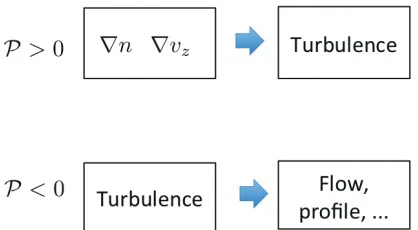
Dis the collisional dissipation. The production term takes the form of flux times gradient. For example, the first term is the product of turbulent particle flux and the gradient in the particle profile, while the second term is the product of turbulent momentum fluxv˜xv˜ and the gradient in par-allel flow velocity. In this sense, the production term can be thought of as entropy production term for fluctuation. Importantly, the production term identifies the direction of energy flow (Fig. 3). For example, if the production term is positive, fluctuation gains energy from free energy source. On the other hand, if the production term is negative, fluc-tuation loses energy to drive secondary structures, such as parallel flows or peaked density profiles.
As an illustration of the fluctuation production, here we first look at fluctuations dominated by drift waves. In this case, by keeping leading order contribution in the particle and momentum transport channel, the production
Fig. 3 A schematics for fluctuation production. When the pro-duction is positive, turbulence gains energy by releasing free energy stored in gradients. When the production is negative, turbulence loses energy and can drive a sec-ondary structure.
term is given as:
P = Dn L2
n
−
k
kyρscsk
k2
D eφ˜k
Te
2∂xvz . (6)
Here the average is evaluated by integrating inyandz di-rection. Dn =
kc2s/(k2D)ρs2ky2|eφ˜k/Te|2 is the turbulent
diffusivity. The first term is the production term associated with density relaxation. This term is positive definite; thus density gradient is driving turbulent fluctuation. This is plausible since we are investigating drift wave dominated regime. In contrast, the second term, which is due to paral-lel flow coupling, can be negative. In this case, drift wave turbulence can generate secondary flow structures in mag-netic field direction. Importantly, to have a finite contribu-tion in this channel, we must havekyk 0 where (...) de-notes spectrum average. In other words, we need a symme-try breaking of drift wave turbulence in the magnetic field direction. This is very analogous to the nature of resid-ual stress to drive intrinsic rotation in toroidal plasmas [6]. In the case of basic experiment, we note that experimental configuration can break the symmetry, since source is lo-cated at one end while sink is lolo-cated at the other end. Thus the symmetry in the magnetic field direction of typical ba-sic experiments is broken and it is quite likely to have non-zero residual stress. As a consequence, it is quite likely to produce a secondary flow structure along magnetic field by drift wave turbulence.
As the second illustration, we discuss production term for D’Angelo modes. In this case, the production term is evaluated as:
P =DV
vz cs
2
−
k
cskρskyvz γKH+k2D
eφ˜k
Te
2. (7)
HereDV=kc2s/(γKH)ρ2sk2y|eφ˜k/Te|2is the eddy viscosity
5. Transport
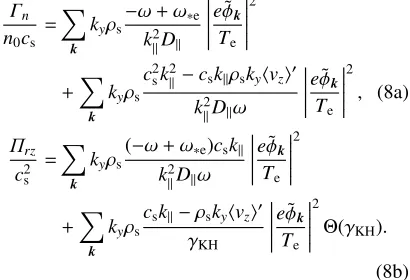
In order to elaborate the impact of the coupled dy-namics on transport processes, here we explicitly evaluate transport fluxes. By using a simplified quasilinear theory, we have:
Γn n0cs =
k
kyρs−ω+ω∗e k2
D eφ˜k
Te
2
+
k kyρsc
2
sk2 −cskρskyvz k2Dω
eφ˜k
Te 2, (8a) Πrz
c2 s
=
k kyρs
(−ω+ω∗e)csk k2
Dω eφ˜k
Te
2
+
k
kyρscsk−ρskyvz
γKH
eφ˜k
Te
2Θ(γKH).
(8b) HereΘ(γKH) is the step function. The transport flux has
both diagonal and off-diagonal terms. The first term in the particle flux is diagonal term, which is driven by density gradient. At the simplest level, this term is related to turbu-lent diffusivity. The second term is off-diagonal term that is related to gradient in parallel flow velocity. Importantly, when D’Angelo modes are unstable, the last term tend to drive inward flux. Later we show that the net inward flux is indeed possible for certain plasma parameters. The mo-mentum flux also has diagonal and off-diagonal terms. The second term is diagonal term, which is driven by parallel flow velocity gradient. At the simplest level, this term is related to eddy viscosity on the flow. The first term is off-diagonal term. This is akin to residual stress, which is important to understand the generation mechanism of intrinsic rotation. Symmetry breaking is required to have non-vanishing residual stress.
To be more specific, here we discuss transport caused by D’Angelo modes. When D’Angelo modes are domi-nant, the turbulent flux reduces to:
Πrz−DVvz , (9a)
Γn n0cs
k
kyρs ω∗e
k2
D
1+2k2
⊥ρ2s
2(1+k2
⊥ρ2s)
eφ˜k
Te
2
−
k
2(1+k2⊥ρ2s)
k2
D
(Lnkρskyvz ) eφ˜k
Te
2. (9b)
Here DV = kc2sγKH/(ω2KH +γ2KH)ρ2sk2y eφ˜k/Te 2
is the eddy viscosity on flows. When D’Angelo modes are dom-inant, momentum flux is down the gradient. The flux is characterized by the eddy viscosity. The particle flux con-sists of two terms. The first part is due to density gradi-ent. This term yields diffusive, outward flux. The second term is off-diagonal term due to gradient in parallel flows. Importantly, this term is negative definite for peaked pro-file Ln ∝ −dn /dx > 0, since necessary condition for D’Angelo modes to be unstable requires kkyvz > 0.
Physically put, the condition is required for turbulence to mix free energy in parallel flow velocity gradient. For a given configuration, the parallel momentum flux ∝ kyk must have a corresponding sign to relax velocity profile. In this situation, the mixing in parallel momentum re-sults in inward flux of particle. The inward particle can compete against the outward, diffusive flux. When the influx due to the parallel flow velocity becomes strong enough, net inward, up-gradient particle flux can result and can peak density profile. By using plasma parame-ters for D’Angelo instability: ρsky = 0.8, kLn = 0.06, eφ/˜ Te ∼ 0.2, cs = 3 × 10³[m/sec], L
n = 0.04 [m], vz=2×10⁵[1/sec], andD
=1.4×10⁴[m2/sec], we have
Γn∼ −0.17×10²¹[1/m2sec]. Thus net inward flux and
den-sity peaking is possible for typical plasmas parameters, as observed in experiments. Finally, we note thatLn <0 for hollowed profile, so the off-diagonal term produces out-ward flux. In this case, D’Angelo mode tends to further hollow the profile.
6. Summary and Discussion
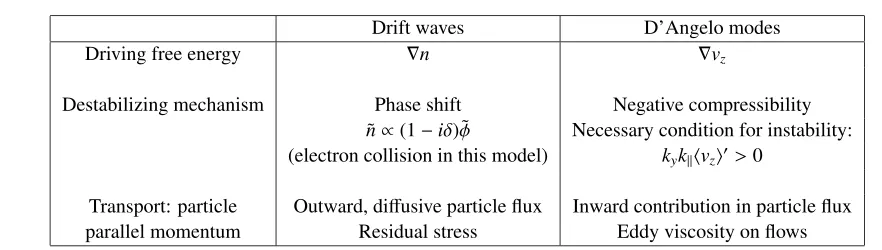
In summary, we have discussed coupled dynamics of drift waves and D’Angelo modes. Plasma parameters that determines which modes are dominant are estimated from Fig. 1. Dynamics is characterized by calculating turbu-lent fluctuation production. The results are summarized in Table 1. When drift waves are dominant, fluctuation is driven by density gradient. Instability is set by phase shift, which is due to electron collision in this model. Trans-port is characterized by diffusive particle flux and residual stress on flows. In particular, to have non-zero residual stress, symmetry breaking in the parallel direction is re-quired. When D’Angelo modes are dominant, fluctuation is driven by parallel velocity gradient. Instability is due to negative compressibility, which is only available for fluc-tuation withkykvz > 0. As a consequence, mode pat-terns are characterized by fixed pitch, as depicted in Fig. 2. Parallel momentum flux is down the gradient and is char-acterized by eddy viscosity. Particle flux consists of both density gradient driven diffusive flux and parallel flow ve-locity driven off-diagonal term. The off-diagonal particle flux is inward for unstable D’Angelo modes. For typical plasma parameters, net inward, up-gradient particle flux is possible, which can be thought of as an origin of density peaking behavior.
geophys-Table 1 A summary of analysis. Relevant driving free energy, relevant destabilizing mechanism, impact on transport are listed. In the presence of multiple driving source, transport interfere each other. For example, drift waves drive transport of parallel momentum, which can result in parallel flow inversion. Alternatively, parallel flow shear driven D’Angelo modes tend to drive inward particle flux, which can cause net inward particle flux to peak density profile.
Drift waves D’Angelo modes
Driving free energy ∇n ∇vz
Destabilizing mechanism Phase shift Negative compressibility ˜
n∝(1−iδ) ˜φ Necessary condition for instability: (electron collision in this model) kykvz >0
Transport: particle Outward, diffusive particle flux Inward contribution in particle flux
parallel momentum Residual stress Eddy viscosity on flows
ical fluid dynamics [23–25]. Secondary, we note that the simplified quasilinear transport modeling presented in this work may not be applicable when plasmas are dynami-cally perturbed [26]. In this case, dynamical perturbation can immediately couple to turbulence dynamics to impact transport processes [27]. This effect may be relevant when we try to control particle transport via parallel flows by in-jecting neutral beam. In this case NBI would dynamically perturb plasmas and transport in these perturbed plasmas would require transport modeling beyond quasilinear the-ory. Finally, another important extension is to extend the analysis presented in this work to collisionless plasmas, where kinetic effect plays an important role. Indeed, some of the branches driven by parallel flows are characterized by resonance drive. Then we may ask a question of what happens when the resonance is strong enough. In this case, we would expect that phase space structures can form and phase space turbulence can develop [28]. Transport in this situation is described not by simplified quasilinear diff u-sive flux but by Lenard-Balescu flux with dynamical fric-tion [29, 30]. Phase space structures may convert poloidal and toroidal flows to produce doubly connected flow struc-ture [31].
With the caveat in mind, here we discuss a possible ap-plication of the ideas presented in this paper. In the context of fusion research, this type of parallel flow shear driven turbulence may be used for fueling control. When parti-cle source is localized in peripheral region, the partiparti-cles can be transported inward by using the parallel flow shear driven turbulence. In the context of astrophysical plasmas, we may be able to exploit this type of ides to explain colli-mation of jets. After injected, astrophysical jets may drive Kelvin-Helmholtz like instability as presented in this work. In that case, parallel flow shear driven instability may drive inward flux of plasmas and may introduce pinching effect, whereby collimation may result.
Acknowledgement
We thank stimulating discussion with Drs. S. Inagaki, T. Kobayashi, P.H. Diamond, A. Fujisawa, A. Fukuyama,
T. Takizuka. This work was supported by Grants-in-Aid for Scientific Research of JSPF of Japan (21224014, 23244113, 25887041), Asada Science Foundation, Kyushu University Interdisciplinary Programs in Education and Projects in Research Development.
[1] B.B. Kadomtsev, Tokamak Plasma: A Complex Physical
System(IoP publishing, Bristol and Philadelphia, 1992).
[2] K. Itoh, S.-I. Itoh and A. Fukuyama,Transport and
Struc-tural Formation in Plasmas(IoP publishing, Bristol and
Philadelphia, 1999).
[3] P.H. Diamond, S.-I. Itoh, K. Itoh and T.S. Hahm, Plasma Phys. Control. Fusion47, R35 (2005).
[4] B.B. Kadomtsev, Plasma Turbulence (Academic, New
York, 1965).
[5] K. Ida and J.E. Rice Nucl. Fusion54, 045001 (2014). [6] P.H. Diamond, Y. Kosuga, Ö.D. Gürcan, C.J. McDevitt,
T.S. Hahm, N. Fedorczak, J.E. Rice, W.X. Wang, S. Ku, J.M. Kwon, G. Dif-Pradalier, J. Abiteboul, L. Wang, W.H. Ko, Y.J. Shi, K. Ida, W. Solomon, H. Jhang, S.S. Kim, S. Yi, S.H. Ko, Y. Sarazin, R. Singh and C.S. Chang, Nucl. Fusion53, 104019 (2013).
[7] W.E. Amatucci, J. Geophys. Res.104, 14481 (1999). [8] B. Albertazzi, A. Ciardi, M. Nakatsutsumi, T. Vinci, J.
Beard, R. Bonito, J. Billette, M. Borghesi, Z. Burkley, S.N. Chen, T.E. Cowan, T. Herrmannsdörfer, D.P. Higginson, F. Kroll, S.A. Pikuz, K. Naughton, L. Romagnani, C. Ri-conda, G. Revet, R. Riquier, H.-P. Schlenvoigt, I.Yu. Sko-belev, A.Ya. Faenov, A. Soloviev, M. Huarte-Espinosa, A. Frank, O. Portugall and H. Pepin, J. Fuchs, Science346, 325 (2014).
[9] V.V. Garvrishchaka, S.B. Ganguli and G.I. Ganguli, Phys. Rev. Lett.80, 728 (1998).
[10] E. Agrimson, N. D’Angelo and R.L. Merlino, Phys. Rev. Lett.86, 5282 (2001).
[11] C. Teodorescu, E.W. Reynolds and M.E. Koepke, Phys. Rev. Lett.88, 185003 (2002).
[12] T. Kaneko, H. Tsunoyama and R. Hatakeyama, Phys. Rev. Lett.90, 125001 (2003).
[13] T. Kobayashi, “Parallel flow structure formation by turbu-lent momentum transport in linear magnetized plasmas,” The 4th Asia Pacific Transport Working Group Interna-tional Conference, BO2 (2014).
[14] N. D’Angelo, Phys. Fluids8, 1748 (1965).
1719 (1973).
[16] L. Bai, A. Fukuyama and M. Uchida, Phys. Plasmas5, 989 (1998).
[17] L. Bai, A. Fukuyama and M. Uchida, Plasma Phys. Con-trol. Fusion40, 785 (1998).
[18] M. Uchida, S. Sen, A.Fukuyama and D.R. McCarthy, Phys. Plasmas10, 4758 (2003).
[19] N. Mattor and P.H. Diamond, Phys. Fluids31, 1180 (1988).
[20] M. Wakatani and A. Hasegawa, Phys. Fluids 27, 611
(1984).
[21] D.R. McCarthy, A.E. Booth, J.F. Drake and P.N. Guzdar, Phys. Plasmas4, 300 (1997).
[22] Y. Kosuga, P.D. Diamond and Ö.D. Gürcan, Phys. Plasmas
17, 102313 (2010).
[23] J.G. Charney and P.G. Drazin, J. Geophys. Res. 66, 83
(1961).
[24] P.H. Diamond, Ö.D. Gürcan, T.S. Hahm, K. Miki, Y.
Ko-suga and X. Garbet, Plasma Phys. Control. Fusion 50,
124018 (2008).
[25] L. Wang, P.H. Diamond and T.S. Hahm, Plasma Phys. Con-trol. Fusion54, 095015 (2012).
[26] S. Inagaki, T. Tokuzawa, N. Tamura, S.-I. Itoh, T. Kobayashi, K. Ida, T. Shimozuma, S. Kubo, K. Tanaka, T. Ido, A. Shimizu, H. Tsuchiya, N. Kasuya, Y. Nagayama, K. Kawahata, S. Sudo, H. Yamada, A. Fujisawa, K. Itoh,
and the LHD Experiment Group, Nucl. Fusion53, 113006
(2013).
[27] S.-I. Itoh and K. Itoh, Sci. Rep.2, 860 (2012).
[28] M. Lesur, P.H. Diamond and Y. Kosuga, Plasma Phys. Con-trol. Fusion56, 075005 (2014).
[29] T.H. Dupree, Phys. Rev. Lett.25, 789 (1970).
[30] Y. Kosuga, P.H. Diamond, L. Wang, Ö.D. Gürcan and T.S. Hahm, Nucl. Fusion53, 043008 (2013).