Basic-SiM Train-The-Trainer: A Model to Prepare
Aviation Educators for Simulation Based-First Aid
Learning
Muhamad Nur Fariduddin1, Wee Lei Hum2∗, Lilia Halim3 and Mohd Johar Jaafar4
1Faculty of Education, Universiti Teknologi MARA (UiTM),
Level 5 & 7, FSK Building 1 5, 42300 Bandar Puncak Alam,
Selangor, Malaysia Selangor Darul Ehsan, Malaysia
2School of Healthcare Sciences, Faculty of Health Sciences, Universiti Kebangsaan Malaysia,
Jalan Raja Muda Abdul Aziz, 50300 Kuala Lumpur, Malaysia
3Department of Methodology & Educational Practice, Faculty of Education,
Universiti Kebangsaan Malaysia, 43600 Bangi, Selangor, Malaysia
4Department of Emergency Medicine, Pusat Perubatan Universiti Kebangsaan Malaysia,
Jalan Yaacob Latif, Bandar Tun Razak, 56000 Cheras, Kuala Lumpur, Malaysia
Medical emergency on board is a new phenomenon that lack of attention. Despite the presence of cabin crew who is certified to provide medical care to the passenger, failure to acquire the non-technical skills and low level of knowledge and technical skills retention is reported to be major challenges in developing a highly competent cabin crew in providing effective medical care. Having the ability to design simulations, implement it into teaching, and effectively evaluate simulated performance is starting to become a key role for educators in health care. For most educators, a practical knowledge and skills gap resides between the need for simulation learning and proficiencies in designing and utilising simulation. The purpose of this model was to develop a ‘trained educators’ from the aviation industry with the knowledge and skills to utilise simulation effectively. The steps involve identification, development, and integration with a follow-up assessment. The implementation of the pro-gram yielded a significant improvement on the participants’ knowledge, t (129) = -6.27, p
< .001 together with a total DASH-SV score of 6.32. The barriers, including difficulties encountered executing the model, are discussed combined with the implication for future ap-plication. This model is an effective approach for developing a trained educator in first aid for aviation incorporated with simulation learning. The trained educator will then become a pioneer and train another organisation.
Keywords: simulation learning, three step model, first aid, aviation education, cabin crew
∗
corresponding author: [email protected]
I. INTRODUCTION
indus-people in Malaysia to choose commercial flights
that are increasingly rising to two million
com-pared to years ago. The statistics of airlines
activities show that the increasing use of
com-mercial flights around the world along with the
addition to ageing population contributes to an
increase in cases involving medical emergencies
in flight (http://www.transtats.bts.gov).
Emer-gency medical case that occurs in flight is a
new phenomenon that lack of attention (Amit
& Shauna, 2013). Apart from a compact and
small cabin with minimal space to provide
med-ical care as well as a low probability to get help
from a medical doctor, nurse or medical
assis-tant are indirectly impacted and caused a variety
of complications to passengers (Amit & Shauna,
2013).
The above mentioned problems can be
over-come by the presence of crew trained in first aid
in ensuring proper treatment is given quickly and
accurately. Each crew member on duty must
un-dergone intensive training and certified as first
aider. In addition, nearly three-quarters of all
emergency cases prevailing are handled alone
by the crew and the crew demonstrates
compe-tence in carrying out their duties as a first aider
(Dowdall, 2007). Based on the guidelines issued
by the Federal Aviation Administration (FAA),
the Aerospace Medical Association (AsMA) Air
Transport Medicine Committee’s, and the
In-ternational Civil Aviation Organization (ICAO),
each aircraft should have an emergency
medi-cal kit, automated external defibrillators (AED),
and crew involved in every flight should be
cer-tified in accordance with the syllabus of first aid
Basic Life Support (BLS).
However, a study conducted by the
Welling-ton School of Medicine in assessing the
under-standing and performance of the CPR (Cardio
Pulmonary Resuscitation) and AED among the
crew who attended the refresher course after a
year showed an unsatisfactory result. These
in-clude their failure to place proper hand position
while performing CPR, usage of AED as well as
low level of knowledge and self-confidence.
Low mastery of technical skills and
knowl-edge retention in first aid among crew members
have been documented in several previous
stud-ies that attributed to several key factors such as
teaching and learning techniques that are less
ef-fective (Kayeet al., 1991), modular teaching and
learning of different uses for each airline academy
(Parnell & Larsen, 2007) and short period in the
training of the crew to acquire the knowledge of
first aid (Mahony et al., 2008).
In addition to knowledge and technical skills,
non-technical skills also play an important role
in improving the safety of patients (Selvadalis et
al., 2012). In medical and health sciences
educa-tion, professional training conducted by faculty
is more focused on technical knowledge and skills
and is not geared specifically to non-technical
skills such as communication, teamwork, and
leadership. However, presently in the medical
world, non-technical skills should also be
im-portant skill that must be practiced in everyday
work (Rasmussenet al., 2012).
In developing a quality crew in providing
medical care to patients, teaching and
learn-ing methods should be extended and no longer
focused on the technical knowledge and skills
alone, due to the lack of exposure to
non-technical skills particularly that contribute
sig-nificantly to an error in giving emergency
treat-ment to passengers (Pronovost, 2013). In
addi-tion, the lack of exposure of the crew in an
emer-gency, short training period, together with time
constraints to interact with the facilitator are
additional factors leading to less effective
exer-cise in conveying knowledge effectively, and thus
have an impact on the quality and crew
perfor-mance in providing emergency treatment to
pa-tients (Dreifuerst, 2009).
The train-the-trainer (TTT) model
inte-grated with simulation-based learning is an
in-structional method that has been used
success-fully in health sciences and medical education
that benefit the development of clinical skills,
knowledge of students, patients and health
man-agement (Riley et al., 2003). Apart from it,
this learning reduces the risk to patients and
improves the performance of medical personnel
to enable them to acquire the skills and
experi-ence without practicing to a real patient
(Don-aldson, 2009). The Institute of Medicine (1999)
also suggests this learning as one of the
innova-tion in strengthening learning in the health
sci-ences clusters that can improve their skills and
thereby reducing the risk of errors on patients.
Nursing professionals are also concerned about
the importance of this learning method,
there-fore trainers in this field use this method as a
teaching and learning methodology to generate
specific clinical skills (Gantt & Webb, 2010).
Having the ability to design simulations,
im-plement it into teaching, and effectively evaluate
simulated performance is starting to become a
key role for educators in health care. For most
educators, a practical knowledge and skills gap
resides between the need for simulation learning
and proficiencies in designing and utilising
sim-ulation. In this article, we share a three-step
train-the-trainer model to coach aviation
educa-tors to utilise simulation effectively in the
per-spective of a non-medical community. The steps
involve identification, development, and
integra-tion with a follow-up assessment. Considering
the fact that this model was utilised to coach
numerous faculty to assimilate simulation across
the curriculum, this could be successfully applied
in preparing staff development educators
partic-ularly trainer or facilitator to implement
simu-lation into their instruction. In this article, we
also discuss potential barriers to success
II. METHODS
A. The Necessity for Development
The present medical condition demands
highly effective methods to prepare cabin crew
with the necessary skills required to address
pas-sengers with complicated needs in order to
de-liver excellent outcomes. The stakes today are
higher for the trainer in the particular airline
academy to cultivate a remarkably skilled cabin
crew. Simulation offers a mechanism for the
stu-dents to practice the application of particular
knowledge, skills (technical & non-technical) and
behaviours whilst contemplating through
possi-ble judgments in a standardised simulated case
scenario within a safe learning environment. The
trainer can create scenarios together with
associ-ated responses to learner actions via low to high
fidelity mannequin. This education offers
prac-tice to better prepare cabin crew to attend to
a complicated patient on board. Therefore, as
a trainer, it is crucial that they have the
knowl-edge and necessary skills not just to design
simu-lations but at the same time to implement them
effectively in their courses and programmes.
B. Trainer Development in the Application
of Simulation: The Train-The-Trainer Model
The train-the-trainer model is an efficient
method for improving an educator’s knowledge
and skill in equally subject material together
with delivery. This method has been proved to
be highly effective (Center for the Health
Pro-fessions, 2012; American Association of Colleges
of Nursing, 2013 & Jeffries, 2008), then again
the method was further improved by the authors
by integrating new instruction for the trainer
and bringing together with a follow-up
assess-ment. By including follow up assessment with
regard to the model, it will enable the trainers
to hone a definite range of acquired skills and
knowledge, for instance, the ability to perform
the complete simulation with debriefing to the
respective learner.
C. Basic SiM - Three Step Model
The three step train-the-trainer model was
adapted from Lane & Mitchell (2013) and
fur-ther customised by the authors to accommodate
the needs to prepare trainer in the aviation
in-dustry for simulation learning. The initial step
involved in the process was to determine the
aviation educators for the simulation education.
These particular educators are going to be
ac-countable for designing and leading the future
implementation of simulation programmes and
will certainly become the simulation trainers of
the current organisation. The following step of
the process was development. The educators
would receive education and training in the skills
and knowledge required to design and execute
the simulation learning. The last steps
high-lighted the integration of educator in the role of
the follow-up sessions to assure the effective
im-plementation.
Step 1: Identification
Prior to the identification of potential
edu-cators, author and team members obtained a
written agreement with one of the airline
com-panies in the region of South East Asia for this
project. With the help of the respective
air-line company, the airair-line academy which is
re-sponsible for the training and development of
the airline crews has identified several potential
trainers from the department of Safety &
Emer-gency under the division of first aid. After a
thorough brief, the selected individuals were
in-terested and willing to participate in the
train-ing which allows them to enhance their
knowl-edge and skills. With healthcare backgrounds
(registered nurse & medical doctor), experienced
in teaching and learning with simulation
knowl-edge, such specific qualifications are appropriate
to be a candidate for a simulation training.
Step 2: Development
The second step is truly the train-the-trainer
step. Once the selected educators with the
nec-essary qualifications and experience are
identi-fied successfully, the next step focuses on
edu-cation and training in the knowledge and skills
related to simulation learning which includes
learning theory and behavioural skills,
design-ing case scenario, conductdesign-ing effective
simula-tion learning and debriefing techniques
follow-ing simulation learnfollow-ing. There are several
ex-cellent resources for assisting the educators to
learn and develop their pool of knowledge in
simulation either through online or workshop
courses. Authors adapted the course content
for simulation training from Structure &
Sup-port Debriefing Instructor Training (American
Heart Association) & SimPle Teach (Simulation
Practice for Teaching & Learning) which was
endorsed by the experts from Pusat Perubatan
Universiti Kebangsaan Malaysia (UKM). At this
stage, it is important to determine the baseline
of the simulation-related knowledge of the
se-lected educators. The current scope of first aid
for cabin crew covers the BLS with a role-playing
session with different types of case scenario for
every refresher courses conducted by the
edu-cators. Thus, authors utilised the descriptions
and learning objectives for each lesson to
deter-mine the suitable courses required to enhance
the knowledge and skills in conducting effective
simulation learning.
The courses that are helpful for the
educa-tors include: (1) introduction to simulation; (2)
non-technical skills [identifying, training,
assess-ing safe behaviour]; (3) gettassess-ing to know your
simulator; (4) Basic Scenario Design; (5)
Intro-duction to feedback & debriefing; (6) “Hand-on”
Debriefing and (7) Adult Learning Behaviour. A
timeline for completing this course was
estab-lished ranging from several minutes to hours for
each session and was conducted in 1-day sessions
from 0800 to 1700 hrs which include
presenta-tions, discussion and interactive sessions among
au-thors and the team members, however, the
facil-ities were provided by the airline company.
Step 3: Integration
The final step of the model was to integrate
their role as simulation educators. At this stage,
educators are required to plan the overall
sim-ulation activities, implement and evaluate the
simulation learning effectively. To assimilate the
immersion of this role effectively, several
inter-ventions were recommended. The intervention
involved a half-day sessions with the cabin crew
with the desired outcomes such as (1)
identifica-tion of suitable educaidentifica-tional activities related to
BLS scope which involve simulation; (2)
design-ing a case scenario; (3) practical session by
im-plementing the designated simulation activities
integrated with several elements (non-technical
& technical skills); (4) proper usage of
simula-tion equipment and (5) effective debriefing
ses-sion following simulation.
After a few redundancies for every session,
the instructors ought to be very much prepared
to expect their role as simulation educators. To
pursue their support to the educational
pro-grammes, educators are encouraged to identify
resources to implement this simulation for their
agency. In order to incorporate the
simula-tion effectively into their teaching approaches,
authors suggested follow-up evaluation plan in
order to measure the effectiveness of the
pro-gramme.
Post Training – Evaluation
An assessment plan ought to be formulated
to evaluate the outcomes of the train-the-trainer
programme. The purpose of this programme
was to develop a ‘trained educators’ from the
respective airline company with the knowledge
and skills to conduct simulation learning
associ-ated with BLS scope to train cabin crews. As
such, the overall outcomes of this programme
were (1) identification of three first aid trainers
to serve as simulation educators; (2) completion
of each session in step 2; (3) integration into the
simulation educator’s role through the
interven-tion in step 3; (4) active implementainterven-tion of the
simulation programme as part of the training for
cabin crew.
At the end of the programme, all educators
continued to implement the programme as part
of the training for cabin crew. The aim of this
learning was to teach the simulation learning
as-sociated with BLS knowledge and skills using a
case scenario to cabin crews who were assumed
to have no prior knowledge and experience in
simulation learning. The focus of this learning
was on BLS knowledge, practical skills and
non-technical skills that would be required by these
cabin crews in their working environment which
include three approaches, to maintain the
air-ways and breathing, to provide effective CPR
and to utilise the AED to a victim on board
associated with the elements of non-technical
skills such as effective communication, teamwork
among crew members, decision making and
D. Implementation of the Simulation
Program
This phase involved the “trained trainers”
to conduct a simulation based-first aid learning
over a period of 10 weeks. In this phase, the two
trainers were involved and they both worked in
pairs to deliver the simulation learning to 10-15
participants per session maintaining a minimum
ratio of 1 trainer to 10 participants at all
ses-sions. The participants were experienced cabin
crews of the respective airline company.
The trainers carried out the simulation
learn-ing with the aid of trainlearn-ing mannequins and
other supporting safety equipment on board the
aircraft, as well as learning materials such as
power point presentation and a wall chart. Prior
to the session, all baseline data of each
partic-ipant were collected together with the consent
form. Each session was held from 0800 hrs to
1600 hrs, which include a general briefing,
as-sessment, simulation via role playing and a
de-briefing session. The simulation learning
inter-vention started with a general briefing followed
by a pre-assessment on the cabin crews’
knowl-edge on BLS via 30 multiple choice questions
(MCQ) lasting for approximately an hour. Next,
each participant was grouped together consist of
five members assimilating a team in operating
a flight and were given placard of a case
sce-nario with roles. They were oriented to the
role-playing based on the case scenario which covers
the expected learning objective and skills
(tech-nical & non-tech(tech-nical) based on the elements
written on the wall chart.
The afternoon session covered the
role-playing which lasted for 10-15 minutes. In this
session, the trainer assisted the role-playing
ses-sion by providing instructions and prompts on
specific actions and expected actions to be taken
by the team members. Following the session,
the trainer conducted a 30-45 minute of
debrief-ing session to reflect on the participants’ action
which consists of positive feedback and
construc-tive criticism during the session. Lastly, all
par-ticipants were required to answer the post
sessment test which was similar to the pre
as-sessment test, nevertheless the contents was
ran-domly segregated. Before the session end, all
participants were given with the DASH-SV
(De-briefing Assessment for Simulation in Healthcare
– Student Version) form in order to evaluate the
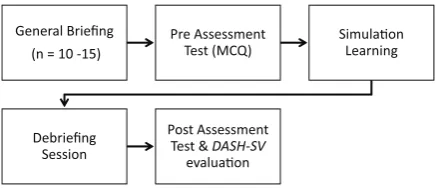
debriefing session conducted (Figure 1).
General Briefing
(n = 10 -15)
Pre Assessment Test (MCQ)
Simula!on Learning
Debriefing Session
Post Assessment Test & DASH-SV
evalua!on
Figure 1. Flowchart showing the summary of
the simulation program
E. Ethical Consideration
Before this study was conducted,
Fac-ulty of Health Sciences, Universiti Kebangsaan
Malaysia (UKM) Research Committee
(NN-2017-105) on Ethical Research in humans where
the first researcher of this study is affiliated. The
institutional review board gave approval,
pro-vided this study did not harm participants’ right
in any way or violate research ethics. As per
protocol, our team described the details of the
study to the trainers prior to the training
ses-sion, and for the respondents, a written consent
was obtained prior to the commencement of the
intervention.
F. Outcomes
The primary outcome was to assess the
effec-tiveness of this model in improving cabin crews’
BLS knowledge taught by the ‘trained trainers’.
Thus, the knowledge was assessed based on the
scores in an MCQ test based on the simulated
cardiac event. The MCQ was a modified version
of the American Heart Association (AHA) Basic
Life Support (BLS) and validated by the selected
experts in terms of its content and suitability
which tested the aspects of airways &
breath-ing, performing CPR and usage of AED. One
mark was awarded for every correct answer and
no penalty was given for missed or incorrect
an-swers.
G. Statistical Analysis
A power calculation estimated a total of 128
participants were needed to provide more than
80% of power to detect a statistically
cant difference between two groups at
signifi-cance level of 0.05. As such, we aimed to recruit
a final total of 150 participants which include an
additional of 10-15% of dropout rate to allow for
attrition. The estimated sample size calculation
was performed using G Power software version
3.12. The mean MCQ test scores were compared
using a dependent t-test analysis to look for a
change between baseline and post intervention.
To analyse the quality of the debriefing
tech-niques conducted, the mean total of DASH-SV
scores from the participants were calculated to
illustrate the patterns of the data. The
statisti-cal analysis was carried out using SPSS Version
22.
III. RESULTS & DISCUSSIONS
The DASH-SV consists of six different
ele-ments, which was based on how the
instruc-tor conducted the debriefing sessions effectively.
Based on Table 1 below, both trained instructors
were rated with the mean scores ranging from
6.12 – 6.46 for each elements (consistently
effec-tive/very good), with a total mean scores of 6.32
which summarise the overall (very good)
impres-sion of effectiveness for the whole elements.
Table 1. The mean scores of DASH-SV
elements
Elements N Mean SD
1 125 6.12 .666
2 130 6.37 .595
3 129 6.31 .593
4 126 6.28 .631
5 128 6.35 .649
6 130 6.46 .633
Total 123 6.32 .591
was higher (M = 24.28, SD = 2.66) in the
post-intervention compared to the baseline (M
= 22.34, SD = 3.49). A dependent t – test was
conducted to determine the statistically
signifi-cant differences between the MCQ scores of both
groups. Based on the results presented in Table
3, with an alpha level of .05 and MCQ scores
from 130 individuals, on average the participants
scores 1.93 , 95% CI [-2.50, -1.32], higher
follow-ing the simulation-based first aid learnfollow-ing
inter-vention than they did during the baseline. The
difference is statistically significant, t (129) =
-6.27, p < .001, with a medium effect size, d
= .63. It was concluded that the assumptions
of normality and normality of difference scores
were not violated after outputting and visually
inspected the relevant histograms.
Table 2. Comparison of baseline & post
intervention MCQ mean scores
MCQ Scores N Mean SD
Baseline 130 22.34 3.49
Post-Intervention 130 24.28 2.66
The use of simulation based learning has
become a widely accepted innovative teaching
strategy which promotes active participation
and provides experience in applying practical
skills as well as developing cognitive skills. With
such platforms, the opportunity for the
partic-ipants to function more independently can be
achieved with minimal risk of harm or errors that
may occur. Apart from it, the debriefing has
been identified as the key element to the
effec-tive simulation experience to identify the
teach-able moments which occurred during the
simu-lation scenario. In this study, the evidence
sug-gested that the participants were able to obtain
and successfully retain the cognitive skills
fol-lowing simulation learning by achieving higher
scores compared to baseline. Besides that, the
responses provided by the participants’
DASH-SV scores were found to be beneficial, which
in-dicates the effectiveness on the applications of
debriefing techniques to assist the participants
on the reflection process following simulation
ac-tivity. Overall, the above results support the
ev-idence of a successful implementation of the
pro-gram for the cabin crew. Nevertheless, further
assessment, such as technical and non-technical
skills, are required before reaching definitive
con-clusion on the effectiveness of this program
en-tirely.
The main key to success for this type of
project is to address several main issues such
as obtaining the mutual agreement with the
in-tended airline company. After obtaining the
op-Table 3. Mean comparison of MCQ scores
Mean SD
95% CI
t df Sig (2-tailed)
Effect size
(d) Lower Upper
Post-Baseline differences
-1.93 3.52 -2.50 -1.32 -6.27 129 .000 .63
eration, it is advisable to proceed with the
identi-fication of the head of the operation as suggested
by the higher management. The operation
man-ager of the respective airline academy is the key
position to lead and provide a commitment for
this project. Apart from it, the manager may
also identify a project leader and provide
ad-ministrative support as required by the research
team. Once all of these resources are in place,
the next step is to secure and build up a good
rapport with the chosen project leader, which is
the head of the selected educator from the
re-spective team of training department in order to
execute the train-the-trainer model. Once the
selected educators are identified accordingly, the
overall plan should be oriented to each of the
educators to ensure a mutual understanding is
successfully obtained between the research team
and the educators.
Another area of concern is to design an
ap-propriate course content together with the time
allocated to complete the course which can be
challenging. In the authors’ experience,
encour-agement and periodic reminders were effective in
engaging all educators to be motivated to
com-plete the course and realised the importance of
these training which could benefit them in their
future practice. Most airline utilised their
self-designed training module based on the
guide-lines provided by the International Civil
Avi-ation OrganizAvi-ation (ICAO), as such our team
collaborate with the experts from the respective
airline trainer to ensure all contents were fully
designed based on the airline modules to prevent
any form of deviations which might impact the
overall learning outcomes. Further challenges
are associated with the scheduling for the
ed-ucators to complete the training and to conduct
the training accordingly. For examples,
opera-tions requirement might supersede the training
which results in the delay of executing the
train-ing. Authors were advised to carefully planned
the dates ahead of time, though there were no
guaranteed the operations might agree and
pro-vided the time and slot to execute the training
session. During the follow-up session, authors
were unable to obtain the appropriate numbers
of crews as requested; however, some adjustment
was done by the educators in order to meet the
simulation learning objective.
IV. IMPLICATIONS FOR AVIATION
EDUCATORS
The three-step train-the-trainer model was
successfully used to prepare educators in
health-care industries for simulation instruction and
be-gin to emerge as one of the potential approaches
in a non-medical community such as aviation
medical cases on board the aircraft, the cabin
crew are now being challenged to provide the
best care towards passenger and this has become
a crucial area among educators of the respective
airline academy to continuously introduce new
regulations to ensure each cabin crews are able
to obtain the latest and most effective ways to
overcome such emergencies. Most educators are
constantly introducing new regulations, trends,
and topics, and to ensure its effectiveness,
simu-lation provides the best platform which helps to
integrate these types of learning methods into
their current educational programme.
The use of this three-step model helps to
de-velop an educator specifically in any topic area
which can be both effective and efficient. This
group of trained educators can then mentor and
train another trainer from the same or different
association as requested and this will benefit the
industry. With the specifically developed
train-the-trainer model for aviation industry tailored
to the needs of first aid training, authors were
hoping to integrate this teaching and learning
method as part of the modules used by the cabin
crew as a refresher training courses. With the
support from the higher management of the
re-spective airline company, this model will be
fur-ther evaluated by the Department of Civil
Avi-ation (DCA) to ensure its suitability to be
ap-plied by all aviation companies across the
coun-try. With such accomplishment, the intended
airline company has now become a pioneer in
the simulation learning and the group of trained
educators is now responsible to train other
edu-cators from other company.
V. CONCLUSION
In respond to the medical emergencies on
board that is growing rapidly over the years,
advancement in knowledge and skills
prepara-tion is crucial to help cabin crews to transit
into a more knowledgeable and highly skilled
life saver. The educators’ role of the
respec-tive training department is challenged by
ad-dressing the latest teaching and learning method
which helps to provide the educational support
to ensure the competencies among cabin crews
are met. In response to this, specifically
de-signed programme is required and the
educa-tors must have the necessary knowledge and
skills not only to design but also to implement
the necessary educational programmes. The use
of the three-step
[Identification-Development-Integration] train-the-trainer model is the key
strategy to address this need effectively.
VI. ACKNOWLEDGEMENT
Authors would like to express their gratitude
to the Chief Operating Officer of the
respec-tive airline company for the support and
ap-proval given to conduct the project. Authors
would like to thank the Manager of the Airline
Academy (Madam Rosnina Abdullah) for the
through-out the project and to the selected first aid
trainer from the Department of Safety &
Emer-gency (Madam Shueraya, Madam Eswari and Dr
Putri) for their commitment and interest to
com-plete the project successfully.
[1] Airline activity: national summary (US flights), Bureau of Transportation Statistics, viewed 23 May 2016,<http://www.transtats.bts.gov>
[2] Amit, C & Shauna, C 2013, ‘In flight medi-cal emergencies’, Western Journal of Emergency Medicine, vol. 14, no. 5, pp. 499-504.
[3] American Association of Colleges of Nurs-ing, End of Life Nursing Education Con-sortium, 2013, viewed 31 July 2017,
<www.aacn.nche.edu/elnec>
[4] Center for the Health Professions, Emerging nurse leaders train the trainer, 2012, viewed 31 July 2017,
<http://futurehealth.ucsf.edu/Public/ LeadershipPrograms/Home.aspx?pid=554>
[5] Dowdall, N 2013, ‘Is there a doctor on the air-craft?’ Top 10 in-flight medical emergencies, British Medical Journal, vol. 321, pp. 1336-1337. [6] Donaldson, L 2009, Annual Report of the Chief
Medical Officer, The Stationary Office, 2008. [7] Dreifuerst, KT 2009, ‘The essentials of
debrief-ing for meandebrief-ingful learndebrief-ing to foster develop-ment of clinical reasoning in simulation’, Jour-nal of Nursing Education, vol. 51, no. 6, pp. 326-333.
[8] Grantt, LT & Webb, CR 2010, ‘Using simula-tion to teach patient safety behaviors in under-graduate nursing education’, Journal of Nursing Education, vol. 49, no. 1, pp. 48-51.
[9] Institute of Medicine, to err is human: Build-ing a safer health system, 1999, viewed 31 May 2016,<www.nas.edu>
[10] Jeffries, PR 2008, ‘Getting in S.T.E.P with sim-ulations: Simulations take educator prepara-tion’. Nursing Education Perspectives, vol. 29, no. 2, pp. 70-73.
[11] Kaye, W, Rallis, SF, Mancini, ME, et al 1991, ‘The problem of poor retention of cardiopul-monary resuscitation skills may lie with the in-structor, not the learner of the curriculum’, Re-suscitation vol. 21, no.1, pp. 67-87.
[12] Mahony, PH 2008, ‘Retention of knowledge and skills in first aid and resuscitation by airline cabin crew’, European Resuscitation Council, vol. 76, no. 3, pp. 413-418.
[13] Parnell, MA & Larsen, PD 2007 ‘Poor quality teaching in lay person CPR courses’, Resuscita-tion, vol.73, pp. 271-278.
[14] Pronovost, P 2013, ‘Teamwork matters. Devel-oping and enhancing teamwork in organizations: evidence-based best practices and guidelines’, San Francisco (CA), Jossey-Bass, p. 11-12. [15] Rasmussen, MB, Dieckmann, P, Isenberg, S,
Os-tegard, D, Seroide, E & Ringsted, CV 2012, ‘Long term intended and unintended experi-ences after advanced life support training’, Re-suscitation.
[16] Riley, RH, Grauze, AM, Chnnery, C, Horely, RA & Trewhella, NH 2003, ‘Three years of CASMS: the world’s busiest medical simulation centre’, Med J Aust vol. 179, pp. 626-630.