Corresponding Author: Lai Ching Siew, Department of Child Development, KK Women’s and Children’s Hospital, Singapore, [email protected]
53
Journal of Social Science and Humanities, 1 (2): 53-57, 2018 e-ISSN: 2600 - 9056
© RMP Publications, 2018 DOI: 10.26666/rmp.jssh.2018.2.9
Using Apps Based Medium to Reach Out to Children with Learning Needs
Lai Ching Siew *, Hui Nee Tang
Department of Child Development, KK Women’s and Children’s Hospital, Singapore
Abstract: Learning to read in English language can be a struggle for young children whose first language is not English, especially for those who fall behind in their basic literacy skills compared to their same-aged peers. Current services for this group of children are often labour intensive, time consuming, expensive and not very accessible. This pilot trial examined the appropriateness of using mobile applications (apps) with a group of 6 year-old children who were weak in reading, particularly in their visual discrimination skills and vocabulary recognition when negotiating print. These two skills are critical reading readiness skills, as cited by the National Early Literacy Panel in the United States (2008)[1]. A pre-post test methodological design with 25 kindergarten children consisting of experimental and control groups in regular preschool setting participated in the pilot trial. Initial outcomes showed the appropriateness of using mobile apps as a facilitation tool to assist in building up these children’s visual discrimination skills and vocabulary in the acquisition of reading.
Key words: Mobile Apps based resources
1. INTRODUCTION
In Singapore, young children with clearly identified developmental and learning needs are usually located in regular preschools, such as childcare centres and kindergartens. Learning to read in English language can be a struggle for young children whose first language is not English, especially those who fall behind in their basic literacy skills compared to their same-aged peers. They often avoid and are fearful of reading and writing activities due to their experiences with repeated failure. Possible factors affecting these children’s failure to engage include reading motivation, auditory and visual attention on print, working memory, vocabulary, concepts about print and prior knowledge.
These children with learning needs in literacy and language skills often fail to respond to typical classroom instructions in reading and require remedial attention. Current available support system to these children are labour intensive, time consuming and expensive and not very accessible. The common approaches to supporting these children range from
providing, remedial support in a group or individual setting, such as tuition. While these remedial programmes have worked to improve children’s reading, the results are varied. It may relate to the individual differences and learning needs of these children. For those programmes which are targeted at developing children’s higher level literacy skills (e.g. decoding, reading fluency, reading comprehension, etc.), it may not be appropriate if their foundational skills (e.g. concepts about print, print knowledge, reading readiness (include vocabulary), oral language, visual processing) have not yet been established. According to the National Early Literacy Panel in the United States (2008)[1], these five variables consistently predicted later literacy achievement together with six other higher level literacy skills, which were alphabet knowledge, phonological awareness, rapid automatic naming (RAN) of letters or digits, RAN of objects or colours, writing or writing name, phonological memory.
educational therapists. A shortage of trained therapists often results in extended waiting times, and inadequate support provision. Further, the high cost of these support services shuts out families of children who cannot afford it.
Providing timely appropriate and affordable support is therefore critical to give these children a head start. The purpose of this pilot literacy project is to use mobile applications (apps) to reach out to children with learning needs in literacy and language.
Using mobile devices can be an alternative avenue to reach out to these children. Mobile devices have become increasingly accessible to children in Singapore (Media Development Authority (MDA), 2015[2]; Rideout, 2013)[3]. When used appropriately, interactive media (such as applications) are potential learning tool and resources to engage children’s learning (Hirsh-Pasek et al. 2015[4]; Khoo et al. 2015)[5]. Indeed, emerging research showed positive outcomes from using apps with children in learning (Chmiliar, 2017[6]; Neumann, 2016[7]; McClanahan et at., 2012[8]; Moore et al., 2015[9]).
2. Objective
The project’s objective is to develop and implement mobile apps targeted on foundational skills in literacy and language with children with learning needs.
Mobile apps will be used to complement the current support services, not to replace them. The use of appropriately designed apps ensures that essential foundational skills can potentially be acquired at a minimum cost and readily available to a wide audience, especially those who currently cannot afford therapy support. Provision of timely self-paced accessible support to these children will partially address parents’ concerns regarding the provision of support services for their children.
MOBILE APPLICATIONS (APPS)
The goal of the custom developed mobile apps is to provide self-paced accessible support to children with learning needs to build up their foundational skills in literacy and language acqusition.
A pilot trial was conducted with a group of Kindergarten 2 children (6 year-old) with weaknesses
in two critical foundational skills, visual discrimination skills and vocabulary. These two skills are critical reading readiness skills, cited by the National Early Literacy Panel in the United States (2008)[1]. Research studies showed vocabulary is strongly correlated to reading comprehension (Cunningham & Stanovich, 1997[10]; Snow, Burns, & Griffin1998[11]). Visual discrimination problems were linked to poor reading (Feagans & Merriwether 1990)[12].
Purpose
This trial examined the appropriateness of using mobile apps in supporting children with weaknesses in visual discrimination skills and vocabulary recognition in their basic literacy skill.
Method
Participants: 31 Kindergarten 2 children consisting of experimental and control groups in regular preschool setting participated in the pilot trial. There were fourteen children assigned to the experimental group, who were weak in reading as identified by their class teacher. Seventeen typical developing children were assigned to the control group. This pilot trial was carried out during learning corner time in the preschool.
Procedure: A Learning Support Educator administered the pretest and posttest with the experimental and control groups.
Materials: In-house screeners were used for the pretest and posttest. Tablets with preloaded apps were used for intervnetion.
Selection Criteria:
1. For experimental and control groups:
a) For visual discrimination skills screen, the selection criteria was children scoring less than or equal to 5 out of 10 items presented at the pretest.
b) For picture naming (expressive vocabulary) screen, children scored less than or equal to 30 out of 56 pictures on a picture chart were selected for the trial.
2. Control group
55 App Intervention:
Eight children of the experimental group were selected to receive the intervention using the custom developed apps targeted on visual discrimination skills and vocabulary.
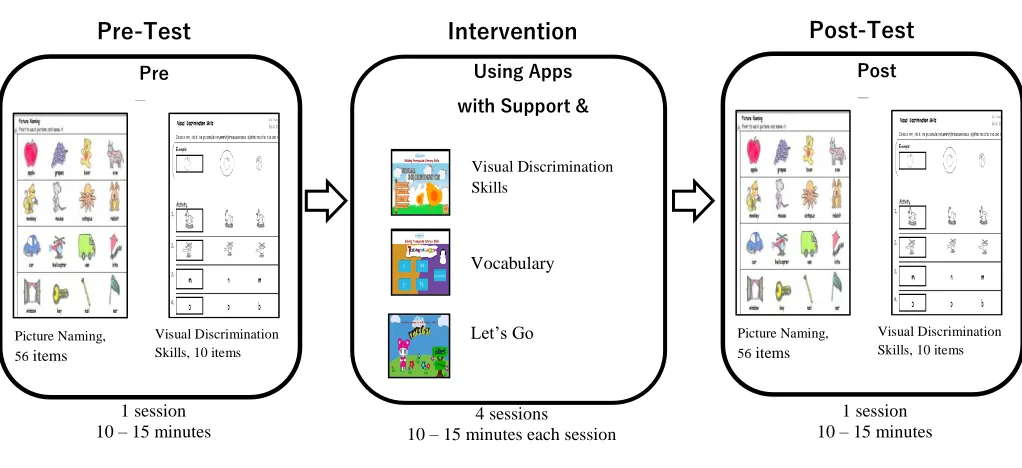
There were a total of 6 sessions carried within 2 weeks consisting of 1x pretest, 4x app intervention and 1x posttest for the experimental group (See Figure 1).
Figure 1
* Using Apps with Support & Independently
• The children were given a tablet loaded with 3 apps focusing on visual discrimination skills and vocabulary after the pretest.
• Session 1 was guided by a learning support educator.
• From 2nd to 4th session, the children would engage in a self-directed learning using the tablet. • A total of 3 apps for each of the 4 sessions were used.
• Duration for each session was between 10-15 minutes.
The typical developing children in the control group were administered the pretest and posttest. They were not exposed to any apps.
Measurement: The trial used a pre-post design to look
at the shift on children’s gains in visual discrimination skills, as well as expressive vocabulary using the the custom developed mobile apps. The T-test ANOVA was used to analyse the pretest and posttest.
Results
1) Visual Discrimination Skills
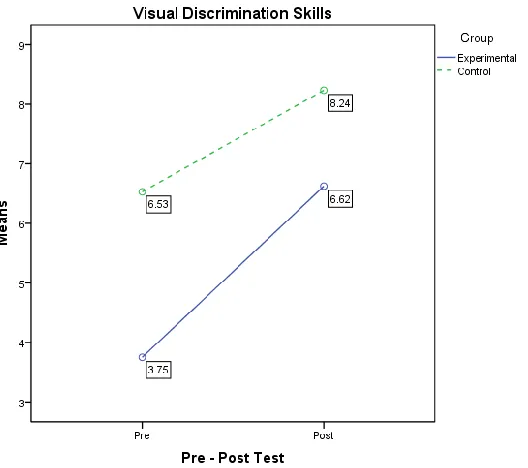
Results in posttest showed that all 8 children made a significant improvement in their visual discrimination skills. For the experimental group, the gradient was steeper as compared to the control group (See Figure 2).
2) Picture Naming (Expressive Vocabulary)
On average, the experimental group showed a significant shift by approximately 7 points on the picture naming. The gradient was steeper in the experimental group, as compared to the control group (See Figure 3).
Pre-Test
Intervention
2 weeks
1 session10 – 15 minutes
4 sessions
10 – 15 minutes each session
1 session 10 – 15 minutes
Post-Test
Picture Naming, 56 items
Visual Discrimination Skills, 10 items Pre
Test
Picture Naming, 56 items
Visual Discrimination Skills, 10 items Post
Test Using Apps
with Support &
Independently*
Figure 2: Visual Discrimination Skills Figure 3: Picture Naming
Limitations
As a pilot trial, the results are only indicative and not conclusive of positive outcome. Future trials should consider bigger group size as well as including a comparison group of similar profile as experimental group but does not participate in the intervention.
Conclusion
The appropriate use of targeted mobile applications can be an effective tool to support children with learning needs in their foundational literacy skills. The preliminary results obtained from the pilot trial have indicated the appropriateness of using mobile apps as a medium to assist in the building up of children’s foundational literacy skills, specifically visual discrimination skills and vocabulary over 4 sessions of up to 15 minutes each. The implications of using apps as a support medium will lead to a better utilization of human resources in supporting other skills needed for literacy development include concepts about print, alphabet knowledge, phonological awareness, phonological memory, comprehension and so forth; possibility of self-paced learning by children; a timely accessible support made available for children at a minimum cost. The accessibility of apps will also result in more children being supported without solely relying on the often expensive and scarce human resources.
Acknowledgments
We wish to acknowledge our partners: Singapore Nanyang Polytechnic, PAP Community Foundation (PCF), My First Skool (MFS) and Presbyterian Community Services (PCS) for making this trial project possible.
Funding/Support
Lien Foundation, Singapore
References
[1] National Early Literacy Panel. (2008). Developing early literacy: Report of the National Early Literacy Panel, A scientific synthesis of early literacy development and implications for intervention. Washington, DC: National Center for Family Literacy, National Institute for Literacy.
[2] Media Development Authority (MDA). (2015). MDA Zero-to-Fourteen Consumer Experience Study 2015
[3] Rideout V. J. (2013). Zero to Eight: Children’s Media Use in America 2013. San Francisco, CA: Common Sense Media.
57 science of learning. Psychol Sci Public Interest, 16(1), 3-34. doi:10.1177/1529100615569721
[5] Khoo, E., Merry, R., & Nguyen, N. H., with Bennett, T., & MacMillan, N. (2015). iPads and opportunities for teaching and learning for young children (iPads n kids). Hamilton, New Zealand: Wilf Malcolm Institute of Educational Research.
[6] Chmiliar, L. (2017). Improving learning outcomes: the iPad and preschool children with disabilities. Front. Psychol. 8:660. doi: 10.3389/fpsyg.2017.00660 [7] Neumann M. M. (2016). Young children’s use of touch screen tablets for writing and reading at home: relationships with emergent literacy. Comput. Educ. 97 61–68.
[8] McClanahan, B., Williams, K., K. & Tate, S. (2012). A Breakthrough for Josh: How Use of an iPad Facilitated Reading Improvement. TechTrends: Linking Research and Practice to Improve Learning, 56(3), 20-28
[9] Dennis W. Moore, Svetha Venkatesh, Angelika Anderson, Stewart Greenhill, Dinh Phung, Thi Duong, Darin Cairns, Wendy Marshall & Andrew J. O. Whitehouse. (2015). TOBY play-pad application to teach children with ASD – A pilot trial, Developmental Neurorehabilitation, 18:4, 213-217
DOI: 10.3109/17518423.2013.784817
[10] Cunningham, A. E., & Stanovich, K. E. (1997). Early reading acquisition and its relation to reading experience and ability 10 years later. Developmental Psychology, 33(6), 934–945.
[11] Snow, C., Burns, S., & Griffin, P. (1998). Preventing reading difficulties in young children. Washington, DC: National Research Council.
[12] Feagans L.V. & Merriwether A. (1990). Visual Discrimination of Letter-Like Forms and Its Relationship to Achievement over Time in Children with Learning Disabilities. Journal of Learning
Disabilities, 23. 417-25.