APPLICATION OF RHA’S POZZOLANIC PROPERTIES IN THE
MAKING OF CEB
Fetra Venny Riza
Faculty of Civil and Environmental Engineering, Universiti Tun Hussein Onn Malaysia (UTHM)
Email: [email protected]
ABSTRACT
The production of Compressed Earth Brick (CEB) does not require burning as compared to normal clay brick. However it requires cement to stabilize and bind the clay into brick. This study tried to replace cement with Rice Husk Ash (RHA) as a binding material in the making of CEB. Since RHA is commonly used as a pozzolanic material in strengthening concrete where it react with calcium hydroxide generated from the cement hydration, this study used hydrated lime to mix with RHA to produce the same pozzolanic reaction. The result shows that the mixture with combination 25% RHA and 75% hydrated lime give the best result. Even though the strength do not reach the standard set by MS76 for load bearing brick, however it could be used as non load bearing brick.
1.0
INTRODUCTION
Rice husk ash (RHA) as a by-product from agriculture usually was thrown away to the landfill without further use. Farmer and rice mill tend to burn the rice husk as a fuel in the rice milling which generated pollution that can endanger health of inhabitants around the site. This study was trying to make use the RHA which known to have pozzolanic properties incorporated in the Compressed Earth Brick (CEB) production.
Other researchers have tried to utilized the RHA in the concrete making, lightweight concrete and the results quite instigated that addition of RHA could improved the performance of concrete [1-12] .
The aim of this study is trying to produce affordable building materials with locally available disposal waste and at the same time minimize the environmental problem because the making of CEB has environmental benefit such as no firing need in the making of CEB, reduce carbon dioxide emission. The OPC used in the production of common CEB was substituted with RHA and hydraulic lime.
2.0
CEMENTATION PROPERTIES OF RHA
2.1
PHYSICAL PROPERTIES
The weight of rice husk about 20% of the rice weight and when its burnt, its generated ash 25% from the rice husk weight [13]. Rice husk contains 50% cellulose, 25-30% lignin and 15-20% silica [14]. When the husk is burning, cellulose and lignin was removed and leave only silica ash. The ash color depend on burnt process, when completely burnt it will resulted in white greyish ash, where partially burnt is blackish. Table 1 provides the data of particle size distribution and specific surface of RHA and OPC.
Table 1: Particle size distribution and specific surface of RHA and OPC Original RHA Passed 300 µm
sieve RHA
Ground RHA
Cement OPC
Specific surface (cm2/g) 1,753.80 4,538.88 14,342.53 19,027.98
Diameter at 10% (µm) 26.77 26.34 2.20 1.89
Diameter at 50% (µm) 60.54 59.52 13.43 14.44
Diameter at 90% (µm) 102.65 97.81 35.65 36.68
2.2
POZZOLANIC PROPERTIES
Pozzolanic definition by ASTM C618 is 'a siliceous or siliceous and aluminous material which, in itself, possesses little or no cementitious value but which will, in finely divided form in the presence of moisture, react chemically with calcium hydroxide at ordinary temperature to form compounds possessing cementitious properties'.
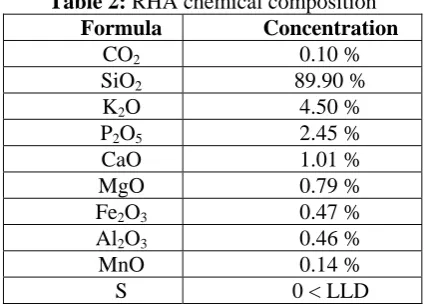
From the XRF test, the chemical composition of the RHA used in this study was obtained as shown in table 2.
Table 2: RHA chemical composition
Formula Concentration
CO2 0.10 %
SiO2 89.90 %
K2O 4.50 %
P2O5 2.45 %
CaO 1.01 %
MgO 0.79 %
Fe2O3 0.47 %
Al2O3 0.46 %
MnO 0.14 %
S 0 < LLD
Based on ASTM C618 the result showed that the RHA Muar fulfilled the requirements to all class of pozzolan N, F and C where the SiO2 89.9% (> 70% and 50%), SO3 very low (> 4%
and 5%), moisture content is o.5% (<3%) and LOI 1.2% (<10% and 6%).
Depending on the burning temperature, latest research showed that amorphous silica will be produced at burning temperature up to 700°C and above that temperature regime will resulted in crystalline silica [11, 15-17]. The best temperature for producing highly amorphous silica is between 500-700°C as suggested by Nair et al [18].
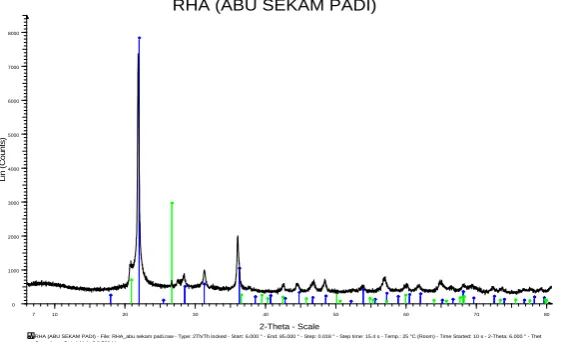
Based on XRD result, this RHA was crystalline (cristobalite and quartz) indicated by sharp peak as can be seen in picture 1.
The amorphous silica appears mainly in the external face of the husk and minor concentration on the inner surface, and if crystalline silica exists before calcinations, it’s probably due to contamination by sand [19].
RHA reactivity depends on the amorphous/crystalline ratio [20], and when rice husk was burnt at uncontrolled temperature, it tend to produce crystalline silica and consequently poor pozzolanic properties. The RHA used in this study was from rice milling in Muar where the rice husk was used as a fuel in the boiler in uncontrolled temperature.
Zhang et al [21] suggested that Ca(OH)2and calcium silicate hydrates (C-S-H) was the main
hydration product in RHA paste which Yu et al [22] support the finding concluded reaction between RHA and Ca(OH)2 responsible for the improvement of concrete properties. Cisse and
RHA (ABU SEKAM PADI)
01-070-3755 (*) - Quartz - SiO2 - Y: 27.50 % - d x by: 1. - WL: 1.5406 - Hexagonal - a 4.91580 - b 4.91580 - c 5.40910 - alpha 90.000 - beta 90.000 - gamma 120.000 - Primitive - P3121 (152) - 3 - 113.199 - I/Ic PDF 01-071-3839 (N) - Cristobalite, low - SiO2 - Y: 73.61 % - d x by: 1. - WL: 1.5406 - Orthorhombic - a 7.01000 - b 7.01000 - c 7.01000 - alpha 90.000 - beta 90.000 - gamma 90.000 - Primitive - P212121 (19) - 8 - 344.47 Operations: Strip kAlpha2 0.500 | Import
RHA (ABU SEKAM PADI) - File: RHA_abu sekam padi.raw - Type: 2Th/Th locked - Start: 6.000 ° - End: 85.000 ° - Step: 0.018 ° - Step time: 15.4 s - Temp.: 25 °C (Room) - Time Started: 10 s - 2-Theta: 6.000 ° - Thet
L
in (
C
ou
nt
s
)
0 1000 2000 3000 4000 5000 6000 7000 8000
2-Theta - Scale
7 10 20 30 40 50 60 70 80
Figure 1: XRD result of RHA
3.0
SAMPLING AND TESTING OF CEB
Raw materials for production of CEB are soil, sand, water, RHA and hydraulic lime. The soil used was laterite soil from Ayer Hitam, Malaysia, which was crushed in crushing machine. Sand was obtained from local vendor and passing 2 mm sieve. The water was from tap water with balanced pH. The RHA source was from rice milling in Muar, Malaysia. And the hydrated lime used was acquired from lime kiln in Johor Bahru, Malaysia. For the control sample, OPC was used as a binder.
3.1
MIX RATIO
The mix ratio used in this study based on proportional percentage between RHA and hydraulic lime, which are 0.25:0.75, 0.5:0.5: and 0.75:0.25 consecutively. For the binder:soil:sand ratio used is 1:8:2. Also the 1:1:4:2 ratio was used where indicating RHA:hydrated lime:soil:sand in order. Water used was max 15%. Mixing of raw materials was done by hand. Dimension and shape of bricks used in this project is a small scale solid brick with size 100 X 50 x 25 mm. These samples were then compressed using manual compaction with compression rate 2000 psi.
3.2
DEVELOPMENT AND CURING
After production of CEB, the sample then cured by spraying it with tap water daily.
3.3
TESTING OF CEB
To determine the performance of the CEB produced, compressive strength test were conducted
4.0
RESULT AND ANALYSIS
The compressive strength of the bricks was determined by using Universal Testing
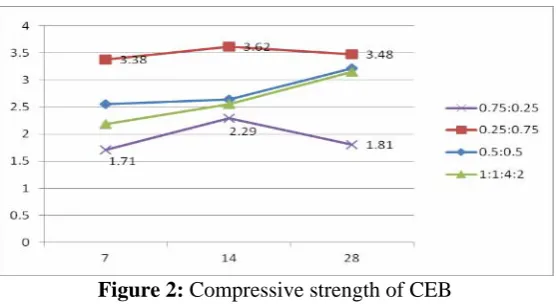
The best result in compressive strength was attained by sample with ratio of RHA:hydrated lime is 0.25:0.75 in 14th day with 3.62 MPa and its 28th day strength was 3.48 MPa. Overall trend indicated increasing of RHA proportion in mix ratio will reduce the strength consequently.
Figure 2: Compressive strength of CEB
But for 0.25:0.75 and 0.75:0.25 ratio showed the strength in 28th day reduce from the strength of 14th day. However, ratio 0.5:0.5 and 1:1:4:2 showed consistent strength growth from 7, 14 and 28 day compressive strength.
5.0
CONCLUSION AND SUGGESTION
It is possible to substitute cement with RHA obtained from uncontrolled burning temperature and hydrated lime as a binder in producing CEB. Although the strength of CEB made from this RHA not fulfilled minimum requirement of MS 76 for load bearing brick which need >7 MPa, the brick can be used for non load bearing purposes.
The strength can be improved by applied suitable curing method for hydrated lime reaction which required no or minimum oxidation occurs during curing process, which is the next stage of the study.
ACKNOWLEDGEMENT
The authors would like to thank the Universiti Tun Hussein Onn (UTHM), Johor, Malaysia for providing the international student scholarship and finally acknowledge the research and staffing resources provided by the Faculty of Civil and Environment of the Universiti Tun Hussein Onn (UTHM).
REFERENCES
[1] Al-Khalaf, M.N. and H.A. Yousif (1984), "Use of rice husk ash in concrete. International Journal of Cement Composites and Lightweight Concrete", Vol 6 (4), pages: 241-248.
[2] Chindaprasirt, P., C. Jaturapitakkul, and U. Rattanasak (2009), "Influence of fineness of rice husk ash and additives on the properties of lightweight aggregate" Vol 88 (1), pages: 158-162. [3] Ganesan, K., K. Rajagopal, and K. Thangavel (2008), "Rice husk ash blended cement:
Assessment of optimal level of replacement for strength and permeability properties of concrete", Construction and Building Materials, Vol 22 (8), pages: 1675-1683.
[5] Hani, A.S., et al. (2009), "The influence of micronised biomass silica in compressive strength and water permeability of concrete", MASAUM Journal of Basic and Applied Sciences, Vol 1 (3), pages: 493-496.
[6] Hassan, M.A. and A.H.M. Mustapha (2007), "Effect of rice husk ash on cement stabilized laterite", Leonardo Electronic Journal of Practises and Technologies, Vol 11, pages: 47-58. [7] Nair, D.G., K.S. Jagadish, and A. Fraaij (2006), "Reactive pozzolanas from rice husk ash an alternative to cement for rural housing", Cement and Concrete Research, Vol 36, pages: 1062-1071.
[8] Ndazi, B.S., et al.(2007), "Chemical and physical modifications of rice husks for use as composite panels", Composites Part A: Applied Science and Manufacturing, Vol 38 (3), pages: 925-935.
[9] Nuruddin, M.F., N. Shafiq, and N.L.M. Kamal (2009), "The effect of types of rice husk ash on the porosity of concrete", Joint Conferences APSEC - EACEF 2009. Langkawi, Malaysia.
[10] Qing-ge, F., et al. (2004), "Concrete with highly active rice husk ash", Journal of Wuhan University of Technology - Materials Science, Vol 19 (3), pages: 74-77.
[11] Ramezanianpour, A.A., M.M. Khani, and G. Ahmadibeni (2009), "The effect of rice husk ash on mechanical properties and durabilityof sustainable concrete", International Jornal of Civil Engineering, Vol 7 (2), pages: 83-91.
[12] Zain, M.F.M., et al. (2011), "Production of rice husk ash for use in concrete as a
supplementary cementitious material, Construction and Building Materials, Vol 25(2), pages: 798-805.
[13] Siddique, R. (2008), "Waste Materials and By-Products in Concrete", India: Springer-Verlag. [14] Ismail, M.S. and A.M. Waliuddin (1996), "Effect of rice husk ash on high strength concrete", Construction and Building Materials, Vol 10 (7), pages: 521-526.
[15] Sensale, G.R.d. (2006), "Strength development of concrete with rice-husk ash", Cement and Concrete Composites, Vol 28(2), pages: 158-160.
[16] Nehdi, M., J. Duquette, and A. El Damatty (2003), "Performance of rice husk ash produced using a new technology as a mineral admixture in concrete", Cement and Concrete Research, Vol 33(8), pages: 1203-1210.
[17] Chindaprasirt, P., S. Homwuttiwong, and C. Jaturapitakkul (2007), "Strength and water permeability of concrete containing palm oil fuel ash and rice husk-bark ash", Construction and Building Materials, Vol 21(7), pages: 1492-1499.
[18] Nair, D.G., et al. (2008), "A structural investigation to the pozzolanic activity of rice husk ashes", Cement and Concrete Research, Vol 38, pages: 861-869.
[19] Jauberthie, R., et al. (2000), "Origin of the pozzolanic effect of rice husks", Construction and Building Materials, Vol 14 (8), pages: 419-423.
[20] Payá, J., et al. (2001), "Determination of amorphous silica in rice husk ash by a rapid analytical method", Cement and Concrete Research, Vol 31(2), pages: 227-231.
[21] Zhang, M.H., R. Lastra, and V.M. Malhotra (1996), "Rice-husk ash paste and concrete: Some aspects of hydration and the microstructure of the interfacial zone between the aggregate and paste", Cement and Concrete Research, Vol 26(6), pages: 963-977.
[22] Yu, Q., et al. (1999), "The reaction between rice husk ash and Ca(OH)2 solution and the nature of its product", Cement and Concrete Research, Vol 29(1), pages: 37-43.