ORIGINAL ARTICLE
A SURVEY AMONG GUARDIANS ON CHILD RESTRAINT SYSTEM (CRS) USAGE
IN CENTRAL PENINSULAR MALAYSIA
Noor Faradila P.1,3*, Baba M.D.3, Aqbal Hafeez A.1, Azhar H.1, Rohayu S.2, Akmalia S.2, Mohd Syazwan S.1
1 Vehicle Safety & Biomechanics, Malaysian Institute of Road Safety Research, 43000 Kajang Selangor 2 Crash Data & Exposure Analysis, Malaysian Institute of Road Safety Research, 43000 Kajang Selangor
3 Faculty of Engineering and Built Environment, Universiti Kebangsaan Malaysia, 43650 Bandar Baru Bangi, Selangor,
Malaysia
ABSTRACT
Children are much more likely than adults to get serious injuries in car crashes due to their softer bones, weaker neck muscle and fragile bodies. Child restraint system (CRS) can help in reduce injury and prevent fatality in the event of a crash. Thus the aim of this paper is to gauge the prevalence of CRS usage among guardians of children age below 11 years old. A survey to addressed guardians knowledge on CRS usage, practice and their views on fitting child restraints system to their vehicles were carried out among parents and carers who are caring children aged 11 years old and below. Seventy-four percent (74%) out of 500 respondents cited they have used CRS, however only 40% of them is currently using CRS with their children. Respondent in Kuala Lumpur and younger guardians reported twice likely to use CRS. In addition, graduate respondents are 1.5 times more likely to use CRS for their children. In conclusion, high incorrect usage rate and understanding of the CRS could promote additional injury towards the children in a car crash. Many initiatives could be introduced before the implementation of the CRS law in Malaysia such as awareness, community-based programs and CRS clinics that aim to guide guardians on the correct and effective way of installing the CRS device in their car.
Keywords: child restraint system, child safety, vehicle safety, traffic safety
INTRODUCTION
Children are considerably more likely than adults to get serious injuries in auto collisions due to their weaker neck muscle, softer bones and delicate bodies. Child restraint system (CRS) can help in diminish injury and prevent casualty. In the case of an accident, an unrestraint youngster gets to resemble a rocket that is tossed with incredible power. As indicated by Automobile Association Malaysia (AAM), an unsecured baby weighing 7kg an accident velocity of only 50km/h will be tossed forward at a force that is proportionate to an adult tumbling from a five-story building1.
As reported by the World Health Organisation (WHO) on Child Injury Prevention, road traffic injury is the second major reason that caused
casualty among 5 to 14 year olds2. Road casualty
rates are higher in low and middle-income countries involving children aged 14 and underneath2. In Malaysia, children aged 1 to 4
are the leading group of casualties among young private vehicle passengers, which mostly occur
within the residential areas3. Thus the aim of this
paper is to gauge the prevalence of CRS usage among guardians of children age below 11 years old.
METHODS
A prospective self-administered survey was carried out among guardians who have children aged 11 years old and below. The study was held at selected shopping malls and supermarkets
around Selangor and Malacca. After obtaining verbal informed consent, a questionnaire was given to the respondents for the assessment of
the guardians’ socioeconomic status, and their
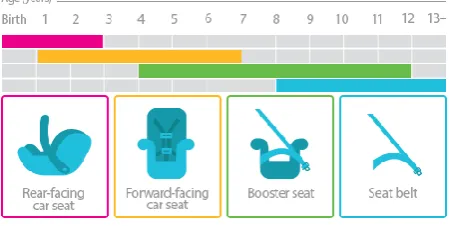
knowledge relating to the CRS. The CRS are inclusive of rear facing, forward-facing, and booster seat as shown in figure 1.
Figure 1 – CRS type according to child age.
The self-administered semi-structured
questionnaire was developed based on the literatures4,5,6, followed by face & content
validity and pilot test. The survey questions
addressed guardians’ usage and practice of
The study area consists of two states in Central Peninsular Malaysia, namely Selangor and Malacca. Both states were selected to revisit observation study conducted by Muammar et al and Kulanthayan et al, whereby they had observed CRS usage rate in 2010 and 2004 respectively7,8. Response data were analysed by
using Statistical Package for the Social Sciences (SPSS) version 17.0 software. Logistic regression technique was used to estimate the relative risks by approach of odds ratios (OR) at 95% confidence intervals (CI). An OR value that is greater than 1 indicates higher risk to the concerned attribute and vice versa.
RESULTS
This section will tabulate the result of the survey
from sociodemographic, CRS usage and
installation, and guardians’ knowledge.
Sociodemographic profile
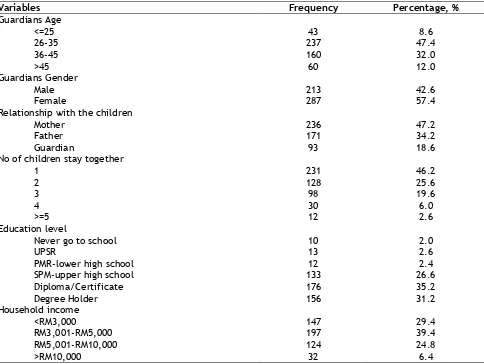
A total of 500 guardians who have children age 11 years old and below had contributed in the survey. The average age of the respondents was 35.49 years, the youngest was 18 years old and the oldest was 60 years old (mode = 30 YO, S.D. = 8.18). As shown in Table 1, more than half of the respondents (57.4%) were female. Around 46.2% of the respondents were caring only one child, 25.6% cared for two children and the remaining 28.6% cared for three or more children under 12 years old. The majority of the respondents reported household incomes in the lower incomes group. Lastly, a very high majority of the respondents (95.6%) are drivers.
Table 1 - Sociodemographic data of CRS study respondents
Variables Frequency Percentage, %
Guardians Age
<=25 43 8.6
26-35 237 47.4
36-45 160 32.0
>45 60 12.0
Guardians Gender
Male 213 42.6
Female 287 57.4
Relationship with the children
Mother 236 47.2
Father 171 34.2
Guardian 93 18.6
No of children stay together
1 231 46.2
2 128 25.6
3 98 19.6
4 30 6.0
>=5 12 2.6
Education level
Never go to school 10 2.0
UPSR 13 2.6
PMR-lower high school 12 2.4
SPM-upper high school 133 26.6
Diploma/Certificate 176 35.2
Degree Holder 156 31.2
Household income
<RM3,000 147 29.4
RM3,001-RM5,000 197 39.4
RM5,001-RM10,000 124 24.8
>RM10,000 32 6.4
CRS Usage
Table 2 shows the relationship between CRS
usage with respondents’ demographic variables
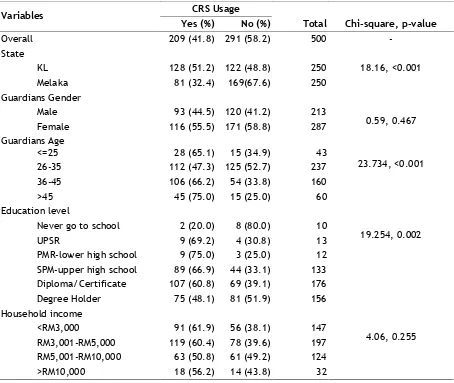
such as location, age, gender, education level and incomes. Reported CRS usage is rather low, with over 41.8% indicating they use CRS while travelling. CRS usage difference between the location of data collection found that Klang
Valley area recorded a higher rate of usage (51%) compared to Melaka (32%). From the table, it
could be seen that study location, guardians’ age
Further analysis was carried out among the variables that showed a significant difference in CRS usage as depicted in Table 3 to gauge the odd ratio. Kuala Lumpur population and younger
guardians, aged 35 years old and lower, are twice likely to use CRS. In addition, graduated respondents are 1.5 times more likely to use CRS for their children.
Table 2 - Crosstabs analysis of gender, age, education level and household income with CRS usage
Variables CRS Usage
Total Chi-square, p-value
Yes (%) No (%)
Overall 209 (41.8) 291 (58.2) 500 -
State
KL 128 (51.2) 122 (48.8) 250 18.16, <0.001
Melaka 81 (32.4) 169(67.6) 250
Guardians Gender
0.59, 0.467
Male 93 (44.5) 120 (41.2) 213
Female 116 (55.5) 171 (58.8) 287
Guardians Age
<=25 28 (65.1) 15 (34.9) 43
23.734, <0.001
26-35 112 (47.3) 125 (52.7) 237
36-45 106 (66.2) 54 (33.8) 160
>45 45 (75.0) 15 (25.0) 60
Education level
19.254, 0.002
Never go to school 2 (20.0) 8 (80.0) 10
UPSR 9 (69.2) 4 (30.8) 13
PMR-lower high school 9 (75.0) 3 (25.0) 12
SPM-upper high school 89 (66.9) 44 (33.1) 133
Diploma/Certificate 107 (60.8) 69 (39.1) 176
Degree Holder 75 (48.1) 81 (51.9) 156
Household income
4.06, 0.255
<RM3,000 91 (61.9) 56 (38.1) 147
RM3,001-RM5,000 119 (60.4) 78 (39.6) 197
RM5,001-RM10,000 63 (50.8) 61 (49.2) 124
>RM10,000 18 (56.2) 14 (43.8) 32
Table 3 - Odd ratio of the significant variables
Variables CRS Usage Odd Ratio
Yes (%) No (%)
State
KL 128 (51.2) 122 (48.8) 0.457
Melaka 81 (32.4) 169(67.6)
Guardians Age
18-35 140 (50.0) 140 (50.0) 0.457
36-60 69 (31.4) 151 (68.6)
Education level
1.523
Up to high school 59 (35.1) 109 (64.9)
Certificate and degree holder 150 (45.2) 182 (54.8)
CRS Usage Practice
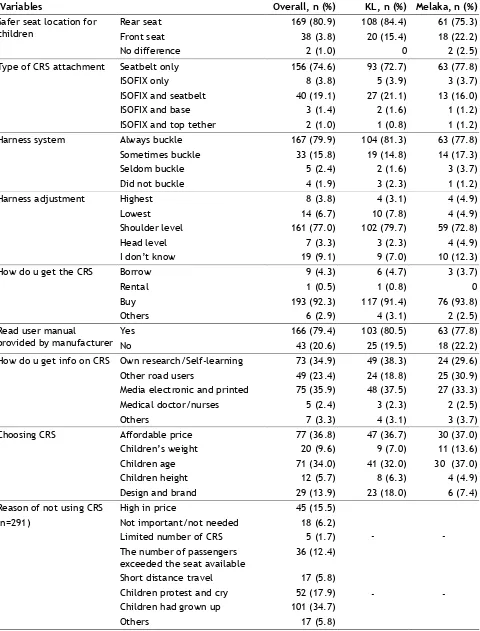
Table 4 shows CRS practice among guardians who are currently using the CRS for their children. Among the initial 500 respondents, only 209 guardians answered this section of the questionnaire as they are using CRS currently. 80% of them believe that the rear seat is safer as
system should be set on the same level of the children shoulder when the children sit on the CRS. The majority of them (92%) bought their own CRS. Only 1 person rent the CRS. 79.4% read the user manual provided by the CRS manufacturer. Guardians also indicated that they get information about CRS by electronic and printed media (35.9%) such as TV and magazines, self-learning (34.9%) and by other road users (23.4%) such as friends, family and colleague. When they were asked about factor influence their choice of CRS, 36.8% indicated that they choose due to affordable price, 34% chose due to their children age and 13.9% choose it due to design and brand.
Among those who did not use CRS for their children, 291 respondents, 34.7 % indicated that their child has outgrown the CRS. However,
when they were asked to specify the child’s age,
they are only 4 to 8 years old.
DISCUSSION
This study evaluated the prevalence of CRS usage in central Peninsular Malaysia. The result of this self-reported study recorded a high national CRS
usage compared to real-world national
observation studies7,8,9. However, it is considered
low usage compared to other high-income countries.
In Malaysia, there are no particular rules on CRS usage in a passenger vehicle. Additionally, in ASEAN nations, just three countries that have specific laws requiring the usage of CRS, to be particular Brunei, Cambodia and Singapore. It is about time to introduce child restraint system regulation in Malaysia as the number of children involving in road traffic accidents are increasing
yearly3,9. CRS has been shown to be highly
effective in reducing child fatality in road traffic accidents. Age- and size-appropriate CRS has been reported can reduce the risk of death up to
54% for toddles and 71% for infants10.
The finding of low rates of child restraint system use represents a dispute to preventive medicine in Malaysia, requiring consideration and
attention to promote it across the board use. In order to accelerate the widespread of CRS usage, a comprehensive promotion of awareness activities should be conducted both among children and their guardians with regards to the safety benefits that can associate with correct and appropriate CRS use and seating position. A combination of enforcement and education program in the community was proven successful in increasing the usage of CRS from the baseline of 61% to 71%11.
From the result, it shows that most guardians are not aware of CRS type especially for older children aged around 5 to 8 years old. Most of them stated the main reason for not wearing CRS for their children are due to the child had outgrown the CRS. It could be said that they did not aware of the existing of CRS for older children, namely booster seat. The Early graduation from CRS into adult seatbelt may increase the severity of injury during car accidents due to delicate children body
structure12. Thus, education on CRS type and
how to choose the correct CRS are very crucial at this stage11,13,14.
CONCLUSION
Child restraint use was associated with location,
guardian age and guardians’ educational level.
The low usage of CRS might be due to low exposure on the importance of CRS. Thus, awareness and education on the benefits of CRS are crucial especially in choosing the correct types of CRS with consideration of child age and sizes.
ACKNOWLEDGEMENTS
Table 2 - CRS usage practice
Variables Overall, n (%) KL, n (%) Melaka, n (%)
Safer seat location for children
Rear seat 169 (80.9) 108 (84.4) 61 (75.3)
Front seat 38 (3.8) 20 (15.4) 18 (22.2)
No difference 2 (1.0) 0 2 (2.5)
Type of CRS attachment Seatbelt only 156 (74.6) 93 (72.7) 63 (77.8)
ISOFIX only 8 (3.8) 5 (3.9) 3 (3.7)
ISOFIX and seatbelt 40 (19.1) 27 (21.1) 13 (16.0)
ISOFIX and base 3 (1.4) 2 (1.6) 1 (1.2)
ISOFIX and top tether 2 (1.0) 1 (0.8) 1 (1.2)
Harness system Always buckle 167 (79.9) 104 (81.3) 63 (77.8)
Sometimes buckle 33 (15.8) 19 (14.8) 14 (17.3)
Seldom buckle 5 (2.4) 2 (1.6) 3 (3.7)
Did not buckle 4 (1.9) 3 (2.3) 1 (1.2)
Harness adjustment Highest 8 (3.8) 4 (3.1) 4 (4.9)
Lowest 14 (6.7) 10 (7.8) 4 (4.9)
Shoulder level 161 (77.0) 102 (79.7) 59 (72.8)
Head level 7 (3.3) 3 (2.3) 4 (4.9)
I don’t know 19 (9.1) 9 (7.0) 10 (12.3)
How do u get the CRS Borrow 9 (4.3) 6 (4.7) 3 (3.7)
Rental 1 (0.5) 1 (0.8) 0
Buy 193 (92.3) 117 (91.4) 76 (93.8)
Others 6 (2.9) 4 (3.1) 2 (2.5)
Read user manual
provided by manufacturer
Yes 166 (79.4) 103 (80.5) 63 (77.8)
No 43 (20.6) 25 (19.5) 18 (22.2)
How do u get info on CRS Own research/Self-learning 73 (34.9) 49 (38.3) 24 (29.6)
Other road users 49 (23.4) 24 (18.8) 25 (30.9)
Media electronic and printed 75 (35.9) 48 (37.5) 27 (33.3)
Medical doctor/nurses 5 (2.4) 3 (2.3) 2 (2.5)
Others 7 (3.3) 4 (3.1) 3 (3.7)
Choosing CRS Affordable price 77 (36.8) 47 (36.7) 30 (37.0)
Children’s weight 20 (9.6) 9 (7.0) 11 (13.6)
Children age 71 (34.0) 41 (32.0) 30 (37.0)
Children height 12 (5.7) 8 (6.3) 4 (4.9)
Design and brand 29 (13.9) 23 (18.0) 6 (7.4)
Reason of not using CRS High in price 45 (15.5)
-
-
-
-
(n=291) Not important/not needed 18 (6.2)
Limited number of CRS 5 (1.7)
The number of passengers exceeded the seat available
36 (12.4)
Short distance travel 17 (5.8)
Children protest and cry 52 (17.9)
Children had grown up 101 (34.7)
REFERENCE
1. Automotive Association Malaysia, 2015,
Driving Your Bundle of Joy...Safely!,
Retrieve from
http://www.aam.org.my/aamweb/childseat .php on 26/6/2015.
2. WHO, 2008, World Report on Child Injury
Prevention. Geneva: World Health
Organisation & United Nations Children Fund.
3. Norlen M., Wong S. V., Hizal H. H., and
Ilhamah O., 2011, An overview of road traffic injuries among children in Malaysia and its implication on road traffic injury prevention strategy. MRR 3/2011. Kuala Lumpur: Malaysian Institute of Road Safety Research.
4. Siddiqui E., Ejaz K., Waheed S., Kazi G.I., and Khursheed M., Attitudes towards child restraints and seat belts usage in the learned population of Karachi, Pakistan,
World J Emerg Med. 2014; 5(3): 223–228.
5. Stewart T.M., and Lennon A.J., Parents
knowledge and use of child restraint in regional and rural NSW: result from a survey. In Proceedings Australasian College of Road Safety Conference on Infants, Children and Young People and Road Safety, Sydney, 2007.
6. Ainy E. and Hamid S., Mandatory Child
Restraints: A KAP Study among Parents and Nursery Instructors, British Journal of Medicine & Medical Research;2014, Vol. 4 Issue 30, p4901
7. Muammar Quadaffi Mohd Ariffin, Nurulhana
Borhan, Nor Fadilah Mohd Soid, Abdullah Sukardi, 2014, child restraints system uses among children while travelling to day care centres Kajang, Malaysia, Journal of Asian Scientific Research, Special
8. Kulanthayan S., Ahmad R., and Schenk E.,
2010, Driver characteristics associated with child safety seat usage in Malaysia: A cross-sectional study, Journal of Accident Analysis and Prevention, vol. 42, pp. 509-514.
9. Sharina S., Nurulhana B., Azhani A., Child
restraint system use in vehicles among children aged 0-11 in Klang Valley, In proceeding The inaugural Conference of ASEAN Road Safety 2015, CARS-15-04-014, 3-6 November 2015, Kuala Lumpur, Malaysia.
10. Durbin D.R., Chen I., Smith R., Elliot M.R., Winston F.K., 2005, Effects of seating position and appropriate restraint use on the
risk of injury to children in motor vehicle crashes, Pediatrics, 115:e305-e309.
11. Decina L.E., Temple M.G., Dorer H.S., 1994,
Increasing child safety seat use and proper use among toddlers., Evaluation of an enforcement and education program. Accid Anal prev, 26: 667-673
12. Winston, F K., 2000, The danger of
premature graduation to seat belts for
young children. Pediatrics. 105:1179-1183.
13. Durbin D.R., 2011, Technical Report−Child
Passenger Safety, Pediatrics, vol. 127, pp. e1050-e1066.