M E E T I N G A B S T R A C T S
Open Access
PHO 2019 Conference Abstracts
San Diego, CA, USA. 25-26 October 2019
Published: 26 November 2019
P1.
Towards developing mobility ontology in Acquired Brain Injury (ABI) population: an umbrella review of mobility PROMs
Rehab Alhasani1,2,6, Cluadine Auger2,4, Sara Ahmed1,2.3,5
1School of Physical and Occupation Therapy, McGill University, Montreal,
Canada;2Centre de Recherche Interdisciplinaire en Réadaptation (CRIR), Montreal, Canada;3Constance Lethbridge Rehabilitation Center,
Montreal, Canada;4Université de Montréal, School of Rehabilitation, Montreal, Canada;5Centre de réadaptation Lucie-Bruneau du Centre
integré universitaire de sante et de services sociaux (CIUSSS) du Centre-Sud-de-l’Ile-de-Montréal, Montreal, Canada;6Princess Noura Bint
Abdulrahman University, Riyadh, Saudi Arabia
Correspondence:Rehab Alhasani ([email protected])
Journal of Patient-Reported Outcomes2019,3(Suppl 1):P1.
Background
Our group is developing a patient portal as part of digital infrastructure to systematically collect PROMIS measures and clinical data to support deci-sion making in rehabilitation care. To tailor mobility interventions to pa-tient sub-groups, mobility ontology is needed to link data from multiple sources (PROMs, clinician, technology). As a first step to develop the ontol-ogy, an umbrella review was conducted to identify mobility PROMs; and to map the mobility domains from PROMs to the International Classifica-tion of FuncClassifica-tioning, Disability and Health Framework (ICF)1 and the Web-ber’s framework.2 A secondary objective was to map the extent to which the PROMIS mobility item bank covered each of the identified domains. Methods
MEDLINE, CINAHL, Cochrane and EMBASE were systematically searched for systematic reviews of mobility measures for the ABI population. Two investigators independently screened abstracts and full texts against pre-defined criteria and extracted data. References of included systematic reviews were hand-searched. Mobility mea-sures, including their domains, from each systematic review were mapped to the ICF and Webber’s framework. PROMIS mobility items were mapped to items identified in the literature.
Results
Among 9 systematic reviews, 215 mobility items across 39 mobility PROMs were identified in the ABI population. Based on the ICF, mo-bility items were categorized at the level of body function (13%), ac-tivity (67%), participation (10%) and environmental factors (6%). According to Webber’s framework, factors influencing mobility were covered across physical (45%), psychosocial (21%), cognition (10%), and environmental (19%). None of the measures covered the per-sonal factors. Although PROMIS covered most of the items in the ex-tracted mobility PROMs, none of the systematic reviews included PROMIS mobility.
Conclusions
Mobility PROMs covered most of the relevant items in the ICF and Webber’s framework. Reviews did not include PROMIS mobility meas-ure and this may be because it has not been tested in the ABI popu-lation. Mobility PROMs used different terminology to describe the same domain and perationalized items and measurement scales cov-ering the same content differently. Thus, developing mobility ontol-ogy will provide a common language and allow mapping between relevant mobility items, making it easier to map data across multiple sources to evaluate mobility and conduct comparative effectiveness of rehabilitation interventions.
P2.
Differences in reported pain among patients with low back pain: PROMIS-10, NRS, and ODI
Mark Alan Fontana1,2, Catherine H. MacLean1, Harvinder S. Sandhu1, Sheeraz Qureshi1, Vinicius C. Antao1
1
Center for the Advancement of Value in Musculoskeletal Care, Hospital for Special Surgery, New York, NY, USA;2Department of Healthcare
Policy and Research, Weill Cornell Medical College, New York, NY, USA
Correspondence:Vinicius C. Antao ([email protected])
Journal of Patient-Reported Outcomes2019,3(Suppl 1):P2.
Objective
To compare pain scores as measured by single questions from three instru-ments administered the same day to patients with lumbar spine disease. Methods
Responses to a numeric pain rating scale (NRS, 0–10 scale), and sin-gle pain items on each the PROMIS Scale v1.2–Global Health (PRO-MIS-10) (0–10 scale) and the Oswestry Disability Index (ODI, 6 options) were compared among patients presenting to one of 15 spine surgeons at a single facility between January 2017 and April 2019. The PROMIS-10 and NRS could be directly compared given their identical scales. To compare either the PROMIS-10 pain item or NRS to the ODI pain item, we collapsed the 0–10 scales to 6 options by consolidating responses to maximize agreement between each pair of instruments. For each pair of surveys, we report the Spearman correlation coefficient between responses, as well as the percentages of responses that identically match, that are off by one point, and are off by more than one point.
Results
Among 25,497 total patients, there were 5,084 with responses to 2/3 of the survey questions on the same day, and 2,777 with responses to all three questions on the same day. For the 2,981 patients with responses to both the PROMIS-10 and the NRS, the correlation was 82%; 57% answered identically between the two instruments; 84% answered within one point of the other; and 16% answered two or more points differently. Comparing the collapsed PROMIS-10 to the ODI, there were 7,168 patients with responses to both; the correl-ation was 75%; 55% answered identically between the two instru-ments; 93% answered within one point of the other; and 7% answered two or more points differently. For the collapsed NRS and ODI, there were 3,075 patients with responses to both; the correl-ation was 68%; 52% answered identically; 92% answered within one point of the other; and 8% answered two or more points differently. Conclusions
Patients with lumbar spine disease report similar levels of pain ac-cording to the NRS and single pain items on the PROMIS-10 and ODI.
P3.
Assessing use of PROMIS outcomes in pediatric neuromuscular scoliosis patients
Liam Wong1, Reed Ling1, Madeleine A.Z. Ball1, Yashar Javidan1,2, Eric O.
Klineberg1,2, Rolando F. Roberto1,2
1Shriners Hospitals for Children Northern California, Sacramento, CA,
USA;2University of California Davis Orthopaedic Surgery, Sacramento, CA, USA
Correspondence:Liam Wong ([email protected])
Journal of Patient-Reported Outcomes2019,3(Suppl 1):P3.
Background
Neuromuscular scoliosis (NS) is primarily characterized by progressive spinal curvature due to Duchenne muscular dystrophy (DMD), cerebral palsy (CP), and spina bifida (SB). These patients possess a broad range of physical function, pain levels, and communication abilities. To assess and validate use of PROMIS in NS, we will differentiate between parent-reported proxy and self-report (SR) for normative Pain Interference (Pain), Upper Extremity Function (UE), Peer Relationships (Peer), and Mobility scores. Our goal is to elucidate significant score differences by severity levels assessed by Gross Motor Function Classification Scale (GMFCS 1-5), major NS diagnoses (DMD, SB, CP), and reported pain (mild-normal, moderate-severe). Methods
In this IRB-approved single-center retrospective review, we analyzed NS PRO-MIS scores for 615 children aged 5-17 between July 28, 2017 and March 11, 2019. Raw scores were converted to t-scores with a mean of 50 and a stand-ard deviation 10. Student t-tests identified differences between groups. Results
Pain and Peer mean scores were in normal range for 357 SR and 259 proxy subjects, but depressed in Mobility and UE. Significant differences (p<0.00005) were found between SR and proxy for all tested domains. When stratifying by GMFCS (1-2 vs. 3-5), subjects with increased severity had lower mean Mobility (27.87) and UE (18.90) (p<2.16E-41). CP subjects (n=491) had significant disagreement between SR and proxy (p<3.96E-5); DMD (n=15) had the highest reported mean pain score (54.62). Subjects with normal pain had reduced Mobility and UE; both domains were sig-nificantly lower (p<1.56E-13) for subjects with pain.
Conclusions
NS children report impacted Mobility and UE scores. When parents answer for their children, they report higher Pain and lower UE, Mobility, and Peer scores. Elevated GMFCS (3-5) and Pain had the greatest correlation to lower Mobility and UE scores. Results show significant differences between SR and proxy by NS severity level, diagnosis, and pain scores establishing the need for further investigation into the use of proxy and SR methods.
O4.
Using PROMIS to determine if the patient acceptable symptom state differs by socioeconomic status
David N. Bernstein1, Kiah Mayo1, Judith F. Baumhauer1, Chris Dasilva1, Kathleen Fear1, Jeff R. Houck2
1
University of Rochester Medical Center, Rochester, New York, USA;
2George Fox University, Newberg, Oregon, USA
Correspondence:David N. Bernstein ([email protected])
Journal of Patient-Reported Outcomes2019,3(Suppl 1):O4.
Background
Understanding the impact socioeconomic status (SES) plays on patient-reported outcome measures (PROMs), such as PROMIS, and patient satis-faction is crucial to ensure health equity. We sought to determine whether SES factors impact the patient acceptable symptom state (PASS) threshold and PROMIS scores in an orthopaedic foot and ankle population. Methods
Between 2/15-12/17, foot and ankle patients presenting for new patient visits to an academic clinic completed PROMIS PF, PI, and Depression, as well as answered the PASS question. SES factors (e.g., age, sex, race, ethnicity) were recorded from patient charts and using Census Block Groups (CBGs). Chi-square two-way ANOVA with pairwise comparisons, and receiver operating characteristic (ROC) curve analyses were used to evaluate the impact of SES factors on PROMIS scores and PASS status. Results
A total of 2,597 patients were analyzed. While small, age was the only pa-tient factor that was associated with a difference in PASS rate (15% vs. 11%). For PROMIS PF, PI, and Depression, the average difference between patients in the highest lowest income brackets was 4.6, -5.8, and -5.0, re-spectively. The PROMIS PF PASS threshold for the highest income bracket was near the population mean (48.9), while the PROMIS PF PASS thresh-old for the lowest income bracket was more than a standard de-viation below the population mean (39.4). Similarly, the PROMIS PI PASS threshold differed by 5.7 points when comparing the lowest and highest income brackets. PROMIS Depression was un-able to discriminate PASS status.
Conclusions
Patients in the lowest income bracket reported significantly worse symptoms and perceived them as satisfactory, while the opposite oc-curred for patients in the highest income bracket. Possible explana-tions for this discrepancy include unequal access to care and inflated expectations of healthcare outcomes based on SES factors. This raises important ethical questions focused around autonomy, justice, ben-eficence, and non-maleficence.
P5.
Early improvement in physical function after symptomatic syndesmotic screw removal
Jessica M. Kohring, Catherine A. Humphrey, Kyle T. Judd, Gillian Soles, John T. Gorczyca, John P. Ketz, Judith F. Baumhauer
University of Rochester Medical Center, Rochester, NY, USA
Correspondence:Judith F. Baumhauer ([email protected])
Journal of Patient-Reported Outcomes2019,3(Suppl 1):P5.
Background
There is questionable need for hardware removal after ankle fracture fixation and surgeon variation in performing this surgery. The purpose of this study was to investigate the early impact of syndesmotic screw removal on PROMIS outcomes and ankle range of motion (ROM) in pa-tients who had ankle fracture with syndemosis screw placement. Methods
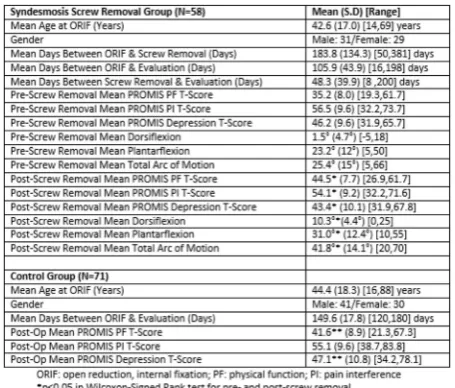
58 ankle fractures with syndesmotic injury that required ORIF with syn-desmotic fixation and subsequent had painful synsyn-desmotic screw symptoms and had subsequent removal met criteria for inclusion from February 2015 to May 2018. We analyzed PROMIS scores collected just prior to syndesmotic screw removal and at the first post-operative visit. A retrospective chart review was performed to collect demographic and ankle ROM data. Cohort data was collected for 71 patients who underwent ORIF with syndesmotic fixation but had no screw symptoms and did not have screw removal during the same study period. Results
The PROMIS physical function (PF) T-score was 35.2 at an average of 106 days after ORIF just prior to syndesmotic screw removal. There was a sta-tistically significant improvement in the PF T-score to 44.5 (p<0.01) in the immediate post-operative period after screw removal. There was statisti-cally significant improvement in ankle ROM after screw removal (p<0.01). In a cohort comparison group of 71 patients during the same time period who did not undergo syndesmotic screw removal, the PF T-score was 41.6 at a mean 150 days after surgery, similar to the PF T-score (44.5) for patients after syndesmotic screw removal (p=0.06), Table 1.
Conclusions
In our study, there was an immediate clinically meaningful improve-ment in physical function outcomes and ankle ROM after symptom-atic syndesmotic screw removal for patients who underwent ankle fracture ORIF with syndesmotic fixation, similar to asymptomatic pa-tients who did not require syndesmotic screw removal within the same post-operative timeframe. This provided strong evidence that patient will benefit from symptomatic screw removal and it did change the care provided to these trauma patients.
P6.
How well do patients recover compared to population norms after an ankle arthrodesis surgery?
Judith F. Baumhauer1, Jessica M. Kohring1, Irvin Oh1, Sam Flemister1,
John P. Ketz1, Jeffrey R. Houck2
1University of Rochester Medical Center, Rochester, NY, USA;2George
Fox University, Newberg, OR, USA
Correspondence:Judith F. Baumhauer ([email protected])
Journal of Patient-Reported Outcomes2019,3(Suppl 1):P6.
Background
extent that ankle arthrodesis restores overall physical function(PF), pain interference(PI) and depression relative to population norms will assist with provider/patient decisions to have the surgery and recovery after.
Objective
The objective was to determine how Patient Reported Outcome Measurement Information (PROMIS) PI, PF, and Depression scales pre-operatively and postoperatively compare to population norms.
Methods
The PROMIS scales are administered at the University of Roches-ter during routine clinical care. Patients with current procedural codes consistent with ankle arthrodesis and data of at least 4 months or more were included (n=68). A minimum 4 month fol-low up was determined by examining recovery curves for PF and PI for ALL available data(>600 points). This resulted in an average follow up of 362 days (range 123–1123 days). The proportion of patients 1 standard deviation (SD) worse than normal, between 1 SD worse than normal and 1 SD above normal was calculated for pre-operative and post-operative follow-up points. Chi-square ana-lysis was used to compare the proportions between time points. The proportion of patients improving by at least a 0.5 SD in PF, PI, or either PF or PI was also reported.
Results
Preoperatively patients 1 SD worse than normal totaled 24.2% for Depression, 72.1% for PF and 75.0% for PI. Post operatively patients 1SD worse than normal was significantly lower for De-pression (15.2% p<0.01), PF (45.6% p<0.01) and PI (35.3% p< 0.01). Except for Depression, these proportions were higher than population norms by 2.9 and 2.2, for PF and PI, respectively. A 0.5 SD improvement was achieved in PI for 58.8%, and for 52.9% in PF; And either PF or PI was improved by 0.5 SD in 67.6% of patients.
Conclusions
A majority of patients improve in PF and PI a 0.5 SD and achieve final scores within 1 SD of population norms. These data are likely helpful to patients/providers pre-operatively and post-operatively as they make clinical decisions associated with whether to have ankle arthrodesis surgery and determine whether patients are meeting expected recovery benchmarks.
P7.
Are global pain interference, physical function and depression important problems in patients with diabetic foot ulcers?
Olivia Waldman1, Jeff R. Houck2, Stephanie Hao1, Nicolette Lee3, Judith Baumhauer1, Irvin Oh1
1Department of Orthopaedics and Rehabilitation, University of Rochester,
Rochester, NY, USA;2Department of Physical Therapy, George Fox
University, Newberg, OR, USA;3Sydney Kimmel Medical College at Thomas Jefferson University, Philadelphia, PA, USA
Correspondence:Judith Baumhauer ([email protected])
Journal of Patient-Reported Outcomes2019,3(Suppl 1):P7.
Background
Diabetic foot ulcer (DFU) patients present with varying reports of pain. Many patients describe numbness, yet persistent pain second-ary to advanced peripheral neuropathy. Painful diabetic peripheral neuropathy (PDPN) is one of the most common complications of dia-betes, but underdiagnosed and remains poorly understood. Objective
The objective was to investigate changes in DFU patient’s pain per-ception by analyzing PROMIS pain interference (PI), physical func-tion(PF), and depression(D) scores before and after foot ulcer treatment. The hypotheses were that due to PDPN, a majority of DFU patients will have high baseline PROMIS PI scores, that remain un-changed by surgical intervention. Moreover, those with high PROMIS PI scores are likely to report low PF and increased depression. Methods
Prospectively collected PROMIS physical function (PF), pain interference (PI), and depression scores were obtained for patients who underwent a procedural intervention for an infected DFU between February 2015 and November 2018 (n=240). Patients with at least 3 consecutive visits, a minimum post-procedural follow-up of 3 months and completion of PROMIS surveys for each visit were included in this study (n=92). Demographics, BMI, medical comorbidities, Hemoglobin A1C, proce-dures performed, and wound healing status data were collected. Chi-Square test, Spearman’s rank correlation coefficient, and minimum clin-ically important differences (MCID) were calculated.
Results
Eighty percent of participants were males (n=74) with an average age of 60.5 (range, 33 to 96) and BMI of 34.1 (range, 22.0 to 57.5). The average follow-up period was 4.7 (range, 3 to 12) months. Poperatively a majority (57.6% and 76.5%, respectively) of patients re-ported PI and PF at least one standard deviations (SD) worse than the US average. Average change on all PROMIS scales was less than 1.7 t-score points. Patients with depression were more likely to have lower PF (p=0.007) and higher PI (p=0.001).
Conclusions
Despite PDPN causing numbness, a majority (57.6%) of patients with PDPN reported PI greater than 1 SD worse than the US population normal. The effects of PDPN and DFU on function are significant, resulting in PF levels that imply difficulty with daily activities. Depres-sion is an important symptom for clinicians to focus on as patient function declines and pain increase.
P8.
Derivation via scoring service of PROMIS® fatigue scores based on FACIT with Sarilumab in rheumatoid arthritis
Clifton O. Bingham III1, Susan Boklage2, Toshio Kimura2, David Cella3 1
Johns Hopkins University, Baltimore, MD, USA;2Regeneron, Tarrytown, New York, NY, USA;3Northwestern University, Chicago, IL, USA Correspondence:Clifton O. Bingham III ([email protected])
Journal of Patient-Reported Outcomes2019,3(Suppl 1):P8.
Background
There is growing interest in the Patient Reported Outcome Measure-ment Information System® (PROMIS®) for the assessMeasure-ment of fatigue, a prevalent symptom of rheumatoid arthritis (RA). This study derived PROMIS-Fatigue 13- and 10-item scores from individual patient-level FACIT-Fatigue scores, via the publicly available scoring service (http:// www.healthmeasures.net), to assess treatment effect from 3 global Table 1 (abstract P6).Demographic and PROMIS Data for Patients
Phase 3 trials with sarilumab. Sarilumab, a fully human monoclonal antibody directed against IL-6Rα, is for treatment of moderately-to-severely active RA. Sarilumab 150mg or 200mg subcutaneous (SC) every 2 weeks (Q2W) vs placebo was assessed in tumor-necrosis-factor-inhibitor-irresponsive patients (24-week TARGET; n=546), methotrexate-irresponsive patients (52-week MOBILITY; n=1197) and as monotherapy with sarilumab 200mg vs adalimumab 40mg SC Q2W (24-week MONARCH; n=369).
Methods
For each trial and treatment arm, least-square mean (LSM) Week 24 change-from-baseline (CFB) FACIT-Fatigue, PROMIS-Fatigue 13- and 10-item scores were obtained for sarilumab 200mg, placebo and adalimumab 40mg, globally and by study region: South America (S-America), Western Europe (W-Europe), Eastern Europe (E-Europe), Asia, Australasia and Africa. Results
Baseline PROMIS-Fatigue 13- and 10-item scores were similar per trial. Respective FACIT-Fatigue//PROMIS-Fatigue scores, differing regionally, ranged between 20.84–24.4//58.77–62.85, 24.92–30.64//55.27–59.50 and 22.35–25.50//58.48–61.58 across the regions in TARGET, MOBILITY and MONARCH, respectively, indicating high levels of baseline fatigue. FACIT-Fatigue//PROMIS-Fatigue 13 item LSM-CFB scores: were 6.82//–4.69 and 5.80//–4.37 for placebo; 10.06//–6.63 and 9.15//–6.65 for sarilumab (TAR-GET and MOBILITY, respectively); and 8.41//–5.56 for adalimumab and 10.18//–6.71 for sarilumab (MONARCH). Regionally, FACIT-Fatigue//PRO-MIS-Fatigue 13 item LSM-CFB scores ranged from 2.34//–1.93(E-Europe) to 11.61/–8.03 (Asia) for placebo, 6.78//–3.67(N-America) to 13.16(S-Amer-ica)//–9.83(Asia) for sarilumab in TARGET; 5.03(Asia)//–3.03(W-Europe) to 7.23(Africa)//–5.17(S-America) for placebo, 7.34(N-America)//– 4.87(Austra-lasia) to 11.54(Austra4.87(Austra-lasia)//–7.56(W-Europe) for sarilumab in MOBILITY; 4.93(N-America)//–3.75(N-America) to 13.33//–8.69(Africa) for adalimu-mab, and 4.33(Africa)//–2.43(Africa) to 11.75(W-Europe)//–8.96(N-America) for sarilumab in MONARCH. Treatment-by-region interaction tests, in which no nominal P-values were less than 0.05, suggested that there were no treatment differences across the regions, nor were there varia-tions in baseline scores that could explain the CFB differences.
Conclusions
Although baseline mean values for and PROMIS-Fatigue scores differed across regions, the treatment effect across regions was comparable.
Funding
The study was funded by Sanofi and Regeneron Pharmaceuticals, Inc.
Conflict of interest
S. Boklage and T. Kimura are employees and shareholders in Regeneron Pharmaceuticals, Inc. D. Cella is a consultant to Sanofi and Regeneron Pharmaceuticals. C. Bingham is a consultant to Sanofi and Regeneron.
Acknowledgments: Medical writing support was provided by Gauri Saal, MA Economics, Prime, Knutsford, UK and was funded by Sanofi and Regeneron Pharmaceuticals, Inc.
P9.
Anxiety and depression symptoms increase office telephone communication for patients with rheumatoid arthritis
Dana DiRenzo, Michael Wu, Thomas Grader-Beck, Clifton O. Bingham III Johns Hopkins University, Baltimore, MD, USA
Correspondence:Clifton O. Bingham III ([email protected])
Journal of Patient-Reported Outcomes2019,3(Suppl 1):P9.
Background
We hypothesized mental health disturbances in patients with Rheumatoid Arthritis (RA) would significantly impact office communi-cation volume. We evaluated telephone call volume in RA patients who completed the Patient Reported Outcome Measurement Infor-mation System (PROMIS) Global Profile-29 during routine clinical care.
Methods
A convenience sample of 530 medical records of patients who received care at a university specialty care center were screened. RA patients who received care for at least 1 year duration and completed the PROMIS Global-29 profile during routine appointments between April and Septem-ber 2018 were identified; telephone call encounters were retrospectively
totaled for 1 year. Patients were stratified by symptoms of high and low anxiety and depression symptoms based on PROMIS anxiety and depres-sion T-scores that were </>= 60. Telephone call volume was compared between groups using student’s t-tests and a multivariable linear regres-sion model was constructed to evaluate the association with high anxiety or depression symptoms.
Results
182 RA patients met the 2010 American College of Rheumatology classification criteria and had profiles completed. Patients were mostly female (n=131, 72%) and white (n=127, 70%) with a mean age (SD) of 59 (14). The median RA disease duration (SD) was 8.5 years (5, 16) and median CDAI (IQR) was moderate at 7.5 (4, 18). High anxiety symptoms were present in 26% of RA patients (n=47), and high depression symptoms in 20% (n=36). RA patients with high vs low anxiety or depression symptoms had significantly more tele-phone encounters (7.3 (11.5) vs 3.0 (5.1), p=0.0179; 8 (11.8) vs 3.1 (5.6), p=0.0217). Anxiety symptoms and depression symptoms both were significantly associated with telephone communication volume in multivariable regression (β=0.209, p=0.014; β=0.180, p=0.034). However, when controlling for use of a mood stabilizer, anxiety and depression symptoms no longer impacted communication volume. Conclusions
This study demonstrates the ability of PROMIS measures to identify patients with high levels of anxiety and depressive symptoms in rou-tine care settings. Identification of anxiety and depression symptoms may prompt implementation of multi-modal strategies to address these symptoms and to provide additional information to alleviate patient concerns regarding their health.
P10.
A real-world evidence-based assessment and intra-method correlative analysis of PROMIS-29, pain interference short form 6b, fatigue short form 7a, with the clinical disease activity index and sf-36 questionnaire among a community-based rheumatoid arthritis population
Clifton O. Bingham III1, Shelly Kafka2, Shawn Black2, Stephen Xu3and Jeffrey R. Curtis4
1
Johns Hopkins University, Baltimore, MD, USA;2Janssen Scientific Affairs, LLC. Horsham, PA, USA;3Janssen Research & Development, LLC. Spring
House, PA, USA;4University of Alabama at Birmingham, Birmingham, AL, USA
Correspondence:Clifton O. Bingham III ([email protected])
Journal of Patient-Reported Outcomes2019,3(Suppl 1):P10.
Objective
Use of PROs to assess health-related quality of life in clinical practice, research studies, and clinical trials in Rheumatoid Arthritis (RA) re-mains an ongoing area of research. The Clinical Disease Activity Index (CDAI) utilized in rheumatology practice is derived from four components including Physician Global Assessment, Patient Global Assessment, Swollen and Tender joint counts (from a total of 28 indi-vidual joints, with a maximum score of 76). SF36 is commonly used in RA trials but is not easily adaptable for practice settings to guide care. PROMIS (Patient Reported Outcomes Measurement Information System) may address this gap but has not been widely assessed in RA patients starting therapy in real world clinical practice or com-pared with overall or component CDAI scores. These were evaluated in the AWARE (Comparative and Pragmatic Study of Golimumab IV Versus Infliximab in Rheumatoid Arthritis) study, an ongoing Phase 4 study designed to provide a real-world assessment of intravenous Tumor Necrosis Factor inhibitor (TNFi) medications in RA pts. Methods
the AWARE study. Baseline study data are reported here. Correlations between PROMIS measures and (1) CDAI component and total scores and (2) comparable SF36 component scores were calculated using Pearson Correlations. Data are mean ± standard deviation (SD). Results
At baseline, the mean CDAI of all pts (n=1262) was 32.2±15.597. The % of pts with High Disease Activity (CDAI>22), Moderate Disease Activity (CDAI >10 and≤22), Low Disease Activity (>2.8 and≤10) and Remission (<=2.8) was 70.4, 22.8, 6.1 and 0.7, respectively. Mean PROMIS-29 T-scores (except Anxiety and Sleep Disturbance) among patients with HDA were significantly different from patients with MDA, LDA or remis-sion. Further, mean PROMIS T-scores of PF, F, PSRA, PI, Pain Intensity, PI6b and P7a among patients with MDA, were significantly different from patients with more or less severe RA (by categorical CDAI). Among CDAI component scores, the Patient Global Assessment was consist-ently the most highly correlated with PROMIS T-scores among the four CDAI components (Tender Joint count, Swollen joint count, patient glo-bal assessment and physician gloglo-bal assessment); the most highly cor-related among the PROMIS-29 domains were Pain Intensity (0.743), Pain Interference (0.645). PI6b had a Pearson correlation of 0.647 for Pa-tient Global assessment. The mean baseline P29 Depression and Anx-iety T-scores were within 0.5 SDs of respective population means. P29 scores were >0.5 SD worse than population means for Physical Func-tion (PF, 38.1±6.84), PI (63.4±7.68), F (58.8±9.95), Sleep Disturbance (55.1±8.68); Ability to Participate in Social Roles/Activities (PSRA, 43.4± 8.58). PI6b, F7a, and P29 domain T-scores were highly correlated with the comparable SF36 subdomain and component scores (r’s >0.58), ex-cepting sleep, for which no comparable SF36 element was applicable. Examples include: PI6b (r=0.-796) and P29-PI (0.807) with SF-36-Bodily Pain; F7a (-0.765) and P29-F (-0.774) with SF36-Vitality; P29-PF with SF36-PF (0.766), Role-Physical (0.688), and Physical CS (0.731); P29 Anx-iety with SF36-Mental Health (-0.715), Role- Emotional (-0.559), Mental CS (-0.695); and P29-PRSA with SF36-Social Functioning (0.705). Conclusions
High correlations between individual PROMIS29 domain T-scores and SF36 component scores, and categorical CDAI, provide strong evi-dence of PROMIS construct validity in a real-world population of RA patients.
P11.
The EPIC PROMIS: implementing routine PROMS collection in orthopaedics
Jeanne T. Black, Marco Castro, Mark Vrahas
Cedars-Sinai Medical Center, Los Angeles, CA, USA–all authors
Correspondence:Jeanne T. Black ([email protected]); Marco Castro ([email protected])
Journal of Patient-Reported Outcomes2019,3(Suppl 1):P11.
Background
Despite CMS mandates and growing recognition that PROMs are import-ant in assessing value, few institutions have successfully implemented their routine collection. The Orthopaedic Department at Cedars-Sinai committed to collecting PROMS routinely across all subspecialties. This re-port describes our implementation strategy and results.
Methods
Key components of our strategy were 1) Obtain high level organizational support and resources for implementation; 2) Demonstrate leadership’s ongoing commitment; 3) Minimize disruption to clinical flow and pro-viders; 4) Offer patients options for survey completion. Orthopaedic lead-ership garnered commitment from senior management to dedicate necessary IT department resources. The Orthopaedic Chairman made multiple presentations to clinic staff and physicians, explaining the initia-tive and its importance. Ongoing reinforcement is provided through con-tinuing Chairman presentations, weekly reports to clinic managers on collection rates, monthly staff lunches when rates exceed goal, and monthly reports to physicians showing their collection rate compared to other physicians in their clinic. The orthopaedic project manager visited 3 institutions where routine PROM collection had been implemented to understand their workflows and analyzed Cedars-Sinai workflows. After reviewing several platforms, the team agreed that PROMIS computer adaptive tests (CAT) collected directly on EPIC’s platform would best
satisfy our goal of minimal disruption to clinic operations while allowing the collection of a standard set of instruments relevant to all orthopaedic subspecialties (Physical Function, Pain Interference, Depression). Patients have two options to complete the PROMs, online using EPIC’s MyChart and/or at their clinic visit. Patients can complete the PROMIS CAT in Epic’s Hyperspace, using the exam room clinical workstation, locked so only the questionnaire is visible. Physicians can view patient t-scores and graphed results immediately in Epic and use a SmartLink to pull the t-scores into their progress notes.
Results
The original collection goal of 75% was achieved in the first 3 months, with an average of 78%. The goal was increased to 80%; for the subsequent 9 months, clinics collected PROMs for 83% of pa-tients. Patients completed 10% of PROMS via MyChart and 90% dur-ing their clinic visits.
Conclusions
A multi-pronged strategy was essential to our success. Continued reinforcement is required to maintain high collection rates.
O12.
A new measure from the PROMIS adult physical function item bank: developing and validating clinician-reported inpatient physical function
Heather E. Brown1, Michael A. Kallen2, Joeffrey R. Hatton1, William A. Doyle1, Ryan Murphy1, Ryan Elliott1, Ann T. Tran1, Mark A. Gutierrez1,
John D. Litten1, Richard C. Gershon, PhD2, Vincent X. Liu1
1The Permanente Medical Group, Kaiser Permanente;Oakland, CA, USA; 2
Northwestern University Department of Medical Social Sciences, Chicago, IL, USA
Correspondence:Heather E. Brown ([email protected])
Journal of Patient-Reported Outcomes2019,3(Suppl 1):O12.
Background
We aimed to develop and validate a precise, score-level targeted clinician-reported inpatient physical function (PF) measure. Item con-tent was derived from PROMIS PF item bank concon-tent and scores re-ported on the PROMIS PF metric.
Methods
The PROMIS PF item bank was reviewed by psychometricians and clini-cians to identify items measuring lower-level PF (T-scores 10-50) that, col-lectively, offered high score-level reliability (≥ 0.90), suggested by established PROMIS PF item performance. Selected items were edited for clinician reporting, reviewed by external clinicians, and field tested. Re-sponse data were assessed for meeting measure development standards; items were calibrated on the PROMIS PF metric via a single-group design linking study, using patient-reported responses to the PROMIS PF items identified for clinician reporting. A 5-item short form (SF) was constructed and new clinical data analyzed for validity evidence.
Results
Nine PROMIS PF items were candidates for clinician reporting of in-patient PF; three new items were written to extend content coverage. (Table 1.) N = 515 inpatients (55.1% female; mean age = 66.2 years) were assessed by physical therapists using the 12 inpatient PF items. Response data analyses indicated the items met expected measure de-velopment standards (e.g., eigenvalue 1 = 83.8% of variance; Cron-bach’s alpha = 0.97). The 12 inpatient PF items were linked to the PROMIS PF metric, using inpatient responses to the nine original PRO-MIS PF items for anchoring (raw scorer= 0.73). The 5-item SF assesses inpatient PF from T-scores 10-60 (score-level reliabilities≥0.90 for T-scores 10-45). Validation study (N = 481) median SF T-T-scores were 35.8 (IQR 28.8-39.9) for inpatients discharged home without home health, 30.4 (IQR 26.0-34.0) for those discharged with home health, and 21.9 (IQR 17.3-26.0) for those with other discharge dispositions. The SF dem-onstrated very good to excellent discrimination for inpatient discharge home without home health (46.8% of inpatients; c-statistic 0.78) and home including home health (76.1% of inpatients; c-statistic 0.87), com-pared with other discharge dispositions.
Conclusions
P13.
Validation of the Arabic version of PROMIS-10 global health assessment in a Swedish immigrant population
Susan Ghalayini1, John E Chaplin2
1
Institute of Medicine, Gothenburg University, Gothenburg, Sweden;2 Institute of Clinical Science, Gothenburg University, Gothenburg, Sweden
Correspondence:John E Chaplin ([email protected])
Journal of Patient-Reported Outcomes2019,3(Suppl 1):P13.
Background
Given the level of global migration, it is increasing necessary to iden-tify valid instruments for the measurement of health in immigrant populations. The objective is to test the validity of the Arabic version of PROMIS-10 in an immigrant population in Sweden.
Methods
Data using the Arabic versions of the PROMIS-10, Hospital Anxiety & Depression scale (HADS) and socio-demographic background ques-tions were collected via an internet survey tool. Adults over the age of 18 were contacted in Gothenburg City, Sweden. The data were collected via an online survey. The link to the survey was sent via so-cial media groups to people living in Gothenburg, email and via handouts to people in shopping malls. Internal consistency of indi-vidual items with the overall score was assessed using Cronbach's alpha coefficient. Construct validity was evaluated by determining Spearman's correlation between the Arabic PROMIS-10 score and scores from the HADS Physical and Mental health. Arabic, Swedish and English versions were available on-line.
Results
There were 106 Arabic versions of the questionnaire completed (72% female) with a further 30 Swedish and 10 English. 125 people classi-fied themselves as an immigrant (86%) with 79% from Arabic coun-tries. 72% of respondents had been in Sweden for less than 5 years; 95% with high school education or higher; 37% were in full-time em-ployment. From the cut-off score for the HADS 35% were anxious and 6% depressed. Internal consistency for Physical Health was 0.804, and Mental Health 0.824. Construct validity for Physical health - HADS Anxiety -0.423; HADS Depression -0.513; Mental health – HADS Anxiety -0.734; HADS Depression -0.670.
Conclusions
The PROMIS-10 Arabic version has good internal consistency in an immigrant population in Sweden. The GH-mental health scale ap-pears to be valid against the HADS mental health score. The instru-ment retains the characteristics of the original English and Swedish language versions.
O14.
Checking the metric: PROMIS domain short form equivalence, scoring methods and the impact of missing data
Robert Chapman, Benjamin D. Schalet, Kathryn Jackson Northwestern University, Department of Medical Social Sciences, Chicago, IL, USA
Correspondence:Robert Chapman
Journal of Patient-Reported Outcomes2019,3(Suppl 1):O14.
Background
PROMIS measures can be administrated with a variety of item con-tent and test lengths, have multiple scoring methods, but simplify to a common metric. The multiplicity of PROMIS scoring options and test lengths allows users to accommodate to the realities of clinical or population-based research, balancing measurement error and pa-tient burden. However, it is unclear to what extent the tests and scor-ing methods are interchangeable. This work evaluates the equivalence of PROMIS profile domain short forms and scoring methods across research contexts and levels of missing data. We offer recommendations for managing group-level missing data. Methods
Analyses were conducted in three“studies”. Study 1 used simulation datasets to examine scale-level score agreement (ICC) and error across short forms and scoring methods (IRT pattern response, look-up table). Study 2 evaluated agreement and error among short forms
and scoring methods in both clinical and general population empir-ical datasets. Study 3 examined intra-individual missing data, data
imputation methods and differences in custom short form
parameters. Results
In Study 1, we simulated 1,000 model scores directly from IRT param-eters. Multiple short forms and scoring methods showed excellent agreement with each other (ICC2 0.95-0.99) and minimal error (2.28-5.11 RMSE T-score units), with no clear preference for pattern vs look-up table scoring. Results were similar in empirical data sets (ICC2 0.90-0.97, 0.59-5.55 RMSE). When missing item data was in-duced, differences between short forms and scoring methods emerged, with longer pattern scored short forms best minimizing error, but look-up table scoring with missing data and mean-item substitution showing little additional bias or disagreement. Across both scoring methods, shorter measures showed twice the rate of error of longer measures.
Conclusions
PROMIS profile domain short forms stay close to the true metric by producing equivalent and reliable scores across short forms, scoring methods and research contexts. Pattern response scoring is recom-mended as a“gold standard”scoring, due to its flexibility, marginally better score stability across short forms and relative insensitivity to missing data. However, look-up table scoring is a valid alternative, even when item-level data are missing and parameters vary across short forms.
P15.
Chinese children’s health Status in the initial three months of cancer treatment
Lei Cheng1, Ying Gu2, Jiashu Wang3, Wen Zhang1, Yingwen Wang2,
Changrong Yuan1
1School of Nursing, Fudan University, Shanghai, China;2Children ’s Hospital of Fudan University, Shanghai, China;3Shanghai University of Medicine&Health Sciences, Shanghai, China
Correspondence:Lei Cheng ([email protected])
Journal of Patient-Reported Outcomes2019,3(Suppl 1):P15.
Background
Children with cancer suffers from symptoms and function changes during their disease continuum. However, there were limited self-reported data about their health status in the initial three months of cancer treatment. The aim of the study was to measure patient-reported outcomes (PROs) in children with cancer in the initial three months of cancer treatment and factors that potentially were associ-ated with their symptoms and function level.
Methods
Children aged 5-18 years, newly diagnosed with cancer were en-rolled. The Pediatric Patient-Reported Outcome Measurement Infor-mation System (PROMIS) was used to measure anxiety, depression, fatigue, anger, pain interference, mobility, upper extremity function, and peer relationship. Test statistics and ANOVA were used to evalu-ate relationships between PROMIS measures and potentially influen-tial variables.
Results
A total of 131 children of 5-18 years (mean age = 8.62 years; 64.90% males), completed the survey, 61.4% had leukemia/lymphoma. Most of the PRO symptom scores were positively correlated, but negatively correlated with functional scores, except for peer relationships. Male patients reported higher fatigue and lower peer relationship. Children undergoing radiotherapy reported highest fatigue. Younger children (less than 8 years old) reported higher anxiety and pain interference, but lower upper extremity function. Children who ad-mitted to hospital more than twice reported lower peer relationships. (Allp<0.05)
Conclusions
O16.
Measurement characteristics of PROMIS Computer Adaptive Testing (CAT) fatigue and ESASr tiredness in kidney transplant
Sumaya Dano1, Evan Tang1, Gauree Chavla1, Niroban Jayakumar1, Areej Ali1, Susan J. Bartlett2, Madeline Li3,
Doris Howell3, John D. Peipert4, Marta Novak5, Istvan Mucsi1 1Multi-Organ Transplant Program, University Health Network, Toronto,
Canada;2Dept. of Clinical Epidemiology, Research Institute of the McGill University Health Centre, Montreal, Canada;3Princess Margaret Cancer Centre, Toronto, Canada;4Department of Medical Social Sciences,
Feinberg School of Medicine, Northwestern University, Chicago, IL, USA;
5
Centre for Mental Health, University Health Network, Toronto, Canada
Correspondence:Sumaya Dano ([email protected])
Journal of Patient-Reported Outcomes2019,3(Suppl 1):O16.
Background
Fatigue is a common and debilitating symptom and is currently not screened for systematically in organ transplant in part due to the lack of sensitive and feasible tools. In this study we evaluate and compare the diagnostic accuracy of the NIH Patient Reported Outcomes Meas-urement Information System CAT fatigue item bank (PROMIS-F CAT) and Edmonton Symptom Assessment System fatigue (ESASr-F) scores in kidney transplant recipients (KTR).
Methods
A cross-sectional, convenience sample of adult outpatient KTR com-pleted PROMISF CAT, the ESASr and the Functional Assessment of Chronic Illness Therapy-Fatigue (FACITF) scale on an electronic data capture system. Spearman’s rho was used to report correlations, and receiver operating characteristic (ROC) analysis was used to assess discrimination of
ESASr-F and PROMIS-F CAT, using the FACIT-F scale score≤30 as a diagnostic criterion for moderate/severe fatigue. Cut-off scores were identified using the Youden index. In a different set of analyses, the PROsetta Stone crosswalk was used to determine the PROMIS-F CAT cut off score that corresponds to the FACIT-F cut-off.
Results
Among 65 KTR patients (mean [SD] age 54[13] years, 38 males [58%]), 11% had moderate to severe fatigue based on the FACIT-F score. Correla-tions between FACIT-F and PROMIS-F CAT (rho=-0.68; p<0.01) and ESASr-F (rho=-0.68; p<0.01) were strong. The PROMIS-ESASr-F CAT had numerically higher discrimination compared to ESASr-F, however the difference was not statistically significant (area under the curve: PROMIS-F CAT =0.93, CI:0.83-1; ESASr-F =0.86, CI:0.62-1; p=0.66). The PROMIS-F CAT cut-off score for significant fatigue identified by the Youden index was 57 (Sensi-tivity=86%, Specificity=88%, Positive Predictive Value (PPV)=0.46, Nega-tive PredicNega-tive Value (NPV)= 0.98); the cut-off score for ESASr-F was 6 (Sensitivity=86% Specificity=93%, PPV=0.6, NPV=0.98). The PROMIS-F CAT cut-off score based on the ROC curve analysis was similar (57.8) to the cut-off determined using the PROsetta Stone crosswalk file.
Conclusions
In this analysis we found that the PROMIS-F CAT and ESASr-F had simi-lar discrimination for significant fatigue. We also identified clinically use-ful cut-offs for significant fatigue for PROMIS-F CAT and ESASr-F. The results suggest that both PROMIS-F CAT and ESASr-F may be potentially feasible as a screening tools for fatigue among KTRs.
P17.
Do utility elicitations preserve the psychometric benefits of PROMIS® item banks?
Barry Dewitt1, Janel Hanmer2
1Department of Engineering & Public Policy, Carnegie Mellon University,
Pittsburgh, PA, USA;2Division of General Internal Medicine, University of Pittsburgh, Pittsburgh, PA, USA
Correspondence:Barry Dewitt ([email protected])
Journal of Patient-Reported Outcomes2019,3(Suppl 1):P17.
Background
Health utility scores map health states to a unidimensional construct, utility, that compactly represents preferences for those health states. For utility elicitation tasks that are used to create the score map-pings, health states are described using multi-dimensional qualitative
descriptions, where each state is described using levels of health do-mains (e.g.,
physical function, depression, fatigue). The PROMIS®-Preference (PROPr) score is the first health utility score mapped from item banks. Item re-sponse theory guarantees the commensurability of different items from the same item bank. However, no one knows whether, in practice, that commensurability is preserved in utility elicitation tasks.
Methods
PROPr is constructed from seven PROMIS domains. In utility elicitation tasks, each domain is represented with two items from its item bank. We compare utility elicitations that produced the PROPr score (n=983) with a second online panel (n=630) that undertook the same prefer-ence elicitation task, but with different items from three of the item banks: Cognitive Function-Abilities (cognition), Depression (depression), and Pain Interference (pain). We use beta regression to determine the size of the item-choice effect on single-attribute utility functions. Results
The choice of items does not affect the utility function for the depression domain. For the cognition domain, it affects the curvature of the utility function but not its estimate of the population mean value of cognition (coefficient = 0.28, logit scale, p<0.01). For the pain domain, it affects the mean utility estimate for the population mean value of pain but not the curvature of the utility function (coefficient = -0.39, p<0.01).
Conclusions
Two of the three domains showed little item-choice effect on the most important part of the utility function, its curvature. Thus, to some ex-tent, utility elicitations preserve the commensurability of items within an item bank. Future research should quantify the degree to which the standard gamble utility elicitation, its particular implementation in this study, and participant characteristics affect these results.
O18.
Preoperative PROMIS 10 physical function scores help predict opioid dependence after lumbar fusion surgery
Terence P Doorly1, Rachel C Sisodia2 1
NSPG Spine Program, Peabody, MA, USA;2Massachusetts General Hospital & Partners HealthCare System, Boston, MA, USA
Correspondence:Terence P Doorly ([email protected])
Journal of Patient-Reported Outcomes2019,3(Suppl 1):O18.
Objective
Opioid naïve patients undergoing lumbar fusion surgery are seldom informed that opioid dependence is a potential postoperative out-come. We sought to determine the incidence of postoperative opioid dependence in this population, and to evaluate preoperative PROMIS 10 physical function scores as a tool to help predict those patients at higher risk of opioid dependence.
Methods
Patients undergoing spinal fusion surgery are routinely administered the following surveys - PROMIS 10, PROMIS physical function and PROMIS pain interference, preoperatively and at 30, 90, 180 and 365 days postopera-tively. During the period January 1, 2014, to October 1, 2018, data was col-lected on 95% of eligible patients. For this study, patients were secol-lected for analysis if at the time of surgery they were opioid naïve and had not filled a narcotic prescription within the previous year, as validated by state and federal prescriber monitoring databases. Post-operative opioid use was validated using the same databases. Patients were defined as opioid dependent if they were still filling narcotic prescriptions 6 months after surgery. Appropriate statistical analysis was performed.
Results
Conclusions
Currently, 9% of our opioid naïve patients undergoing lumbar fusion surgery become opioid dependent postoperatively. PROMIS 10 phys-ical function scores help predict the risk of this complication, and when used in conjunction with other validated tools, enhance shared decision making prior to surgery, and direct judicious prescribing of narcotics postoperatively.
P19.
Use of Caregiver-Selected PROMIS measures in the evaluation a pragmatic clinical trial for children with medical complexity
Nora Fayed1, Julia Orkin2, Nathalie Major-Cook3, Audrey Lim4, Eyal
Cohen2
1Queen
’s University, Kingston, Ontario, Canada;2The Hospital for Sick
Children, Toronto, Ontario, Canada;3Children’s Hospital of Eastern Ontario, Ottawa, Ontario, Canada;4McMaster Children
’s Hospital, Hamilton, Ontario, Canada
Correspondence:Nora Fayed ([email protected])
Journal of Patient-Reported Outcomes2019,3(Suppl 1):P19.
Background
Children with Medical Complexity (CMC) have medical fragility, chronic health conditions, and elevated healthcare service use. CMC account for as little as 0.5 % of all children in Canada (~400,000 in the US), yet they use about one-third of all child health resources. A pragmatic clinical trial for CMC, is evaluating the roll-out of a coordi-nated care intervention to meet CMC needs. Caregivers and expert clinician providers set out to develop an evaluation framework to guide the selection of primary and secondary trial endpoints. Methods
Literature review of outcomes, caregiver and clinician engagement survey, and consensus conference methods were used to determine the core set of outcomes requiring measurement in the trial. Out-comes were assessed by caregivers and clinicians based on their im-portance and amenability for change due to intervention.
Results
The primary endpoint,‘experience of coordinated care’, was rated by caregivers and clinicians as the most important and amenable for change. Caregiver sleep, energy and fatigue and mood were priori-tized as secondary endpoints, and PROMIS tools were endorsed for use in the trial to measure them.
Conclusions
PROMIS tools that measure sleep, energy and fatigue and mood were endorsed as important and amenable to change in the context of clinical trials for caregivers of medically complex children. Trial re-sults as evaluated by PROMIS tools will be available September 2020.
P20.
Reducing respondent burden for spine patients–developing a prediction model for ODI and COMI based on PROMIS 29
Claudia Hartmann, Felix Fischer
1
Center of Internal Medicine and Dermatology, Department of Psychosomatic Medicine, Charité–Universitaetsmedizin Berlin, corporate member of Freie Universität Berlin, Humboldt-Universität zu, Berlin and Berlin Institute of Health, Berlin, Germany
Correspondence:Claudia Hartmann ([email protected])
Journal of Patient-Reported Outcomes2019,3(Suppl 1):P20.
Objective
The Charité Spine Center collects several PROMs in order to meet re-quirements such as the Registry of the German Spine Society and the ICHOM Lower Back Pain Set. Therefore, the following quality of life measures are currently collected: ODI, EQ-5D-5L, PROMIS Profile 29 and COMI (Back and Neck). In total 65 questions are asked, 20 of them tar-geted to measure pain and pain intensity. In order to reduce respond-ent burden, we investigated whether scale
scores of the ODI and/or COMI Back could be predicted from PROMIS Profile 29.
Methods
We used PROMs from 350 patients undergoing treatment (surgery or none invasive) at our Spine Center care units. Data was randomly
split in calibration (n = 250) and validation (n = 100) sample. First, we analyzed between-scale correlations for all of the questionnaires. We then predicted the ODI and COMI Back score by different sets of predictor variables in a
multivariate regression: all PROMIS Domain Scores, Top3 and Top2 correlated scores, and a single regression with highest correlated score. We then tested each of the three prediction models on indi-vidual and sample level in the validation sample.
Results
The highest correlations (r = -0.87) was found between ODI Score and PROMIS Physical function and between COMI Back Score and PROMIS Pain Interference (r = 0.70). The regression models for the ODI showed that for an individual prediction the root-mean-square deviation varies from RMSE single regression = 12.92 and evolves by adding variables to 9.69 (Top3). For COMI Back the RMSE for single regression is 1.50 and evolves to 1.477 for multi regression (Top3). Conclusions
Prediction of ODI scores on a sample level using multivariate regres-sion with 3 variables was feasible, but predictions of individual scores came with substantial error. Inclusion of predictors moderately asso-ciated with the ODI improved prediction. Prediction of COMI Back score on a sample level and for individual scores using multivariate regression with the TOP 3 correlated variables was feasible. Inclusion of predictors moderately associated with the COMI-back score mod-erately improved prediction.
O21.
Measuring PROMs using Computer Adaptive Testing (CAT) after an operative intervention of an extremity fracture
Roos J.M. Havermans1,2, Koen W.W. Lansink2, Taco Gosens3Mariska A.C. de Jongh1
1
Brabant Trauma Registry, Network Emergency Care Brabant’, Tilburg, the Netherlands;2Department of Surgery, ETZ Hospital
(Elisabeth-TweeSteden Ziekenhuis), Tilburg, the Netherlands;3Department of Orthopaedics, ETZ Hospital (Elisabeth-TweeSteden Ziekenhuis, Tilburg, the Netherlands
Correspondence:Roos J.M. Havermans ([email protected])
Journal of Patient-Reported Outcomes2019,3(Suppl 1):O21.
Background
Patient Reported Outcome Measurement Information System (PROMIS) is a valid measurement system and can contribute to the evaluation of health care and health related quality of life. It was designed to enhance communication between clinicians and patients. The use of Computer Adaptive Testing (CAT) based on Item Response Theory (IRT) required significantly fewer questions and less time to complete. The aim of the study is to examine the correlation between the generic PROMIS CAT questionnaires and injury specific questionnaires after an operative intervention of an upper or a lower extremity fracture. Methods
A prospective cohort study was conducted. All trauma patients who underwent an operative intervention of an upper or lower extremity fracture between April and December 2018 and responded to the CAT questionnaires were included. The injury specific questionnaires are the Quick Disabilities of the Arm, Shoulder and Hand (DASH) and the Lower Extremity Functional Scale (LEFS) for the upper and lower extremity fractures respectively. The correlation between the injury specific ques-tionnaires and the CAT quesques-tionnaires (PROMIS Physical Function (PF), PROMIS Social Function (SF) and PROMIS Pain Interference (pain)) were calculated with the Pearson’s correlation (r). Response burden and floor/ceiling effects were calculated for each questionnaire.
Results
Conclusions
In conclusion, the generic CAT questionnaires are reliable during re-habilitation after an operative intervention when compared to the Quick DASH and LEFS with a strong correlation and a lower response burden. The PROMIS physical function should be combined with the PROMIS social function.
O22.
Identifying responders to treatment
Ron D. Hays1, Karen L. Spritzer1, Steven P. Reise2
1Department of Medicine, University of California, Los Angeles, CA, USA; 2
Department of Psychology, University of California, Los Angeles, CA, USA
Correspondence: Ron D. Hays ([email protected])
Journal of Patient-Reported Outcomes2019,3(Suppl 1):O22.
Background
It is important to provide guidance on options for evaluating individ-ual change because there is confusion in the literature. For example, the U.S. Food and Drug Administration guidance document recom-mended identifying responders using empirical evidence from anchor-based methods. But using group-level change to identify re-sponders leads to misclassification of patients as rere-sponders when they have not actually changed. In comparison to group change, much larger change is needed for statistically significant change in an individual’s score, because of the much larger standard errors for estimates of individual change.
Materials and Methods
We use two waves of data collected 3-months apart in a longitudinal observational study of 1834 chronic low back pain or neck pain pa-tients. Average age was 49 and 74% female. We categorize people into three change groups (got worse, stayed the same, got better) using the reliable change index based on classical test theory (CTT) and item response theory (IRT) estimated standard errors for the 4-item PROMIS®-29 physical functioning scale.
The study was approved by the RAND Corporation Human Subjects Protection Committee (#2013-0763) and was registered as an observa-tional study on ClinicalTrials.gov (ID:
NCT03162952). Results
Seventy-eight percentstayed the same according to CTT estimates versus 91% based on IRT. Of the 1425 that were classified as the
same according to CTT, 99% were also classified as the sameby IRT. However, only 27% of the 173 people that were worse ac-cording to CTT were classified as such by IRT. Similarly, only 38% of the 236 people classified asbetter by CTT were also deemed
betterby IRT. The Spearman rank—order correlation between CTT and IRT categories of change was 0.54 (p = 0.0228) and Cramer's V was 0.50 (p <.0001). People who changed by a substantial amount (12-13 T-score points on average) were consistently denoted as changing by CTT and IRT.
Conclusions
Because CTT often classified people as changing when IRT indi-cated no change, the approach used has noteworthy implications for who ends up being classified as changed. Either approach is better than using the minimally important difference as the threshold, but IRT is preferred because it allows the standard error to vary across individuals.
Acknowledgements
This study was supported by a NIH National Center for Complementary and Integrative Health Grant No. 1U19AT007912-01.
P23.
Clinical utilization of patient reported outcomes in the upper extremity orthopaedic population: comparing the PROMIS upper extremity bank v2.0 and the QuickDASH measures
Edward Heinle IV, Michael Suk, Joel Klena, L. Christopher Grandizio Geisinger Medical Center, Danville, PA, USA
Correspondence:Edward Heinle IV ([email protected])
Journal of Patient-Reported Outcomes2019,3(Suppl 1):P23.
Background/Objective
Recent advancements in Computer Adapted Testing (CAT) technol-ogy has had a prominent effect in the realm of Patient Reported Outcome Measures (PROMs). It has shown to reduce time to com-pletion and question burden while maintaining reliability. PROMIS Upper-Extremity bank v2.0 (UE) CAT and QuickDASH (QDASH) are PROMs that are intended to assess the physical functions in pa-tients with upper extremity health conditions. The two scores have both been shown to be responsive over time as well as to be corre-lated with each other [Overbeek, 2015]. Moreover, a cross-walk table has been developed which maps the QDASH raw score onto the PROMIS metric. However, the QDASH has a usage history of a dozen years, and its progenitor, the full form DASH, has been used extensively for over 20 years. The purpose of this work is to provide a nuanced understanding of how to preserve this historical legacy as the UE CAT becomes increasingly popular. We have placed an emphasis on the Minimal Clinically Important Difference (MCID) as a clinical anchor for relating the two scores, as well as more in depth psychometric considerations.
Methods
A cohort of 2,822 patients who had undergone outpatient upper ex-tremity orthopaedic surgery completed baseline and post-operative sessions for the QuickDASH survey alongside the PROMIS Upper Ex-tremity v2.0 CAT and VAS Pain measure.
We conducted a retrospective review and analysis of the raw scores and patient demographics, as well as the completion time and num-ber of questions answered per session.
Results
The QuickDASH took 0:52.05 on average, compared to the PROMIS UE v2.0’s 1:48.50. Despite the additional time, the PROMIS Upper Ex-tremity demonstrated a higher consistency, with an average pre-operative score of 34.68 (SD 9.39) compared to the QDASH’s average of 48.54 (SD 23.01).
Conclusion
The PROMIS UE v2.0 CAT item bank demonstrates high reliability and internal consistency relative to the QuickDASH outcome measure. The difference in statistical reliability outweighs the greater comple-tion time for the PROMIS UE CAT and stresses the importance of in-creased development in Computer Adapted Testing technology.
O24.
What PROMIS T-score thresholds discriminate when a patient reaches acceptable symptom state in primary care?
Ryan Jacobson, Daniel Kang, Jeff Houck George Fox University, Newberg, OR, USA
Correspondence:Ryan Jacobson ([email protected])
Journal of Patient-Reported Outcomes2019,3(Suppl 1):O24.
Background
Clinical interpretation of PROMIS T-scores continues to be a chal-lenge, limiting clinical application. Studies thresholding to patient ac-ceptable symptom state (PASS)—a validated question for judging whether a patient believes their current health state is satisfactory— -show thresholds at ½ to 1 standard deviation (SD) worse than the US average for certain scales (Physical Function (PF), Self-Efficacy for Symptom Management (SE), Pain Interference (PI)). The objective of this analysis was to establish PASS thresholds for PROMIS PF, SE, PI, Fatigue, and Depression, and to determine if ½ or 1 SD worse than the US average sufficiently discriminate PASS in primary care patients at intake, 3-14 days, and 45-60 days follow-up.
Methods
Results
At intake, AUC values were 0.76-0.79, except Depression which was 0.71. At 3-14 days AUC values were 0.81-0.84, and at 45-60 days 0.82-0.85, except for Depression which never exceeded 0.72. At intake, ac-curacy of“optimal” T-score thresholds to discriminate PASS ranged 71.2%-73.7%, except for Depression at 66.3%. At 3-14 and 45-60 days, accuracy increased 3.0-5.2% for all scales. Rounding to thresholds ½ or 1 SD worse than average lead to decrements in accuracy of≤3.6%. Conclusions
Clinicians should consider PROMIS T-score thresholds at ½ or 1 SD worse than the US average to discriminate PASS with good accuracy (>70%) at intake and follow-up, except for Depression. Accuracy marginally improves after intake up to 5.2%. Knowing these PASS thresholds enhances pro-viders’ability to use PROMIS scales for patient engagement and prioritizing patient symptoms across a broad spectrum of primary care patients.
P25.
Are PROMIS assessments important for determining patient acceptable symptom state in primary care?
Ryan Jacobson, Daniel Kang, Tyler Cuddeford, Jeff Houck George Fox University, Newberg, OR, USA
Correspondence:Ryan Jacobson ([email protected])
Journal of Patient-Reported Outcomes2019,3(Suppl 1):P25.
Background
Assessments in primary care need to inform provider decisions or dir-ectly impact care. Complex symptom profiles, as provided by PROMIS scales, may be“nice to know”rather than actionable for providers. A limited set of PROMIS scales demonstrated utility in identifying a pa-tient’s satisfaction with their overall symptom state (i.e. PASS question) in orthopedic patients.
Objective
The objective of this analysis was to establish whether a more com-prehensive set of PROMIS scales across a wider spectrum of patients was able to predict PASS during a primary care encounter.
Methods
A broad spectrum of patients ages 20-97 years (mean=66.9±17.0; 52.7% female; diagnosis 20.9% endocrine, 18.2% circulatory, 17.9% musculoskel-etal) attending primary care were administered 5 PROMIS computer adaptive scales and PASS at intake (n=368) and 45-60 days (n=234). Aver-age number of comorbidities were 5.5±2.7. A total of 58.4% of patients were PASS yes. Univariate correlations were all significant among scales suggesting possible redundancy. Backward logistic regression was used to determine which scales best modeled PASS. Model fit was evaluated using the Hosmer-Lemeshow Test. The same analysis was run on the 45-60 day data to determine the repeatability of the analysis.
Results
The PROMIS SE(p<0.01), Fatigue(p=0.01) and PI(p<0.01) scales were retained in the final model. The accuracy of predicting PASS im-proved from 58.4% prior to applying the model to 76.4% after apply-ing the model. Hosmer-Lemeshow test indicated adequate fit (p= 0.46). The same PROMIS scales were retained for the 45-60 day data and model fit was adequate (p=0.79). The prevalence of PASS prior to applying the regression model for the 45-60 day sample was 60.2% and after was 80.5%.
Conclusions
PROMIS assessments across a spectrum of diagnoses are effective at assisting providers in understanding why patients’PASS state may be negative or positive. This knowledge may prove critical in assisting pro-viders to dissect complex symptom sets. Because PROMIS scales target key symptoms that are linked to a patient’s acceptable symptom state, specific actionable treatments addressing symptoms are needed.
P26.
Parent-child agreement on PROMIS asthma impact
Aaron J. Kaat1, Raj Kumar2, Jin-Shei Lai1 1
Department of Medical Social Science, Northwestern University, Chicago, IL, USA;2Allergy and Immunology, Lurie Children
’s Hospital, Chicago, IL, USA
Correspondence:Aaron J. Kaat ([email protected] )
Journal of Patient-Reported Outcomes2019,3(Suppl 1):P26.
Background
The PROMIS Asthma Impact Scale (PAIS) 8-item short form has a parent-report version for ages 5-18 years, and a self-report version for ages 8-18 years. It is one of the few scales within PROMIS that is not centered on a general-population sample, but rather on a clinical sample of children with asthma. While the psychometric properties of the PAIS have been mostly well-described, much less is known about inter-rater reliability. This study aims to address this gap. It has been well-documented that parent-child agreement was poor on be-havioral outcomes while moderate on physical health outcomes, and as such, we hypothesize poor-to-moderate agreement herein. Methods
Children and their parents from three asthma clinical trials independ-ently completed the PAIS. For dyads with more than one PAIS comple-tion, one testing occasion was chosen for analyses. The reliability was calculated independently within each trial and then aggregated across trials to ensure that eligibility differences between studies did not mod-ify reliability coefficients. Inter-rater reliability was evaluated using Krippendorff’s alpha with interval-scaled measurement (i.e., PROMIS T-scores), and with graphical analyses using Bland-Altman plots. Results
There were 250 dyads across the three samples. In two samples, chil-dren rated their asthma impact more severe than their parents by 3 or 3.5 T-score points, but in the third sample parents rated asthma impact one T-score point worse, with a weighted average difference of higher self-report by one T-score point. However, there was wide variability in these differences (weighted SD of differences = 10.1). Agreement was modest (Krippendorff’s alpha = 0.43). Graphical ana-lyses suggest that floor effects were common for both raters, even though this was a clinical sample. Floor effects occurred on 38% of parent-report data and 22% of self-report, with 16% of dyads being at the floor for both raters.
Conclusions
Parent-child interrater reliability on the PAIS is similar to other pediatric conditions. There is modest agreement between raters, and wide variability in the score differences. Floor effects were problem-atic and may have affected these reliability estimates. For these rea-sons, information from both informants should be gathered, when possible, to fully understand asthma impact among children and adolescents.
P27.
Further evidence on the validity of the multiple sclerosis-specific PROMIS Fatigue short form in the UK MS register population
Paul Kamudoni1, Jeffrey Johns2, Sam Salek2, 3, Dagmar Amtmann4,Karon
Cook5, Jana Raab1, Ying Sun1, Oliver Guenther1, Rod Middleton6, Christian Henke1
1
Global Evidence & Value Development–R&D, Merck Healthcare KGaA, Darmstadt, Germany;2School of Life and Medical Sciences, University of
Hertfordshire, Hatfield, UK;3Institute of Medicines Development, Cardiff, UK;4Department of Rehabilitation Medicine, University of Washington,
Seattle, WA, USA;5Feinberg School of Medicine, Northwestern University, Chicago, IL USA;6UK MS Register, Swansea Medical School,
Swansea, UK
Correspondence:Paul Kamudoni ([email protected])
Journal of Patient-Reported Outcomes2019,3(Suppl 1):P27.
Background
The content validity and measurement properties of the PROMIS Fa-tigue short form are well established, based on several studies con-ducted in the USA.
Objective
The aim of this study was to generate further evidence on the measure-ment properties of the PROMIS Fatigue short form, including test-retest reliability and responsiveness, based on the UK MS Register population. Methods