O R I G I N A L A R T I C L E
Effect of lintel on horizontal load-carrying capacity
in post-beam structure
Chun-Young Park•HyungKun Kim• Chang-Deuk Eom•Gwang-Chul Kim• Jun-Jae Lee
Received: 20 December 2012 / Accepted: 29 July 2013 / Published online: 5 November 2013
The Japan Wood Research Society 2013
Abstract This study is aimed to evaluate whether lintel has structural effect because it has not been categorized as a structural member. This study experimentally evaluated the horizontal load-carrying capacity of post-beam timber frame structures with bi-linear model and energy dissipa-tion mechanism. To evaluate the effect on horizontal per-formance of lintel which has been widely used as wall frame in Korean traditional post-beam structure, two frames were tested in different types. One had no lintel and the other one had lintel at the height of 800 mm, respec-tively. Cyclic loading tests were conducted for each frame according to the standard loading protocol. Frame which had lintel showed slightly higher stiffness. And it showed noticeably significant energy dissipation performance after yield point of the joint. And that leads to the conclusion that lintel has structural effect and it should be considered
as an important factor when evaluating horizontal perfor-mance of the structure after yield point of the joint. Keywords Post-beam structureHorizontal load-carrying capacityEnergy dissipationDovetail joint
Introduction
Timber structures have been shown significant horizontal shear performance in historical earthquake. Extensive studies have been conducted on horizontal load-carrying capacity of light framed houses throughout North America and Europe and post-beam structures in East Asian region. Han-ok which means Korean traditional building is cate-gorized into post-beam structures. As well as its beautiful appearance, its structural performance has been an issue. However, it was not easy to calculate structural stability because Han-ok has been built by own hands of craftsman and not by machine. In this reason, most Han-oks have been over designed and caused wasting of expensive wood members.
There have been various approaches to evaluate struc-tural performance of Han-ok. Many researchers have thought that most of the structural performance came from the joint. Therefore, most of the study about Han-ok is concentrated on the joint performance. Some of the studies were conducted on the traditional frame but there were no consideration about lintel. Recently, lintel has been draw-ing attention in reinforced concrete construction. And it is also a very important member for infilling wall in tradi-tional and modern Han-ok.
Yu [1] conducted the research about the traditional wooden joint in Han-ok. All kinds of traditional joints
Part of this paper has been presented at the world conference on timber engineering (WCTE 2012), Auckland, New Zealand, July, 2012.
C.-Y. ParkG.-C. Kim
Department of Forest Sciences, Chon-Buk National University, Seoul 151-921, Korea
H. Kim
Department of Forest Sciences,
Seoul National University, Seoul 151-921, Korea
C.-D. Eom
Korea Forest Research Institute, Seoul 130-712, Korea
J.-J. Lee (&)
Department of Forest Sciences, Research Institute for Agriculture and Life Sciences, College of Agriculture and Life Sciences, Seoul National University, Seoul 151-921, Korea e-mail: [email protected]
were organized based on their shape and location. But, it was limited to the categorization of the joints and there was no consideration about their performance. Han [2] investigated mechanical performance of mortise-tenon joint. Series of experiments were conducted and optimum size of the mortise-tenon joint was determined. Similar test was conducted by Han [3] about the size effect of the mortise-tenon joint. Joint performance was evaluated under consideration of wood properties. Pang et al. [4] evaluated the moment-carrying capacity of dovetail joints in traditional Korean wooden buildings. Yet, it was limited to the joint.
In 1999, Seo et al. [5] started to conduct traditional frame test under lateral loading. Lateral yield strength of timber post-beam structure with different joints was ana-lysed. As a result, joint performance was emphasized. Another test was conducted by Hwang et al. [6]. Horizontal shear test was conducted to evaluate the horizontal shear performance of the post and beam wood wall. They are similar tests, but did not consider the effect of the lintel and the vertical load.
Research about the lintel is scarce because lintel has not been considered as a structural member in construction field. Recently, Lee and Oh [7] conducted a static experiment to evaluate the seismic performance of a two-story reinforced concrete (RC) shear wall system. As a result, it was shown that the specimen with a lintel beam underwent the seismic performance with an ultimate strength and ductility capacity better than the specimen without a lintel beam.
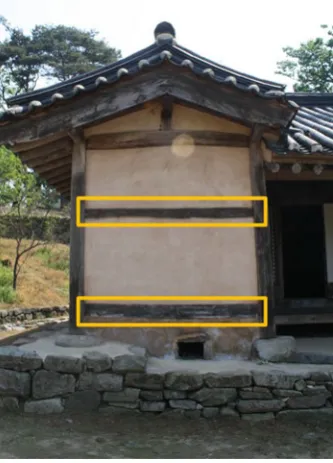
Among all of the members, lintel has been overlooked for its structural performance. Figure1shows middle and
bottom lintels which are installed in Han-ok. Lintel is a horizontal member which is used as wall frame and it has been categorized as non-structural member without any experimental background. Therefore, this study is aimed to investigate the effect of lintel on structural performance in post-beam structure and, furthermore, to investigate seis-mic performance using cyclic loading test.
Materials and methods
Specimens
Glulam using Japanese Larch (Larix leptolepis) was pre-pared for full-scale test. Moisture content of each lamination was below 13.16±1.32 % and the grade of Glulam was 10S30B by Korean Standard (KS). Size of specimens was 180 9180 92400 (mm) for the post, 1809240 93420 (mm) for the beam and 180918093420 (mm) for the lintel. The beam was assembled on the top of posts with dovetail joint. After all, the frame had total width of 3780 (mm) which was 3600 (mm) from the middle to the middle of two posts and height of 2400 (mm). Dovetail joint was chosen to imitate Korean traditional joint and cut by Pre-Cut machine (K2, Hundegger). A detailed view of the joint is presented in Fig. 2.
Cyclic loading test
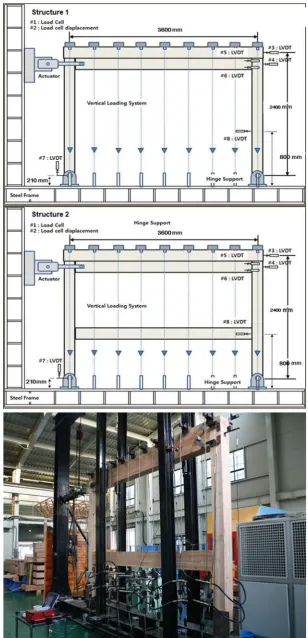
Structure 1 was constructed with two posts and a beam, Structure 2 had same composition as Structure 1 with lintel
in the height of 800 mm from the bottom. Details of the test specimen are presented in Fig.3.
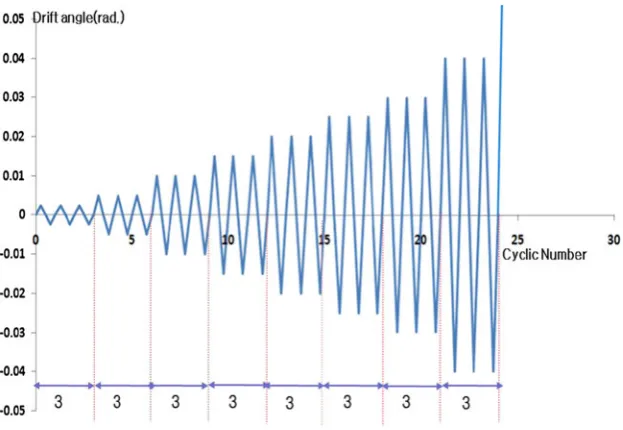
Cyclic loading test had been conducted for those two frames. Cyclic load was applied on the left upper corner of the frame according to the loading procedure shown in Fig.4. Loading speed and maximum displacement were 1 mm/s and±100 mm, respectively. Using 6 LVDTs and computer data acquisition system, displacements of each part were obtained. Supporting condition was assumed to be hinge support. A pin which has a diameter of 18 mm was inserted to the post at the height of 210 mm from the bottom steel plate. Details of loading procedure for each cycle are shown in Table1.
Fig. 4 Loading procedure
Table 1 Detail of loading procedure
Drift angle (rad) Frequency (Hz) Cycle number
0.0025 0.043668 3
0.005 0.021834 3
0.010 0.010917 3
0.015 0.007278 3
0.020 0.005459 3
0.025 0.004367 3
0.030 0.003639 3
0.040 0.002729 3
Failure 1
Vertical load
Han-ok has beautiful, yet significantly heavy roof. This weight of the roof is delivered to rafter and then distributed to beams and upper parts of the posts uniformly. To cal-culate the roof load delivered to unit frame, standard
Han-ok was selected. Unit roof load was calculated according to KBC (Korean Building Code 2009) and the value was 36 kN. And simulated vertical load was applied on the frame using 18 hydraulic cylinders. As a result, the test setup was shown in Fig. 3.
Evaluation methods
Strength properties were calculated using bi-linear method regulated by Architectural Institute of Japan (AIJ). Struc-tural characteristic factor (Ds-Eq.1) which decides seismic performance of the frame can be calculated by using duc-tility factor (l) which means that the ratio between the beginning point (hv) and the finishing point (hu) of the ultimate load (Pu) is based on the Plasto-Elasticity model. Other structural characteristic values in elastic range are shown in Fig.5. This is the method which evaluates the behaviour of the structure distinguishing the plastic region from the elastic region. And it is suitable to calculate Fig. 6 Concept of energy dissipation
allowable shear stress of the frame considering low initial stiffness and large deformation of wooden dovetail joint that exists in traditional timber structures [8–11]
Ds¼1=
ffiffiffiffiffiffiffiffiffiffiffiffiffiffiffiffiffi 2l1
ð Þ
p
ð1Þ
Energy dissipation is defined as the energy dispersed in structural system against the external load and it determines the seismic performance of the structural frame which is used as very critical factor in seismic design along with the response modification factor. Energy dissipation can be evaluated by calculating the inner area of the hysteresis loop (Fig.6). In general, energy
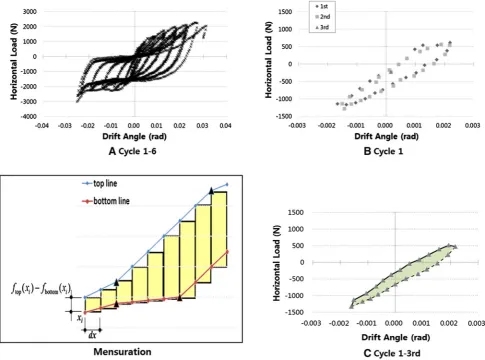
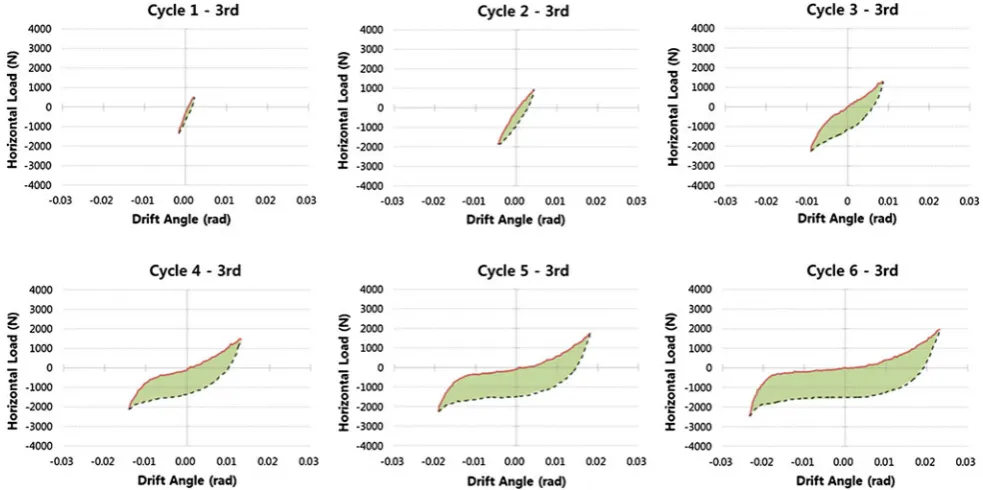
dissipation should be calculated at the point that the story-drift ratio reaches 3.5 % [12, 13]. And this corresponds to the point between the 7th and 8th cycle in this study. However, experiment of Structure 2 which had lintel was not completed to reach this cycle for safety reason, so energy dissipation of the 6th cycle was compared. Third cycle of each hysteresis curve was selected and simplified to calculate the inner area. Then displacement was separated into differential length (dx) to apply a mensuration of division as shown in Fig.7.
Result and discussion
Hysteresis curve
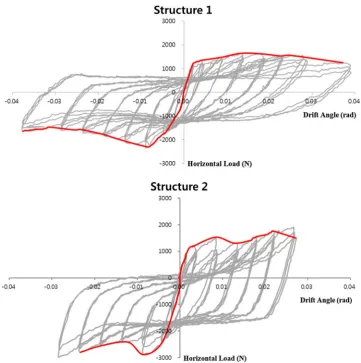
Figure8 shows hysteresis curves of two structures. The two structures show similar shape of hysteresis curves. They yielded after 3rd cycle and lost most of their stiffness. However, unlikely to the Structure 1, strength of the Structure 2 increased slightly after yield point. And also, Structure 2 does not show dramatic decrease in strength Fig. 8 Hysteresis curves of
structures
after yielding. This result means that lintel has structural effect after yield point.
Hysteresis curve shows similar behaviour with that of common post-beam frame, strain softening which means decreasing horizontal load as frame is subjected to repeated load (Fig.9). It was shown that stress was consistently decreasing throughout 1st to 3rd cycle in Structure 1. On the other hand, there was significant decrease at second cycle in Structure 2, yet the total decrease was about the same with the Structure 1.
Strength properties
Lintel has been considered as a non-structural member so far. From the result of the experiment (Table2), there was no significant structural difference according to a lintel in elastic region, yet even higher structural performance was
observed when there was no lintel [yield force (Fy), yield drift angle (hy), Initial stiffness (K)].
However, for the plastic region, ductility factor (l) and structural characteristics factor increased when the lintel was installed. That means there was large deformation in plastic region and it could be the effect on the safety of structure.
Energy dissipation
Energy dissipation performance of each frame was evalu-ated by calculating the inner area of the hysteresis curve. And the energy dissipation was calculated at stages in third cycle of the whole hysteresis curve (Fig. 10).
Structure 1 which was composed of two posts and beam showed 1355 (N rad) of energy dissipation throughout 6 cycle of loading. On the other hand, Structure 2 which had Table 2 Strength properties
Fy(N) hy(rad) K(N/rad) Fmax(N) hmax(rad) Fu(N)
Structure 1 1202 0.002 551638 1639 0.013 1390
Structure 2 1074 0.004 355808 1890 0.017 1262
hu(rad) hv(rad) S(N rad) l Ds P120(N)
Structure 1 0.034 0.003 49.704 13.680 0.190 1458 Structure 2 0.022 0.005 31.763 5.010 0.339 1390
Fyyield force,hyyield drift angle,Kinitial stiffness,Fmaxmaximum force,hmaxdrift angle inFmax,Fuultimate force,huDrift angle inFu,hv
beginning drift angle of plastic behaviour,Senergy of plasto-elastic behaviour,lductility factor,Dsstructural characteristic factor,P120load in
drift angle 1/120
lintel showed 2483 (N rad) throughout same cycle. And the difference of value was significant after third cycle when the joint started to yield. Comparison of the energy dissi-pation performance is shown in Table3. As similar to the
l, ductility factor, energy dissipation performance is one of the critical factors when conducting seismic design. Lintel proved that it could absorb or transform dynamic energy into other form of energy when it was subjected to cyclic loading. Especially, it is clearly confirmed by accumulative dissipation.
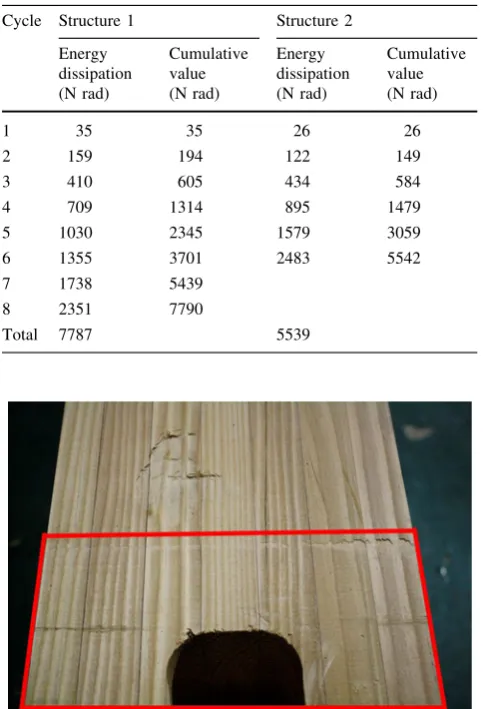
Effect of lintel was confirmed by the bearing line on the post member after the experiment. But the bearing surface and depth are not significant because lintel had effect in latter part of the behaviour and not on the initial part. In other words, there was no significant effect of lintel on energy dissipation before yielding point because there was slight gap between the post and the lintel joint. Even though this gap was small, there was no significant interior deformation in the lintel joint because the story drift of the lintel level was shown to be only 33.3 % of the top beam.
However, bearing occurred on the top and the bottom of the lintel joint as the deformation increased more than the gap of the joint after yield point. And the bearing was developed to surface contact from point contact after yield point. It is shown in Fig.11. It is considered that this changing form of contact caused by inner deformation in lintel joint had dedicated to the enhanced energy dissipa-tion performance.
Conclusions
Structural effect of lintel which has been overlooked was evaluated from the experiment. Following conclusions can be drawn from the present study:
• It is verified that lintel had structural effect when it is subjected to cyclic loading.
• Lintel has no significant effect in initial elastic region but, shows structural effect in plastic region.
• Lintel shows significant energy dissipating performance after yield point.
• Applying lintel to structure can be an effective way to enhance seismic performance of structures.
• Bearing occurred between post and lintel throughout the whole behaviour is the reason for increasing of energy dissipation.
Acknowledgments ‘‘This paper was supported by research funds of Chon-buk National University in 2012’’.
References
1. Yu SH (1988) Study about jointing of Korea wooden structure. Master’s Thesis Paper, Korea University
2. Han JS (2005) An experimental study on mechanical perfor-mance of column and girder joint system for analysis on struc-tural system and modernization on traditional of wooden architecture. J Korean Constr 21(11):195–206
3. Han SR (2006) Evaluation of the mechanical performance of various types of column and girder joint in Korean traditional wooden building. Master’s Thesis Paper
4. Pang SJ, Oh JK, Park JS, Park CY, Lee JJ (2011) Moment-carrying capacity of dovetailed mortise and tenon joints with or without beam shoulder. J Struct Eng 137(7):785–789
5. Seo JM, Choi IK, Lee JR (1999) Static and cyclic behaviour of wooden frames with tenon joints under lateral load. J Struct Eng 125(3):344–349
6. Hwang KH, Park JS, Park MJ (2007) Horizontal shear perfor-mance of pre-cut post and beam wall applying traditional wood system. J Korean Constr 27(1):301–304
7. Lee SH, Oh SH (2010) Static experiment for the seismic per-formance of a 2 story RC shear wall system. J Korean Seism Eng 14:55–65
8. Richard N, Yasumura M, Davenne L (2003) Prediction of seismic behaviour of wood-framed shear walls with openings by pseudodynamic test and FE model. J Wood Sci 49:145–151
Table 3 Energy dissipation for each cycle and accumulation Cycle Structure 1 Structure 2
Energy dissipation (N rad) Cumulative value (N rad) Energy dissipation (N rad) Cumulative value (N rad)
1 35 35 26 26
2 159 194 122 149
3 410 605 434 584
4 709 1314 895 1479
5 1030 2345 1579 3059 6 1355 3701 2483 5542 7 1738 5439
8 2351 7790
Total 7787 5539
9. Oshiumi S (2000) Testing and evaluation method for the ele-ments in post and beam structures (in Japanese). Kenchiku Gi-jutsu 608:174–179
10. Sawata K, Yasumura M (2003) Estimation of yield and ultimate strength of bolted timber joints by nonlinear analysis and yield theory. J Wood Sci 49(4):383–391
11. Gatto K, Uang C (2003) Effect of loading protocol on the cyclic response of woodframe shears. J Struct Eng 129(10):1384–1392
12. Choi HK, Yoo CH, Choi YC, Choi CS (2010) Structural capacity evaluation of hybrid precast concrete beam-column connection subjected to cyclic loading. J Korea Concr Inst 22(3):325–333 13. ACI T1.1R-01 (2002) Commentary of acceptance criteria for