Volume 11, Issue 09 (September 2015), PP.18-26
Secure Image Transmission for Cloud Storage System
Using Hybrid Scheme
Shelly
1, Dr Rajesh Kumar Bawa
2 1Student of Punjabi University, Patiala. 2Proff. Of Punjabi University, Patiala.
Abstract :- Data over the cloud is transferred or transmitted between servers and users. Privacy of that data is very important as it belongs to personal information. If data get hacked by the hacker, can be used to defame a person’s social data. Sometimes delay are held during data transmission. i.e. Mobile communication, bandwidth is low. Hence compression algorithms are proposed for fast and efficient transmission, encryption is used for security purposes and blurring is used by providing additional layers of security. These algorithms are hybridized for having a robust and efficient security and transmission over cloud storage system.
Keywords:- Secure Image Transfer, Encryption, Blur Map Model, Compression.
I.
INTRODUCTION
Every user require secure storage and safe data transmission. Several trends are there in cloud computing, which are an internet based deployment. The more powerful processors together with the (SaaS) software as a service computing architecture, transforming data centers into pools of service on large scale. To subscribe high quality services we have to increase network bandwidth, yet flexible connections can be made. As we know that data security is an important term of (QOS) quality of service, cloud computing has to invent new challenging security threats for number of reasons. firstly, traditional cryptographic primitives are the most basic blocks which are used to build cryptographic protocols and security. various kind of user’s data is stored on cloud and demand for secure and safe data for long term and verifying the correctness of that data in the cloud becomes even more challenging. Secondly, cloud computing is not just a third party data warehouse. The data stored in the cloud is continuously changing by including insertions, deletion , modification , appending, recording . basically the stored data is frequently updated by users. It is the paramount important to ensure the correctness of data under such dynamic data updates. However, this dynamic feature also makes the traditional integrity insurance technique futile and entails new solutions. User’s data is redundantly stored on multiple physical locations to further reduce the data integrity threads. Last, but not the least, deployment of cloud computing is powered by data centers running in the cooperated, simultaneous and distributed manner. Here, distributed are used to ensure the correctness of data in cloud for achieving the secure and robust cloud data storage system in real world.
II.
SECURITY ON IMAGES
2.1 Image Compression Using DWT
When an image has been processed of the DWT, the total number of transform coefficients is equal to the number of samples in the original image, but the important visual information is concentrated in a few coefficients. To reduce the number of bits needed to represent the transform, all the sub bands are quantized. Quantization of DWT sub bands is one of the main sources of information loss. In the JPEG2000 standard, the quantization is performed by uniform scalar quantization with dead-zone about the origin. In dead-zone scalar quantizer with step-size j, the width of the dead-zone is 2j as shown in Figure below. The standard supports
separate quantization step-sizes for each sub band. The quantization step size j for a sub band j is calculated
based on the dynamic range of the sub band values. The formula of uniform scalar quantization with a dead-zone is
( , )
( , )
sign(
( , ))
jj j
j
W m n
q m n
y m n
where Wj(m,n) is a DWT coefficient in sub band j and j is the quantization step size for the subband j. All the
resulting quantized DWT coefficients qj(m,n) are signed integers.
After the quantization, the quantized DWT coefficients are then use entropy coding to remove the coding redundancy.
2.2 Image Encryption using Blowfish
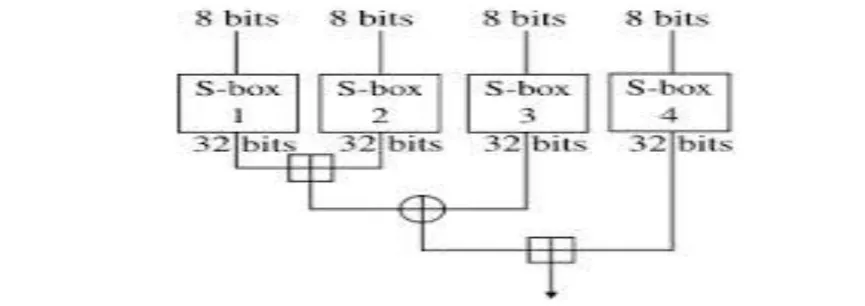
To perform the encryption in the second object, blowfish encryption algorithm is used to hide the image details of hidden object.[1,3-4,8] A significant number of research papers on the performance evaluation and work flow of encryption algorithms has been studies under the literature survey part. The AES and Blowfish algorithms were selected in the final short listing of encryption algorithms, because these two provide the best encryption security. Out of the two shortlisted ones, the conclusion was obtained that the blowfish encryption algorithm is considered the fastest one among the all other options. [14] Blowfish encryption algorithm is designed in a customized way to work with images in MATLAB environment. The algorithm code is designed to perform various rounds of encryption. The encryption algorithm is used here to hide the image details and to create a new image with dizzy image details. The image details are made hidden in chaotic way to create a new image with less number of details. The image is not made completely unreadable because it provokes the hacker to crack into the encryption, whereas a low resolution less detail encryption can be easily mistaken as a bad image.. The decryption process is the reverse process, which is used to obtain the original image by using the reverse engineering of the cryptographic process on the receiver’s end. For the decryption, user has to enter the same key as it was entered on the sender’s side while encrypting the image. The decryption process returns the full resolution original image from the encrypted image once the process is complete. The image encryption using blowfish process has been listed in the figure below(see Figure 2.
Figure 2 Blowfish encryption for image processing
j
j
j2
j
j
j
j3
2
1
0
1
2
3
Blowfish is a variable-length key, 64-bit block cipher. The algorithm consists of two parts: a key-expansion part and a data- encryption part. Key key-expansion converts a variable-length key of at most 56 bytes (448 bits) into several sub key arrays totaling 4168 bytes. Data encryption occurs via a 16-round Feistel network. Each round consists of a key-dependent permutation, and a key- and data-dependent substitution. The additional operations are four indexed array data lookups per round. Implementations of Blowfish that require the fastest speeds should unroll the loop and ensure that all sub keys are stored in cache.
1.1.1 Sub keys:
Blowfish uses a large number of sub keys. These keys must be precomputed before any data encryption or decryption.
1. The P-array consists of 18 32-bit sub keys: P1, P2,..., P18. 2. There are four 32-bit S-boxes with 256 entries each:
S1,0, S1,1,..., S1,255; S2,0, S2,1,..,, S2,255; S3,0, S3,1,..,, S3,255; S4,0, S4,1,..,, S4,255.
Generating the Sub keys:
1. The sub keys are calculated using the Blowfish algorithm. The exact method is as follows:
2. Initialize first the P-array and then the four S-boxes, in order, with a fixed string. This string consists of the hexadecimal digits of pi (less the initial 3). For example:
P1 = 0x243f6a88, P2 = 0x85a308d3, P3 = 0x13198a2e, P4 = 0x03707344 2. XOR P1 with the first 32 bits of the key, XOR P2 with the second 32-bits of the key, and so on for all bits of
the key (possibly up to P14). Repeatedly cycle through the key bits until the entire P-array has been XORed with key bits.
3. Encrypt the all-zero string with the Blowfish algorithm, using the sub keys described in steps (1) and (2).
4. Replace P1 and P2 with the output of step (3).
5. Encrypt the output of step (3) using the Blowfish algorithm with the modified sub keys. 6. Replace P3 and P4 with the output of step (5).
6. Continue the process, replacing all entries of the P- array, and then all four S-boxes, with the output of the continuo
There are a number of building blocks that have been demonstrated to produce strong ciphers.
Large S-boxes: Larger S-boxes are more resistant to differential cryptanalysis. An algorithm with a 32-bit word length can use 32-32-bit S-boxes.
Key-dependent S-boxes: key-dependent S-boxes are much more resistant to these attacks differential and linear cryptanalysis.
Combining operations: Combining XOR mod 216, addition mod 216, and multiplication mod 216+1 [7]. Key-dependent permutations: The fixed initial and final permutations of DES have been long regarded as cryptographically worthless.
2.3 Blurring Algorithm
The proposed scheme is a modification of the one suggested by Lian et al. In their blurring algorithm, an explicit diffusion function based on a logistic map is used to spread out the influence of a single plain image pixel over many cipher image elements. Although the diffusion function is executed at a fairly high rate, it is still the highest cost, in terms computational time, of the whole blurring algorithm. This is because multiplications of real numbers are required in this stage. Table 1 lists the time required in different parts of Lian et al’s blurring algorithm. It shows that the time for completing a single diffusion round is more than four times longer than that for a permutation. The test is performed on a personal computer (PC) with 2.0GHz Core i3 processor, 6 GB memory and 500GB harddisk capacity.
right cyclic shift on the binary sequence s, LSB3(s) refers to the value of the least three significant bits of s, vi is the resultant pixel value in the permuted image. The seed [ ] 0, 1 v−1 ∈ L − is a sub-key obtained from the key generator.
As the pixel value mixing depends on the value of the previously processed pixel, the operation sequence cannot be changed. This may lead to a problem in the reversed confusion process required in deblurring. A solution is to make the first decipher round perform the reverse position permutation only. Then both reverse position permutation and pixel value change are performed from the second decipher round. In this manner, an additional deblur round is required for the reverse of pixel value modification. It composes of the simple add-and-shift operation and adds only little cost to the overall deblur procedures.
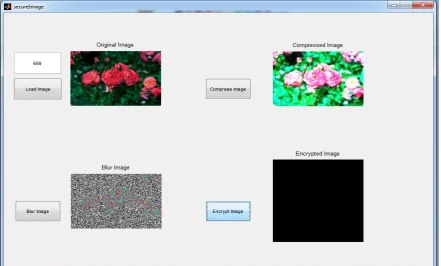
Figure 3: The step-wise security embedding model using compression, blur and encryption for the proposed system security model to secure the new image and add it to the database
Index File Size (Kb)
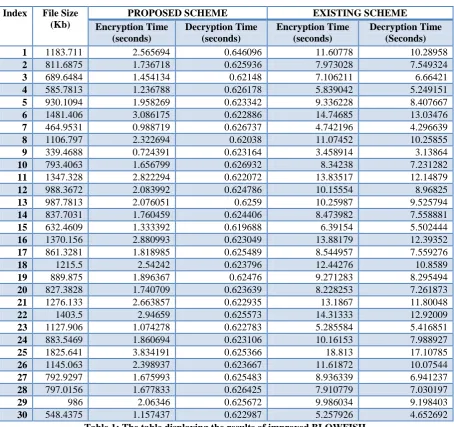
PROPOSED SCHEME EXISTING SCHEME Encryption Time (seconds) Decryption Time (seconds) Encryption Time (seconds) Decryption Time (Seconds) 1 1183.711 2.565694 0.646096 11.60778 10.28958 2 811.6875 1.736718 0.625936 7.973028 7.549324 3 689.6484 1.454134 0.62148 7.106211 6.66421 4 585.7813 1.236788 0.626178 5.839042 5.249151 5 930.1094 1.958269 0.623342 9.336228 8.407667 6 1481.406 3.086175 0.622886 14.74685 13.03476 7 464.9531 0.988719 0.626737 4.742196 4.296639 8 1106.797 2.322694 0.62038 11.07452 10.25855 9 339.4688 0.724391 0.623164 3.458914 3.13864 10 793.4063 1.656799 0.626932 8.34238 7.231282 11 1347.328 2.822294 0.622072 13.83517 12.14879 12 988.3672 2.083992 0.624786 10.15554 8.96825 13 987.7813 2.076051 0.6259 10.25987 9.525794 14 837.7031 1.760459 0.624406 8.473982 7.558881 15 632.4609 1.333392 0.619688 6.39154 5.502444 16 1370.156 2.880993 0.623049 13.88179 12.39352 17 861.3281 1.818985 0.625489 8.544957 7.559276 18 1215.5 2.54242 0.623796 12.44276 10.8589 19 889.875 1.896367 0.62476 9.271283 8.295494 20 827.3828 1.740709 0.623639 8.228253 7.261873 21 1276.133 2.663857 0.622935 13.1867 11.80048 22 1403.5 2.94659 0.625573 14.31333 12.92009 23 1127.906 1.074278 0.622783 5.285584 5.416851 24 883.5469 1.860694 0.623106 10.16153 7.988927 25 1825.641 3.834191 0.625366 18.813 17.10785 26 1145.063 2.398937 0.623667 11.61872 10.07544 27 792.9297 1.675993 0.625483 8.936339 6.941237 28 797.0156 1.677833 0.626425 7.910779 7.030197 29 986 2.06346 0.625672 9.986034 9.198403 30 548.4375 1.157437 0.622987 5.257926 4.652692
Table 1: The table displaying the results of improved BLOWFISH Implementation on dataset of 50 images
Figure 5: The graphs of Encryption and Decryption processing speeds [Also the average results] for proposed model
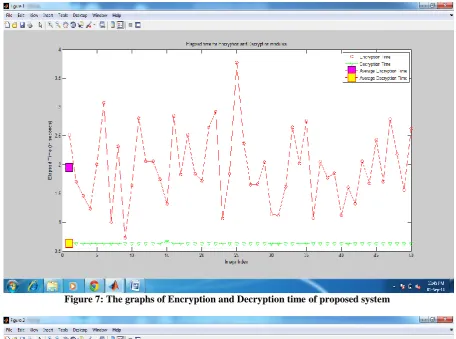
Figure 7: The graphs of Encryption and Decryption time of proposed system
Figure 8: The graphs of Encryption and Decryption time of existing system
III.
CONCLUSIONS
In this paper, we are proposing the compression, encryption and blurring security techniques by using DWT , BLOWFISH and BLURMAP [ providing extra layers of security] and proposed hybridized algorithm technique for more secure and effective security system. Blowfish is compared with AES technique which proves that Blowfish is best encryption technique in all way.
ACKNOWLEDGEMENT
I deeply thankful to Dr Rajesh Kumar Bawa , professor , Punjabi University, Patiala. For providing his valuable help throughout my work. I am thankful for his stimulating guidance, continuous encouragement, and supervision. And with all hard work I completed my Research Paper.
REFERENCES
[1]. Al-Hilo, Eman A., and Rusul Zehwar. "Fractal Image Compression by YIQ Color Space." In Computational Science and Computational Intelligence (CSCI), 2014 International Conference on, vol. 1, pp. 221-225. IEEE, 2014.
[2]. Xiangui Kang, Jiwu Huang [2003]: “A DWT-DFT composite watermarking scheme robust to both affine transform and JPEG compression” IEEE aug 2003.
[3]. Sonja Grgic, Mislav Grgic [2001]: “Performance analysis of image compression using wavelets.”
Industrial elsctronics. IEEE 2001.
[4]. Marcelloni, Francesco, and Massimo Vecchio. "A simple algorithm for data compression in wireless sensor networks." Communications Letters, IEEE 12, no. 6 (2008): 411-413.
[5]. Srisooksai, Tossaporn, Kamol Kaemarungsi, Poonlap Lamsrichan, and Kiyomichi Araki. "Energy-Efficient Data Compression in Clustered Wireless Sensor Networks using Adaptive Arithmetic Coding with Low Updating Cost."International Journal of Information and Electronics Engineering 1, no. 1 (2011): 85-93.
[6]. Xi Xu et al. [2012]:Image Compression Using Radon Transform With DCT : Performance Analysis. International Journal of Scientific Engineering and Technology. Volume No. 2, Issue No. 8, pp : 759-765.
[7]. Dong-U Lee et al. [2009]:Precision-Aware Self-Quantizing Hardware Architectures for the Discrete Wavelet Transform, volume 21, IEEE [2009].
[8]. Dolfus, Kirsten, and Torsten Braun. "An evaluation of compression schemes for wireless networks." In Ultra Modern Telecommunications and Control Systems and Workshops (ICUMT), 2010 International Congress on, pp. 1183-1188. IEEE, 2010
[9]. . A Survey on Data Compression in Wireless Sensor Network Naoto Kimura and Shahram Latifi
Electrical and Computer Engineering, University of Nevada, Las Vegas{naoto, latifi}@egr.unlv.edu
International Conference on Information Technology: Coding and Computing (ITCC’05) IEEE [2000]. [10]. Medeiros, Henry Ponti, Marcos Costa Maciel, Richard Demo Souza, and Marcelo Eduardo Pellenz.
"Lightweight Data Compression in Wireless Sensor Networks Using Huffman Coding." International Journal of Distributed Sensor Networks 2014 (2014).
[11]. Liang, Yao. "Efficient temporal compression in wireless sensor networks." InLocal Computer Networks (LCN), 2011 IEEE 36th Conference on, pp. 466-474. IEEE, 2011.
[12]. Marcelloni, Francesco, and Massimo Vecchio. "A simple algorithm for data compression in wireless sensor networks." Communications Letters, IEEE 12, no. 6 (2008): 411-413
[13]. Paar, Christof. "Applied cryptography and data security." Lecture Notes), Ruhr-Universität Bochum (http://www. crypto. ruhr-uni-bochum. de) (2000).
[14]. Hager, Creighton TR, Scott F. Midkiff, Jung-Min Park, and Thomas L. Martin. "Performance and energy efficiency of block ciphers in personal digital assistants." In Pervasive Computing and Communications, 2005. PerCom 2005. Third IEEE International Conference on, pp. 127-136. IEEE, 2005.
[15]. Kessler, Gary C. "An overview of cryptography." (2003).
[16]. Agarwal, Navita, and Himanshu Sharma. "An Efficient Pixel-shuffling Based Approach to Simultaneously Perform Image Compression, Encryption and Steganography." International Journal of Computer Science and Mobile Computing (IJCSMC) 2, no. 5 (2013): 376-385.
[17]. Mathur, Milind, and Ayush Kesarwani. "Comparison between Des, 3des, Rc2, Rc6, Blowfish And Aes." In Proceedings of National Conference on New Horizons in IT-NCNHIT. 2013.
[18]. Verma, O. P., Ritu Agarwal, Dhiraj Dafouti, and Shobha Tyagi. "Peformance analysis of data encryption algorithms." In Electronics Computer Technology (ICECT), 2011 3rd International Conference on, vol. 5, pp. 399-403. IEEE, 2011.
problems and their applications to cryptography." InInternet Technology and Secured Transactions (ICITST), 2011 International Conference for, pp. 46-52. IEEE, 2011.
[20]. Kautsky, Jaroslav, Jan Flusser, Barbara Zitová, and Stanislava Šimberová. "A new wavelet-based measure of image focus." Pattern Recognition Letters 23, no. 14 (2002): 1785-1794.
[21]. Welk, Martin, David Theis, and Joachim Weickert. "Variational deblurring of images with uncertain and spatially variant blurs." Lecture notes in computer science 3663 (2005): 485.
[22]. Levin, Anat. "Blind motion deblurring using image statistics." In Advances in Neural Information Processing Systems, pp. 841-848. 2006
[23]. Danielyan, Aram, Vladimir Katkovnik, and Karen Egiazarian. "BM3D frames and variational image deblurring." Image Processing, IEEE Transactions on 21, no. 4 (2012): 1715-1728.
[24]. Whyte, Oliver, Josef Sivic, Andrew Zisserman, and Jean Ponce. "Non-uniform deblurring for shaken images." International journal of computer vision 98, no. 2 (2012): 168-186.
[25]. Chen, Gu L., Ching Yang Lin, Hon Fai Yau, Ming Kuei Kuo, and Chi Ching Chang. "Wave-front reconstruction without twin-image blurring by two arbitrary step digital holograms." Optics express 15, no. 18 (2007): 11601-11607.
[26]. Couzinie-Devy, Florent, Jian Sun, Karteek Alahari, and Jean Ponce. "Learning to estimate and remove non-uniform image blur." In Computer Vision and Pattern Recognition (CVPR), 2013 IEEE Conference on, pp. 1075-1082. IEEE, 2013.
![Figure 5: The graphs of Encryption and Decryption processing speeds [Also the average results] for proposed model](https://thumb-us.123doks.com/thumbv2/123dok_us/1397607.1651514/6.595.74.526.70.406/figure-graphs-encryption-decryption-processing-average-results-proposed.webp)