ISSN: 2278-7461, ISBN: 2319-6491
Volume 1, Issue 11 (December2012) PP: 21-27
Economic Analysis of Hybrid Photovoltaic-Thermal
(PVT) Integrated Solar Dryer
Sujata Nayak
1, Zeba Naaz
2, Pushpendra Yadav
3, Ruchi Chaudhary
41,2,3,4Department of Mechanical Engg., Manav Rachna College of Engineering,
Faridabad- 121004, Haryana, India
Abstract:–In the post-harvesting technology, the mechanical drying of agricultural products is an energy consuming operation. Due to unavailability, shortages and high prices of fossil fuels, greater emphasis has been given to using solar energy sources. A solar dryer incorporating a directly coupled photovoltaic (PV) powered D.C. fan has been developed. The dryer has been designed to utilize forced air circulation without the use of external power supplies like grid electricity. The dryer has been coupled to a solar air heater having a sun-tracking facility and blackened surface of absorber for improved energy collection efficiency. For the fulfilling our purposes, a new PVT integrated solar dryer consisting of a solar air heater and a drying chamber with chimney was developed. This system can be used for drying various agricultural products like fruits and vegetables. In the present work, the experimental study has been conducted for the forced mode under no load and load conditions and a techno-economic analysis of hybrid PVT dryer has been carried out.
Key words:–Photovoltaic-thermal, Air heater, Solar dryer, Economic analysis
I.
INTRODUCTION
The traditional sun-drying technique is labor-intensive and requires a lot of land per unit throughput. Drying is a process of moisture removal from a product, involves both heat and mass transfer. During drying, the produce also undergoes to physical and chemical changes which may or may not be desirable depending on the properties required for the product output.The researches and development work for PV applications have been increased in recent years to conserve the conventional energy sources. A very few researchers have used PV module powered air circulation for forced convection drying. The fan or blower, used for forced circulation of heated air from the collector area to the drying beds in active solar energy dryers, can be operated either by grid electricity or DC electricity produced by photovoltaic (PV) module. The hybrid photovoltaic-solar dryers use DC electricity produced by PV module to drive the fan or blower for forced circulation of heated air [1]. A solar dryer was studied with photovoltaic solar cells, incorporated in the solar air heater section, to drive a DC fan. The dryer dried 90 kg maize grain per batch from an initial moisture content of 33.3 to 20 percent (dry basis) in just one day. In comparison to sun drying, solar grain drying with a PV-driven DC fan reduces the drying time by over 70 percent [2]. Farkas et al. [3] developed a modular solar dryer in which a PV panel (maximum power: 2 × 20 W), to drive an electrical fan for artificial air circulation, was installed in the front side of the dryer with changeable elevation angle suitable to the different angle of the sunshine in the different periods of the year. Hossain et al. [4] optimized a solar tunnel drier for chilli drying in Bangladesh and reported that the design geometry was not very sensitive to minor material costs, fixed cost and operating cost but more sensitive to costs of major construction materials of the collector, solar radiation and air velocity in the drier. Phougchandag and Woods [5] developed a mathematical model of the indirect sun drying of banana and showed to be in good agreement with experimental result under lights and a set of field data from Thailand.
However, a PV based solar dryer is a self-sustained solar dryer. This type of dryer does not require any other energy during operation. Hence, this dryer may become a more suitable proposition for the rural sector and other areas in which electricity is scarce and irregular supply. A PV based solar dryer is designed and fabricated and installed at Manav Rachana College of Engg. (MRCE) at Faridabad, Haryana. It consists of an air heater and drying chamber with chimney and a supporting stand. The photovoltaic (PV) based solar dryer has been developed for rural applications where grid electricity does not reach and adequate supplies of fossil fuel to drive a fan or blower are lacking. The dryer in this study has been designed to use a D.C. fan powered by directly coupled photovoltaic. A techno-economic analysis of the above dryer has also been carried out.
II.
METHODOLOGY
2.1. Detail description of PV-T integrated solar dryer
Working Principle
The principal components of a solar drying system are solar air heater and drying unit. Solar air heater are used consists of PV panel and flat plate collector. This unit or system consists of PV panel (Glass-to-glass) for converting solar radiation into electricity. This panel has been integrated with flat plate collector at an inclination of 30O for receiving maximum solar radiation. Solar air heater is used for heating the ambient air available at the inlet point of air duct. The principle of this system is solar energy collection and its use is described in figure 1. In this case the drying unit is connected to the air heater. The incoming solar radiations fall on the PV module, which converts solar radiation into electricity and the collector absorbs the radiation, converted into thermal energy. That energy has been utilized to heat the working fluid generally air, which is supplied to the drying unit for reduction of moisture content of agricultural commodity. The heated air from the air heater is extracted by a fan of capacity 12V, provided at the outlet of air heater, which is operated by the electricity generated from the PV module and supplying that air into the drying chamber where materials to be dried, placed into the three trays.
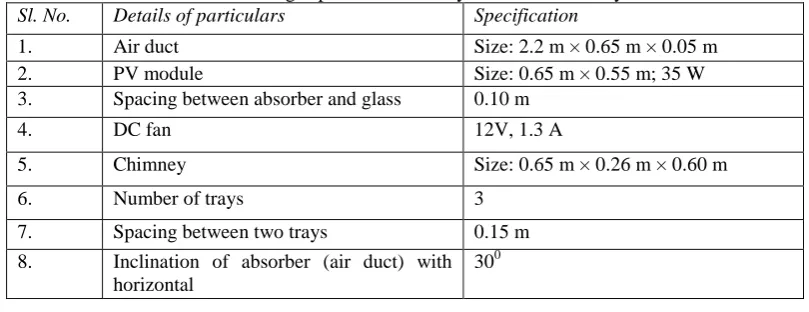
Table. 1. Design specifications of hybrid PV-T solar dryer
Sl. No. Details of particulars Specification
1. Air duct Size: 2.2 m × 0.65 m × 0.05 m
2. PV module Size: 0.65 m × 0.55 m; 35 W
3. Spacing between absorber and glass 0.10 m
4. DC fan 12V, 1.3 A
5. Chimney Size: 0.65 m × 0.26 m × 0.60 m
6. Number of trays 3
7. Spacing between two trays 0.15 m
8. Inclination of absorber (air duct) with horizontal
300
III.
EXPERIMENTAL SET UP AND OBSERVATIONS
A hybrid PVT solar dryer has been designed and installed Manav Rachana College of Engg.(MRCE) at Faridabad, Haryana. India. The dryer consists of a collector unit, drying chamber, DC fan etc. (Figure 1). The collector unit comprises a PV module glass) and flat plate air collector. The PV module (glass-to-glass) was provided at lower part of solar collector to operate a DC fan for forced mode of operation. In this case, the solar radiation through non packing factor area is also available to the absorber below PV module for preheating of ambient air. The DC fan is fitted at the junction of collector module exit and drying chamber inlet to suck the hot air from collector module and force it into drying chamber. The hot air flows from bottom to top of the drying chamber through wire mesh trays and takes away moisture from crops placed in the trays and exhausted to outside through openings provided at top of east and west side walls of drying chamber. The sides of the dryer are made from plywood/wood for insulation and sealed in to avoid any air leakage. For easy rain water drainage, a slanting roof was provided above the drying chamber. There are drawers consisting wire mesh trays and placed in drying chamber from back portion of the dryer. Design specifications of PV/T mixed mode dryer are given in Table 1. No load test of dryer has been conducted to analyze the temperature in air heater and drying chamber. Under this condition, the useful heat is extracted but it is not utilized. A fan extracts the heated or hot air from the air heater and transfer it to the drying chamber and thus trays inside the drying chamber could attain the required temperature.
hourly basis. Hourly solar radiation on air collectors have also been measured by using solarimeter having an accuracy of 20 W/m2, manufactured in India by Central Electronics Ltd. PV module was manufactured by CEL Sahibabad, Ghaziabad (U.P.). The current and voltage are measured by AC/DC digital clamp meter having an accuracy of 0.1 A and 0.1 V. The experiment was carried out for forced mode under no load conditions during April, 2012 (Table 2a).
The following parameters were measured hourly during the experimentations: 1. Inlet temperature. 2. Outlet temperature. 3. Ambient temperature. 4. Solar cell temperature. 5. Total and diffuse solar intensity on collector.
6. Load current (IL) and load voltage (VL). 7. Short circuit current (Isc) and open circuit voltage (Voc).
Figure 1: Photograph of hybrid Photovoltaic-thermal (PV-T) integrated solar dryer
3.1. Experimental Observations (without Load test condition):
Table 2(a). Hourly variation of solar intensity and various temperatures
Temperature (oC) Tray temperature (oC) Chimney
outlet temp. (Tchfo)
Inclined solar radiation
(It) Time (hr)
Ambient temperature
Collector Outlet
temp. T1 T2 T3
t Tfi=Ta Tcfo (oC) (oC) (oC) (oC) W/m2
9.00 34.5 45.5 45 44.5 44 43.5 530
10.00 35 46 45.5 45 44.5 44 570
11.00 36 46.5 46 45.5 45 44.5 710
12.00 37 48.5 48 47.5 47 46.5 800
13.00 37.5 47.5 47 46.5 46 45.5 700
14.00 38 47.5 47 46.5 46 45.5 680
15.00 38.5 46.5 46 45.5 45 44.5 550
16.00 39.5 45.5 45 44.5 44 43.5 290
Table 2(b). Hourly variation of solar intensity, ambient air temperature, current and voltage
Time (hr)
Ambient temperature
Inclined solar radiation
(It)
Open circuit voltage
(Voc)
Short circuit current (Isc)
Load voltage
(VL)
Load current
(IL)
t Tfi=Ta W/m2 Volts Amp. Volts Amp.
9.00 34.5 530 16.6 1.5 16.5 0.4
10.00 35 570 16.5 1.7 16.2 0.4
11.00 36 710 16.3 1.8 15.9 0.4
12.00 37 800 16.8 2.1 16.4 0.5
13.00 37.5 700 16.4 1.9 16.1 0.5
14.00 38 680 15.9 1.8 15.5 0.4
15.00 38.5 550 15.6 1.4 15.4 0.4
3.2. Load Testing
a) Selection of product:
The fresh fully matured, white and compact cauliflower (Brassica oleracea var. botrytis) was selected from the local market. The leaves, stems and other in edible parts were removed.
b) Slicing/cutting and washing:
After removing the damaged parts, leaves and stems, the cauliflower heads were broken and cut into pieces about 3 cm length and 1.5 cm diameter at top with a stainless steel knife. Sliced pieces were washed under tap water to remove dust, dirt and other impurities adhered to the material.
c) Blanching process:
Thoroughly washed cauliflower pieces were wrapped in muslin cloth and immersed into plain hot water bath for 3-4 minutes at 80 ± 1 oC, to prevent the browning reaction by inactivation of the peroxidase and catalase in fresh cauliflower. Samples were drawn from blanched cauliflower for determination of moisture content.
d) Drying process (Testing procedure):
Actual performance of dryer can be judged only through load testing i.e. useful heat extracted and utilized to remove the moisture from the material placed on trays inside the drying chamber. Thermocouples were placed on each tray and temperatures were recorded at an interval of one hour.
Initial moisture content of the material was determined by standard oven dry method. Samples were prepared and spread uniformly in trays and trays were put inside the dryer. Three sample trays of size (60 cm×26 cm×13 cm) cm each were used for each drying tray to designate the drying behavior of material. The weight of sample tray was recorded at an interval of one hour to determine the quantity of moisture removed.
IV.
TECHNO-ECONOMIC ANALYSIS
Techno-economic analysis of hybrid PVT solar dryer was done for drying of cauliflower. First, the embodied energy for hybrid PVT integrated solar dryer has been calculated.
V.
ANNUAL THERMAL OUTPUTS
Energy output per year from hybrid PVT integrated solar dryer:
It is the sum of net electrical output and thermal output from the dryer. Net daily average electrical output from a PV module
= No load output – On load output = (0.8 × Isc × Voc – IL ×VL) = 27- 8
= 19 W
Net annual average electrical output
= Net daily average electrical output (W) × peak sunshine hours per day (h) × No. of clear sunny days in a year × 10-3 kWh/year
= 19 × 8× 300× 10-3 = 45.6 kWh/year Net annual average equivalent thermal output
=
Net annual average electricaloutput
45.6
0.38
0.38
= 120 kWh per yearThe dryer was used for drying of 450 gm cauliflower in each tray. The experiments were conducted in October 2008 to dry cauliflower. The cauliflowers were purchased from local market, manually sorted, washed with fresh water to remove undesirable materials e.g. dust and foreign materials. The drying time was 2 clear sunny days of 8 hrs (10.00 to 5.00) by using hybrid PVT integrated solar dryer.
350 gm moisture was removed in 2 days from drying 450 gms cauliflower.
The daily thermal output of the dryer,
udaily
Q
= moisture evaporated (kg) × Latent heat of evaporation (J/kg)=
6
6
0.35 2.26 10
3.6 10
kWh = 0.227 kWhTherefore, annual thermal output of the dryer,
E
aout=
Daily thermal output of the dryer (kWh)
300
2
= 0.227 × 150 = 34.05 kWh
For three trays, average annual thermal output of the dryer = 34.05 × 3= 102.15 kWh Therefore, total annual energy outputs of the dryer = 120 + 102.15= 222.15 kWh
5.1 Energy Payback Time (EPBT)
1257.39
EPBT
222.15
= 5.6 years6.1. Annual Income, Cash flow (CF)
Wt. of dried product in each tray = 100 gms
Wt. of dried product in three trays per year = 100 × 3 × 150 = 45, 000 = 45 kg Average cost of dried cauliflower per year = Rs. 30/ kg
Annual income, CF (Rs.) = 45 × 30 = Rs. 1350 where,
Pi is initial investment (Rs.) = 17,628.8
S is salvage value of the dryer at the end of the life (Rs.)
= 10% of initial investment = Rs. 1762.8 n is life of the dryer = 30 years
I is annual rate of interest (in fraction) is taken as 4% = 0.04 Rm is operational and maintenance expenses (Rs) = 0
R is annualized present cost (Rs.) and R´ is annualized salvage value of the dryer and I is the income and CF is net cash flow at the end of each year.
6.2. Annualized uniform cost, Unacost (R)
Annualized uniform cost, Unacost (R) is defined as the product of net present value of the system and capital recovery factor (CRF) and can be written as (Tiwari, 2002):
Unacost (R) =PNPV × Capital recovery factor (CRF)
, ,1
Unacost ( )
1
1
n
NPV PR i n NPV n
i
i
R
P
F
P
i
The Capital recovery factor (CRF) can be expressed as:
, ,1
1
1
nPR i n n
i
i
CRF
F
i
R= 17,628.8 × 0.0578= Rs. 1092.42
6.3. Annualized salvage value (R´)
, ,R´
1
1
R´
nSR i n
i
S
i
SF
R´ = 1762.8 × 0.0178 = Rs. 31.42
6.4 Annualized cost of dried cauliflower (Rs.) = (R- R´ ) = 1092.42-31.42 = Rs. 988
6.5. Cost of drying (Cg)
If Mp is the dried product output per year (in kg), then cost of drying (Cg) can be evaluated as:
Unacost,
(
.)
Cost of drying
(
. /
)
Dried product output per year,
(
)
g
p
R Rs
C
Rs kg
M
kg
= 24.5 (Rs./kg)6.6.Total benefits (Rs.) = Rs.1350 – 988= Rs. 362
Nomenclature
A Area, m2
b Width of PV module, m
L Length of PV module, m
C Cost of drying, Rs. /Kg Cs Specific heat, J kg-1oC-1
CF Net cash flow
CRF Capital recovery factor
aout
E
Annual thermal output, kWh EPBT Energy payback time, yrs i IncomeI (t) Incident solar intensity, Wm-2
IL Load current, A
Isc Short circuit current, A
n Life of dryer, Yrs N No. of sunshine hrs Pi Initial investment, Rs.
.
u daily
Q
Daily thermal output, kWh
R Annualized present cost, Rs. R′ Annualized salvage value, Rs.
Rm Operational and maintenance expenses S Salvage value, Rs.
T Temperature, oC-1
VL Load voltage, V
Voc Open circuit voltage, V
Subscripts
a Ambient
c Solar cell
d Drying
g Glass
NPV Net present value
VI.
CONCLUSIONS
Following are the conclusions of hybrid PV-T solar dryer
(i) PV based solar dryer is a self-sustained solar dryer harnessing abundantly available solar energy. (ii) The total energy payback period for hybrid PVT solar dryer is 5.6 years, which is much less than the
expected life of the dryer.