Study and Analysis of Software Defined Networking (SDN) using Open Source
Tools and Techniques
R.Vedhapriyavadhana1, E.Francy Irudaya Rani2 and M.Theepa3
1Associate Professor, Francis Xavier Engineering College, Tamilnadu, India. 2Assistant Professor, Francis Xavier Engineering College, Tamilnadu, India. 3PG Scholar, Francis Xavier Engineering College, Tamilnadu, India.
Article Received: 29 January 2018 Article Accepted: 26 February 2018 Article Published: 18 April 2018
1. INTRODUCTION
In the present state, the routers and switches are the main part of technology that makes the sharing of information
through digital packets all around the world by the distributed control and transport network. One can use low-level
and often vendor-specific commands to execute the high-level network policies and network operators which will
configure each network device. There are three planes of functionality in the computer networks: The data, Control
and the management planes (Fig.1.)
Fig.1 Layered view of networking functionality
Efficient forwarding of data is done by the networking devices connected with data plane. The forwarding tables
are populated by the control plane which represents all the protocols of the data plane elements. Software devices
like SNMP-based tools which are used to remotely supervise and build up the control functionality.
2. PROBLEM STATEMENT
The improvement of technology will be more in the upcoming days. Virtualization in computing is the major
innovation in it industries and the importance of storage has also improved. In the existing system, the control and
the data planes are closely coupled and that are embedded in the same networking devices. It can be seen in Fig.2
A B S T R A C T
In the widespread of digital society the traditional IP networks are believed to be complex and hard to manage. It is also bit tough to use the policies in configuring the networks that is to reconfigure the faults, changes and all. This type will be really consuming too much of time and thereby it requires more spending in case of generating virtual machines, migration and network configuration. To overcome these challenges, flexible, agile, efficient and scalable software defined networks is needed. Software defined Networking (SDN) is the emerging networking archetype that will be useful for current communication networks. This research paper speaks on the basic performance of Mininet which is the first system that will provide the easy and quick way to evaluate and prototype the SDN protocols.
Fig 2 Traditional Networks
In the traditional type of configuration, many steps are needed by an IT administrator just to add or remove a
device. This type of configuration is also time-consuming and error-prone. So, the organizations have to encounter
security break, non-compliance with allegation.
2.1 STATUS QUO IN NETWORKING
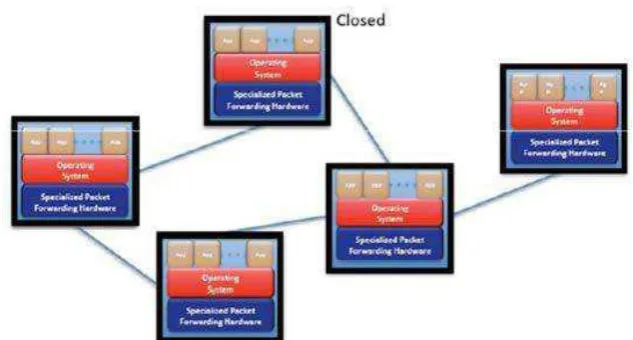
Fig.3 Closed Boxes and fully distributed protocols
Average types of organization possess different variety of equipments from different vendors. (Fig.3.) So, to
configure all these device types a wide spread knowledge is needed. This traditional architecture even complicates
the network segmentation where all the devices from different vendors will incorporate within their network in a
safe, systematic and structured method. There is no evident reason for giving them access to all network components. Rather the ‘administrative hassle’ makes network segmentation a multifaceted process and rapidly
leads to network clutter. To conclude, new perspectives on the management of network have to be introduced to
overcome the traditional networking limitations.
2.2 AIM OF THE RESEARCH
The aim of the research is to facilitate the innovation in network, to have fast upgrades, to use standard open
interface in layered architecture, to make the programmability more flexible, to use other software applications for
each layer and finally to research using non-bulky and non-expensive equipment.
3. PROPOSED SYSTEM
Software-Defined Networking (SDN) has newly reignited the interest of network researchers for programmable
networks. This also opens the attention of the networking community through the innovative and simplified process
of managing and designing networks to establish the current way if approach. High level of complexity is involved
in the managing and designing of computer networks which becomes a daunting task. This will help to know how
the programming languages can be used to reprogram computers which will perform numerous tasks without any
continuous modification in the hardware platform.
SDN is a fairly new model of a programmable network that changes the way that networks are managed and
designed by implementing a concept that decouples the control from the data plane (Fig.4.). A software guide
application is related as the controller that has an overview of the whole network which is also accountable for the
final decision. The hardware (routers, switches etc.) is merely responsible for forwarding packets into their
destination like a set of packet-handling rules under proper controller’s instructions.
Fig.4 SDN Architecture and its fundamental abstractions.
The important tool of research in computer science and Information technology is Abstractions. There are three
types of abstractions: Forwarding abstraction, distribution abstraction and specification. The abstraction which
allows the network program, to forward any behaviour with the hiding details of any underlying hardware is
forwarding abstraction. The distribution abstraction makes the distributed control problem into one by shielding
SDN application from various distributed state. Finally, the specification should allow a network application to
4. RESULTS AND DISCUSSION
4.1 Single Topology
A single topology having 16 numbers of hosts is designed in Mininet using CLI command as
“$ sudo mn --topo = single,16”
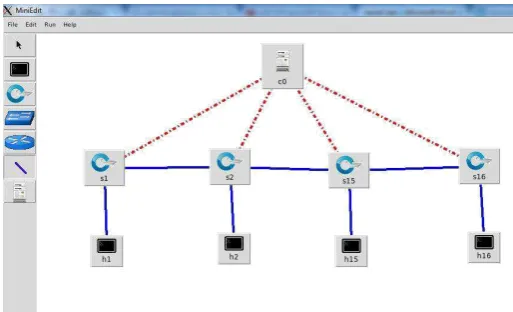
On an execution of above command for OpenFlow-enabled single topology in command prompt, a Mininet console
will create a single OpenFlow-enabled network topology having 16 hosts connected with a single
OpenFlow-enabled switch (Fig.5).
Fig.5 Shows OpenFlow-based Single Topology having 16 hosts.
4.2 Linear Topology
A linear topology having 16 hosts is designed in Mininet using CLI command as:
“$ sudo mn --topo = linear,16”
On an execution of above command for linear topology in command prompt, a Mininet console will create an
OpenFlow-enabled linear topology with 16 hosts (Fig.6).
Fig. 6 Shows OpenFlow-based Linear Topology having 16 hosts.
4.3 Tree Topology
A tree topology having 16 hosts is designed in command prompt CLI using following command:
indicates the number of levels of switches and fanout indicates the number of output ports available to connect
switches or hosts (Fig.7).
Fig. 7 Shows OpenFlow-based Tree Topology having 16 hosts.
5. BASIC PERFORMANCE EVALUATION ON MININET
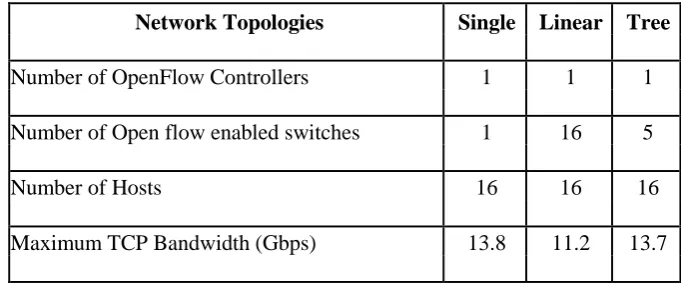
Performance analysis for the three topologies as discussed above is done for a topological designed network of 16
hosts. Bandwidth utilization for all three Open Flow topologies is tabulated below,
Network Topologies Single Linear Tree
Number of OpenFlow Controllers 1 1 1
Number of Open flow enabled switches 1 16 5
Number of Hosts 16 16 16
Maximum TCP Bandwidth (Gbps) 13.8 11.2 13.7
Table 1 Bandwidth Utilization for basic Open Flow topologies
6. CONCLUSION
Compare this new paradigm with traditional networks and discussing how academy and industry helped shape
software-defined networking. Following a bottom-up approach, Provided an in-depth overview of eight
fundamental facets of the SDN problem. Various Simulation and emulation tools were analysed and identified the
suitable tool (Mininet) for Software Defined Networking (SDN). Basic simple topology created for the single
similar network and it is simulated using mininet graphical user interface. Basic UDP and TCP transmission
performance throughput evaluation is plotted. Connection between the hosts also verified. SDN has successfully
managed to give the way towards a future generation networking, seeding an innovative research and development
environment, supporting advances in several areas: evolution of scalability switch and controller platform design,
ACKNOWLEDGEMENT
This work was supported in part by Department of Science & Technology (DST), FIST Program at Francis Xavier
Engineering College, Tirunelveli, Tamilnadu, India.
REFERENCES
[1] Diego Kreutz, Fernando M. V. Ramos, Paulo Verissimo, Christian Esteve Siamak Azodolmolky, and Steve
Uhlig -Software-Defined Networking: A Comprehensive Survey 8 OCT 2014 IEEE
[2] Shie-Yuan Wang Department of Computer Science National Chiao Tung University Hsinchu, Taiwan
Comparison of SDN Open Flow Network Simulator and Emulators: EstiNet vs. Mininet (2017).
[3] Ruban Kingston. M, Muthukumaran. and N, Ravi. R, 'A Novel Scheme of CMOS VCO Design with reduce
number of Transistors using 180nm CAD Tool', International Journal of Applied Engineering Research,
Volume. 10, No. 14, pp. 11934-11938, 2015.
[4] Muthukumaran. N and Ravi. R, 'Design and analysis of VLSI based FELICS Algorithm for lossless Image
Compression', International Journal of Advanced Research in Technology, Vol. 2, No. 3, pp. 115-119,
March 2012.
[5] Manoj Kumar. B and Muthukumaran. N, 'Design of Low power high Speed CASCADED Double Tail
Comparator', International Journal of Advanced Research in Biology Engineering Science and
Technology, Vol. 2, No. 4, pp.18-22, June 2016.
[6] N. Muthukumaran, 'Analyzing Throughput of MANET with Reduced Packet Loss', Wireless Personal
Communications, Vol. 97, No. 1, pp. 565-578, November 2017, SPRINGER.
[7] P.Venkateswari, E.Jebitha Steffy, Dr. N. Muthukumaran, 'License Plate cognizance by Ocular Character
Perception', International Research Journal of Engineering and Technology, Vol. 5, No. 2, pp. 536-542,
February 2018.
[8] Wenfeng Xia, Yonggang Wen,, Chuan Heng Foh, Dusit Niyato, Memberand Haiyong Xie -A Survey on
Software-Defined Networking (2015) IEEE Communication Surveys & Tutorials, vol. 17
[9] Faris Keti and Shavan Askar Electrical and Computer Engineering Department Faculty of Engineering
Duhok-Kurdistan Region -Emulation of Software Defined Networks Using Mininet in Different
Simulation Environments-2015 Iraq 6th International Conference on Intelligent Systems, Modelling and
Simulation
[10] Muthukumaran, Mrs R.Sonya, Dr.Rajashekhara and Chitra V, 'Computation of Optimum ATC Using
Generator Participation Factor in Deregulated System', International Journal of Advanced Research Trends
in Engineering and Technology, Vol. 4, No. 1, pp. 8-11, January 2017.
[11] Keziah. J, Muthukumaran. N, 'Design of K Band Transmitting Antenna for Harbor Surveillance Radar
Application', International Journal on Applications in Electrical and Electronics Engineering, Vol. 2, No. 5,
Processing', International Journal of Engineering Research and Applications, Vol. 5, pp. 59-65, March
2014.
[13] Muthukumaran. N and Ravi. R, 'Quad Tree Decomposition based Analysis of Compressed Image Data
Communication for Lossy and Lossless using WSN', World Academy of Science, Engineering and
Technology, Volume. 8, No. 9, pp. 1543-1549, 2014.
[14] Marvin Mark. M and Muthukumaran. N, 'High Throughput in MANET using relay algorithm and
rebroadcast probability', International Journal of Engineering Research and Applications, Vol. 5, pp.
66-71, March 2014.
[15] Marvin Mark. M and Muthukumaran. N, 'An Advanced Homogeneous Pattern for Mobile Ad Hoc
Network', International Journal of Advanced Research in Computer Science and Management Studies,
Vol. 2, Issue 4, pp. 6-8, April 2014.
[16] Casimer DeCusatis1 PhD, Aparicio Carranza PhD and Jean Delgado-Caceres2 Marist College,
Poughkeepsie, NY USA - Modeling Software Defined Networks using Mininet (2016) Proceedings of the
2nd International Conference on Computer and Information Science and Technology Ottawa, Canada –
May 11 – 12 , 2016 Paper No. 133
[17] Idris Zoher Bholebawa, Upena D. Dalal Electronics and Communication Engineering Department, S. V.
National Institute of Technology, Ichchhanath, Dumas Road, Surat-395007, Gujarat, India - Design and
Performance Analysis of Open Flow-Enabled Network Topologies Using Mininet (2016) International
Journal of Computer and Communication Engineering April 18.
[18] Habib Mostafaei Gabriele Lospoto Roberto di Lallo Massimo Rimondini Giuseppe Di Battista Roma Tre
University -SDNetkit: A Testbed for Experimenting SDN in Multi-Domain Networks (2017)Department