(General article)
Global Communication using Satellites
Banita Chadhaa* , Ankit ChadhabaDepartment of Information and Technology, Maharishi Markandeshwar Engineering College, Maharishi Markandeshwar University, Mullana, Ambala (Haryana)
bDepartment of Management and Technology, Maharishi Markandeshwar Management College, Maharishi Markandeshwar University, Mullana, Ambala (Haryana)
Received 19 April 2012; accepted 2 May 2012, Available online 1June 2012
Abstract
Today the world is dominated by the two Mobile System (1) GSM (2)WLL .The architecture of both the system provides limited mobility. To overcome this and other such problems, Mobile communication-using satellite is being invented Global mobile satellite communications (GMSC) are specific satellite communication systems for maritime, land and aeronautical applications. It enables connections between moving objects such as ships, vehicles and aircrafts, and telecommunications subscribers through the medium of communications satellites, ground earth stations, PTT or other landline telecommunications providers. The basic architecture consist of satellite phone which directly transmits to the satellite orbiting above it .This satellite connect the user to the nearest Earth station also known as Hub. This hub is connected to the local network exchange mobile communication can also be done using GPS networks.
Keywords: P
rotocols , Services , Multiple access schemes , GPRS core network
1. Introduction
1GPRS (General Packet Radio Service) is a packet based
upgrade to the GSM networks. It allows GSM networks to be truly compatible with the Internet. GPRS uses a packet-mode technique to transfer bursty traffic in an efficient manner. It promises data rates from 56 up to 114 Kbps and continuous connection to the Internet for mobile phone and computer users. Along the evolution path of the GSM network towards 3G and beyond, GPRS is referred as a 2.5G technology.
GPRS Network Architecture
Fig.1 GPRS Network Architecture
* Corresponding author's email: [email protected]
General packet radio service (GPRS) is a packet oriented mobile data service on the 2G and 3G cellular communication system's global system for mobile communications (GSM). GPRS was originally standardized by European Telecommunications Standards Institute (ETSI) in response to the earlier CDPD and i-mode packet-switched cellular technologies. It is now maintained by the 3rd Generation Partnership Project (3GPP).
GPRS usage is typically charged based on volume of data. This contrasts with circuit switching data, which is typically billed per minute of connection time, regardless of whether or not the user transfers data during that period.
GPRS data is typically supplied either as part of a bundle (e.g., 5 GB per month for a fixed fee) or on a pay-as-you-use basis. Usage above the bundle cap is either charged per megabyte or disallowed. The pay-as-you-use charging is typically per megabyte of traffic.
GPRS is a best-effort service, implying variable throughput and latency that depend on the number of other users sharing the service concurrently, as opposed to circuit switching, where a certain quality of service (QoS) is guaranteed during the connection. In 2G systems, GPRS provides data rates of 56–114 kbit/second 2G cellular technology combined with GPRS is sometimes described as 2.5G, that is, a technology between the second (2G) and third (3G) generations of International Journal of Engineering, Science and Metallurgy
mobile telephony. It provides moderate-speed data transfer, by using unused time division multiple access (TDMA) channels in, for example, the GSM system. GPRS is integrated into GSM Release 97 and newer releases.
2. Protocols
2. GPRS Tunnelling Protocol (GTP) is a group of IP-based communications protocols used to carry General Packet Radio Service (GPRS) within GSM, UMTS and LTE networks. In 3GPP architectures, GTP and Proxy Mobile IPv6 based interfaces are specified on various interface points.
GTP can be decomposed into separate protocols, GTP-C, GTP-U and GTP'. GTP-C is used within the GPRS core network for signalling between Gateway GPRS Support Nodes (GGSN) and Serving GPRS Support Nodes (SGSN). This allows the SGSN to activate a session on a user's behalf (PDP context activation), to deactivate the same session, to adjust quality of service parameters, or to update a session for a subscriber who has just arrived from another SGSN [1].
GTP-U is used for carrying user data within the GPRS Core Network and between the Radio Access Network and the core network. The user data transported can be packets in any of IPv4, IPv6, or PPP formats.
GTP' (GTP prime) uses the same message structure as GTP-C and GTP-U, but has an independent function. It can be used for carrying charging data from the Charging Data Function (CDF) of the GSM or UMTS network to the Charging Gateway Function (CGF). In most cases, this should mean from many individual network elements such as the GGSNs to a centralized computer that delivers the charging data more conveniently to the network operator's billing center.
Different GTP variants are implemented by RNCs, SGSNs, GGSNs and CGFs within 3GPP networks. GPRS mobile stations (MSs) are connected to a SGSN without being aware of GTP.
GTP can be used with UDP or TCP. UDP is either recommended or mandatory, except for tunnelling X.25 in version 0. GTP version 1 is used only on UDP.
Fig.2 GPRS user plan
GPRS tunnelling protocol
GPRS Network Entities
2.1 MS
GPRS enabled MS.
2.2 BTS
Same as the GSM BTS
2.3 BSC
The GSM BSC enhanced with the Packet Control Unit (PCU) to differentiate whether data is to be routed to the packet switched or circuit switched networks.
The PCU or Packet Control Unit is a hardware router that is added to the BSC. It differentiates data destined for the standard GSM network (circuit switched data) and data destined for the GPRS network (Packet Switched Data). The PCU itself may be a separate physical entity, or more often these days it is incorporated into the base station controller, BSC, thereby saving additional hardware costs [2].
2.4 SGSN
The SGSN or Serving GPRS Support Node element of the GPRS network provides a number of takes focussed on the IP elements of the overall system. It provides a variety of services to the mobiles:
• Packet routing and transfer • Mobility management • Attach/detach
• Logical link management • Authentication
• Charging data
There is a location register within the SGSN and this stores location information (e.g., current cell, current VLR). It also stores the user profiles (e.g., IMSI, packet addresses used) for all the GPRS users registered with the particular SGSN.
2.5 GGSN
then forwarding the data. In the opposite direction, packet data from the mobile is routed to the right destination network by the GGSN [3].
3. GPRS Interfaces and Protocols
Fig.3 GPRS Interfaces and Protocols
4. GPRS Control and User Planes
Fig.4 GPRS Control and User Planes
5. GPRS Core Protocol — GTP
GPRS Tunnelling Protocol (GTP) is the core protocol used in GPRS network between the SGSN and the GGSN for GPRS service control and user data delivery. It is is a group of IP-based communications protocols. GTP can be classified into separate protocol subgroups according to their usage, GTP-C, GTP-U and GTP’ respectively [5]. GTP-C is used within the GPRS core network for signalling between the GGSN and the SGSN. GTP-C includes the control procedures that allows the SGSN to activate a session on a user’s behalf (PDP context activation), to deactivate the same session, to adjust quality of service parameters, or to update a session for a subscriber who has just arrived from another SGSN.
GTP-U is used for carrying user data within the GPRS Core Network and between the Radio Access Network and the core network. The user data transported can be packets in any of IPv4, IPv6, or PPP formats.
GTP’ (GTP prime) uses the same message structure as GTP-C and GTP-U, but has an independent function. It can be used for carrying charging data from the Charging Data Function (CDF) to the Charging Gateway Function (CGF) [4].
Fig.5 Charging getaway function
6. GPRS User Sessions — PDP Context
A Packet Data Protocol (PDP) context is a GPRS user session established allowing the MS and the network to exchange IP packets with QoS specifications. A PDP Context has a record of parameters, which consists of all the required information for establishing the end-to-end connection:
• PDP Type • PDP address type
• QoS profile request (QoS parameters requested by user) • QoS profile negotiated (QoS parameters negotiated by network)
• Authentication type (PAP or CHAP) • DNS type (Dynamic DNS or Static DNS)
7. Services offered
GPRS extends the GSM Packet circuit switched data capabilities and makes the following services possible:
SMS messaging and broadcasting
"Always on" internet access
Multimedia messaging service (MMS)
Push to talk over cellular (PoC)
Instant messaging and presence—wireless village
Internet applications for smart devices through wireless application protocol (WAP)
Point-to-point (P2P) service: inter-networking with the Internet (IP)
Point-to-Multipoint (P2M) service: point-to-multipoint multicast and point-to-point-to-multipoint group calls
If SMS over GPRS is used, an SMS transmission speed of about 30 SMS messages per minute may be achieved. This is much faster than using the ordinary SMS over GSM, whose SMS transmission speed is about 6 to 10 SMS messages per minute.
Multiple access schemes:
Fig.7 Multiple access schemes
GPRS is a data network that overlays a second-generation GSM network. This data overlay network provides packet data transport at rates from 9.6 to 171 kbps. Additionally, multiple users can share the same air-interface resources simultaneously.
GPRS attempts to reuse the existing GSM network elements as much as possible, but to effectively build a packet-based mobile cellular network, some new network elements, interfaces, and protocols for handling packet traffic are required [6].
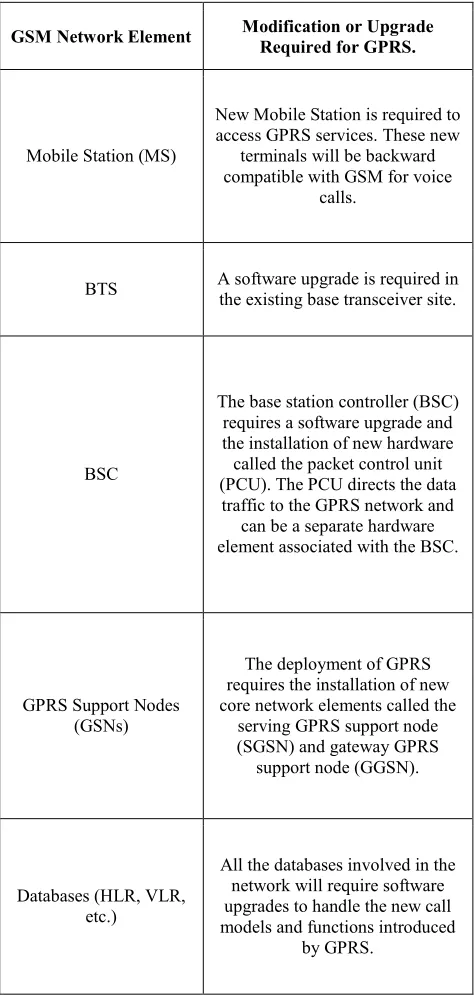
Therefore, GPRS requires modifications to numerous GSM network elements as summarized below:
Table 1 GSM network elements
GSM Network Element Modification or Upgrade Required for GPRS.
Mobile Station (MS)
New Mobile Station is required to access GPRS services. These new
terminals will be backward compatible with GSM for voice
calls.
BTS A software upgrade is required in the existing base transceiver site.
BSC
The base station controller (BSC) requires a software upgrade and the installation of new hardware called the packet control unit (PCU). The PCU directs the data
traffic to the GPRS network and can be a separate hardware element associated with the BSC.
GPRS Support Nodes (GSNs)
The deployment of GPRS requires the installation of new core network elements called the
serving GPRS support node (SGSN) and gateway GPRS support node (GGSN).
Databases (HLR, VLR, etc.)
All the databases involved in the network will require software upgrades to handle the new call models and functions introduced
by GPRS.
Fig.8 GSM network elements summary
8. GPRS Mobile Stations
including a high-speed version of current phones to support high-speed data access, a new PDA device with an embedded GSM phone, and PC cards for laptop computers. These mobile stations are backward compatible for making voice calls using GSM.
GPRS Base Station Subsystem
Each BSC requires the installation of one or more Packet Control Units (PCUs) and a software upgrade. The PCU provides a physical and logical data interface to the base station subsystem (BSS) for packet data traffic. The BTS can also require a software upgrade but typically does not require hardware enhancements.
When either voice or data traffic is originated at the subscriber mobile, it is transported over the air interface to the BTS, and from the BTS to the BSC in the same way as a standard GSM call. However, at the output of the BSC, the traffic is separated; voice is sent to the mobile switching center (MSC) per standard GSM, and data is sent to a new device called the SGSN via the PCU over a Frame Relay interface.
GPRS Support Nodes:
Following two new components, called GPRS support nodes (GSNs), are added
Gateway GPRS support node (GGSN)
The Gateway GPRS Support Node acts as an interface and a router to external networks. The GGSN contains routing information for GPRS mobiles, which is used to tunnel packets through the IP based internal backbone to the correct Serving GPRS Support Node. The GGSN also collects charging information connected to the use of the external data networks and can act as a packet filter for incoming traffic.
Serving GPRS support node (SGSN)
The Serving GPRS Support Node is responsible for authentication of GPRS mobiles, registration of mobiles in the network, mobility management, and collecting information for charging for the use of the air interface.
Internal Backbone
The internal backbone is an IP based network used to carry packets between different GSNs. Tunnelling is used between SGSNs and GGSNs, so the internal backbone does not need any information about domains outside the GPRS network. Signalling from a GSN to a MSC, HLR or EIR is done using SS7 [7].
Routing Area
GPRS introduces the concept of a routing area. This is much the same as a Location Area in GSM, except that it will generally contain fewer cells. Because routing areas are smaller than Location Areas, less radio resources are used when a paging message is broadcast.
GPRS core network
The GPRS core network provides mobility management, session management and transport for Internet Protocol packet services in GSM and WCDMA networks. The core network also provides support for other additional functions such as billing and lawful interception. It was also proposed, at one stage, to support packet radio services in the US D-AMPS TDMA system, however, in practice, all of these networks have been converted to GSM so this option has become irrelevant.
Fig.9 GSM core networks
Like GSM in general, GPRS module is an open standards driven system. The standardization body is the 3GPP GPRS tunnelling protocol is the defining IP-based protocol of the GPRS core network. Primarily it is the protocol which allows end users of a GSM or WCDMA network to move from place to place while continuing to connect to the Internet as if from one location at the Gateway GPRS Support Node (GGSN). It does this by carrying the subscriber's data from the subscriber's current Serving GPRS Support Node (SGSN) to the GGSN which is handling the subscriber's session. Three forms of GTP are used by the GPRS core network.
GTP-U
For transfer of user data in separated tunnels for each Packet Data Protocol (PDP) context
GTP-C
Setup and deletion of PDP contexts
Verification of GSN reachability
Updates; e.g., as subscribers move from one SGSN to another.
GTP'
For transfer of charging data from GSNs to the charging function.
GGSNs and SGSNs (collectively known as GSNs) listen for GTP-C messages on UDP port 2123 and for GTP-U messages on port 2152. This communication is direct within a single network, or in the case of international roaming, via a GPRS roaming exchange (GRX).
The Charging Gateway Function (CGF) listens to GTP' messages sent from the GSNs on TCP or UDP port 3386. The core network sends charging information to the CGF, typically including PDP context activation times and the quantity of data which the end user has transferred. However, this communication which occurs within one network is less standardized and may, depending on the vendor and configuration options use proprietary encoding or even an entirely proprietary system.
GTP version zero supports both signalling and user data under one generic header. It can be used with UDP (User Datagram Protocol) or TCP (Transmission Control Protocol) on the registered port 3386. GTP version one is used only on UDP. The control plane protocol GTP-C (Control) using registered port 2123 and the user plane protocol GTP-U (User) using registered port 2152.
GPRS support nodes (GSN)
A GSN is a network node which supports the use of GPRS in the GSM core network. All GSNs should have a Gn interface and support the GPRS tunnelling protocol. There are two key variants of the GSN, namely Gateway and Serving GPRS Support Node.
References
1. Akyildiz, Ian F., and Seong-Ho Jeong (1997), Satellite ATM Networks, IEEE Communications Magazine. July. 2. Brandon, W.T. (1994), Market Elasticity of Satellite
Communications Terminals, International Journal of Space Communications.
3. Cromer, Donald. (1997), Personal discussion with the Chairman of Hughes Space and Communications.
4. Glover, D., and M. Allman (1997), Ongoing TCP Research Related to Satellites. Enhancing TCP over Satellite Channels using Standard Mechanisms, ITU, World Telecommunications Development Report 1996/7. 5. Ovum, March 1997, Facts Through Figures A Report for
the European Commission.
6. Partridge, C., and Timothy J. Shepard (1997), TCP/IP Performance over Satellite Links , IEEE Network.