Conservative treatment of a tibialis posterior
strain in a novice triathlete: a case report
Scott Howitt,
DC, FCCSS(C), FCCRS(C)*Sarah Jung,
DCNicole Hammonds,
DCObjective: To detail the progress of a novice triathlete with an unusual mechanism of a tibialis posterior strain who underwent successful conservative treatment and rehabilitation. Tibialis posterior tendon dysfunction will be discussed as it relates to the case.
Clinical Features: The clinical features of tibialis posterior dysfunction are swelling and edema posterior to the medial malleolus with pain and an inability to weight bear. This injury may occur in endurance athletes such as triathletes, most often occurring during running.
Intervention and Outcome: The conservative treatment approach used in this case consisted of medical
acupuncture with electrical stimulation, Graston
Technique©a soft tissue instrument assisted mobilization
technique, Active Release Technique®, ultrasound
therapy with Traumeel, and rehabilitation. Gait analysis and orthotic prescription was completed when the patient was ready to return to play. Outcome measures included subjective pain rating and return to pre-injury activities. Objective measures included swelling and manual muscle testing.
Conclusion: A novice triathlete with a grade I tibialis posterior strain was quickly relieved of his symptoms and able to return to his triathlon training with conservative treatment. Practitioners treating this type of injury could consider including the soft tissue techniques, modalities and rehabilitation employed in our case for other patients with lower leg strains and/or tibialis posterior dysfunction.
(JCCA 2009; 53(1):23–31)
* Assistant Professor, Clinical Education, Canadian Memorial Chiropractic College, 6100 Leslie St., Toronto, Ontario M2H 3J1. Phone: (416) 482-2340 ext. 395 Fax: (416) 488-0470 Email: [email protected]
© JCCA 2009.
Objectif : Énumérer les progrès d’un jeune triathlonien affichant un mécanisme rare d’une
élongation du jambier postérieur traité avec succès par une méthode conventionnelle, puis une réadaptation. Nous commenterons la problématique du
dysfonctionnement du tendon du jambier postérieur, qui se rapporte au présent cas.
Caractéristiques cliniques : Les caractéristiques cliniques du dysfonctionnement du jambier postérieur se manifestent par une tuméfaction et un œdème postérieur de la malléole interne, marqués par la douleur et une incapacité de supporter un poids. Cette blessure se présente chez les athlètes qui pratiquent des sports d’endurance, par exemple le triathlon, et survient la plupart du temps pendant la course.
Intervention et résultat : L’approche conventionnelle du traitement dans le présent cas a consisté à avoir recours à l’acupuncture médicale avec une stimulation électrique, la technique Graston®, une technique de
mobilisation assistée par un instrument pour tissus mous, l’Active Release Technique® (technique de relâchement
active), l’ultrasonothérapie avec le médicament régulateur de l’inflammation Traumeel et la
réadaptation. Une fois le malade prêt à retourner au jeu, on a procédé à une analyse de la démarche et prescrit une orthèse. Dans les indicateurs de résultats, on compte un niveau subjectif de la douleur et le retour aux activités pratiquées avant la blessure. Les mesures objectives comprenaient l’inflammation et un test fonctionnel du bilan musculaire.
Tibialis posterior strain
k e y w o r d s: tibialis posterior strain, Active Release Technique®, Graston Technique©, triathlete
Introduction
Lower limb strain injuries are a common complaint that present to chiropractic and sports injury clinics. This area of complaint is especially common among triathletes be-cause of the repetitive motions that occur while training for increased endurance in each sport (swimming, cycling and running). The most common injuries that occur in tri-athletes are a result of overuse.1,2,3,4 The repetitive
mo-tions that are indicative of endurance training invariably put the triathlete at an increased risk of suffering an over-use injury. Most triathletes follow a periodized training schedule to achieve a balance between intense workouts and base or tempo workouts to avoid the effects of over-training. The majority of triathletes have a previous run-ning background, however, overtrairun-ning associated with high volumes of running mileage is reportedly common.2,3
Epidemiology studies note that the majority of triath-lon-related injuries occur during run training and affect the lower limb.3 This is thought to be a result of poor
run-ning mechanics and/or trairun-ning errors which may involve increasing mileage too rapidly, speed training, and hill training.3 These lower limb injuries are further
confound-ed by cycling training which requires a continual effort from the gastrocsoleus group to generate power during pe-daling. This cumulative effect may lead the athlete to be more susceptible to overuse trauma during running.1,2
The majority of literature on triathlon injuries has fo-cused on the most common injuries that occur during running. The incidence of swimming-related injuries amongst triathletes is relatively low, despite the relative inexperience in swimming for the majority of triathletes.3
Injuries directly related to swimming typically involve the shoulder and are primarily tendon or impingement-re-lated diagnoses.3 Although the shoulder is the most
com-mon area injured during swimming, injuries indirectly related to swimming include lower leg injuries as posteri-or calf tightness is associated with pointing the toes dur-ing leg kickdur-ing for swim propulsion.3 While swimming,
the feet are maintained in a plantar flexed position for a more streamlined position and this plantar flexed position promotes a relative shortening of the posterior calf mus-culature.
Case Report
A 41-year old male novice triathlete training for an Iron-man distance triathlon, presented with a chief complaint of acute right ankle pain. The onset was three days prior while performing a flip-turn in a swimming pool during a training swim. Some discomfort developed in the right calf about an hour into the swim and just before the end of the session he felt extreme right calf pain when he pushed off the edge of the pool; there was no pop or snap reported but he had an immediate cramping sensation. He stopped swimming at that point and was able to walk for the rest of the day with only mild discomfort. The follow-ing day the calf worsened as there was significant swell-ing posterior to the right medial malleolus which he attempted to control with a tensor wrap. The patient rated the initial intensity of the pain as eight out of ten (on a ten point scale) and described it as an achy sensation. Aggra-vating activities included climbing stairs and driving his car, both of which he avoided due to pain.
retourner à l’entraînement grâce à un traitement conventionnel. Les praticiens ayant à soigner ce type de blessures peuvent envisager d’inclure des techniques de traitement des tissus mous, des méthodes et une réadaptation utilisées dans le présent cas pour d’autres malades souffrant de blessures dans la partie inférieure de la jambe et/ou d’un dysfonctionnement du jambier postérieur.
(JACC 2009; 53(1):23–31)
The ankle pain progressively worsened over the first three days after onset, to the point that upon presentation to a multidisciplinary sports injury clinic he had a signifi-cant limp as he avoided putting any pressure on the right foot and kept his right foot dangling in a plantar flexed position. This patient had been treated three months prior for a distal iliotibial band (ITB) friction syndrome and a gluteus medius weakness/dysfunction. Treatment for this former complaint included Active Release Techniques®
(ART®), Graston Technique©, acupuncture and gluteal
strengthening exercises. He continued to train while managing the ITB injury focusing on his swimming technique, and cycling endurance, with a decreased fre-quency and duration of his running to avoid further exac-erbation. His lateral knee complaint was improving with each successive treatment and was nearly 100% resolved when he suffered the new complaint.
On examination he was unable to bear weight through his right leg and refused the challenge to attempt a “toe-off” or toe walk. Palpation of the tibialis posterior tendon reproduced his extreme discomfort as did resisted plantar flexion and inversion. Passive dorsiflexion and eversion also caused a great deal of pain (all rated as eight out of ten). Gastrocnemius and soleus palpation was unremark-able and although palpation of the medial Achilles ten-don was somewhat discomforting it did not reproduce his
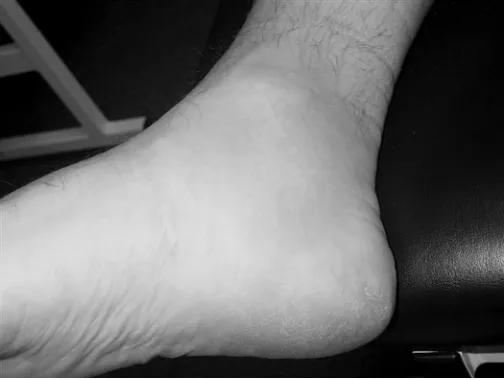
chief complaint. Ankle ligamentous stress testing was un-remarkable. Swelling and discoloration were significant [Figure 1]. Girth measurement was 29 cm around the right lower leg, compared to 25.5 cm around the left.
The working diagnosis was a 1st degree tibialis
posteri-or strain. Initial treatment consisted of medical acupunc-ture (4 points surrounding the injury) with electrical stimulation (IC-1107+ at 2 Hz frequency), therapeutic ultrasound with Traumeel (5 minutes, 50% duty cycle, 1 MHz frequency, 0.7 W intensity), Active Release Tech-nique® (ART®) of gastrocnemius, soleus, and tibialis
posterior muscles above and below the injury, and Gras-ton Technique© soft tissue mobilization with GT 6 and
GT 2 [Figure 2] posterior to the medial malleolus fol-lowed by ten minutes of ice and elevation. Five days after the injury, the athlete was assessed by a sports specialist medical physician who agreed with the working diagno-sis of a calf strain prescribing Celebrex (200 mg) for the inflammation and ordering a diagnostic ultrasound to grade the injury.
Eight days after the initial presentation at the third treatment, the discoloration had noticeably improved and the right lower leg girth had improved to 27 cm. At this point the patient was bearing weight and walking with a deliberate gait without a compensatory limp. The pain progressed from being a constant ache to an occasional Figure 1 Photographs taken at initial consultation
showing swelling and edema posterior to medial malleolus
Figure 2 Graston Technique© Instruments (GT 2 on the
Tibialis posterior strain
jab (rated as six out of ten) when he “stepped down the wrong way” (excessive pronation/eversion noted in stair decent). By the fourth visit (thirteen days later) the pain was rated “two or three” out of ten and the inflammation continued to improve. He no longer walked with any limp, could climb and descend stairs pain-free, and dem-onstrated that he only felt the pain when “planting his foot and rotating” (internal tibial rotation). Examination revealed residual mild tenderness with palpation of the tibialis posterior tendon and myotendinous junction with resisted plantar flexion and inversion testing causing minimal pain. At this point, he had returned to training in the pool, using a pullbuoy to minimize kicking and avoided pushing off the wall to change direction. He also had resumed his cycling training and reported no aggra-vation of ankle symptoms.
The patient could not attend treatment for the next two weeks due to work travel, but returned one month post-injury with the results of the diagnostic ultrasound that showed limited inflammation and no further evidence of muscular tear, ruling out any damage beyond the 1st
de-gree strain. Further examination found no evidence of in-flammation and only “slight” tenderness at the tibialis posterior tendon just posterior to the medial malleolus. At this point, he was instructed to continue his pre-injury
training schedule: biking (three times per week), swim-ming (three times per week) with the modification of a pullbuoy, and was given tibialis posterior strengthening exercises of “tib post heel-ups” with a tennis ball squeezed between the medial malleoli [Figure 3]. One week later he returned with virtually no tenderness (less than one out of ten), full range of motion, full strength, and an otherwise resolved tibialis posterior strain.
Six weeks after the initial presentation the patient re-turned feeling 100% and reported no pain in or around the medial malleolus and no recurrences. He had contin-ued with his biking and swimming program which had significantly progressed in distance and intensity, and he showed an eagerness to return to running. A gait analysis was performed to assess his running mechanics and re-vealed his natural “preferred” running cadence to be 80 strides per minute at 6 mph. He ran with excessive anteri-or lean of his upper body and a decreased amount of hip flexion/extension and knee flexion. His right foot showed increased pronation with a toeing-out / eversion position-ing and he was noted to catch his right heel occasionally on his left calf when swinging his right leg anterior. Fur-ther analysis of his lower limb function showed a joint coupling dysfunction with single leg squat (excessive in-ternal tibial rotation), excessive pronation while weight-bearing with a low arch height, and calluses were noted under his metatarsal heads on both feet with dropped metatarsal heads evident. Ankle dorsiflexion was ade-quate, general foot motion was normal, and propriocep-tion was unremarkable. A gait scan confirmed clinical findings of over-pronation and showed excessive weight (pressure) being absorbed through his right foot. Orthot-ics were prescribed and the patient was advised to alter his technique by increasing his knee and hip flexion through running drills, and to increase his cadence to 90+. The increased hip and knee motion and cadence sig-nificantly improved his foot position during foot strike and swing.
At follow-up, one month later, the patient reported no further tibialis posterior discomfort. He was running ap-proximately three hours per week easily, at an improved cadence of 90, with a comfortable/efficient body posi-tion. The patient had also consulted his coach and was following our advice to gradually build up the duration and intensity of his runs to avoid any further aggravation or incidental injury.
Discussion
Due to the physical demands of triathlon, it is not surpris-ing that triathletes sustain a high number of overuse inju-ries. Burns et al. found that during a six-month training period, 50.4% of triathletes were injured.1 This is
consist-ent with other studies that found that 75% of injuries ex-perienced by triathletes occurred during training and 78.9% were defined as overuse. 2 The most commonly
re-ported injuries amongst triathletes are the ankle/foot, thigh, knee, lower leg, and the back. The frequency of lower extremity injuries is not surprising when consider-ing the repetitive impact of weight-bearconsider-ing forces associ-ated with running and the extensive use of the lower extremities in cycling.3 Overall, the majority of injuries
occurred during running training while swimming and cy-cling were associated with a lower numbers of injuries.1,3,4
The patient in this case report sustained an acute lower leg/ankle injury during a swimming training session which represents an uncommon mechanism of a lower
limb injury for a triathlete. As previously mentioned, the incidence of swimming-related injuries is low and most of these injuries involve the shoulder.3 Injuries related to
swimming that do not commonly occur in the pool may include achilles tendonopathy, gastroc/soleus muscle strains, and tibialis posterior dysfunction due the position of the ankle and foot during the swim. This shortening or tightness in the calf can increase the susceptibility of the triathlete to overstress of these lower leg tendons.3
The tibialis posterior muscle originates on the posterior aspect of the tibia, fibula, and the interosseous membrane. It courses posteriorly and medially around the ankle in a groove adjacent to the medial malleolus and inserts on the midfoot in the area of the navicular tuberosity.5,6 The
me-dial malleolus serves to change the direction of pull on the tendon. [Figure 4 and 5] This is believed to increase the stresses on the tendon as rupture usually occurs in this area.5,7 The tibialis posterior functions as a plantar flexor
of the ankle and an inverter of the subtalar joint complex. Figure 4 Tibialis posterior tendon coursing posterior to
the medial malleolus
3D anatomy images copyright Primal Pictures Ltd. www.primalpictures.com
Figure 5 Tibialis posterior muscle
Tibialis posterior strain
The tibialis posterior muscle initiates the process of inver-sion of the hindfoot during gait bringing it into a neutral position. This muscle truly drives the position of the hind-foot and determines the flexibility of the hind-foot by its control over the transverse tarsal joints. The loss of the inversion force of the muscle explains why patients with tibialis pos-terior tendon injuries have only a limited ability, or are completely unable, to rise onto their toes from a position of single-leg stance.6 While an acute tibialis posterior
strain is uncommonly reported, the mechanism of the strain is relatively straightforward as a force imparted into the muscle exceeds its strength. On the other hand, the eti-ology of the more commonly investigated and reported tibialis posterior tendon dysfunction remains somewhat unclear and may include vascular, metabolic, or mechan-ical factors.8 Dysfunction of the tibialis posterior tendon
is a common cause of acquired adult flatfoot deformity (AFFD).5 Middle age women are most commonly
affect-ed and the incidence is known to increase with age. Pes planus, hypertension, diabetes mellitus, and seronegative arthropathies have all been identified as risk factors for tibialis posterior dysfunction.9
Patients with tibialis posterior injuries will typically present with an insidious onset of vague pain in the medi-al foot and swelling behind the medimedi-al mmedi-alleolus medi-along the course of the tendon. Roughly half of all patients have a history of trauma that was initially thought to be a sprain.5,6 Symptoms are usually aggravated by standing
and walking and in addition to pain patients often note dysfunction in their gait. Typically these patients are una-ble to run and note difficulty taking a long stride as well as they have an inability to push off onto their toes and raise their heel. Some authors describe patients with tibi-alis posterior dysfunction presenting simply with pain and apparent inflammation along the tendon without any evidence of clinical deformity but most patients have some collapse of the foot.6,9 Kohls-Gatzoulis et al. found
that the complaint of medial pain or swelling behind the medial malleolus together with a change in foot shape identified 100% of patients with tibialis posterior dys-function and had a specificity of 98%.9
Typically the physical examination of tibialis posterior dysfunction patients reveals a flatfoot deformity that consists of flattening of the medial longitudinal arch, hindfoot valgus, and abduction of the midfoot on the hindfoot. This abduction allows relatively more toes to be
seen when standing behind the patient leading to the “too many toes” sign which is characterized by this condi-tion.5,6,9,10 Patients typically have a flatfooted heel-toe
progression and a poor or absent heel rise, in fact those with a dysfunctional tibialis posterior muscle asked to rise onto their toes from a position of single-leg stance are either completely unable to comply or can do so only to a limited degree.5,6,9 Ranges of motion are typically
full in earlier stages of the condition and as the condition progresses the joints can lose motion and may eventually become fixed.5,9
Manual muscle testing of the tibialis posterior is per-formed by placing the foot in an everted, plantar flexed position and the patient is asked to invert the foot. Weak-ness or pain during contraction of an injured tibialis pos-terior muscle is characteristic. Palpation usually reveals tenderness along the distal aspect of the posterior tibial tendon from the medial malleolus to the navicular tuber-osity; however, tenderness to palpation proximally along the musculotendinous junction of the tibialis posterior muscle may also be present in muscle strains. An accu-rate diagnosis of tibialis posterior tendon dysfunction can usually be made through a simple clinical examination however radiographic evaluation may be helpful in deter-mining the severity of the condition or osseous involve-ment. Radiographic evaluation should include four weight-bearing films: an anteroposterior view of both ankles, an anteroposterior view of both feet, and lateral foot and ankle views of each side to allow comparison in patients who have unilateral disease. Typical deformity includes apparent shortening of the hindfoot on the weight-bearing anteroposterior radiograph, which is in-dicative of collapse through the subtalar joint complex. On the weight-bearing lateral radiographs, the inclination of the talus is plantarward in comparison to normal, with collapse typically through the talonavicular joint.6 A
more overt muscle strain or tendonopathy would easily be visualized through a diagnostic ultrasound which would also be useful for grading the injury or quantifying any underlying inflammation.
Johnson and Strom11 initially described a classification
scheme for tibialis posterior tendon insufficiency which was added to by Myerson.12 [See Table 1] Although the
acute tibialis posterior strain would be typical of stage 1 or stage 2 in this classification system.
It has been noted that there are difficulties with this classification systems reliability, making it somewhat difficult to compare results from various studies that use this system.
The tibialis posterior acts as a heel inverter creating an obliquity of the transverse tarsal joint, thereby allowing for a rigid midfoot during terminal stance, which in turn allows efficient transfer of stored energy in the lower ex-tremity for toe-off and swing phase.6,13 Therefore,
dys-function of the tibialis posterior muscle results in less efficient gait, as the heel does not effectively medialize, and the gastrocsoleus complex requires greater excursion to become a heel inverter.13 Theoretically, rearfoot
ever-sion and an increased medial longitudinal arch angle move the talonavicular and calcaneocuboid joints to a more par-allel position, unlocking the foot for shock absorption. Gait patterns in normal subjects progress from a neutral (or slightly inverted position) to eversion at foot flat, the
role of shock absorption is linked to these foot kinematics. While normal subjects increase rearfoot eversion and medial longitudinal arch angle throughout the stance, the subjects with posterior tibial tendon dysfunction are at, or near, peak rearfoot eversion and medial longitudinal arch angle during loading response. This failure of gradual shock absorption to occur may contribute to abnormal stresses on secondary ligamentous support (spring liga-ment, plantar fascia, interosseous talocalcaneal ligament) as the foot is loaded. During the terminal stance and pre-swing phases of gait, abnormal kinematics of the patients with posterior tibial tendon dysfunction suggests a failure to position the foot effectively for push off.14
Non-operative management of tibialis posterior inju-ries focuses on improving a patient’s symptoms, usually by attempting to decrease the forces which pass through the posteromedial hindfoot. Any acute inflammation sur-rounding the sheath of the tibialis posterior tendon should be dealt with before the chronic aspect of the condition is treated.9 Non-steroidal anti-inflammatory medication
may decrease pain and associated swelling, however, the initial conservative treatment of acute injuries of the tibi-alis posterior dysfunction is not unlike any other muscle strain and should include P.R.I.C.E. principles: Protec-tion, Relative Rest (allowing as much motion and activity as possible to counter the deleterious effects of disuse while not unnecessarily stressing the healing tissues), Ice, Compression, and Elevation. Conservative treatment for stage 1 and 2 tibialis posterior dysfunction is largely based on the clinician’s anecdotal evidence as the majori-ty of the literature focuses on diagnosis, classification system, and operative options.
Alvarez et al. conducted a study involving non-opera-tive treatment of stage 1 and 2 tibialis posterior tendon dysfunction which included prescription of orthotics and a rehabilitation program.15 The rehabilitation program
focused on specific strengthening exercises for the tibia-lis posterior, peroneals, tibiatibia-lis anterior, and gastrocso-leus. Progression was aimed at achieving high repetitions of double and single leg heel raises in order to train the muscles for long-term endurance. This study found that 89% of patients responded to a regimen of orthotic use and supervised physical therapy.15
The patient in our case study was treated with medical acupuncture (4 points surrounding the injury) with elec-trical stimulation (IC-1107+ at 2 Hz frequency), thera-Table 1 Staging Classification
Stage 1: defined as the absence of a fixed deformity of the foot or ankle. Patient typically presents with pain along the course of the tibialis posterior tendon and lo-cal inflammatory changes; however the tendon is of normal length and function.
Stage 2: characterized by dynamic deformity of the hindfoot. The standing patient displays an increased degree of hindfoot valgus, apparent weakness of tibialis posterior function, “too many toes” sign, and inability to do a single leg heel rise; however patients still have a relatively normal arc of subtalar motion.
Stage 3: patients have a fixed deformity of the hindfoot and it is not possible to reduce the talonavicular joint. Typically these patients also have an accompanying fixed forefoot supination deformity that is a compensa-tory change to accommodate the hindfoot valgus.
Tibialis posterior strain
peutic ultrasound with Traumeel (5 minutes, 50% duty cycle, 1 MHz frequency, 0.7 W intensity), ART® of
gas-trocnemius, soleus, and tibialis posterior muscles above and below the injury, and Graston Technique© with GT 6
and GT 2 posterior to the medial malleolus followed by ten minutes of ice and elevation. The intent of these treat-ments was to restore the proper blood supply to the muscle, reduce fibrotic tissue/adhesions and restore func-tion to the muscle.
Graston Technique®, also referred to as an augmented
soft tissue mobilization technique, employs specially de-signed stainless steel instruments with bevelled edges to augment a clinician’s ability to perform soft tissue mobi-lization. The instruments are utilized in a multidirectional stroking fashion applied to the skin at a 30°–60° angle at the treatment site. This application allows the clinician to detect irregularities in the soft tissue texture through the undulation of the gliding tools.16,17 In addition to
remov-ing scar tissue adhesions, Graston Technique® is
pro-posed to enhance the proliferation of extracellular matrix fibroblasts, improve ion transport and decrease cell ma-trix adhesions.16,17
Active Release Technique® therapy is utilized with the
underlying understanding that the anatomy of the limbs has traversing tissues situated at oblique angles to one an-other that are prone to reactive changes producing adhe-sions, fibrosis and local edema and resultant pain and tenderness.18,19 During Active Release Technique®
thera-py, the clinician applies a combination of deep digital tension at the area of tenderness and the patient actively moves the tissue through the adhesion site from a short-ened to a lengthshort-ened position.18,19
Activity modifications were also prescribed, including a break from his running training while continuing cy-cling and swimming with the use of a pullbuoy. Tibialis posterior strengthening exercises of heel-ups with a ten-nis ball between the medial malleoli were prescribed.14
A gait analysis and a gait scan was also performed from which orthotics were prescribed and fitted before running was resumed. The prescription of orthoses for early stage tibialis posterior dysfunction is well support-ed in the literature.5,6,9,14,15
A wide variety of operative treatments have been re-ported for tibialis posterior tendon dysfunction. Stage 1 and 2 dysfunction is rarely treated operatively unless conservative management has failed, at which time
debri-dement and immobilization is considered. There are a variety of isolated soft-tissue procedures designed to compensate for a dysfunctional tibialis posterior tendon and these reconstructive surgeries or osteotomies are em-ployed to improve alignment of the foot in stage 3 and 4 dysfunction. Recovery from reconstructive surgery is prolonged and an eventual return to asymptomatic unre-stricted activities is unpredictable.5
Conclusion
Injuries to the lower leg/ankle are common in triathletes due to overuse mechanisms. These injuries are common-ly reported during running and rarecommon-ly reported during swimming. The patient in this case report presented with an acute injury to the lower leg/ankle as a result of a swimming injury. This patient was treated seven times consisting of medical acupuncture with electrical stimu-lation, Active Release Technique®, Graston Technique©,
strengthening exercises, and gait analysis. He responded favourably to these conservative measures and was able to return to pre-injury status and resume triathlon train-ing. Practitioners treating this type of injury could con-sider including the soft tissue techniques and modalities employed in our case for patients with lower leg strains and/or tibialis posterior injuries.
References
1 Burns J, Keenan AM, Redmond AC. Factors associated with triathlon-related overuse injuries. J Orthop Sports Phys Ther. 2003; 33:177–184.
2 Wilk BR, Fisher KL, Rangelli D. The incidence of musculoskeletal injuries in an amateur triathlete racing club. J Orthop Sports Phys Ther. 1995; 22(3):108–112. 3 Cipriani DJ, Swartz JD, Hodgson CM. Triathlon and the
multisport athlete. J Orthop Sports Phys Ther. 1998; 27(1):42–50.
4 Shaw T, Howat P, Trainor M, Maycock B. Training patterns and sports injuries in triathlons. J Sci Med Sport. 2004; 7(4):446–450.
5 Pinney SJ, Lin SS. Current concept review: acquired adult flatfoot deformity. Foot and Ankle International. 2006; 27(1):66–75.
6 Beals TC, Pomeroy GC, Manoli A. Posterior tibial tendon insufficiency: diagnosis and treatment. J Am Acad Orthop Surg. 1999; 7(2):112–118.
8 Uchiyama E, Kitaoka HB, Fujii T, Luo ZP, Momose T, Berglund LJ, An KN. Gliding resistance of the posterior tibial tendon. Foot and Ankle International. 2006; 27(9):723–727.
9 Kohls-Gatzoulis J, Angel JC, Singh D, Haddad F, Livingstone J, Berry G. Tibialis posterior dysfunction: a common and treatable cause of adult acquired flatfoot. British Medical Journal. 2004; 329:1328–1333.
10 Yeap JS, Singh D, Birch R. Tibialis posterior tendon dysfunction: a primary or secondary problem? Foot and Ankle International. 2001; 22(1):51–55.
11 Johnson KA. Tibialis posterior tendon dysfunction. Clin Orthop. 1989; 239:196–206.
12 Myerson MS. Adult acquired flatfoot deformity: treatment of dysfunction of the posterior tibial tendon. J Bone Joint Surg. 1996; 78A:780–792.
13 Ness ME, Long J, Marks R, Harris G. Foot and ankle kinematics in patients with posterior tibial tendon dysfunction. Gait and Posture. 2008; 27:331–339.
14 Tome J, Nawoczenski DA, Flemister A, Houck J. Comparison of foot kinematics between subjects with posterior tibialis tendon dysfunction and healthy controls. J Orthop Sports Phys Ther. 2006; 36(9):635–644.
15 Alvarez RG, Marini A, Schmitt C, Saltzman CL. Stage I and II posterior tibial tendon dysfunction treated by a structured nonoperative management protocol: an orthosis and exercise program. Foot and Ankle International. 2006; 27(1):2–8.
16 Sevier TL et al. Treating Lateral Epicondylitis. Sports Medicine. 1999; 28(5):375–380.
17 Gehlsen GM et al. Fibroblast responses to variation in soft tissue mobilization pressure. Med Sci Sports Exerc. 1999; 31(4):521–5.
18 Mooney V. Overuse Syndromes of the upper extremity: rational & effective treatment. J Musc Med. 1998; 15(8):11–18.