A profile of the Youth Olympic Taekwondo Athlete
Mohsen Kazemi, RN, DC, FRCCSS(C), FCCPOR(C), DACRB, MSc
*Marco G. De Ciantis, DC, Hons BSc
**Alima Rahman, DC, Hons BSc(Kin)
* Associate Professor, Faculty of Clinical Education, Research and Graduate Studies, Sports Sciences Residency program coordinator, Canadian Memorial Chiropractic College, 6100 Leslie Street, Toronto, ON, M2H 3J1.
Tel: 416-482-2340, 416-385-0110
** Sports Specialist Rehab Centre, 300 York Mills Rd., Suite 205, Toronto, ON, M2L 2Y5 Research conducted at the Canadian Memorial Chiropractic College.
©JCCA 2013
Our study aims to identify trends in anthropomorphic attributes and competitive strategies of successful (medalists) versus non medalist young Olympic
Taekwondo competitors by gender in terms of body mass, body-mass index (BMI) and fighting technique at the Youth Olympic Games 2010. Results were then compared to adult Taekwondo Olympic athletes in 2000, 2004 and 2008. Data on 96 Taekwondo athletes were obtained from the official Youth Olympic website. A LOGIT analysis was performed on the following six independent variables: height, body mass, body mass index, gender, techniques used to score, and warnings obtained during a match. The study did find some differences between winners and non-winners for males and female, although none of the differences were statistically significant. Consequently, training personnel may enhance winning potential of Taekwondo competitors by focusing on offensive versus defensive techniques and improving the quality of punching.
(JCCA 2013;57(4):293-300)
k e y w o r d s: profile, Olympic, Youth, Taekwondo, Martial arts, success, athlete
Notre étude visait à identifier les tendances, aux Jeux Olympiques de la Jeunesse de 2010, dans les attributs anthropomorphiques et les stratégies compétitives des jeunes athlètes olympiques champions (médaillés) de taekwondo par rapport à ceux des non-médaillés, par sexe, du point de vue de la masse corporelle, de l’indice de masse corporelle (IMC) et de la technique de combat. Les résultats ont été ensuite comparés aux athlètes olympiques adultes de Taekwondo de 2000, 2004 et 2008. Les données sur les 96 athlètes de taekwondo ont été obtenues du site Web officiel des Jeux Olympiques de la Jeunesse. Une analyse LOGIT a été réalisée sur les six variables indépendantes suivantes : hauteur, masse corporelle, indice de masse corporelle, sexe, techniques utilisées pour marquer, et avertissements obtenus lors d’un match. L’étude a établi quelques différences entre les gagnants et les non-gagnants, pour les hommes comme pour les femmes, mais aucune des différences n’était statistiquement significative.
Par conséquent, les entraîneurs peuvent améliorer la chance de gagner des athlètes de Taekwondo en mettant l’accent sur les techniques offensives au lieu de défensives, et en améliorant la qualité des coups. (JCCA 2013;57(4):293-300)
Taekwondo, a Korean martial art form was traditionally used for self-defence during warfare and has been de-veloped for over 20 centuries in Korea.1 The term
‘Taek-wondo’ literally translates as “tae-” to hit using the foot, “-kwon-” to hit using the fist, and “-do” referring to the art2 thus directly translating into “the art of kicking and
punching”. Being one of many martial art forms, Taek-wondo is unique by the predominant use of powerful kicking techniques. In more recent times, Taekwondo has transformed from a Korean self-defence skill set during warfare to a recognized international sport. It is a popu-lar organized activity (particupopu-larly in Korea), and recent studies have shown that related training activities such as sparring and kicking drills along with repetition can im-prove cardiovascular function, anaerobic power and leg strength. It increases lean body mass in adult male and female participants, thus Taekwondo training may be a useful organized activity for improving essential elements of overall physical fitness.3
In Taekwondo, competitors must be able to move with high velocity, speed, and power. A surplus of body mass can hinder this ability especially if excess mass is in the form of adipose tissue which is less metabolically ac-tive than muscle. Therefore these parameters are import-ant factors for Taekwondo competitors to consider when training. Variables such as height, body mass, body-mass index (BMI), and VO2 max have been investigated in various body mass-classed sports such as freestyle wrest-ling4, and karate5.
Previous studies have indicated that elite Olympic Taekwondo athletes used kicks to score points 98-100% of the time.6,7,8 A large emphasis is placed on lower limb
power in the sport of Taekwondo due to the large amount of explosive leg power needed for kicking9, though
punch-ing is a trained aspect of the sport used in combat.
Determining the ideal body composition for any sport can be challenging. Studies have been conducted in an attempt to identify predictors of the ideal competitor. The first Youth Olympic Games took place in Singapore in August 2010, whereby athletes were younger than 17 years of age (athletes were restricted to those born in 1993 and 1994). The profile of adult Taekwondo Olympic ath-letes has been investigated in the past6,7,8, however, the
profile of young Olympic Taekwondo athletes has not. As such our study aims to identify trends in
anthropomorph-pic Taekwondo competitors winners (medallists) versus non-winners by gender in terms of body mass, BMI and fighting technique, and compare them to those of Adult Olympic Taekwondo athletes. Results of this study will allow Taekwondo coaches and competitors to practice evidence-based success in sport.
Methods
Participants
The data on 96 male and female Taekwondo athletes participating in the 2010 Youth Olympic Games for this study was obtained from the official 2010 Youth Olympic website, http://www.singapore2010.sg/ a public domain website. The average age of the 96 competitors, males and females are 16.17, 16.38 and 15.97, respectively. The information obtained from this website included the fol-lowing: participants in each category, participants body mass, height, date of birth, country, each round fought report, points obtained, warnings, deduction points, de-fensive kicks, ofde-fensive kicks, ofde-fensive and dede-fensive punches, list of referee and judges with country of origin.
Data Procurement
The data set used in this study was procured from a public domain website. As such there was no need to obtain con-sent and all names of participants were kept confidential. The work reported has been approved by the ethics com-mittee and review board of Canadian Memorial Chiro-practic College.
Statistical Analysis
obtained during a match. The sample size has been de-termined based on the number of independent variables to ensure reliability of the regression model. We needed a minimum of 60 subjects based on ten subjects for each independent variable. Hence the sample of 96 was suffi-cient . A secondary evaluation was performed by compar-ing the results of this study to similar previous studies by the contact investigator. The sample size is limited to the number of participants who competed.
Results
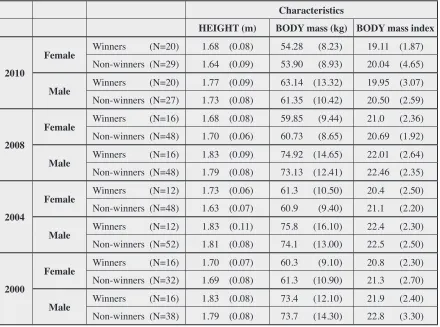
Descriptive statistics for the 2010, 2008, 2004 and 2000 samples according to height, body mass and BMI can be
found in Table 1. There were no statistically significant differences found between winners and non-winners with respect to height, body mass, or BMI stratified by gender. However, both male and female winners were slightly taller, heavier, with marginally lower BMIs when com-pared to non-winners.
Analysis of mean total points per match, mean offen-sive points and mean defenoffen-sive points were conducted, and indicated that winners evidently incurred more points in all 3 categories (mean points winners: offensive = 2.61, defensive = 2.33, total points per match= 4.94; mean points non-winners: offensive = 0.85, defensive = 1.27, total points per match=2.12) (See Table 2). Furthermore, Table 1:
Demographic Profiles of Athletes in 2000, 2004, 2008 & 2010 Olympic Games. Data are Means (±SD). P-value for winners 0.13 and non-winners 0.44
Characteristics
HEIGHT (m) BODY mass (kg) BODY mass index
2010
Female Winners (N=20) 1.68 (0.08) 54.28 (8.23) 19.11 (1.87)
Non-winners (N=29) 1.64 (0.09) 53.90 (8.93) 20.04 (4.65)
Male Winners (N=20) 1.77 (0.09) 63.14 (13.32) 19.95 (3.07)
Non-winners (N=27) 1.73 (0.08) 61.35 (10.42) 20.50 (2.59)
2008
Female Winners (N=16) 1.68 (0.08) 59.85 (9.44) 21.0 (2.36)
Non-winners (N=48) 1.70 (0.06) 60.73 (8.65) 20.69 (1.92)
Male Winners (N=16) 1.83 (0.09) 74.92 (14.65) 22.01 (2.64)
Non-winners (N=48) 1.79 (0.08) 73.13 (12.41) 22.46 (2.35)
2004
Female Winners (N=12) 1.73 (0.06) 61.3 (10.50) 20.4 (2.50)
Non-winners (N=48) 1.63 (0.07) 60.9 (9.40) 21.1 (2.20)
Male Winners (N=12) 1.83 (0.11) 75.8 (16.10) 22.4 (2.30)
Non-winners (N=52) 1.81 (0.08) 74.1 (13.00) 22.5 (2.50)
2000
Female Winners (N=16) 1.70 (0.07) 60.3 (9.10) 20.8 (2.30)
Non-winners (N=32) 1.69 (0.08) 61.3 (10.90) 21.3 (2.70)
Male Winners (N=16) 1.83 (0.08) 73.4 (12.10) 21.9 (2.40)
Offensive, Defensive, and Total Points Per Match: Winners vs. Non-winners, p-value 0.04
Variables OFFENSIVE
points DEFENSIVE points points per matchTOTAL
NON-WINNERS Mean (N=56)Proportion of Points (%) 0.85 (1.48)40 1.27 (1.75)60 2.12 (2.52)—
WINNERS Mean (N=40)Proportion of Point (%) 2.61 (1.38)52 2.33 (1.84)47 4.94 (2.39)—
Table 4:
Punch Utilization in Tournament: Winners Versus Non-Winners.
OFFENSIVE punch
mean points (SD) DEFENSIVE punch mean points (SD)
NON-WINNERS (N=56) 0 (0) 0 (0)
WINNERS (N=40) 0.075 (0.35) 0.125 (0.52)
Table 5:
Offensive & Defensive Kick Utilization in Tournament by Type: Winners Versus Non-Winners in Percentage.
TYPE 1 TYPE 2 TYPE 3
NON-WINNERS 64.5 2.15 33.3
WINNERS 65.0 4.58 29.8
Table 3:
Gender Techniques Among Winners:
Males Versus Females in Relation to Offensive, Defensive and Total Points; p-value 0.11
OFFENSIVE techniques
(%) DEFENSIVE techniques (%) TOTAL points
FEMALE 176 (56%) 137 (44%) 313 (53.9%)
MALE 133 (49.6%) 135 (50.4%) 268 (46.1%)
the proportion of points, categorized by offensive points and defensive points highlighted a statistically significant difference whereby non-winners gained less points of-fensively (40% offensive points, 60% defensive points). Winners, however, gained more points offensively and less points defensively (52% of points offensively and 47% defensively).
No statistically significant relationship was elicited af-ter conducting logistical regression for offensive and de-fensive points stratified by gender. Table 3 indicates that females used offensive techniques to accumulate 56% of points, while men used this strategy to obtain 49.6% of points in this sample. Alternatively, females used defen-sive techniques to gain 44% of their points, while males
used defensive techniques to gain 50.4% of their points in this sample. While not statistically significant, overall, offensive strategies were used slightly more commonly than defensive techniques (53.1% offensive vs. 46.8% de-fensive) and females gained slightly more overall points than males.
Logistical regression analysis revealed that non-win-ners did not score any offensive nor defensive punches during combat. Winners used defensive punches to score more often (mean points=0.125) compared to offensive punches (mean points=0.075) (See Table 4).
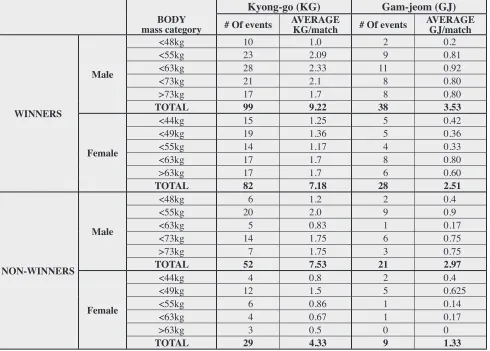
Table 5 indicates the chi-square analysis results for 3 different types of kicks used to score, compared between non-winners and winners. Two types of kicks were used, Table 6:
Averages of Warnings Through Competition, by Gender and Outcome (Winning Verse Non-Winning).
Kyong-go (KG) Gam-jeom (GJ)
BODY
mass category # Of events AVERAGE KG/match # Of events AVERAGE GJ/match
WINNERS
Male
<48kg 10 1.0 2 0.2
<55kg 23 2.09 9 0.81
<63kg 28 2.33 11 0.92
<73kg 21 2.1 8 0.80
>73kg 17 1.7 8 0.80
TOTAL 99 9.22 38 3.53
Female
<44kg 15 1.25 5 0.42
<49kg 19 1.36 5 0.36
<55kg 14 1.17 4 0.33
<63kg 17 1.7 8 0.80
>63kg 17 1.7 6 0.60
TOTAL 82 7.18 28 2.51
NON-WINNERS
Male
<48kg 6 1.2 2 0.4
<55kg 20 2.0 9 0.9
<63kg 5 0.83 1 0.17
<73kg 14 1.75 6 0.75
>73kg 7 1.75 3 0.75
TOTAL 52 7.53 21 2.97
Female
<44kg 4 0.8 2 0.4
<49kg 12 1.5 5 0.625
<55kg 6 0.86 1 0.14
<63kg 4 0.67 1 0.17
>63kg 3 0.5 0 0
cate how many points a successful landing of that kick is worth. According to the World Taekwondo Federation (WTF), one point is awarded for a valid attack on the trunk protector, two points for a valid turning kick (180° rotation) to the trunk protector and three points for a valid kick to the head (http://www.wtf.org/wtf_eng/site/rules/ competition.html). The common technique used by win-ners was a trunk kick followed by a head and then body shot that involved rotation, types 1, 3 and 2 respectively. Although statistically insignificant (p-value=0.501) Table 5 indicates that a type 1 kick was used more commonly (64.5% non-winners, 65% winners), followed by type three kick (33.3% non-winners, 29.8% winners), and last-ly type 2 kick (2.15% non-winners, 4.58% winners). Each type of kick was used in similar proportions between win-ners and non-winwin-ners.
According to the World Taekwondo Federation2
penal-ties are considered prohibited acts with two types of pen-alties existing: Kyong-go and Gam-jeom. A kyong-go is a warning penalty with two kyong-gos being counted as a gain of one point for the opponent. Gam-jeom is a deduc-tion penalty and is counted as an addideduc-tional point for the opposing contestant. Winning males on average tabulated more penalties, kyong-gos (9.22) and gam-jeom (7.53), when compared to non-winners (7.53 kyong-go; 2.97 gam-jeom). This pattern also occurred in winning females with 7.18 kyong-go and 2.51 gam-jeom, respectively. Discussion
Three previous studies investigated the anthropomorphic profile of adult Olympic Taekwondo athletes that par-ticipated in the 2000, 2004 and 2008 Olympic games6,7,8
with the average age of competitors ranging from 22-25. This study, as the previous, did not find any statistically significant differences between winners and non-winners with regards to body mass, height and BMI. There are, however, certain tendencies that were observed. This study is the first of its kind to review anthropomorphic data collected in young Olympic Taekwondo athletes, as well as the first to compare results of the Youth Olym-pic Taekwondo athletes to their adult counterparts. The specific profile qualities reviewed in the young athletes may not be as fully developed as they are compared to adults.
As with the 2008 Olympic Taekwondo competitors,
non-winners, which corresponds well with previous stud-ies conducted on the 2000 and 2004 Olympic games.6,7,8
The average height of the female winners was also slight-ly higher than that of non-winners, which is in sync to the female Taekwondo athletes in the 2000 and 2004 Olympic games but contrary to the females in the 2008. A trend exists between youth and adult males, where taller athletes may have a biomechanical advantage over their shorter competitors. Taller athletes have longer upper and lower limbs, which translates into longer levers providing them with greater ability to cover a larger area with less energy.
In the 2000 Olympic games male and female Taekwon-do winners were lighter than the non-winners. In 2008, the male winners were slightly heavier than the male non-winners whereas the female winners were slightly lighter than their counterparts. In comparison to the 2004 Olympic Taekwondo athletes, both male and female win-ners were slightly heavier than the non-winwin-ners. This was maintained in the 2010 youth athletes, where both male and female winners were heavier than non-winners. As such, no distinct trend exists between body mass and out-come.
The 2000 games revealed winners having slightly lower BMI than their body mass category average.6 This
tendency continued in the 2004 and 2010 games for both sexes and only males in 2008.6,7 Contrary to the female
winners in previous studies, the female 2008 Olympic Taekwondo winners had higher BMI than their non-winner counterparts.7 Another study10 determined that
the physiological profile of male and female Taekwondo black belts consisted of very low body fat percentages and a high lean body mass. Such results mirror those of the current study, as well as previous studies6,7,8 whereby
athletes with lower BMI were linked to winning through above average results for muscle strength, flexibility, an-aerobic and an-aerobic capacities compared to their higher BMI counterparts10. Moreover, studies evaluating BMI in
relation to speed, speed-endurance and flexibility show that successful Taekwondo competitors are leaner, which has a positive effect on performance which can lead to medallist status.11 Elite female Taekwondo athletes were
found to be more mesomorphic with less fat than collegi-ate female Taekwondo athletes.12
fe-male winners received more warnings per match than non-winners6, which is consistent with the 2010 games.
In 2004 males had on average 3.7 kyong-go and 1.41 gam-jeom deductions per match versus females who had on average 2.32 kyong-go and 0.75 gam-jeom deductions per match.7 The 2008 games showed males had a 5.08
kyong-go and 2.38 gam-jeom on average, while females had 7.44 and 1.9 on average, respectively. Between 2004 and 2008 there was no significant variation in the ratio of penalties to warnings although the frequency of warnings did decrease by approximately 65.7%.8 Considering
win-ners and non-winwin-ners in 2010, males on average suffered 8.37 kyong-go and 3.25 gam-jeom with females incurring 5.76 and 1.92 on average. This may indicate that the win-ners were more aggressive in their game plan.
In 2004, males and females both used offensive and defensive one-point kicks more often then the two-point versions.7 This continued in 2008 where for all athletes,
offensive one and two point kicks accounted for approxi-mately 39% of techniques used to score for male winners and 38% of techniques used to score for female winners.8
During the 2000 Olympic games, there was no extra point awarded for different types of kicks (to the body or head, rotational and non rotational) used to score and all were awarded only one point.6 Nonetheless, it is known that
offensive techniques were used slightly more than de-fensive.6 In 2000 games, 52% of the techniques used to
score points were offensive kicks, rather than defensive ones.6 Ninety-eight percent of all techniques used to score
were kicks. For the 2010 games, Type 1 offensive and defensive kicks were also two-thirds of the time to score points. This was followed by three-point then two-point kicks. It is rationalized that the lower limb has the greatest length and power potential. Kicking generates the most powerful strikes while keeping the greatest distance from the opponent, therefore it is not surprising that the lower limb has been found to be the most commonly injured body segment in Taekwondo athletes.13-17 No tendency
can be solidified between all years due to various changes in methods and points for scoring techniques and lack of data recorded and reported in the 2000 games.
The lack of statistical significance might be as a result of small sample size per Olympic Game. Limitations of this study include a) lack of a priori sample size, and b) pos-sible lack of power to detect significance between group difference due to the small sample size. Further research
may consider investigating Taekwondo athletes sampled from several Olympic games rather than one at a time. Conclusion
This is the first study to look at the profile of First Youth Olympic Games Taekwondo athlete winners versus non-winners. Certain tendencies became apparent which div-ide winners from non-winners and genders. Female win-ners used more offensive versus defensive kicks to score, and almost all punches used to score were from winners (both male and female). Though further research with lar-ger sample size is required, Taekwondo training person-nel may enhance the winning potential of their athletes by focusing on offensive verse defensive techniques and improving the quality of punching technique.
Acknowledgements
Research was conducted at the Canadian Memorial Chiropractic College. All authors acknowledge that they do not have any commercial or proprietary interest in any device, equipment, instrument, or drug that is the subject of the article in question along with any financial interest. The authors of this paper would like to acknowledge the work of Dave Soave, Assistant Professor at the Canadian Memorial Chiropractic College for his statistical calcu-lations that contributed to the success of this paper and Emma Conn and Sarah Thorne for their contribution to the success of the study.
References
1. Lee M-G, Kim Y-G. Effects of short-term body mass loss on physical fitness, isokinetic leg strength, and blood variables in male high school Taekwondo players. Presented at: The 1st International Symposium for Taekwondo Studies; May 16, 2007; Beijing, China. 2. World Taekwondo Federation. Rules – Competition. http://
www.wtf.org/wtf_eng/site/about_taekwondo/taekwondo. html, Published 2010. Accessed August 17, 2012. 3. Hyan-Bae K, Stebbins CL, Chai J, Song J. Taekwondo
training and fitness in female adolescents. J Sports Sci. 2011; 29: 133-138.
4. Callen SD, Brunner DM, Devolve KL, Mulligan SE, Hesson J, Wilber RL, Kearney JT. Physiological profiles of elite freestyle wrestlers. J Strength Cond Res. 2000; 14: 162-169.
Olympic taekwondo competitors. JSSM. 2006; 1: 114-121. 7. Kazemi M, Casella C, Perri G. 2004 Olympic Tae Kwon
Do Athlete Profile. JCCA. 2009; 53: 144-152.
8. Kazemi M, Perri G, Soave D. A profile of 2008 Olympic taekwondo competitors. JCCA. 2010; 54: 243-249. 9. Shirley M. Sports performance series: the taekwondo
sidekick: A kinesiological analysis with strength and conditioning principles. J Strength Cond Res. 1992;14:7-8. 10. Heller J, Peric T, Dlouha R, Kohlikova E, Melichna J,
Novakova H. Physiological profiles of male and female taekwondo (ITF) black belts. J Sports Sci. 1998; 16: 243-249.
11. Wojtas A, Unierzyski P, Hurnik E. Fitness and skill performance characteristics of Polish Female national tae kwon do squad members. International J Performance Analysis in Sport. 2007; 7: 1-8.
12. Gao B, Zhao Q, Liu B. Measurement and evaluation on body composition and figure of taekwondo athlete. J Xi’an Institute of Physical Educ. 1998; 15: 29-33.
of a five-year national survey. Am J Sports Med. 1988; 16: 408-410.
14. Phillips JS, Frantz JM, Amosun SL, Weitz W. Injury surveillance in taekwondo and judo during physiotherapy coverage of the seventh All Africa Games. South African J Physiotherapy. 2001; 57: 32-34.
15. Beis K, Abatzides G. Injuries of the taekwondo athletes in the official championships of the Greek taekwondo federation. Presented at: The 1st International Symposium for Taekwondo Studies; May 16, 2007; Beijing, China. 16. de Oliveira FCL. Injuries in the taekwondo athletes.
Presented at: The 1st International Symposium for Taekwondo Studies; May 16, 2007; Beijing, China. 17. Pieter W, Kazemi M. Competition injuries in young