The Teaching Resources Center: The Application of
Practical Teaching Methods for Lifelong Learning
*
Chiying Chien
Department of Foreign Languages, Foo-Yin University, Taiwan
Copyright©2016 by authors, all rights reserved. Authors agree that this article remains permanently open access under the terms of the Creative Commons Attribution License 4.0 International License
Abstract
The Teaching Resources Center (TRC) was developed at the university as an integrated project funded by the Ministry of Education. The focus of the TRC is not only on enhancing students' motivation in self-access study and written English, but also on providing the resources for research and information to develop lifelong learners and independent researchers. The teaching and learning goals were realized by the project’s three sub-programs: (1) several workshops and a symposium were held on the methodology of providing and using resources in teaching research; (2) the Adaptive Instruction Program was assisted by outside reading; (3) a Teaching Resources Center was established to integrate resources to enhance an environment for practicing written English. Data was collected using qualitative and quantitative methods and used to analyze the effectiveness of implementation. Generally, it was shown that teachers want to take part in quantitative, practical, hands-on research in the hope of understanding specific examples. Similarly, many teachers are positive about outside reading and online written evaluations, whereas students' attitudes need further encouragement and support from teachers to implement future lifelong learning.Keywords
Teaching Resources Center, Outside Reading, Online Writing Evaluation, Lifelong Learning1. Introduction
It is essential to identify the academic needs of teachers and students when we design a teaching resource center and construct a learning environment. Activities at the center will provide a solid foundation for the values, needs, and support of teachers and students. As Lepetit and Cichocki [13] point out, needs-assessment surveys have contributed the first step to successful organizations and programs. Today, adult English learners enter school with specific expectations for English language learning, and need-assessment plays an important role in understanding those expectations.
The Teaching Resources Center (TRC) was established to
integrate the Self-Access Center (SAC), Writing Center, classics reading resources, Teaching Website and platform, as well as research resources for supporting a variety of needs for school teachers and students. This paper presents an analysis of a needs survey that, on the one hand, focuses on student perspectives on how to apply online writing and classics reading resources offered by the TRC and, on the other, emphasizes the resources and activities for assisting teachers with independent research.
For this purpose, we have held several workshops in the first and second semesters (2015-2016) on the topic of research, used the online Criterion writing evaluation program for over one year, and implemented reading activities for two years. The study’s planning and execution were carefully structured and introduced to students and teachers with diversified opportunities in English learning and independent study. We hope that the study will be a useful reference for future projects that examine the effectiveness and efficiency of teaching methodologies.
2. Literature Review
The categorical definitions presented here give some distinctive features for teaching, reading, writing, and researching needs for both teachers and students. If we want to make the TRC acceptable to most teachers and students, the role it plays will have an important influence on the effectiveness of this project.
2.1. Review of Teaching Needs
indicators of needs assessment survey tools, and their roles played plus considerations they have were discussed in the process. These indicators include teacher beliefs, self-assessed skill level, barriers to access, technology use and integration, professional development resources, needs and wants, leadership, and demographics. It is recommended that strategic planning cooperating with these indicators in the needs assessment process can improve effectiveness of technology support and educational integration.
2.2. Review of Research Needs
The purpose of education is to apply thinking, criticism, and application within a curriculum and open them up to discussion. This method can be used to investigate questions about whom, how and what to teach, and why. In other words, this systematic study attempts to improve the educational practice of groups of participants by encouraging them to reflect upon their own actions [7]. Therefore, action research is the way for teachers to apply along with their teachings. The theory and the practice of action research won increasing attention since the Coghlan and Brannick [5] published their first edition about issues of action research in 2001, and then a numerous published articles, books, as well as theses and dissertations have discussions about special issues ever since. The approach is aimed at both taking action and creating theory or knowledge about actions. Unlike traditional researches which only produced and wrote what they found in the research, the innovation of action research is aimed at finding outcomes for both action and research, and featured a cyclical process with self-consciousness deliberately. It begins from (a) assessing a situation that could be changed, (b) planning to take action, (c) take action, (d) evaluating the action, and (e) leading to further cycles from the finding of previous planning.
Nevertheless, there are other implementing details that could also draw our attention. According to a comparison between traditional research and action research, Tsai [19] listed the differences between two methods and summarized as follows:
(1). Orientation before research: a traditional researcher may need extensive training in measurement and statistics, while an action researcher can still research even though he or she lacks methodological skills. Action research uses case study methodology in an attempt to share what is going on and how events work together.
(2). Discussion for research questions: a traditional researcher may not design research questions, which are often considered problematic by practitioners, while an action researcher frames questions that are designed to answer problematic questions.
(3). Experimental design: usually, a traditional researcher makes a comprehensive plan for decreasing error and bias, and also for controlling variables. The purpose of an action researcher, however, is to find out if the innovation can improve the working situation while
ignoring unknown biases.
(4). Data analysis and its application: the results of traditional research can cover all phenomena, while action research uses simple analysis to emphasize the practical data and opinions of participants; it is more useful than traditional research for acquiring practical responses within an authentic teaching environment. (5). Traditional research emphasizes both flexibility and
validity as the research progresses, while action research can only be validated in unconstrained dialogue from the participants.
Obviously, action research is collaborative to have members participating actively in the cyclical process, and teachers in this organization can find the problems, design the action, carry the plan out, and use the results to solve the problems or improve further [15]; while members in the traditional research are only objects in the study without getting informed the results with them.
Judging from the benefits that teachers might accrue from solving problematic questions, the provision of useful analyses, and sharing with others in an authentic teaching environment, action research can be seen as a valuable resource to be developed in TRC.
2.3. Review of Student Needs
1. Reinforced needs of reading activities
Among the four language skills, reading in English is the one that non-native students long to acquire [20]. For students of EFL/ESL or other academic purposes, English reading has been the main source for acquiring greater fluency but also as a means of measuring language proficiency [3]. For this purpose, English reading should focus not only on intensive reading but also on extensive reading, to comprehensively study how learning effectiveness can be improved [21].
As others have said [1,6,16], the ideal way for enhancing effectiveness in foreign language learning is to offer wide-ranging reading material. The main reason for this is that, by being learner centered, it meets every student’s interests and needs. For example, Hasan [8] would like to developed the reading materials by modifying Borg and Gall‘s model [2] to include three main cycles in his study: evaluation and needs assessment, materials development, and materials validation. Through the evaluation and analyses, he found existing materials did not match student’s needs, so he added 13 more basic competencies and materials for the course. It can be see that the important thing for English reading is not only to increase exposure to the language and cultivate good English reading habits, but also care about learner’s needs and learning needs.
2. Online evaluation-needs for writing
their essays. Several reasons, given below, may contribute to this, but, generally, limited hours for writing classes and class size will restrain teachers from teaching written English. Second, most students lack a writing strategy or have insufficient knowledge to affect the learning process. Third, a majority of students treat English essay writing as a boring academic activity, to be endured rather than enjoyed, which leads to poor motivation [4]. TRC consulted several experts and took their opinions about how to teach writing [4,14,22] in consideration. Criterion online evaluation was, then, applied to foster the use of writing strategies and motivate students in essay writing, in the hope of improving their writing skills. Criterion is one of AWE (automated writing evaluation) tools and a Web-based service developed by ETS Technologies, Inc. in order to evaluate student essay writing skills.
Liao [9,10] adopted Criterion and process-writing approach to reduce EFL grammatical errors. She concluded that improvement of grammatical performance was easy to be found in each essay, but the improvement of writing of new texts can be observed only after the third essay. It is useful to facilitate language modification and initial writing ability, especially for students with higher motivation. As to students with intermediate or lower achievement, their attitude toward using AWE remained further encouraged as they have been used to the traditional writing teaching for a long time.
3. The Study
This study investigates teacher and student perspectives about the needs of teachers and students at the university level in southern Taiwan. The study has a qualitative and quantitative design: qualitative data were used for the researcher to elicit information from participants, and quantitative data shows the identified opinions from both teachers and students.
Several questionnaires were administered to the different grades of students and their teachers. For the teachers, there are four, as follows:
(1). A questionnaire for workshops on research skills; it emphasizes how research skills can help teachers with independent studies.
(2). A questionnaire on action research; it is for the researcher to see if the symposium on action research can help teachers find better topics for researching teaching problems.
(3). A questionnaire on the perspectives for using reading materials as outside reading in English courses for four- and two-year programs; it was used to realize the advantages and disadvantages of the strategies we used. (4). A questionnaire on the assessment for using Criterion-online writing evaluation, the purpose of which is to investigate if software can help improve student writing skills and enhance teacher efficiency. For the students, there are two questionnaires for
researching outcomes after they use Criterion and implement the project on outside reading in their English courses. In the Criterion questionnaire, we asked about student habits for using computers on Criterion and the learning outcome for improving writing skills. We also used the questionnaire to understand student opinions about practicing outside reading and Classic reading authenticating activities.
3.1. The Instrument
All the questionnaires consisted of closed and open-ended questions. Closed-ended questions were analyzed by statistical software to discover if a majority of students benefited from the exercises. The open-ended questionnaires were classified into different groups for specific information. In addition, Criterion-online writing evaluation is used in the writing classes for first- and second-year university students. TRC bought 200 accounts from ETS with different levels of writing topics, with an expiration date of one year. Teachers of each class controlled their own accounts.
3.2. Data Collection and Analysis
Data was collected in three areas: (1) The questionnaires for teacher research and teaching interests and needs; (2) The questionnaires for research to understand student and teacher opinions about their using Criterion online writing evaluation; (3) The questionnaires for practicing outside reading activities. Initial data collection was based on a sequence of observations and interviews with the teachers and students, and the written reports were organized under the categories of related questions and included in the results and discussion sections.
In the first questionnaires about teacher research and teaching, TRC used the prior questionnaire to understand the teachers’ interests and needs for teaching and research. The results show that their preferences are ‘theory of action research’, ‘methodology’, the ‘application in research results’, ‘data collecting and analyses’, ‘validity problems’, ‘ethical issues in qualitative research’, and ‘analysis of survey and questionnaire’.
From the symposium we held on action research, we collected 53 questionnaires for data analysis. As for the second questionnaire, it is used for evaluating outside reading. TRC received 24 questionnaires from English teachers and 1487 from students, in total.
As to the third questionnaire, which assessed the effects of using the Criterion online writing tool, we collected six questionnaires from teachers of writing classes, and 188 papers from students. All the teachers in the writing classes requested students to write one to four online essays during one semester. The average essay-length for each student was 2.98 sheets of paper.
4. Results and Discussion
(1). A symposium of action research
The TRC symposium is intended to help teachers understand action research, its theoretical structure, research methods, and how to apply it in English teaching and research. The speakers illustrated how teachers can combine action research with a related curriculum, such as a course on business. It is hoped that teachers can take the results back to the classroom to solve teaching and learning problems automatically. According to the results of the questionnaires, most teachers were satisfied with the topic and the helpful examples, and believe it can enhance research capacity, improve teacher confidence, and interest in action research. Furthermore, they welcomed the possibility of mixing action research with current issues, practical examples, and completed analyses for individual research.
(2). The workshops of qualitative and quantitative research The purpose of TRC workshops is to help teachers not only to realize how to process information, but also to understand skills and information at their deepest level. The best way is to do this is to encourage teachers to take those ideas in to their research interests. Among the workshops, qualitative research took examples from social linguistic research, and speakers interacted with participants on the research topics they were engaged in, and then provided productive suggestions for the teachers to follow.
As for quantitative research, research design and common errors were discussed. Statistical methods and application of SPSS software were demonstrated and practiced for data analysis. Finally, teacher responses to research workshops showed that it did indeed help them to understand the differences between the two research methods and the benefit of individual research design. Moreover, most teachers wanted a longer study time for each workshop, to have the opportunity for authentic practice and discussion with speakers about practical topics.
(3). The workshop survey
Several points for teachers to take into consideration are (1) the purpose of the survey, (2) items for planning a questionnaire, (3) examples of educational research, (4) common errors and methods for improvement, and (5) a demonstration for analyzing data of questionnaire by SPSS software.
Although most teachers were eager to learn how to make an effective research design in individual study, most participants expressed concern about the lack of practice for running data on computers. In addition, they wanted more details for explaining the results, the appropriate opportunity and limitation for doing statistics, the ways to build feasibility and validity, and a complete demonstration of the process of research design and data analysis. It is obvious that it pays teachers to spend more time on statistical analyses, and demonstrations with practical issues from a variety of domains are more feasible and effective for them. 2. Comparison perspectives of taking outside reading
As far as Adaption Instruction Program is concerned, there were total 946 freshmen divided into 16 classes with
different levels. Sophomores were total 541 students to be divided into 8 classes also with different levels.
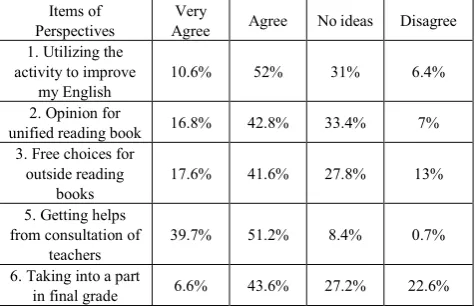
In according to experts [20,21], the current tough issues for developing extensive reading in school are: (1) no extra period of time for leading students’ reading, and (2) lack of proper reading books. Hence, TRC cooperated with department’s organization system for adopting outside reading activities into regular curriculum. From the data shown below (Table 1), about 74.2% of students would finish the unified reading of the class, and about 52.2 % of teachers will discuss the classics reading books with students, which means the practicing of unified reading system was accepted by most students and teachers. At to the ways for assessing reading results are very interesting and different between teachers and students. Most students don’t want to try writing a summary in the regular reading curriculum but are willing to write a summary as a quiz of outside reading books, which are opposite to teachers’ ways of assessing that prefer to use quizzes for evaluating students’ outcomes.
[image:4.595.312.552.401.558.2]In terms of the second problem for the amounts of available books, it was always our concern as TRC planned to carry on this project. From the result shows the location and quantity of outside reading books can satisfy most teachers and students, which was also TRC’s policy for keeping the amounts enough for most readers.
Table 1. The unified reading book for whole class Unified Reading
Books Students Teachers
1. The unified reading book in
class
Interesting (44%); Not
interesting (55.4%) Not interesting (0%) Interesting (100%);
2. Difficulty level
of choosing books Intermediate (54.6%) Difficult (39.1%); Intermediate (50%) Difficult (50%);
3. Reading unified books
Read before test (38.7%); Read when
free (35.5%) Not finish reading
(24.3%)
Discussion in class (52.2%); Students’ self-study (26.1%); Read when free
(17.4%) 4. Quiz for unified
reading books
Summary (42.1%); Quizzes (34.6%);
Q&A (14.5%)
Quizzes (65.2%); Summary (21.7%);
Q&A(13%)
Table 2. Perspectives from students about taking outside reading activities Items of
Perspectives Agree Very Agree No ideas Disagree
1. Utilizing the activity to improve
my English 10.6% 52% 31% 6.4%
2. Opinion for
unified reading book 16.8% 42.8% 33.4% 7%
3. Free choices for outside reading
books 17.6% 41.6% 27.8% 13%
5. Getting helps from consultation of
teachers 39.7% 51.2% 8.4% 0.7%
6. Taking into a part
in final grade 6.6% 43.6% 27.2% 22.6%
[image:4.595.314.552.579.732.2]this activity as one of ways to improve their English, and free choices of books allow students to develop their reading habits. However, it pays us to notice that students are just like most of Asia students tending to rely on teacher’ consultation, which remained concerned if we want to train students with self-independence reading. And, this is why some teachers leave students to read by themselves (about 52.2 % of teachers will discuss the classics reading books with students).
After all, the policy of this system, asking teachers and students to take the score of classics reading into their partial grade of whole semester was accepted. Consequently, now it is important for TRC to mix this activity into regular courses and help students make progress every day.
3. Perspectives toward Criterion online writing evaluation
Teacher opinions about the online writing tool (1). Regarding the use of Criterion on writing classes
Most teachers thought that Criterion did not save teachers’ time correcting students’ writing (4 persons). Most teachers wondered about accuracy of score Criterion’s score and its feedback (4 persons). Teachers mentioned that the immediately score feedback system usually gave grades by the length of each article and key words used in each paragraph (2 persons). Furthermore, Criterion’s feedback for error analysis was ambiguous or not specific. Students’ commands need to be explained further by teachers for clarity. They thought this program can help to improve grammar, but it’s a poor judge of structure and content. It is also difficult for a machine to indicate students’ writing problems, such as usage of words and English rhetoric, style of article, or logic of writing. Hence, some teachers thought that it was still necessary for teachers to do accurate revising for students.
(2). Regarding the effects of Criterion in improving students writing
Five teachers still believe that it would be helpful to have more opportunities for practicing their writing, and they still recommend their students to continue using this program. Besides, 4 teachers think the program can help guide students to write, the more they write, they better they make progress. Nevertheless, as regarding increased interests and motivations, or offer of appropriate help and assisting in writing, it is impossible for a machine to fulfill the task during the student’s writing process. In short, most writing teachers still hold positive attitudes toward online writing evaluation, yet they remained in doubt about helping students improve their writing ability.
Student perspectives about online writing tool
There are 188 students in total and the time and frequency for logging in Criterion is the time before handing in papers (63%). As to the Criterion’s functions that are helpful for students ranked from high to low are grammar (47.3%) spelling (34.1%), view feedback analysis (28.6%), view
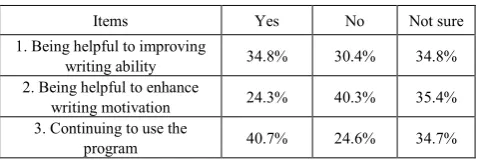
[image:5.595.313.553.220.301.2]sample essays (26.9%), view score summary (24.2%), word usage (12.6%), style (6.02%), mechanics (5.5%) and organization (3.1%). Apparently, word usage, style, mechanics, and organization are those that Criterion cannot take over teachers’ position, and this finding was close to the result professors made that this kind of AWE tool failed to identify errors for Chinese students in the use of articles, prepositions, word choice and expressions [12]. Table 3 shows that many students are still concerned about the effectiveness of machine help.
Table 3. The benefits from Criterion
Items Yes No Not sure
1. Being helpful to improving
writing ability 34.8% 30.4% 34.8%
2. Being helpful to enhance
writing motivation 24.3% 40.3% 35.4%
3. Continuing to use the
program 40.7% 24.6% 34.7%
According to the survey, the reasons that students like using Criterion include prompt score feedback (78%), personal writing records (67.1%), permitting numerous revisions (60.8%), correcting grammar (58.4%), providing sample essays (52.9%), content suggestion (49.7%), assistance to improve personal writing (45.6%). In contrast, the reasons that students dislike using Criterion include internet connecting the program (76.2%), inappropriate scoring (60.5%), unspecified error analysis (45%), no further suggestions for content or writing logic (53.3%), and no interest in topics (28.2%).
On the whole, results from questionnaires and interviews showed 40% of students wish to continue to use Criterion online evaluation and over 50% would take advantage of score summary and feedback analysis to improve their writing with partial assistance from their writing teachers or teachers from in TRC. The functions students prefer in Criterion are grammar and spelling, which coincides with the teachers’ perspective described above. Due to the limit of topic choices (five topics per class/semester), it was obvious that teachers and students do not think that the program can increase writing interests or enhance writing motivation. On the other hand, the system problems of connectivity related to being user-friendly could be the biggest concern in carrying on the activity for students.
5. Conclusions
The purpose of the Teaching Resources Center is to integrate teaching resources and technology and offer services to nourish self-directed learning in students and support independent research for teachers.
online Criterion evaluation and reading activities.
This study hopes that all learning environments and resources can, with appropriate instruction for teachers and students, provide enriched opportunities for learning. We expect that those opportunities will improve student motivation and that the ideal of life-long learning is embodied in students and teachers alike.
Note
*The abstract of this paper was presented at 2nd International Conference on Lifelong Learning and Leadership for All (ICLEL-16), in Liepaja on July, 21-23, 2016.
REFERENCES
[1] Bell, T. (1998). Extensive reading: Why? And How? The Internet TESL Journal, 4 (12). [Online], Available: http://iteslj.org/Articles/Bell-Reading.html
[2] Borg, W. R., and Gall, M. D. (1983). Educational Research.4th ed. New York: Longman Inc.
[3] Carrell, PP. (1988). Introduction: Interactive Approaches to Second Language Reading. Interactive Approach to Second Language Reading. New York: Cambridge. pp. 1-7.
[4] Chen, Y. J. (2003). Online Metacognition Enhancement Program for Essay Writing. The Proceedings of the Twelfth International Symposium on English Teaching, pp. 338-347. [5] Coghlan, D. and Brannick T. (2014). Doing Action Research
in Your Own Organization. London: SAGE Publishings. [6] Day, R. R. and Bamford, J. (1998). Extensive Reading in The
Second Language Classroom. Cambridge University Press. [7] Ebbutt, D. (1985) ‘Educational Action Research’ in Burgess R.
(Ed) Qualitative Methodology and the Study of Education,
Brighton: Falmer Press.
[8] Hasan, C. (2015). Reading Materials Development Through Task-Based Language Instruction Approach For Business Administration Students. Journal Linguistik Terapan Pascasarjana Unimed. 12 (2). pp. 82-91.
[9] Liao. H. C.(2015). Using Automated Writing Evaluation to Reduce Grammar Errors in Writing. ELT Journal, 70(3), pp. 308-319.
[10]Liao. H. C.(2016). Enhancing the grammatical accuracy of EFL writing by using an AWE-assisted process approach. [Online]. Available:
http://www.sciencedirect.com/science/article/pii/S0346251X 16000312.
[11]Liou, H. C. (2001). Reflective Practice and English Teacher Education: Theory, Research, and Implications. Taipei: The Crane Publishing Co., Ltd.
[12]Liu, S. and Kunnan, A. J. (2016). Investigating the Application of Automated Writing Evaluation to Chinese Undergraduate English Majors: A Case Study of WriteToLearn, CALICO Journal, 33(1), pp. 71-91.
[13]Lepetit, D. & Cichicki, W. (2002). Teaching Languages to Future Health Professionals: A Needs Assessment Study.
Modern Language Journal, 86, pp. 384-396.
[14]Lin, M. S. (2002). Cultivating Students with English Writing Talent. The Proceedings of Academic Conference for English Writing and Evaluation.
[15]McNiff, J., and Whitehead, J. (2011) All You Need To Know About Action Research, Los Angeles: SAGE Publishings. [16]Nation, PP. (1997). The Language Learning Benefits of
Extensive Reading. The Language Teacher online, 21(5), pp.13-16.
[17]O’Reilly E. N. (2016). Developing Technology Needs Assessments for Educational Programs: An Analysis of Eight Key Indicators. International Journal of Education and Development using Information and Communication Technology (IJEDICT), 12(1), pp.129-143.
[18]Shetzer, H., & Warschauer, M. (2000). “An electronic literacy approach to network-based language teaching.” In Warschauer, M., & Kern, R. (eds), Network based language teaching. Cambridge: Cambridge University Press. pp. 171-185 [19]Tsai, C.T. (2000). Educational Action Research. Taipei:
Wu-Nan Publishing.
[20]Tsao, F. F. (1991). Current Shortages and Improving Ways for Reading and Teaching. The proceedings of the Eighth international symposium on English teaching. Taipei: Crane Publishing, pp. 291-304.
[21]Wei, C. L. (2004), Feasible Suggestions to Involve English Extending Reading into Regular Curriculum. Journal of English Education Online, 3. pp.26-33.
[22]Yang, N. T. (2004). Using My Access! TM in EFL Writing.