USING SOFT SYSTEMS TO EXPLORE THE COMPLEXITY OF SPACE
BEYOND ITS DIGITAL REPRESENTATIONS
Mohammad Mayouf, Sharon Cox & David Boyd Birmingham City University, United Kingdom
ABSTRACT: Space is fundamentally considered to be one of the most complex aspects of the built environment. Research and industry continually seek to improve digital representations of space in order to minimize the gap between predicted experience and actual experience of space in a building. However, space is an elusive concept, representing it requires going beyond consideration of its tangible requirements represented in digital forms, to also consider intangible aspects of space. Intangible aspects of space affect the actual lived experience of those who use and manage the space in a building. A more holistic approach to representing space is therefore needed that acknowledges the different perspectives of those who use and experience the space in a building, in order to support the design of better spaces. This paper aims to explore the problematic nature of space, going beyond digital representations of space that mainly focus on tangible requirements, to represent a richer view of space, which acknowledges both tangible and intangible aspects. Soft systems methods will be used to represent the different experiences of space from three stakeholders (building designer, facility management team and building occupants). Data have been attained from interviews with these stakeholders and from feedback on the use of digital models used to communicate building design. The paper concludes by highlighting the information requirements and information categories needed to construct representation of space, which potentially can overcome the current deficiencies in the data used to construct digital models of space. Further work is needed to extend this richer representation of building space so that the designers’ view of space becomes explicitly informed by the lived experience of space. This paper provides a richer information-based view of space, which contributes to enhancing digital representations of space that are needed to deliver building performance that satisfies the needs of different stakeholders.
KEYWORDS: SPACE, SOFT SYSTEMS, INFORMATION REQUIREMENTS, DIGITAL REPRESENTATIONS, INFORMATION CATEGORIES.
INTRODUCTION
Space is considered to be one of the most complex aspects involved in the design of buildings because of its ambiguous nature (Dovey, 2010). There are many aspects within the building that are affected by space such as layout, utilization and spatial planning. Representations of space need to be communicated to multiple stakeholders during the design and delivery of a building to ensure that the building delivered will meet their different requirements. While architects consider abstract representations of space, building occupants experience space by living, working and using the building (Forty, 2000). There is therefore a need to develop richer models that bridge the communication gap between representations of predicted and actual experiences of space in a building. Building information modelling (BIM) is a collaborative tool where multiple divergent perspectives can be accommodated to achieve better design solutions (Sabol, 2008). BIM is a software tool that captures data and creates two dimensional and three dimensional models to represent different aspects of the building design. The models are used to facilitate communication between different stakeholders in the building design process and inform their understanding of how the final building delivered is likely to perform. This paper seeks to identify the information needed to enrich the models of space in BIM. The following section briefly considers representations of space. This paper then extends previously conducted research (Mayouf et al., 2014b) using soft systems methods to explore the different information needs of stakeholders in building design. The paper concludes by proposing information requirements and information categories needed to form representations of space within a building.
BACKGROUND
physical space. In the study of visual space, it is assumed that the observer has an internal representation of surrounding physical space where he/she attempts to measure properties of visual space to establish how well various properties of physical space are preserved in the mapping to visual space (Loomis et al., 1992). However, architects recognise that experience of space is hard to predict by relying on representations of space (Luck, 2007). This has led to research to investigate how designers can deliver experience of the space designed for the end users (Dunston et al., 2007; Maftei and Harty, 2013). Sanoff (2000) has pointed out the difficulty of delivering this experience is due to the gap between the demands from the users and the design provided by the architects. Therefore, incorporating the users’ knowledge and preferences in the architectural, engineering and construction (AEC) project is gaining importance (Jensen et al., 2011), as this will help to reduce the potential gaps in understanding between what is planned and what is expected.
BIM provides a full design model repository integrating structural, architectural, mechanical, electrical and plumbing, and heat, ventilation and air conditioning information in one location (Porwal and Hewage, 2012). Different stakeholders have different requirements, therefore multiple perspectives in space perception need to be included in BIM environments (Mayouf et al., 2014a). Applications such as CIBIM (Lee and Ha, 2013) and UASEM (Shen et al., 2012) have been developed using BIM to enhance the user’s visual experience of a building design and support their involvement in the decision-making process. Such applications raise two issues; first the extent to which knowledge can be embedded in BIM design representations and second, how to involve building users in the design process.
Most BIM applications cannot represent architectural design knowledge. Architectural knowledge tends to be more explicit in drawings, but once these drawings are converted to BIM, some of this knowledge is often lost (Lin, 2015). Therefore, by implication, it even becomes more difficult to represent users’ knowledge and demands (Amstel et al., 2014) in BIM models. Eliciting and representing users’ knowledge leads to the question of how, when and how frequently to involve users in the design decisions. Oijevaar et al., (2009) emphasize the importance of selecting the appropriate method to involve users, however, selecting the method of involving users may not lead to the desired output (Kim et al., 2015).
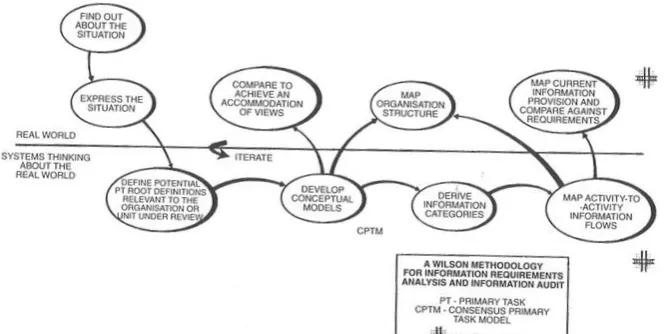
Soft systems methods provide a means to explore complex situations by facilitating a flexible approach to understand the issues within a particular problematic situation (Checkland, 1999). According to Cox (2014) “soft systems approaches use techniques that help to explore different views of the same situation and expose areas of conflict, which may be the root cause of problems in the organization”. Soft systems provide a flexible approach to exploring information requirements, providing a constructive method about situation thinking (Liu et al., 2012). Soft systems methods recognize that people view the same situation differently and provides tools to explore the different perceptions of the situation. Soft systems methods can therefore be used to explore the different perspectives of stakeholders in building design (Mayouf et al., 2014b). The following sections outline the use of soft systems methods to explore the complexity of space and its digital representations by inquiring into the designer’s thinking when designing a space, and what concerns/queries arise from users when perceiving these designs. For this paper, Wilson’s (1981) approach in soft systems will be used (see figure 1).
METHODOLOGY
Soft systems approaches enable different views of a problematic situation to be explored. Wilson’s (1990) soft systems method is used here as in addition to exploring different views of a situation it includes modelling tools to identify the information needed to support the different views explored. Wilson’s soft systems method (1990) is based on the soft systems method proposed by Checkland (1981). Both approaches incorporate the same first four stages (find out about the situation, express the situation, define root definitions and develop conceptual models). Wilson (1990) then seeks to achieve a consensus conceptual model and identify the information categories needed to support the consensus model derived. The study was conducted on a newly designed university building where BIM was used to produce the digital representations. The analysis of the problem situation is based on the data gathered from using questionnaires with the facility management team and building occupants, and an interview with the building designer. As part of soft systems methodology (SSM), a rich picture has been created to express the views of these three groups, which can then be used to identify contradictions and points of conflict in the situation (Sutrisna and Barrett, 2007). CATWOE one of the modelling tools in SSM is then used to demonstrate the different space requirements by deriving root definitions based on multiple perspectives of those involved in this research. Vacik et al., (2014) suggest that CATWOE has helped to simplify complex situations, which has led to better descriptions of the problem being investigated. In order to analyse the different information needs of each perspective, conceptual models were then developed based on the root definitions derived from CATWOE. A conceptual model was created for each root definition and then a consensus model was formed to encompass a shared view of those involved in the situation. The next step was to define information categories generated from the consensus model in order to determine the information needed to support each view of space in a building.
According to Wilson (1990), an information category represents a collection of data that provides a means of classification, which has meaning within the conceptual model being described. There are two approaches to identify information categories using soft systems tools. The first is creating a table that documents the data required as input to and output from each activity in the consensus model (Wilson, 1990). The second is using the words used in CATWOE and root definitions to form the initial list of cognitive categories (Lewis, 1994). Although it is claimed that combining these two approaches would ensure identifying all information categories, for the purpose of this research, Wilson’s approach will be used to derive information categories. The final step is to use a Maltese Cross tool, which maps the information categories input to and output from activities included in the consensus conceptual model and equivalent existing information processes in the real world. The Maltese Cross enables the completeness of information requirements needed to support the activities in the consensus model to be verified and compared with the existing system in the real world. In this study, three stakeholders were involved in the data collection process: building occupants (4 staff members), facility management team (2 members) and the building designer. Data were collected using questionnaires with the building occupants and the facility management team, and through an interview with the building designer. The questionnaire was based on space representations from the BIM model produced by the building designer where building occupants and facility management team were asked for their comments and queries arising about different spaces (public, social/community and private spaces) from the BIM model. A semi-structured interview was conducted with the building designer to determine the aspects that are taken into consideration in relation to space when designing different types of spaces in a building.
RESULTS AND FINDINGS
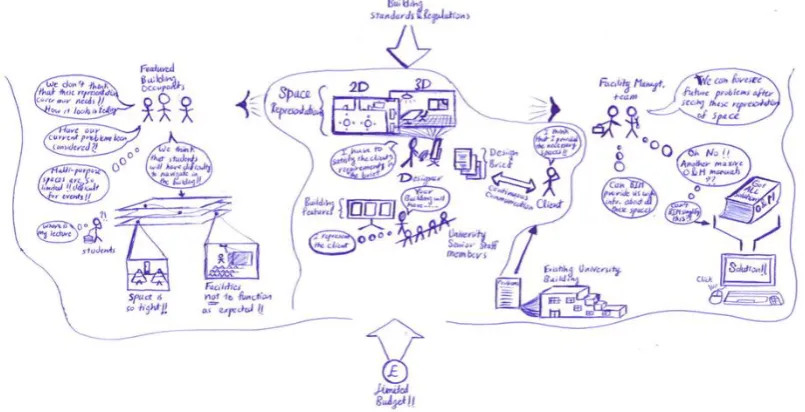
This section represents the findings accordingly based on the order mentioned in the previous section (methodology). It begins with the rich picture, which represents the current situation, highlighting those involved in that situation. Based on the rich picture, CATWOE analysis is presented in table 1 that shows the different worldviews of the stakeholders targeted in this study to support deriving the root definitions shown in table 2. Conceptual models (figures 3, 4 & 5) are then formed based on the worldview of those stakeholders involved in this study to inform the design of the consensus model. The section concludes by presenting the information categories derived from the consensus model mapped in the Maltese Cross.
Rich Picture
the space in the finished building and the Facility Management Team are concerned with predicting potential problems in maintaining the building. The rich picture also highlights the different pressures on the building designer.
Figure 2: Rich Picture Presenting the Situation of the Problem.
CATWOE and Root definitions
A CATWOE has been formed for each of the three stakeholder views (building occupants, facility management team and building designer), shown in Table 1. The use of CATWOE helped to construct a root definition for each stakeholder’s view, which captured the key values that provided the foundation for the views of each stakeholder group.
Table 1: CATWOE analysis derived from the Rich Picture.
CATWOE Building Designer Facility Management Team (FMT) Building Occupants
Weltanschauung Space is represented using 2D
and 3D representations.
Space representations should provide information on how occupants’ needs are addressed; maintenance and management requirements and different spaces should have baseline functionality within the building.
Space representations need to demonstrate how different spaces look in reality, connectivity between different spaces, facilities provided and the degree of flexibility within the spaces.
Transformation To create a coherent
representation of a building which is feasible and acceptable to stakeholders.
To interpret the suitability of building design in terms of managing its operation and integrity from a representation of a building.
To appreciate the performance of a building in terms of the extent to which it supports tasks and social activities, from a representation of the building.
Customers Client. Facility management team, building
occupants.
Building occupants.
Actors Client, Building designer,
Client’s representative.
Building designer, Facility management team.
Client’s representative, Building occupants.
Environmental Available budget, capability of
the design tools, building legislations by the government.
Time constraint, representations of space requirements, possible design iterations, possible poor aesthetics.
Representations of information related to space, available budget, possible design iterations.
Owners Building designer. Facility management team, Building
designer, Client’s representative.
Table 2: Root Definitions derived from CATWOE.
Root Definition Based on the Building Designer’s View
Root Definition Based on the Facility Management Team’s (FMT) View
Root Definition Based on the Building Occupants’ View
A system owned by the building designer, which is operated by the client, building designer and the client’s representative, to create a coherent representation of a building which is feasible and acceptable to stakeholders, and meets the needs of the client, by representing space using 2D and 3D representations, within the constraints of available budget, capability of the design tools and building legislations by the government.
A system owned by the facility management
team, building designer and client’s
representative, which is operated by the building designer and facility management team, to interpret the suitability of building design in terms of managing its operation and integrity from a representation of a building, which will benefit the facility management team and building occupants who require information on the related information on operation and maintenance of the space such as occupants’ needs, requirements and the space’s baseline functionality, within the constraints of time, representations of space requirements, many design iterations and possible poor aesthetics.
A system owned by the building occupants, client’s representative and the building designer, which is operated by the client’s representative and building occupants, to appreciate the performance of a building in terms of the extent to which it supports tasks and social activities, from a representation of the building, which will benefit the building occupants who require different space information related to how it looks in reality,
connectivity between different spaces,
facilities provided and the degree of
flexibility, within the constraints of
representations of information related to space, available budget and possible design iterations.
Conceptual Models
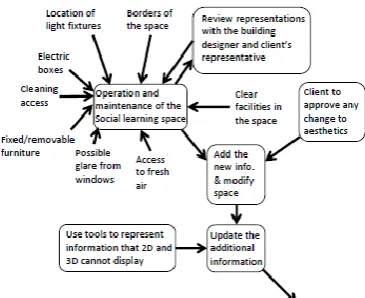
In soft systems methods, conceptual models are constructed to design the activities needed to form the system described in the root definitions. Figures 3, 4 and 5, present the conceptual models developed from the root definitions presented in Table 2, which represent the views of the stakeholders in relation to social/community space in the university building, referred to as social learning space.
The Building Designer’s Conceptual Model
Figure 3: Conceptual Model of Community/Social Space Based on the World View of the Building Designer.
The Facility Management Team’s Conceptual Model
The Building Occupants’ Conceptual Model
Figure 5: Conceptual Model of Community/Social Space Based on the World View of Building Occupants.
Consensus Model
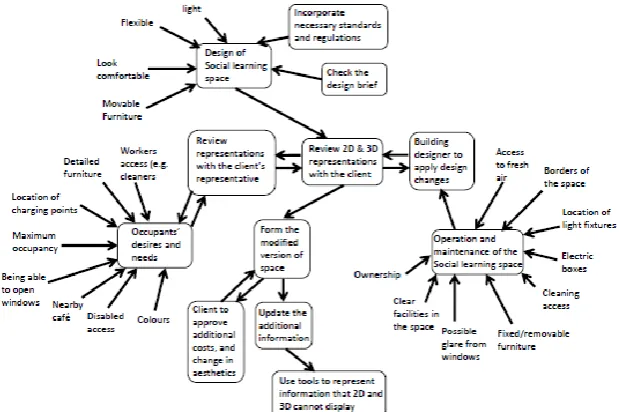
The consensus model incorporates activities that promote collaboration by joining conceptual models presented based on the three perspectives. It is important to acknowledge that some activities are repeated in two or more of the conceptual models, because having the related information to that activity may have different implications on different perspectives.
Figure. 6: Consensus Conceptual Model of the Social Learning Space for the Building Designer, Facility Management Team and Building Occupants.
Information Requirements
According to Wilson (1990), an information category is a collection of data that provides classification in which its boundary is defined by specifying the data items that the category contains. For example, referring back to Table 1, operational and maintenance related information may be considered to be an information category that includes data related to operation and maintenance such as: location of lighting fixtures, electric boxes and having clear description about facilities. Lewis (1994) suggested that if a value can be assigned to something, it becomes an attribute, rather than an information category. For instance, location of charging points can be considered as valuable input; it then becomes an attribute of information category, such as occupants’ needs and desires. As mentioned before, Wilson’s (1990) approach will be used to identify these information requirements, documenting the data required as input to and output from each activity in the consensus model where this is shown in Table 3. Information categories have been extracted from Table 3, and are presented in the Maltese Cross (see figure 7). Table 3: Information Required by Activities as Extracted from the Consensus Model.
Role of Information Design for a Social Learning Space
Operation and Maintenance for a Social Learning Space
Needs and Desires for a Social Learning Space
Input to the Activity Degree of flexibility.
Comfort (natural and artificial light).
Design brief.
Standards and Regulations.
Operational requirements (access to fresh air, cleaning access, electric boxes, and glare from windows).
Maintenance requirements (lighting fixtures, borders of the space, clear facilities).
Management requirements (ownership, fixed/removable facilities).
Space specification (finishes, facilities and layout).
Level of detail (furniture and colour).
Comfort (maximum occupancy and control of windows).
Connectivity (Location of charging points and nearby café).
Accessibility (disabled access and cleaning access).
Output from the Activity Design specification (size, dimensions, and materials).
Space information. Space specification (finishes,
facilities and layout).
Representation of Activities.
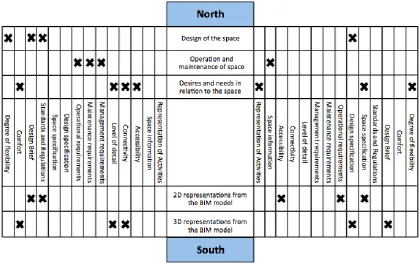
Maltese Cross
The Maltese Cross supports two phases of data to process mapping (Wilson, 1990). It separates the systems thinking environment from that in the real world. The Maltese Cross consists of two main parts; the top part of the Maltese Cross considers the information that is needed as input to and output from the activities in the consensus conceptual model. The candidate information categories (middle part), which are derived from Table 3 is mapped to the activities from the consensus model to form the top part of the Maltese Cross.
Figure 7: Maltese Cross presenting the candidate information categories, which supports comparing information needed as input (top part) and the current system (bottom part).
the Maltese Cross lists all activities from the current system, which in this study are 2D and 3D representations from the BIM model. Similarly to the top part of the Maltese Cross, the left side represents the information categories needed where placing (X) indicates the input for each activity, and placing (X) on the right side indicates the output from each activity. Analysis of the top and bottom part of the Maltese Cross prompts discussion of the information and activities needed to support the views expressed by the stakeholders.
Discussion
This section intends to discuss the findings outlined in the previous section. It begins with discussing the importance of the information categories outlined in Figure 7, which compares the information requirements identified from using soft systems methodology and the current digital representations of space. The implication of this highlights the importance of identifying these information requirements in order to acknowledge the value of intangibles within the space in a building.
Information Requirements vs. Digital Representations
There were three information requirements identified through the conceptual models, which are the design of the space, operation and maintenance of the space, and desires/needs for occupying the space. The first information requirement represents the designer’s perspective, which clearly defines the input and output activities he takes in consideration when designing a social/community space. Although it is claimed by the designer that ‘degree of flexibility’ is one of the inputs taken in consideration when designing a space, this is not reflected in the current 2D and 3D representations of space (shown in Figure 7). This highlights a limitation of the information included in the current digital representations of space.
Figure 7 shows that the two information categories ‘operation requirements’ and ‘maintenance requirements’ are input into the activity ‘operation and maintenance’ of space. However, these information categories are not created as output from the existing activities, therefore further analysis is needed to ensure this information is captured. These information categories are also not explicitly included in the current 2D and 3D representations of space. Motawa & Almarshad (2013) have proposed a KMoBM tool, which can represent maintenance information for building objects (such as windows) using data exported from the BIM model. Other standardized tools such as COBie (construction operation building information exchange) have also provided information that support managing facilities within the building (BIMTaskgroup, 2012). However, these tools and many others provide the operation and maintenance requirements for the overall building whereas the facility management team stressed the importance of having this information assigned to different spaces to provide ‘baseline functionality’ and enhance occupants’ experience.
When looking at the information requirements in relation to desires and needs for the space, representing the activities within the social learning space requires defining clear comfort criteria, level of detail, connectivity and accessibility related attributes. Although two of the information categories (level of detail and connectivity) can be represented using the 3D representations, they tend to be used to support checking compliance with the design brief and approve the design specification. Amstel et al. (2014) argue that there is a need to expand the design object into spatial practices, as this will make more coherent representation of the actual experience. It was argued that the study had a positive impact on the project, as it involved the participation of featured users when communicating with the designer. As for this study, exploring different information requirements along with the information categories did not only provide a holistic way of looking at the complexity of space, but more importantly, supported recognizing the value of ‘intangibles’, which tend to be explored when the space is occupied.
Acknowledging the Value of ‘Intangibles’ within a Space
factors to deliver the required space, and thus defining its degree of flexibility to suit different activities.
CONCLUSION
Soft systems methodology was used to explore the different information needs in digital representations of space of building occupants, facility management and designers. The paper has highlighted the shortcomings of digital representations of space and acknowledged its different complexities. Wilson’s (1990) approach to soft systems has been used to explore different information requirements within social space in a university building. The study was conducted on a newly designed building, which involved building occupants and the facility management team in terms of gathering their queries and concerns based on 2D and 3D representations of spaces within the building. A rich picture was formed which highlighted the issues and conflicts between those involved within the building design. Root definitions and conceptual models were produced to reflect the views of the three sets of stakeholders. A consensus model was then formed to identify the information categories that formed the main core of the Maltese Cross. Analysis of the information categories derived from the consensus model and the information available in current digital representations of space has highlighted limitations of the existing representations. The use of the soft systems approach has provided a means to compare the current space representations with the information needed by each stakeholder group. The findings also highlight the importance of intangible information relating to a space. Further work is needed to refine the information requirements of each of the stakeholders and to define the changes needed to existing systems to embed the required information into digital representations of space. This paper forms a part of a larger study, which intends to consider these information requirements using not only digital experience, but also the lived experience.
REFERENCES
Allen, S. (2009). Practice: Architecture, Technique and Representation. Abingdon: Routledge.
Amstel, F. M. van., Zerjav, V., Hartmann, T., Voort, M. C. van der and Dewulf, G. P. M. R. (2014). Expanding the representation of user activities, Building Research & Information, Vol. 43, No. 2, 144-159.
BIM Task Group (2012). COBie UK 2012, Retrieved from: http://www.bimtaskgroup.org/cobie-uk-2012/ (Accessed on: 20th May 2015).
Checkland, P. (1981). Systems Thinking, Systems Practice. Chichester: Wiley.
Cox, S. (2014). Managing Information in Organizations: A Practical Guide to Implementing an Information Management Strategy. London: Palgrave Macmillan.
Dovey, K. (2010) Becoming Places: Urbanism/Architecture/Identity/Power. Routledge: London.
Dunston, P., Arns, L. and McGolthin, J. (2007). An Immersive Virtual Reality Mock-Up for Design Review of Hosptial Patient Rooms, 7th International Conference on Construction Applications of Virtual Reality, 22-23
October 2007, University Park, PA, USA.
Forty, A. (2000) Words and Buildings: A Vocabulary of Modern Architecture. Thames & Hudson Ltd.: London. Hatfield, G. (2003). Representation and constraints: the inverse problem and the structure of visual space, Acta Psychologica, Vol. 114, 355-378.
Jensen, P., Alexander, K. and Fronczek-Munter, A. (2011). Towards an Agenda for User Oriented Research in the Built Environment, 6th Nordic Conference on Construction Economics and Organization, Copenhagen, Denmark,
13-15 April.
Kim, T. W., Cha, S. H. and Kim, Y. (2015). A framework for evaluating user involvement methods in architectural, engineering and construction projects, Architectural Science Review.
Lee, S. and Ha, M. (2013). Customer interactive building information modelling for apartment unit design,
Automation in Construction, Vol. 42, 78-89.
Lin, C-Jen. (2015). Architectural Knowledge Modeling: Ontology-Based Modeling of Architectural Topology with the Assistance of an Architectural Case Library, Computer-Aided Design & Applications, Vol. 12, No. 4, 497-506.
Liu, X., Eybpoosh, M, & Akinci, B., (2012). Developing As-Built Building Information Model Using Construction Process History Captured by a Laser Scanner and a Camera, American Society of Civil Engineers, pp.1232-1241. Loomis, J. M, Da Silva, J. A, Fujita, N. and Fukusima, S. S. (1992). Visual Space Perception and Visually Directed Action, Journal of Experimental Psychology: Human Perception and Performance,Vol. 18, 906-921.
Lorino, P., Tricard, B. and Clot, Y. (2011). Research methods for non-representational approaches to organizational complexity: The dialogical mediated inquiry’, Organization Studies, Vol. 32, No. 6, 769-801.
Luck, R. (2007). Using artefacts to mediate understanding in design conversations, Building Research & Information, Vol. 35, No. 1, 28-41.
Maftei, L. and Harty, C. (2013). Accounting for users: design team work in immersive reality environments In:
Smith, S. D. and Ahiaga-Dagbui, D. D. (Eds) Proceedings of the 29th Annual ARCOM Conference, 2-4 September
2013, Reading, UK, Association of Researchers in Construction Management, 157-166.
Mayouf, M., Boyd, D. and Cox, S. (2014a). Perceiving Space From Multiple Perspectives For Buildings Using BIM, In: Raiden, A. B. And Aboagye-Nimo, E. (Eds.) Proceedings of 30th Annual ARCOM Conference, 1-3
September 2014, Portsmouth, UK, Association of Researchers in Construction Management, 683-692.
Mayouf, M., Boyd, D. and Cox, S. (2014b). Exploring different information needs in Building Information Modelling (BIM) using Soft Systems. Proceedings of International Data and Information Management Conference, Loughborough, UK, 36-48.
Motawa, I. and Almarshad, A. (2013). A knowledge-based BIM system for building maintenance, Automation in Construction, Vol. 29, 173-182.
Oijevaar, K., Jovanovic, M. and Otter, A. (2009). User Involvement in the Design Process of Multifunctional Buildings, Changing Roles – New Roles, New Challenges, Noordwijk aan Zee, Netherlands, 5-9 October. Porwal, A. and Hewage, K. N. (2012). Building Information Modelling (BIM) Partnering Framework for Public Construction Projects. , Automation in Construction, Vol. 31, pp. 204–214.
Sabol, L. (2008) Building Information Modelling & Facility Management, IFMA World Workplace.
Sanoff, H. (2000). Community Participation Methods in Design and Planning. New York: John Wiley & Sons. Shen, W. Shen, Q. and Sun, Q. (2012). Building Information Modelling-based user activity simulation and evaluation method for improving designer-user communications, Automation in Construction, Vol. 21, 148-160. Sutrisna, M. and Barrett, P. (2007). Applying rich picture diagrams to model case studies of construction project,
Engineering, Construction and Architectural Management, Vol. 14, No. 2, 164-179.
Vacik, H., Kruttila, M., Hujala, T. Khadka, C., Haara, A., Pykäläinen, J., Honkakoski, P., Wolfslehner, B. and Tikkanen, J. (2014). Evaluating collaborative planning methods supporting programme-based planning in natural resource management, Journal of Environmental Management, Vol. 144, 304-315.
Wilson, B. (1990). Systems: Concepts, Methodologies and Applications, 2nd Ed. Chichester: Wiley.