
Submitted to the BCS AI 2011 special issue: Extracting
Knowledge from Web Communities and Linked Data for
Case-based Reasoning Systems
Christian Severin Sauer∗, Thomas Roth-Berghofer
University of West London, School of Computing and Technology, St Mary’s Road, London W5 5RF
Abstract
Web communities and the Web 2.0 provide a huge amount of experiences and there has been a growing availability of Linked (Open) Data. Making experiences and data available as knowledge to be used in case-based reasoning (CBR) systems is a current research effort. The process of extracting such knowledge from the diverse data types used in web communities, to transform data obtained from Linked Data sources, and then formalising it for CBR, is not an easy task. In this paper we present a prototype, theKnowledge Extraction Workbench(KEWo), which supports the knowledge engineer in this task. We integrated the KEWo into the open-source case-based reasoning tool myCBR Workbench. We provide details on the abilities of the KEWo to extract vocabularies from Linked Data sources and generate taxonomies from Linked Data as well as from web community data in the form of semi structured texts.
Keywords: Information Extraction, Case-based Reasoning, Experience Web, Linked Data
1. Introduction
The kind of data with the fastest growth in volume on the Web is user generated con-tent, which is mostly in the form of semi-structured texts. This user generated content often contains artefacts of user experiences, expressed explicitly or implicitly [1]. Addi-tionally the recent development in the field of Linked (Open) Data (LOD) further added
∗Corresponding author. Email addresses:
[email protected](Christian Severin
Sauer),[email protected]
(Thomas Roth-Berghofer)
URL:thomas.roth-berghofer.de(Thomas
Roth-Berghofer)
Following the idea of the Experience Web [5] one has also to ask how experience based technologies such as case-based reason-ing (CBR) might be able to benefit from the experience contained in semi-structured texts generated by the users of web communities and social networks. According to Richter [6], the knowledge of CBR systems comprises four knowledge containers: vocabulary, similar-ity measures, transformational (or adaptation) knowledge and cases. An approach for ex-tracting a controlled vocabulary and similar-ity knowledge in the form of taxonomies from semi-structured texts provided by a web com-munity is described in [7]. The respective tool is called ‘Knowledge Extraction Work-bench’ (KEWo). In this paper we show how integrating KEWo into the open-source case-based reasoning tool and SDKmyCBR 3[8, 9] supports the knowledge modelling of vocab-ularies and similarity measures. We further demonstrate how the similarity measure con-tainer can be provided with a taxonomy built from LOD as well as from web community data. Our approach aims here at direct au-tomatisation. Thus we propose a schema that extracts knowledge from LOD/web commu-nity sources and feeds it directly to themyCBR Workbenchand/or any CBR system built with
myCBR 3SDK.
myCBR focuses on the similarity-based re-trieval step of the CBR cycle [10]. A popu-lar class of such retrieval-only systems com-prises case-based product recommender sys-tems [11]. myCBR provides user interfaces for modelling and use of highly sophisticated, knowledge-intensive similarity measures [12]. Such domain specific similarity measures can improve the retrieval quality substantially. However, they do increase the development ef-fort significantly.
In contrast to earlier versions of myCBR, which were plug-ins for the open source
on-tology editor Prot´eg´e1 [13], myCBR 3 is a
complete reimplementation and consists of a software development kit (SDK) and a new and OSGi-based, eclipse-like graphical user interface, the myCBR Workbench. The my-CBR Workbench still focuses on ease-of-use regarding the creation of the case model, mod-elling of similarity measures and testing the similarity-based retrieval by offering an easy-to-use graphical user interface. In order to re-duce the effort of the preceding step of defing an appropriate case representation, it in-cludes tools for generating the case represen-tation automatically from existing raw data.
The capabilities of KEWo to extract el-ements of a controlled vocabulary and to build similarity measures in the form of tax-onomies of terms plus the ability to gener-ate at least limited amounts of adaptation-knowledge from the taxonomies are a use-ful addition to myCBR. This belief is further strengthened by the (semi-)automatic extrac-tion of such vocabularies and their respective similarity measures from semi-structured and, to a certain extent, even unstructured texts that
KEWosupports [7].
A desirable next step for the extraction of data from the web, to be used in CBR systems is to enable the access to Linked Data, espe-cially to Linked Open Data. LOD is provided without charge and contains comprehensive ontologies based on Semantic Web standards. The complex knowledge repository DBpedia is a prominent example of an LOD repository. It is generated from the on-line encyclopaedia Wikipedia. The terms are organised in an on-tology and are being enriched with further in-formation. Currently, the DBpedia ontology contains 1.83 million instances.2
1http://protege.stanford.edu/
2http://dbpedia.org/About [Last access: 22
Accessing LOD has the potential to further ease the development of Web CBR systems. Within this paper we demonstrate the capabil-ity of theKEWoto extract similarity measures from LOD [14]. The ability to adapt KEWo
with a relatively small amount of effort to new data types from which it extracts knowledge for CBR systems further adds to the idea of in-tegratingKEWointomyCBR Workbenchto en-able knowledge and system engineers to ben-efit from the knowledge extraction capabilities ofKEWo.
The rest of the paper is structured as fol-lows: In Section 2 we give an overview of related work in the field of knowledge extrac-tion from web-data for CBR systems. The pro-cess model for knowledge extraction used by
KEWois described in Section 3, andKEWo it-self and its functionalities are detailed in sec-tion 4. After introducing KEWo and its ap-proaches to knowledge extraction we take a brief look at the performance ofKEWoin Sec-tion 5. In SecSec-tion 7 we give a detailed view of the challenges we met during the integration of KEWo into myCBR Workbench. The last section summarises our approach and gives an outlook on how to further extend the abilities ofKEWo.
2. Related Work
The knowledge of case-based reasoning systems comprises the four knowledge con-tainers: vocabulary, similarity measures, trans-formational (or adaptation) knowledge, and the case base [6]. In order to extract data from the Web 2.0, respectively from a web commu-nity, and to use in a CBR system, the extracted data needs to be formalised properly to meet the formal needs of the chosen knowledge con-tainer for which it is extracted.
The wide variety of web communities can be classified into certain archetypes and
preva-lent forms of data types used in these com-munities [4, 15]. One, then, faces a multi-tude of possible combinations. Combinations consists of the possible forms the source-data types used in a web community and the for-mal structure of a target knowledge container for which to extract knowledge from the com-munity data are designed. However, with re-spect to the fast growing amount of very di-verse data, containing a rich amount of experi-ences from the users of web communities, the task of extracting knowledge from this data to use in CBR systems would seem to be worth the effort. Given the fact that the underlying methodology of CBR traditionally works upon previously recorded experiences, the develop-ment of Web CBR was the next logical step (see, e.g., [16]). An issue yet to be solved is the already mentioned problem of numerous pos-sible combinations of source data and targeted knowledge container(s) for which knowledge is to be extracted.
In contrast to myCBR, jCOLIBRI3 is a
framework for developing CBR systems in Java and for modelling knowledge for such systems [17, 18]. As Recio-Garc´ıa et al. point out, there are a variety of opportunities if web-based data sources can be integrated into a de-velopment framework for CBR systems such as jCOLIBRI [16]. Their approach is sim-ilar to the approach described in this paper. However, myCBR Workbench follows a tool approach with a rich graphical user interface, providing ease-of-use by itself. Considering that theKEWoprototype itself also offers a va-riety of easy to use GUI features makes them a perfect match.
KEWo focuses on the extraction of knowl-edge from semi-structured texts plus, from LOD, for the knowledge containers
vocab-3http://gaia.fdi.ucm.es/projects/
ulary and similarity measures. During the development of this approach it was found that, due to the formal needs of the knowl-edge containers, it was only possible to ex-tract knowledge from web data in a highly customised process. There are plenty of sim-ilar approaches for certain combinations of web community data and knowledge contain-ers to extract knowledge from that web com-munity data, e.g. [5, 19, 1, 20]. All of these approaches prove the benefits of extracting knowledge from web community data but they also have in common the need for highly tai-lored processes to fit the formal needs of the knowledge representation in the knowledge containers.
The integration of KEWo into such a tool as myCBR provides a starting point for us-ing standard techniques for knowledge extrac-tion from community data and for just trying out initial tests. KEWo already enables the extraction from varying forms of source data types for two of the four knowledge contain-ers, thus sparing developers of CBR systems the work of designing customised ways to ex-tract, formalise and integrate knowledge from web sources into their CBR systems.
3. Knowledge Extraction Process
The knowledge extraction approach utilised byKEWo is to extract relevant terms out of a previously specified domain from text data re-trieved from web communities. Upon the ex-tracted terms a taxonomy is built by assigning the terms in a hierarchy according to an analy-sis of the term frequency in a given text.
As already mentioned theKEWoprovides a limited amount of adaption knowledge by con-structing taxonomies of symbols in a given do-main. The approach to exploit the taxonomies as a source of adaption knowledge can be de-scribed as follows. The nodes in the
taxon-omy are assigned with similarity values ac-cording to their distance in the taxonomy. This approach allows KEWo to derive also a lim-ited amount of adaptation knowledge from the structure of the taxonomy by offering the pos-sibility to choose between different siblings, sharing the same level and parent node in the taxonomy [7].
A possible example for such an adaption is the following in the domain of travel medicine: A case describing a headache contains an at-tribute ‘medicamentation’, meaning the med-ication best used and the best choice offered by the case base is the instance ‘Aspirin’ for the attribute ‘medicamentation’. The user now states to the system that Aspirin is not avail-able in his context. The system then could ac-cess the taxonomy of medicaments and adapt the case, namely the value of the attribute ‘medicamentation’ with the instance ‘Ibupro-fen’ which is another sibling of the parent node of ‘Aspirin’, which might be ‘Painreliefers’ as an abstraction of ‘Aspirin’ and ‘Ibuprofen’. Thus an adaption is realised using substitution knowledge from the taxonomies.
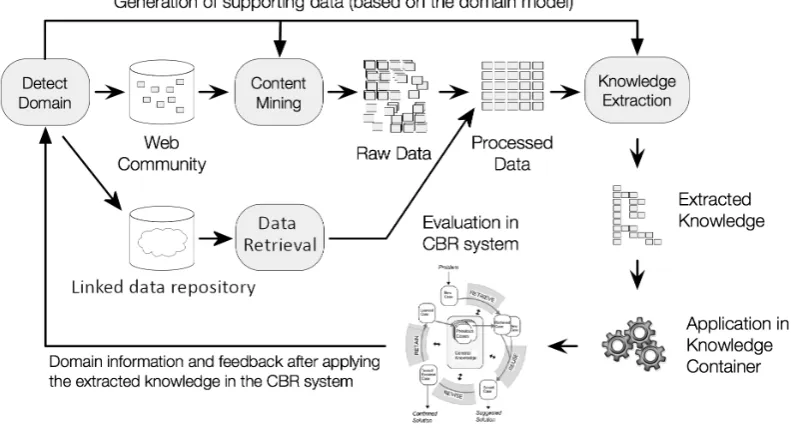
The KEWo knowledge extraction ap-proach [7] follows a process model based on the knowledge discovery in databases (KDD) process [21]. This process model can be seen as a valid approach in all possible combinations of source data from which to extract knowledge and target knowledge containers for which knowledge is extracted.
The process model described in Figure 1 shows a knowledge extraction for a CBR sys-tem with the aim to extract knowledge for two of the CBR systems knowledge containers namely the vocabulary and the similarity mea-sure. The extracted knowledge is then used and evaluated in the CBR system itself for which it is extracted.
Figure 1: Knowledge Extraction Process Model for CBR Systems (web communities and linked data)
construction of taxonomies itself is already implemented as a fully automatic process the last step of the process model, the evaluation still has to be done manually.
Referring to the process model we will now inspect each step of the process closer and give a brief insight into how the step in question is implemented withinKEWo.
1. Domain Detection This first step de-scribes the identification of the domain properties and results in the assignment of what kind of information can be ex-tracted and in which knowledge container it should be integrated. For KEWo this can be almost any domain. Targeted knowledge containers are the vocabulary, the similarity measures and to a certain extent the adaptation knowledge.
2. Web Community SelectionIn this step a web community is identified from which data should be used for extraction. With regards to KEWo currently text based communities, e.g., forums are preferred.
3. Linked Data Repository In this step a suitable repository or repositories supply-ing linked data, preferable open data, are identified. The data the repositories pro-vide is checked for its format and suit-ability for the modelling of the domain at hand with regard to transformation effort from linked data format to the knowledge formalisation of the knowledge container for which the knowledge is extracted. 4. Content Mining This describes the
pro-cess of acquiring the raw data. This can be accomplished by, e.g., web crawlers. A more convenient way is described in [22] with the approach of intelligent web forums.
5. Data retrievalThis describes the process of designing a suitable query and acquir-ing the data from a chosen repository or range of repositories by querying them. This can be accomplished for example by accessing available SPARQL endpoints. 6. Processing Raw DataNoise, stop words
steps are already implemented in KEWo
and are executed automatically if KEWo
accesses raw text data from a database un-derlying a web forum.
7. Processed Data The automatically re-fined text data is now ready for analysis byKEWo.
8. Knowledge Extraction In this step
KEWo extracts relevant terms and builds a taxonomy of these terms as already de-scribed. Additional input data for the ex-traction process, e.g., gazetteers, is au-tomatically updated by KEWoduring the extraction process.
9. Extracted KnowledgeBeing closely wo-ven in with the preceding step, in this step the taxonomy generated byKEWois saved back to amyCBRand is ready to be used.
10. Application in Knowledge Container The obtained taxonomy can be used in the development and testing of a CBR system using themyCBRtool.
11. EvaluationEvaluating the generated tax-onomy may deliver hints on how to op-timise the auxiliary data and preferences for the ANNIE (A Nearly-New Informa-tion ExtracInforma-tion System) applicaInforma-tion [23] (see next section) used in the extraction process. The evaluation may result in performance gains and/or gains in quality of the extracted taxonomies. These steps still have to be done manually within
KEWo.
KEWooffers the user a high degree of inter-activity, ranging in modes of operation from fully automatic to manual. The degree of use-ful automatic analysis strongly depends on the quality of the data to be analysed and the qual-ity of the auxiliary data, e.g., the gazetteers and rule sets, used by the ANNIE application withinKEWo.
The degree of interactivity can be increased from fully automatic by enabling dialogues with the knowledge engineer. Such an increase of interactivity can consist of questioning her if either a found symbol is valid and/or if a newly found symbol, not yet part of the used ANNIE gazetteer should be integrated in the gazetteer in use. Furthermore the knowledge engineer can at any time during the extraction process interact with the taxonomy currently being built to make adjustments if so desired.
KEWo is a Java-based middleware for the extraction of knowledge for CBR systems. CurrentlyKEWorelies onmyCBRfor the data type of the taxonomies and the calculation of distance-based similarity measures between the symbols of the taxonomies. The main pur-pose of KEWo is to extract symbols from a given domain and construct taxonomies us-able in myCBR from the extracted symbols. The process underlying the extraction of sym-bols is mainly provided by the text engineering tool set GATE [23], specifically by the AN-NIE application, which has been customised forKEWoby using specific gazetteers and rule sets that identify terms from a given domain. Thus KEWo relies on a customised ANNIE application to extract symbols from unstruc-tured texts and either build completely new or expand existing taxonomies of symbols to be used inmyCBR.
4. Knowledge Extraction Workbench
abilities to recalculate the similarity measures of the symbols with almost any given formula and the possibility to edit the taxonomy sym-bols manually to refine the taxonomy [7].
It provides a minimalistic browser with which the user can navigate a web forum tar-geted for extraction. The user can choose between two different analysis methods that define the strategy in which the symbols are added to the taxonomy. Furthermore, the user can decide if she either wants to run a fully automatic analysis or an interactive one, in which she can decide if extracted symbols are added to the taxonomy and/or added to support data used by the extraction techniques, e.g., gazetteers. As a third option the user can de-cide to extract from a given thread posting-by-posting or from the whole thread as one text.
In addition, the user can define and apply a new formula for recalculating the similarity values of the symbols in the taxonomy as well as load, manually edit and save the taxonomy. The taxonomy can be saved inmyCBRformat. For a complete description of the functionali-ties ofKEWowe refer to [15].
The approach of offering two ways for the processing of texts that was mentioned above has some impact on the resulting taxonomy. Using the approach to analyse each posting of a thread as a singular text KEWo tends to generate deeper taxonomies whilst using the approach to analyse a thread as a whole text generates a shallow taxonomy. The described effects on the depth of the taxonomies gener-ated originates from the numerical approach used byKEWo to build the taxonomies. Upon the extracted terms a taxonomy is built by as-signing the terms in a hierarchy according to an analysis of the term frequency in a given text, assuming that two similar terms appear together more often [25].
With regard to the extraction from LOD we can query the DBpedia ontology in order
to extend our information retrieval by using the Resource Description Framework Schema (RDFS) [26] to retrieve labels of concepts in different languages. In RDF, meaning is ex-pressed by facts encoded in sets of triples [27]. We also retrieve the Simple Knowledge Or-ganisation System based (SKOS) information about the categories a concept belongs to. SKOS is a family of formal languages. It is designed for representing a structured con-trolled vocabulary.4 SKOS is built upon RDF.
Its main objective is to enable easy publica-tion of controlled structured vocabularies for the Semantic Web.
The technique used for these initial retrieval steps are a set of SPARQL queries conducted via the open source Desktop-SPARQL-Query tool “Twinkle” 2. The simplest task was the extraction of data for the knowledge container vocabulary. For this task we simply derived the labels of the concepts from the retrieved data. The building of a taxonomy was then fol-lowing the same approach as described earlier, just requiring a few steps of pre-processing the LOD retrieval result. Thus we came up with a process of taxonomy generation as fol-lows: extract the concepts and the categories to which the concepts belong to as described above. The resulting data is, due to the tech-niques used for taxonomy generation by the
KEWo, further formatted in a special way. The special formatting lists the category twice followed by the concept. This results in a chain describing a category-concept-pair, e.g., Mammal (category) – Mammal (category) – Dog (concept). This formatting is due to the numerical approach the analysis methods of theKEWoemployed. The basic requirements, regarding a tool for a first step in the direction of standardised knowledge extraction from the
4http://www.w3.org/TR/2009/
Figure 2: Screenshot of the Knowledge Extraction Workbench [24]
web for specific knowledge containers of a CBR system, are met by KEWo. In the next section we show that the performance require-ments are also met.
5. Experiment and Results 1: Information Extraction from Text
In order to show the effectiveness of the knowledge extraction process experiments were performed on text data provided by a fo-rum of experts in the field of travel medicine (in German). KEWo was used to extract tax-onomies of terms out of the three domains:
diseases, medicaments, and geographical loca-tions from the 6,500 postings in that forum.
Both of the approaches, to analyse posting by posting or whole threads as a single text, were evaluated and delivered the already men-tioned different kinds of taxonomies, regard-ing the depth of the taxonomies (see section 4 above). Figure 4 shows two of the gener-ated taxonomies with the result of the thread analysis in the upper half and the post-by-post analysis in the lower half.
Figure 3: Screenshot of the Forum Browser of the Knowledge Extraction Workbench [24]
of the generated taxonomies.
All generated taxonomies were of accept-able quality with regard to making sense in the hierarchy of extracted terms. Figure 5 shows two snippets of a taxonomy of German terms from the domain of diseases. The taxonomy was built fully automatic by KEWo. While processing text data the F1-score of the term extraction gained by KEWo ranged between 68.7 and several numbers in the 80s range, de-pending on the domain and the degree of aux-iliary data provided for the extraction [15].
For each domain: ‘diseases’, ‘locations’ and ‘medicaments’, a gazetteer and a Jape trans-ducer was designed in the ANNIE
Figure 4: Taxonomy depth comparison (overview) (adapted from [24])
tion. Each Jape transducer consisting of a set of Jape rules to identify word composites. The new ANNIE application was then used by
KEWofor term extraction from the postings. The gazetteers for the three domains con-tained a randomly chosen set of terms from the given domain. The gazetteer for diseases contained 717 terms, for locations there were 331 terms and 32 terms for medicaments were present at the start of the experiment [15].
To test KEWo’s and its underlying ANNIE application’s abilities to extract terms from fo-rum postings a set of experiments were per-formed. During these experimentsKEWo(and its underlying ANNIE application) was able to automatically expand the gazetteers by identi-fying word composites. The additions were: 74 terms for diseases, 47 terms for locations and 123 terms for medicaments. The high number of composites found for the domain of medicaments was partly due to the deliber-ately low initial population of the gazetteer for this domain to explicitly test KEWo’s ability to work with sparse gazetteers and rely on the rule based Jape transducers the ANNIE appli-cation provided [15].
In another experiment, the first 100 post-ings of the forum from which the knowledge
was extracted from were analysed manually. All occurrences of terms from the domain of medicaments were identified and counted manually, resulting into 38 manually identified terms from the domain medicaments. Of these 38 terms KEWo was able to automatically identify 22 terms correctly and 4 terms were incorrectly identified as medicaments [15].
The maximum depth the taxonomies reached was 8. Figure 6 shows the total numbers of symbols KEWo identified and integrated into the taxonomies. The numbers are given from left to right for the domains: diseases, locations and medicaments. Please note that the category ‘fair’ refers to symbols which were correct from their syntactic structure but did not have a correct semantic meaning in the domain for which they were extracted. Most of these symbols were synonyms.
Figure 6: Number of symbols found and integrated into taxonomies byKEWofor the domains ‘diseases’, ‘locations’ and ‘medicaments’ [24]
6. KEWo Experiment and Results 2: Re-trieval of Linked Open Data
For the generation of the taxonomy we used retrieved LOD of diseases and the relevant cat-egories they belong to. The KEWo was able to process the text containing the information from the LOD and so build a taxonomy of dis-eases. We took the first 1000 category-disease-pairs and processed them in the described way, receiving a taxonomy describing 116 diseases. Figure 5 shows a snippet from the generated taxonomy generated purely from LOD.
Our SPARQL query to the DBpedia on-tology returned 2004 unique English disease-labels. Further queries returned 2000 Ger-man disease-labels, 2000 English category-concept-pairs. For the first knowledge con-tainer, vocabulary, we were able to extract all of the either English or German disease labels resulting into disease vocabularies consisting of 2004 English respectively German terms for diseases.
For the third knowledge container similar-ity measure it was possible to build a tax-onomy formalising the similarity of two dis-eases by their distance within the taxonomy. The generated taxonomy contained 116 dis-ease terms and was built upon 1000
category-concept pairs. The generated taxonomy shows a satisfying quality. Nevertheless in deeper levels of the taxonomy the quality of disease item links e.g. making ‘sense’ as parent-child pairs of nodes deteriorates quickly. Despite the lack of quality regarding the linking of Disease terms in the deeper levels of the taxonomy the generation of a similarity measure in form of a taxonomy can be seen as equally accelerated as the generation of the vocabulary by the use of LOD.
One question to ask is, given the fact that we used 1,000 category-concept-pairs, why are there not more diseases in the taxonomy than the 116 present? The comparatively low amount of concepts, here given by dis-eases, showing up in the generated taxonomy is partly caused by a certain kind of ‘misuse’ of our own ToolKEWo. This ‘misuse’ occurs as theKEWois optimised for analysing natural language and not such highly structured text as was present during this experiment.
7. Challenges of Integrating KEWo with
myCBR Workbench
commu-nity knowledge to be used in the development of CBR systems. Now we want to focus on some challenges we faced when integrating
KEWointomyCBR Workbenchand some chal-lenges we foresee for the integration of further features into theKEWobeing embedded in my-CBR Workbenchnow.
Making the data types used byKEWo com-patible with myCBR data types is an already solved problem as KEWowas specifically de-veloped for myCBR 2. A point more chal-lenging was the extension of KEWo’s ability to extract knowledge for the two containers not yet covered byKEWo: adaptation edge and case base. For the adaptation knowl-edge we added the capability to browse in the taxonomy in order to derive adaptation knowl-edge from the structure of the taxonomy. For the extraction of cases we had to implement an extension to KEWo aiming at structural cases, due to the ease such cases may be ex-tracted with techniques derived from the well researched field of template completion.
Currently we provide a taxonomy of terms annotated with a similarity value for each term derived from its position in the taxonomy. Bringing together the variety of data types given for web data and the strict formalisms of adaptation knowledge and cases, we focussed at first on certain types ranging from at least semi-structured data sources such as annotated documents for the extraction of cases to fully structured data such as RDF-based sources of Linked (Open) Data to extract structural infor-mation, e.g. hierarchies, to be directly used in generating adaptation knowledge.
To access more data sources we will inte-grate more flexible interfaces into KEWo al-lowing it to better parse and thus pre-process the raw data from a wider variety of web sources. Tasks involved in acquiring this goal are the addition of more flexible text and XML parsers, a flexible interface to connect
to MySQL-databases and an option to use a crawler on a web source, e.g. a forum, from which data is to be extracted.
We already included into KEWo the abil-ity to connect to any given online repository of Linked Data. After this prototypical inclu-sion KEWo is able to query the repository it has connected using SPARQL queries which are handled by use of the open-source Sesame framework.5 We are working on exploiting this connectivity to further facilitate the re-trieval from highly structured data repositories which to a high degree will help reducing the effort currently invested in knowledge extrac-tion due to the, at best, semi-structured format data is currently mostly available on the net.
8. Summary and Outlook
In this paper we emphasised the benefits of integrating a capability for extracting knowl-edge from web-sources for the development of CBR systems into themyCBR Workbench.
We examined the performance and limi-tations of the KEWo prototype by pointing out its abilities to extract and correctly for-malise knowledge from semi-structured texts and Linked Data for two CBR knowledge containers, vocabulary and similarity measure. The ability to tap into such highly structured sources as LOD was successfully tested in a second KEWo prototype. The containers ad-dressed by this prototype were vocabulary and the similarity measure. We have described our experimental setup regarding the meth-ods used to acquire concepts from available LOD repositories. We were able to produce good quantitive and qualitative results for the knowledge containers vocabulary and assign-ing similarity measures in form of a taxonomy
5http://www.openrdf.org/ [Last access: 8
to it, both based upon LOD using our cus-tomised toolKEWo.
During our work with LOD we discovered that it is occasionaly hard to identify relevant LOD repositories. It is further hard to retrieve the specific names of the attributes or of predi-cates of the items in these repositories. Notic-ing that there are on-goNotic-ing efforts to improve the searchability of LOD we still deem the lack of searchability is hampering the use of LOD.
A future goal, after integrating KEWo into
myCBR Workbench, is given by the shifting of the extraction approach now implemented in KEWo in the direction of Linked Open Data retrieval, where some first results have been reported elsewhere [9]. This goal will be followed to benefit from the rapidly grow-ing amount of highly structured data available on the web and at the same time reduce the costly process of extracting knowledge from less structured data [2].
As another future goal we look at adding ex-planation capabilities to the integrated KEWo
making it easier to use. The myCBR tool al-ready possesses some explanation capabilities, namely conceptualisation of symbols from a vocabulary and explaining the similarity cal-culation [28]. We aim towards an automatic extraction of both of these sources of con-ceptualising information from the web and at adding provenance information.
Acknowledgement
This work was supported by the Research Excellence Framework (REF) of the UK (Explanation-aware myCBR development). We would thank our colleague Ray Gumme for his valuable feedback.
References
[1] E. Plaza, C. Baccigalupo, Principle and praxis in the experience web: A case study in social
mu-sic, in: S. J. Delany (Ed.), ICCBR 2009 Workshop Proc., Workshop Reasoning from Experiences on the Web, pp. 55–63.
[2] C. Bizer, T. Heath, T. Berners-Lee, Linked data-the story so far, Int. J. Semantic Web Inf. Syst. 5 (2009) 1–22.
[3] R. Bergmann, Experience Management: Founda-tions, Development Methodology, and Internet-Based Applications, volume 2432 of LNCS, Springer, 2002.
[4] D. M. Boyd, N. B. Ellison, Social network sites: Definition, history, and scholarship, Journal of Computer-Mediated Communication 13 (2007) 210–230.
[5] B. Smyth, P.-A. Champin, P. Briggs, M. Coyle, The case-based experience web, in: S. J. Delany (Ed.), ICCBR 2009 Workshop Proc., Workshop Reasoning from Experiences on the Web, pp. 74– 82.
[6] M. M. Richter, Introduction, in: M. Lenz, B. Bartsch-Sp¨orl, H.-D. Burkhard, S. Wess (Eds.), Case-Based Reasoning Technology – From Foun-dations to Applications, LNAI 1400, Springer-Verlag, Berlin, 1998.
[7] K. Bach, C. S. Sauer, K.-D. Althoff, Deriving case base vocabulary from web community data, in: C. Marling (Ed.), ICCBR-2010 Workshop Pro-ceedings: Workshop on Reasonng From Experi-ences On The Web, pp. 111–120.
[8] A. Stahl, T. R. Roth-Berghofer, Rapid prototyping of cbr applications with the open source tool my-cbr, in: ECCBR ’08: Proc. of the 9th European conference on Advances in Case-Based Reason-ing, Springer, Heidelberg, 2008, pp. 615–629. [9] T. Roth-Berghofer, B. Adrian, A. Dengel, Case
acquisition from text: Ontology-based informa-tion extracinforma-tion with SCOOBIE for myCBR, in: I. Bichindaritz, S. Montani (Eds.), Case-Based Reasoning Research and Development: 18th In-ternational Conference on Case-Based Reasoning, ICCBR 2010, number 6176 in LNAI, Springer, Alessandria, Italy, 2010.
[10] A. Aamodt, E. Plaza, Case-based reasoning: Foundational issues, methodological variations, and system approaches, AI communications 7 (1994) 39–59.
[11] D. Bridge, M. H. G¨oker, L. McGinty, B. Smyth, Case-based recommender systems, Knowledge Engineering Review 20 (2006).
thesis, University of Kaiserslautern, 2003. [13] J. H. Gennari, M. A. Musen, R. W. Fergerson,
W. E. Grosso, M. Crub´ezy, H. Eriksson, N. F. Noy, S. W. Tu, The evolution of Prot´eg´e an environment for knowledge-based systems development, Int. J. Hum.-Comput. Stud. 58 (2003) 89–123.
[14] C. S. Sauer, K. Bach, K.-D. Althoff, Integra-tion of linked open data in case-based reasoning systems, in: M. Atzm¨uller, D. Benz, A. Hotho, G. Stumme (Eds.), Proceedings of LWA2010 -Workshop-Woche: Lernen, Wissen & Adaptivi-taet, Kassel, Germany.
[15] C. S. Sauer, Analyse von Webcommunities und Extraktion von Wissen aus Communitydaten f¨ur Case-Based Reasoning Systeme, Master’s the-sis, Institute of Computer Science, University of Hildesheim, 2010.
[16] J. A. Recio-Garc´ıa, M. Casado-Hern´andez, B. D´ıaz-Agudo, Extending cbr with multiple knowledge sources from web, in: I. Bichindaritz, S. Montani (Eds.), Case-Based Reasoning. Re-search and Development, volume 6176 ofLecture Notes in Computer Science, Springer Berlin/ Hei-delberg, 2010, pp. 287–301. 10.1007/ 978-3-642-14274-1 22.
[17] J. Bello-Tom´as, P. A. Gonz´alez-Calero, B. D´ıaz-Agudo, JColibri: An Object-Oriented Framework for Building CBR Systems, in: P. A. G. Calero, P. Funk (Eds.), Proceedings of the 7th European Conference on Case-Based Reasoning, Lecture Notes in Artificial Intelligence LNAI, Springer, 2004.
[18] J. A. Recio-Garc´ıa, B. D´ıaz-Agudo, M. A. G´omez-Mart´ın, N. Wiratunga, Extending jcolibri for textual cbr., in: H. Mu˜noz-Avila, F. Ricci (Eds.), Case-Based Reasoning, Research and Development, 6th International Conference, on Case-Based Reasoning, ICCBR 2005, Chicago, IL, USA, August 23-26, 2005, Proceedings, vol-ume 3620 ofLecture Notes in Computer Science, Springer, 2005, pp. 421–435.
[19] P. Milne, N. Wiratunga, R. Lothian, D. Song, Reuse of search experience for resource transfor-mation, in: S. J. Delany (Ed.), ICCBR 2009 Workshop Proc., Workshop Reasoning from Ex-periences on the Web, pp. 45–54.
[20] N. Ihle, A. Hanft, K.-D. Althoff, Extraction of adaptation knowledge from internet communities, in: S. J. Delany (Ed.), ICCBR 2009 Workshop Proc., Workshop Reasoning from Experiences on the Web, pp. 269–278.
[21] U. Fayyad, G. Piatetsky-Shapiro, P. Smyth, The kdd process for extracting useful knowledge from volumes of data, Commun. ACM 39 (1996) 27– 34.
[22] D. Feng, E. Shaw, J. Kim, E. Hovy, An intelli-gent discussion-bot for answering student queries in threaded discussions, in: IUI ’06: Proc. of the 11th Intl Conf. on Intelligent user interfaces, ACM Press, New York, NY, USA, 2006, pp. 171–177. [23] H. Cunningham, D. Maynard, K. Bontcheva,
V. Tablan, Gate: A framework and graphical de-velopment environment for robust nlp tools and applications, in: Proc. of the 40th Anniv.Meeting of the Assoc. for Comp. Linguistics (ACL’02). [24] C. Sauer, T. Roth-Berghofer, Web community
knowledge extraction for myCBR 3, in: Re-search and Development in Intelligent Systems XXVIII incorporating Applications and Innova-tions in Intelligent Systems XIX, Springer Verlag, New York, 2011.
[25] K. W. Church, P. Hanks, Word association norms, mutual information, and lexicography, Computa-tional Linguistics 16 (1990) 22–29.
[26] W3C, Rdf primer, 2004. http://www.w3.org/
TR/2004/REC-rdf-primer-20040210/ [Last
access: 2010-02-26].
[27] R. Bergmann, M. Schaaf, Structural Case-Based Reasoning and Ontology-Based Knowledge Management: A Perfect Match?, Journal of Universal Computer Science 9 (2003) 608–
626. http://www.jucs.org/jucs_9_7/
structural_case_based_reasoning [Last
access: 2010-02-26].
9. The Authors
9.1. Christian Sauer
Christian Sauer is Research Assistant at the School of Computing and Technology at the University of West London, UK. Christian holds a Masters Degree in Information Man-agement and Information Technologies gained at the University of Hildesheim, Germany.
Christian’s research interests are in the fields of explanation generation and more general explanation-capable information sys-tems, case-based reasoning and more gen-eral knowledge-based systems and in context-aware and context-sensitive systems.
9.2. Thomas Roth-Berghofer
Thomas Roth-Berghofer is Professor of Ar-tificial Intelligence at the University of West London and head of the Centre for Model-based Software Engineering and Explanation-aware Computing, which is based in the School of Computing and Technology. He has worked in software industry as software devel-oper, technical consultant, and manager qual-ity and support for several years, before he joined the German Research Centre for Arti-ficial Intelligence DFKI GmbH as senior re-searcher. After a year as visiting professor at the University of Hildesheim he joined the University of West London.
![Figure 2: Screenshot of the Knowledge Extraction Workbench [24]](https://thumb-us.123doks.com/thumbv2/123dok_us/1030528.1603233/8.595.112.486.103.485/figure-screenshot-knowledge-extraction-workbench.webp)
![Figure 5:Snippets of a taxonomy generated byKEWo [24]](https://thumb-us.123doks.com/thumbv2/123dok_us/1030528.1603233/9.595.147.450.110.462/figure-snippets-of-a-taxonomy-generated-bykewo.webp)
![Figure 4: Taxonomy depth comparison (overview) (adapted from [24])](https://thumb-us.123doks.com/thumbv2/123dok_us/1030528.1603233/10.595.78.520.123.281/figure-taxonomy-depth-comparison-overview-adapted.webp)
![Figure 6: Number of symbols found and integrated into taxonomies by KEWo for the domains ‘diseases’, ‘locations’and ‘medicaments’ [24]](https://thumb-us.123doks.com/thumbv2/123dok_us/1030528.1603233/11.595.92.497.117.254/figure-number-symbols-integrated-taxonomies-diseases-locations-medicaments.webp)
