STEEL FIBER EFFECT ON THE BEHAVIOR OF HOT
MIXTURE ASPHALT WITH VARIABLE ASPHALT
CONTENT
Asst. Prof. Dr. Ahmed S. D. AL-Ridha, Asst. Lec. Sinan K. Ibrahim,
Eng.Layth Sahib Dheyab
1,2
Highway and Transportation Department,
Al-Mustansiriya University/ College of Engineering
,
Baghdad, (Iraq
)
3Consultant Engineer, Baghdad, (Iraq
)
ABRTRACT
The objective of the study is evaluate the effect of added steel fiber as a volume fraction of total volume
mixture (0.1, 0.2 , 0.3 , 0.4) % within surface course grade (type B) according to State Corporation of Roads
and Bridges in Iraq, on behavior of hot asphalt mixture at temperature (60) Co , compaction no. of blows (75)
with different percent of asphalt content (5, 5.5 ,6) % from total weight of mix. The samples were tested by the
mechanical response of reinforced hot asphalt mix with different steel fiber %, in term of stability, flow and bulk
specific gravity. The results in this research found that When the asphalt mixture without steel fiber, the stability
value and bulk specific gravity decreased with increasing asphalt content, and When using steel fiber in hot
asphalt mixture, the stability value and bulk specific gravity of asphalt mixture increasing with increase asphalt
content. This increment increased with increasing volume fraction of steel fiber. And also obtained the optimum
value of volume fraction of steel fiber according to stability value, increased with increasing asphalt content.
Keywords: Asphalt Content, Hot Mix Asphalt, Modifier, Stability, Steel Fiber, Modifier.
I. INTRODUCTION
Asphalt additives have been used to improve pavement performance and decreasemanydistress types ,
which, rutting, thermal cracking and fatigue cracking are the most commondistresses. Fiber is one of the
modifiers used for this objective [1]. Using fibers to enhance theperformance of materials is not a new idea. The
use of fibers to strengthen a hardening material can be foundin Egyptian times when asbestos fiber was used to
support clay pots [2]. Fibers are commonly used as reinforcing agent in concrete, however, the currentmeans of
fiber reinforcement started in the early 1950s [3].
Flexible pavements are aimed so as to have at minimum20 yearsdesign life. The present studies contain
concentrating on enhance the performance anddesign lifefor off-road pavements. It is achieved that by
usingdifferent modifiersmaterials [4].
Steel fibers have been used in Portland concrete since the first 1900s.The primary fibers shape were
rounded and very smooth and the wire was cut or split to the useful lengths. The use of straight, smooth
fibers has vanished and recent fibers have either roughness, angular ends or are rolled through their length.
Recent commercially existing steel fibers are industrial from drawn steel wire, from cut sheet steel or by the
melt-extraction process which produces fibers that have a crescent-shaped section[5].
II. THE OBJECTIVE OF STUDY
The main objective of the study is evaluate the effect of addedsteel fiber as a volume fraction of total volume
mixture (0.1, 0.2 , 0.3 , 0.4)% within surface course grade (type B) based on State Corporation of Roads and Bridges
of Iraq in on behaviorof hot asphalt mixture withtesting the samples byMarshall test at temperature (60) Co,no.
of compaction blows (75) with different percent of asphalt content (5, 5.5 ,6) % by total weight mix.
III. MATERIALS
In This study,used local materialthat be used in road erection in Iraq except the material of steel fibers,are
available in local market in Baghdad but not yet used in the asphalt road constructions.
3.1Bitumen
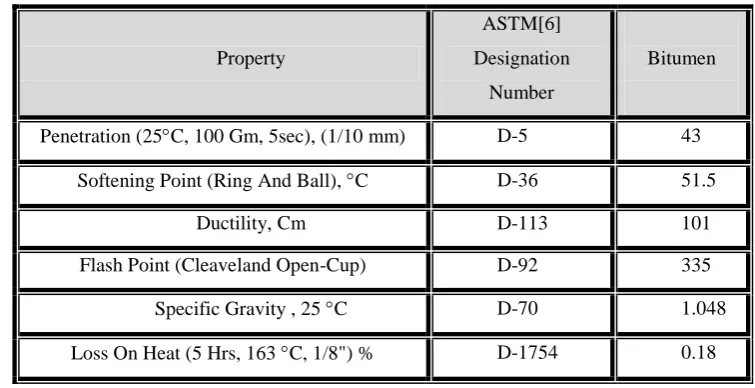
Thebitumenthat used in study manufacture in Daurah refinery with grade (40-50) .The physical characteristics
of bitumen are illustrated in Table (1).
Table (1) Physical Characteristicsof Bitumen
Property
ASTM[6]
Designation
Number
Bitumen
Penetration (25C, 100 Gm, 5sec), (1/10 mm) D-5 43
Softening Point (Ring And Ball), C D-36 51.5
Ductility, Cm D-113 101
Flash Point (Cleaveland Open-Cup) D-92 335
Specific Gravity , 25 C D-70 1.048
3.2 Aggregate
The source of mineral aggregate is from local quarry (Al-Nibai). The gradation of surface course with
nominalsize of (9.5mm) was used consider with State Corporation of Roads and Bridges[7].The Table(2) and
Fig.(1) show the upper and lower limits of the Iraqi standards and the selected gradation of mineral aggregate.
Table (2)Selectedand Standard Limits Gradations of Mineral Aggregate[7]
Sieve No. Sieve Opening (mm)
Surface Course Gradation (Type B)
StandardGradation Limits Selected Gradation
½ 12.5 100 100
3/8 9.5 90-100 95
4 4.75 55-85 70
8 2.36 32-67 50
50 0.4 7-23 15
200 0.075 4-10 7
Figure (1): selected and standard limits gradation of mineral aggregate
3.3 Mineral Filler
Table (3): Chemical Conformation of Portland Cement.*
Chemical Composition* (%) Cement
L.O.I. 3.5
SiO2 20.25
CaO 62.44
MgO 2.19
SO3 1.88
Fe2O3 4.32
Al2O3 4.73
Table (4): Physical Characteristicsof Portland cement*
Property Cement
Specific Surface* (cm2/gm) 3372
Bulk sp. gr. (gm/cm3) 3.4
% Passing No. 200 96
* The Result fromthe National Center for Construction Laboratories.
3.4 Steel Fiber
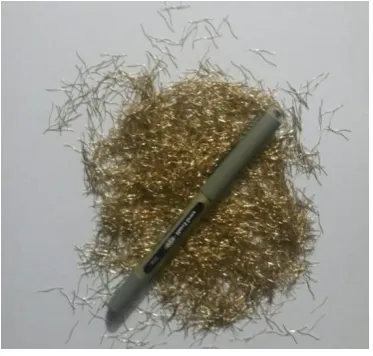
The steel fibers that used in this research were industrial by Bekaert Corporation. Steel fiber has a widthand
length of about 175 μm, 13 mm respectively [8]. The steel fibers characteristicsillustrated in Table (5). A thin
brass coating is applied to the fibers through the drawing process; therefore, the new fibers may be gold/-color.
Fig. (2) illustrations the steel fibers used in this study.
Table (5): Characteristics of the Steel Fibers*
Description Length (mm) Diameter (mm) Density (Kg/m3)
Tensile Strength
Fu(Mpa) Aspect Ratio
Straight 13 0.2 7800 2600 65
Figure (2) steel fiber
IV. WORK STUDY
The work plan of this study is toprepare an asphalt samples from selected grade of mineral aggregate , mineral
filler and differentpercent of steel fiber (0 ,0.1 ,0.2 ,0.3 ,0.4) % of total mixturevolume and asphalt content
(5.0,5.5 ,6.0)% of total mixtureweight, and the asphalt applied to several cycles of heating. The samples were
testedto computeMarshall stabilityandflow, bulk specific gravity at temperature(60 Co) and compaction
blows(75). Fig. (3)represent the work plan of study.
Fiber
0%
0.1%
0.2%
0.3%
Fiber
0%
0.1%
0.2%
0.3%
Fiber
0%
0.1%
0.2%
0.3%
Ac 40-50, selected
aggregate grade
Compaction
75 blows
Temperature
60 C
oAsphalt Content
6 %
V. EXPERIMENTAL RESULTS
The following tests were achievedin asphalt laboratory on the prepared samples to assessment the performance
ofHMA with different quantities of steel fiber:
1. Marshal Method (Stability and flow values, ASTM D 1559).
2. Bulk specific gravity test (ASTM D 2726).
5.1 Marshal Method (Stability and flow values)
Marshall Method for mix design is used in this research as ameasure to plastic flow. Stability and flow were
tested for allspecimens using ASTM D 1559.
5.1.1. Effect of Volume Fraction of Steel Fiber on Stability with Variable Asphalt Content
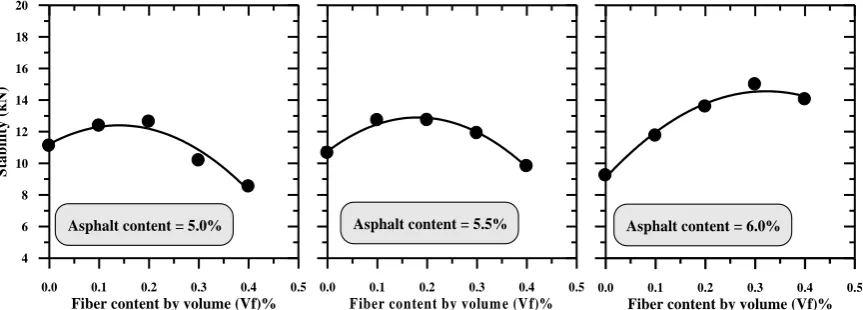
Fig.(4) show the effect of increasing steel fiber on stability value of marshal test, with three variable asphalt
content (5, 5.5, and 6)%. This figure represents the optimum point of volume fraction of steel fiber according to
stability value, increased with increasing asphalt content. This phenomenon caused may be that when increasing
the volume fraction of steel fiber, the surface area was increased which lead to required more asphalt content
that covered this area, that mean the increasing in steel fiber increase the required optimum asphalt content for
the mixture and improve the activity of steel fiber.
When add steel fiber the stability value was increased with variable asphalt content, this behavior may be that
the steel fiber prevent the created of micro-cracks and reduce growth of cracks[9].
0.0 0.1 0.2 0.3 0.4 0.5
Fiber content by volume (Vf)%
4 6 8 10 12 14 16 18 20
S
ta
b
il
it
y
(
k
N
)
0.0 0.1 0.2 0.3 0.4 0.5
Fiber content by volum e (Vf)%
0.0 0.1 0.2 0.3 0.4 0.5
Fiber content by volume (Vf)%
Asphalt content = 5.0% Asphalt content = 5.5% Asphalt content = 6.0%
Figure (4) effect of volume fraction steel fiber on stability with variable asphalt content
5.1.2. Effect of Asphalt Content on Stability with Variable Volume Fraction of Steel Fiber
The effect of increasing asphalt content (5,5.5,6) % on stability value with variable steel fiber (0,0.1, 0.2,0.3,
0.4) % illustrated in fig. (5). The figure represent thatwhen the asphalt mixture without steel fiber, the stability
value decreases with increasing asphalt content. And when adding steel fiber , the stability value increased with
increasing asphalt content at the same volume fraction of steel fiber, and this increasement increase with
increasing volume fractin of steel fiber. This phonomena that may be when increasing steel fiber the surface
area was increased which requierd to incresead the asphalt content to fill the voids and increase the adhesion in
4.5 5.0 5.5 6.0 6.5
Asphalt content by weight %
4 6 8 10 12 14 16 18 20 S ta b il it y ( k N )
4.5 5.0 5.5 6.0 6.5
A sphalt content by w eight %
(Vf )=0.3 % (Vf )=0.4%
4.5 5.0 5.5 6.0 6.5
Asphalt content by weight %
4 6 8 10 12 14 16 18 20 S ta b il it y ( k N )
4.5 5.0 5.5 6.0 6.5
Asphalt content by weight %
4.5 5.0 5.5 6.0 6.5
Asphalt content by weight %
(Vf )=0.0 % (Vf )=0.1% (Vf )=0.2%
Figure (5) effect of asphalt content on stability with variable volume fraction of steel fiber
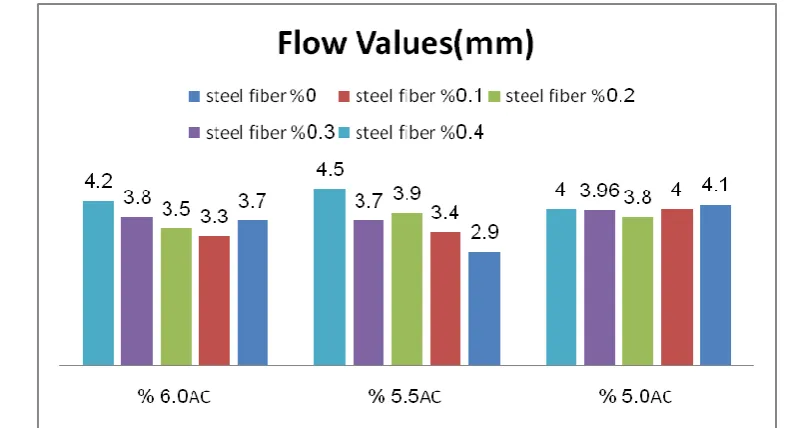
5.1.3. Flow Value Relationship with Variable Volume Fraction of Steel Fiber and Asphalt Content
The flow value of Marshall test with volume fraction steel fiber (0,0.1, 0.2,0.3, 0.4) % and asphalt
4.5 5.0 5.5 6.0 6.5
Asphalt content by weight %
2.10 2.13 2.16 2.19 2.22 2.25 2.28 2.31 2.34 2.37 2.40 D en si ty ( g m /c m 3 )
4.5 5.0 5.5 6.0 6.5
A sphalt content by w eight %
(Vf)=0.3% (Vf)=0.4%
5.2. Bulk Specific Gravity Relationship with Variable Rate of Steel Fiber and Asphalt Content
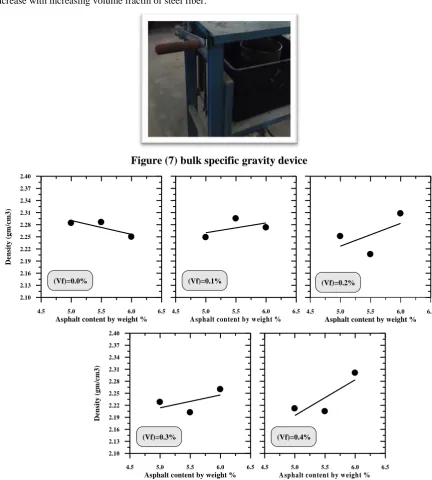
This test was achieved in laboratory using bulk specific gravity device Fig. (7), the Bulk Specific GravityRelationship with volume fraction of Steel Fiber (0, 0.1, 0.2, 0.3, 0.4) % and Asphalt Content (5, 5.5, 6)
%shown in fig. (8). The figure illustrated that when the asphalt mixture without steel fiber, the bulk specific
gravity value decreases with increasing asphalt content. And when adding steel fiber, the bulk specific gravity
value increased with increasing asphalt content at the same volume fraction of steel fiber, and this increasement
increase with increasing volume fractin of steel fiber.
Figure (7) bulk specific gravity device
4.5 5.0 5.5 6.0 6.5
Asphalt content by weight %
2.10 2.13 2.16 2.19 2.22 2.25 2.28 2.31 2.34 2.37 2.40 D en si ty ( g m /c m 3 )
4.5 5.0 5.5 6.0 6.5
Asphalt content by w eight %
4.5 5.0 5.5 6.0 6.5
Asphalt content by weight %
(Vf)=0.0% (Vf)=0.1% (Vf)=0.2%
VI. CONCLUSION
1- The optimum value of volume fraction of steel fiber according to stability result, increased with increasing
asphalt content.
2- The effect of asphalt content on stability value with variable volume fraction of steel fiber lead to:
a- When the asphalt mixture without steel fiber, the stability value decrease with increasing asphalt content.
b- Whenadding steel fiber to asphalt mix, the stability value increased with increasing asphalt content at the
same volume fraction of steel fiber, and this increasement increase with increasing volume fractin of steel
fiber.
3- The effect ofAsphalt Contentwith Variable volume fraction of Steel Fiber on Bulk Specific lead to:
a- When the asphalt mixture without steel fiber, the bulk specific gravity decrease with increasing asphalt
content.
b- When using steel fiber in hot asphalt mixture, the bulk specific gravity of asphalt mixture increasing with
increase asphalt content. This increment increased with increasing volume fraction of steel fiber.
VII. ACKNOWLEDGMENT
We thank the colleagues listed below for their achievement search:
1.
Dr. Zainab Alkaisi . Assistant professor at Highway and Transportation Department – College ofEngineering – Al- Mustansiriya University – Baghdad – Iraq.
2.
Dr.Mohammad B. Abduljabar.Lecturer at Highway and Transportation Department – College of Engineering– Al- Mustansiriya University – Baghdad – Iraq.
3.
Lecture Atheer N. Hameed ,Lecturer. Abbas F. Jassim [PhD student in USA] , Dr. Nagham T. H. Al-Shafi'i.Staff members of Highway and Transportation Department – College of Engineering – Al- Mustansiriya
University – Baghdad – Iraq.
4.
Staff members of asphalt laboratory of Highway and Transportation Department – College of Engineering –Al- Mustansiriya University – Baghdad – Iraq, essentially engineer Ahmed Sh. Qusad and Assist
engineerTeba T. Khaleed.
REFERENCES
[1] Thomas, D. W. and Haiming, H.,1999.Effect of Fibers on HMA Performance.TRB, National Research
Council, Washington, D.C.
[2] Mehta, P.K. and Monteiro, P.J.M., 2006.Concrete; Microstructure, Properties, and Materials. 3rd ed., New
York: McGraw-Hill.
[5] Ravindra V. S., C. B. Mishra., F. S. Umrigar and D. A. Sinha., 2011. Use of Steel Fiber in Concrete
Pavement: A Review. National Conference on Recent Trends in Engineering & Technology.
[6] ASTM Annual Book of ASTM Standard.,1996.Section 4, Volume 04.03, Road and Paving Materials;
Pavement Management Technology.American Society for Testing and Materials, Philadelphia, Pa.
[7] SCRB ., 2003. General Specification for Roads and Bridges.Section R9, Hot –Mix Asphalt Concrete
Pavement, Revised Edition.
[8] Roux, N., Anreade, C and Sanjuan, M. A.,1996. Experimental Study of Durability of Reactive Powder
Concretes. Journal of Materials in Civil Engineering, February, pp. 1-6.
[9] Dr. Ahmed S.D. AL- Ridha, Mr. AtheerNaji Hameed, Mr.SinanKhaleel Ibrahim, "Effect of steel Fiber on
thePerformance of Hot Mix Asphalt with DifferentTemperatures and Compaction". Australian Journal of
![Table (2)Selectedand Standard Limits Gradations of Mineral Aggregate[7]](https://thumb-us.123doks.com/thumbv2/123dok_us/9248321.1461181/3.595.65.522.182.642/table-selectedand-standard-limits-gradations-mineral-aggregate.webp)