EDGE WEIGHTED CONSISTENT FUZZY
CENTROIDAL CLUSTER MODEL FOR ROBUST
IMAGE SEGMENTATION
M.Nagalakshmi
1, R.Padmapriya
21
Mphil Scholar,
2Assistant Professor
,
Department of Computer Science,
Nadar Saraswathi College (India)
ABSTRACT
Image segmentation by clustering is one of the key problems in computer vision. Before high-level reasoning
can be applied to an image, Clustering or Segmentation refers to the process of partitioning a digital image into
multiple segments or regions. Existing method of image clustering, K-means algorithm obtains cluster results
converged to minimum with speedy but consistent lost due to random initialization cluster centroid, as well as
the method sensitivity to noised image produces undesirable clustering results. In our proposed method of
enhanced K-mean clustering algorithm reduce these drawbacks and obtains better results than existing method.
Our method extract initial cluster centroids from image intensity distribution and bilateral filter model of
Gaussian weightening technique reduce noise influence while execution of clustering algorithm. The experiment
carried out on different set of images standard, medical and natural images produced clustered results better
than existing algorithms.
I. INTRODUCTION
Clustering or Segmentation refers to the process of partitioning a digital image into multiple segments or
regions. The goal of segmentation is to simplify the representation of an image into something that is more
meaningful and easier to analyze. Image segmentation is typically used to locate objects and boundaries in
images. More precisely, image segmentation is the process of assigning a label to every pixel in an image such
that pixels with the same label share certain visual characteristics. Image segmentation is a very important field
in image analysis object recognition, image coding and medical imaging. Segmentation is very challenging
because of the multiplicity of objects in an image and the large variation between them. Image segmentation is
the process of division of the image into regions with similar attributes. The process of grouping a set of
physical or abstract objects into classes of similar objects is called clustering. A cluster is a collection of data
objects that are similar to one another within the same cluster and are dissimilar to the objects in other clusters.
By clustering, one can identify dense and sparse regions and therefore, discover overall distribution patterns and
interesting correlations among data attributes. Clustering may be found under different names in different
contexts, such as unsupervised learning (in pattern recognition), numerical taxonomy (in biology, ecology),
typology (in social sciences) and partition (in graph theory). By definition, "cluster analysis is the art of finding
groups in data", or "clustering is the classification of similar objects into different groups, or more precisely, the
partitioning of a data into subsets (clusters), so that the data in each subset (ideally) share some common
trait-often proximity according to some defined distance measure". Clustering is a challenging field of research as it
each cluster, and to focus on a particular set of clusters for further analysis. Alternatively, cluster analysis serves
as a preprocessing step for other algorithms, such as classification, which would then operate on detected
clusters.
II. LITERATURE SURVEY
Author : Maoguo Gong;Yan Liang ; Jiao Shi ; Wenping Ma ; Jingjing Ma “Fuzzy C-Means Clustering With
Local Information and Kernel Metric for Image Segmentation” . Image Processing, IEEE Transactions on
Volume:22 , Issue: 2 . In this paper, Author presented an improved fuzzy C-means (FCM) algorithm for image
segmentation by introducing a tradeoff weighted fuzzy factor and a kernel metric. The tradeoff weighted fuzzy
factor depends on the space distance of all neighboring pixels and their gray-level difference simultaneously. By
using this factor, the new algorithm can accurately estimate the damping extent of neighboring pixels.
Author : Maoguo Gong , Xi''an, China ; Zhiqiang Zhou ; Jingjing Ma “Change Detection in Synthetic Aperture Radar Images based on Image Fusion and Fuzzy Clustering” Image Processing, IEEE Transactions on
(Volume:21 , Issue:4 )
This paper presents an unsupervised distribution-free change detection approach for synthetic aperture radar
(SAR) images based on an image fusion strategy and a novel fuzzy clustering algorithm. The image fusion
technique is introduced to generate a difference image by using complementary information from a mean-ratio
image and a log-ratio image. In order to restrain the background information and enhance the information of
changed regions in the fused difference image, wavelet fusion rules based on an average operator and minimum
local area energy are chosen to fuse the wavelet coefficients for a low-frequency band and a high-frequency
band, respectively.
Author : Yi Yang , Hangzhou, China ; Dong Xu ; Feiping Nie ; Shuicheng Yan “Image Clustering Using Local
Discriminant Models and Global Integration” Image Processing, IEEE Transactions on (Volume:19 , Issue: 10
)
In this paper, Author presented a new image clustering algorithm, referred to as clustering using local
discriminant models and global integration (LDMGI). To deal with the data points sampled from a nonlinear
manifold, for each data point, we construct a local clique comprising this data point and its neighboring data
points. Inspired by the Fisher criterion, we use a local discriminant model for each local clique to evaluate the
clustering performance of samples within the local clique. To obtain the clustering result, we further propose a
unified objective function to globally integrate the local models of all the local cliques. With the unified
objective function, spectral relaxation and spectral rotation are used to obtain the binary cluster indicator matrix
for all the samples.
Author : Yanfei Zhong , Wuhan, China ; Ailong Ma ; Liangpei Zhang “An Adaptive Memetic Fuzzy Clustering
Algorithm With Spatial Information for Remote Sensing Imagery” Selected Topics in Applied Earth
Observations and Remote Sensing, IEEE Journal of (Volume:7 , Issue: 4 )
Due to its inherent complexity, remote sensing image clustering is a challenging task. Recently, some
spatial-based clustering approaches have been proposed; however, one crucial factor with regard to their clustering
quality is that there is usually one parameter that controls their spatial information weight, which is difficult to
and a global search capability. Furthermore, these methods only use a single optimization method rather than
hybridizing and combining the existing algorithmic structures.
III. PROPOSED MODEL OF IMAGE CLUSTERING
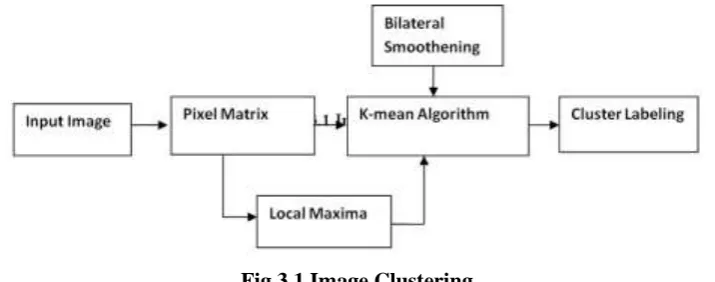
In proposed model of clustering, The K-means algorithm enhanced with initial centroidal selection and local
weight on clustering distance functions for produce consistent performance results and robustness against noise
on the image. The initial centroidal value randomly chosen in existing k-means whereas in our proposed model
local maxima values are considered as initial centroidal for better results in terms of consistency and accuracy
than the existing method.
The noises are added with on the image due to deficit accusation and transmission process. The results obtained
from exiting method on noise contaminated image not satisfied in terms of accuracy measurements. In proposed
method, by introduce local weightening factor reduces noise influence while clustering and obtain results
approximately as same as noiseless image results.
Fig 3.1 Image Clustering
3.1 Modules
3.1.1 Centriod Initialization
Initial centriod value selection is important in k-means algorithm as well as others, centroidal based image
clustering techniques. Since, In K-means algorithm’s output performance depends directly to initial centroidal
selection. The better centroid selection produce better clustered outputs whereas bad centroid initial value
produces bad clustering results.
Fig 3.1 Centriod Initialization
In order to produce better clustering results, The K-means algorithm were executed repeatedly with different
initial random centroidal value to specified number of times. The centroid values are producing better clustering
results are accepted and others were rejected. The repeated execution of K-mean algorithm is time consuming
and also high computational barden due to huge amount of pixels in an image. In avoidance of repeated
execution the Kmeans needs good initial clusters for getting better result in single running. We propose a
technique called local mode or maxima value as centroid which are derived from distribution of image
3.1.2 Bilateral Smoothening
The image are corrupted by Gaussian noise and are input to the clustering process, whose results not acceptable
when noise level increasing after certain level. The results degradation cause of clustering process carried out on
corrupted pixels. In our proposed segmentation model, the smoothening by bilateral filter incorporated into
clustering process to eliminate results degradation on noise corrupted image.
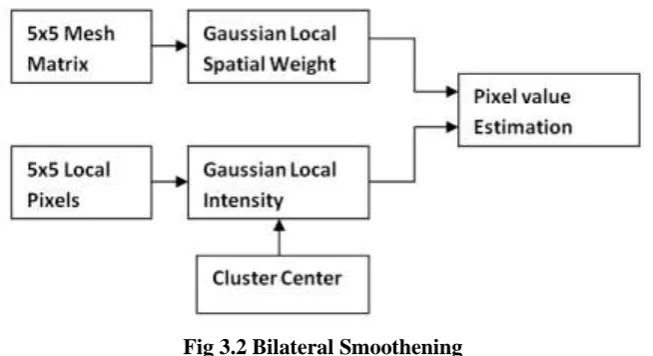
The bilateral filter estimate new pixel value from corrupted neighborhood pixels and the estimated pixel value
used for clustering process instead of corrupted pixel value. The estimation pixel of value process carried out
using Gaussian function to neighboring spatial distance and neighboring pixel intensities.
Fig 3.2 Bilateral Smoothening
The figure shows flow diagram of estimation of smoothened pixel using two kinds of Gaussian filter weights
namely Gaussian Spatial filter and Gaussian Intensity filter.
3.1.3 Gaussian Spatial Weight
The Gaussian filter, bell shaped curve to estimate neighboring pixel’s weight from central pixel of spatial
coordinates and neighboring pixel of spatial coordinates.
where x is the distance from the origin in the horizontal axis, y is the distance from the origin in the vertical
axis, and σ is the standard deviation of the Gaussian distribution and w(x, y) is spatial weight of Local
neighboring pixel of coordinate x and y. Each pixel's new value is set to a weighted average of that pixel's
neighborhood. The original pixel's value receives the heaviest weight (having the highest Gaussian value) and
neighboring pixels receive smaller weights as their distance to the original pixel increases. This results in a blur
that preserves boundaries and edges better than other, more uniform blurring filters.
3.1.4 Gaussian Intensity Weight
The Gaussian function here employed to measure weights among central pixel and their neighboring pixel
intensity. Each pixel has number neighboring pixels defined by window size 5x5 and hence 24 neighboring
pixels would be to a central pixel. The center pixel 3rd row and 3rd column as central pixels and others pixels considered as neighboring pixels.
pixels would be to a central pixel. The center pixel 3rd row and 3rd column as central pixels and others pixels considered as neighboring pixels.
si -neighboring pixel’s intensity value
cj -Jth Cluster center value
σ - Standard deviation of Gaussian
Wij - weight of ith pixel to jth cluster
The result of Gaussian function weight depends on how much closeness between central pixel and neighboring
pixel. If the central pixel and a neighboring pixel is very close to each other, the result of weight will be near to
1. Whereas if not close, the result to will be close to 0.
3.1.5 Robust K-Mean Clustering
The presence of noise on the image is unavoidable due to hardware and accusation defects and other things.
While segmentation process carried out on the image in presence of noise using conventional K-means
algorithm, the result of the process, would not be acceptable because noisy image produce noisy segmented
results. Hence we proposed a novel K-means algorithm called Robust K-means. The conventional K-means
algorithm combined with bilateral filter process to make robust clustering in presence of noise on the image.
1. X = {x1,x2,x3…..xm }, X –Set or image containing each pixel represented by x
2. Choose initial n number cluster centroids C = {c1, c2.. cn} and window size ws =(5x5)
3. Measure distance matrix Dij using bilateral filter and Euclidean distance metric among cluster centroid, C
and image, X.
4. Assign a label to each cluster in which member x close to the cluster centre than other cluster center.
5. Update cluster center value by taking averaging member of the cluster
6. Measure difference between new (updated) cluster center value and before updating value
7. If the difference value less than epsilon stop otherwise goto step 3
IV. RESULTS
The experiments carried out and results are taken to four different standard images (house, leena, lake and
pepper) used in most processing techniques. The first experiment carried on the images without adding noise
using conventional K-means segmentation and results shown on figure (5-8). Result of segmentation depends
on initial cluster centroid, hence on each repeated execution getting different results. The second experiment
carried on images using conventional K-means with choosing cluster centroid from local maxima or mode from
image intensity distribution. Result of segmentation improved in terms of inter and intra cluster value as well as
iteration count decreased, while choosing appropriate cluster centriod
The third experiment carried on the images with adding Gaussian noise having parameter zero mean and 0.005
standard deviation using conventional K-means segmentation and results shown on figure (13-16). The results
show that the conventional K-means segmentation algorithm sensitivity noise and presents noise segmented
The fourth experiment carried on the images with adding Gaussian noise having parameter zero mean and 0.005
standard deviation using proposed Robust K-means segmentation and results shown on figure (17-20). The
results show that the proposed K-means segmentation algorithm insensitivity noise and presents noiseless
segmented outputs for most images.
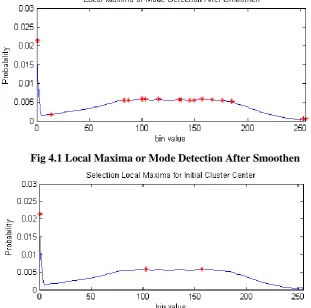
Fig 4.1 Local Maxima or Mode Detection After Smoothen
Fig 4.2 Selection Local Maxima For Intial Cluster Center
Fig 4.3 Gaussian Function
V. CONCLUSION
The image segmentation process using conventional K-means algorithm the way to initialize the means was not
specified. One popular way to start is to randomly choose k of the samples. The results produced depend on the
initial values for the centeriods. In our proposed K-means, for the initial cluster centroid, we have used local
robustness to noise on the image while clustering. The segmented output of robust K-means is being same as
output no noised images.
REFERENCES
[1] Maoguo Gong, Member, IEEE, Yan Liang, Jiao Shi, Wenping Ma, and Jingjing Ma” Fuzzy C-Means
Clustering With Local Information and Kernel Metric for Image Segmentation” IEEE transactions on
image processing, VOL. 22, NO. 2,
[2] Rafael C Gonzalez, Richard E. Woods, [Digital Image Processing], Second Edition, Prentice Hall, (2009).
[3] Maoguo Gong , Xi''an, China ; Zhiqiang Zhou ; Jingjing Ma “Change Detection in Synthetic Aperture
Radar Images based on Image Fusion and Fuzzy Clustering” Image Processing, IEEE Transactions on
(Volume:21 , Issue:4 )
[4] Yi Yang , Hangzhou, China ; Dong Xu ; Feiping Nie ; Shuicheng Yan “Image Clustering Using Local
Discriminant Models and Global Integration” Image Processing, IEEE Transactions on (Volume:19 ,
Issue: 10 )
[5] Yanfei Zhong , Wuhan, China ; Ailong Ma ; Liangpei Zhang “An Adaptive Memetic Fuzzy Clustering
Algorithm With Spatial Information for Remote Sensing Imagery” Selected Topics in Applied Earth
Observations and Remote Sensing, IEEE Journal of (Volume:7 , Issue: 4 )
[6] Nan Li, Hong Huo ; Yu-ming Zhao ; Xi Chen “A Spatial Clustering Method With Edge Weighting for
Image Segmentation” Geoscience and Remote Sensing Letters, IEEE (Volume:10 , Issue: 5 )
[7] M. Gong, Z. Zhou, and J. Ma, “Change detection in syntheticaperture radar images based on image fusion
and fuzzy clustering,”IEEE Trans. Image Process., vol. 21, no. 4, pp. 2141–2151, Apr.2012.
[8] N. Cristianini and J. S. Taylor, An Introduction to SVM’s and Other Kernel-Based Learning Methods.
Cambridge, U.K.:Cambridge Univ.Press, 2000.
[9] X. Yang and G. Zhang, “A kernel fuzzy C-means clusteringbased fuzzy support vector machine algorithm
for classification problems with outliers or noises,” IEEE Trans. Fuzzy Syst., vol. 19, no. 1, pp. 105–
115,Feb. 2011.
[10] V. Roth and V. Steinhage, “Nonlinear discriminant analysis using kernel functions,” in Advances in
Neural Information Processing Systems 12, S. A Solla, T. K. Leen, and K.-R. Muller, Eds. Cambridge,