A Design Method for Object-Oriented Programming
Winnie W. Y. Pun
T h esis su b m itte d for the deg ree o f P h D
D epartm en t o f Com puter Science
All rights reserved
INFORMATION TO ALL USERS
The qu ality of this repro d u ctio n is d e p e n d e n t upon the q u ality of the copy subm itted.
In the unlikely e v e n t that the a u th o r did not send a c o m p le te m anuscript and there are missing pages, these will be note d . Also, if m aterial had to be rem oved,
a n o te will in d ica te the deletion.
uest
ProQuest 10797824
Published by ProQuest LLC(2018). C op yrig ht of the Dissertation is held by the Author.
All rights reserved.
This work is protected against unauthorized copying under Title 17, United States C o d e M icroform Edition © ProQuest LLC.
ProQuest LLC.
789 East Eisenhower Parkway P.O. Box 1346
Abstract
Object-oriented programming has come forth as an important programming paradigm in the 1980’s. As more and m ore people practise object-oriented programming, the subject of how to design and develop a system towards an object-oriented implementation becomes important. There is, therefore, a general demand for a design method which is specially developed for object-oriented programming.
The theme of this thesis is to develop such a design method. The thesis starts off with a comprehensive background on object-oriented programming and how it differs from tradi tional programming. It also gives a detailed analysis o f why existing design methods are inadequate for object-oriented programming. The thesis then presents the design method which has been developed in this research. The different stages of the design method and the various tasks that have to be performed at each stage are discussed thoroughly. The design method also embeds a design description language which allows system designers to communicate with each other during the design phase and this is also talked about in the thesis.
Inheritance is regarded as an important feature found in object-oriented programming. A design method without substantial support for inheritance is considered to be incomplete. Therefore, a mechansim which is called the inheritance factorisation process is developed to assist system designers to construct class hierarchies in object-oriented programming. The mechanism has a formal model which ensures its correctness. The details o f the formal model and the issues concerning how to use the mechanism forms a crucial part o f this thesis.
To examine the performance of the inheritance factorisation process, a factorisation engine is implemented and experiments have been carried out. To illustrate how the design method is used in system designs, two case studies have been carried out and are presented in this thesis.
Acknowledgements
I would like to acknowledge my indebtness to my supervisor Russel W inder who assisted, advised and gave me tremendous support throughout this work. W ithout his guidance and continous encouragement, the thesis would not have been the success it is.
The list o f people who I want to thank for their help and advices in the last few years are too numerous to list. I would, however, like to thank the following individuals in particular: John Campbell, Nigel Chapman, Helen Sharp and Graham Roberts for their invaluable comments on the first draft o f this thesis; Simon Deal who patiently correct my usage o f English in the thesis; Vemon who, probably didn’t realised himself, first introduced the term ‘object- oriented’ into my life; Mildred, m y old friend, who never fails giving me support in good and bad times.
Contents
1 Introduction ... 1
1.1. The Evolution of Software Engineering ... 1
1.1.1. Programming Languages and Design Methods ... 4
1.1.2. The Road Towards Higher Levels o f A b stra c tio n ... 6
1.2. Object-Oriented P ro g ram m in g ... 7
1.3. An Object-Oriented Design M e th o d ... 9
1.4. Thesis Goals ... 9
1.5. Thesis Organisation ... 10
2 Background ... 12
2.1. W hat i s ‘Object-Oriented Programming’? ... 13
2.1.1. O b je c t... 14
2.1.2. Class ... 15
2.1.3. Class Inheritance ... 16
2.1.4. A Language that supports Object-Oriented P ro g ram m in g ... 19
2.2. Designing Object-Oriented Software ... 19
2.2.1. Data Flow Design Methods ... 20
2.2.2. Data Structure Design Methods ... 22
2.2.3. Transformations of Conventional Design M e th o d s ... 24
2.2.4. Entity Relationship M o d e llin g ... 25
2.2.5. Booch and HOOD Design M e th o d ... 27
2.2.6. Mittermeir Object Oriented Software D e s ig n ... 30
2.2.7. O b je c tO ry ... 31
2.2.8. S u m m a ry ... 33
2.3. Conclusion ... 35
3 The Design Method ... 36
3.1. Basic Principles o f the Design M e th o d ... 36
3.1.2. Analysis and Design ... ... 37
3.1.3. M o d e llin g ... 39
3.1.4. Design Description Language ... 41
3.1.5. User Interface Design ... 41
3.1.6. Design in Different Problem D o m a in s ... 42
3.2. An Overview o f the Design M ethod ... 42
3.3. Detailed Description o f the Design M ethod ... 44
3.3.1. The Conceptual Level ... 44
3.3.1.1. Identification of Objects ... 45
3.3.1.2. Identification of Actions ... 46
3.3.1.3. The Two Layers of the Conceptual Level ... 47
3.3.1.4. Object Interaction Diagrams ... 48
3.3.1.5. Levelled Object Interaction Diagrams ... 49
3.3.2. The System Level ... 50
3.3.2.1. The Concept o f Implementation Objects ... 51
3.3.2.2. T h e ‘Contain’ Relationship ... 51
3.3.2.3. The ‘U se’ Relationship ... 53
3.3.2.4. The ‘Inherit’ R ela tio n sh ip ... 55
3.3.2.5. How to Proceed? ... 56
3.3.3. The Specification Level ... 58
3.3.3.1. The Class Structure C h a r t ... 58
3.3.3.2. The Message Structure Chart ... 59
3.4. Other I s s u e s ... 61
3.4.1. Data Modelling in Object Oriented Programming ... 61
3.4.2. Cohesion and Coupling ... 62
3.4.3. Factors for a Good Object-Oriented Design ... 63
3.5. Conclusion ... 64
4 The Inheritance Factorisation Process ... 66
4.1. Background ... 67
4.1.1. Classes and T y p e s ... 67
4.1.2. Inheritance as a Design Issue ... 67
4.1.3. Inheritance in Different Domains o f Discourse ... 6 8 4.1.4. Inheritance from Different Perspectives ... 69
4.1.5. The Problem in Constructing Class Hierarchies ... 70
A Design Method for Object-Oriented Programming Winnie Pun
4.2.2. Attributes ... 72
4.2.3. Class Specification ... 73
4.2.4. The Class Hierarchy Construction P ro b le m ... 74
4.2.5. Axioms for the Inheritance Factorisation Process ... 74
4.2.6. Class Hierarchy Expression ... 79
4.2.7. Detecting M utiple Inheritance ... 80
4.2.8. Class Hierarchy Graphs ... 81
4.2.9. Examples to use the IFP ... 84
4.3. The IFP in Various Inheritance M o d e ls ... 87
4.3.1. The IFP with Name-Compatibility ... 8 8 4.3.2. The IFP with Signature-C om patibility... 89
4.3.3. The IFP with Behaviour-Compatibility ... 91
4.3.4. The IFP with Priority A ttrib u te s... 93
4.4. Applying the IFP to Systems Design ... 95
4.4.1. In Building a Class Hierarchy from Scratch ... 95
4.4.2. In Adding a New Class to an Existing Class Hierarchies ... 96
4.4.3. The Importance o f Specifications in the IFP ... 98
4.4.4. Incorporating the IFP into the Proposed Design M e th o d ... 99
4.5. Automating the IFP ... 99
4.6. The Truth of the IFP ... 101
4.6.1. The Techniques of Cluster Analysis and the IFP ... 101
4.6.2. The Benefits brought by the EFP ... 102
4.7. C o n c lu sio n ... 104
5 A Prototype of The IFE ... 105
5.1. An Overview of the Inheritance Factorisation Engine ... 106
5.2. Data S tru c tu re s... 107
5.2.1. The Class Specification ... 107
5.2.2. The Class Hierarchy E x p re ssio n ... 108
5.3. The M ethod of Factorisation ... 112
5.3.1. Factorisation Process ... 112
5.3.2. Detecting Multiple Inheritance ... 116
5.3.3. Updating Expressions with Single Inheritance Alone ... 117
5.3.4. Updating Expressions with Multiple In h erita n c e... 118
5.4. Complexity o f the A lg o rith m ... 119
5.5. Other Components in the Automation P ro c e s s ... 121
6 E v a lu a tio n ... 123
6.1. The Inheritance Factorisation Process ... 123
6.1.1. Introductory Examples ... 124
6.1.2. Miscellaneous Examples ... 127
6.1.3. Limitations o f the I F P ... 135
6.1.3.1. The Requirement for a Precise Specification ... 135
6.1.3.2. The Practicability of the IFP ... 138
6.2. The Design M ethod ... 139
6.2.1. General A sse ssm e n t... 139
6.2.2. Comparison with Other Existing Design Methods ... 140
6.2.3. Evaluation by Other Users ... 141
6.3. Conclusion ... 142
7 F u tu r e W o rk ... 143
7.1. Immediate Future Work ... 144
7.1.1. The Inheritance Factorisation Process ... 144
7.1.2. Usability o f the Design M ethod ... 144
7.2. Future W ork in Long T e r m ... 147
7.2.1. Computer Aided Software Engineering E n v iro n m e n t... 147
7.2.2. The Object-Oriented D a ta b a s e ... 149
7.2.3. The Object M anagement System ... 150
7.2.4. The Development Toolkit for the Design Phase ... 150
7.2.5. Other Tools ... 153
7.3. Conclusion ... 153
8 C o n c lu sio n ... 155
A p p e n d ix A T h e G P S u r g e r y N o te s S y ste m ... 159
A p p e n d ix B T h e H o m e H e a tin g S y s t e m ... 175
List of Figures
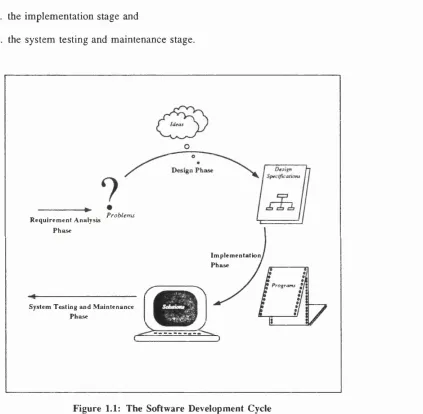
1.1 The Software Development C y c l e ... 2
1.2 The Transformation o f Different Represenation ... 3
1.3 The Two Programming Paradigms ... 4
1.4 The Evolution o f Programming Languages ... 5
1.5 The Roads towards higher Abstractions ... 7
2.1 An Entity-Relationship Diagram ... 26
2.2 Graphical Notations for the Booch’s Diagram ... 28
2.3 Graphical Notations for the HOOD Diagrams ... 29
2.4 A Schematic Conceptual M odel of the System’s Use Cases ... 32
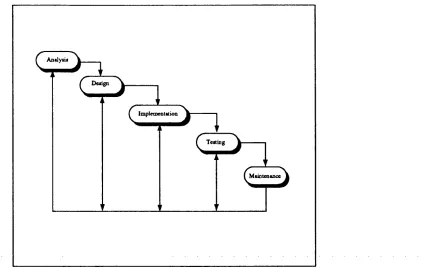
3.1 The ‘Waterfall M odel’ for the Software Development Cycle ... 38
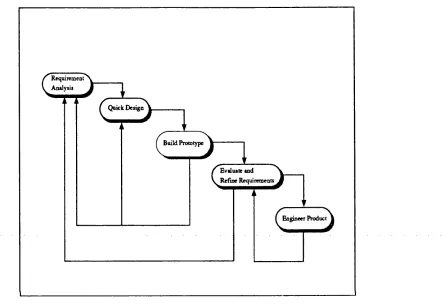
3.2 The ‘Prototype M odel’ o f the Software Development Cycle ... 39
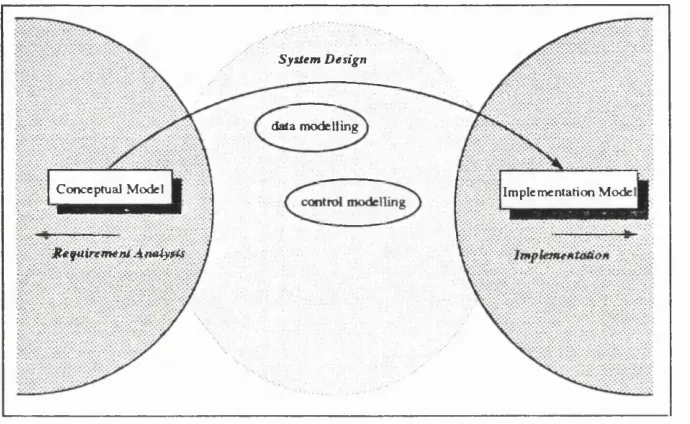
3.3 Modelling in Software Development Cycle ... 40
3.4 The Overview of the Design M ethod ... 43
3.5 The Two Layers of the Conceptual Level ... 47
3.6 An Object Interaction Diagram of the GP S y s te m ... 49
3.7 A Levelled Object Interaction Diagram ... 49
3.8 A Levelled Data Flow Diagram ... 50
3.9 The ‘Contain’ Relationship o f the Object ‘Room ’ ... 52
3.10 An Object which Sends a Message to I t s e l f ... 54
3.11 T h e ‘U se’ Relationship between Objects ... 54
3.12 The Procedure suggested for the System L e v e l... 57
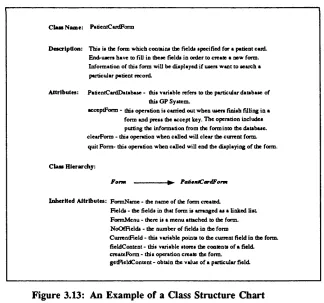
3.13 An Example o f a Class Structure Chart ... 58
3.14 A Message Structure Chart in the GP Surgery System ... 60
3.15 An Example o f Message Structured Chart with Private M essage ... 61
4.1 The Algebraic Structure of the I F P ... 80
4.2 The Grammar for the Parser ... 83
4.3 The Class Hierarchy Graph o f Example 4.2 ... 8 6 4.4 The Multiple Inheritance Graph for Example 4.3 ... 87
4.5 The IFP in Various Inheritance Models ... 87
4.7 The Algebraic Specifcation for the Class ‘Stack’ ... 92
4.8 Adding a New Class as an External Node ... 97
4.9 A Restructuring of a Class Hierarchy ... 97
4.10 The Automation Process of the Inheritance Factorisation Model ... 100
5.1 The Input and Output o f the I F E ... 105
5.2 A n Overview o f the Algorithm for the Factorisation Engine ... 106
5.3 A Typical classS p ecL in k ... 108
5.4 The Data Representation o f a Single Inherit E x p re ssio n ... 108
5.5 The Data Representation of a M ultiple Inherit E x p re ssio n ... 109
5.6 The Data Representation for the Initial Class Hierarchy Expression ... 110
5.7 The Data Representation after the 1st Factorisation ... 110
5.8 The Data Representation o f the Normalised E x p re ss io n ... 110
5.9 The Data Structure o f ‘attlnfoLink’ ... 115
5.10 The attlnfoLink List o f Example 5.2... 115
5.11 An AttrlnfoLink that involved Multiple Inheritance ... 117
5.12 The Main Body o f the A lg o rith m ... . ... 119
6.1 Input and Output O f Example 6.1 ... 124
6.2 Input and Output o f Example 6.2 ... 125
6.3 Input and Output for Example 6 .6 ... 126
6.4 Output for Example 6.4 ... 127
6.5 The Definition o f a set of Class Specifications ... 128
6 .6 The Result obtained with Manual IFP ... 128
6.7 Result Obtained from the Automated IFP for Example 6.5 ... 129
6 .8 The Definition o f the set of Class Specifications of Example 6 . 6... 130
6.9 The Results obtained from the M anual IFP ... 130
6.10 The Results Generated for Example 6 .6 ... 131
6.11 An Extract from the Interview s System Class H ie ra rc h y ... 132
6.12 The Description o f the Class Specifications for Example 6.7 ... 133
6.13 The Definitions o f the Class Specifications for Example 6.7 ... 134
6.14 The Graph Structure obtained from Example 6.7 ... 134
6.15 The Class Hierarchy Graph without the ‘H M enu’ and ‘VMenu* ... 136
6.16 The Class Specifications with a Different ‘HM enu’ Class ... 137
6.17 Result Generated with Different Class Specifications ... 137
7.1 The Structure o f the Traditional CASE E n v iro n m e n t... 148
A Design Method for Object-Oriented Programming Winnie Pun
List of Tables
5.1 The Adjacency Table before F acto risatio n... I l l
5.2 The Adjacency Table after the First Factorisation ... 112
5.3 The Adjacency Table of a Normalised Class Expression ... 112
5.4 The Complexity of an Average Size Problem ... 121
7.1 The Result o f the Experiment in table format ... 146
"There’s always something wrong with a new idea. But you have to be careful o f people who say there are no new ideas because they’re likely to fool you into never getting
any new ideas."
Marvin Minsky ~
Chapter 1
Introduction
1.1. The Evolution of Software Engineering
The term ‘software crisis’ refers to a num ber of problems that are encountered in the development o f computer software [Pre87]. These problems range from whether the systems function properly to how to design and maintain the system. The consequence o f the ‘software crisis’ is that a vast amount of money is being spent on developing software. In fact, Boehm has suggested that the cost of software is increasing at a rate of 12% per year and that the worldwide annual software costs will exceed $435 billion by 1995 [Boe75, Boe87].
Although there is not yet a satisfactory solution to the ‘software crisis’, it is believed that applying sound engineering principles is the best approach to obtain economical software that is reliable and works efficiently. This approach was introduced in the early 1970’s and emphasises the use of:
i. comprehensive methods for all phases in software development, ii. better tools to automate these methods,
iii. better techniques for software quality assurance and
iv. a m ore formal approaches to control and manage the development process.
engineering disciplines. Thus, a m odel o f the softw are developm ent process which was derived from other engineering activities was suggested”. This basic m odel o f the software developm ent process is divided into four stages (See Figure 1.1):
i. the requirem ent analysis stage, ii. the system and software design stage, iii. the im plem entation stage and
iv. the system testing and m aintenance stage.
The process o f softw are developm ent can, in fact, be view ed as a series of transform ations from one representation to another, each transform ation introducing m ore detail and greater precision to the representation [ABF85]. Softw are engineers start o ff by developing an abstract m odel o f the solution in their heads. A s the developm ent progresses, the abstract model is transform ed into a conceptual m odel by introducing som e prim ary concepts o f the required com putational m odel. O nce the conceptual m odel is set up, m ore details about the im plem entation phase, for exam ple, the characteristic o f the style of the program m ing
o
Problem s R e q u ire m e n t A nalysis
P h a se
Im p lem e n ta tio n
P h ase /
System T e stin g a n d M ain ten a n c e Ph ase
A Design Method for Object-Oriented Programming Winnie Pun
language chosen for the computational model, are added to the conceptual model which transforms it into the implementation model. The implementation model is a representation which software engineers can take away to construct the system model. This kind of transformation is illustrated in Figure 1.2.
System Model
Abstract Model Conceptual Model Implementation Model
Requirement Analysis Design
Figure 1.2: The TVansformation of Different Represenation
The conceptual model is generally set up at the requirement analysis stage. The transfor mation process from the conceptual model to the system model is then carried out in the design and the implementation phases. With trivial problems, the transformation from the conceptual model to the implementation model, which takes place in the design phase, is not that significant. Human minds can cope with the thinking in terms of the programming language required to construct the system model. The system model can, therefore, be constructed directly from the conceptual model. However, with complex problems, the design phase becomes a significant stage in the development process and design methods become essential to guide software engineers in the transformation of the conceptual model into the implementation model.
Design methods are responsible for guiding software engineers in the organisation o f the design activities towards a particular implementation. A design method should fulfill at least the following two goals [ABF85]:
i. defining the language or graphical notations so that software engineers can express their ideas and conduct a formal communication.
ii. giving rules or hints to guide the transformations smoothly from one stage to another.
picture o f the developm ent of design m ethods, it is necessary to exam ine the developm ent o f program m ing languages first.
1.1.1. P r o g r a m m in g L a n g u a g e s a n d D esign M e th o d s
Recursive Function Theory Human
Declarative . Programming
T u rin g Machine
Machine
Figure 1.3: The Two Program m ing Paradigm s
G enerally speaking, program m ing languages can be classified into tw o m ajor paradigm s: the im perative and the declarative. The im perative program m ing paradigm has a m achine architecture (e.g., von N eum an m achine) as the underlying m odel o f com putation. It is concerned w ith specifying how a com putation is perform ed as a sequence of state transitions. On the other hand, the declarative program m ing paradigm , such as functional program m ing and logic program m ing, has a com pletely different com putational m odel. It is based on recursive function theory and is concerned with specifying what is to be com puted.
A Design Method for Object-Oriented Programming Winnie Pun
Machine ^ Assembly Procedural / Block Structured
Languages Languages Languages
Figure 1.4: The Evolution of Programming Languages
The evolution of programming languages as illustrated in Figure 1.4, starts with machine languages^. A machine language is effectively a sequence o f bits such as ‘01011100’. As one can imagine, to write or read a program in l ’s and 0 ’s is a painful task. So in the 1950’s, assembly language was developed in which mnemonic names were used to stand for binary codes. The idea of the assembly language as described by Hofstadter [Hof79] is to ‘chunk’ the individual machine language instructions so that one can write a single symbol, such as ‘add’ instead of its binary code, say ‘01011100’. Although a program in assembly language is not very much different from its machine language equivalent as there is still a one-to-one correspondence between assembly language instructions and machine language instructions, assembly language makes the program more legible.
After people had program med in assembly language for some time, they found that there were some characteristic structures which kept reappearing in program after program. At the same time, assembly language was found to be inadequate for handling complicated programs. Hence, there was a need for higher-level languages which provided the ability to define new higher level entities. This led to the development of procedural and block- structured languages^. With procedural languages, there is no longer a straight forward one- to-one correspondence between the statements in the procedure and the machine language instructions. A program segment is abstracted in terms o f a procedure name and a param eter list. This procedure name and the parameter list will be expanded into the appropriate ‘chunks’ o f instructions by the compiler or the interpreter which are then ready to be executed.
Some people may consider that computer programming was originally done at an even lower level, i.e., connecting wires to each other, so that the proper operations were ‘hard-wired’ in.
Block-structured languages are a specialisation o f procedure languages in which procedures and data declarations are nested [Weg88b].
This advancement from the machine language to the assembly language to the procedural language can be viewed as the early development of programming languages.
The development of design methods has been closely related to that of the development of programming languages. W hen most programs were still written in machine language and assembly language, they tended to be small and therefore the need for a design method not that significant. However, when high-level languages were introduced, ways o f solving problems and how to design the programs, emerged as a significant part of the software development process, for example, the step-wise refinement technique [Wir71], the top- down design approach etc. These programming and design techniques were later developed into a design philosophy called the structured design method [Pre87]. Structured design methods provide a systematic approach to software development and guide system designers to design solutions towards a procedural implementation.
The fact that the development of design methods is found to be dependent on the development of programming languages is rather disturbing. History shows that instead o f designing programming languages and hence machines, that match how people think about solutions to problems, design methods were developed to guide people to think in a way that fits the programming language designed for the machine. This can probably be explained by the fact that people are more adaptable. It is easier for people to adjust their thinking to fit how machines operate than vice versa. Besides, the way in which people think is not as yet fully understood; each individual may solve the same problem differently. It is, therefore, difficult to come up with programming languages that suit every human and very expensive to build machines that execute such languages.
Although the development of programming languages and design methods has not been in the most natural direction, nevertheless the evolution o f programming languages has indicated an effort to bridge the gap between how people think and how machines operate by advancing the abstraction technique in programming languages [PeW90].
1.1.2. The Road Towards Higher Levels of Abstraction
Abstraction is the key concept for controlling complexity [Gri79, Sha84, Yeh77]. A good abstraction is one that emphasises details that are significant and suppresses those that are immaterial. By having abstraction, one can concentrate on relevant information and ignore the irrelevant in problem solving.
A Design Method for Object-Oriented Programming Winnie Pun
provides a higher abstraction. The binary machine code is abstracted into meaningful names. Again, the development o f procedural languages provides an even higher level of abstraction technique than that of the assembly language. With procedural languages, the implementation of the procedure is being abstracted under a name and a list of parameters and programmers can concentrate on the overall organisation o f the program.
Improvement o f Abstraction Techniques
---p*.
Machine __ A ssem bly____ Procedural _ ADT _ Object-Oriented ^
Languages Languages Languages Languages Languages
A
Object-Oriented
^ Design Method ^
Figure 1.5: The Roads towards higher Abstractions
Although the abstraction techniques offered by these procedural languages, such as FOR TRAN and Pascal, are quite considerable when compared to the earlier generation o f machine code and assembly languages, when large programs are to be developed and maintained, these programming languages still fall short in handling the complexity of these programs [Pok89]. Therefore, new programming styles with higher levels o f abstraction emerged, abstract data type programming and object-oriented programming.
1.2. Object-Oriented Programming
Abstract data type programming was developed independently of object-oriented program ming. Languages such as CLU [LiG8 6] and Ada [Bar82] are examples of programming languages that support abstract data types. Abstract data type languages emphasise data abstraction whilst retaining the same control flow mechanisms developed for procedural languages. The essence is to package each data structure with its associative operations into a single construct. The resulting construct contains information necessary to treat the data structure and its operations as a type.
Object-oriented programming represents another step forward in programming development.
« g
1
1
3
Its basic philosophy is to support programming in abstract data types [B0 0 8 6, C0 0 8 6, M ic8 8, PLT87, Ren82, Weg8 8a] and introduce message passing as the control flow. Here, each data structure and its associated operations are packaged in a construct known as a ‘class*. Each object is created as an instance of a class and embeds a set o f variables that describes the state of the object and a set o f operations which can act upon that object. Unlike some abstract data types languages such as Ada, classes are first class citizens and they can be passed as parameters. Besides, in object-oriented programming classes are also used as a classification tool which capture the common attributes o f a set o f objects in a class definition while ignoring their differences. W ith this kind o f abstraction technique, object- oriented programming brings with it an enormous increase in expressive power [Kay84]. In addition, the encapsulation o f state and behaviour within an object allows one to model real world entities that possess state and behaviour [RoG89]. This explains why object-oriented programming is a natural step forward in the evolution of programming development and that it helps to bridge the gap between the problem and the solution spaces.
Although the basic principle o f object-oriented programming is to encourage the usage o f abstract data types, there are other features found in object-oriented programming that distinguish it from general abstract data type programming [B0S8 6, Pas8 6]. These features are:
i. Message Passing
Computation in object-oriented programming is achieved by passing messages to objects. Objects within the system respond to messages by evaluating the method matching the selector in the message and returning objects as a result. W ith the message passing mechanism, an object-centered approach to programming is further advocated. Instead o f active procedures acting on the passive data passed to them, objects are asked to perform operations that have been assigned to them [C0 0 8 6, Pas8 6].
ii. Inheritance
Inheritance allows new classes to be created from existing classes via specialisation. The new class that is created as the specialisation is known as the subclass. The existing class, in this case, is known as the superclass. The subclass is said to inherit all the instance variables, class variables and methods o f its superclass. The subclass may add m ore instance variables, class variables and methods on top of what it inherits. Inheritance enhances the resuability o f software and is an important feature o f object-oriented programming.
iii. Dynamic Binding
A Design Method for Object-Oriented Programming Winnie Pun
object-oriented programming. In conventional procedural programming languages, the names o f operators and functions are bound to their operations at compile time. This leads to the result that an unique name is required for an unique operation. W ith dynamic binding, the name of the operators and functions are bound at run-time. This means that the same name can be used for different operations. For example, instead o f using ‘drawCircle’ for the operation that draw a circle, ‘drawSquare’ for the operation that draw a square, a generic name ‘draw ’ can be used for both operations. Dynamic binding provides a mechanism which enables the correct piece o f code to be executed at run-time.
1.3. An Object-Oriented Design Method
As happened to traditional structured programming in the 1970’s, object-oriented design methods have been greatly in demand as object-oriented programming became more popular in the 1980’s. The need for an object-oriented design method can be viewed as two-fold.
i. As mentioned earlier, design methods are responsible for assisting system designers to organise design activities towards a particular implementation. Since object- oriented programming introduces new concepts in constructing software, a new design method is needed to help system designers to construct an object-oriented implementation model.
ii. Computer Aided Software Environments (CASE) have become m ore and more important in contemporary software development process. The environment com prises a set of tools which contributes to the automation of the software development processes. This has enabled dramatic productivity advances in software engineering [Gib89, McC89]. Although substantial tools have been developed to support software development in traditional design methods, very few have been developed for software development in object-oriented programming. In order to develop the suitable CASE tools to aid object-oriented software development, a proper design method for object-oriented programming has to be developed first. Such a design method defines the process to be automated and what sort of tools are required in the environment.
1.4. Thesis Goals
The process started with writing programs in one-lined instruction statements. Then, struc tured programming came along which abstracted instruction statements into functions or modules with parameter lists. W hen abstract data types programming and object-oriented programming came, they advanced the abstraction into a higher level in which functions are abstracted into an object and behaviour is separated from implementations. Such an advent provides a better integration between human cognition and the programming process. It also helps to increase productivity, improve reliability and ease system modifications. Further, object-oriented programming encompasses new programming features such as inheritance to attack areas that conventional programming has been unable to address satisfactorily. Although object-oriented programming has become m ore and m ore popular, so far a proper design method to support the construction o f object-oriented software has not emerged. Therefore, the primary goal o f this thesis is to develop a design method specially for object- oriented programming. The characteristic o f this design method are:
i. It is dedicated for an implementation in object-oriented programming. It contains sufficient guidelines to assist system designers to organise the design activities towards an object-oriented implementation.
ii. It defines the design description language which is used throughout the design phase.
iii. It has substantial support to help system designers handle inheritance which is an important feature found in object-oriented programming.
The usage o f this design method is then presented in two case studies.
1.5. Thesis Organisation
The remainder o f this thesis is organised as follows:
Chapter 2 provides a background to the research. It states the definition of ‘object-oriented program ming’ as used in this thesis. It then analyses why existing design methods are inadequate to support systems design in object-oriented programming. The analysis includes both the popular structured design methods and the few newly emerged object-oriented design methods. The results o f the investigation highlight the necessity o f this research to look for a more appropriate design method for object-oriented programming. It also helps to specify the requirements o f such a design method.
A Design Method for Object-Oriented Programming Winnie Pun
the specification level. The details o f each level and the tasks which are required to be performed at each level are discussed.
The design method embeds an inheritance factorisation process at the system level. This pro cess helps system engineers to construct class hierarchies during the design stage. Chapter 4 discusses the details of this process. The formal model which lies behind the inheritance factorisation process is presented. The application o f such a process in system designs is also discussed.
In order to examine the performance o f the inheritance factorisation process, the first pro totype o f the factorisation engine is assembled. Chapter 5 describes the implementation o f this prototype. The algorithms which are employed to implement the prototype and their efficiencies are discussed and compared.
Chapter 6 is the evaluation chapter. Both the inheritance factorisation process and the design m ethod are evaluated. Plans for further evaluations are also presented in this chapter. It is recognised that this research is only the first step towards a complete computer aided software development environment for object-oriented programming. Therefore, Chapter 7 talks about the further work involved in this area.
will be in the 1980’s what structured programming was in the 1970’s. Everyone will be
in favour of it. Every manufacturer will promote his products as supporting it. Every
manager will pay lip service to it. Every programmer will practice it (differently). And
no one will know just what it is.”
Object-oriented programming increased in popularity during the 1980’s. As mentioned in Chapter 1, this new programming paradigm encompasses distinguishing features such as data abstraction, dynamic binding, information hiding, message passing and inheritance which are not found in conventional programming. As Auld [Aul89] explains the reason why object-oriented programming is better than conventional programming style is because “it attacks the area that traditional methods have been unable to address satisfactory: reusability, extensibility and modularity”. However, the excellence o f object-oriented programming also causes a casual usage o f the term ‘object-oriented’. Stroustrup [Str8 8] mentions that the term ‘object-oriented’ has become a synonym for ‘good’ and people tend to use it anywhere they can. Thus, it is necessary to define clearly the definition o f ‘object-oriented’ used in this research before any further discussion. This chapter begins with a rigorous definition of ‘object-oriented programming’. It analyses the features found in object-oriented programming and highlights the difference between object-oriented programming style and the conventional procedural programming style.
Once the definition o f the term ‘object-oriented program ming’ has been stated, one can then embark on the development o f a design method for object-oriented programming. Prior to this, an investigation o f why existing design methods are inadequate for object-oriented programming is presented. Such an investigation is important because it lays down the foundation o f this research. The investigation is divided into two parts. First o f all, it examines the compatibility o f conventional procedural design methods and object-oriented
Tim Rentsch
Chapter
2
A Design Method for Object-Oriented Programming Winnie Pun
to be suitable for object-oriented programming. The results obtained from this investigation show the necessity of this research. It also helps to specify the requirements o f the design method that has to be developed.
2.1. What is ‘Object-Oriented Programming’?
The notion o f ‘object’ was first introduced in the programming language Simula [Bir73, N yg8 6] in the 1960’s. The basic idea is to have the programming activity developed around the data structure, ‘object’. An object encapsulates a set of variables that describes the state o f the object and a set o f operations which can act upon the object to change its states. Although the idea o f object-oriented programming was around then, it did not take o ff as an important paradigm until the late 1970’s when Smalltalk-80 [Gol83a] appeared.
As more and more people recognised the usefulness o f object-oriented programming in software development, the fundamental concepts and definitions o f the term ‘object-oriented’ become misused. In order to impress customers, system designers casually attached the label ‘object-oriented’ to any software they developed and programming languages they used. In 1988, Peter Wegner published three papers [Weg87, Weg8 8a, Weg8 8b] about the defi nitions o f ‘object-oriented’. In these papers, he successfully differentiated between object- oriented programming and conventional programming. Furthermore, he distinguished object- oriented programming from object-based and class-based programming. This has helped to resolve some controversial issues regarding what object-oriented programming is.
According to Wegner, the term ‘object-oriented’ is defined as:
object-oriented = object + class + class inheritance
This means a programming language is ‘object-oriented’ if and only if it satisfies the following three criteria:
i. The language supports ‘object’ as a major language feature.
ii. An object is created as an instance o f a class and a class is a template that specifies an interface o f operations.
iii. Related classes are grouped into a class hierarchy via inheritance.
polymorphism [BGM89]. Since, these alternative definitions are either modified or expanded from W egner’s, it is decided that W egner’s concise definition should be applied in this research. The following sections serve to explain these three criteria in more detail.
2.1.1. Object
In the new Collins dictionary [Han87], an object is defined as: i. a tangible and visible thing,
ii. a thing seen as a focus for feelings, thought, etc, and iii. an aim or objective.
In a way, such a definition has already captured the essence of an object in object-oriented programming. An object in object-oriented programming is a data entity, a target for messages, and each object implements a goal. An object is the basic unit o f modularity in object-oriented programming. It is an abstraction o f state and behaviour that consists of:
i. a set of variables which describe the state of that object and
ii. a set of operations which can act upon the object to change the state.
It is strongly believed that the major merit of object-oriented programming lies in its direct correspondence to the real world. The computational model o f object-oriented programming is constructed around objects and their interactions amongst each other. Such a computational model is a natural metaphor o f the real world [B0 0 8 6, Bor85, Gol83b]. This excellence o f object-oriented programming has, in fact, been recognised in human factors research on programming languages. Curtis [Cur82] mentions that in a study, it was found that students spent more time with data manipulations and less time with transfer o f control. He identifies that this as an important point. Conventional programming languages tend to provide massive control structures with embedded data manipulations. However, the natural human tendency seems to begin with data manipulations and add control structures as a qualification to the action. This implies that a programming language which concentrates on data manipulations, such as object-oriented programming, provides a better integration of programming process with the structure of human cognition. This is almost certainly one o f the reasons for the success of object-oriented programming in software development.
A Design Method for Object-Oriented Programming Winnie Pun
definition o f an object instead o f its various extensions in different problem domains, hence the definition o f an object as an abstraction o f state and behaviour is sufficient.
2.1.2. Class
In object-oriented programming, an object is created as an instance o f a class. A class is a template that specifies the state and behaviour o f the object belonging to that class. Hence, a class consists of:
i. a set o f variables, and ii. a set o f operations.
At a first glance, the definition of an object is very similar to that o f a class. The main difference between the two actually lies in the fact that a class is a static template which defines the structure o f a group o f similar objects, a class exists in program text. W hereas an object is an active entity and its states are updated at run-time [Mey8 8].
O f course, this is not the only possible approach to look at classes and objects. In Smalltalk [Gol83a], classes are viewed as objects themselves. The main advantage of treating classes as objects is that it makes it possible to define class routines which can be applied to all classes, rather than to all the instances o f a given class as standard features do. Further, there are discussions about ‘classless’ object-oriented programming languages such as Self [Hew77, UnS87] and Actor [Agh83]. In a ‘classless’ language, an object is created by copying an existing object, i.e., prototyping. The argument for a ‘classless’ object-oriented programming language is that it is simpler. It does not require object-oriented programmers to grasp two concepts namely the ‘is an instance o f’ relationship and the ‘is a kind o f ’ relationship which are typical for a ‘class-based’ object-oriented language, in constructing software.
2.1.3. Class Inheritance
Inheritance is an important programming issue introduced by object-oriented programming. Inheritance is always associated with the specialisation/generalisation relationship between two classes. Its basic definition in object-oriented programming is analogous to the usual meaning which is familiar to everybody. For example, if classA and classB share an ‘IS-A’ relationship and classA is more general than classB, i.e. classB needs a larger set o f attributes to describe its behaviour, then classA is defined as the superclass of classB and attributes defined in classA can be used by classB through inheritance.
Inheritance can be single or multiple. In the case o f single inheritance, a subclass has only one superclass, hence the class hierarchy is a tree form. In the case o f multiple inheritance, a subclass is allowed to have several superclasses which leads to a directed graph hierarchy structure. Although, it is said that multiple inheritance is extremely useful and provides m ore flexibility to object-oriented programmers [Car84, M ey8 8, Str8 8], it is also believed by some people that multiple inheritance can lead to very complicated systems which are difficult to comprehend [BoI82],
Danforth and Tomlinson say [DaT8 8], “a primary motivation for the use o f inheritance in programming is that it provides both a specification structuring mechanism and a means of reusing specification that is based on common sense notions that are natural to our way of thinking”. Indeed, the advantages o f having inheritance are basically two-fold:
i. Reusability o f Software
Inheritance enhances the reusability of software which is an important aspect of software engineering. Inheritance in object-oriented programming brings along two kinds of reusability, ‘reusing code’ and ‘reusing specification’ [Joh8 8].
ii. Classification Technique
Inheritance acts as a classification technique which groups related classes together in a hierarchical structure. This enhances the readability and understandability of a system.
Although inheritance is such a useful feature, it is also a problematic issue. System engineers have encountered extensive difficulties in constructing class hierarchies [Joh8 8]. However, most o f the difficulties evolved around the basic questions of how to use inheritance and what exactly should be inherited. The following discussion gives two different usages of inheritance. It also highlights two different school of thoughts concerning inheritance.
i. Non-Strict Inheritance
A Design Method for Object-Oriented Programming Winnie Pun
ing. Its essence is to reuse as much o f the existing implementation as possible. Non-strict inheritance is usually found in weakly-typed object-oriented languages such as Smalltalk. In these languages, the notion of types is implicit and is always embeded in the notion o f class. The term ‘class’, as mentioned before, denotes the template for a group o f objects with common properties. These templates use symbolic labels to specify the state and the behaviour o f a particular class of objects. Hence, a label either refers to a storage space or a piece of code. In the case o f non-strict inheritance, system designers/programmers determine a superclass/subclass relationship by:
• applying their intuition to the two classes to decide whether an obvious TS-A’ relationship exists. For example, the class ‘c a r’ is naturally a subclass o f the class ‘vehicle’.
• checking whether there exist some properties in the potential superclass that can be used by^the subclass.
Since there is no type-checking mechanism in a weakly-typed object-oriented language to check the formal definition of a label, a more casual attitude to class hierarchies construction is allowed. For example, although it is required that there must be an ‘IS-A’ relationship between two classes for a superclass/subclass relationship to be established, there is no penalty for system designers/programmers that violate this rule. Therefore, a reasonable and meaningful class hierarchy construction depends very much on the self discipline of the system designers. In the extreme, one can put two conceptually unrelated classes in the same hierarchy provided they share some common attributes. For example, in the Smalltalk- 80 system classes, the class ‘semaphor’ is created as a subclass o f ‘linked-list’. Conceptually, there is no obvious relation between ‘semaphore’ and ‘linked-list’ which may lead people to think that they should be put together. One suspects that the reason for doing this is because the class ‘semaphore’ can be implemented as a linked-list. This certainly breaks down the possibility o f using inheritance as a clas sification technique. At the same time, it leads to the formation of a class hierarchy which is conceptually confusing. Furthermore, if multiple inheritance is applied, one can get a very unstructured network which is impossible to comprehend. ii. Strict Inheritance
specification which involves the signature and the semantic meaning (axioms) of the operations in a class. W ith strict inheritance, a subclass can be derived from a superclass if and only if:
• All operations defined in the superclass mean something to the subclass, i.e. no redundant operations may be inherited.
• Operations which share the same name, types of input and output argu ments must do the same thing, i.e. operations which share the same name must share the same semantics. For example, a ‘stack’ and a ‘queue’ may have the same operations such as ‘add’ to add an element and ‘delete’ to remove an element. However, a stack applies a ‘last in first out’ policy whereas a queue applies ‘first in first out’ policy. The operation ‘delete’ again employs different methods in the implementation. Thus, according to the definition of strict inheritance, ‘stack’ and ‘queue’ are not directly related.
As one can see, this kind o f inheritance imposes a very strict discipline on building class hierarchies. A subclass must inherit both the syntactic and the formal semantic aspects o f its superclass. As M eyer says [Mey8 8], this type o f complete, non- ambiguous, precise manner of using inheritance can only be achieved by specifying the interface of a class in formal specification languages [GoM82].
However, strict inheritance can be partially fulfilled in strongly typed object- oriented languages such as Eiffel [Mey8 8] and Solve [RWW8 8]. Here, system engineers not only have to deal with a superclass/subclass relationship but also the supertype/subtype relationship in constructing class hierarchies. The term ‘type’ denotes the signature of an operation. The language provides type-checking facility at compile time. Therefore, a strongly-typed object-oriented language prohibits system designers/programmers from constructing meaningless class hierarchies, at least to a certain extenri.
Another mechanism which serves the same purpose as inheritance is delegation [Lie8 6, Weg87]. Delegation is always found in ‘classless’ languages. It is a mechanism that allows objects to delegate properties to one or more ‘successors’. Since in this thesis, the term ‘object-oriented’ implies object-based, class-based and class inheritance, the fact that delegation is found in ‘classless’ languages makes it inappropriate to be discussed in this thesis.
A Design Method for Object-Oriented Programming Winnie Pun
2.1.4. A Language that supports Object-Oriented Programming
The above discussion has stated the definition of the term ‘object-oriented’ as used in this research. O f course, object-oriented programming also contains other features such as dynamic binding and message passing as mentioned in Chapter 1. However, these two features are more to do with implementation and language issues rather than design. Thus, this research regards object, class and inheritance are the three basic criteria for object- oriented programming.
Though the term ‘object-oriented’ is now defined properly, it is still insufficient to give a clear idea as to what an object-oriented programming style is. To most system engineers, object-oriented software has to be implemented using one o f the orthogonal object-oriented languages such as Smalltalk, C++ or Eiffel. On the other hand, there are programmers who claim that they can perform object-oriented programming in conventional structured programming languages such as C, Ada and Pascal [JaK87]. To these programmers, they have to exhibit extra effort or skill to write programs which are object-oriented. They have to write extra libraries to attain the object, class concepts and inheritance. The main question here is, ‘how does one classify a language that supports object-oriented programming?’. The answer to this question is well-stated in Stroustrup’s paper [Str8 8], “a language supports a programming style if it provides facilities that make it convenient (reasonably easy, safe, and efficient) to use that style. A language does not support a technique if it takes exceptional effort or skill to write such programs; in that case, the language merely enables programs to use the techniques”.
Therefore, in this thesis, the term ‘object-oriented programming’ refers to a technique which allows programming in object/class concepts and reuse software via inheritance. Object- oriented programming has to be supported by an orthogonal object-oriented languages which comprises o f facilities and constructs that help programmers to achieve this technique with e aset.
2.2. Designing Object-Oriented Software
Now that the definition of object-oriented programming is stated, one can investigate how software can be constructed in object-oriented programming.
The construction o f reliable software depends a lot on using a proper design method. A design method gives guidelines for system designers to organise their design activities towards a
particular implementation model. At present, most o f the popular design methods are o f procedural style. They target software developments which use procedural programming languages such as Pascal and COBOL. Although some people are currently adopting these methods in object-oriented programming, it is not a good practice. In order to justify this claim, the first part o f this section analyses why conventional structured design methods are inadequate for object-oriented programming. As it stands, there are a wide range o f conventional design methods around and they can be basically divided into two types: the data flow and the data structure design methods. Hence, the analysis mainly concerns these two types of structured design methods. In additional to this, a few people have suggested that entity-relationship modelling is useful in object-oriented programming [Pow87]. Therefore, there is a need to look into the possibility of using entity-relationship modelling in object- oriented programming.
Apart from conventional design methods, a few so called ‘object-oriented’ design methods have emerged recently. The main development includes Booch’s object-oriented development
[B0 0 8 6], Robinson’s Hierarchical Object-Oriented Design (HOOD) [Rob89], M itterm eir’s
object-oriented software design [Mit8 6] and Jacobson’s ObjectOry [Jac87]. These design methods are also examined in detail in this section to see whether they support object- oriented development to a satisfactory level.
Hence, the rest of this chapter serves as a detailed survey on whether these existing design methods are adequate for object-oriented programming.
2.2.1. Data Flow Design Methods
Stevens and Constantine were probably the earliest proposers o f using data flow design in designing a system [Pre87] but it was Yourdon and Myers who widely propagated the method [YoC75]. Data flow design methods use ‘functional decomposition’ as the backbone but also focus on the movement o f data in a system. It is widely used in data-processing.
A Design Method for Object-Oriented Programming Winnie Pun
an object-oriented language. However, to carry out such investigations for each design method mentioned in this chapter is time consuming. At the beginning o f this research, use was made of the fact that 35 second year Computer Science undergraduates at UCL have to design a system using Yourdon’s design method and implemented in C++ as their Software Engineering coursework. Therefore, their courseworks were conveniendy used in this research to analyse whether data flow design methods are adequate for object-oriented programming. W hen examining their courseworks, attention was paid to any significant effects cast from the design phase onto the implementation phase.
As a result, two observations were obtained from examining the students’ courseworks: i. The coding o f m ost students showed that they were actually writing procedural
programs in an object-oriented language, C++. They had not exploited the use o f classes as data abstraction technique and inheritance as a means of achieving software reuse.
ii. A few students’ implementations bore some kinds o f object-orientation. However, their design specifications showed no direct correspondence to the decisions they made for the implementation phase.
Therefore, it seems that data flow design methods are not suitable for object-oriented programming^. The m ain reasons for this inadequacies are:
i. The basic concept o f data flow design methods is to model a system in terms o f data and transformation processes. It emphasises what input data and output data exist in a system and how the input data is transformed into the output data, i.e., identifying the required transformation processes in the system. This is very different from the basic model found in object-oriented programming. In object- oriented programming, one is concerned with the set o f objects and the interactions amongst these objects in a system. Data flow design methods do not support the identification o f objects and interactions o f the system. There is no guidelines about how to construct an object, classifying an object and the concept o f inheritance does not exist.
ii. Furthermore, data flow design methods are targeted at a procedural implementation in which modules are generated around operations; data structures are distributed between resulting routines. However, in object-oriented programming the reverse occurs and the emphasis is on data structures; modularisations and operations are generated around data structures.
Such an analysis of the students’ coursework not only has shown that data flow design methods are inadequate for object-oriented programming but also has highlighted the issues one has to pay attention to when developing a design method for object-oriented program ming, for example, the identification and the construction o f objects, the identification of the interactions between objects. These are very useful in setting up the specification for the design method for object-oriented programming.
2.2.2. Data Structure Design Methods
Data structure design methods are said to be useful for systems with well understood data structures [RPT84]. They produce a program structure by designing input/output data structures. A strong representation o f this type o f design method is Jackson System Design (JSD) [Jac83].
JSD is a design method that covers system development from definition through design into the production phase [Bi085]. Unlike data flow design methods, it does not start with functional requirements but concentrates on modelling the real world. The development steps o f JSD can be classified into three stages: the modelling stage, the network stage and the implementation stage.
The modelling stage is to specify the model of the real world. It further subdivides into two steps, the entity-action and the entity-structure steps. In the entity-action step, all the entities and actions involved in a system are identified. In JSD terminology, an entity is characterised by the action which it performs or suffers. An action is always performed or suffered by one or m ore entities. An action must take place in the real world at a specific instant o f time. The action not only occurs in the system itself but also in reality. The entity-structure step specifies how the actions are ordered within an entity. It defines the ordering o f actions that describes the life cycle of the entity. This step also contains a set of graphical notations which supports the three classical algorithm/programming constructs: iteration, sequence and selection.
In JSD, the entity structures constructed in the first stage are regarded as model processes. The network stage concerns how to connect new processes to these model processes to form a network. New processes can be added to model processes either by state vector connection or data stream connection. This stage is further subdivided into three steps:
i. the initial model step which simulates the real world in terms o f communicating model processes.
A Design Method for Object-Oriented Programming Winnie Pun
the required system functions into the model in the form of function processes. iii. system timing step which specifies the timing constraints in the system for use in
the next step.
The implementation stage of JSD emphasises two important issues: i. how to run the processes that comprise the specification? ii. how to store the data that they contain?
An important point in the JSD design method is that it conceptually assumes that every entity runs on an individual processor. For example, each book in a library is a process that runs on a processor. O f course, this is not yet feasible. Hence, the main theme o f the implementation stage is to transform such a design into a form that can be realised on the target programming language, operating system and computer.
The main reasons why JSD is said to be a potential design method for object-oriented programming are:
i. its entity-action step is about identifying entities and actions involved in a system and this is analogous to the step concerns identifying objects and interactions as found in object-oriented programming,
ii. its network stage concerns how to connect new processes to model processes to form a network and this can be viewed as identifying the interactions amongst objects in object-oriented programming.
However, when one examines the method more closely, JSD is not a good candidate for object-oriented programming as it seems to be. Firstly, although both JSD and object- oriented programming emphasises identifying entities/objects and actions within a system, there is a difference between the term ‘entities’ used in JSD and the term ‘objects’ used in object-oriented programming. According to JSD, an entity has to contain an ordered set o f actions. In other words, an entity in JSD is just like a process which is defined as a sequence o f actions. But in object-oriented programming, an object is defined as a set o f variables which describes its state and a set o f operations which describes its behaviour. The order of the operations is not required. Although, there are papers which mentioned that the object- oriented paradigm is similar to the process-paradigm and that one can be incorporated in the other [Str86a], it is strongly felt that to treat an object as a process imposes unnecessary constraints on the user. Moreover, object-oriented programming emphasises reuse. One way to achieve this is to design the object as general as possible so that its properties can be reused through inheritance. If one has to define the order o f operations for an object, the object becomes specific to a particular application and difficult to reuse. Therefore, it seems
that JSD is m uch more o f a ‘modelling approach’ than it is an ‘object-oriented approach’. It emphasises creating time-based models o f real world entities and models of their ‘real w orld’ interactions. Whereas, the objects found in object-oriented programming should not be designed based on their life cycles within a particular application.
2.2.3. Transformations of Conventional Design Methods
Since conventional structured design methods cannot be used directly in object-oriented programming, a few people have proposed some transformation techniques to convert speci fications which are generated from conventional design methods to be used in object-oriented programming. For example, Alabiso [Ala88] has presented a transformation for data flow analysis models to object-oriented designs. Ward [War89] has introduced a method to integrate object-orientation with structured analysis and design. Poo et al. [PLK89] and Elizabeth et al. [EHZ89] have investigated how to modify JSD to be used in specifying object-oriented systems. The reasons for modifying conventional design methods to be used in object-oriented programming are two-fold:
i. Most system designers have been using these conventional design methods for a while. They are familiar with these design methods and may be unwilling to adopt a new design method.
ii. A popular and adequate design method for object-oriented programming has not yet emerged.