176 | P a g e
IMPLEMENTATION OF RSA ALGORITHM AND
MODIFIED RSA ALGORITHM METHODS:A REVIEW
Sarika Y. Bonde
1, Prof.Dr. U. S. Bhadade
21
Research Scholar, North Maharashtra University, Jalgaon, (M.S) (INDIA)
2
Professor and Head of IT department, S. S. B. T. College of Engineering & Technology
Bambhori, Jalgaon, (M.S) (INDIA)
ABSTRACT
Now days, security is required to transmit confidential information over the network. Security is also demanding
in wide range of applications. Cryptographic algorithms play a dynamic role in providing the data security
against malicious attacks. RSA encryption algorithm is Public key cryptography is also called as asymmetric
key cryptography.This paper presents the literature review of methods of implementation of RSA algorithm and
modified RSA algorithm.
Keywords-
Cryptography, RSA.I .INTRODUCTION
To send the note from one party to another intended party securely, is the work of cryptography. The
cryptographic technique is also called cryptosystem or cryptographic algorithm or encryption/decryption
algorithm. The algorithms in cryptography are categorized into two classes: Symmetric and Asymmetric
encryption. In symmetric encryption both the sender and receiver share the same secret key. Examples are: DES,
3DES, AES etc. In asymmetric encryption the sender and receiver use a pair of keys (one key for encryption and
another for decryption). Examples are RSA, Diffie-Hellman etc.
1.1 RSA ALGORITHM
RSA algorithm is a public key encryption algorithm developed by Ronald Rivest, Adi Shamir, and Leonard
Adleman in 1978. RSA is widely used Public-Key algorithm.
The RSA algorithm involves three steps: key generation, encryption and decryption [1,2].
A) KEY GENERATION
RSA involves a public key and a private key. The public key can be known by everyone and is used for
encrypting messages. Messages encrypted with the public key can only be decrypted by using the private key.
eis released as the public key exponent and d is kept as the private keyexponent. The steps for key generation
are explained below:
i. Select p and q where p ≠ q and both p and q are prime numbers.
ii. Determine n = p x q
iii. Compute φ(n) = (p-1) x (q-1),where φ is Euler's totient function.
iv. Choose an integer e such that gcd (φ(n), e) = 1 and 1 <e<φ(n)
177 | P a g e
vi. Public Key (PU) = {e, n}vii. Private Key (PR) = {d, n}
B) ENCRYPTION PROCESS
The steps for encryption of message in order to get the cipher-text are explained below :
i. Obtain a plain text M such that M <n.
ii. Compute the cipher text as C = Me mod n
C) DECRYPTION PROCESS
The steps for decryption of cipher-text in order to get the original message are explained below :
i. Get the cipher text C.
ii. Calculate the plain text as M = Cd mod n
1.2 ORGANIZATION
This paper has organized into 3 sections. Section 2 presents Literature reviewon methods of Implementation of
RSA algorithm andModified RSA Algorithm. In section 3 Summary of methods of Implementation of RSA
algorithm and Modified RSA Algorithm is discusses.
II. LITERATURE REVIEW ON METHODS OF IMPLEMENTATION OF RSA
ALGORITHM AND MODIFIED RSA ALGORITHM
Literature review on different methods of implementation of RSA algorithm and modified RSA algorithm is
done as follows:
Hanae Nozaki et al.[3] has described implementation of RSA cryptosystem using the RNS Montgomery
multiplication.
Milan Markovic et al.[4] has elaborated Montgomery's modular reduction algorithm and Chinese Remainder
Theorem (CRT) for RSA private key operation. Possible optimization techniques for RSA algorithm realization
on assembler of Texas Instruments TMS320C54x family of signal processors are considered. Obtained results
justify the use of the proposed optimization methods and also show that the TMS320C54x family of signal
processors is suitable for the RSA algorithm realization.
Jean-Claude Bajard and Laurent Imbert [5] has presented a new implementation of Montgomery multiplication
in RNS and have shown its efficiency toward a new full RNS implementation of RSA.
VitalyYakovyna [6] has analyzed software realization of RSA public key encryption algorithm using CryptoAPI
on .NET platform.
Ying-yu Cao, Chong Fu [7] has built an integrated large integer library by using C++ and gives the
implementations of Miller-Rabin, extended Euclid and Montgomery algorithms for complex numeric operations
in RSA. The random RSA public and private key pair with arbitrary length can be generated effectively by using
178 | P a g e
Sonal Sharma et al. [8] has presents a modified version of Subset-Sum problem over RSA algorithm called RSAAlgorithm using Modified Subset Sum Cryptosystem. For the simulation purpose, MSSRPKC cryptosystem is
implemented as a user-friendly GUI. This GUI application is implemented using JAVA BigInteger library
functions.
Sami A Nagar et al. [9] has speedup the RSA algorithm by developing a new generation keys method called
RSA-Key Generations Offline and saved all keys values in tables within database. The keys are generated by a
program prepared in a C # language and then save these values of the keys in the databases created by SQL
Server 2008 R2.
Ravi Shankar Dhakar et al. [10] has proposed the Modified version of RSA Encryption Algorithm (MREA).
MREA is is based on the factoring problem, it has an additive homomorphism cryptosystem, the encryption is
computed using m1+m2.The simulation result of the algorithm MREA, implemented in JAVA.
B.Persis Urbana Ivy et al [11] has developed modified RSA cryptosystem based on ‗n‘ prime numbers and used
JAVA language to get the private key and public Key.
Yezhen Liang, GuoqiangBai[12] has implement RSA as well as RSA-CRT is proposed. The proposal requires a
less amount of time and energy to prevent all types of fault attacks with the absence of the public key e by
taking advantage of the characteristic of the Montgomery Ladder.
CuipingShao[13]has presented an RSA implementation with FPGA, dedicated for ion fault injection
experiment. Handshake protocol between the RSA circuit and the microbeam facility of IMP is designed and
verified. Aswathy B.G, Resmi R.[14]has presents two architectures for FPGA implementation of modular
exponentiation algorithm based on Montgomery technique- one with parallel technique and another with
maximum sequential operation . Finally these architectures are analyzed with respect to area, speed, and power
using Xilinx ISE.
Abdulameer K. Hussain et al.[15] hasproposed a method to eliminate the redundant messages occurred in the
RSA method by applying the k-nearest neighbour values of either p or q or both.
Ari ShawkatTahir [16] has proposed efficient architecture to implement an optimized 1024-bit RSA
encryption/decryption algorithm for restricted system using multiply and square algorithm to process the
Modular exponential for encryption and decryption. The architectures have been implemented on reconfigurable
platforms FPGAs. The whole system is implemented using VHDL code targeting Spartan3 (device XC3S50,
package PG208, speed -4) from Xilinx. The whole design is tested using Xilinx ISE Design Suite 12.2 tool.
Xinming Huang and Wei Wang [17] has proposed an FFT-based modular multiplication and exponentiation
algorithm and its hardware architecture for RSA cryptosystem with very large key size. ASIC implementations
of the 8 K/12 K-bit and 48 K-bit RSA cryptosystem are presented.
RupaliVerma [18] has presents the implementation results of RSA on FPGAs based on carry save Montgomery.
Narander Kumar, PriyankaChaudhary [19] provide a modify RSA algorithm based on the n prime numbers and
bit stuffing. This technique uses n prime numbers because large prime numbers are not easily factorized and bit
stuffing provide extra layer of encryption by which we provide maximum security and efficiency for data over
the network. The implementation is done using Net Bean IDE 8.0 software.
AsmaChaouch [20] have evaluated three famous encryption algorithms ECC, RSA and AES in terms of
encryption speed, security level, encrypted JPEG image size, key generation, time and throughput. The software
179 | P a g e
Somesh Kumar [21] haveimplementedthe RSA algorithm with feed forward artificial neural network using MATLAB.III . SUMMARY OF IMPLEMENTATION OF RSA ALGORITHM AND MODIFIED RSA
ALGORITHM
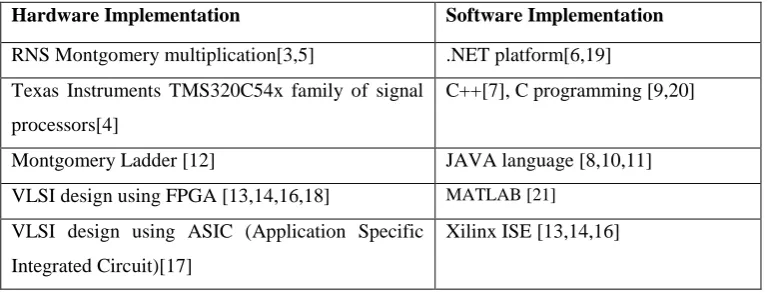
Modified version of RSA algorithm was developed by many researchers.The goal of this paper is to observe
the different implementation methods of RSA algorithmand modified RSA algorithm, which are as shown in
table 1.
Table 1: Implementation methods of RSA algorithm and modified RSA algorithm
Hardware Implementation Software Implementation
RNS Montgomery multiplication[3,5] .NET platform[6,19]
Texas Instruments TMS320C54x family of signal
processors[4]
C++[7], C programming [9,20]
Montgomery Ladder [12] JAVA language [8,10,11]
VLSI design using FPGA [13,14,16,18] MATLAB [21]
VLSI design using ASIC (Application Specific
Integrated Circuit)[17]
Xilinx ISE [13,14,16]
VI .CONCLUSION
In this paper different method of implementation of RSA algorithm and modified RSA algorithmhas been
surveyed and conclude that TITMS320C54x signal processors,VLSI design using FPGA,VLSI design using
ASIC, RNS Montgomery multiplication are suitable for hardwareimplementation of RSA algorithm. For
software implementationof RSA algorithmthe platform used is .NET, C, C++, Xilinx ISE,MATLAB and
JAVA.Each technique is unique, which might be used for different applications. Everyday new approach is
evolving hence fast and secure RSA algorithm always work out with high rate of security.
REFERENCES
[1] Bruce Schneir, ―Applied Cryptography‖, 2nd edition, John Wiley & Sons, 2007.
[2] William Stallings, ―Cryptography and Network Security‖, Pearson Education, Fourth Edition, 2007.
[3] Hanae Nozaki, Masahiko Motoyama, Atsushi Shimbo, and Shinichi Kawamura, ―Implementation of RSA
Algorithm Based on RNS Montgomery Multiplication‖, CHES 2001, LNCS 2162, Springer-Verlag Berlin
Heidelberg 2001, pp. 364–376.
[4] Milan Markovic, TomislavUnkasevic, GoranDordevic, ―RSA ALGORITHM OPTIMIZATION ON
ASSEMBLER OF TI TMS320C54X SIGNAL PROCESSORS‖, IEEE 11th European Signal Processing
Conference, 2002 , 3-6 September 2002, pp.1-4.
[5]Jean-Claude Bajard and Laurent Imbert, ―A Full RNS Implementation of RSA‖, IEEE TRANSACTIONS
ON COMPUTERS, VOL. 53, NO. 6, JUNE 2004, pp.- 769-774.
[6] VitalyYakovyna, DmytroFedasyuk, MaxymSeniv, OrestBilas , ―The Performance Testing of RSA
180 | P a g e
[7] Ying-yu Cao, Chong Fu, ―An Efficient Implementation of RSA Digital Signature Algorithm‖, IEEEInternational Conference on Intelligent Computation Technology and Automation, 2008, pp.100-103
[8] Sonal Sharma, Prashant Sharma, Ravi Shankar Dhakar, ―RSA Algorithm Using Modified Subset Sum
Cryptosystem‖, IEEE International Conference on Computer and Communication Technology(ICCCT),
2011, p.p. 457-461.
[9]Sami A. Nagar, SaadAlshamma, ―High Speed Implementation of RSA Algorithm with Modified Keys
Exchange‖, IEEE6th
International Conference on Science of Electronics, Technologies of Information
and Telecommunications (SETIT), March 2012, p.p.639- 642.
[10] Ravi ShankarDhakar, Amit Kumar Gupta, Prashant Sharma, ―Modified RSA Encryption Algorithm‖
(MREA), IEEE Second International Conference on Advanced Computing & Communication
Technologies, 2012, p.p. 426-429.
[11] B. Persis Urbana Ivy, PurshotamMandiwa. Mukesh Kumar ―A modified RSA cryptosystem based on
‗n‘ prime numbers‖, International Journal of Engineering And Computer Science, Vol.1, Issue 2,
November 2012 pp. 63-66.
[12] Yezhen Liang, GuoqiangBai, ―A New FA and SPA Resistant Implementation of RSA‖, IEEE 3rd
International Conference on Computer Science and Network Technology, Dalian, China, 2013, pp.893-897.
[13] Cuiping Shao, Huiyun Li, Xiaolong Zhang, ―Cryptographic Implementation of RSA for Ion Fault Injection
Attack‖, IEEE Consumer Communications and Networking Conference (CCNC 2014) Special Seesion:
Big Data Security and Privacy, 2014, pp.-791-794.
[14] Aswathy B.G, Resmi R, ―Modified RSA Public Key Algorithm‖, IEEE First International Conference on
Computational Systems and Communications (ICCSC), 17-18 December 2014 , Trivandrum, pp.252-255.
[15] Abdulameer K. Hussain, ―A Modified RSA Algorithm for Security Enhancement and Redundant
Messages Elimination Using K-Nearest Neighbor Algorithm‖,IJISET – International Journal of
Innovative Science, Engineering & Technology, Vol. 2, Issue 1, January 2015.ISSN 2348 – 7968, p.p.
159-163.
[16] Ari ShawkatTahir, ―Design and Implementation of RSA Algorithm using FPGA‖, INTERNATIONAL
JOURNAL OF COMPUTERS & TECHNOLOGY Vol. 14, No. 12, ISSN 2277-3061,S e p t e m b e r 2 2 ,
2 0 1 5, pp. 6361- 6367.
[17] Xinming Huang and Wei Wang, , ―A Novel and Efficient Design for an RSA Cryptosystem With a Very
Large Key Size‖, IEEE TRANSACTIONS ON CIRCUITS AND SYSTEMS—II: EXPRESS BRIEFS,
VOL. 62, NO. 10, OCTOBER 2015, pp. 972-976.
[18] RupaliVerma, MaitreyeeDutta, RenuVig, ―FPGA Implementation of RSA based on Carry Save
Montgomery Modular Multiplication‖, IEEE International Conference on Computational Techniques in
Information and Communication Technologies (ICCTICT),2016, pp.1-6
[19] Narander Kumar, PriyankaChaudhary, ―Implementation of Modified RSA Cryptosystem for Data
Encryption and Decryption based on n Prime number and Bit Stuffing‖, International Conference on
Information and Communication Technology for Competitive Strategies (ICTCS-2016), March 04-05,
181 | P a g e
[20] AsmaChaouch, BelgacemBouallegue, OuniBouraoui, ―Software Application for Simulation-BasedAES,RSA and Elliptic-Curve Algorithms‖, IEEE 2nd International Conference on Advanced Technologies
for Signal and Image Processing (ATSIP), March 21-24, 2016, Monastir, Tunisia, pp.77-82.
[21] Somesh Kumar, RajkumarGoel , ―Implementation of RSA with Feed-forward NeuralNetwork using
MATLAB‖, International Journal of Computer Applications (0975 – 8887),Volume 148 – No.2, August