Preventing Self-Harm From Repeat
Foreign-Body Ingestion
Christina Low Kapalu, PhD,a,bJohn Lantos, MD,a,bAdam Booser, MD,a,bMike Thomson, MD,cThomas Attard, MDa,b
abstract
Mental health disorders in adolescents present some of the most challenging of all ethical dilemmas. This is particularly true when they lead to self-injurious behavior that can only be prevented by either limiting the freedom of the adolescent or forcing treatments on them that they do not want. Intentional and repeated foreign-body ingestion (FBI) in youth is a poorly understood self-injurious behavior that can be life-threatening. It poses unique clinical and ethical challenges. Ingestion of sharp or magnetic objects increases the need for endoscopic retrieval or surgical intervention with associated risks, including perforation and anesthesia-related adverse events. When behavior modification efforts fail to prevent recurrent FBI, the cumulative risk of medical intervention mounts. Sometimes, as a last resort, doctors consider surgical procedures that limit jaw movement and may physically prevent recurrent FBI. In this Ethics Rounds article, we present a case in which doctors consider whether it is in the best interest of a teenager with this behavior to undergo orthodontic jaw wiring as a next step in treatment of repeated FBI. Doctor commentary on the ethical decision-making process is provided.
CASE PRESENTATION
A nearly 17-year-old African American male patient with a history of
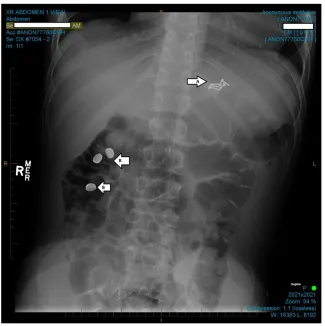
posttraumatic stress disorder and asthma has had.2 dozen hospitalizations over 4 years for intentional FBI. Ingested objects included plastic utensils, combs, toothbrushes, writing implements, magnets, batteries, and a coiled coat hanger (see Fig 1). Depending on the characteristics of ingested objects, management has been either observation or upper and lower endoscopy with foreign-body removal. Recently, he has undergone monthly endoscopic foreign-body removal procedures under general anesthesia at a tertiary care children’s hospital. When endoscopic removal of a sharp object could not be completed, the patient had laparoscopy, gastrostomy, and foreign-body removal.
The patient has a history of abuse and neglect. He was removed from his parents’care at age 3 years and has lived in multiple foster homes. A state-appointed caseworker has medical decision-making power.
Psychopharmacology and supportive mental health therapies have been ongoing for many years. No inpatient mental health facility will accept him because of his frequent FBIs and need for urgent transfer to inpatient care.
The patient reports intentionally swallowing objects when“bored,”to “get out of a situation,”or when upset. He denies suicidal intent. He informs caretakers of ingestion within a short time of the behavior.
He has been evaluated and cared for by multiple specialists, including those from gastroenterology, surgery, psychiatry, psychology, child life, and ethics. When hospitalized, he requires
aChildren’s Mercy Kansas City, Kansas City, Missouri;bSchool of Medicine, University of Missouri–Kansas City, Kansas City, Missouri; andcDepartment of Gastroenterology, Sheffield Children’s Hospital, Western Bank, Sheffield, United Kingdom
Drs Low Kapalu, Attard, Booser, and Lantos conceptualized and designed the ethics article and contributed to the writing, review, and revision of the manuscript; Dr Thomson contributed to the writing, review, and revision of the manuscript; and all authors approved thefinal manuscript as submitted and agree to be accountable for all aspects of the work.
DOI:https://doi.org/10.1542/peds.2019-1515 Accepted for publication May 16, 2019
Address correspondence to Christina Low Kapalu, PhD, Division of Developmental and Behavioral Health, Children’s Mercy Kansas City, 2401 Gilham Rd, Kansas City, MO 64108. E-mail: [email protected] PEDIATRICS (ISSN Numbers: Print, 0031-4005; Online, 1098-4275).
Copyright © 2020 by the American Academy of Pediatrics
FINANCIAL DISCLOSURE:The authors have indicated they have nofinancial relationships relevant to this article to disclose.
FUNDING:No external funding.
POTENTIAL CONFLICT OF INTEREST:The authors have indicated they have no potential conflicts of interest to disclose.
1:1 supervision when asleep and 2:1 supervision when awake, prohibition of writing and feeding utensils, body checks, and room sweeps for ingestible objects. Attempts to limit reinforcement associated with hospitalization are ongoing. Still, he has managed to ingest several objects during hospitalizations. His
gastroenterologist asks whether it would be appropriate to wire his jaw shut. The patient opposes this. The medical team calls for an ethics consultation.
Christina Low Kapalu, PhD (Psychology), Comments
This case warrants a look from both 50 000 feet and the ground. All health care providers have the ethical and moral obligation to promote
nonmaleficence and beneficence. Our obligation to our patients is to protect their safety, even when they will not or cannot, and to balance the benefits of treatment with its associated risks. In this case, our patient repeatedly makes decisions that carry the risk of significant harm both in the act itself and related treatment. Providers then become implicit in potential harm each time they perform surgical intervention and understandably have growing discomfort with this.
If our patient had ingested
medications, a logical next step would be to implement means restriction, an evidence-based intervention for reduction of self-harm behaviors.1 Psychologists are routinely involved in disposition evaluations after suicide attempts and recommend limiting access to items and/or situations that could be used to inflict self-harm (eg, locking upfirearms and medications) to prevent future self-harm behaviors. In this case, stringent means-restriction policies have been implemented in residential placement and in the hospital; however, minor inconsistencies in implementation have resulted in additional ingestions. The patient has also escalated to swallowing sharp objects, requiring
higher levels of surgical intervention. The question then becomes, "how does one restrict access to
everything?" Clinically, we know that intentional FBI in adults is resistant to treatment.2–4
The next step in prevention efforts might be to put on a mask or other wearable device contingently. This intervention poses a significant challenge in our case because the patient is physically large and increasingly combative, requiring physical and chemical restraints for patient and staff safety.
Does orthodontic jaw wiring then become the next extension of means restriction or restraint? Is it done in the name of beneficence? If so, we must ask ourselves, as we would with any restraint procedure, the following
questions: Is this a treatment of last resort? Is this decision
nonretaliatory? Is it therapeutic or preventive? If our answer to these 3 questions is no, we should not proceed. Clinicians must also take great care to ensure that decisions to escalate or remove care are not related to countertransference and/ or a way to manage our own frustration with the patient or behavior.4Ethics consultation can help tease apart these nuanced decision points and help providers to engage in repeated and deliberate self-reflection during what may seem to be an impossible situation. Details such as how long the patient’s jaw will be wired shut or how the team will respond if the patient removes the wire should also be carefully considered because there
FIGURE 1
are no standardized treatment guidelines and no way to predict patient response to treatment.
Now for the ground-level view, the consideration of patient specifics. Our patient, like many of our patients, is multilayered and complex and exists within a cultural and historical context that warrants careful consideration. His intersecting layers of vulnerability, including being a minor in state custody, having a trauma and mental health history, and being a racial minority, each pose a challenge to the application of 50 000-foot medical decisions. In addition, these vulnerabilities necessitate that all less-invasive treatment options have been exhausted before escalating care.
As a minor, he is not yet legally able to consent for treatment. Medical treatment decisions are the responsibility of a caseworker who gives“informed permission.”5 Additionally, brief cognitive screening suggests that this patient’s cognitive functioning falls in the borderline range, calling into question his capacity for medical decision-making. The prefrontal cortex, involved in problem-solving, decision-making, and impulse control is known to continue developing well into young adulthood, further contributing to the patient’s suboptimal decision-making. Cognitive- and executive-functioning impairment must be considered when evaluating patient ability to consent to or decline treatment.
Our patient also has a history of physical and emotional trauma. Trauma often involves a“violation of a person’s bodily integrity,”which has been related to subsequent health-seeking behaviors.6Seeking informed consent for treatment is foundational in trauma-informed care. In this case, we do not have it. Doing a jaw-wiring procedure without consent could exacerbate behavioral problems or retraumatize an already vulnerable patient because it would be another
violation of his personal autonomy. In addition, maladaptive coping
(ingestion) could be viewed as a reaction to previous trauma and conceptualized as an expected way to try to modify his environment when he otherwise has little control.
Finally, but still relevant, our patient exists within a historical and social context of repeated abusive medical treatment of African Americans and patients with mental illness. Historical trauma, including slavery and oppression of African Americans, as well as current racial injustices and institutional racism continues to shape the lives of children, families, and communities.7Medical
experimentation on nonconsenting African American patients, including the Tuskegee Syphilis Experiment and treatment of Henrietta Lacks, is not a distant phenomenon. If jaw wiring has not been proven to be an effective treatment of recurrent FBI, I would advocate for, at the very least, consideration of historical inequities and maltreatment when treatment planning. With our history of significant maltreatment of patients with mental illness, we also owe it to our patient to evaluate whether all less-invasive treatment options have been trialed.
Have we exhausted all other possibilities? One could argue that although behavioral treatment to prevent future FBI has been extensive during his inpatient care, his
outpatient mental health care has lacked evidenced-based trauma treatment that could address the root cause of FBI rather than just the symptoms.
We may, in the end, come to 2 very different conclusions when
considering the 50 000-foot and ground-level views for our patient. A broader, problem-based approach may overlook patient-specific factors, whereas taking an overly narrow view may lead to missed
opportunities to promote patient
safety. Although there may be precedent for voluntary jaw wiring in the medical literature, it would not be voluntary for this patient. At the very least, I advocate for continuous and intentional reflection at the personal, institutional, and societal level when weighing risks and benefits of this treatment and, in doing so, acknowledge that either approach (surgical or ongoing behavioral treatment) could make the problem worse and lead to serious and irreversible self-harm or death.
Thomas Attard, MD, and Mike Thomson, MD (Gastroenterology), Comment
Foreign-body removal requiring upper endoscopy can be
a challenging, high-risk, emergent procedure in the case of sharp foreign bodies, multiple magnets, or button batteries. In itself, removal of sharp objects during endoscopy, especially if relatively large, entails a risk of penetrating trauma and bleeding.8 Emergent upper endoscopy can be complicated by insufficient preoperative fasting, implying an increased risk of aspiration. Intentional, recurrent FBI is well described in the adult patient literature and established in 2 scenarios: patients with severe psychiatric disorders and individuals detained in prison, wherein emergent transfer to the better environment of a medical facility delivers significant positive reinforcement. These populations are vulnerable and test provider empathy on several levels.
between the patient’s goals and the health care team’s goals. It is extremely frustrating to repeatedly conduct emergent and high-risk therapeutic endoscopy procedures.
In a minor, there is the additional level of vulnerability because the child is seldom involved in planning for emergent procedures. Even if the teenager could be involved, the underlying psychiatric pathology makes communication challenging. In addition, the teenager is often given medication for pain or sedation.
In our particular scenario, the challenging aspects of care included escalating risk with the ingestion of larger and progressively sharper foreign bodies and a lack of success in preventing recurrent ingestion. Furthermore, the patient’s primary care providers were disengaged from the patient’s tertiary care.
From the pediatric
gastroenterologist’s view, the repeated endoscopies and surgeries seemed to be both dangerous and ineffective. Their frustration peaked when the patient presented with an embedded sharp foreign body in the stomach that required open surgery for removal. The gastroenterologists were reluctant to continue with an approach that seemed likely to lead only to ongoing adverse events, cumulative harm, and, potentially, the patient’s death.
In proposing jaw wiring as an extreme, potentially irreversible option, the gastroenterology team intended to underscore with all parties involved the gravity of the situation and to document that the best possible effort had been made to critically assess all therapeutic alternatives with their different impacts and risk profiles.
Orthodontic jaw wiring historically was established as a treatment modality to address compulsive eating disorders but has lost favor in view of presumed less invasive, endoscopic, and surgical techniques
for obesity control. There is a well-established body of literature (and device patents) in which orthodontic jaw wiring to manage obesity and mitigate its long-term deleterious outcomes in adults and children is described.9–14Even within that specific population, coexisting psychiatric morbidity is associated with a lower success rate but does not constitute a contraindication.15 Orthodontic immobilization is not an established procedure for recurrent intentional FBI and, in itself, entails significant risk and morbidity as well.
Mandibular immobilization, as in any surgical intervention, could not be guaranteed to be effective, especially holistically, because our patient might revert to ingestion of caustic or corrosive liquids that would still warrant, then more complicated, endoscopy or surgery. The patient might engage in alternative self-harming behaviors if ingestion were not possible.
Furthermore, the likely negative psychological impact would have been impossible to predict. However, especially in view of the historic acceptability of orthodontic wiring to mitigate adverse outcomes from obesity, it was thought reasonable to consider in the management of this patient. This was not a frivolous or casual recommendation. Instead, it reflected our urgent efforts to critically evaluate all options, including unconventional and extraordinary measures, to address a potentially fatal behavior. We purposefully did not consider the patient’s socioeconomic status, psychiatric vulnerability, or minority status because to do so would be discriminatory in itself. We were only focused on what was best for this individual who was suffering.
Adam Booser, MD (Anesthesia), Comments
Pediatric anesthesiologists regularly care for children who ingest foreign objects. These cases usually involve
an infant or toddler who ingests a piece of a toy, a coin, or a food item. In adults and adolescents, intentional FBI usually“is the result of
psychiatric impairment (self-harm or suicidal ideation), intellectual disability, intoxication, or secondary gain seen in prisoners.”16 Foreign-body removals from the esophagus can be challenging cases for anesthesiologists. Patients may develop total airway obstruction by the foreign body, which can turn an urgent case into a struggle to save the patient’s life.
The total number of intentional ingestions and subsequent anesthetics in this patient is extraordinarily uncommon. The patient’s risk from anesthesia is a composite one because of the combination of the risks of each and every anesthetic exposure.
Perioperative respiratory adverse events are the most common complications seen in pediatric anesthesia, with laryngospasm, bronchospasm, aspiration, and airway obstruction (caused by the foreign body) being the most important. Risks of an allergic reaction, other adverse drug responses, hypotension, arrhythmias, and cardiac arrest are at a much lower rate of occurrence but are not negligible. In this patient, the risk of complications is magnified by the total number of anesthetics provided. Thus, this patient is putting himself in great risk of possible harm during the perioperative period.
There are 2 predominant ethical principles important to the
goes beyond simply the medical risks to include the patient’s belief systems and cultural interests. What is in the best interests of the patient also links the 2 separate concepts of
beneficence and respect for patient autonomy.
Active intervention to prevent harm is relevant in this case because the patient is intent on harming himself for secondary gain. This patient has stated that his intentional ingestions are not the result of suicidal ideation, suggesting that there is a limit to his self-harming behavior. To this point, it has proved impossible to prevent him from recurrent FBI, even with the application of significant
precautionary measures.
The patient’s uncontrollable self-harming behavior led to a discussion of wiring his jaw closed to prevent him from ingesting foreign objects. However, it was acknowledged that subjecting him to forced jaw wiring may result in additional psychological damage, especially given his history.
The anesthetic for jaw wiring may require general anesthesia with nasal intubation. There is an increased risk of respiratory complications,
including aspiration of vomit without the ability to quickly suction. If airway obstruction occurs, there would not be easy and rapid access to the mouth if his jaw is wired shut. If a painful and restrictive surgical procedure with inherent risks and consequential treatment (ie, indefinite tube feeding) is forced on him, there is the prospect of doing more harm than good, and it may not be in his best interests.
Respect for autonomy is the ethical principle that has to do with a patient’s right to choose their own path in treatment, including choosing to accept or not accept lifesaving measures.
This patient is a minor in the eyes of the state and was in state custody at the time. Still, most adolescents have the capability to understand the risks
and benefits of a procedure. In fact, many adolescents are“competent in that they possess qualities associated with self-determination—that is, cognitive ability, rationality, self-identity, and ability to reason hypothetically.”18An ethical dilemma would arise if a decision was made to proceed with forced jaw wiring in a traumatized patient who understands all the risks and consequences of the procedure and still refuses. I would recommend seeking a court order before proceeding.
Most states designate 18 years as the age of competence to consent to a medical procedure. Some states have“mature minor”doctrines, in which a minor can“petition the court to recognize that they fully
understand the treatments and consequences of their decisions and should therefore be allowed to make treatment decisions independently.”19 There are no laws outlining the procedure for emancipation in Missouri. Presumably, a minor in Missouri could petition the courts for emancipation under common law. Regardless of the patient’s age, respect for autonomy should be taken seriously in this case, and thoughtful consideration should be given to his objection to the procedure.
This patient was exhibiting serious self-harming behavior. His intentional FBI resulted in bowel perforation that put his life and well-being in danger. Because of his behavior and need for repeat procedures, anesthetic risks are magnified by the number of anesthetics provided to this patient. However, by attempting to prevent the FBIs, the risks associated with jaw wiring under general anesthesia can result in real physical and
psychological harm. This case brings up a challenging ethical dilemma for those who care for him.
As anesthesiologists, it is our responsibility to evaluate and, if necessary, get directly involved in the
ethical dilemmas of our patients. The medical team, including the
anesthesia team, must give careful consideration to determine what is in the best interests of the patient in this difficult and remarkable case.
Given all the considerations
mentioned above, I would be willing to anesthetize this patient for a jaw-wiring procedure only if he
consented. If he did not consent, I would not support seeking a court order to force this treatment on him. Forced jaw-wiring cannot be the only option left to those who care for him. Due to the potential for causing more harm than good, I would advocate for other methods to prevent him from his self-harming behavior.
John Lantos, MD (Ethics), Commentary
This is an extraordinary case that just might justify an extraordinary intervention. Because the
intervention is so extraordinary (and may, in fact, be unprecedented for this presentation), there is no way to know whether it would work. It is a radical, innovative procedure for an extremely rare but life-threatening behavior. It should, of course, be a last resort. But when can we say that conventional treatment has failed so that it is time for a last resort? For this, I would defer to the
a desire not to repeat past racist mistakes. That, too, may lead to avoidable harms.
ABBREVIATION
FBI: foreign-body ingestion
REFERENCES
1. Daigle MS. Suicide prevention through means restriction: assessing the risk of substitution. A critical review and synthesis.Accid Anal Prev. 2005;37(4): 625–632
2. Huang BL, Rich HG, Simundson SE, Dhingana MK, Harrington C, Moss SF. Intentional swallowing of foreign bodies is a recurrent and costly problem that rarely causes endoscopy complications. Clin Gastroenterol Hepatol. 2010;8(11): 941–946
3. Palta R, Sahota A, Bemarki A, Salama P, Simpson N, Laine L. Foreign-body ingestion: characteristics and outcomes in a lower socioeconomic population with predominantly intentional ingestion.Gastrointest Endosc. 2009;69(3, pt 1):426–433 4. Poynter BA, Hunter JJ, Coverdale JH,
Kempinsky CA. Hard to swallow: a systematic review of deliberate
foreign body ingestion.Gen Hosp Psychiatry. 2011;33(5):518–524 5. Katz AL, Webb SA; Committee on
Bioethics. Informed consent in decision-making in pediatric practice.Pediatrics. 2016;138(2):e20161485
6. Raja S, Hasnain M, Hoersch M, Gove-Yin S, Rajagopalan C. Trauma informed care in medicine: current knowledge and future research directions.Fam Community Health. 2015;38(3): 216–226
7. National Child Traumatic Stress Network. National Child Traumatic Stress Network position statement: racial injustice and trauma: African Americans in the U.S. 2016. Available at: https://www.nctsn.org/sites/default/file s/resources//racial_injustice_and_trau ma_african_americans_in_the_us.pdf. Accessed April 5, 2019
8. Hong KH, Kim YJ, Kim JH, Chun SW, Kim HM, Cho JH. Risk factors for
complications associated with upper gastrointestinal foreign bodies.World J Gastroenterol. 2015;21(26):8125–8131 9. Garrow JS. When to advise surgery for severe obesity.Postgrad Med J. 1989; 65(759):10–13
10. Garrow JS, Gardiner GT. Maintenance of weight loss in obese patients after jaw wiring.Br Med J (Clin Res Ed). 1981;282(6267):858–860
11. Gross AN. Management of patients with jaws wired for obesity. A review of 122 cases.Br Dent J. 1979;146(11):335–339 12. Lieber CP, Seinige UL, Sataloff DM, Blake HA II, Rovito PF. Temporary intervention: dental splinting and the intragastric bubble.Gastroenterol Clin North Am. 1987;16(3):451–460
13. Ramsey-Stewart G, Martin L. Jaw wiring in the treatment of morbid obesity.Aust N Z J Surg. 1985;55(2):163–167 14. Rodgers S, Burnet R, Goss A, et al. Jaw
wiring in treatment of obesity.Lancet. 1977;1(8024):1221–1222
15. Jönsson B, Björvell H, Espmark S, Levander S, Rössner S. Psychiatric determinants of weight changes in
jaw-fixed obese patients.Acta Psychiatr Scand. 1986;73(2):196–202
16. Kurowski JA, Kay M. Caustic ingestions and foreign bodies ingestions in pediatric patients.Pediatr Clin North Am. 2017;64(3):507–524
17. Waisel DB, Truog RD. An introduction to ethics.Anesthesiology. 1997;87(2): 411–417
18. Larcher V. Consent, competence, and confidentiality.BMJ. 2005;330(7487): 353–356
DOI: 10.1542/peds.2019-1515 originally published online December 12, 2019;
2020;145;
Pediatrics
Attard
Christina Low Kapalu, John Lantos, Adam Booser, Mike Thomson and Thomas
Preventing Self-Harm From Repeat Foreign-Body Ingestion
Services
Updated Information &
http://pediatrics.aappublications.org/content/145/1/e20191515 including high resolution figures, can be found at:
References
http://pediatrics.aappublications.org/content/145/1/e20191515#BIBL This article cites 18 articles, 4 of which you can access for free at:
Subspecialty Collections
http://www.aappublications.org/cgi/collection/ethics:bioethics_sub Ethics/Bioethics
following collection(s):
This article, along with others on similar topics, appears in the
Permissions & Licensing
http://www.aappublications.org/site/misc/Permissions.xhtml in its entirety can be found online at:
Information about reproducing this article in parts (figures, tables) or
Reprints
DOI: 10.1542/peds.2019-1515 originally published online December 12, 2019;
2020;145;
Pediatrics
Attard
Christina Low Kapalu, John Lantos, Adam Booser, Mike Thomson and Thomas
Preventing Self-Harm From Repeat Foreign-Body Ingestion
http://pediatrics.aappublications.org/content/145/1/e20191515
located on the World Wide Web at:
The online version of this article, along with updated information and services, is
by the American Academy of Pediatrics. All rights reserved. Print ISSN: 1073-0397.