University of Pennsylvania
ScholarlyCommons
Publicly Accessible Penn Dissertations
2019
Modeling And Control For Robotic Assistants:
Single And Multi-Robot Manipulation
Monroe David Kennedy
University of Pennsylvania, [email protected]
Follow this and additional works at:
https://repository.upenn.edu/edissertations
Part of the
Mechanical Engineering Commons
, and the
Robotics Commons
This paper is posted at ScholarlyCommons.https://repository.upenn.edu/edissertations/3299
For more information, please [email protected].
Recommended Citation
Kennedy, Monroe David, "Modeling And Control For Robotic Assistants: Single And Multi-Robot Manipulation" (2019).Publicly
Accessible Penn Dissertations. 3299.
Modeling And Control For Robotic Assistants: Single And Multi-Robot
Manipulation
Abstract
As advances are made in robotic hardware, the complexity of tasks they are capable of performing also increases. One goal of modern robotics is to introduce robotic platforms that require very little augmentation of their environments to be effective and robust. Therefore the challenge for a roboticist is to develop
algorithms and control strategies that leverage knowledge of the task while retaining the ability to be adaptive, adjusting to perturbations in the environment and task assumptions. This work considers approaches to these challenges in the context of a wet-lab robotic assistant. The tasks considered are cooperative transport with limited communication between team members, and robot-assisted rapid experiment preparation requiring pouring reagents from open containers useful for research and development scientists. For cooperative transport, robots must be able to plan collision-free trajectories and agree on a final destination to minimize internal forces on the carried load. Robot teammates are considered, where robots must reach consensus to minimize internal forces. The case of a human leader, and robot follower is then considered, where robots must use non-verbal information to estimate the human leader's intended pose for the carried load. For experiment preparation, the robot must pour precisely from open containers with known fluid in a single attempt. Two scenarios examined are when the geometries of the pouring and receiving containers and behaviors are known, and when the pourer must be approximated. An analytical solution is presented for a given geometry in the first instance. In the second instance, a combination of online system identification and leveraging of model priors is used to achieve the precision-pour in a single attempt with considerations for long-term robot deployment. The main contributions of this work are considerations and implementations for making robots capable of performing complex tasks with an emphasis on combining model-based and data-driven approaches for best performance.
Degree Type Dissertation
Degree Name
Doctor of Philosophy (PhD)
Graduate Group
Mechanical Engineering & Applied Mechanics
First Advisor Vijay Kumar
Second Advisor Kostas Daniilidis
Keywords
Subject Categories
MODELING AND CONTROL FOR ROBOTIC ASSISTANTS:
SINGLE AND MULTI-ROBOT MANIPULATION
Monroe D. Kennedy III
A DISSERTATION
in
Mechanical Engineering and Applied Mechanics
Presented to the Faculties of the University of Pennsylvania
in
Partial Fulfillment of the Requirements for the
Degree of Doctor of Philosophy
2019
Vijay Kumar, Supervisor of Dissertation
Nemirovsky Family Dean of Penn Engineering and Professor of Mechanical Engineering and Applied Mechanics
Kostas Daniilidis, Co-Supervisor of Dissertation Professor of Computer and Information Science
Kevin Turner, Graduate Group Chairperson
Professor of Mechanical Engineering and Applied Mechanics
Dissertation Committee
Mark Yim, Professor of Mechanical Engineering and Applied Mechanics
Vijay Kumar, Nemirovsky Family Dean of Penn Engineering and Professor of Mechanical Engineering and Applied Mechanics
Kostas Daniilidis, Professor of Computer and Information Science
M. Ani Hsieh, Professor of Mechanical Engineering and Applied Mechanics
MODELING AND CONTROL FOR ROBOTIC ASSISTANTS:
SINGLE AND MULTI-ROBOT MANIPULATION
c
COPYRIGHT 2019
Acknowledgments
I would first like to thank my advisor Vijay Kumar for the opportunity to work in his world-class
laboratory with amazing collaborators and exciting, multi-disciplinary research. I truly appreciate
his mentorship technique, throughout my studies he always had high expectations which he coupled
with support. This led me to challenge myself and rise to the research objectives he initially set for
me, and later, to those I would set for myself. By observing and working with him, I learned how to
have academic confidence combined with techniques to quickly assimilate knowledge. Not only did
he guide me through fundamentals, but also showed me how to confidently address new research
directions with sound research skills. Being a part of multiple projects, I was able to observe first
hand how he seamlessly transitioned between very different projects in aerial vehicles, micro-robots
and manipulation while remaining extremely insightful and guiding directions for research. His
multi-disciplinary ability and lack of fear when it came to addressing new problems is something I
will strive to reproduce for my entire career. His care for myself and my labmates made the lab a
family, and I will do my very best to continue his legacy of academic and professional excellence.
I would like to thank my co-advisor Kostas Daniilidis for his wisdom and guidance as he
pro-vided me with real-world research problems to tackle. He also propro-vided me with access to his robots
and gave me a deep appreciation for modern techniques in robotics which I now combine with
clas-sical approaches. I would like to thank Dinesh Thakur for showing me how to connect theory with
practical implementation, and for working alongside me as we completed papers and competitions.
I would like to thank my committee members, Dr. M. Ani Hsieh, Dr. Mark Yim and Dr. Subhrajit
Bhattacharya of Lehigh University, for all of their guidance and for their collaboration on papers.
other up when things were intense. I would like to thank the MEAM and GRASP Staff for their
unfailing support.
I would like to thank my parents for giving me a love for engineering at a very young age. My
dad, for providing me with a template of excellence both as an academic and as an individual. My
mom, for sacrificing her career to directly invest her engineering and physics degrees in my siblings
and my education. I would like to thank my wife Sonia, for always caring for me, praying for me
and building me up on this journey, I cross the finish line standing and strong because of her and
answered prayers.
I would like to thank the National Consortium for Graduate Degrees for Minorities in
Engineer-ing and Science (GEM) and the National Science Foundation (NSF) for their support through
grad-uate research fellowships. I am grateful to NSF for their support through grants NSF-IIS1138847,
NSF-IIS1328805, NSF-IIS1426840, NSF-1138847, NSF-1328805 and also to GlaxoSmithKline
through NSF-IIP-1439681. I would also like to thank Army Research Laboratory for their support
ABSTRACT
MODELING AND CONTROL FOR ROBOTIC ASSISTANTS:
SINGLE AND MULTI-ROBOT MANIPULATION
Monroe D. Kennedy III
Kostas Daniilidis
Vijay Kumar
As advances are made in robotic hardware, the complexity of tasks they are capable of
per-forming also increases. One goal of modern robotics is to introduce robotic platforms that require
very little augmentation of their environments to be effective and robust. Therefore the challenge
for a roboticist is to develop algorithms and control strategies that leverage knowledge of the task
while retaining the ability to be adaptive, adjusting to perturbations in the environment and task
assumptions. This work considers approaches to these challenges in the context of a wet-lab robotic
assistant. The tasks considered are cooperative transport with limited communication between team
members, and robot-assisted rapid experiment preparation requiring pouring reagents from open
containers useful for research and development scientists. For cooperative transport, robots must be
able to plan collision-free trajectories and agree on a final destination to minimize internal forces
on the carried load. Robot teammates are considered, where robots must reach consensus to
min-imize internal forces. The case of a human leader, and robot follower is then considered, where
robots must use non-verbal information to estimate the human leader’s intended pose for the
car-ried load. For experiment preparation, the robot must pour precisely from open containers with
known fluid in a single attempt. Two scenarios examined are when the geometries of the pouring
and receiving containers and behaviors are known, and when the pourer must be approximated. An
analytical solution is presented for a given geometry in the first instance. In the second instance, a
combination of online system identification and leveraging of model priors is used to achieve the
precision-pour in a single attempt with considerations for long-term robot deployment. The main
contributions of this work are considerations and implementations for making robots capable of
per-forming complex tasks with an emphasis on combining model-based and data-driven approaches for
Contents
Acknowledgments iv
Abstract vi
List of Tables x
List of Figures xi
Conventions and Nomenclature xv
I Preliminaries 1
1 Introduction 2
1.1 Motivation . . . 2
1.2 Challenges and Opportunities . . . 2
1.3 Problem Statement . . . 3
1.4 Thesis Contributions and Outline . . . 4
2 Collaborative Robotics 9 2.1 Collaborative Tasks . . . 9
2.2 Methods of Improving Task Execution in Unstructured Environments . . . 10
2.3 Cooperative Transport . . . 11
2.4 Autonomous Pouring . . . 12
3 Mathematical Preliminaries 14 3.1 Mobile Manipulator Kinematics . . . 14
3.1.1 Mobile Base Kinematics . . . 16
3.1.2 Manipulator Kinematics . . . 17
3.2 Mobile Manipulator Dynamics . . . 18
3.2.1 Manipulator Dynamics . . . 20
3.2.2 Base Dynamics . . . 23
3.2.3 Coupled Dynamics for the Manipulator and Base . . . 26
3.3 Optimal Control . . . 29
3.3.1 Essentials of Optimization . . . 29
3.4 Model Predictive Control . . . 37
3.5 State Estimation . . . 39
3.6 Model Approximation . . . 42
3.7 Essentials of Controller Stability Analysis . . . 47
II Cooperative Transport 49 4 Obstacle Modeling and Path Planning for Cooperative Transport 50 4.1 Introduction . . . 50
4.2 Obstacle Modeling and Collision Checking . . . 51
4.3 Generating Traversable Corridors . . . 52
4.4 Results . . . 55
5 Robot-Robot Cooperative Transport 60 5.1 Introduction . . . 60
5.2 Force Distribution in Cooperative Transport . . . 60
5.3 Interaction Force Minimization Through Consensus . . . 62
5.4 Results . . . 64
6 Human-Robot Cooperative Transport 66 6.1 Introduction . . . 66
6.2 Human and Environment Sensing for Cooperative Transport . . . 67
6.3 Modeling Human Intent for Cooperative Transport . . . 71
6.4 Results . . . 76
6.5 Conclusion . . . 77
III Precision Pouring 86 7 Precision Pouring from Known Containers 87 7.1 Introduction . . . 87
7.2 General Pouring Problem . . . 88
7.3 Container Geometry Influence on Pouring Dynamics . . . 90
7.4 Hybrid Control for Precision Pours . . . 93
7.5 Results . . . 95
7.6 Conclusion . . . 97
8 Precision Pouring from Unknown Containers 98 8.1 Introduction . . . 98
8.2 Methodology . . . 100
8.2.1 Problem Formulation . . . 100
8.2.2 Model Learning . . . 102
8.2.3 Real-Time Volume Estimation . . . 105
8.2.4 Trajectory Planning and Control . . . 105
8.3 Implementation . . . 108
8.3.2 Simulated Pouring . . . 109
8.3.3 Volume Estimation and Attenuation . . . 110
8.3.4 Volume Profile and Time Delay Estimation . . . 110
8.3.5 Pouring System . . . 111
8.4 Results and Discussion . . . 111
8.4.1 Volume Profile Estimation Method Comparison . . . 111
8.4.2 Semi-Parametric Estimation for Diverse Containers . . . 112
8.5 Conclusions . . . 113
IV Conclusions 121 9 Contributions and Future Work 122 9.1 Contributions . . . 122
9.2 Future Work . . . 124
9.3 Concluding Remarks . . . 125
List of Tables
3.1 Modeling types and estimation techniques [47]. . . 43
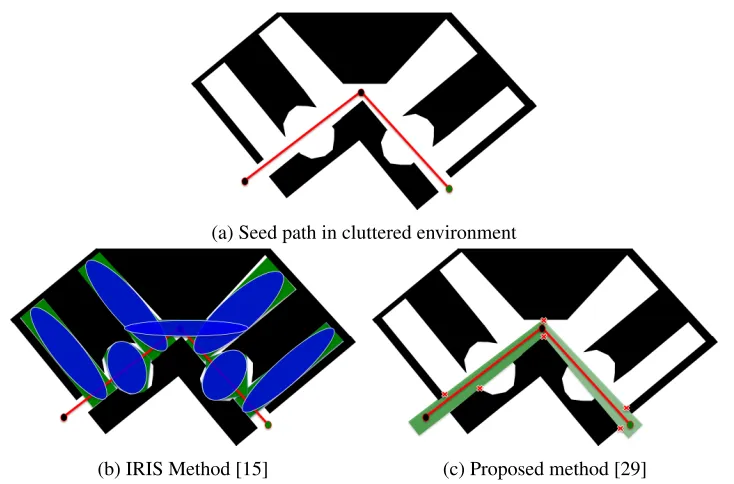
4.1 Collision Free Corridor Generation Method Comparison: Free-space characterization for proposed method, and methods shown in [39] and [15]. These are statistics for the free space of the proposed method and Liu et al. method divided by free space of IRIS method respectively, producing a fractional relationship. . . 56
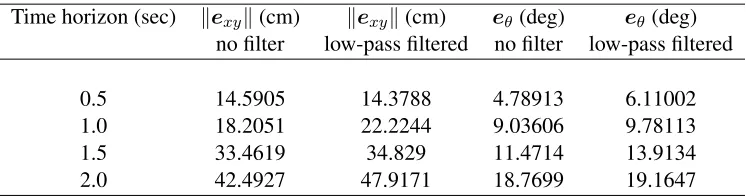
6.1 Human Intent Training: Using the MP assumption for each time horizonth, the
List of Figures
1.1 An illustration of a mobile manipulator. This manipulator has seven degrees of freedom and the mobile base is non-holonomic. For every joint the position, velocity and efforts are observable. . . 4
3.1 Mobile Redundant Manipulator Diagram: Frames R,Eare robot and end-effector frames respectively. Angular coordinates of manipulator and base represented with
qi and the generalized coordinates of the base is the SE(2) constrained location of
frameRand the jointsqA,ifor the manipulator. . . 15
4.1 Implementation on KUKA youBot. Figure 4.1a shows the planned trajectory where the seedpath is shown in red and the optimal path for the convex hull of the robot is shown in blue. Figure 4.1b shows execution on the youBot platform. . . 56 4.2 Smooth trajectory generation where red points show the seed path, green dashed
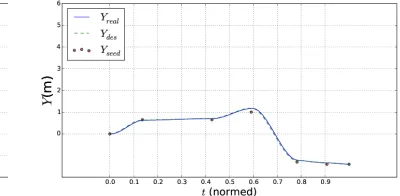
lines are the desired trajectory and blue lines represent the actual odometry. . . 57 4.3 General method comparison of free space: single chord indicated by red arrow, 30
generated obstacles and free space characterized by each method. . . 58 4.4 Given a seed path, the IRIS method requires more computation to calculate the
effective, usable free-space than the proposed method. . . 58
5.1 Robot-Robot Cooperative Carrying: 100 robots executingwdes =[1, 1, 1]T, with a
static communication structure and convergence rate. . . 65
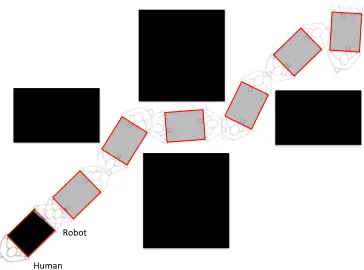
6.1 Human Robot Carrying Problem: The goal is to allow an autonomous robot to coop-eratively carry a load through a cluttered environment collision free, with a human counterpart with the added constraint that explicit communication is not viable. The robot must transport efficiently by estimated the humans intended motion in the context of the environment. . . 67 6.2 Human Intent Observation: It is asserted that the human and robot will transport
facing each other. It is also asserted that the robot is capable of sensing the human leader’s head orientation h, step vector s, applied wrench w(force and torque), the twist of the carried load p˙Wsys := ˙pWO (for carried load frame O) and the
surrounding obstacles. . . 69 6.3 Human Intent Sensor Diagram: The sensor consists of a RGB-D Kinect sensor used
6.4 Human Intent Data Collection: The Fetch mobile manipulator is used to construct a map of the environment. Then a human leader and human follower then traverse the environment without explicit communication (verbal, gesture). By observing the human leader and the environment, the human follower predicts the leaders intended pose. . . 72 6.5 Obstacle maps for training human intent inference. . . 79 6.6 Neural net architecture for detecting human intent for cooperative transport.
Con-volutional layers are denoted with conv. and the number of channels and kernel size are shown with the notation: channel @ kernel size. Fully connected layers are denoted by FC and the number of nodes in the width shown. Leaky ReLU acti-vation functions were used for all nodes. This network was trained by minimizing predicted pose error inSE(2)in units of degrees and centimeters squared. To im-prove generalization, a dropout rate of10%was used for convolution and20%for fully connected layers. The essential intuition for this particular architecture is that the head and step vectors pass through the same layers as they are both related to the expected position. The local map serves as a constraint, with convolutional and fully connected layers working to model the constraint. These are then combined with the wrench which relates to acceleration and system twist for velocity through a set of fully connected layers which models there interdependence for predicting the expected pose on the time horizon. . . 80 6.7 NN training error for position error squared, each legend is for horizon time in
seconds on hold out set (training data never touched and used to truly evaluate model performance). For times much greater than 2 seconds the Markov process assertion begins to break down as expected in cluttered environments. . . 81 6.8 NN training error for angular error squared. Each legend is for horizon time in
seconds on hold out set. . . 81 6.9 NN training error combined for both position and angular error squared, each legend
is for horizon time in seconds on hold out set. . . 82 6.10 Top down view of human intent prediction for a look-ahead time horizonth= 1.5s.
The purple arrows are predictedSE(2)poses, the red arrows are the actual pose of the carried load. This was obtained in Rviz in top-down-view, hence while it may appear that the trajectory goes over obstacles this is an artifact of this view. . . 82 6.11 Top down view of human intent prediction for a look-ahead time horizonth= 1.5s.
Additional images of the intention predictions performance with same representa-tion as Figure 6.10. . . 83 6.12 Comparison between neural net prediction and velocity integration for expected
pose for a given time horizon. Shown are the mean and variance errors for position kexykand orientationeθfor all maps shown in Figure 6.5. Neural net outperforms
velocity clearly forkexykfor all time horizons, with increasing disparity for longer
6.13 Human-Robot Cooperative Transport System Algorithm: The human and environ-ment are first observed, then using methods presented in Chapter 6 the human lead-ers intended pose is estimated. Then using methods presented in Chapter 4, a col-lision free trajectory is planned to the estimated goal pose. Then the robot actuates along the calculated trajectory using methods presented in Chapter 5. During im-plementation the robot follower would be compliant while continually observing the human and environment and constantly updating the estimated intended pose. . . . 85
7.1 The Rethink Robotics Sawyer manipulator precisely pours colored water into a beaker using visual feedback from a mvBluefox MLC202bc camera. . . 88 7.2 The Pouring Problem: For a fluid poured from container α to container β with
specified geometric parameters, the goal is to pour a precise amount of fluid using visual or weight feedback based on an analytical model and closed form control. . . 89 7.3 Pouring geometry used to derive the analytical model. . . 91 7.4 Using background subtraction, Sobel gradient detection and K-means clustering
(Figure 7.4a), the top of the fluid is tracked for feedback control. In Figure 7.4b the goal was to pour 100ml which was achieved. . . 96 7.5 Representative experimental trials of pouring. The trials are for pouring 80, 100,
and 120ml, over three different time intervals. . . 96 7.6 Figure 7.6a 50 Trials pouring 100ml for 10s trajectories. Black line is average,
shaded region is 1st standard deviation. Figure 7.6b average and standard deviation between scale and vision report of height. Consistent dip is due to detection of the top of the fluid at the beginning of the pour from camera perspective registering as higher heights. . . 97
8.1 The objective is to pour precisely from an unknown container. The pouring rate (which depends on the profile of maximum volume of fluid containable at a given tilt angle) is modeled by estimating the container geometry (Figure 8.1a) and then using model priors and online system identification to identify the profile and pour precisely in a single attempt (Figure 8.1b). . . 99 8.2 The goal is to pour a specified amount of a known fluid from container αto
con-tainer β quickly and precisely. The receiver volumeVβ is sensed (through weight
and heighthβ) and the geometry of the pourerΓis estimated. WhereΓdescribes
the radius as a function of height. Vα,t andVα,θ are the transient and steady state
volumes inαfor a given tilt angleθ. . . 100 8.3 Pouring Control Diagram. The desired volume is specified by trajectory generator,
the controller fu processes this and the model approximations (fV and ft which
must be determined) in order to control the angular rate of the pouring container. . 102 8.4 Volume in the receiver is detected combining vision and weight. The volume is
visually estimated by using a fiducial to locate the receiver of known geometry then a network detects fluid pixels. The detection is robust to fluid color and transparency. 108 8.5 Artificial containers are generated to provide a simulation of pouring liquid of known
8.6 Container geometry is scanned, where it is assume that it is a surface of revolution and the geometry can be represented with the edge profile Figure 8.6c. A time of flight sensor is used to extract the edge-profile. For simplicity, the time of flight sensor is used, an alternative method for extracting edge profiles from surfaces of revolution is discussed in [54]. . . 115 8.7 System pipeline for autonomous pouring . . . 116 8.8 Container profiles and pour statistics: containers 1, 2 and 3 are 8.8a, 8.8b and 8.8c
respectively, with their statistics directly below each container. Percentages are the mixture probabilities defined in (8.8). Final volume error statistics are shown for a 100ml target volume in the second row for each method (30 pours each), and 200ml target volume in the third row (10 pours each). Each method statistics are shown using violin plots for distribution and inset box plot with mean and quartiles. A total of 360 pours are shown. . . 117 8.9 Container 3 negative example with weak priors along with method statistical data
for pours of 100ml in 8.9b and 200ml in 8.9c. . . 118 8.10 Semi-parametric method: final error versus container height for 13 containers. Mean
and variance are shown for 10 pours of 100ml each. Trend line and variance fit shows the general increase in error with container height attributed to constant lower bound angular velocity. A Gaussian process is used to generate this fit with the ker-nel defined in (3.116) withσκ= 5.7andlκ = 0.12. . . 119
Nomenclature
SE(3) The special euclidean group in three dimensions.
W,R,E,H,O SE(3) frames: world, robot, end-effector, human, carried load (respectively).
A,B Mobile manipulator arm and base SE(3) frames respectively.
t, td, t0, tf Time:tis current time,tdis time delay,t0is an initial time andtf is the final time. RWA Rotation matrix: subscript indicates rotation from frameAtoW.
φWA Vector of exponential coordinates: rigid body orientation vector in SE(3). Subscript
indi-cates rotation from frameAtoW. φWAis the axis angle representation of rotation from
frameAtoWwhich is the unit rotation axis multiplied by the rotation angle and satisfies the exponential map:RWA=exp
φ[W×A]
(which is the exponential of the skew symmet-ric matrix constructed fromφWA).
ri Position vector in inertial frameW.
pWA(t) Pose vector: the pose of frameAin inertial frameW,pWA(t) =
x y z φx φy φz
T
withx, y, zbeing the translation component andφWAthe vector of exponential
coordi-nates.
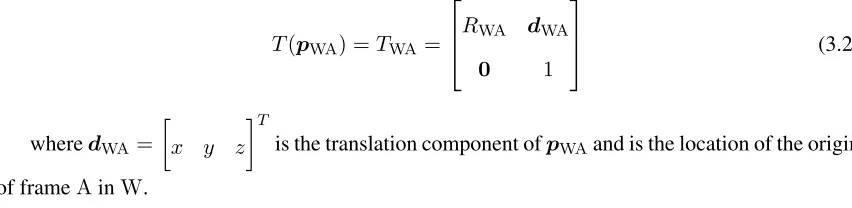
T(pWA), TW,A,F K(·) Transformation matrix: SE(3) transformation matrix describing
transla-tion and rotatransla-tion from frameAto frame W. F K(·) is transformation from inertial frame to end-effector frame.
d Translation componentx, y, zof rigid body transformation.
x,x˙,xˆ,x¯,x,X State representations: state, time differentiated state, estimated state, state mean, state vector, state matrix respectively.
z Output variable, derived from the state.
v,ω Velocities: Linear and angular velocities in inertial frame.
qa,i, qb,i, q Generalized coordinates: generalized coordinates of manipulator, base and vector
representation.
J(q) Jacobian: The derivative of the forward kinematics map with respect to generalized coordi-nates.
m,ρ,V Material properties: mass, density and volume.
g Gravity.
li Manipulator link lengths: (constant quantities for determining forward kinematics).
I, I˜ Rigid body inertia: 3×3 inertia matrix in body fixed frame and transformed into another frame.
D(q),C(q˙,q),G(q) System Dynamical Terms: Generalized inertia matrix, Coriolis, centrifugal vector and gravity vector.
K,P Energy: kinetic and potential energy respectively. L Lagrangian.
H Hamiltonian.
τ Torque: applied at revolute joints.
f 3x1 force vector in inertial frame.
w Wrench: 6x1 force and torque vector in inertial frame
ex Error vector, subscript indicates state.
Ch,Cnh Sets for holonomic and non-holonomic constraints.
Amanip Constraint matrix for manipulator dynamics against external forces.
Gi Contact wrench: contact wrench used to define the resultant force and moment in body fixed
frame for a force applied atri.
f(·),F Dynamical systems model: describes the evolution of states as a function of the current state, inputs and systems parameters.F is a linear model.
β(t) Model parameter vector: vector of model parameters that may vary with time.
S Objective function for optimization.
PH Objective function hessian.
∇x Gradient operator. γ Step-size gain.
λ Lagrange multipliers.
Q Positive semi-definite matrix.
pr(·) Probability density function.
pstat Discrete probability of an event.
η Noise: usually associated with sensor measurement or general uncertainty. N Gaussian Distribution
Σ Generic covariance matrix.
χ Chi-points: points in unscented Kalman filter used to characterize the uncertainty for nonlinear functions
Zkf,χ,Kkf,Qkf,Rkf,Lkf,Mkf Kalman Filter: measurement matrix, Chi/sigma points, Kalman
gain, measurement uncertainty, process uncertainty, measure-ment covariance update, state covariance update.
σ(·), cov(·), Γkf, Wσ Kalman filter: sigma point operator, covariance operator, sigma point
matrix operator, sigma point weighting matrix.
κ(·,·) Kernel function.
V[·] Variance: used to characterize uncertainty of a test point for a Gaussian process.
σκ,lκ,K,LGP Gaussian process parameters: Gaussian radial basis function variance and
length-scale, covariance matrix, information matrix.
eres Residual error between model approximation and generating data. u Control input.
s Control objective: error attenuation after feedback linearization if necessary.
Llie Lie derivative operator: lie derivative of a function along a vector field measures changes in
the function along differential equation solutions of the vector field.
V, Llie,fV(x) Lyapunov function and Lie derivative, note that ifx(t) is a solution tox˙(t) = f(x(t), t)thenV˙(x(t)) =Llie,fV(x).
L,A,D,G Laplacian matrix, adjacency matrix, diagonal neighbor matrix and graph respectively.
Tchrd Path Planning: time allocated to complete path chord segment.
h,s Human Intent Quantities: Human leader head orientation and step vectors.
α,β Pouring and receiving containers respectively. These will be used in Part III.
Vα,Vβ Container volume: for either containerαorβ.
Aβ,Aα Area: associated with cross-sections in either containersαorβ. hα,hβ Fluid height: fluids heights associated with either containersαorβ. LL,α Container lip width function: describes lip width for the pouring container. qf r Volumetric flowrate.
Vβ Pouring: receiving container fluid volume.
VL,α,Vα,t Pouring: volume above the pouring container lip edge. Vs,α,Vα,θ Pouring: volume below the pouring container lip edge.
As,α Pouring: cross sectional area separating volume above and below pouring edge in pouring
container.
hL,α Pouring: height of fluid above the pouring edge lip of the pouring container. AL Pouring: cross-sectional area of fluid exiting pouring container at the pouring edge. v(hL,α) Pouring: velocity of fluid exiting pouring container.
Pbern Pouring: Pressure on fluid from atmosphere used in Bernoulli equation. Wα Pouring: Specified pouring container width.
Hα Pouring: Specified pouring container height. lα Pouring: Specified pouring container length.
ϕ,rL,α Pouring: pouring container lip opening angle for V-shaped lip with angleϕand circular
lip with radiusrL,α.
Γ(·) Pouring: Symmetric container geometry function, describes symmetric radius as a function of height.
HΓ Pouring: Symmetric container height.
Vβ,θ,Vα,θ Pouring: Volume profile, this is the volume versus angle for the receiver and pouring
containers.
eΓ Pouring: ‘distance’ between two symmetric container geometries. ¯
rres, rres,max Pouring: residual after fitting volume profile, residual average and maximum
Part I
Chapter 1
Introduction
1.1
Motivation
Over the past few decades robotics has evolved from automation in the 1980-90’s to major
break-throughs in autonomy in the 2000’s and now to human-augmentation. With each advance, robots
have become more capable, with augmentation being the most exciting endeavor to date. The goal
is to now go beyond teleoperation and performing repetitive tasks, and become effective, capable
collaborators with human teammates. To meet this objective robots must not only be capable of
completing complex tasks, but it is essential that the robots be able to consider humans working
alongside them. Using human-human collaboration as a standard, humans are able to effectively
complete complex tasks together, and sometimes require minimal explicit (e.g. verbal)
communi-cation by anticipating the actions of others in the team. Incorporating these abilities into robots is a
large area of research, and this work takes a step towards making it become a reality.
1.2
Challenges and Opportunities
To be effective collaborators, robots must be able to perform complex tasks reliably in unstructured,
dynamic environments designed for humans. An outstanding challenge is how to effectively model
the complex tasks in such a way that natural perturbations that occur for a deployable robotic system
can be accommodated within expected operation conditions. Another challenge is how can the robot
human counterparts (where natural indicates similarity to human-human interaction). An additional
challenge is how to make the robot capable of performing complex tasks and becoming an effective
collaborator with limited training examples and data. To address these challenges, this work
pro-poses to leverage model-based approaches (such as knowledge of physical models and principles)
along with the modern data-driven techniques in system identification, to allow the robot to adapt
to perturbations in task assumptions and in one presented instance, even estimate the humans intent
within the task.
1.3
Problem Statement
Given a collaborative (or assistive) manipulation task with a given metric of success, can the robot’s
model of the task be learned or adapted, and a controller designed which maximizes the metric of
success?
For a given task which can be represented in terms of relevant statesx, the problem is to
de-termine the set of robot actionsuthat will facilitate the desired state. Formally, given a statex(t)
which combines the robot and the task, the robot’s inputu(t), modeling parametersβ(t), and output
z(t), the general system dynamics are described by
˙
x(t) =f(x(t), u(t),β(t), t)
z(t) =h(x(t),β(t), t) (1.1)
wheref(·) is the dynamical system process model andh(·) is the output function. If a desired output based on the task objective is described by the function
zdes(t) =hdes(x(t),β(t), t), (1.2)
then output error can be defined as
The goal is to find the control input which meets the task objective by minimizing this error while
better approximating the system dynamics. In certain applications this requires adjusting the model
of the system dynamics to better reflect the true world model. This is represented formally by
minimizing the following functional subject to the system dynamics
min
u(t) S=m(x(tf), u(tf), tf) +
Z tf
t0
g(e(t),β(t),x(t), u(t), t)dt
subj to:x˙(t) =f(x(t), u(t),β(t), t)
z(t) =h(x(t),β(t), t) (1.4)
wherem(·)andg(·)are the terminal and running costs respectively. For the described model and parameters this may reduce to an optimal control problem, but for unknown model parameters this
formally considered an adaptive control problem. In some instances the complete structure off(·)
andh(·)are unknown (not just parametersβ). In this case to meet the overall objective by reaching a final desired output, these functions must also be identified.
1.4
Thesis Contributions and Outline
Figure 1.1: An illustration of a mobile manipulator. This manipulator has seven degrees of freedom and the mobile base is non-holonomic. For every joint the position, velocity and efforts are observable.
When a robot performs a manipulation task, the control problem in (1.4) can be subdivided into
the characterization of a functional describing operational success, a model for the robot, a model
for the task and a control policy. The control policy is designed to combine the knowledge of both
the robot and the task to approach the optimum described by the functional. When prior knowledge
about the task dynamics are known, it can be combined with system identification techniques for
the system. When this is required, the estimated model can be used in predictive control with the
performance improving with increasing model accuracy.
This thesis considers these concepts of task modeling for stable control in real-world
collabora-tive tasks. This work first presents the cooperacollabora-tive transport problem where robots must transport a
load as a member of a team through an obstacle filled environment. The task is to transport the load
while avoiding obstacle collisions, as well as minimizing internal stresses in the carried load which
consume energy and do not contribute to motion. It is noted that the optimal solution is centralized,
where a single governor dictates the actions of all members. However when robots are
decentral-ized, or when humans are present as teammates, centralized solutions are not always viable. Hence,
it becomes a necessity to collaborate in order to approach the centralized performance. The
contri-butions of this work toward this goal considers the entire pipeline of effective transport. First, if a
goal pose is agreed upon by all teammates, with the assumptions that all collaborators want to avoid
collision and conserve energy by taking the shortest feasible path this work presents a
computa-tional efficient way to decompose traversable free-space which contains the optimal path. Secondly,
this work considers the case when robots are teammates with other robots while not knowing other
robots grasp locations, but the the goal pose and optimal path is known by all robots. For this case,
this work presents a computationally efficient way that robots can minimize internal stresses in the
carried load if they reach consensus while simultaneously transporting. Third, this work considers
the case when robots are teammates with humans, and humans are the leaders with an internal goal
pose that is not initially known to the robot. In this case it is assumed that the human does not want
to collide with obstacles and wants to take the shortest, feasible path. This work presents a way
that robots can learn from how humans effectively transport with humans based on human leader
observation, specifically asking the question: based what direction is the leader’s head pointing,
how are their feet moving, what is the haptic force and torque felt in the carried load applied by
the leader, what is the velocity of the carried load and finally what are the surrounding obstacles
how do human followers predict the motion of human leaders? A method of transferring this highly
complex model from the human-human observation to the robot is successfully demonstrated. With
short look-ahead time a collision free trajectory can be applied and with the known grasp points
of the human and robot the wrench that minimizes internal stresses can also be applied along the
calculated optimal trajectory for efficient transport. This work presents this method of prediction
and leaves for future work the complete combination of the pipeline from demonstrated successful
components.
This work then considers the task of a robot assistant preparing an experiment for collaboration
with wet-laboratory research scientists. The task is to efficiently pour fluid between an open pouring
and a receiving container. An efficient pour is characterized as both quick and precise. It is assumed
that there is no spillage and that the properties of the poured fluid are known. The contributions of
this work for this task are two fold. In the case where the geometry of all containers are known,
and the receiver can be observed during the pour, an analytical solution is provided which considers
the expected flow-rate of the fluid given both containers geometry. With this analytical solution,
the robot is able to pour very quickly and precisely leveraging a hybrid controller that both ensures
steady flow and considers the system dynamics in order achieve the desired receiver volume. In the
case where the geometry of the pouring container is not known analytically, it is assumed that the
geometry can be approximated by an initial external scan of the container. While for simplicity this
work considers symmetric pouring containers, this is not a limitation as long as a distance metric can
be defined between container geometries. During the pour only the receiving container is observed,
and the system dynamics must be adjusted based on an initial estimate obtained from a single scan
of the pouring container geometry. The main contribution in this case is that both classical system
identification and learning are used simultaneously to predict the pouring container behavior. This
prediction is a necessity because the time delay between the rotational velocity control input of the
pouring container and the observed volume in the receiver is substantial for certain pouring container
geometries. This predicted model for the pouring container is then used in a hybrid controller to
achieve the control objective by anticipating the nonlinear dynamics. This is implemented on the
Rethink Robotics Sawyer and KUKA intelligent industrial work assistant (iiwa) manipulators.
The methods developed in this work are easily generalized for new tasks. It is assumed that
process model manifold that is continuous with low curvature, system identification can leverage
the inherent structure and be coupled with model priors from data utilized in a framework such as
Bayesian modeling approach (in this work a Gaussian process). When the process model manifold
is continuous but has high curvature, statistical modeling approaches like the Gaussian process
be-come expensive in areas of high curvature as the generating data must be maintained. Here it is
advantageous to utilize a neural network with adequate architecture. This is because the
computa-tional graph is capable of representing the highly curvature manifold of the process manifold with
the static computational graph structure, allowing for an efficient model representation. Often with
high curvature process model manifolds it is harder to exploit knowledge of the inherent structure.
However this knowledge can usually be used as a guide when designing the neural net architecture.
The rest of the thesis is organized as follows, Chapter 2 presents related work in collaborative
robotics and task adaptation, Chapter 3 presents mathematical preliminaries. In the next section,
the problem of cooperative transport is investigated. Robots must collaborate in order to transport
a load in a cluttered environment without collision while conserving energy by minimizing internal
stresses on the load during transport. Given a target pose for the carried load, Chapter 4 presents
a method of computationally efficiently modeling the free space that can be traversed. This free
space decomposition is then used to obtain an optimal trajectory that remains in the interior of the
free space. In Chapter 5, it is assumed that a target trajectory has been determined, and the goal is
to efficiently transport the load while minimizing internal stresses and therefore conserve energy.
When all robotic teammates know the grasp location of all other teammates the control input can
be calculated to transport along the trajectory while minimizing internal stresses. Chapter 5
investi-gates the scenario where there are teams of robots, but communication is limited or expensive and
the grasp location of other robotic teammates are unknown. An efficient consensus algorithm is
proposed where robots share critical, minimal information in order to reduce internal stresses. In
Chapter 6, a human leader robot follower scenario is considered. The stipulation is that explicit
communication (verbal, digital, gestures) is not permissible between the human and robot. It is
also assumed that no prior contextual knowledge about the carried object is known for the robot
must observe both the human leader and the surrounding environment to make an educated guess
on a local horizon about the humans intended target pose which would lie on the global intended
trajectory. Chapter 6 presents a method of leveraging select measurable quantities to estimate the
human leaders intended pose on a local time horizon.Together, these sections describe and provide contributions to the entire cooperative transport framework for human robot collaborative trans-port. When carrying with a human collaborator, Chapter 6 allows for the prediction of the leaders intended pose for a local time horizon, Chapter 4 allows for computationally efficient free space
decomposition for planning a collision free trajectory to the local goal, and if the grasp location of
the human is known then Chapter 5 presents a controller to actuate along the trajectory in a manner
that minimizes interaction forces.
In the next section, autonomous precision pouring is investigated. The goal is for a robotic
assistant to quickly and precisely pour a specified amount of a known fluid between open containers.
This is directly useful for wet-lab scientists who perform many rapid experiments. In Chapter 7 it
is assumed that analytically models for both the pouring and receiving container geometries are
known. A control strategy is proposed that allows for quick precise pours leveraging the known
analytical model. In Chapter 8 the geometry of the pouring container does not have an analytical
representation and the geometry must be estimated in order to approximate the underlying pouring
dynamics. A modeling strategy is proposed which leverages both system identification as well as
machine learning to estimate the model while performing control in order to pour precisely from the
known container in a single attempt. Finally, conclusions and ideas for future work are presented in
Chapter 2
Collaborative Robotics
2.1
Collaborative Tasks
The goal of robotics is to make human life safer, more enjoyable and more productive. As robotics
matures use cases arise where robots must work with and around humans in close proximity while
manipulating objects and navigating in unstructured, dynamic environments. Specifically,
human-robot collaboration is an important emerging field with high societal and economic impact. Robots
can perform collaborative tasks in a variety of environments, including but not limited to indoor
environments such as a domestic or office buildings and perform service tasks for assisted living or
general assistance. Assistant robots are also valuable in outdoor environments in both rural and
ur-ban settings with examples being street cleaning, farming or construction. This work will focus on
robot assistants in indoor environments, specifically pertaining to home or work environments. An
example of collaborative robots in such domestic settings is robots living alongside people as
effec-tive ‘roommates’, setting the stage for robots preparing meals and performing or assisting in chores
[7, 8, 53, 84]. Collaborative robots can also be considered to directly augment the disabled, with
a common use case being a semi-autonomous wheelchair with manipulation capabilities [42, 52].
In these instances, robots must be able to perform dexterous tasks in human-based unstructured
environments. A challenge is the modeling the expected dynamics of manipulated objects while
adapting to other environmental considerations that may perturb the expected behavior while
and style of manipulation) that may be a function of the object geometry or augmented property
(e.g. an open container filled with liquid may be handled differently than an empty container).
Ap-propriate methods to approximate and model these affordances for manipulation while achieving an
expected performance is a topic of ongoing research [51].
2.2
Methods of Improving Task Execution in Unstructured
Environ-ments
One approach to improve manipulation abilities for complex tasks in low or unstructured
environ-ments is learning from demonstration. In the context of manipulation, various levels of abstraction
may be employed. For instance, the relation between task success and joint motion or even low
level joint velocities and efforts correlating to a portion of a task. In imitation learning, the robot
attempts through trial and error to reproduce operational success by extracting key features from
ob-served motions and efforts [36, 37, 53]. The robot may also record the joint states during successful
operation and try to reproduce these for repeated success [57, 58].
A more contextual approach is to better understand the task and environment in order to better
reason about the conditions leading to successful task execution. One obvious approach is to use
prior knowledge about expected interaction during manipulation with a level of compliance so that
desired performance can be achieved without a highly accurate model [1]. Another approach is to
improve the model by explicitly involving the human in the model update through direct questions
[12]. The robot can interact with the human in the context of training where the robot tests the
humans response, essentially playing games with a purpose [36]. If it is possible for the robot
to ‘fail’ at a task multiple times with the ability to reset the task state and not suffer significant
repercussion, then the robot may perform the task and use failure cases to improve performance
under certain assumptions [69].
One component the robot may be required to model is the collaborating human’s intent. One
effective way to convey intent is through explicit verbalization [84]. A drawback to this approach
is that for complex tasks, this form of communication can quickly become laborious. When intent
the human intends [7]. Therefore, in such cases it is often useful to consider the human input in the
context of the task and environment along with some prior knowledge. An example of this in the
transport scenario is the assumption that the human would want to avoid collision. In this example,
the task becomes determining the free region of space and estimating the desired path which would
minimize expended energy [29, 52]. Methods of implicit communication may include (but are not
limited to) tracking of the pose of the human leader’s head, observing the wrench applied by the
leader and observing the motion of the human leader’s feet [7, 20, 67].
The works considered in this section all performed the tasks of autonomous pouring or
cooper-ative transport in a cluttered environment in whole or in part. The next section will further consider
the task of cooperative transport.
2.3
Cooperative Transport
The general cooperative transporting problem is to have a robotic agent work effectively with single
or multiple counterparts to transport an object through a cluttered environment without collision
while wasting limited energy on motions or forces that do not contribute to the specified desired
trajectory. One way to characterize these wasted forces is through interaction forces, which are
forces that apply tension or compression to the carried object while not contributing to overall
wrench or motion [35, 78]. An example of wasted motion is that which does not contribute to
achieving the objective trajectory or obstacle avoidance, adding no value to transport (e.g. spinning
in place). When there is a designated leader, the robot must be able to ascertain the desired trajectory
from the leader in order to carry effectively. This objective can be performed through explicit
communication where for a human leader indicates desired motions verbally to direct the robot. And
in the case of repeated carrying paths, the expected efforts can be recorded and mimicked [57, 84].
When explicit communication is limited, the robot teams can use their limited communication to
augment existing shared knowledge to transport effectively [30, 31, 68, 71]. When explicit or digital
communication is not possible or feasible, then implicit communication must be employed. A
common approach is to allow the robot to be compliant, where an applied wrench over a given
addition to compliance, it is important for the robot to move in a manner that considers the grasping
and kinematic constraints [17, 63, 74, 82]. It is also important during fast motions to consider the
coupled dynamics of the manipulator and the mobile base of the mobile robot [14, 83]. Another
consideration is the modeling of obstacles for collision avoidance. Obstacles can be represented
using polytopes with mixed integer quadratic programming to ensure estimated feasible trajectories
lie outside obstacles [43]. This is usually very computationally expensive, which leads to the method
of modeling free traversable space for collision avoidance [16, 29, 77], and is usually far more
computationally tractable. Another approach is to use a more continuous representation of obstacles
with potential fields, where viable paths do not pass through or too close to obstacles as the heuristic
would drastically penalize an invalid path [52]. Finally, when carrying an object with a human with
implicit communication, the human intent (as it relates to desired motion) must be modeled. With
commercially available sensors and open-source software it is relatively straightforward to track a
humans head pose, feet motion, torso and the applied wrench through the manipulator. If desired,
these can be combined with predefined gestures that indicate desired motion, or the relation between
these quantities and the intended motion can be adapted from a model prior or learned with no or
few assumptions using deep learning methods [20, 67]. Studies show that human collaborators
prefer when robotic teammates can anticipate their intent as this makes the interaction feel more
natural [22]. In implementation, this usually takes the form of the robot being proactive, by using
intent estimation as a feed-forward term in control [6, 27]. Another challenging task is autonomous
pouring, where similar to cooperative transport the objective for successful task completion is clear
however the pouring model may be unknown.
2.4
Autonomous Pouring
Robotic autonomous pouring is an important technology for improving the safety, productivity and
repeatability in the wet laboratory setting as well as increasing the abilities of mobile manipulators
in domestic environments. Work has been done to allow robots to effective manipulate containers
and pour liquids in kitchen settings [8, 51, 53]. To effectively handle fluids, the liquid must first
using thermal imaging or optical flow [61, 80] to detecting the surface of standing fluid [56] or in
a clear pouring container classifying the amount of fluid into discrete amounts [45]. Once the fluid
has been observed, the pouring process must be modeled. This can be done by either designing
pouring dynamics that resembles the observed physics then using system identification to improve
estimated parameters [49, 72], or by learning effective motion primitives that produce the expected
flowrate correlated with joints states [34, 58, 69] or container geometry [11, 38].
In order to pour precisely, the robot must perform feedback control to pour the desired amount
of fluid. To pour relatively quickly, smooth pouring trajectories can be designed with input shapers
to transport the filled container to the pour location and pour without sloshing [2, 4, 85], and it is
noted in [33] that minimum jerk motions are especially effective in minimizing sloshing. Depending
on the desired degree of precision, the volume of the fluid can be generally classified to set volume
amounts [62], or the fluid can be directly observed for more precision [28]. The geometry of the
pouring container determines the relation between the robots angular motion and the pouring rate.
The geometry of the container and flowrate can be explicitly modeled [28, 50] or the container
model can be abstracted by realizing that pour motions for full containers if followed are successful
for any starting volume and describes a maximum volume versus angle curve for sufficiently slow
Chapter 3
Mathematical Preliminaries
In this section the mathematical foundation is presented for controlling manipulators for complex
tasks in unstructured environments. First, the essentials of mobile manipulator kinematics and
dy-namics is presented. Then the fundamentals of optimization and optimal control is discussed, which
then sets the stage for model predictive control. In real world scenarios, the estimated task models
may need to be adjusted and adapted as more information is obtained. This leads to a discussion
of state estimation, then model approximation and adaptive control. When the main structure of
the model is unknown, learning techniques can be leveraged to construct a model from data.
Fi-nally, given an adequate model representation, the essentials for nonlinear control and stability are
presented. While most of the work in later chapters require model estimation in addition to
nonlin-ear control, the discussion of considerations leading to these methods is valuable when considering
deployable robots.
3.1
Mobile Manipulator Kinematics
Consider a rigid body, the degree of freedom (DOF) of the body describes the number of
param-eters (or coordinates) required to fully describe the pose of the rigid body. Holonomic constraints
are those that are functions of the coordinate states. If these constraints are not explicit functions
of time they are called scleronomic constraints. Whereas if they are they are functions of time,


![Table 4.1: Collision Free Corridor Generation Method Comparison: Free-space characterization for proposedmethod, and methods shown in [39] and [15]](https://thumb-us.123doks.com/thumbv2/123dok_us/9217354.1457264/76.612.185.504.68.235/collision-corridor-generation-method-comparison-characterization-proposedmethod-methods.webp)
![Figure 5.1: Robot-Robot Cooperative Carrying: 100 robots executing wdes = [1, 1, 1]T , with a static com-munication structure and convergence rate.](https://thumb-us.123doks.com/thumbv2/123dok_us/9217354.1457264/85.612.146.501.89.614/figure-robot-cooperative-carrying-executing-munication-structure-convergence.webp)