• No results found

Reinforcement Learning with Internal Reward for Multi-Agent Cooperation: A Theoretical Approach

N/A
N/A
Protected

Academic year: 2020

Share "Reinforcement Learning with Internal Reward for Multi-Agent Cooperation: A Theoretical Approach"

Copied!
8
0
0

Loading.... (view fulltext now)

Full text

(1)

Reinforcement Learning with Internal Reward for

Multi-Agent Cooperation: A Theoretical Approach

Fumito Uwano

The University of Electro-Communications W6-309, 1-5-1 Chofugaoka,

Chofu, Tokyo, Japan

[email protected]

Naoki Tatebe

The University of Electro-Communications W6-309, 1-5-1 Chofugaoka,

Chofu, Tokyo, Japan

[email protected]

Masaya Nakata

The University of Electro-Communications W6-309, 1-5-1 Chofugaoka,

Chofu, Tokyo, Japan

[email protected]

Keiki Takadama

The University of Electro-Communications W6-309, 1-5-1 Chofugaoka,

Chofu, Tokyo, Japan

[email protected]

Tim Kovacs

The University of Bristol Merchant Venturers Building, Woodland Road, Clifton BS8

1UB, United Kingdom

[email protected]

ABSTRACT

This paper focuses on a multi-agent cooperation which is generally dicult to be achieved without sucient informa-tion of other agents, and proposes the reinforcement learning method that introduces an internal reward for a multi-agent cooperation without sucient information. To guarantee to achieve such a cooperation, this paper theoretically derives the condition of selecting appropriate actions by changing internal rewards given to the agents, and extends the rein-forcement learning methods (Q-learning and Prot Sharing) to enable the agents to acquire the appropriate Q-values up-dated according to the derived condition. Concretely, the internal rewards change when the agents can only nd bet-ter solution than the current one. The intensive simulations on the maze problems as one of testbeds have revealed the following implications:(1) our proposed method successfully enables the agents to select their own appropriate cooper-ating actions which contribute to acquiring the minimum steps towards to their goals, while the conventional methods (i.e., Q-learning and Prot Sharing) cannot always acquire the minimum steps; and (2) the proposed method based on Prot Sharing provides the same good performance as the proposed method based on Q-learning.

Categories and Subject Descriptors

I.2.11 [Articial Intelligence]: Distributed Articial Intelli-genceMultiagent systems

General Terms

Performance

Keywords

Multi-Agent System, Analysis, Q-learning, Internal Reward

1.

INTRODUCTION

Multi-agent reinforcement learning is suitable to tackle the many problems such as multi-robot cooperation and cars navigation. However, it is generally dicult to derive the good performance because the agents have to cooperate with each other. For this issue, some previous works, for exam-ple, have proposed swarm reinforcement learning[1] and fast adaptive learning in stochastic games[2]. Concretely, swarm reinforcement learning anables agents to choose appropriate actions from agents' various actions to generate some forma-tion of agents. Fast adaptive learning, on the other hand, enables agents to choose the optimal action for stochastic games by observing actions of other agents, which promotes other agents to choose the optimal actions by showing the action of the agent. However, swarm reinforcement learn-ing is heuristic, meanlearn-ing that the agent cooperation cannot be guaranteed due to insucient information of the other agents. Fast adaptive learning is theoretic but the complete information is needed which is generally dicult to acquire such an information. Even if we assume to acquire the com-plete information, a huge amount of communication would be needed but we generally cannot guarantee no communica-tion failure. To tackle the above issues, this paper proposes the theoretic method with a (very) small amount of infor-mation. Concretely, this paper theoretically derives the con-dition of selecting appropriate actions by changing internal rewards given to the agents, and extends the reinforcement learning methods (i.e. Q-learning and Prot Sharing) to en-able the agents to acquire the appropriate Q-values updated according to the derived condition. Note that Q-learning agents are employed because of the mathematical proof in Q-learning (i.e., the convergence of Q-value is proofed in the single agent environment.), and prot sharing agents are also employed for a comparison with Q-learning ones. As the rst step towards our purpose in this paper, we start to investi-gate the proposed method in the simple maze problem where two agents learn the actions to minimize the steps towards their goals through the cooperation with each other by a

BICT 2015, December 03-05, New York City, United States Copyright © 2016 ICST

(2)

small amount of communication. This paper is organized as follows. Section 2 explains reinforcement learning and Sec-tion 3 describes the multi-agent cooperaSec-tion task addressed in this paper. Our method is proposed in Section 4. Sec-tion 5 conducts the experiment and analyzed the obtained results. Finally, our conclusion is given in Section 6.

2.

REINFORCEMENT LEARNING

Before we add a mechanism using the internal reward to two reinforcement learning techniques Q-learning and Prot Sharing, this section gives their brief descriptions.

2.1

Q-learning

Q-learning[3] is a very popular reinforcement learning tech-nique which is originally designed for a single-agent task. As the general framework of reinforcement learning, an agent interacts with an environment; the agent observes a state from an environment, takes an action then receives a reward from it.

In Q-learning, the agent calculates a state-action value (called Q-valueQ(s, a)) for each possible state-action pair in the

en-vironment, which estimates a future reward the agent will eventually receive when its actionais executed in its state s. The agent acquires a policyπ(s, a)to decide which action

should be executed to maximize the received reward. This results in nding the minimum step to a proper goal return-ing the maximum reward. Technically the policyπcan be

a probability in selecting the action on the states and is

calculated on the basis of Q-valueQ(s, a), a∈AwhereAis

the action space that denes possible actions the agent can take at the states.

The agent which is powered by Q-learning aims at estimat-ing all possible Q-values accurately in order to nd the min-imum step, thorough the interaction with the environment.

Q(s, a)is updated as follows; Q(s, a)←Q(s, a) +α[r+γmax

a′∈A′Q(s

, a)Q(s, a)], (1)

wheremaxQ(s′, a′)is the largest Q-value in states′after the

transition from statestos′with executing actiona;ris the

reward received from the environment;αis the learning rate

andγ is the discount factor.αis the real number from 0 to

1, and expresses what percentage of new value(reward, etc) incorporated to Q-value. γ is the real number from 0 to 1,

and presents how much incorporate the Q-value calculated before to new Q-value.

2.2

Profit Sharing

Prot Sharing[4] is also a popular reinforcement learning technique. Similar to Q learning, an agent interacts with the environment and calculates the stat-action values on the framework of Prot Sharing. Dierent from Q-learning, Prot Sharing is designed to calculate Q-values when the agent when the agent receives the reward; Q-learning calcu-lates Q-values every after executing the action. The agent stores a history of state-action pairs the agent sensed and executed. Then, a set of Q-values for all stored state-action pairs is calculated as follows;

Q(st, at)←Q(st, at) +Cbid[r(t)−Q(st, at)], (2)

while t= 1,· · ·,episode1,

0 20 40 60 80 100

0

2

4

6

8

10

Reward Function of Q−learning

If max time in episode is 100 and reward is 10time

re

w

ard

Figure 1: Reward function for Prot Sharing this paper em-ploys

㻳㼛㼍㼘

㻿㼠㼍㼞㼠 㻳㼛㼍㼘

㻿㼠㼍㼞㼠

Figure 2: Actions putted value (left) and all actions (right)

where (st,at) is the state-action pair the agent was placed

at timet;r(t)is a reward function decides a value of reward

assigned to Q(st, at); Cbid is the coecient. The reward

functionr(t)can be dened in several ways. Here, we

em-ploy the following reward function as shown in Figure 1;

r(t) =episode−t (3)

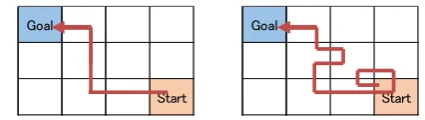
In this study, A Prot Sharing agent put Q-value on the actions of the path made by the agent as left of gure 2. In gure 2, the agent reaches the goal by passing through the path same as right of gure 2. then, the agent makes the path left of gure 2 from right of gure 2, and updates actions on the path left of gure 2. the way of making the pass is according to the following three rules.

1. The agent follows a path, and stores the path it already pass.

2. When the agent goes back to the same state, the path between same states from the path already stored by the agent is reset.

3. If the agent reaches the goal, the way is nished.

The reason why the agent makes this path is that Q-values of all actions become like Q-value of common Q-learning and the situation becomes like that of proposed method.

3.

MULTI-AGENT COOPERATION TASK

(3)

㻳㼛㼍㼘 㻿 㻿㼠㼍㼞㼠

㻭 㻿㼠㼍㼞㼠㻮

㻳㼛㼍㼘 㻸

Figure 3: Maze Problem

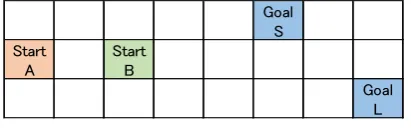
each agent attempts to selshly learn the minimum step for him thus does not nd a cooperating behavior with other agents. For instance, on the maze problem shown by Figure 3, when two agents are placed at states A and B respectively, they attempt to reach the same goal state S since their min-imum steps to goal can be achieved by reaching it. In this case, the agent who is placed at state B can potentially reach goal state S faster than another agent at state A. Thus, the agent at state A should reach the goal state L. This is the best (but selsh) solution for the agent at state B while the worst solution for agent at state A since he should take the longest step to reach goal. The cooperating behavior can be determined as; the agents at state A and B reach the goal state S and L respectively. This diculty is often called as a dilemma problem.

2EVHUYHVWDWH

6HOHFWDFWLRQ EHJLQ

HQG <HV

1R 7KHQXPEHURILWHUDWLRQV

EHFRPHVRYHUWKUHVKROG" *HWUHZDUG

,QWHUQDOUHZDUGVKDSLQJ XSGDWH4YDOXH

*RDOGHWHUPLQDWLRQ 8SGDWHPLQLPXPVWHSV

6WDWHWUDQVLWLRQ

6WHSEHFRPHVRYHU WKUHVKROG" 1R

<HV

5HDFKWKHJRDO" 1R

<HV

XSGDWH4YDOXH

Figure 4: Flow chart of proposed method

4.

PROPOSED METHOD

In the dilemma maze problem like Figure 3, in order to achieve the cooperation of agents, the proposed method mainly has the following two steps; Step 1 is a process of goal determination with communication between the agents, and step 2 is a process of internal reward shaping. The remain of this section rst explains the overview of the proposed method as shown in Figure 4 and then the main 2 steps pointed at the processes 8 and 9 on the gure.

4.1

Overview of procedure

As shown in Figure 4, the agents observe a state and then choose an action as the framework of reinforcement learn-ing (processes 1 and 2), which results in the state transition as process 3. Then, the agent updates Q-value for the exe-cuted action (process 4). These processes are the standard procedure of the reinforcement learning and the cycle from processes 1 to 4 is often called as step".

After process 4 the proposed method determines whether each agent reached the goal (process 5). If the agent reach the goal, the receives reward (process 6); otherwise, jump to process 11. In process 7, the agent updates minimum steps; specically, if the number of steps from a start position to goal are shorter than stored minimum steps the agent has acquired before, the agent replaced the minimum steps with the new ones the agent newly founded.

Next, in process 8, the agent determines the optimal goal by the minimum steps (detail can be founded in subsection 4.2). Then, the agent estimates an internal reward by us-ing the minimum steps (detail can be founded in subsection 4.3). After that, the agent updates Q-value using internal reward in process 10. In process 11, the system determines whether the step count is greater than a threshold; If true, the system go to 12; otherwise, the agent goes back to pro-cess 1. In propro-cess 12, the system counts iteration of learning and determines whether this iteration count is greater than a threshold. the whole process is ended when the system meets this condition; otherwise, the system returns to pro-cess 1.

4.2

Goal determination

ŽŵŵƵŶŝĐĂƚŝŽŶ

DŝŶŝŵƵŵƐƚĞƉƐ DŝŶŝŵƵŵƐƚĞƉƐ

͛ƐƐƚĞƉƐ ͛ƐƐƚĞƉƐ

hƉĚĂƚĞƐƚĞƉƐ

㻳㼛㼍㼘 㻿 㻿㼠㼍㼞㼠

㻿㼠㼍㼞㼠 㻮

㻳㼛㼍㼘 㻸

/ŶƚĞƌŶĂůƌĞǁĂƌĚ

/ŶƚĞƌŶĂůƌĞǁĂƌĚ

Figure 5: Goal determination

(4)

In the gure, agent A has reached goalS and agent B has

reached goalLby passing through the path indicated by the

directional arrows. In this time, if the number oftASnewly

discovered is shorter than the number oftAS which agent A

already has had, thetAS is replaced with newtAS, and sent

to agent B. Then, Agent B update tBL by the way same

as agent A. This results in that each agent memorizes the minimum steps between all agents and all goals. Then, each agent determines the goal where all agent can receive the maximum rewards. In this gure, goalS is the goal which

agent A must reach and goalL is the goal which agent B

must reach, because the step count is shortest when agent A reaches goalS and agent B reaches goalL.

4.3

Internal Reward Shaping

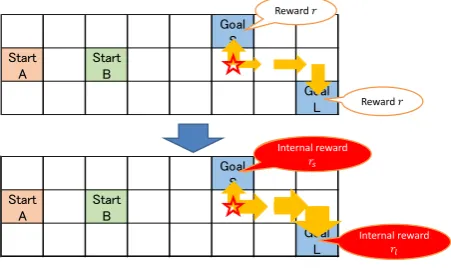
In this process, each agent shapes reward function to reach the goal chosen in rst step. Figure 6 presents a way for two agent to cooperate each other. tBS is minimum step count

between start B to goal S andtBL is minimum step count

between start A to goal L. Red star presents the turning point to determine whether the agent reaches goal state S or L. Yellow directional arrows present the agent's mainly action for each goal states, and arrows' thickness present Q-value.

Note that each agent knows the goal with the process in-troduced in subsection 4.2. The agent estimates Q-value to reach the optimal goal determined in subsection 4.2 by an internal reward for Q-value described above.

In gure 6, agent A should reach goalSand agent B should

reach goalL. Note, it is not necessary for agent A to set

in-ternal reward, since it reaches goalS normally (maximizing

reward for the agent a). However, Agent B should set the internal reward; under the standard reinforcement learning Agent B would reach to the goalS, while Agent B need to

reach the goalLfor maximizing the reward for all agents.

Then, in the proposed method, the internal reward is added to reform the reward shaping of agent B to reach the goal

L.

In the turning point on Figure 6, the Q-value of the action to reach goalS eventually converges to a valuer and thus

the Q-value of the action to reach goal L is2. If Agent

B uses the internal rewardrS,rL, the Q-value of the action

to reach goal S isrS and the Q-value of the action to reach

goal L isrLγ2. SincerLγ2 > rS is satised, ifrLis γr2+ 1

andrSisr, agent B will reach goal L nally and be able to

cooperate. We explains the general way to shape internal reward in the following.

4.3.1

Mathematical Analysis

In this section, there is mathematical description for internal reward shaping in preceding section. Therefore, we describe generalized proposed method on the case of the maze of gure 6 in this paper.

Agents estimate rAS, rAL, rBS and rBL for agents to get

cooperative action. rAS is agent A's internal reward for

goal S, rAL is agent A's internal reward for goal L,rBS is

agent B's internal reward for goal S and rBL is agent B's

internal reward for goal L. Whether to reach goal S or not is determined by Q-value in the turning point, if there are

㻳㼛㼍㼘 㻿 㻿㼠㼍㼞㼠

㻿㼠㼍㼞㼠 㻮

㻳㼛㼍㼘 㻸

ሗ㓘್

ሗ㓘್ /ŶƚĞƌŶĂůƌĞǁĂƌĚ

/ŶƚĞƌŶĂůƌĞǁĂƌĚ

㻳㼛㼍㼘 㻿 㻿㼠㼍㼞㼠

㻿㼠㼍㼞㼠 㻮

㻳㼛㼍㼘 㻸

ZĞǁĂƌĚ

ZĞǁĂƌĚ

Figure 6: Internal reward

same rewards in both goal in gure 6. Because agent A must reach goal S from the situation in gure 6, its Q-value had by action toward goal S is largest in the state in front of goal S. Also in the same manner for agent B, its Q-value of the action toward goal L is largest in the turning point. If tAS

represents minimum step count when agent A reaches goal S,tALrepresents minimum step count when agent A reaches

goal L,tBS represents minimum step count when agent B

reaches goal s and if tBL represents minimum step count

when agent B reaches goal L, each Q-value of the action toward goal S is as follow:

γtASr

AS, γtBSrBS (4)

Each Q-value of the action toward goal L is as follow:

γtAL−tASr

AL, γtBL−tBSrBL (5)

Because agent A must reach to goal S the expression is sat-ised as follows:

rAS> γtAL−tASrAL (6)

Also in the same manner for agent B, the expression is sat-ised as follows:

rBL>

rBS

γtBL−tBS (7)

In gure 6, equation 7 is equal torLγ2 > rS(2 ofrLγ2> rS

in gure 6 is tBL−tBS). As for agent A, it is not

neces-sary to set internal reward, sincerAS =r > γ2r =γ2rAL

is established while rAS =rand rAL=r. Therefore,

gen-eralization from gure 6 is succeeded. On implementation, the system must consider the quantity of the dierence to meet equation 6 and 7. Proposed method in this paper set parameterδ. rAS andrBL usingδare equation 8 and 9.

rAS=γtAL−tASrAL+δ (8)

rBL=

rBS

γtBL−tBS +δ (9)

Furthermore, we show the expression obtained by modifying the above equations below.

γtASr

AS> γtALrAL (10)

γtBSr

BS< γtBLrBL (11)

γtASr

AS presents the Q-value the action to reach goal S in

agent A's start point. γtALr

(5)

Ϭ ϭϬ ϮϬ ϯϬ ϰϬ ϱϬ ϲϬ ϳϬ ϴϬ ϵϬ ϭϬϬ

ϭ ϲ

ϭ

ϭ

ϭ

ϲ

Ϯ

ϭ

Ϯ

ϲ

ϯ

ϭ

ϯ

ϲ

ϰ

ϭ

ϰ

ϲ

ϱ

ϭ

ϱ

ϲ

ϲ

ϭ

ϲ

ϲ

ϳ

ϭ

ϳ

ϲ

ϴ

ϭ

ϴ

ϲ

ϵ

ϭ

ϵ

ϲ

^

Ƶ

ĐĐ

Ğ

ƐƐ

Ɖ

ƌŽ

ď

Ă

ď

ŝů

ŝƚ

LJ

;й

Ϳ

DĂnjĞŶƵŵďĞƌ

Figure 7: Q-learning case 1

Ϭ ϭϬ ϮϬ ϯϬ ϰϬ ϱϬ ϲϬ ϳϬ ϴϬ ϵϬ ϭϬϬ

ϭ ϲ

ϭ

ϭ

ϭ

ϲ

Ϯ

ϭ

Ϯ

ϲ

ϯ

ϭ

ϯ

ϲ

ϰ

ϭ

ϰ

ϲ

ϱ

ϭ

ϱ

ϲ

ϲ

ϭ

ϲ

ϲ

ϳ

ϭ

ϳ

ϲ

ϴ

ϭ

ϴ

ϲ

ϵ

ϭ

ϵ

ϲ

^

Ƶ

ĐĐ

Ğ

ƐƐ

Ɖ

ƌŽ

ď

Ă

ď

ŝů

ŝƚ

LJ

;й

Ϳ

DĂnjĞŶƵŵďĞƌ

Figure 8: Proposed method(Q-learning, gap10) case 1

Ϭ ϭϬ ϮϬ ϯϬ ϰϬ ϱϬ ϲϬ ϳϬ ϴϬ ϵϬ ϭϬϬ

ϭ ϲ

ϭ

ϭ

ϭ

ϲ

Ϯ

ϭ

Ϯ

ϲ

ϯ

ϭ

ϯ

ϲ

ϰ

ϭ

ϰ

ϲ

ϱ

ϭ

ϱ

ϲ

ϲ

ϭ

ϲ

ϲ

ϳ

ϭ

ϳ

ϲ

ϴ

ϭ

ϴ

ϲ

ϵ

ϭ

ϵ

ϲ

^

Ƶ

ĐĐ

Ğ

ƐƐ

Ɖ

ƌŽ

ď

Ă

ď

ŝů

ŝƚ

LJ

;й

Ϳ

DĂnjĞŶƵŵďĞƌ

Figure 9: Q-learning case 2

Ϭ ϭϬ ϮϬ ϯϬ ϰϬ ϱϬ ϲϬ ϳϬ ϴϬ ϵϬ ϭϬϬ

ϭ ϲ

ϭ

ϭ

ϭ

ϲ

Ϯ

ϭ

Ϯ

ϲ

ϯ

ϭ

ϯ

ϲ

ϰ

ϭ

ϰ

ϲ

ϱ

ϭ

ϱ

ϲ

ϲ

ϭ

ϲ

ϲ

ϳ

ϭ

ϳ

ϲ

ϴ

ϭ

ϴ

ϲ

ϵ

ϭ

ϵ

ϲ

^

Ƶ

ĐĐ

Ğ

ƐƐ

Ɖ

ƌŽ

ď

Ă

ď

ŝů

ŝƚ

LJ

;й

Ϳ

DĂnjĞŶƵŵďĞƌ

Figure 10: Proposed method(Q-learning, gap10) case 2

Figure 11: Common Q-learning vs Proposed method

action to reach goal L in agent A's start point. γtBSr

BS

presents the Q-value the action to reach goal S in agent B's start point. γtBLr

BL presents the Q-value the action to

reach goal L in agent B's start point. Therefore, whether to reach the goal or another goal, is decided by whether to choose action towards the goal or another goal, at the start state.

5.

EXPERIMENT

5.1

Experimental setting

Here, we test our mechanism on two reinforcement learning techniques Q-learning and Prot Sharing, i.e., both are ex-tended with the proposed method to be applicable to the multi-cooperation task on the maze problem. Specically, we apply both extended techniques to 100 dierent types of 3x8 grid mazes where two start states and two goal states are dierently placed in the maze. Note this paper deals with 2 agents cooperation task. We consider the following four cases as possible congurations on multi-agent cooperation task;

case 1 ideal and easy case

In this case, an agent cannot reach the goal another agent already reached, and all agents already knows minimum steps between every start and every goal at

rst. In addition, if each agent observes the same state three times and Q-value is decreased over 0.1, Q-value is not updated in that iteration.

case 2 ideal and dicult case

In this case, each agent reaches the goal even if other agents reached same goal and all agents already knows minimum steps between every start and every goal at rst.

case 3 practical and easy case

In this case, an agent cannot reach the goal another agent already reached, and all agents do not know min-imum steps between every start and every goal at rst. In addition, if each agent observe same state three times and Q-value is decreased over 0.1, Q-value is not updated in that iteration, and when minimum steps were updated, agents initialize all Q-value.

case 4 practical and dicult case

(6)

Ϭ ϭϬ ϮϬ ϯϬ ϰϬ ϱϬ ϲϬ ϳϬ ϴϬ ϵϬ ϭϬϬ

ϭ ϲ

ϭ

ϭ

ϭ

ϲ

Ϯ

ϭ

Ϯ

ϲ

ϯ

ϭ

ϯ

ϲ

ϰ

ϭ

ϰ

ϲ

ϱ

ϭ

ϱ

ϲ

ϲ

ϭ

ϲ

ϲ

ϳ

ϭ

ϳ

ϲ

ϴ

ϭ

ϴ

ϲ

ϵ

ϭ

ϵ

ϲ

^

Ƶ

ĐĐ

Ğ

ƐƐ

Ɖ

ƌŽ

ď

Ă

ď

ŝů

ŝƚ

LJ

;й

Ϳ

DĂnjĞŶƵŵďĞƌ

Figure 12: Proposed method(Q-learning) case 3

Ϭ ϭϬ ϮϬ ϯϬ ϰϬ ϱϬ ϲϬ ϳϬ ϴϬ ϵϬ ϭϬϬ

ϭ ϲ

ϭ

ϭ

ϭ

ϲ

Ϯ

ϭ

Ϯ

ϲ

ϯ

ϭ

ϯ

ϲ

ϰ

ϭ

ϰ

ϲ

ϱ

ϭ

ϱ

ϲ

ϲ

ϭ

ϲ

ϲ

ϳ

ϭ

ϳ

ϲ

ϴ

ϭ

ϴ

ϲ

ϵ

ϭ

ϵ

ϲ

^

Ƶ

ĐĐ

Ğ

ƐƐ

Ɖ

ƌŽ

ď

Ă

ď

ŝů

ŝƚ

LJ

;й

Ϳ

DĂnjĞŶƵŵďĞƌ

Figure 13: Proposed method(Prot Sharing) case 3

Ϭ ϭϬ ϮϬ ϯϬ ϰϬ ϱϬ ϲϬ ϳϬ ϴϬ ϵϬ ϭϬϬ

ϭ ϲ

ϭ

ϭ

ϭ

ϲ

Ϯ

ϭ

Ϯ

ϲ

ϯ

ϭ

ϯ

ϲ

ϰ

ϭ

ϰ

ϲ

ϱ

ϭ

ϱ

ϲ

ϲ

ϭ

ϲ

ϲ

ϳ

ϭ

ϳ

ϲ

ϴ

ϭ

ϴ

ϲ

ϵ

ϭ

ϵ

ϲ

^

Ƶ

ĐĐ

Ğ

ƐƐ

Ɖ

ƌŽ

ď

Ă

ď

ŝů

ŝƚ

LJ

;й

Ϳ

DĂnjĞŶƵŵďĞƌ

Figure 14: Proposed method(Q-learning) case 4

Ϭ ϭϬ ϮϬ ϯϬ ϰϬ ϱϬ ϲϬ ϳϬ ϴϬ ϵϬ ϭϬϬ

ϭ ϲ

ϭ

ϭ

ϭ

ϲ

Ϯ

ϭ

Ϯ

ϲ

ϯ

ϭ

ϯ

ϲ

ϰ

ϭ

ϰ

ϲ

ϱ

ϭ

ϱ

ϲ

ϲ

ϭ

ϲ

ϲ

ϳ

ϭ

ϳ

ϲ

ϴ

ϭ

ϴ

ϲ

ϵ

ϭ

ϵ

ϲ

^

Ƶ

ĐĐ

Ğ

ƐƐ

Ɖ

ƌŽ

ď

Ă

ď

ŝů

ŝƚ

LJ

;й

Ϳ

DĂnjĞŶƵŵďĞƌ

Figure 15: Proposed method(Prot Sharing) case 4

Figure 16: Q-learning vs Prot Sharing

We use the parameters for Q learning and Prot sharing as summarized in Table 1. To evaluate eectiveness of our method, as an evaluation criterion, we calculate a success rate of two agents took the cooperating behaviors at the end of iterations (among 999110000 iterations). We calculate the average of the success rate of 10 experiments.

Table 1: Parameters

Q-learning Prot Sharing

iterations 10000

active frequency 100

initial Q-value 0.1 0

learning rateα 0.1 not exist

discount rateγ 0.9 not exist

coecientCbid N/A 0.1

random seed 0 1 2 3 4 5 6 7 8 9

action selection ϵ-greedy

ϵ= 0.7 ϵ= 0.5

reward 10

constantδ 0.1 0.5 1 10 1

5.2

Result

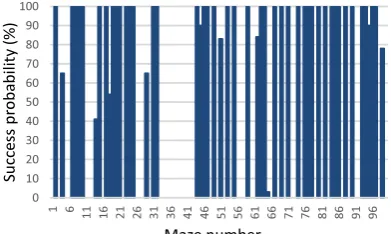
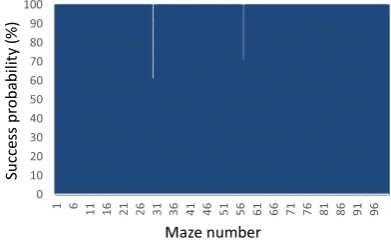
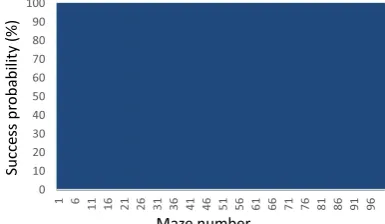
Figures 9-15 show the success rate. The vertical axis shows success times of cooperation and horizontal axis presents 100

kinds of mazes. Agents could always cooperate each other in case 1 and 2, but agents could not always cooperate each other in case 3 and 4. Common Q-learning agents failed to cooperate each other and proposed method agents succeeded in cooperating each other in case 3 and 4. At the result of compare learning agents and Prot Sharing agents, Q-learning agents were better than Prot Sharing agents.

5.2.1

Common Q-learning vs Proposed Method

The comparison result of common Q-learning and proposed method is as follow gure 11. Success rate of proposed method is 100 percent, and the proposed method is seen as the performance is good compared to common Q-learning.

5.2.2

Q-learning vs Profit Sharing

The comparison result of Q-learning applied the proposed method and Prot Sharing applied the proposed method is as follow gure 16. The performance of Prot Sharing is good. However, the performance of Q-learning is better than that of prot sharing.

5.2.3

The results of each reward difference

(7)

Ϭ ϭϬ ϮϬ ϯϬ ϰϬ ϱϬ ϲϬ ϳϬ ϴϬ ϵϬ ϭϬϬ ϭ ϲ ϭ ϭ ϭ ϲ Ϯ ϭ Ϯ ϲ ϯ ϭ ϯ ϲ ϰ ϭ ϰ ϲ ϱ ϭ ϱ ϲ ϲ ϭ ϲ ϲ ϳ ϭ ϳ ϲ ϴ ϭ ϴ ϲ ϵ ϭ ϵ ϲ ^ Ƶ ĐĐ Ğ ƐƐ Ɖ ƌŽ ď Ă ď ŝů ŝƚ LJ ;й Ϳ DĂnjĞŶƵŵďĞƌ

Figure 17: gap0.1, case 1

Ϭ ϭϬ ϮϬ ϯϬ ϰϬ ϱϬ ϲϬ ϳϬ ϴϬ ϵϬ ϭϬϬ ϭ ϲ ϭ ϭ ϭ ϲ Ϯ ϭ Ϯ ϲ ϯ ϭ ϯ ϲ ϰ ϭ ϰ ϲ ϱ ϭ ϱ ϲ ϲ ϭ ϲ ϲ ϳ ϭ ϳ ϲ ϴ ϭ ϴ ϲ ϵ ϭ ϵ ϲ ^ Ƶ ĐĐ Ğ ƐƐ Ɖ ƌŽ ď Ă ď ŝů ŝƚ LJ ;й Ϳ DĂnjĞŶƵŵďĞƌ

Figure 18: gap0.5, case 1

Ϭ ϭϬ ϮϬ ϯϬ ϰϬ ϱϬ ϲϬ ϳϬ ϴϬ ϵϬ ϭϬϬ ϭ ϲ ϭ ϭ ϭ ϲ Ϯ ϭ Ϯ ϲ ϯ ϭ ϯ ϲ ϰ ϭ ϰ ϲ ϱ ϭ ϱ ϲ ϲ ϭ ϲ ϲ ϳ ϭ ϳ ϲ ϴ ϭ ϴ ϲ ϵ ϭ ϵ ϲ ^ Ƶ ĐĐ Ğ ƐƐ Ɖ ƌŽ ď Ă ď ŝů ŝƚ LJ ;й Ϳ DĂnjĞŶƵŵďĞƌ

Figure 19: gap1, case 1

Ϭ ϭϬ ϮϬ ϯϬ ϰϬ ϱϬ ϲϬ ϳϬ ϴϬ ϵϬ ϭϬϬ ϭ ϲ ϭ ϭ ϭ ϲ Ϯ ϭ Ϯ ϲ ϯ ϭ ϯ ϲ ϰ ϭ ϰ ϲ ϱ ϭ ϱ ϲ ϲ ϭ ϲ ϲ ϳ ϭ ϳ ϲ ϴ ϭ ϴ ϲ ϵ ϭ ϵ ϲ ^ Ƶ ĐĐ Ğ ƐƐ Ɖ ƌŽ ď Ă ď ŝů ŝƚ LJ ;й Ϳ DĂnjĞŶƵŵďĞƌ

Figure 20: gap0.1, case 2

Ϭ ϭϬ ϮϬ ϯϬ ϰϬ ϱϬ ϲϬ ϳϬ ϴϬ ϵϬ ϭϬϬ ϭ ϲ ϭ ϭ ϭ ϲ Ϯ ϭ Ϯ ϲ ϯ ϭ ϯ ϲ ϰ ϭ ϰ ϲ ϱ ϭ ϱ ϲ ϲ ϭ ϲ ϲ ϳ ϭ ϳ ϲ ϴ ϭ ϴ ϲ ϵ ϭ ϵ ϲ ^ Ƶ ĐĐ Ğ ƐƐ Ɖ ƌŽ ď Ă ď ŝů ŝƚ LJ ;й Ϳ DĂnjĞŶƵŵďĞƌ

Figure 21: gap0.5, case 2

Ϭ ϭϬ ϮϬ ϯϬ ϰϬ ϱϬ ϲϬ ϳϬ ϴϬ ϵϬ ϭϬϬ ϭ ϲ ϭ ϭ ϭ ϲ Ϯ ϭ Ϯ ϲ ϯ ϭ ϯ ϲ ϰ ϭ ϰ ϲ ϱ ϭ ϱ ϲ ϲ ϭ ϲ ϲ ϳ ϭ ϳ ϲ ϴ ϭ ϴ ϲ ϵ ϭ ϵ ϲ ^ Ƶ ĐĐ Ğ ƐƐ Ɖ ƌŽ ď Ă ď ŝů ŝƚ LJ ;й Ϳ DĂnjĞŶƵŵďĞƌ

Figure 22: gap1, case 2

Figure 23: Result of reward dierence for proposed method(Q-learning)

5.3

Discussion

From the result in the cases 1 and 2, we can think the math-ematical analysis in Section 4 is validated, since our analysis argues that the internal reward can be theoretically deter-mined if agents know the minimum steps to possible goal states. However, as shown in the results of the cases 3 and 4, for some mazes, our method fails to enable agents to cooper-ate with each other. Let us discuss why the agent sometimes fail to cooperate.

In case 3 and 4, proposed method agents using Q-learning fail to cooperate each other in same two mazes. Thus, there are mazes that agents cannot cooperate easily. The reason of this is that agents cannot reach every goal enough times. In addition, a gap between case 1,2 and 3,4 is whether agents know minimum steps or not. Therefore, the reason of error is that agents cannot search minimum steps. Against this problem, if we increase learning iterations, the errors are decreased. For example, gure 25 shows the result of 30000 iterations in case 4. However, solution for many learning iterations is not practical. From the above, a searchability of agents decides whether an agent succeeds in cooperating another agent. We put 0.7 to epsilon in order to improve the searchability in experiment of this paper. Therefore, agents search many times to large areas of maze. In this paper experiment, epsilon is larger than normal.

5.3.1

Profit Sharing

When reaching a goal, Prot Sharing agents update Q-values of actions between from start to goal. Therefore, Prot Sharing agents are better eciency than Q-learning agent in terms of searching areas. However, experiment results of proposed method using Prot Sharing are worse than those of proposed method using Q-learning. The reason of this is the dierence of ability of searching minimum steps

be-tween Q-learning and Prot Sharing. Q-learning is better in terms of searching minimum steps, because Q-learning ensures optimality of Q-value. However, the result of Prot Sharing didn't have dependence of each maze. For that rea-son, Prot Sharing agents can search larger areas than Q-learning agents in terms of Q-value.

Ϭ ϭϬ ϮϬ ϯϬ ϰϬ ϱϬ ϲϬ ϳϬ ϴϬ ϵϬ ϭϬϬ ϭ ϲ ϭ ϭ ϭ ϲ Ϯ ϭ Ϯ ϲ ϯ ϭ ϯ ϲ ϰ ϭ ϰ ϲ ϱ ϭ ϱ ϲ ϲ ϭ ϲ ϲ ϳ ϭ ϳ ϲ ϴ ϭ ϴ ϲ ϵ ϭ ϵ ϲ ^ Ƶ ĐĐ Ğ ƐƐ Ɖ ƌŽ ď Ă ď ŝů ŝƚ LJ ;й Ϳ DĂnjĞŶƵŵďĞƌ

Figure 25: Result of 30000 iterations

5.3.2

Gap between internal rewards

(8)

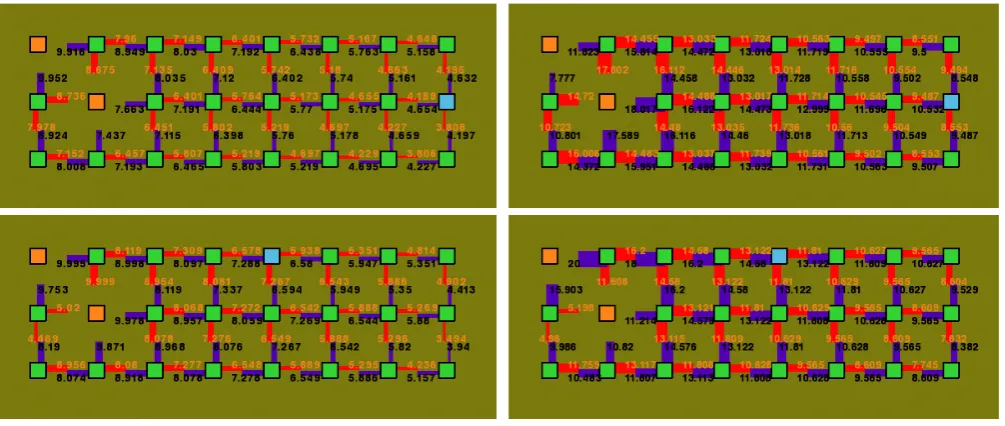
Figure 24: Q-value in maze 14 (upper left: agent A and internal reward gap is 0.1, lower left: agent B and internal reward gap is 0.1, upper right: agent A and internal reward gap is 10, lower right: agent B and internal reward gap is 10)

bar extending from squares presents action that agents can choose in this position. Red bar presents right and down action, and blue bar presents left and up action. The number near these bars presents Q-value. Upper mazes shows about Q-value of agent A, and other mazes shows about Q-value of agent B. Left mazes shows Q-value when internal reward gap is 0.1, and right mazes shows Q-value when internal reward gap is 10. From gure 24, left agents could not cooperate, but right agents had cooperated. In addition, If the gap of internal reward is increased, the gap between Q-value of actions in same position is increased. From this thing, it becomes dicult for agents to choose dierent action in each position than before, because the magnitude relation of Q-value does not change hardly. From the above, agents have a robustness to incorrect learning by using the gap of internal reward. Therefore, if the gap of internal reward is increased, agents can reach the goal for cooperation between agents. However, if agents make mistake to choose the goal, in other words, if agents learn by mistake without cognition, agents cannot correct learning hardly by same reason.

6.

CONCLUSION

This paper focused on a multi-agent cooperation which is generally dicult to be achieved without sucient informa-tion of other agents, and proposed the reinforcement learn-ing method that introduced an internal reward for a multi-agent cooperation without sucient information. To guar-antee to achieve such a cooperation, this paper theoreti-cally derived the condition of selecting appropriate actions by changing internal rewards given to the agents, and ex-tends the reinforcement learning methods (i.e., Q-learning and Prot Sharing) to enable the agents to acquire the ap-propriate Q-values updated according to the derived con-dition. Through the intensive simulations on the 3x8 grid maze problems where two agents are required to cooperate with each other, the following implications were revealed: (1) our proposed method successfully enables the agents to

select their own appropriate cooperating actions which con-tribute to acquiring the minimum steps towards to their goals, while the conventional methods (i.e., Q-learning and Prot Sharing) cannot always acquire the minimum steps. Note that the same tendency is obtained even in the dif-ferent parameter settings such as the epsilon and the gap of internal reward; and (2) the proposed method based on Prot Sharing provides the same good performance as the proposed method based on Q-learning. What should be no-ticed here is that the results have only been obtained from one simple gird maze problem with two agents. Therefore, further careful qualications and justications, such as an analysis of results using other maze problems or an increase of the number of agents, are needed to generalize our re-sults. Such important directions must be pursued in the near future in addition to the following future research: (1) reducing the number of sending the information to other agents; and (2) applying proposed method to other tasks.

7.

REFERENCES

[1] H. Iima and Y. Kuroe, Swarm Reinforcement Learning Methods Improving Certainty of Learning for a Multi-Robot Formation Problem, CEC Conference, pp.3026-3033, 2015. [2] Mohamed Elidrisi, Nicholas Johnson, Maria Gini and Jacob

Crandall, Fast Adaptive Learning in Repeated Stochastic Games by Game Abstraction, AAMAS Conference, pp.1141-1148, 2014.

[3] Christopher JCH Watkins, Learning from Delayed Rewards, King's College, 1989.

[4] John J. Grefenstette, Credit Assignment in Rule Discovery Systems Based on Genetic Algorithms, Machine Learning, 3, pp.225-245, 1988.

[5] Christopher JCH Watkins and Peter Dayan, Technical Note: Q-Learning, Machine Learning, 8, pp55-68, 1992.

Figure

Figure 1: Reward function for Pro�t Sharing this paper em-ploys
Figure 4: Flow chart of proposed method
Figure 6: Internal reward
Figure 9: Q-learning case 2
+4

References

Related documents

This is an interesting work because, on the basis of what was defined by Toms (2002) with regard to the determinants of corporate reputation, this thesis

Njegov govor žestoko osuđuje imperijalizam (pogotovo američki) i poziva sve sunarodnjake u Jugoslaviji na borbu za ideale koje promiče Jugoslavija. S druge strane tajnik

Considering the behavior of power factor, current and voltage harmonic distortion, unbalance factors and reactive power daily variation, the developed tool is able to select

We all have areas in our lives where we feel stuck, at least one area that we cannot change, but look for what you can change, look for what you can learn, look for what God

Findings from this explorative, qualitative study support the need to focus on data quality, data locatability, data compatibility between systems, system reliability, training

The instrument contained 13 attitudinal statements related to the newsletter received, measured on a seven-point Likert scale: reactions to the site (newsletter frequency, drop

For children, a higher unemployment rate is associated with a 1.37 percentage point (4.69%) higher probability of public health insurance coverage, with the result that there is

Objetivo: Caracterização das espécies de Candida, na flora oral de crianças infectadas pelo HIV-1, identificadas antes e após a introdução da terapêutica com inibidores