9
TEAMWORK IN EDUCATION
Andrea Bencsik Széchenyi István University, Hungary E-mail: [email protected] Erzsébet Noszkay, Ildiko Marosi
Szent István University, Hungary E-mail: [email protected]
Abstract
Knowledge is a determinative factor for companies at the competitive market. Demands change very quickly. Organizations may suit these demands if they can build knowledge management system at their companies. One of the most important elements of this process is teamwork. How can we achieve - from teachers to professors at schools and at universities – that children and students should work in teams with pleasure?
This international research started in the year of 2001 in Mexico and from that time a lot of teachers, research-ers, professors from different countries have joined it.
The hypothesis was that there are samples in teachers’ behaviour that can be defi ned in advance and that come from their national cultures especially in the area of teamwork.
We have continued this research by questionnaires and analyzed it with ANOVA and statistics.
We verifi ed our hypothesis, but this research does not postulate every difference between these countries de-riving from cultures. The fact that there are various forms of differences refer to attitudes to work, which are fundamental differences (structural and cultural, too).
The results of this research can be used in the development of education and teaching methods fi rst in the university. These results also can be used together with another international research to develop the pos-sibilities and methods of teamwork in education at universities and we can give instructions to management how to motivate their employees to the spontaneous and free decision knowledge sharing. We will write about this research and its results in this paper.
Key words: education, knowledge, knowledge management system, teamwork.
Introduction
The secret of successful companies has been debated for a long time. How can it be that one of them is more successful than the other but they compete with each other at the same market, they work with similar employees, they have the same organizational structure, they work in the same division of labour, etc.
10 But we cannot estimate companies without their environment. They work in given social and
cultural conditions and with employees who are chosen by themselves. Their success at the market is determined by these two facts. We talk a lot about the changes of our environment that require organizations to change continuously. This willingness to change, fl exibility, skill of reaction, skill of renewal are determined by the creativity of employees and colleagues, their willingness to study, the leaders’ style and by the organization culture (Gyökér, 2004).
Managers have to prepare for management in a new style, to comply with the requirements of becoming a learning organization, keeping knowledge and at the same time for the adaptation of recent methods of knowledge management not only mentally, but also consciously.
In our opinion groups as the basic pillars of an organization have a remarkable role in the suc-cessful realization of the above mentioned factors. Collective learning, effective teamwork contrib-ute to the realization of successful knowledge management work and the development of learning organization, which are the conditions of successful operation at the market (Nonaka et al., 2001).
About Knowledge
It is a big problem of companies how to have their employees work to achieve a better business result. Should employees work alone or together in groups? Some new management theories and practices have appeared that demand teamwork. One of them is knowledge management - the most popular theory nowadays - that forces to apply this method. This demand and some other factors together lead there that human resources become more and more important in the life of companies at the competitive market. This important role can be felt in the forming of operation of learning organization and in the forming of organizational structures. Forming of a learning organization is an elementary prerequisite for the operation of knowledge management systems in companies. This functional method has some signifi cant features and one of them is teamwork. (Bakacsi et al. 2004)
Possibilities of individuals, their knowledge at a higher level, their performance is a sample of organization. People are not the same, they have different skills, different willingness to study, different abilities and ways of thinking that companies should take into consideration at a higher level to achieve a better business result. It is the principle of the best practice. In each organization there are some people who are at the top of these areas. They are either the fi rst to know something much better than the other or they can do something in a different way. It means that companies use the labour of these excellent people on a group level, after it on organizational level. This initiative from inside the organization is called knowledge sharing. This can support the success of companies at the market.
What can we do to realize these principles in practice? (Davenport, 2001)
best practice has to start from individuals or from groups or from organizational level
•
management and the members of the organization have to be extrovert to this new way
•
of thinking
we have to reward people who use the best practice
•
we have to disregard “lilac fog effect”
•
we have to allow spontaneous self – teaching groups to operate
•
remove obstacles form the way of generalizing best practice
•
11
Teams that can realize these demands in organizations are not under any circumstance formal groups operating with serious rules. These teams can be professional groups that can be formed spontaneously or among rules. They support possibilities of knowledge sharing and study and they help the view of knowledge management to get spread.
The job of these groups is to support the organization in period of change, fi rst in those cases when the aim is what we have written in the upper section (Bencsik, 2003).
Importance of Teams
People have formed a group from the ancient times in order to carry out their jobs or tasks in a more simple and effective way. To be a part of a team can be advantageous or disadvantageous from the view of individuals and teams, too. Advantages are that it gives safety it can give a feeling to belong somewhere, team members accept and support each other. Disadvantages are: strained relations, refusal, confl icts, etc. But people join teams because the balance of advantages and disad-vantages is better than working alone (Farkas, 2003).
Relationship between organization and teams
There are some researches that have shown organizations can gain advantages by means of teams. These advantages are more knowledge and information, approaching problems multilaterally, better understanding of decisions, participation – acceptance. Certain researches support the fact that a team accept decisions and team members feel responsibility for realizing them if they took part in problem solving. With better utilization of human resources, companies can reduce their costs and they can reach their aims in the areas of buyer – orientation, fl exibility and implementation. With a good teamwork employees can be motivated on a higher level, their commitment increases and the organization can expect better innovation, fl exibility and solving of complex tasks.
What else is needed to have really tangible results? To this we need a cultural background, which allows, moreover helps ambitions directed to the development of emotional intelligence of organizational groups and guarantees a convenient background to the correct treatment of possible confl icts.
To the successful realization of group work there are some more elements apart from emotional intelligence which infl uence its successful work. For example:
management based on participation,
•
concentration on future,
•
shared responsibility,
•
concentration on tasks,
•
well-defi ned aim,
•
communication on a high level,
•
creativity,
•
quick reply,
•
effectiveness of group roles etc. (Bencsik, 2003).
•
Role of teamwork in the creation of group and organizational knowledge
In teamwork there are interactions among people which can bring swapping of information and knowledge into action. To get information we have a lot of possibilities. The most important of these: own experiences, studying, coaching, mentor, informal nets, good communication etc. They can be in the front of teamwork. For common aims team members have to work not only close to each other but together. It means they need to use knowledge and experiences of each other. In this situation the requirement of knowledge sharing arises and individual knowledge should be lifted to a group level.
12 with different cultures very often have to work together. That is why it is very signifi cant to know
the characteristics of different countries. Sometimes we can only feel that the colleagues’ behaviour is strange for us, but we do not know the reasons for their different work moral or behaviour. We can especially meet some surprising elements during teamwork.
People can feel it daily who work for multinational companies. But what are our experiences? We work at universities and we can often meet students or colleagues from different countries with different cultures. How can we work and live together with them, how can we treat the different behaviour of versatile cultures?
We can often experience that students or colleagues who worked abroad earlier, could not use their knowledge that they brought from a foreign country because there are some cultural differences in their teamwork.(Herneczki, 2006) The system of education has changed in Hungary and the func-tion of these institufunc-tions demands new competences from leaders and teachers. In the operafunc-tion of this system the mechanisms of market have appeared which force the institutions to be extrovert, to work with partners as a service organization.
A report of Environment and Development World Committee turned to governments, across them to ministries, to education organizations and to institutions. This report speaks directly to the young, teachers to make them understand the basic principium of the future: the conceptual class of sustainable development and knowledge-based society.
When we talk about knowledge – based society, more exactly about educational system and its role in this situation, we can ask some important questions:
What tasks does the education system have in this knowledge – based society?
•
How can education operate more effi ciently?
•
How can educational system initiate each segment of society in this study – process?
•
How can an educational system obey to these changes and to the changed demands that
•
come from these situations?
How can schools compete with different types of the media that can give knowledge, too (for
•
example: written and electronic papers, internet, etc.) or how can it obey to these systems? How can knowledge that comes from the schools be closer to economic demands?
•
How can this knowledge become a basis of development?
•
How can we achieve that knowledge acquisition be simple and fast?
•
On which skills do we have to focus (that are in connection with strengthening society
•
and demands of competitive markets) and which skills are needed to be a participant of this knowledge – based society?
How diffi cult or easy is it for us to accept and adopt these demands into our value – systems? How can we characterize nations - with the same parameters - that were participants in our research?
It is worth examining how the real features of national culture have been shown in researches carried out so far about organizational culture. These features come from the history of countries and from religious habits, etc. This part of the iceberg is under water. These features can be changed with diffi culties they need a long time to be revealed.
Cultures cannot answer the questions how we can increase the effectiveness of processes or which social system is better than the other. But we think we have to know more about national cultures in order to make useful suggestions to improve the education system, especially in the area of successful operation of learning organizations, knowledge sharing and teamwork. We hope if we can understand the reasons of students’ and teachers’ behaviour from different cultures in different situations, we can do more for the economic success in our country and for the future.
13
In our paper we will show the features of national cultures of some countries that participated in our research: China, Russia and Hungary.
How and Why Did We Choose These Cultures?
Culture is the soul of a nation’s life. This factor is as important for people as other physical factors. Development of culture determines the civilization of a nation. If these values are destroyed, it means the end of a nation. We would not have liked to do examinations about national culture, but the earlier results of the same researches determine our ideas. We wanted to choose such nations which are in different culture groups on the basic of earlier researches.
Our starting point is the well known Hofstede model. (Hofstede, 1997) There are some other different models that come from the critical way of thinking or they have developed the earlier models.
On the basis of Hofstede model these are the following categories:
Hungary: well oiled mechanism (low index of power - distance, high index of uncertainty - avoid-ing
China: family (high index of power – distance, low index of uncertainty – avoiding) Russia: pyramid (high index of power – distance, and index of uncertainty – avoiding)
On the basic of another researcher – Jarjabka (Jarjabka, 2003):
Hungary: competing culture – circle (very high MAS and low index of power – distance) China: Janus faced culture – circle (the highest index of power – distance)
Russia: bureaucratic – centralized culture – circle (very high index of uncertainty – avoiding)
We disregard the presentation of these models, they can be found in other literatures. We will focus only on showing of clusters.
Bureaucratic – centralized culture – circle (very high index of uncertainty – avoiding): To this
category more groups of countries belong to:
Islamic world: Egypt, Malaysia, Turkey, Latin culture – circle: Brasil, Guatemala, Spain, Peru, post Communist Slavic countries: Bulgaria, Croatia, Russia, some developed countries: Belgium, France, the Netherlands.
Janus faced culture – circle (the highest index of power – distance): to this group belong to the
fast developing East – Asian countries: India, China, Thailand, African countries: Kenya, Nigeria, South – African Republic and some less developed countries from EU: Portugal. These organiza-tions are characterized by strongly hierarchic structures.
Competing culture – circle (very high MAS and low index of power – distance): To this cluster
more groups of countries belong to: English – speaking world: Australia, Canada, the UK, USA, German culture – circle from Europe: Austria, German, Switzerland, some post – Communist coun-tries: Check Republic, Poland, Hungary, Far – Eastern developed countries: Japan, South Korea. These countries have strong, determined, masculine behaviour at the markets. They like to invest, index of uncertainty – avoiding is lower than generally, their economy is open and there is a sharp competition among the organizations.
Methodology of Research
This international research started in the year of 2001 in Mexico by questionnaires and from this time a lot of teachers, researchers, professors from different countries have joined it. This re-search focused on the different universities from different countries. We joined the above mentioned research in the year of 2006. We compared three different countries that have very different national culture. They are China, Hungary and Russia.
14 The hypothesis was: there are samples in teachers’ behaviour that can be defi ned in advance
and that came from their national cultures especially in the area of teamwork.
Research Method
quantitative method by questionnaires
•
closed, opened and scaled questions
•
analysis of answers with MS Excel and SPSS programs (ANOVA,
• )
Characteristics of the Sample
stratifi ed
•
people of different countries/universities
•
random sampling
•
The survey was made by one – to – one interview and by post. We worked with random sampling and with target audiences. Although our sample was quite largescale (in the respect of the size of the sample) we cannot consider it as a representative sample. We would like to lay down already here that our results are authoritative, but these results cannot mean general connections in the popula-tion according to strict statistic rules. Apart from this we have to emphasize that we consider our investigation as a discover examination because such a complex research has not been conducted according to our note yet.
Table 1. Characteristics of Samples.
Number of cases Characteristics of sample
Russia 97 Random sample
China 96 Random sample
Hungary 105 Random sample
Chapters of Questionnaire
General characteristics
•
Methods of teaching
•
Students’ performance evaluation
•
Team and teamwork
•
○ General Questions
○ Worker Contributions
○ Work Outcomes
○ Work Relationship
In this paper we focus only on the last chapter, on the team and teamwork. We analyzed the questionnaires with ANOVA and statistics. We have compared the means of subsamples. The independent factors were the countries and dependent factors were the opinion about teamwork. In our analysis the signifi cant factors are from the questionnaire:
General Questions about Teams and Teamwork:
I prefer to work in teams even if I am capable of doing the whole job alone 1.
People generally prefer to work in teams even if they are capable of doing the whole 2.
15
Highly skilled people will accomplish more as a team than they would if each worked 3.
independently.
Team members will not help each other unless they trust each other 4.
Even if team members are alike in appearance they will differ in many ways that are not 5.
outwardly observable Worker Contributions:
For good teamwork, the most important factor is to have competent individuals on the 6.
team
For good teamwork, the most important factor is to have good relationships among team 7.
members
For good teamwork, the team itself is more important than individual members and the 8.
relationships among them Work Outcomes:
With teamwork, team morale (spirit) is more important than team performance 9.
With teamwork, team performance is more important than team morale (spirit). 10.
With teamwork, good performance is necessary for good morale (spirit). 11.
Work Relationships:
For effective teamwork, everyone on the team must get along well with everyone else 12.
on the team
For effective teamwork, interpersonal relationships will have little effect on the perform-13.
ance of the team
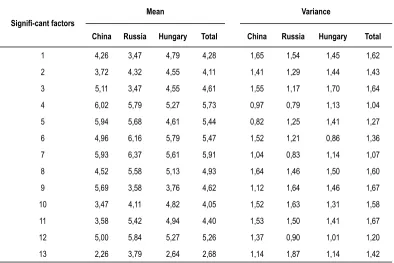
These signifi cant factors are in the following table. You can see the main mean values related to the countries and their variances. (With the ANOVA we compared the countries and their values and analyzed the differences.)
Table 2. Mean and Variance of Signifi cant Factors.
Signifi -cant factors
Mean Variance
China Russia Hungary Total China Russia Hungary Total
1 4,26 3,47 4,79 4,28 1,65 1,54 1,45 1,62
2 3,72 4,32 4,55 4,11 1,41 1,29 1,44 1,43
3 5,11 3,47 4,55 4,61 1,55 1,17 1,70 1,64
4 6,02 5,79 5,27 5,73 0,97 0,79 1,13 1,04
5 5,94 5,68 4,61 5,44 0,82 1,25 1,41 1,27
6 4,96 6,16 5,79 5,47 1,52 1,21 0,86 1,36
7 5,93 6,37 5,61 5,91 1,04 0,83 1,14 1,07
8 4,52 5,58 5,13 4,93 1,64 1,46 1,50 1,60
9 5,69 3,58 3,76 4,62 1,12 1,64 1,46 1,67
10 3,47 4,11 4,82 4,05 1,52 1,63 1,31 1,58
11 3,58 5,42 4,94 4,40 1,53 1,50 1,41 1,67
12 5,00 5,84 5,27 5,26 1,37 0,90 1,01 1,20
16 Results of Research Teamwork
Teams have a very important role in motivating knowledge sharing. People from these three countries prefer teamwork. China support this way of work better than Russia. And at the same time they have different opinion about the other people’s behaviour. You can see it in the Figure 1.
Figure 1. Teamwork (values means).
Worker Contributions
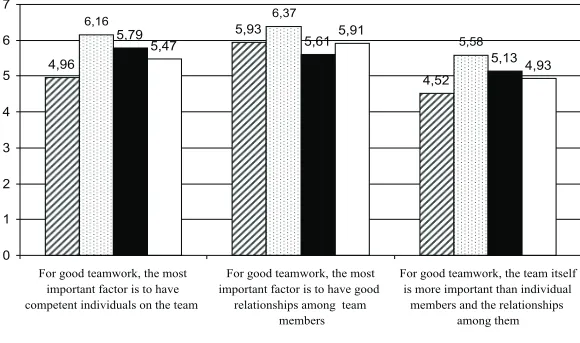
In this area the difference is the biggest between Chinese and Russian people. In worker con-tributions the calculated F values (which is the verifying statistics of ANOVA) were always bigger than those at the F table in the same degree of freedom at α = 0.05 signifi cant level.
In all cases the Russians think that the individuals and their performance are more important than team and team morale. The differences in the way of thinking refl ected most in the worker contributions however the fi gures in the chart do not highlight it so much. See it in the Figure 2.
17 Work Outcomes
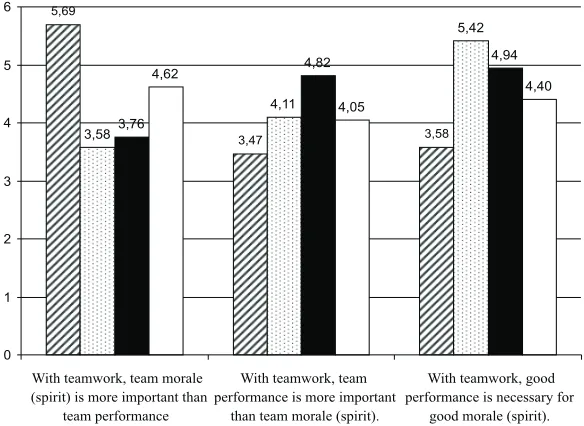
Chinese people prefer the team morale (spirit) most of all, but Russian people have a totally dif-ferent opinion about it, they think that a good performance is necessary for good spirit. We Hungarian people have the same opinion about it and at the same time we think that team performance is more important than team morale. But we think team performance depends on team morale, so we would turn the third question and we would say that good morale is necessary for a good performance. Figure 3rd illustrates this information.
Figure 3. Work Outcomes (values means).
Work Relationships
People from these three countries think it is very important to be in a good relationship with each other for effective teamwork. But they do not think that interpersonal relationship will have little effect on the performance of the team. You can see it in the Figure 4.
18 Advantages of Teamwork
According to the Russians the most important feature is effi ciency in a team. It comes from their earlier opinion. But they do not deem quality as an important factor.
According to Hungarian and Chinese people’s opinion there are some other important factors that bring advantages for teamwork for example: multiple opinion, group motivation, knowledge sharing and quality.
Disadvantages of Teamwork
According to the Hungarians and the Russians too the worst factor is the confl ict in a team. To treat this problem a very good team leader is needed. But the Russians think it is very diffi cult to lead a team and workload is not even.
Good Team Workers
The Russians like to work with reliable, honest, cooperative and highly skilled people. The Hungarians prefer these features, too, but not at the same measure. For the Hungarians the most important factor is to be highly skilled and they think that enthusiasm, persistent and problem
solving is important as well.
About Leadership
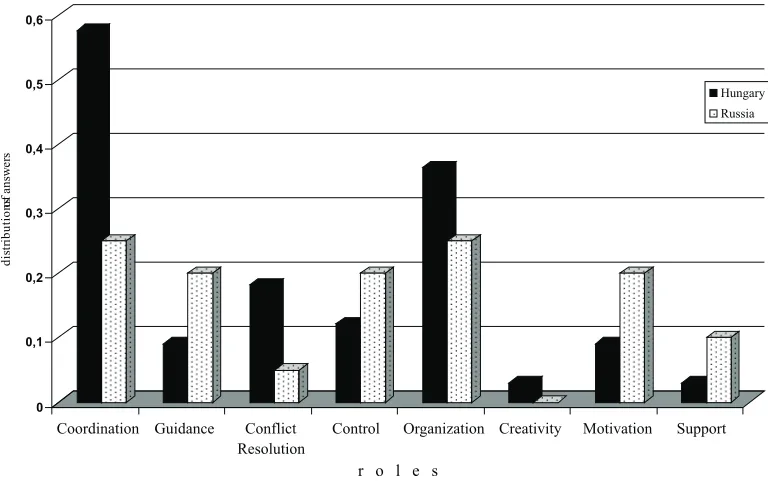
According to the Russians the two most important features are coordination and organization, but in not too high measure. In spite of this opinion the Hungarians think that the most signifi cant factor is coordination. In this area the biggest difference is between these two countries. The Rus-sians think that creativity is not important at all. See it in the Figure 5.
19 Conclusions
We can say that the difference among cultures can be seen from our results. (The calculated F values (which is the verifying statistics of ANOVA) were always bigger than those at the F table in the same degree of freedom at α = 0.05 signifi cant level.)
Clusters of cultures on the basis of earlier researches have been verifi ed.
We could establish that the higher education systems in the examined countries - as fi rstly important knowledge intensive organizations – are not at that high level so that they can support the methods of thinking and behaviour that are very decisive in the life of companies. Teamwork and knowledge sharing are prime movers of the economic development of companies. If we can-not communicate it at a high enough level to the students or cancan-not create the right conditions to change their behavioural style, we cannot hope for a serious development in the future.
But it is our responsibility. We have taken some steps to solve the problems. For example we have divided the extremely large groups of students into smaller groups and we have given them practical exercises that they had to prepare with each other within the frame of teamwork.
It is diffi cult to change the characteristics of cultures that are rooted deeply and sometimes it is impossible. But we have to aspire to move to the direction of demands and we have to do everything we can. Our teaching staff needs to change its attitude, to take part in trainings and we have to change our thinking and viewpoint. In this way we can create the conditions of the development of the educational system. These will be the basis for our students to become extrovert, well trained and prepared for teamwork in companies. In this way we can give a possibility to companies to reach success in the long run on the basis of creating a knowledge management system.
References
Bakacsi Gy.& Bokor A. & Császár Cs. & Gelei A. & Kováts K. & Takács S. (2004). Stratégiai emberi erőforrás menedzsment Budapest KJK- KERSZÖV Jogi és Üzleti Kiadó Kft.
Bencsik, A. (2003): Csoportszerepek és csoportfejlődés a tudásmenedzsment szolgálatában
Vezetéstudo-mány XXXIV./6. 17-24.
Davenport, T. & Prusak, L. (2001): Tudásmenedzsment. Budapest Kossuth Kiadó
Farkas, F. (2003) The Role of Leadership in Knowledge Management and Knowledge Transfer. In:
Knowledge Transfer, Small and Medium Sized Enterprises and Regional Development in Hungary. Szeged JATEPress.
Gyökér, I. (2004). A vállalat szellemi tőkéje - számolatlan vagyon. Harvard Businessmanager 2004,
December, Budapest.
Herneczki, K. (2006). Nemzeti szervezeti kultúrák I. CEOMagazine VII/4. 12-14.
Hofstede (1997). Cultures and Organizations (revised edition). New York: MacGrow Hill.
Jarjabka, A. (2003). Vizsgálatok a szervezeti kultúra témakörében kultúramodellek és hazai
alkalma-zhatóságuk (PhD Dissertation University of Pecs Hungary).
Lengyel, I. & Deák, Sz. (2002): Klaszter: a helyi gazdaságfejlesztés egyik sikeres eszköze.In: Buzás N. & Lengyel I. (Eds.):Ipari parkok fejlődési lehetőségei: regionális gazdaságfejlesztés, innovációs folya-matok és klaszterek. SZTE GTK, Szeged: JATEPress.
Mészáros, T. & Bálint, A. (2003). The Vision of Hungarian Small and Medium Sized Enterprises In:
Lengyel I. (Eds.) Knowledge Transfer, Small and Medium Sized Enterprises Development in Hungary. Szeged JATEPress.
Nonaka, I. & Toyama, R. & Byosiere, P. (2001). A Theory of Organizational Knowledge Creation:
20 Sveiby, K. E. (2001). Szervezetek új gazdagsága: a menedzselt tudás, KJK- KERSZÖV, Budapest Jogi
és Üzleti Kiadó Kft.
Varga, A. (2003). Agglomeration and the Role of Universities in Regional Economic Development In: Lengyel
I. (Eds): Knowledge Transfer, Small and Medium Sized Enterprises Development in Hungary. Szeged JATE-Press.
Adviced by Laszlo Jozsa, Széchenyi István University, Hungary
Andrea Bencsik Associate professor, Széchenyi István University, Hungary 9027 Győr, Egyetem tér 1.
Phone: +36-96-503-487.
E-mail: [email protected] Website: http://www.gtk.sze.hu/mmt/
Erzsébet Noszkay Associate professor, Szent István University, Hungary, 2103. Gödöllő, Páter Károly u. 1. Phone: +36-28-522-000.
E-mail: [email protected] Website: http://www.szie.hu
Ildikó Marosi PhD student, Szent István University,
Hungary, Gödöllő, 2103. Gödöllő, Páter Károly u. 1. Phone: +36-28-522-000.