GSJ: Volume 8, Issue 1, January 2020, Online: ISSN 2320-9186
www.globalscientificjournal.com
S
tudy on Nonlinear Partial Differential Equation by Implementing
MSE Method
Ripan Roy1, Sujit Roy2, Md. Nazmul Hossain3,Md. Zahidul Alam4
1
Department of Mathematics, Bangamata Sheikh Fojilatunnesa Mujib Science & Technology University, Bangladesh
2
Department of Computer Science and Engineering,
Bangamata Sheikh Fojilatunnesa Mujib Science & Technology University, Bangladesh
3
Department of Mathematics, Bangamata Sheikh Fojilatunnesa Mujib Science & Technology University, Bangladesh
4
Bangamata Sheikh Fojilatunnesa Mujib Science & Technology University, Bangladesh
Abstract
This article reflects the exact traveling wave solutions for investigating nonlinear partial Klien-Gordon differential equations by implementing the modified simple equation method. The proposed algorithm has been successfully tested herewith via the hyperbolic and trigonometric function solutions taking some arbitrary parameters. When the parameters are taken as special values, the exact solutions will demonstrate the different types of traveling wave. These waves are widely used in the field of nonlinear complex physical phenomena like as: plasma physics, solid state physics, particle physics etc. The proposed method is highly efficient and a fruitful mathematical scheme with a view to bring out solitary wave solutions of miscellaneous nonlinear evolution equations.
Keywords: The nonlinear partial Klein-Gordon differential equation; modified simple equation
Introduction
method [18, 19], the ansatz method [20, 21], the perturbation method [22, 23], the Lie symmetry method [24], the method of integrability [25], the homotopy analysis method [26] etc.
Fordy and Gibbons [32] investigated upon the integrable nonlinear Klien-Gordon equations and toda lattices. On the other hand, Dehghan & Shokri [33] determined the numerical solution of the nonlinear Klein-Gordon equation using radial basis functions. Recently, Zin et al. [34] established a new trigonometric spine approach to numerical solution of generalized nonlinear Klien-Gordon equation.
The modified simple equation method is effectively used to investigate exact traveling wave solutions of the nonlinear partial Klien-Gordon differential equations by means of hyperbolic and trigonometric function solutions. This method is simple, direct and constructive to find out exact solutions and solitary wave solutions without help of computer algebraic system.
The objective of this work is to find out exact solitary wave solutions of the nonlinear partial Klein-Gordon differential equation by using modified simple equation method. To the best of our knowledge the MSE method has not yet been applied to the above mentioned equation in previous research. It is the fairness and individuality of this work.
3.1
Algorithm of the Modified Simple Equation Method
Let us consider, the nonlinear partial differential equation for is in the form
, (1)
where, is a polynomial in and its various partial derivatives in which the highest order derivatives and nonlinear terms are involved. For investigating the exact solitary wave solutions of the equations, we have to maintain the following fundamental steps:
Step1: We choose the traveling wave variable
, (2)
where, is the speed of the traveling wave. The wave variable (2) permits us to convert Eq. (1) into an ordinary differential equation (ODE) for
, (3)
where is a function of and its derivatives wherein prime indicates the derivative with respect to .
Step 2: Let us assume that the formation of the solution of Eq. (3) is of the form
∑ * +, (4)
where are undetermined constants to be calculated, such that , and is an unknown function to be determined later. In the MSE method, is not previously
elliptic function method, -expansion method etc., the solutions are presented with respect to some pre-defined functions. Therefore, it is impossible to realize before what kind of solutions are may found by through this method. This is the individuality and fairness of this method.
Step 3: The positive integer in Eq. (4) can be estimated by taking into account the homogeneous balance between the highest order derivative and the nonlinear terms of the highest order take place in Eq. (3).
Step 4: Substituting Eq. (4) into (3) and calculating the necessary derivatives
, we interpret the function . In addition to, we have a polynomial in
and its derivatives. Equating the coefficients of like power of this polynomial to
4.1 Applications of the MSE method
The nonlinear Klein-Gordon differential equation plays an important role in the nonlinear nuclear and particle physics over the decades. In this sub-section, we apply the Modified Simple Equation (MSE) method to solve the nonlinear Klein-Gordon differential equation. Let us consider the nonlinear Klein-Gordon equation is in the from
, (5)
where and are the real valued constants. Using the traveling wave variable the Eq. (5) is transformed into the following Ordinary Differential Equation (ODE) for :
(6)
Balancing the highest–order derivative and the nonlinear term of the highest order , we obtain . Therefore, the solution of Eq. (5) becomes the following form:
( ),
(7)
where and are arbitrary constants such that and is an unknown function to be determined later.
Substituting Eq. (7) into Eq. (6) yields a polynomial in and equating the coefficients of to zero yields
, (9)
, (10)
. (11)
Solving Eq. (8), we obtain
√ , (12)
since from Eq. (11) we obtain
√ ( ) . (13)
Solving Eq. (9) and (10), we obtain ( )
, (14)
where, .
Integrating Eq. (14), we obtain
, (15)
where ( ). Therefore, after substitution the solution of Eq. (5) is,
*, ( )
-+. (16)
√ [ { ( ) √
( ) √
}] (17)
Since and are constants of integration, we can randomly choose their values.
If we choose and , then the solution of Eq. (17) becomes,
√ { √ } (18)
Again, if we choose and , then the solution of Eq. (17) becomes,
√ { √ } (19)
Utilizing hyperbolic function identities, the Eqs. (18) and (19) can be rewritten as
√ { √
} (20)
√ { √
} (21)
Remark: The solutions (16) to (21) have been verified by transforming them back into the
original equation and found them correct.
4.2 Physical explanations and graphical Representations
examined underneath from the Eq. (18)-(21) respectively by means of the symbolic computation software Maple.
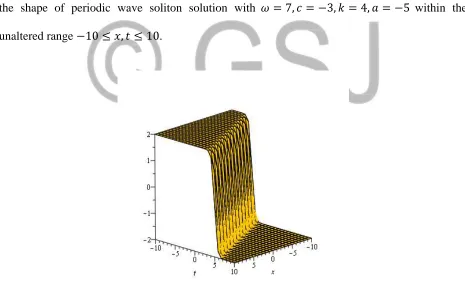
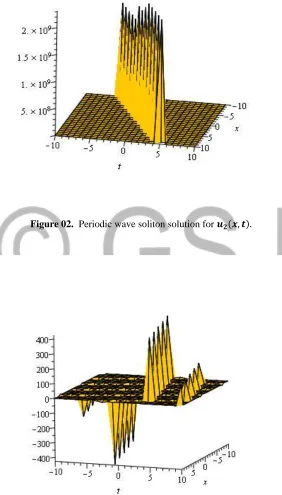
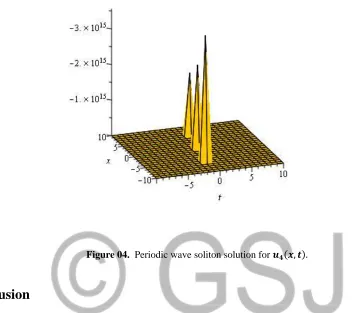
The solution is shown in the Fig.1 which is the shape of singular kink type traveling wave solution with wave speed within the interval . On the other hand, the Fig. 2 is found from the solution represents the shape of
periodic wave soliton solution with wave speed within the interval same interval. Further, the solution is indicated by the Fig. 3 which exhibits the shape of double kink wave soliton solution with wave speed within the interval . Finally, the solution is represented by Fig. 4 and it extracts the shape of periodic wave soliton solution with within the unaltered range .
Figure 02. Periodic wave soliton solution for
Figure 04. Periodic wave soliton solution for
Conclusion
References
1. Jawad AJM, Petkovic MD, Biswas A. Modified simple equation method for nonlinear evolution equations. Appl. Math. Comput.(2010); 217: 869–77.
2. Khan K, Akbar MA. Exact and solitary wave solutions for the Tzitzeica-DoddBullough and the modified KdV-Zakharov-Kuznetsov equations using the modified simple equation method. Ain Shams Eng J (2013); 4(4): 903–9.
3. Akter J. and Akbar M.A. Exact solutions to the Benney-Luke equation and the Phi-4 equations by using modified simple equation method. Results Phys. (2015); 5; 125-130. 4. Wang M, Li X, Zhang J. The -expansion method and travelling wave solutions of
nonlinear evolution equations in mathematical physics. Phys. Lett. A (2008); 372:417– 23.
5. Zayed EME. Traveling wave solutions for higher dimensional nonlinear evolution equations using the -expansion method. J Appl. Math. Inform (2010); 28: 383–95. 6. Roy R, Akbar MA and Wazwaz AM. Exact wave solutions for the time fractional
Sharma-Tasso-Olver equation and the fractional Klein-Gordon equation in mathematical physics. Opt Quan Electron (2018); 50(1): 25.
7. Akbar MA, Ali NHM and Roy R. Closed form solutions of two nonlinear time fractional wave equations. Results in Physics (2018); 9; 1031-1039.
8. Ali AT. New generalized Jacobi elliptic function rational expansion method. J. Comput. Appl. Math. (2011); 235: 4117–27.
10. Zayed EME, Zedan HA and Gepreel KA. On the solitary wave solutions for nonlinear Hirota-Satsuma coupled KdV equations. Chaos, Solitons Fractals.(2004); 22: 285–303. 11. Mohyud-Din ST, Yildirim A and Sariaydin S. Numerical soliton solutions of the
improved Boussinesq equation. Int. J. Numer. Methods Heat Fluid Flow (2011); 21(7): 822–7.
12. Mohyud-Din ST, Yildirim A and Demirli G. Analytical solution of wave system in Rn with coupling controllers. Int. J. Numer. Methods Heat Fluid Flow (2011); 21(2): 198– 205.
13.Mohyud-Din ST, Yildirim A and Sariaydin S. Numerical soliton solution of the Kaup-Kupershmidt equation. Int. J. Numer. Methods Heat Fluid Flow (2011); 21(3): 272–81. 14.He JH. Variational iteration method for delay differential equations. Commun. Nonlinear
Sci. Numer. Simul. (1997); 2(4): 235–6.
15.Abdou AA and Soliman. New applications of variational iteration method. Phys. D. (2005); 211(1–2): 1–8.
16.Rogers C and Shadwick WF. Backlund transformations. New York: Academic Press;1982.
17.He JH and Wu XH. Exp-function method for nonlinear wave equations. Chaos, Solitons Fractals (2006); 30: 700–8.
18.Naher H, Abdullah AF and Akbar MA. New traveling wave solutions of the higher dimensional nonlinear partial differential equation by the Exp-function method. J. Appl. Math. (2012): 14. [Article ID 575387].
20.He JH. Non-perturbative methods for strongly nonlinear problems. Berlin: Dissertation. De Verlag im Internet GmbH; (2006).
21.Hirota R. Exact envelope soliton solutions of a nonlinear wave equation. J. Math. Phys. (1973); 14: 805–10.
22.Hirota R, Satsuma J. Soliton solution of a coupled KdV equation. Phys. Lett. A (1981); 85: 407–8.
23.Abdou MA. The extended tanh-method and its applications for solving nonlinear physical models. Appl. Math. Comput. (2007); 190: 988–96.
24.Malfliet W. Solitary wave solutions of nonlinear wave equations. Am. J. Phys.(1992); 60: 6504.
25.Wang ML and Li XZ. Applications of F-expansion to periodic wave solutions for a new Hamiltonian amplitude equation. Chaos, Solitons Fractals (2005); 24: 1257–68.
26.Sassaman R, Heidari A, Majid F and Biswas A. Topological and non-topological solitons of the generalized Klein-Gordon equations in (2+1)-dimensions. Dyn. Continuous, Discrete Impulsive Syst. Ser. A(2010); 17: 275–86.
27.Song M, Liu Z, Zerrad E, Biswas A. Singular soliton solution and bifurcation analysis of the Klein-Gordon equation with power law nonlinearity. Front Math Chin (2013);8:191– 201.
28.Biswas A, Zony C and Zerrad E. Soliton perturbation theory for the quadratic nonlinear Klein-Gordon equation. Appl. Math. Comput. (2008); 203: 153–6.
30.Biswas A, Kara AH, Bokhari AH and Zaman FD. Solitons and conservation laws of Klein-Gordon equation with power law and log law nonlinearities. Nonlinear Dyn. (2013); 73: 2191–6.
31.Biswas A, Ebadi G, Fessak M, Johnpillai AG, Johnson S, Krishnan EV and Yildirim A. Solutions of the perturbed Klein-Gordon equations. Iran. J. Sci. Technol. Trans. A (2012); 36: 431–52.
32.Fordy AP and Gibbons J. Integrable nonlinear Klien-Gordon equations and toda lattices. Commun. Math. Phys. (1980); 77: 21-30.
33.Dehghan M and Shokri A. Numerical solution of the nonlinear Klein-Gordon equation using radial basis functions. J. Comput. Appl. Math. (2009); 230: 400-410.
34. Zin SM, Abbas M, Majid AA and Ismail AIM. A new trigonometric spline approach to