WWJMRD 2016; 2(6): 36-40 www.wwjmrd.com Impact Factor MJIF: 4.25 e-ISSN: 2454-6615
Olawuni Adeolu Electrical /Electronic Department, Osun State Polytechnic, Osun State, Nigeria
Omotayo Mayowa Emmanuel Electrical /Electronic Department, Osun State Polytechnic, Osun State, Nigeria
Correspondence: Olawuni Adeolu Electrical /Electronic Department, Osun State Polytechnic, Osun State, Nigeria
Design and implementation of programmable ultrafast
circuit breaker with solid state relay
Olawuni Adeolu, Omotayo Mayowa Emmanuel
Abstract
The concept of electronic circuit breaker came into focus realizing that conventional circuit breakers such as MCBs take longer time to trip. Therefore, for sensitive loads it is very important to activate the tripping mechanism at the shortest possible time, preferably instantaneously. This project is demonstrates fast tripping mechanism as against the slow one like MCB. Electronic circuit breaker is based on the voltage drop across a series element proportional to the load current, typically a low value resistor. This voltage is sensed and rectified to DC which is and then compared with a preset voltage by a level comparator to generate an output that drives a relay through a MOSFET to trip the load. The unit is extremely fast and
overcomes the drawback of the thermal type. It uses a microcontroller from 8051 family. The project was designed to shut down the power supply when it is overloaded. Conventional circuit breaker like MCB based is on thermal bimetal lever trip mechanism. It is very slow and the trip time is dependent upon the percentage of overload. This project senses the current passing through a series element and the corresponding voltage drop is compared against the preset voltage proportional to the current by a level comparator to generate an output for the load to trip.
Keywords: Ultra Fast, MCB, 8051 Microcontroller, Overload, Mosfet
Introduction
A circuit breaker (CB) is a kind of switch which is supposed to operate whenever there is a fault condition or sustained overloads in power system. Primary function of a circuit breaker is to isolate the faulty section of the power system thereby protecting the loads and system itself from damage due to excessive currents. There exist different types of circuit breakers such as thermal circuit breakers, electromagnetic circuit breakers, thermal/magnetic circuit breakers and solid state circuit breakers. All of these differ in principle of operation (Ben,2007).
Thermal circuit breakers use a bimetallic strip which bends due to heat produced by excessive current during fault condition. As a result, the current carrying contact open up breaking the main circuit. In electromagnetic type circuit breakers, main current flows through a coil which produces magnetic field to attract an armature. When current is higher than set value, magnetic field becomes strong enough to pull the armature thereby breaking the main circuit. Circuit breakers combining both of these effects are called thermal/magnetic circuit breakers. These use electromagnetic action to provide over-current protection and thermal effect to provide protection against sustained overloads (Henze,2002).
In this project electrical system can be protected from the over load condition. Industrial instruments or home appliances failures have many causes and one of the main causes is over load. The primary of the distribution transformer or any other transformer is designed to operate at certain specific current, if that current flowing through that instrument is more than the rated current, then immediately the System may burn because of over load, through this project we are going to protect the system from over load condition. In this project work for generating high current or over load current more loads are applied to the circuit; so that the current will be increased. Whenever the over current is drawn by load the circuit will be tripped. To trip the circuit we are using one relay which will be controlled through PIC microcontroller. When over load occurred the relay will trip the total circuit. And it will be monitored on the LCD. LCD displays are used to display the status of circuit breaker. For protection from over current condition first we have to measure the total load current. Here we are using CT for measuring the load current and the output of CT is given to ADC for
converting analog output of CT into digital data. Hence ADC output is given for monitoring purpose. When current increases behind certain limit then we are going to trip the load by using relay. In this project we are using 230v bulbs as a load. We are going to increase the load by increasing the number of bulbs ON. When we ON more bulbs it causes over load condition and microcontroller will detect that and it will trip the total load by using relay through MOSFET which acts as switching circuit.
Review of Related Work
Electrical Power System protection is required for protection of both user and the system equipment itself from fault, hence electrical power system is not allowed to operate without any protection devices installed. Power System fault is defined as undesirable condition that occurs in the power system. These undesirable conditions such as short circuit, current leakage, ground short, over current and over voltage(Francesco,2004).
With the increasing loads, voltages and short-circuit duty in distribution system, over current protection has become more important today. The ability of protection system is demanded not only for economic reason but also consumers just expect „reliable‟ service. In a Power System Protection, the system engineer would need to a device that can monitor current, voltage, frequency and in some case over power in the system. Thus a device called Protective Relay is created to serve the purpose. The protective relay is most often relay coupled with Circuit Breaker such that it can isolate the abnormal condition in the system. In the interest
of reliable and effective protection, some designers of power distribution/power controllers select relay as opposed to electro-magnetic circuit breakers as a method of circuit protection.
Source: Huan, 2008
Fig 2.1: Hybrid DC circuit breaker
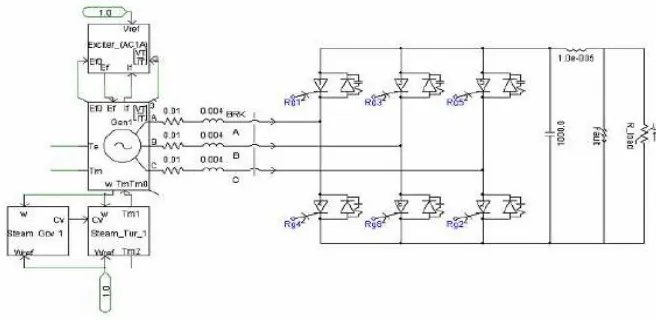
With current technology, there are three approaches to implement the DC solid state fault interrupting scheme. Conventional approach makes use of an ability of VSC to act as a crowbar circuit and AC side circuit breaker interrupts fault current as described in Czucha (2000). This is shown in figure 2.2. Another method is to use a SCR based switch with forced commutation circuit which is required to turn SCR off in case of fault as described in (Bednarczyk, 2007).
Source: (Bednarczyk, 2008)
Fig 2.2: DC circuit breaker scheme employing VSC as crowbar
Methodology Design Overview
In order to design it, first the load current need to measure in order to monitor it using current sensor including testing the fault (over current) and when such condition arise, it will isolate in the shortest time possible without harming the any other electrical devices. It will also including in developing the algorithm for instantaneous over current relay and IDMT (Inverse Definite Minimum Time) relay for the circuit breaker to trip. In this project, PIC microcontroller will be used to control and operate the tripping coil in circuit breaker, To measure and analyze load current from current sensor.
i. The load current (energizing current) will be
measured by using current sensor and converted
from analog voltage to digital using 89c51. Then the load current will display on the LCD.
ii. Trip circuit breaker using 8051 microcontroller.
iii. The over current value is set in the 8051 and when
faults (over current) occur, 8051 will energize the circuit breaker tripping coil which will cause the circuit breaker to trip.
iv. Develop algorithm for instantaneous over current
relay and IDMT relay.
v. The over current setting may be given by definite
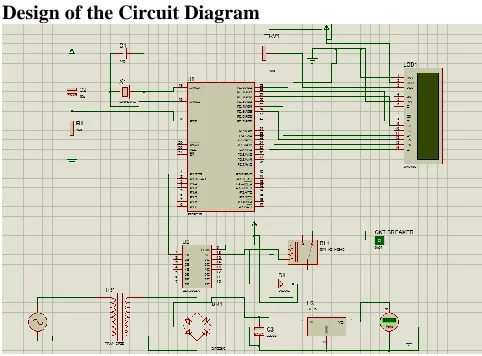
Design of the Circuit Diagram
Source: designed with Labview (www.labview.com)
Complete Circuit diagram
The AC supply to the load is thus cut off from the load and the load is tripped. Once the circuit is tripped it must be reset for further use using reset button as shown in Fig.1. In either case, the microcontroller is programmed so as to show the status of the output on the LCD interfaced to it. In case of normal operation microcontroller will pin will receive 5v dc from regulator and accordingly displays the status on the LCD. In case of any abnormalities, the microcontroller pin doesn‟t receive the 5V input signal and the related status is accordingly displayed on the LCD.
Result and Discussion
Hardware testing results at 60V
For developing a prototype, the hardware is first tested with a 60V supply and a primarily resistive load bank having a small inductance (16uH as measured from waveforms). Instead of putting a real fault at the load terminals, the load resistance is varied from 60ohms to 6.4ohm so that final steady state value of load current is beyond overcurrent threshold set in micro-controller. Results with 2.7A, 5.5A and 8.1A t
Case 1: Current threshold=2.7A
Figure 4.1 below shows output when current threshold is set at 2.7A. Blue waveform is load current while pink waveform is that of micro-controller output command to optocoupler and gate driver. The system makes 3 auto-reclosure attempts and if the fault is still persistent main switch remains off until micro-controller is reset manually. Figure 4.1 shows measured time as 52.6uS as against chosen value 50uS because of other instructions (conditional instructions, incrementing counter) that need to be executed before switch is turned ON again. It is important to note that time taken by micro-controller can vary upto a maximum of 2.2uS depending on which instruction the micro-controller is executing when a fault occurs.
Fig 4.1: SSCB system operation at 2.7A threshold
Fig 4.2: First step, total time (Threshold=2.7A) Fig 4.3: First step, micro-controller and sensor circuitry time (Threshold=2.7A)
occurs, current starts to rise and as a result, current sensor circuitry output (sensor and OPAMP buffer) begins to rise. When feedback to micro-controller increases beyond programmed threshold, the micro-controller sends OFF command to opto-coupler and gate driver circuitry. This is seen as pink waveform (microcontroller output) falling off in figure 4.2. Gate driver and opto-coupler take finite amount of time to send OFF command to main switch and finally main switch takes some time to turn OFF and then load current (blue waveform) begins to commutate to freewheeling diode decaying exponentially as stored energy in inductor dissipates
From figure 4.2, total operation time is seen to be 1.48uS which is less than maximum calculated time 4.042uS. Figure 4.3 shows total operating time of micro-controller and sensor circuitry as 1.025uS which is less than maximum calculated 3.54uS. This implies that total time taken by opto-coupler, gate driver and main switch to turn off is 1.48uS-1.025uS= 455nS which is less than maximum calculated amount 502nS.
After micro-controller sends OFF command to opto-coupler and gate driver, it waits for 50uS (auto-reclosure time) and sends command to turn ON main switch again. Figure 3.8 shows turn ON and subsequent turn OFF which happens since fault is still present.
Fig 4.4: Second step, total time (Threshold=2.7A)
Case 2: Current threshold=5.5A
Figure 4.5 below shows output when current threshold is set at 5.5A. Blue waveform is load current while pink waveform is that of micro-controller output command to optocoupler and gate driver. As in previous case, the system makes 3 auto-reclosure attempts and if the fault is still persistent main switch remains off until micro-controller is reset manually.
Figure 4.5 shows measured time as 52.6uS as against chosen value 50uS because of other instructions (conditional instructions, incrementing counter) that need to be executed before switch is turned ON again. It is important to note that time taken by micro-controller can vary upto a maximum of 2.2uS depending on which instruction the micro-controller is executing when a fault occurs.
Fig 4.5: SSCB system operation at 5.5A threshold
Conclusion
The availability of high-voltage, solid-state switches enable the transition of shipboard power distribution to MVDC power systems and the significant benefits that they contribute. The ability of MVDC systems to interrupt full load currents in microsecond timescales delivers dramatic advances in circuit breaker performance, yielding improved system reliability and safety. The same technology also enables high frequency, high-voltage switching power converters that are rugged, efficient, and compact. With the iCB, existing distribution grid infrastructures can be upgraded towards Smarter Grid applications, without implementing a new and exhaustive IT infrastructure. The iCB will be able to analyse the local grid status. In combination with the knowledge about its own switching capability, the iCB is able to identify, isolate and switch-off failures in a fast and safe way. It was shown, how an iCB has to be designed for distribution grids with decentralised renewable generation
Reference
1. Ben Damsky, Vitaly Gelman, John Frederick, “A solid
state current limiter”, Article
http://www.epa.gov/electricpower sf6/documents/conf02_damsky_paper.pdf
2. C. B. Henze, N. Mohan, C.P. Henze, R. Button, “A
programmable solid state Current limiting circuit breaker for space applications”, IECON 2002.
3. C. Meyer, S. Schroder, Rik W. De Doncker, “Solid
state circuit breakers and Current limiters for medium voltage systems having distributed power systems”, IEEE transactions on power electronics, September 2004.
4. Francesco Bittoni, Guido Fiesoli, Lorenzo Cincinelli,
“Electronic Circuit Breaker” , Patent# Wo 2004/082091 A1, September 2004.
5. G. M. Masters, “Renewable and Efficient Electric
Power Systems” 2004.
“http://www.ionbeamoptics.com/projects.htm” accessed on 10/21/11.
6. Hesam Mirzaee, “Medium-Voltage DC (MVDC)
Power Distribution System for Future Efficient Electric Power Delivery” , NC State University, Spring 2011.
7. Huan Liang Tsai, Ci-Siang Tu, Yi-Jie Su,
congress on Engineering and Computer science, San Fransico, CA, October 2008
8. J. Czucha, J. Woloszyn, M. Woloszyn: “The
comparison of ultra fast A.C. hybrid circuit breakers
with GTO and IGBT”. 35th Universities Power
Engineering Conference UPEC’2000, Belfast, 6-8
September 2000.
9. J. Meyer, A Rufer, “DC Hybrid CB with ultra fast
contact opening with IGCT”,IEEE transactions on power delivery, April 2006
10. Jianguo Mu, Li Wang, Jie Hu, “Analysis and design of
topological structure for DC solid state circuit breaker” , World non grid connected wind power and energy conference, September 2009.
11. M. Baran, S. Teleke, S. Bhattacharya, “Overcurrent
protection in DC zonal Shipboard power systems using solid state protection devices”, Electric ship technologies symposium, May 2007.
12. M. Steurer, K. Frohlich, W. Holaus, K. Kaltenegger,
“A novel hybrid current Limiting circuit breaker for medium voltage: Principle & test results” , IEEE transactions on power delivery, April 2003
13. O. Vodyakho, M. Steurer, D. Neumayr, C.S.
Edrington, G. Karady, S. Bhattacharya, “Solid state fault isolation devices: Application to future power electronics based distribution systems”, Electric power applications, July 11, 2012
14. P. Jankowski, B. Dudojc, J. Mindykowski: “An
optimeter designed to register ultra fast displacement”.
TC4 IMEKO 2008 Symposium and IWADC, Florence,
Italy, September 2008, Proceedings, CD-ROM.
15. P. Jankowski, K. Jakubiuk: “Model obwodowy napedu