Impact of Occupational Stress, Interpersonal Trust, and Organizational
Commitment on Valence, OCB and Job Satisfaction: A Variance-Based
SEM Analysis
Muhammad Shahnawaz Adil∗ Muhammad Owais† Ambreen Qamar‡
Abstract: This study analyzes the impact of these three cognitive forces (occupational stress, interper-sonal trust and organizational commitment) on valence, Organizational citizenship behavior (OCB) and job satisfaction in the healthcare sector of Karachi (Pakistan). A sample of 375 responses is drawn from seven healthcare institutions of Karachi on a self-administered questionnaire. Using PLS-SEM, hypotheses and pre-dictive relevance are tested with bootstrapping method and cross-validated redundancy analysis respectively. The results show that all three cognitive forces have significant impact on valence with the minor exception of affective commitment and strain. Moreover, valence has significant impact on both OCB has also shown a significant effect on job satisfaction. OCB has also shown a significant effect on job satisfaction. The findings of this study substantially contribute in the under-researched domain of OCB and job satisfaction in the con-text of the healthcare sector of Pakistan. Managerial implications and directions for future research are also discussed.
Keywords:Occupational stress, trust, organizational commitment, valence, organizational citi-zenship behavior, job satisfaction, healthcare, Pakistan.
Introduction
In organizational studies, valence refers to “... all possible affective orientations toward outcomes, and it is interpreted as the importance, attractiveness, desirability, or
antici-pated satisfaction with outcomes” (Vroom,1964). It is an affective alignment on the way
to a specific end result. The cognitive forces consist of the drivers which predict the
va-lence of job satisfaction (Mitchell,1974). These forces include occupational stress,
inter-personal trust at work, and organizational commitment. These three antecedences not
∗Assistant Professor at Department of Management Sciences, IQRA University, Karachi, Pakistan.
E-mail: [email protected]
†Deputy Director at Institute of Basic Medical Sciences, Dow University of Health Sciences, Karachi, Pakistan.
E-mail: [email protected]
‡Department of Physiology, Dow International Medical College, Dow University of Health Sciences, Karachi,
Pakistan. E-mail: a [email protected].
Acknowledgement:The authors would like to pay their sincere gratitude to Prof. Dr. Masood Qureshi, Director Institute of Basic Medical Sciences, DOW University of Health Sciences and Prof. Dr. Ghulam Sarwar, Principal, Sindh Medical College for their guidance and motivation throughout the study. The authors also thank Dr. Rabia Arshad and Dr. Khushbakht Nawaz Khan for their assistance in data collection from different healthcare institutions of Karachi. In addition, the authors also wish to thank Dr. James Gaskin (Assistant Professor, Department of Information Systems, Brigham Young University, Utah, United States) for providing his very useful video tutorials of PLS-SEM on his StatWiki Website.
The authors would like to thank both reviewers for their valuable suggestions to improve the manuscript.
only affect the valence of job satisfaction but also influence the organizational citizenship
behavior which could further lead to affect the overall job satisfaction.Organ, Podsakoff,
and MacKenzie(2005) defined organizational citizenship behavior (henceforth, ‘OCB’) as
an “individual behavior that is discretionary, not directly or explicitly recognized by the formal reward system, and in the aggregate promotes the efficient and effective function-ing of the organization”. These activities are directed more in creatfunction-ing effective relation-ships and then task completion. To exhibit OCB, it is required for employees to participate voluntarily in workplace bearing in mind that these efforts may not be rewarded. When many members of a work unit or organization perform OCB consistently over a period of time, not only the interpersonal relationships but also organizational performance is
improved (N. P. Podsakoff, Whiting, Podsakoff, & Blume,2009).
The specific kinds of behaviors considered to manifestations of OCB have been
evolv-ing over time (Bateman & Organ,1983). Examples include taking the initiative to orient
new colleagues, volunteering to attend events that help them improve the image of the
organization (Organ et al.,2005). In the most commonly-used framework, OCB is
cate-gorized into five-dimensions: altruism, conscientiousness, sportsmanship, courtesy, and
civic virtue (LePine, Erez, & Johnson,2002;Organ et al.,2005). These behaviors are often
distinguished in the literature by their intended purpose, which can be other individuals (OCB-I) such as Trust in Supervisors, co-workers, or customers, or the organization itself
(OCB-O) (Morrison,1996;Williams & Anderson,1991).
Occupational stress is the consequences of the encounter of employee with the
unde-sired work’s conditions (Rashid & Talib,2015). The literature clearly shows that
occupa-tional stress affects physical and mental health of employees. Specifically, occupaoccupa-tional
stress may lead to coronary heart diseases (Fitzgerald, Brown, Sonnega, & Ewart,2005),
emotional exhaustion and depression (Beehr, King, & King,1990), and musculoskeletal
disorder, diabetes, and cancer (Kristensen,1996). Although, views may vary, the working
conditions and even the characteristics of the worker serve as the primary reasons of de-veloping occupational stress. These conflicting perspectives are important because they drive different approaches to foil work stress in the working conditions. Therefore, an individual with occupational stress may develop psychological problems such as anxiety,
depression, and nervousness (Cooper & Marshall,2013).
The organizational commitment concept has fascinated much attention in trying to identify the severity and stability of the dedication of employees in their profession
(Eisenberg, Fasolo, & Davis-LaMastro,1990). Despite the growing interest in
organiza-tional commitment, it seems to have much ambiguity and differences of opinion about what commitment is? Where it is headed? How it is evolved? How does it affect the
employee’s behavior? (Meyer & Herscovitch,2001). Job satisfaction among employees is
an important characteristic in predicting high performance (Oshagbemi,2003). Job
sat-isfaction is related to firm performance and productivity, regulatory and other issues, including labor turnover. However, disgruntled employees are often prone to excessive
absenteeism and turnover (Chen, Yang, Shiau, & Wang,2006) which have attracted the
attention of managers (Nizam & Adil, 2014). Job satisfaction is an important factor to
Healthcare in Pakistan
In Pakistan, almost 75 percent of the total population lives in the rural areas of the country where the healthcare facilities are highly questioned. However, healthcare services are provided by both public and private sectors mainly in Karachi. Nursing is considered as one of the major components of the healthcare system in the country. There are a number of nursing schools operating in the city where they encourage nurses to gain certifications for better employment prospects. During 1980s and 1990s, the Canadian International Development Agency has made a substantial amount of funding in nursing education in the country. Pakistan Nursing Council (PNC) is a regulatory authority established in 1948 to safeguard the interests of healthcare professionals, formulate and standardize the working standards for nursing schools, approves relevant academic and professional programs, etc.
According to theWorld Health Organization(2014) report, there is a shortage of 7.2
million skilled health care workers globally, which is expected to rise up to 12.9 million by 2035. This situation is more or less same as Pakistan. Because of high rates of unem-ployment in Karachi, health care professional tends to suffer from a high work anxiety, fatigue and increasing workload. Even healthcare institutions face difficulty in recruiting such healthcare professional which could serve in the organization for a longer period of time. Employees are given various trainings and workshops for their professional de-velopment, however, due to high inflation some of the healthcare employers are not in a position to offer competitive financial benefits to their employees. Since, the healthcare professionals face difficulty and notable hindrances in moving from one organization to another, they tend to continue with their present job as compulsion (called continuance commitment). Notwithstanding, it is often observed that the healthcare professionals suf-fer from occupational stress, which hinders them to exhibit OCB. Moreover, the inter-personal trust among co-workers and supervisors and organizational commitment are significantly related with a valence of job satisfaction.
Theoretical Background and Hypotheses
The subject of occupational stress has been extensively studied in the past, however, it has gained an increased amount of interest among healthcare professionals because of the involvement of technology in this profession. At one side, healthcare professionals tend to adapt state-of-the-art technologies to perform better, faster and accurate in their respec-tive domain. But exactly at the same time, they are exposed to heavy workloads which
often lead to occupational stress (Nowrouzi et al.,2015). This phenomenon is reflected
in the form of deterioration in their physiological, psychological and emotional states.
Therefore, according toRashid and Talib(2015), a great emphasis has been given to
ana-lyze those measures which could mitigate the repercussion of occupational stress or even provide the subject with a situation and knowledge where occupational stress could not be observed in future. These adjustive reactions (or coping behaviors) are classified into three broad categories in the literature: a) problem-focused coping behavior in which a closed attention is given to change the environment so that the chances of events could be
alleviated (Ben-Zur, Yagil, & Oz,2005); b) emotion-focused coping behavior in which the
affects or emotions associated with the stressor are either reduced or eliminated (Carver,
Scheier, & Weintraub,1989); and c) avoidant coping behavior in which the person simply
avoids the stressor as much as possible (Roth & Cohen,1986). This occupational stress not
only affects the employee, but also affects the healthcare institution (Abdel-Halim,1982).
Trust is an indispensable component to the success of multi-party efforts and a
sym-bol of effective relationships (Cyr,1999). In organizational sciences, the experts tend to
agree on this problem (R. M. Kramer & Tyler,1996), though a limited understanding is
there of precisely explain the role of interpersonal trust in the supervisor and subordinate relationship. Precisely, the operational definitions of trust and belief include whether the
partner is reliable (McAllister,1995); takes care of your own interests (Cook & Wall,1980);
and/or dispose of integrity (Robinson,1996). In addition, the conceptual advocates argue
that trust is separate from other variables for group cohesion and group fascination of its
members; friendship and close ties that exist among the people (Jehn & Shah,1997); and
knowledge, and particular information of the other (Goodman & Leyden,1991).
Organizational commitment is an important dimension of behavior that can be used to assess the strength of attachment of staff. In connection with the involvement of the or-ganization, the work-related factors are very important: staff turnover, absenteeism, and
performance (Romzek, 1990). The perception of organizational commitment regularly
improves emotional attachment to the organization in the form of sharing the values of the organization, their desire to stay in the organization, and their willingness to commit themselves to the benefits of the organization. It is committed due to which employees show their vigorous affiliation with the organization in order to give their best for the
welfare of the institution (Mowday, Steers, & Porter,1979). It is widely understood that
those who are deeply involved in the organizations and demonstrate their organizational
commitment tend to stay longer in the organization (Meyer, Allen, & Gellatly,1990). In
the past, affective (want to), continuance (have to), and normative (ought to) are the three
classifications of organizational commitment (Meyer & Allen,1991). Hence, the following
H1:Cognitive forces (i.e. occupational stress, interpersonal trust between the supervisor and colleagues, and organizational commitment) have significant impact on valence.
Job satisfaction is a means through which organization can acquire certain informa-tion from its employees e.g. Their viewpoints, feelings and personal preferences and
expectations as well as their interest in their jobs (Lambert, Hogan, & Griffin,2007). This
information enables managers to understand whether their employees are satisfied with their jobs and financial benefits and these are compatible with their efforts, in particular. There are two very important reasons for being concerned with job satisfaction: a) Job satisfaction can lead to happier and more attractive life; b) It contributes in shaping the person’s family and job attitudes.
Good professional relationship with physicians, greater nurses control over working practices and decisions regarding patient care and useful and positive teamwork per-ceptions are the key characteristics of professional nursing practice environment (Lake,
2007,2002). These characteristics are essential in harmonizing a culture which reinforces
inter-professional collaborations (Orchard, Curran, & Kabene,2005). Moreover, eight
hall-marks have been introduced by theAmerican Association of Colleges of Nursing(2002).
The term of “Magnet Hospitals” has been used in both literature and practice because of the professional nursing practice environment which provides strong and visible nursing practices through authentic leadership and appropriate level of structural empowerment
given to nurses (M. Kramer & Hafner,1989). This is generally referred to as ‘good place
to work’ where one can observe higher nurses’ job satisfaction as well as career growth
within the healthcare institution (Lake,2002) which is reflected in the form of patient
out-comes e.g. higher perceived quality of care and lower mortality and morbidity (Djukic,
Kovner, Brewer, Fatehi, & Cline,2013).
H2: Valence has significant impact on organizational citizenship behavior when controlling for the level of responsibility and work experience of the healthcare professionals in their present organization.
H3: Valence has significant impact on job satisfaction among the healthcare professionals in Karachi when controlling for their gender, marital status, highest qualification, and total work ex-perience.
OCB refers to an “individual conduct that is unrestrictedly not directly or clearly known by the formal reward system, and in the aggregate promotes the efficient and
effective functioning of an organization” (Organ et al.,2005). Interestingly, since male
employees are more career-oriented than females, they are more likely to be interested in
getting a favorable appraisal and reviews (Ng, Lam, & Feldman,2016). Due to the
signif-icance of OCB for organizational functioning, background and precursors of OCBs have been examined in numerous studies. It is emphasized that employees who diligently
dis-played greater levels of job satisfaction exhibited higher OCB (Lapierre & Hackett,2007).
Chiaburu, Oh, Berry, Li, and Gardner(2011) established the stronger relationship of open-ness and agreeableopen-ness with OCB than the role performance after examining Big-five per-sonality trait and OCB.
H4:Organizational citizenship behavior has significant impact on job satisfaction when con-trolling for their gender, marital status, highest qualification, and total work experience.
Method
Samples and Procedures
The research philosophy of this study encompasses the ‘Realism’ belief of Ontology which
in turn, dictates the ‘Etic’ approach of Epistemology for this study (Bryman,2012;Sekaran
& Bougie,2016). In particular, realists believe that one truth exists; truth does not change;
and the truth can be discovered using objective measurements. Moreover, once we find out what the truth is, we can generalize it to other situations. In this study, the authors posited different hypotheses to maintain that there is one truth which could establish a relationship between an IV and a DV; in other words, the results could possibly conclude whether there is (or isn’t) a direct impact. It implies that there will be a non-recursive relationship from an IV towards a DV which is due to its unidirectional nature of causal relationship, i.e. the truth about the reality between two latent variables does not change. Besides, the use of Likert scale items (as an objective measurement to quantify each study variables) also endorses that the truth can be discovered using objective measurements. Finally, since there will be one truth exists regarding the relationship between each of the two study variables, the research findings may be generalized on a larger population of similar social and study contexts.
Furthermore, due to realism Ontological belief, the study employed an etic approach to know the reality (called Epistemology). Using the ‘etic’ approach, the authors dis-tributed the survey questionnaires without becoming an integral part of the respondent’s work system and most importantly, without disturbing the reality which were being stud-ied. Based on these philosophical beliefs (realism with etic approach), the authors believe that there is one truth exist which can be assessed by using objective measurements.
The research design of this empirical study followed a deductive reasoning in which the authors used a quantitative research approach to perform an explanatory study to test research hypotheses. Notably, this was a causal and cross-sectional study which was conducted in a non-contrived field study setting. The unit of analysis is the ‘individual’ working in the public and private healthcare institutions of Karachi, Pakistan.
University Hospital, Ziauddin Medical University, Baqai Medical University, Liaquat Col-lege of Medicine and Dentistry, Jinnah Sindh Medical University) having aforementioned demographical idiosyncrasies.
Despite a number of attempts to gain an officially-approved list of individuals from these seven institutions to employing probability sampling technique, the authors re-mained unsuccessful to obtain even a best approximation of sampling frame. Conse-quently, a non-probability convenience sampling technique was used to draw a sample of 375 responses on a self-completion survey questionnaire from these seven institutions.
During initial data screening phase, a total of 83 univariate and multivariate outliers were detected and removed from the dataset by using standardized (Z) score and
Maha-lanobis Distance value at p<0.001) respectively (Tabachnick & Fidell,2013). It resulted in
a sample of 292 useable responses for data analysis. The response rate was 78 percent.
In addition, Harman’s single factor test (Schriesheim,1979) was used in SPSS to
as-sess the potential presence of common method variance (CMV) bias (P. M. Podsakoff,
MacKenzie, Lee, & Podsakoff, 2003). All 96 observed items (or indicators) used in the
survey questionnaire cumulatively accounted for only 12.8% of the total variance by an un-rotated factor which is less than 50% of the threshold value (P. M. Podsakoff &
Or-gan,1986;Scott & Bruce,1994). It warrants that the data is free from the CMV bias e.g.
(Andersson & Bateman,1997; Aulakh & Gencturk, 2000) and we may proceed further
with the data analysis (Adil, Awais, Khan, & Qureshi,2019).
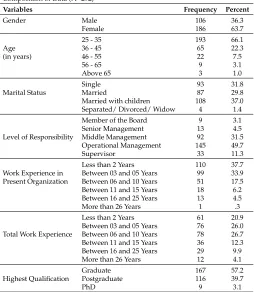
The useable sample comprises of 148 responses from the public sector (50.7 percent), 136 from the private sector (46.6 percent), and 8 responses from the semi-government healthcare institutions. Overall, 127 respondents were associated with teaching medi-cal education (43.5 percent), 57 respondents were from hospital administrative staff (19.5 percent), and the rests of the 108 responses held both the teaching and administrative po-sitions (37 percent). Table 1 shows some other demographic items in the sample drawn.
Measures
Table 1
Composition of Data (N=292)
Variables Frequency Percent
Gender Male 106 36.3
Female 186 63.7 25 - 35 193 66.1
Age 36 - 45 65 22.3
(in years) 46 - 55 22 7.5
56 - 65 9 3.1
Above 65 3 1.0
Single 93 31.8
Marital Status Married 87 29.8 Married with children 108 37.0 Separated/ Divorced/ Widow 4 1.4 Member of the Board 9 3.1 Senior Management 13 4.5 Level of Responsibility Middle Management 92 31.5 Operational Management 145 49.7 Supervisor 33 11.3 Less than 2 Years 110 37.7 Work Experience in Between 03 and 05 Years 99 33.9 Present Organization Between 06 and 10 Years 51 17.5 Between 11 and 15 Years 18 6.2 Between 16 and 25 Years 13 4.5 More than 26 Years 1 .3 Less than 2 Years 61 20.9 Between 03 and 05 Years 76 26.0 Total Work Experience Between 06 and 10 Years 78 26.7 Between 11 and 15 Years 36 12.3 Between 16 and 25 Years 29 9.9 More than 26 Years 12 4.1 Graduate 167 57.2 Highest Qualification Postgraduate 116 39.7
PhD 9 3.1
Occupational stress was measured by an 18-item scale adapted fromSchaufeli, Leiter,
and Kalimo(1995) with three sub-scales: occupational role, personal strain and personal
resource. The first stage Cronbach alpha was 0.68. Interpersonal trust was measured by a
12-item scale developed byCook and Wall(1980). The first stage Cronbach alpha of this
scale was 0.70. A total of 24 items in the form of three sub-scales were used to measure organizational commitment: affective, continuance, and normative commitment (Allen &
Meyer,1990). There were 9 reverse coded items. The first stage Cronbach alpha of this
scale was 0.63. Valence (of job satisfaction) was measured by using 13 items adapted from
Teas(1981). The first stage alpha of this scale was 0.88. Organizational Citizenship
Be-havior was measured by 24 items adapted fromMoorman(1993). The first stage alpha of
this scale was 0.82. Job satisfaction was measured by 5 items adapted fromLee, Mitchell,
Holtom, McDaneil, and Hill(1999). The first stage alpha of this scale was 0.64.
Data Analysis
Data were analyzed by using SmartPLS version 3 software developed byRingle, Wende,
‘PLS-SEM’).
Reasons of Applying PLS-SEM in this Study
Because of the following five prime reasons, PLS-SEM is preferred as the most suitable SEM technique for this study instead of covariance-based SEM (Hair Jr, Hult, Ringle, &
Sarstedt,2016;Sarkkinen & K´’assi,2015):
1. Both the measurement and structural models are ‘formative’ in nature, the study required the weights of the indicator variables which affect its latent variable. The formative model is the one where the direction of the arrows is from the measured
(Likert-scale) items towards the latent variable (Hair Jr et al.,2016).
2. ‘Prediction’ was the main purpose of the inner model which requires each of the endogenous variables to show maximum ‘variance’ (not covariance) to be explained by all of its exogenous variables.
3. Early stages of developing perhaps a new theory which involves cognitive forces, valence, OCB and job satisfaction in the healthcare sector of Pakistan.
4. The model was complex (i.e. 96 Likert-scale items; 6 latent constructs with 14 sub-scales) with smaller sample size (n=292).
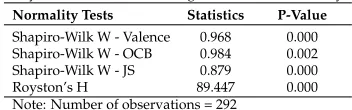
5. The fifth reason of using a non-parametric SEM technique is that the data were not from multivariate normal distribution. For this, the study used Royston’s H test in StatGraphics ® Centurion software (version 18.1.06) to assess multivariate nor-mality. This tests actually combines Shapiro-Wilk tests for all endogenous latent variables. In this study valence, organizational citizenship behavior and job satis-faction are the three endogenous latent variables. Royston’s H test value was 89.447
(p<0.001) indicating that the distribution is not multivariate normal (see Table 2).
Table 2
Royston’s H test for assessing Multivariate Normality
Normality Tests Statistics P-Value
Shapiro-Wilk W - Valence 0.968 0.000 Shapiro-Wilk W - OCB 0.984 0.002 Shapiro-Wilk W - JS 0.879 0.000 Royston’s H 89.447 0.000 Note: Number of observations = 292
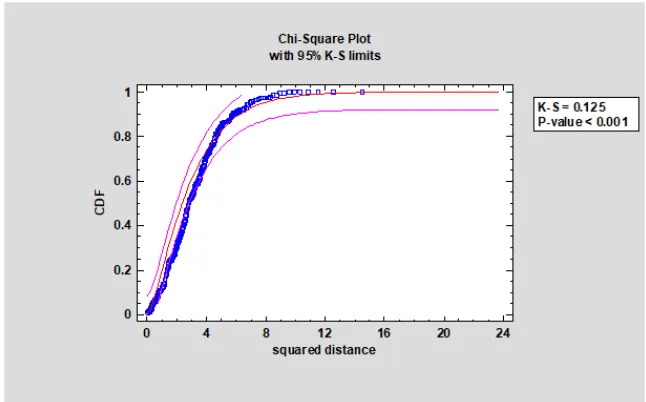
(K-S) limit (0.125; p<0.001). In short, based on both Royston’s H test and the chi-square distribution plot, it was concluded that the data used in this study did not meet the as-sumption of multivariate normality. Therefore, non-parametric SEM with non-parametric bootstrapping method were used to test research hypotheses.
Figure 1
Multivariate Normality using Chi-Square Distribution
Statistical Power Analysis
Since the purpose was to predict the three endogenous variables (valence, OCB and job satisfaction) based on maximum shared variance therefore, it was very important to re-duce Type-II error. For this a higher statistical power was required to achieve. For the
said purpose, G*Power version 3.1 software (Faul, Erdfelder, Buchner, & Lang,2009) was
used. A post-hoc power analysis was computed given the significance level significance
level (α) = 0.05, sample size = 292, and population high effect size = 0.35. It results in a
very high statistical power, i.e. 1.0. In other words, the occurrence of committing Type-II error has been eliminated from this study. For further description of the rules of thumb
for selecting covariance-based SEM or PLS-SEM, referHair, Ringle, and Sarstedt(2011).
In addition, (Hair, Sarstedt, Ringle, & Mena,2012) provides useful guidelines for applying
PLS-SEM.
Formative Measurement Model
construct (Hair et al.,2011). For example, eight indicator variables (i.e. Likert-scale items) of ‘affective’ sub-scale of organizational commitment will determine the magnitude of ‘Valence’. Similarly, interpersonal trust in supervisor and co-workers will influence the ‘Valence’ too. It is important to note that composite reliability (CR), convergent valid-ity through average variance extracted (AVE), and discriminant validvalid-ity through inter-constructs correlations using Fornell-Larcker criterion is reported in ‘Reflective’
measure-ment model (Edwards,2011;Hair et al.,2012). On the contrary, (Hair et al.,2012)
sug-gested the following estimations to report for evaluating the formative measurement model. Please note that measurement and structural models are often called outer and
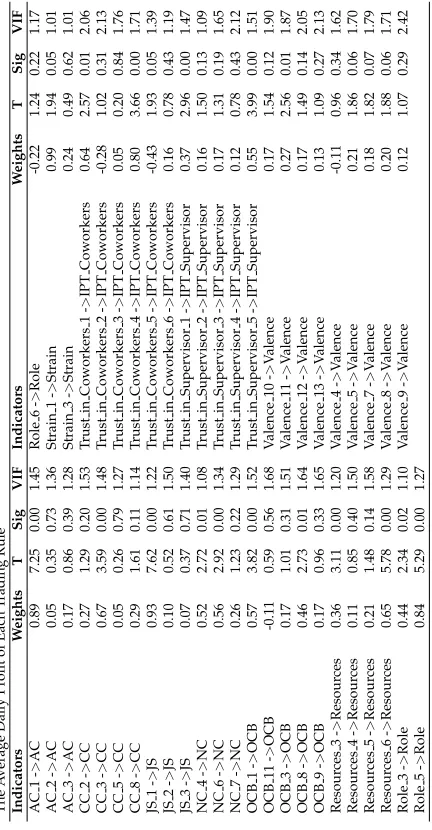
inner models respectively (Hair et al.,2012) as shown in Table 3:
a) Indicator weights instead of factor loadings;
b) t-statistic, p-value or standard errors; and
c) Variance inflation factor (VIF)
Interestingly,Hair et al. (2012) mentioned that it is necessary to report the statistical
significance of each outer weight. In fact, this important issue has been largely condoned by previous researchers. As shown in Table 3, there are 16 weights which have been
found statistically significant at 95 percent confidence level (i.e. t-statistic≥ |1.96|and
p<0.05) to determine the effect on their respective latent variable (henceforth, LV). These
16 significant weights range from 0.27 to 0.93. Except the LV of ‘Strain’, all LVs have one or more significant outer weights.
Since, the ‘weights’ of the formative model are smaller than the ‘loadings’ of a re-flective model, therefore, one may be misled for interpretation by merely looking at the
outer weights (Diamantopoulos & Winklhofer,2001). In essence, there is likelihood that
the weights of the indicators may be unstable (Cenfetelli & Bassellier,2009). Therefore,
variance inflation factor (VIF) should also be reported to assess multicollinearity between
indicators (Hair et al.,2012). Table 3 shows that the VIF of all of the indicators is less than
3. Hence, there is no problem of multicollinearity in the formative measurement model
(Hair et al.,2011).
Hypotheses Testing Using Bootstrapping
There are four major hypotheses in this study. Hypothesis 1 analyzes the separate impact of three cognitive forces on valence. Hypothesis 2 and 3 ascertain the impact of valence on OCB and job satisfaction respectively whereas hypothesis 4 investigates the impact of OCB on job satisfaction. Using PLS-SEM algorithm in the SmartPLS 3.0 software, a struc-tural (inner) model was developed to test these four hypotheses. In fact, in PLS-SEM boot-strap samples are generated to estimate the statistical significance of parameter estimates
(Henseler, Ringle, & Sinkovics, 2009). Therefore, in this study, a 5,000 non-parametric
bootstrap samples were generated by Bias-Corrected and Accelerated (BCA) Bootstrap
method of the confidence interval (Davison & Hinkley,1997;Efron & Tibshirani,1994).
estimates (Henseler et al.,2009) because ‘if the hypothesis is not rejected, the power of the
procedure can be gauged by the width of the interval’ (Shaffer,1995).
Likewise for the outer model,Hair et al.(2012) also recommended the following
esti-mations to report for evaluating the formative inner mode as shown in Table 4:
a) R2
b) Effect Size(f2)
c) Parameter estimates using bootstrapping
d) Confidence intervals
e) Predictive relevanceQ2andq2
Table 4
Path Analysis Using PLS - SEM (Bootstrapping)
(when controlling for level of responsibility, work experience in the present organization, gender, marital status, highest qualification, and overall work experience)
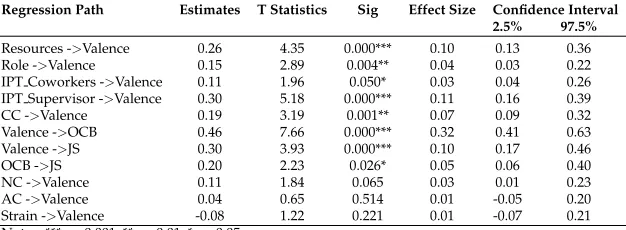
Regression Path Estimates T Statistics Sig Effect Size Confidence Interval 2.5% 97.5%
Resources ->Valence 0.26 4.35 0.000*** 0.10 0.13 0.36 Role ->Valence 0.15 2.89 0.004** 0.04 0.03 0.22 IPT Coworkers ->Valence 0.11 1.96 0.050* 0.03 0.04 0.26 IPT Supervisor ->Valence 0.30 5.18 0.000*** 0.11 0.16 0.39 CC ->Valence 0.19 3.19 0.001** 0.07 0.09 0.32 Valence ->OCB 0.46 7.66 0.000*** 0.32 0.41 0.63 Valence ->JS 0.30 3.93 0.000*** 0.10 0.17 0.46 OCB ->JS 0.20 2.23 0.026* 0.05 0.06 0.40 NC ->Valence 0.11 1.84 0.065 0.03 0.01 0.23 AC ->Valence 0.04 0.65 0.514 0.01 -0.05 0.20 Strain ->Valence -0.08 1.22 0.221 0.01 -0.07 0.21 Notes: *** p<0.001; ** p<0.01; * p<0.05
R-square: Valence = 0.51; OCB = 0.24; JS = 0.25
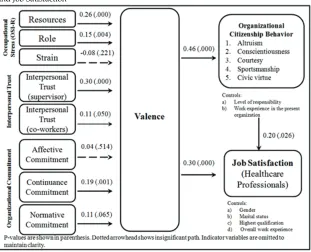
With two exceptions (i.e. affective commitment and strain) rests of the hypotheses are supported. More specifically, the three cognitive forces have shown a statistically signifi-cant impact on valence thus hypothesis 1 is supported. Moreover, valence has shown sta-tistically significant impact on both OCB (0.46, p=.000) and job satisfaction (0.30, p=.000) thus, hypothesis 2 and 3 are also supported. In addition, OCB has also shown significant impact on job satisfaction (0.20, p=. 026) thus, hypothesis 4 is also supported.
Albeit, the t-statistic of normative commitment is slightly less than|1.96|to gain
sta-tistical significance at 95% CI(p <0.05)however, its confidence interval does not include
zero enabling this sub-scale of organizational commitment significant at 90 percent
con-fidence level(p <0.10). However, the confidence interval of both affective commitment
Figure 2
Structural Relationship: Cognitive Forces, Valence, Organizational Citizenship Behavior, and Job Satisfaction
Predictive Relevance Using Cross-validated Redundancy Analysis
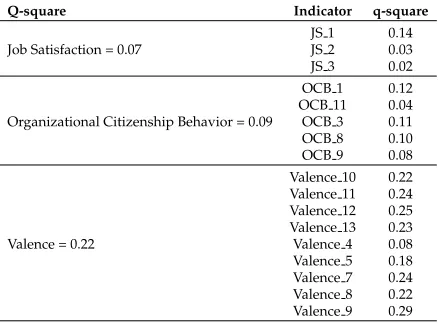
Lastly, according to the guidelines ofHair et al.(2012), the predictive relevance of both
latent variables (Q2) and each of their indicators(q2)serve as the last requirement to
test the structural (or inner) model as shown in Table 5. A blindfolding procedure was
followed to estimate predictive relevance(Q2) andq2. TheQ2 value of three LVs (i.e.
job satisfaction OCB, and valence) and(q2)each of the indicator variables are above zero
which reflects that the structural model has good predictive relevance and the measured
variables are well reconstructed (Henseler et al.,2009).
Discussion and Managerial Implications
Table 5
Predictive Relevance Using Crossvalidated Redundancy Analysis
Q-square Indicator q-square
JS 1 0.14 Job Satisfaction = 0.07 JS 2 0.03 JS 3 0.02 OCB 1 0.12 OCB 11 0.04 Organizational Citizenship Behavior = 0.09 OCB 3 0.11 OCB 8 0.10 OCB 9 0.08 Valence 10 0.22 Valence 11 0.24 Valence 12 0.25 Valence 13 0.23 Valence = 0.22 Valence 4 0.08 Valence 5 0.18 Valence 7 0.24 Valence 8 0.22 Valence 9 0.29
This work pressure tends to increase occupational role stress rendering them very cau-tious and attentive towards their daily routines. Their occupational role requires them to make operational, tactical, and strategic decisions which do not allow them to make unavoidable mistakes in their medical profession. More specifically, the sample consists
of 186 females (64 percent approx.) and 37 percent parents. Irawanto, Noermiyati, and
Primasari(2015) have argued that occupational stress mainly affects the performance of
female employees. However, the demographic variables significantly affect a number of
stress variables (Spielberger & Reheiser,1994). Generally speaking, it is conjectured that
female and male healthcare professionals take their home life and occupation as their
primary obligation respectively (Rashid & Talib, 2015). Hence, it is suggested that the
top management of a health care institution in Karachi should take these matters into
ac-count, particularly at the time of recruitment and selection (Adil, 2015) of a healthcare
professional.
Besides, it is very important to formulate different corporate-wide plans, e.g.
‘work-place health promotion programs’ (Nowrouzi et al.,2015) and exercises to help the
health-care professional mitigate their stress related issues. Failure to do so often results in ag-gressions, psychological and physical impairments and ultimately either straightaway
turnover or even death at workplace (Leigh, 1995; Mosadeghrad, Ferlie, & Rosenberg,
2011) because of work overload (called ‘Karoshi’ in Japan). In addition, considering the Likert-scale items of occupational resource in the context of the both private and public healthcare institution of Karachi, if the person knows the standard operating procedures, the contact person(s) when occupational needs arise, is empowered to adjust work duties according to his/her priorities and takes balance diet then of course, the valence (of job satisfaction) gets increased.
Commitment is the process of identification with the aims of an organization’s several
areas (Reichers,1985). It can take various forms and, arguably, have the potential to
influ-ence organizational effectiveness and employee well-being (Ahmed & Islam,2011;Islam
observing high performance from their employees in case of low commitment. In the past, organizations secured the loyalty of their employees by guaranteeing them job security. But due to high competitive pressure, organizations have to move towards downsizing, restructuring and strategic transformations which create an unsecure organizational cli-mate.
To meet the potential-increasing requirements of this competitive environment, one of the key components for survival is the ability of the organization to use human resource
effectively and efficiently (Ahmed & Islam,2011). The appointment of ‘right’ worker is
crucial, but it is more important for the organization’s ability to establish a portfolio of
committed workforce (Rehan & Islam, 2013). According toIslam et al. (2012),
organi-zational commitment reflects a psychological state of an employee because the person tends to demonstrate a higher level of ownership, which could ultimately result in better
performance (Adil,2015). These highly self-motivated employees start to participate in
various organizational activities with a holistic belief in knowledge sharing with all con-cerned. Consequently, better performance could be observed in the presence of several other antecedences e.g. organizational justice, working conditions, career growth
oppor-tunities, commitment to change (Adil, 2016), low rate of workplace incivility (Cortina,
Magley, Williams, & Langhout,2001), recognition, leader’s change-promoting behavior
(Adil,2014), etc.
The results also show that interpersonal trust between supervisors and co-workers have significant impact on valence of job satisfaction. Trust is considered as one of the
ma-jor antecedents of developing effective and enriching organizational climate.Ng(2015)
ar-gued that a trustworthy employer can inherently inculcate an organizational commitment among employees. Moreover, cost-effective working conditions may further reinforce a better working environment in order to achieve optimum performance of healthcare pro-fessionals. Therefore, the study recommends that the management of healthcare institu-tions should invest in promoting a trusting culture in their organizainstitu-tions (Barthelemy,
2001;Oh, Gallivan, & Kim,2006). It is imperative to recognize that this is the trust which
could assist healthcare professionals embark on better organizational commitment and OCB. People start to take more ownership in the job and working units and collectively over a period of time, a high-performance work system (HPWS) could be established. Knowing that this is a challenging task where there is a high rate of occupational stress, both supervisors and healthcare staff may work together in order to mitigate the reper-cussion of stress and, no doubt, this could only be achieved once there is an interpersonal trust between co-workers and officers of the healthcare institution.
The statistical result uncovers that valence (of job satisfaction) significantly influence OCB and job satisfaction of the healthcare professionals in Karachi. This finding has been
found consistent with the findings ofCabrera and Cabrera(2005) that the valence of job
satisfaction enhances employee’s citizenship behaviors. Therefore, it is essential for firms to select the right person-organization fit for employees with necessary personality traits,
value, intention and inclination to share knowledge (Chatman,1991) so that firms will
be able to create a better organizational environment and culture for knowledge sharing.
This selective hiring practice reaffirmed the finding ofGoodman and Leyden(1991) that
interchange of knowledge among old and new employees. Hence, it is also recommended that it is beneficial to include OCB as one of the major key indicators of employee’s per-formance.
Besides, this study has numerous implications to healthcare management and staff. The OCB has shown a significant impact on job satisfaction. Not to mention, this is the devising platform which enables employees to perform at their best. Although OCB rep-resents a discretionary behavior, it tends to reflect a high level of self-motivation and a strong belief in the management that their efforts would be recognized and hence re-warded within financial constraints of the organization. In line with both monetary and non-monetary rewards, employees seek for better professional growth, mental piece with SMART targets, work-life balance and manageable occupational stress. For this, employ-ees need to behave as per the rules and regulations. Moreover, the psychological contract between the manager and the sub-ordinates should be clarified as early as possible. Later on, employees will be engaged in their routine activities and on-the job trainings may deter the smooth functioning and delivery of the healthcare services. It is equally
im-portant to invest in the healthcare services (Smith, Mitra, & Narasimhan,1998) because
value-added services to patients may also enhance their level of satisfaction which could in turn, motivate the healthcare employees.
It is also predicted that the supply and demand of professionals for healthcare will
extend until 2012 (Geer, 2006). Therefore, this intricate situation will further put more
work load on existing employees causing them leaving their job. They could do this because of getting job satisfaction so the healthcare management must continuously and vigorously look after the workload of health professionals as they are more vulnerable
to stress and fatigue at work (Moore & Love,2005), which can direct them to leave as
they have high levels of intention (Moore & Burke,2002). It may be completed through,
such as, the reduction of role conflict and more benefits from interferences and stress management.
Directions for Future Research
Future studies should study the multivariate and causal relationship between the qual-ity of work life (QWL) and occupational stress among healthcare professionals of Pak-istan. Different constructs may be taken as a mediator or moderator as per the research needs. These variables include leader-member exchange relationship, workplace inci-vility, self-efficacy, and psychological empowerment. This suggested domain has also been an under-researched area in the healthcare sector of other major cities of Pakistan. More specifically, a multi-trait multi-method (MTMM) design may also be used to
mea-sure multiple traits by multiple methods (Byrne,2013). In addition, future studies may
also analyze the non-linear moderating effect of organizational tenure on the relationship
Conclusion
References
Abdel-Halim, A. A. (1982). Social support and managerial affective responses to job
stress. Journal of Organizational Behavior,3(4), 281–295.
Adil, M. S. (2014). Impact of leader’s change-promoting behavior on readiness for change:
A mediating role of organizational culture.Journal of Management Sciences,1(2), 102–
123.
Adil, M. S. (2015). Strategic human resource management practices and competitive
priorities of the manufacturing performance in Karachi. Global Journal of Flexible
Systems Management,16(1), 37–61.
Adil, M. S. (2016). Impact of change readiness on commitment to technological change, focal, and discretionary behaviors: Evidence from the manufacturing sector of
Karachi. Journal of Organizational Change Management,29(2), 222–241.
Adil, M. S., Awais, A., Khan, I., & Qureshi, M. A. (2019). Leader-member exchange, job satisfaction, affective commitment, and job stress: Implications for turnover
in-tentions using covariance-based structural equation modelling. Pakistan Business
Review,21(2).
Ahmed, I., & Islam, T. (2011). Decoding the relationship between employee’s jobs related
behaviors: A study of telecom sector of Pakistan.International Journal of Business and
Social Science,2(8), 245–252.
Allen, N. J., & Meyer, J. P. (1990). The measurement and antecedents of affective,
contin-uance and normative commitment to the organization. Journal of Occupational and
Organizational Psychology,63(1), 1–18.
American Association of Colleges of Nursing. (2002). Hallmarks of the professional
nurs-ing practice environment.Journal of Professional Nursing,18(5), 295–304.
Andersson, L. M., & Bateman, T. S. (1997). Cynicism in the workplace: Some causes
and effects. Journal of Organizational Behavior: The International Journal of Industrial,
Occupational and Organizational Psychology and Behavior,18(5), 449–469.
Aulakh, P. S., & Gencturk, E. F. (2000). International principal–agent relationships:
Con-trol, governance and performance.Industrial Marketing Management,29(6), 521–538.
Barthelemy, J. (2001). The hidden costs of IT outsourcing.MIT Sloan Management Review,
42(3), 60–69.
Bateman, T. S., & Organ, D. W. (1983). Job satisfaction and the good soldier: The
relation-ship between affect and employee “citizenrelation-ship”. Academy of Management Journal,
26(4), 587–595.
Beehr, T. A., King, L. A., & King, D. W. (1990). Social support and occupational stress:
Talking to supervisors. Journal of Vocational Behavior,36(1), 61–81.
Ben-Zur, H., Yagil, D., & Oz, D. (2005). Coping strategies and leadership in the adaptation
to social change: The Israeli kibbutz.Anxiety, Stress & Coping,18(2), 87–103.
Bryman, A. (2012). Social research methods. Oxford University Press.
Byrne, B. M. (2013). Structural equation modeling with eqs: Basic concepts, applications, and
programming. New York: NY, Taylor and Francis Group.
Cabrera, E. F., & Cabrera, A. (2005). Fostering knowledge sharing through people
720–735.
Carver, C. S., Scheier, M. F., & Weintraub, J. K. (1989). Assessing coping strategies: A
theoretically based approach. Journal of Personality and Social Psychology,56(2), 267–
283.
Cenfetelli, R. T., & Bassellier, G. (2009). Interpretation of formative measurement in
infor-mation systems research. MIS Quarterly, 689–707.
Chatman, J. A. (1991). Matching people and organizations: Selection and socialization in
public accounting firms. Administrative Science Quarterly,36(3), 459–484.
Chen, S.-H., Yang, C.-C., Shiau, J.-Y., & Wang, H.-H. (2006). The development of an
employee satisfaction model for higher education. The TQM Magazine,18(5), 484–
500.
Chiaburu, D. S., Oh, I.-S., Berry, C. M., Li, N., & Gardner, R. G. (2011). The five-factor model of personality traits and organizational citizenship behaviors: A
meta-analysis. Journal of Applied Psychology,96(6), 1140–1166.
Cook, J., & Wall, T. (1980). New work attitude measures of trust, organizational
commit-ment and personal need non-fulfilcommit-ment. Journal of Occupational and Organizational
Psychology,53(1), 39–52.
Cooper, C. L., & Marshall, J. (2013). Occupational sources of stress: A review of the
liter-ature relating to coronary heart disease and mental ill health. Journal of Occupational
Psychology,49, 3–23.
Cortina, L. M., Magley, V. J., Williams, J. H., & Langhout, R. D. (2001). Incivility in the
workplace: Incidence and impact. Journal of Occupational Health Psychology, 6(1),
64–80.
Cyr, D. (1999). High tech, high impact: Creating Canada’s competitive advantage through
technology alliances.The Academy of Management Executive,13(2), 17–26.
Davison, A. C., & Hinkley, D. V. (1997).Bootstrap methods and their application. Cambridge:
Cambridge University Press.
Diamantopoulos, A., & Winklhofer, H. M. (2001). Index construction with formative
indicators: An alternative to scale development. Journal of Marketing Research,38(2),
269–277.
Djukic, M., Kovner, C. T., Brewer, C. S., Fatehi, F. K., & Cline, D. D. (2013). Work envi-ronment factors other than staffing associated with nurses’ ratings of patient care
quality. Health Care Management Review,38(2), 105–114.
Edwards, J. R. (2011). The fallacy of formative measurement. Organizational Research
Methods,14(2), 370–388.
Efron, B., & Tibshirani, R. J. (1994). An introduction to the bootstrap. New York: Chapman
Hall.
Eisenberg, R., Fasolo, P., & Davis-LaMastro, V. (1990). Perceived organizational support
and employee diligence, commitment, and innovation.Journal of Applied Psychology,
75(1), 51–59.
Faul, F., Erdfelder, E., Buchner, A., & Lang, A.-G. (2009). Statistical power analyses
us-ing G* Power 3.1: Tests for correlation and regression analyses. Behavior Research
Methods,41(4), 1149–1160.
adult work stress: Social-emotional competence and anger in adolescence. Journal of Behavioral Medicine,28(3), 223–230.
Geer, D. (2006). Software developer profession expanding.IEEE Software,23(2), 112–115.
Goodman, P. S., & Leyden, D. P. (1991). Familiarity and group productivity. Journal of
Applied Psychology,76(4), 578–586.
Hair, J. F., Ringle, C. M., & Sarstedt, M. (2011). PLS-SEM: Indeed a silver bullet.Journal of
Marketing Theory and Practice,19(2), 139–152.
Hair, J. F., Sarstedt, M., Ringle, C. M., & Mena, J. A. (2012). An assessment of the use of
partial least squares structural equation modeling in marketing research. Journal of
the Academy of Marketing Science,40(3), 414–433.
Hair Jr, J. F., Hult, G. T. M., Ringle, C., & Sarstedt, M. (2016).A primer on partial least squares
structural equation modeling (PLS-SEM). USA: Sage Publications, Inc.
Henseler, J., Ringle, C. M., & Sinkovics, R. R. (2009). The use of partial least squares
path modeling in international marketing.Advances in International Marketing,20(1),
277–319.
Irawanto, D. W., Noermiyati, & Primasari, D. (2015). The effect of occupational stress on
work performance of female employees: Study in Indonesia. Asia-Pacific Journal of
Management Research and Innovation,11(4), 336–345.
Islam, T., Ahmad, Z., Ahmed, I., Ahmad, A., Muhammad, S., & Muhammad, S. K. (2012). Does compensation and demographical variable influence on teachers commitment
and job satisfaction? A study of University of the Punjab, Pakistan. International
Journal of Business and Management,7(4), 35–43.
Jehn, K. A., & Shah, P. P. (1997). Interpersonal relationships and task performance: An
examination of mediation processes in friendship and acquaintance groups. Journal
of Personality and Social Psychology,72(4), 775–790.
Kramer, M., & Hafner, L. P. (1989). Shared values: Impact on staff nurse job satisfaction
and perceived productivity. Nursing Research,38(3), 172–177.
Kramer, R. M., & Tyler, T. R. (1996). Trust in organizations: Frontiers of theory and research.
Thousand Oaks, CA: Sage Publications.
Kristensen, T. S. (1996). Job stress and cardiovascular disease: A theoretic critical review.
Journal of Occupational Health Psychology,1(3), 246–260.
Lake, E. T. (2002). Development of the practice environment scale of the nursing work
index. Research in Nursing & Health,25(3), 176–188.
Lake, E. T. (2007). The nursing practice environment. Medical Care Research and Review,
64(2), 104–122.
Lambert, E. G., Hogan, N. L., & Griffin, M. L. (2007). The impact of distributive and procedural justice on correctional staff job stress, job satisfaction, and organizational
commitment. Journal of Criminal Justice,35(6), 644–656.
Lapierre, L. M., & Hackett, R. D. (2007). Trait conscientiousness, leader-member exchange, job satisfaction and organizational citizenship behaviour: A test of an integrative
model.Journal of Occupational and Organizational Psychology,80(3), 539–554.
Lee, T. W., Mitchell, T. R., Holtom, B. C., McDaneil, L. S., & Hill, J. W. (1999). The
unfolding model of voluntary turnover: A replication and extension. Academy of
Leigh, J. P. (1995). Causes of death in the workplace. Westport: CT, Greenwood Publishing Group.
LePine, J. A., Erez, A., & Johnson, D. E. (2002). The nature and dimensionality of
organiza-tional citizenship behavior: A critical review and meta-analysis. American Psychological Association.
McAllister, D. J. (1995). Affect-and cognition-based trust as foundations for interpersonal
cooperation in organizations. Academy of Management Journal,38(1), 24–59.
Meyer, J. P., & Allen, N. J. (1991). A three-component conceptualization of organizational
commitment. Human Resource Management Review,1(1), 61–89.
Meyer, J. P., Allen, N. J., & Gellatly, I. R. (1990). Affective and continuance commitment to the organization: Evaluation of measures and analysis of concurrent and
time-lagged relations. Journal of Applied Psychology,75(6), 710–720.
Meyer, J. P., & Herscovitch, L. (2001). Commitment in the workplace: Toward a general
model.Human Resource Management Review,11(3), 299–326.
Mitchell, T. R. (1974). Expectancy models of job satisfaction, occupational preference and
effort: A theoretical, methodological, and empirical appraisal.Psychological Bulletin,
81(12), 1053–1077.
Moore, J. E., & Burke, L. A. (2002). How to turn around ‘turnover culture’ in it.
Commu-nications of the ACM,45(2), 73–78.
Moore, J. E., & Love, M. S. (2005). IT professionals as organizational citizens.
Communica-tions of the ACM,48(6), 88–93.
Moorman, R. H. (1993). The influence of cognitive and affective based job satisfaction measures on the relationship between satisfaction and organizational citizenship
behavior. Human Relations,46(6), 759–776.
Morrison, E. W. (1996). Organizational citizenship behavior as a critical link between
HRM practices and service quality. Human Resource Management,35(4), 493–512.
Mosadeghrad, A. M., Ferlie, E., & Rosenberg, D. (2011). A study of relationship between job stress, quality of working life and turnover intention among hospital employees.
Health Services Management Research,24(4), 170–181.
Mowday, R. T., Steers, R. M., & Porter, L. W. (1979). The measurement of organizational
commitment. Journal of Vocational Behavior,14(2), 224–247.
Ng, T. W. (2015). The incremental validity of organizational commitment, organizational
trust, and organizational identification. Journal of Vocational Behavior,88, 154–163.
Ng, T. W., & Feldman, D. C. (2011). Affective organizational commitment and citizenship
behavior: Linear and non-linear moderating effects of organizational tenure.Journal
of Vocational Behavior,79(2), 528–537.
Ng, T. W., Lam, S. S., & Feldman, D. C. (2016). Organizational citizenship behavior and
counterproductive work behavior: Do males and females differ?Journal of Vocational
Behavior,93, 11–32.
Nizam, S. A., & Adil, M. S. (2014). Determiants of teacher’s job satisfaction: Evidence
from the primary and secondary schools of Karachi. Journal of Education and Social
Sciences,2(2), 109–126.
in-terventions in nursing and their implications for healthy work environments: A
literature review. Workplace Health & Safety,63(7), 308–315.
Oh, W., Gallivan, M. J., & Kim, J. W. (2006). The market’s perception of the transactional
risks of information technology outsourcing announcements.Journal of Management
Information Systems,22(4), 271–303.
Orchard, C. A., Curran, V., & Kabene, S. (2005). Creating a culture for interdisciplinary
collaborative professional practice. Medical Education Online,13(10), 1–3.
Organ, D. W., Podsakoff, P. M., & MacKenzie, S. B. (2005). Organizational citizenship
behavior: Its nature, antecedents, and consequences. CA: Sage, Thousand Oaks.
Oshagbemi, T. (2003). Personal correlates of job satisfaction: Empirical evidence from UK
universities.International Journal of Social Economics,30(12), 1210–1232.
Podsakoff, N. P., Whiting, S. W., Podsakoff, P. M., & Blume, B. D. (2009). Individual-and organizational-level consequences of organizational citizenship behaviors: A
meta-analysis.Journal of Applied Psychology,94(1), 122–141.
Podsakoff, P. M., MacKenzie, S. B., Lee, J.-Y., & Podsakoff, N. P. (2003). Common method biases in behavioral research: A critical review of the literature and recommended
remedies. Journal of Applied Psychology,88(5), 879–903.
Podsakoff, P. M., & Organ, D. W. (1986). Self-reports in organizational research: Problems
and prospects. Journal of Management,12(4), 531–544.
Rashid, I., & Talib, P. (2015). Occupational stress and coping styles among doctors: Role
of demographic and environment variables. Vision,19(3), 263–275.
Rehan, M. F., & Islam, T. (2013). Relationship between organizational commitment and
citizenship behaviours. World Journal of Management and Behavioral Studies,1(1), 24–
32.
Reichers, A. E. (1985). A review and reconceptualization of organizational commitment.
Academy of Management Review,10(3), 465–476.
Ringle, C. M., Wende, S., & Becker, J.-M. (2015). Smartpls 3. SmartPLS GmbH,
Boenning-stedt.
Robinson, S. L. (1996). Trust and breach of the psychological contract. Administrative
Science Quarterly,41, 574–599.
Romzek, B. S. (1990). Employee investment and commitment: The ties that bind. Public
Administration Review,50(3), 374–382.
Roth, S., & Cohen, L. J. (1986). Approach, avoidance, and coping with stress. American
Psychologist,41(7), 813–819.
Sarkkinen, M., & K´’assi, T. (2015). Predictive modeling of innovation capability in a
regional context.International Journal of Innovation and Technology Management,12(1),
1–25.
Schaufeli, W., Leiter, M., & Kalimo, R. (1995). The general burnout inventory: A
self-report questionnaire to assess burnout at the workplace. Work, Stress and Health,95,
14–16.
Schriesheim, C. A. (1979). The similarity of individual directed and group directed leader
behavior descriptions. Academy of Management Journal,22(2), 345–355.
Scott, S. G., & Bruce, R. A. (1994). Determinants of innovative behavior: A path model
580–607.
Sekaran, U., & Bougie, R. (2016). Research methods for business: A skill building approach.
UK, West Sussex: John Wiley & Sons Ltd.
Shaffer, J. P. (1995). Multiple hypothesis testing. Annual Review of Psychology,46(1), 561–
584.
Smith, M. A., Mitra, S., & Narasimhan, S. (1998). Information systems outsourcing: A
study of pre-event firm characteristics. Journal of Management Information Systems,
15(2), 61–93.
Spielberger, C. D., & Reheiser, E. C. (1994). The job stress survey: Measuring gender
differences in occupational stress.Journal of Social Behavior and Personality,9(2), 199–
218.
Tabachnick, B., & Fidell, L. (2013). Using multivariate statistics. Boston, MA: Pearson
Education.
Teas, R. K. (1981). A within-subject analysis of valence models of job preference and
anticipated satisfaction. Journal of Occupational and Organizational Psychology,54(2),
109–124.
Vroom, V. H. (1964). Work and motivation. New York, NY: Wiley.
Williams, L. J., & Anderson, S. E. (1991). Job satisfaction and organizational commitment
as predictors of organizational citizenship and in-role behaviors. Journal of
Manage-ment,17(3), 601–617.
World Health Organization. (2014).A universal truth: No health without a workforce. Geneva,