
©2012 JNAS Journal-2013-2-1/13-18 ISSN 0000-0000 ©2012 JNAS
A Study on Performance of Fuzzy Logic Type 2 PSS and Fuzzy type 2
Model Reference Learning PSS
Morteza Sharafi1* , Abdol Hossein Ayoubi2, Seyed abolfazl Fakoorian3 and Mohammad Reza Aalami4
1- Islamic Azad University Gonabad branch
2- Ms student of Medical Information Technology Biomedical Engineering Department Amirkabir University of Technology
2- Islamic Azad University Gonabad branch 3- Islamic Azad University Gonabad branch
Corresponding author Email : [email protected]
ABSTRACT: Power system stabilizer (PSS) can provide supplementary control signal to the excitation system to damp electromechanical oscillations between interconnected synchronous generators and to improve dynamic performance. This paper presents a comparison study between a fuzzy type 2 logic PSS (FLPSS) and a fuzzy type 2 model reference learning PSS (FMRLPSS) to improve the stability of a synchronous generator. A fuzzy type 2 logic based PSS and fuzzy type 2 model reference learning are designed and simulated using MATLAB software package. The simulation results are compared. It is shown that the FMRLPSS is superior to FLPSS.
Keywords: Power system stabilizer; Fuzzy type 2 logic control; Fuzzy type 2 model reference learning.
INTRODUCTION
Electro-mechanical oscillation between interconnected synchronous generators is phenomena inherent to power systems. The damping of these oscillations is of vital concern, and is a prerequisite for secure system operation. Power system stabilizers (PSSs) can provide supplementary control signal to the excitation system to damp these oscillations and to improve dynamic performance.
Most PSS in use in electric power systems employ the linear control theory approach based on a linear model of a fixed configuration of the power system and thus tuned at a certain operating condition. Such fixed parameter PSS, called conventional PSS (CPSS), is widely used in power systems, it often does not provide satisfactory results over a wide range of operating conditions.
14
controller: the first using Neuro-Fuzzy type 2 Control technique (ANFIS), the second using a learning technique based on a model reference .In this paper, we introduce a learning controller that is developed by synthesizing several basic ideas from fuzzy set and control theory, self-organizing control, and conventional adaptive control. The adaptive control system is designed so that its “learning controller” has the ability to improve the performance of the closed-loop system by generating command inputs to the plant and utilizing feedback information from the plant. In the case, we utilize a Learning mechanism, which observes the terminal voltage and adjusts the membership functions of the rules in a direct fuzzy controller so that the overall system behaves like a "reference model". The effectiveness of this Fuzzy Model Reference Learning PSS (FMRLPSS) is illustrated by showing that it can achieve high performance learning control for power system stabilizer.
Problem Formulation System modeling
In single machine infinite bus system, the synchronous machine (generator) is connected to an infinite bus through a transformer and two parallel transmission lines. In generator bus, a local load is also supplied as seen Fig. 1.
Figure 1. Schematic of the single machine power system connected to an infinite bus
Fuzzy type 2 logic power system stabilizer (FLPSS)
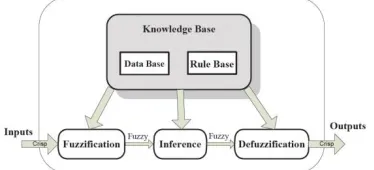
A FLC is a kind of a state variable controller governed by a family of rule and a fuzzy type 2 inference mechanism. The FLC algorithm can be implementation-using heuristic strategies, defined by linguistically describe statements. The fuzzy type 2 logic control algorithm reflects the mechanism of control implemented by people, without using a mathematical model the controlled object, and without an analytical description of the control algorithm. The main FLC processes are fuzzifier, knowledge base, the inference engine and defuzzifier as in Fig. 2.
Figure 2. The basic structure of the fuzzy type 2 controller
The inference engine maps the input values into fuzzy type 2 value using normalized membership functions and input gain. The fuzzy type 2-logic inference engine deduces the proper control action based on the available rule base. The fuzzy type 2 control action is translated to the proper crisp value through the defuzzifier using normalized membership functions and the output gain. The output control signal from FPSS is injected to the summing point of the AVR. In this paper, inputs are fuzzified using normalized triangle membership functions.
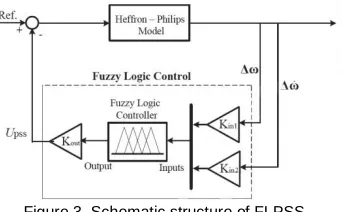
15 Figure 3. Schematic structure of FLPSS
Step (1): In this method, two variable and are used as input signal in PSS. The coefficient Kin1 and Kin2 in
input stage, keep the input signals within value scale to required value in decision limit. The output signal (UPSS) is
injected to the summary point of AVR as the supplementary signal.
Step (2): Each of FLPSS input and output fuzzy type 2 variable Y= (,U
PSS) membership function have been
chosen identical because of the normalization achieved on the physical variables. The normalization is important because is allows the controller to associate equitable weight to each of the rules and therefore, to calculate correctly the stabilizing signal.
Each of the input and output fuzzy type 2 variable, yi is assigned seven linguistic fuzzy type 2 subsets varying
from Negative Big (NB) to Positive Big (PB). Each subset is associated with a triangular membership function to form a set of seven normalized and symmetrical triangular membership function for fuzzy type 2 variables. (See Fig. 4).
Figure 4. Fuzzy type 2 variableya seven membership functions
Step (3): The ymax and ymin represent maximum and minimum variation of the input and output signals. These
values are selected based on simulations data. The range of each fuzzy type 2 variable is normalized between -4 to 4 by introducing a scaling factor to represent the actual signal.
Step (4): The interface mechanism of the FLC is represented by a
7
7
decision table. The set of decision rules relating all possible combinations of input to outputs is based on previous experience in the field. This set is made up of 49 rules expressed using the same linguistic variables as those of the inputs and is stored in the form of a decision table shown in Table 1.Table 1. FLPSS decision table
NB NM NS Z PS PM PB
NB NB NB NB NB NM NS Z
NM NB NB NM NM NS Z PS
NS NB NM NM NS Z PS PM
Z NM NM NS Z PS PM PM
PS NM NS Z PS PM PM PB
PM NS Z PS PM PM PB PB
PB Z PS PM PB PB PB PB
Step (5): Let
1,
2,...,
3 represent the centroids of M membership functions that are assigned to UPSS and wi
represents the firing strength of the ith rule. Thus, for M rules, the output of the controller is:
. .
1 1
M
j j M
J j j
PSS w w U
16
Fuzzy type 2 Model Reference Learning PSS
Figure 5 shows the functional block diagram of the FMRLPSS. It is made up of four main parts; the plant, the fuzzy type 2 controller to be tuned, the reference model, and the learning mechanism (an adaptation mechanism) [8]. The FMRLPSS uses discrete time signals (r(kT), and y(kT) with T as the sampling period. It also uses the learning mechanism to observe numerical data from a fuzzy type 2 control system. With this numerical data, it characterizes the fuzzy type 2 control system’s current performance and automatically synthesizes or adjusts the fuzzy type 2 controller so that some given performance objectives are met.
Figure 5. Fuzzy type 2 Model Reference Learning PSS
Here, the fuzzy type 2 control system loop operates to make y(kT) track r(kT) by manipulating u(kT), while the adaptation control loop seeks to make the output of the plant y(kT) track the output of the reference model ym(kT)by
manipulating the fuzzy type 2 controller parameters.
The fuzzy type 2 controller
The synchronous generator (Heffron-Philips Model) which represents the plant has an input u(kT) from the fuzzy type 2 controller and frequency deviation in output y(kT). The input to the fuzzy type 2 controller is the error
) ( ) ( )
(kT rkT ykT
e and change in error c(kT)e(kT)eT(kTT)
Where r(kT) is a reference input.
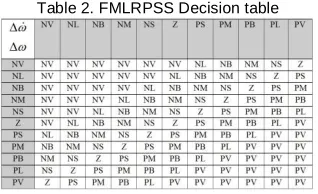
A total of 121 fuzzy type 2 rules were employed as indicated below in table 1 with triangular membership functions.
Table 2. FMLRPSS Decision table
In the table above, NV, NL, NB, NM, NS, ZR, PS, PM, PB, Pl, PV stands for negative very large, negative large, negative big, negative medium, negative small, zero, positive small, positive medium, positive big, positive large, and positive very large.
17
0 1 2 3 4 5 6 7 8 9 10
-5 -4 -3 -2 -1 0 1 2x 10⁻⁴
Time (s) F re q u e n c y d e v ia ti o n ( H Z ) FMRL PSS FL PSS
0 1 2 3 4 5 6 7 8 9 10
-12 -10 -8 -6 -4 -2 0 2x 10⁻⁴
Time (s) F re q u e n c y d e v ia tio n ( H Z ) FMRL PSS FL PSS
0 1 2 3 4 5 6 7 8 9 10 -2.5 -2 -1.5 -1 -0.5 0 0.5x 10⁻³
FMRL PSS FL PSS
Figure 7. Membership functions for output u
The reference Model
A reference model is chosen because this model decays to zero in short time. If T = 0.1 sec, we can use bilinear transformation to find the discrete equivalent continuous time transfer function G(s) by replacing s with . A Fuzzy type 2 Model Reference Learning PSS for Synchronous Generator Terminal Voltage Control
21 19 ) 1 ( 21 1 ) ( ) ( ) ( z z z H z R z ym (2)
where ym(z) and R(z) are the transforms of ym(kT) and r(kT ) respectively. So the discrete time implementation is
) ( 21 1 ) ( 21 1 ) ( 21 19 )
(kT T y kT rkT T rkT
ym m (3)
The Learning Mechanism
The learning mechanism tunes the rule-base of the direct fuzzy type 2 controller so that the closed loop system behaves like the reference model. These rule-base modifications are made by observing data from the controlled process, the reference model, and the fuzzy type 2 controller. The learning mechanism consists of two parts: a fuzzy type 2 inverse model and a knowledge base modifier. The fuzzy type 2 inverse model (having the same rule base with the fuzzy type 2 controller) performs the function of mapping ye(kT)(representing the deviation from the
desired behavior) to changes in the process inputs p(kT) that are necessary to force ye(kT) to zero. The
knowledge-base modifier performs the function of modifying the fuzzy type 2 controller’s rule-base to affect the needed changes in the process inputs.
(a) (b) (c)
Figure 8. Compare performance of FLPSS and FMRLPSS: (a) Normal Load, (b) Heavy Load, (c) Fault in the line
RESULTS
In this section, in order to compare the performance of the FLPSS and FMRLPSS, some simulations are performed and its time domain results are provided. Simulations performed in three different operating conditions as follow: a) Normal load condition: The condition in which the system is operated in initial values. The values are selected as Pe0=1.0 p.u, Qe0=0.015p.u, Vt0=1.05pu.
b) Heavy load conditions: The condition in which the real power (Pe) is increased from 1.0 to 1.3 p.u.
3) In the case of fault occurrence in transmission line: The condition in which the line 2 in Fig. 1 is isolated with normal condition.
Table 3. The coefficients K1 to K6 for The Heffron-Phillips model in different operational conditions
Operation Conditions K1 K2 K3 K4 K5 K6
Nominal Load 0.5441 1.2067 0.6584 0.6981 -0.095 0.8159
Heavy Load 0.4563 1.4477 0.6584 0.8706 -0.167 0.7747
Fault in the Line 0.4007 1.1404 0.7095 0.6834 -0.120 0.8348
18
The application of fuzzy type 2 model reference learning controller is the main focus of this paper. Not only that this controller is adaptive in nature but the behavior of the plant is controlled by identifying (11×11) rules which took care of most nonlinear operating conditions which wouldn’t have been a problem by convectional adaptive and non-adaptive controllers.
the simulation result show that the FMRLPSS has a better performance over a wide of operating condition than the FPSS and is a less sensitive to change in operating condition.(See Figs.8(a)-8(c)).
REFERENCES
Larson E. V. and Swann D. E., "Applying Power system stabilizer: Part I, II and III," IEEE Transactions on Power Apparatus and System, Vol, PAS-100, No. 6, pp. 3017-3041. 1991.
El-Metwally K., and Malik O., "Fuzzy type 2 Logic Power System.
Stabilizer", IEE Proc. Generation, Transmission, and Distribution,vol. 142, no.3, pp.227-281, 1995.
J. Kim, N. Kasabov, “HyFIS: Adaptive neuro-fuzzy inference systems and their application to non-linear dynamical systems Neural Networks”, vol. 9, No. 12. pp. 13–19. , 1999.
T. Procyk and E. Mamdani, "A linguistic self-organizing process controller", Automatica, vol. 15, No. 1, pp. 15-30 , Jan. 1979. V. G. Moudgal, W. A. Kwong, K. M. Passino, and S. Yurkovich, “Fuzzy learning control for a fexible-link robot,” IEEE Trans. On
Fuzzy Systems, vol. 3, N 2, May 1995, pp. 199–210.
Layne J.R., Passino K.M., “Fuzzy Model Reference Learning Control,” Journal of Intelligent andF uzzy Systems, Vol. 4, No. 1, pp. 33–47, 1996.
R. Hooshmand and M. Ataei “An Auto-Tuning Fuzzy Logic PSS Design under Multi-operating Conditions Using Real-Coded Genetic Algorithm" Journal of Electrical Systems, vol. 5, no.1, March 2009.

![PC-Based 台灣手語轉語音溝通輔助系統 (PC-based Taiwanese Sign Language to Speech Communication Aided System)[In Chinese]](data:image/gif;base64,R0lGODlhAQABAIAAAP///wAAACH5BAEAAAAALAAAAAABAAEAAAICRAEAOw==)