INTERACTIVE EFFECT OF SOME VITAMINS AND SALINITY ON THE RATE OF
TRANSPIRATION AND GROWTH OF SOME BROAD BEAN LINES
A.F. RADII, A.M. ISMAIL*l AND M.M. AZOOZJ
'Botany Department, Faculty of Science, Assiut University. Assiut, Egypt. 2,3. Botany Department, Faculty of Science, South valley University, Qena, Egypt
Received on 12 June., 2000. Revised on 18 Feb., 2001
SUMMARY
Transpiration rate, leaf area and dry weights of shoots and roots of three broad bean (Vicia/aba L.)lines, 900-3,67 and 13 were significantly reduced with the increase in salinity. Treatments (seed soaking, or spraying) with vitamins B6 (pyridoxine) or PP(nicotinamide) exhibited variable effects. The rate of transpiration was significantly reduced in treated plants at all salinity levels compared with untreated salinized plants. However, vitamin treatments generally exhibited a significant increase in the leaf area and dry matter yield of salt stressed bean lines, resulting in a complete alleviation of the adverse effect of the high levels of salinity.
Key words: Broad bean (Vicia/aba L.), dry matter, leaf area~ nicotinamide, pyridoxine, salt stress, transpiration.
INTRODUCTION
The plant water relationship parameters were found to be directly affected by salinity. In this context salinity inhibited water absorption by plants especially with the
rise of NaCI concentration (EI-Shahaby 1978).
Consequently, the loss of water via transpiration, was also found to decrease with rise of salinity level (Radi et al., 1988, Schmidhalter and Oertli 1991, and Storey 1995). This reduction in transpiration rate due to salt stress was attributed to some changes in the frequency, size and movement of stomata (Kirschbaum 1987). In addition Brugnoli and Lauteri (1/991) found that the plant growth, leaf area development and stomatal conductance were also strongly reduced by salinity, which could be attributed to a reduction in leaf area and leaf number (Nabil and Coudret 1995). This'reduction as a result of excess Na+ and CI- ions was also associated with chlorosis and death of expanded"leaves leading to a decrease in photosynthetic' activity.
Seed soakingpresowing in vitamins could be exploited to ensure better germination and enhanced early seedling
• Author tor correspondence
24
growth (Samiullah et al. 1985). Thus, the aim of the present work was to test the effect of various vitamin treatments (seed soaking and spraying) in ameliorating the adverse effects of salinity on some broad bean lines. Various treatments were also compared to evaluate their further applicability on a large scale.
MATERIALS AND METHODS
Broad bean (Vieja/aba L.) lines, pure strain (parent) 900-3, FAAU 67 and FAAD 13, were grown in plastic pots with po Iyethy lene bags. Two kg of air-dry soi I(sandi clay 1:2v/v) were put into a polyethylene bag which was then introduced into the plastic pot. Perforated plastic tubes (1.5 cm in diameter and 40 cm long) were inserted into the soil to help the distribution of added solution. Seeds from the experimental lines were sown in the plastic pots and the seedlings, selected on the basis of vigor and uniformity, were subjected to the desired salinization levels (60, ]20, ]80 and 240 mM NaCI). Thereafter, the test plants were daily irrigated with water to reach in each treatmenttothe above desired salinization levels, by weighing the whole system (pot, soil,
EFFECT OF VITAMINS AND SALINITY ON BROAD BEAN tube and polyethylene bag). The plants were left to grow
under the different salinization levels and vitamin treatments until the end of experimental period (40 days). Five plants were allowed to grow in each pot and three replicates from each level ofNaCI were considered.
Two different methods of vitamin application have been used in the present work. Seed soaking: Seeds of experimental plants were soaked in freshly prepared vitamin (vit. B6 or vit. PP) sol. 100 ppm. for 4 hours and then air-dried for 48 hours. The treated seeds sown in pots having the different concentration ofNaCI starting from absolute control (without NaCI) to 240 mM NaCI and left to germinate. Spraying method: Plants attwo leaves stage were sprayed with 100 ppm ofvit. B6or vit. PP. (5 ml for each pot). Spraying was conducted 3 times at intervals of 7 days.
Transpiration rate of the plants (20 days after germination) was estimated as described by Bozcuk (1975). Leaf area was measured by the disk method (Watson and Watson 1953) and given in dm2 per plant. For dry matter determinations the fresh plants (roots and shoots) were dried in an aerated oven at 70°C to constant mass.
RESULTS AND DISCUSSION
The experimental data obtained (Table I) revealed that loss of water via transpiration ofthe three test broad bean lines was slightly affected at low and moderate levels ofNaCI. This slight effect is in accordance with the results observed by Schmidhalter and Oertli (1991). The transpiration rate was severely affected by salinity. This insignificant effect of salinity upon transpiration rate indicate that the bean line tested could be considered as tolerantto the level of60 mM NaCI (broad bean lines 900-3 and 1900-3), and up to 120 mM NaCI (broad bean line 67). The reduced transpiration manifested at the high salinity
levels should be considered harmful because
concomitantly, the potential gradient between leaves and root; which play an important role in water absorption and translocation could be negatively affected (Radi et al.
1988 and Storey 1995).
Treatments with vit. B6 or vit. PP, seed soaking or spraying, resulted a significant reduction in the transpiration rate of the three broad bean lines compared
Indian 1.Plant Physiol., Vol. 6, No.1, (N.S.) pp.24-29 (Jan.-March, 2001)
with those of plants subjected only to the corresponding levels of NaCI. This means that the reduction in the transpiration rate after vitamins treatments was additive to the reduction exerted by salt stress. It has been concluded that application of vitamins stimulated water conservation via stomatal movements and/or decreasing water loss, which is ultimately reflected on the growth of the tested plants.
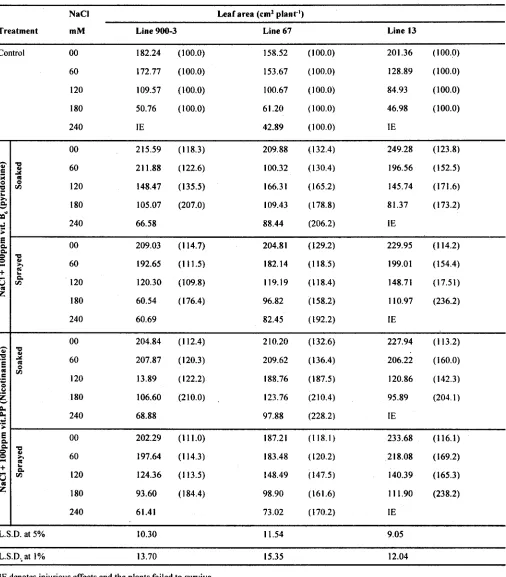
The values of growth parameters (leaf area, and dry matter yield) of the test broad bean lines, (Table 2 and 3) were generally lowered by increasing salinity. This lowering was more obvious in line 13 than in line 900-3 and 67, and in line 900-3 than 67. Generally, it was found that root growth was less affected than shoot growth. This agrees with the results obtained by Ortiz et al.(1994) and Line and Kao (1996). Also, Munns (1993) proposed that the death of old leaves due to uptake of salts in the tissue would prevent the supply of nutrients of hormones to emerging leaves, reducing leaf area.
Applicaion of the two vitamins in this study, led to a significant increase in the values of leaf area, and dry matter yield of the experimentally salt stressed bean lines, consequently the adverse effects of high levels of salinity were compeletely alleviated. Moreover, the lethal effect of salinity of some levels were overcome. It appears probable from th is response that the two vitam ins used act as growth stimulant wh ich can playa role in counteracting the adverse effectsofNaCI on metabolic activities relevant to growth through enhancing cell division and/or cell enlargement. The results may also indicatethatthevitamin treatments had increased the plant efficiency of water uptake, conservation and utilization. By these strategies, broad bean lines could maintain a positive turgor potential, required for cell enlargement and stomatal opening (Jones and Rawson 1979). Such promoting effects of vitamins on the growth rate were also obtained by Mozafar and Oertli (1992).
In conclusion, the results indicate that vitamin B6was more effective in alleviation the adverse effects of salinity than vitamin PP. Considering the application methods, seed soaking was the best method com pared with spraying method. Based on the response and the abi 1ity ofthe broad bean lines to cope with salinity stress, line 67 is more salt tolerant than the two other lines and line 900-3 is moderately salt tolerant, while line 13 is salt sensitive.
Table 1. Interactive effects of salinity and vitamins (pyridoxine and nicotinamide) treatments on transpiration [mg
(HP)cm·2d·l]of broad bean lines. Values in parenthesis show per cent increase/decrease over control.
NaCI Transpiration rate Img
(Hp>
cm·1d·11Treatment h·mM Line 900-3 Line 67 Li"e 13
Control 00 67.47 (100.0) 48.46 (100.0) 91.63 (100.0)
60 63.96 (100.0) 55.18 (100.0) 88.20 (100.0)
120 59.17 (100.0) 53.73 (100.0) 79.63 (100.0)
180 36.46 (100.0) 48.90 (100.0) 56.25 /100.0)
240 IE 38.49 (100.0) IE
00 52.43 (77.40) 50.48 (86.35) 72.63 (79.26)
.-..~
."
~ 60 48.97 (76.56) 39.29 (71.20) 67.87 (76.95)
I: ~
.~
'"
~ ~
."
[/} 120 44.63 (75.43)34.92 (64.99) 55.72 (69.97)
'i:
>.
Q,
180 27.94 (76.63) 32.85 (67.18) 38.15 (67.83)
'-'
='"
..: 240 18.78 24.15 (62.74) IE
'>
e
Q, 00
56.19 (82.95) 52.72 (89.92) 62.65 (68.37)
Q, Q
1.
Q
60 54.13 (84.63) 46.27 (83.8st 60.2'5 (68.31)
-
+'"
..
U
[/)Q, 120 48.67(82.25) 42.30 (78.73) 53.31 (66.95)
'"
:z:180 28.41 (77.92) 31.15 (63.70) 36.76 (65.36)
240 22.16 26.16 (67.97) IE
00 50.57 (74.65) 49.95 (85.44) 70.02 (67.42)
.-..~
."
~
:5! ~
60 41.98 (65.63) 40.07 (74.07) 63.20 (71.66)
e
'"
~'"
[/}I:
120 37.73 (63.77) 30.51 (56.78) 50.47 (63.38)
:;:: ~
u
Z
180 21.95 (60.20) 26.24 (53.66) 34.23 (60.86)'-'
~
~ 240 18.15
21.15 (54.95) IE
..:
'>
e
00 50.12 (73.99)48.15 (82.36) 59.67 (65.21)
Q, Q,
."
Q ~
Q >.
60 39.16 (61.23) 39.19 (71.02) 55.94 (63.42)
-
+'"
..
Q,U
[/} 120 37.24 (62.94)32.12 (59.78) 44.15 (55.62)
'"
:z:180 23.56 (64.62) 31.10 (63.60) 31.28. (55.62)
240 21.63 28.\3 (73.08) IE
L.S.D. at5% 6.92 5.78 8.64
L.S.D. at 1% 9.20 7.69 11.49
IE denotes injurious effects and the plants failed to survive.
EFFECT OF VITAMINS AND SALINITY ON BROAD BEAN
Table 2. Interactive effect of salinity and vitamins (pyridoxine and nicotinamide) on leaf area (cm2 plant'l) of broad
bean lines. Values in parenthesis show per cent increase/decrease over control.
NaCI Leaf area (em2 plant'l)
Treatment mM Line 900-3 Line 67 Line 13
Control 00 182.24 (100.0) 158.52 (100.0) 201.36 (100.0)
60 172.77 (100.0) 153.67 ( 100.0) 128.89 (100.0)
120 109.57 (100.0) 100.67 (100.0) 84.93 (100.0)
180 50.76 (100.0) 61.20 (100.0) 46.98 (100.0)
240 IE 42.89 (100.0) IE
00 215.59 (118.3) 209.88 (132.4) 249.28 (123.8)
.-
~60 (130.4) 196.56 ( 152.5)
Ql Ql
211.88 ( 122.6) 100.32
=
.:t.~
"
Q Q
120 148.47 (135.5) 166.31 (165.2) 145.74 (171.6)
~ ~
.;:
~
Cl. 180 105.07 (207.0) 109.43 ( 178.8) 81.37 (173.2)
'-'
='"
.,J 240 66.58 88.44 (206.2) IE.;;
E
00 209.03 (114.7) 204.81 (129.2) 229.95 (114.2)
Cl. Cl.
Q ~
Q Ql
60 192.65 (111.5) 182.14 (118.5) 199.01 (154.4)
-
~'"
+
..
U
Cl.120 120.30 (109.8) 119.19 (118.4) 148.71 (17.51)
~
"
z
180 60.54 (176.4) 96.82 (158.2) 110.97 (236.2)
240 60.69 82.45 (192.2) IE
00 204.84 (112.4) 210.20 (132.6) 227.94 (113.2)
.-
Ql ~Ql:5! .:t 60 207.87 (120.3) 209.62 (136.4) 206.22 (160.0)
=
"
;; Q~
=
120 13.89 ( 122.2) 188.76 (187.5) 120.86 ( 142.3);':
Q
OJ
Z
180 106.60 (210.0) 123.76 (210.4) 95.89 (204.1 )'-'
c..
c...,J 240 68.88 97.88 (228.2) IE
.;;
E 00 202.29 (111.0) 187.21 (118.1 ) 233.68 (116.1)
Cl.
Cl. ~
Q Ql
60 197.64 (114.3) 183.48 (120.2) 218.08 (169.2)
Q ~
-
+"
..
Cl.U
~ 120 124.36 (113.5) 148.49 (147.5) 140.39 (165.3)"
z
180 93.60 ( 184.4) 98.90 (161.6) 111.90 (238.2)240 61.41 73.02 (170.2) IE
L.S.D. at 5% 10.30 11.54 9.05
L.S.D ..at 1% 13.70 15.35 12.04
IE denotes injurious effects and the plants failed to survive.
Table 3. Interactive effects of salinity and vitamins (pyridoxine and nicotinamide) treatments on dry weight of root and shoot of broad bean lines. Values in parenthesis show per cent increase/decrease over control.
Treatment NaCI Line 900-3 Line 67 Line 13
mM Root Shoot Root Shoot Root Shoot
Control 00 0.308 (100.0) 0.56 I (100.0) 0.290 (100.0) 0.811 (100.0) 0.554 (100.0) 1.2 I 5 (100.0) 60 0.266 (100.0) 0.501 (100.0) 0.288 (100.0) 0.716 (100.0) 0.314 (100.0) 0.708 (100.0) 120 O.197 (100.0) 0.456 (100.0) 0.189(100.0) 0.483 (100.0) 0.21 1(100.0) 0.545 (100.0) 180 0.102 (100.0) 0.203 (100.0) 0.089 (100.0) 0.367 (100.0) 0.156(100.0) 0.385 (100.0)
240 IE IE 0.054 (100.0) 0.245 (l00.0) IE IE
.-..
~ 00 0.475 (154.2) 0.740 (131.9) 0.343 (I 18.3) 1.038 (128.0) 0.628 (1134) 1.525 (125.5)4J ~
I: ..ll:
.~
OIl 60 0.412 (154.9) 0.773 (154.3) 0.335 (116.3) 0.925 (129.2) 0.381 (121.3) 0.973 (137.4)0 0
~ ~
'i:
qo
0.393 (199.5) 0.672 (147.4) 0.337 (178.3) 0.800 (165.6) 0.386 (182.9)0.880 (161.5)
>.
Q"
--='"
180 0.214 (209.9) 0.474 (211.5) 0.199(203.1) 0.657 (179.0) 0.322 (206.4) 0.490 (127.3)...:
.~ 240 0.148 0.396 0.124 (229.6) 0.4 72 (192.2) IE IE
E
Q"
Q" 00 0.469 (152.3) 0.569 (123.9) 0.358 (132.8) 1.112 (137.1) 0.689 ( 124.4) 1.429(117.6)
g ~~
....
>.+ OIl
60 0.351 (132.0) 0.514 (106.6) 0.347 (120.5) 0.868 (121.2) 0.471 (150.0) 1.065 (150.4)
..
U Q"
~
OIl 120 0.265 (134.5) 0.488 (107.0) 0.246 (130.2) 0.550 (111.9)
0.372 (176.3) 0.910 (167.0)
Z
180 0.151 (148.0) 0.407 (200.5) 0.162 (165.3) 0.535 (145.8) 0.345 (221.2) 0.685 (177.9)
240 0.103 0.285 0.096 (177.8) 0.457 (186.5) IE IE
.
G;' ~ 00 0.396 (128.6) 0.743 (132.4) 0.423 (145.9) 1.046 (129.0) 0.611 (110.3) 1.258 (103.5)
:2 ~
E OIl
60 0.485 (182.3) 0.766 (152.9) 0.390 (135.4) 0.972 (135.8) 0.400(127.4) 1.127 (159.2)
Cl
OIl ~ I:
'';:: 120 0.348( 176.6) 0.623 (136.6) 0.362 (191.5) 0.765(158.4) 0.383 (181.5) 0.771 (141.5)
0
...
i 180 0.257 (252.0) 0.472 (232.5) 0.212 (216.3) 0.608 (165.7)
0.315 (201.9) 0.547 (142.1)
--~~ 240
0.142 0.456 0.138(155.6) 0.548 (221. 7) IE IE
...: .~
E
00 0.442 (141.5) 0.696 (124.1) 0.363 (125.2) 0.927 (I 14.3) 0.638 ( I 15.2) 1.339 (I 10.2)
Q"
Q" ~
C ~
c >. 60 ·0.431 (162.0) 0.683 (116.7) 0.371 (128.8) 0.872 (121.8) 0.434 (138.2) 1.079 (152.4)
....
OIl+
..
Q"0
~ 120 0.288 (146.2) 0.501 (110.2) 0.330 (174.6) 0.661 (136.9) 0.397 (188.2) 0.899 (165.0)OIl
Z
180 O.I 90 (186.3) 0.424 (208.9) 0.172 (175.5) 0.526 (143.3) 0.345 (221. I) 0.697 (181.0)
240 0.128 0.288 0.129 (238.9) 0.381 (155.5) IE IE
L.S.D. at 5% 0.029 0.070 0.029 0.075 0.027 0.088
L.S.D. at 1% 0.039 0.091 0.039 0.100 0.036 0.118
IE denotes injurious effects and the plants failed to survive.
EFFECT OF VlT AMINS AND SALINITY ON BROAD BEAN
REFERENCES
Bozcuk, S. (1975). Effect of sodium chloride upon growth and tanspiration in Static sp. and Pisum sativum L. Proc. Third MPP Meeting (Izmir). pp. 37-42.
Burgnoli, E.and Lauteri, M. (1991). Effect of salinity on stomatal conductance, photosynthetic capacity, and carbon isotope discrimination of salt-tolerant Gossypium hirsutum L.and salt-sensitive Phaseolus vulgaris L. C) non~halophytes. Plant Physiol. 95 : 628-635.
Dale, J. E. (1988). The control of leaf expansion. Ann. Rev. Plant Physiol. Plant Mol. Bio/. 39 : 267-295.
EL-Shahaby, O.A. (1978). Metabolic changes in response to water stress in cotton seedling M. Sc. Thesis, Mansoura Univ. Mansoura, Egypt.
Hernandez, 1. A., Olmos, E., Corpas, F. J., Sevilla, F. and Rio, L.A. (1995). Salt-induced oxidative stress in chloroplasts of pea plants. Plant Sci. :105: 151-167.
Jones, M.M. and Rawson, H.M. (1979). Intluence of rate of development of leaf water deficits upon photosynthesis, leaf conductance, water use efficiency and osmotic potential in sorghum. Plant Physiol. 61 : 122-126.
Kirschbaum, M. U. F. (1987). Water stress inEucalyptus pauciflori:
Comparison of effects on stomatal conductance with effects on the mesophyll capacity for photosynthesis, and investigation of a possible involvment of photo inhibit on.Planta 171 : 466-473. Line, C.C. and Kao, C.H. (1996 Proline accumulation is associated with inhibition of rice seedling root growth caused by NaCI.
Plant Sci. 114; 121-128.
IndianJ.Plant Physiol., Vol. 6, No.1, (N.S.) pp. 24-29 (Jan.-March, 2001)
Mozafar, A and Oertli, .1.1.(1992). Uptake of mocrobially-produced vitamin (BI2) by soybean roots. Plant and Soil 139 : 23-30.
Munns, R. (1993). Physiological process limiting plant growth in saline soils: Some damage and hypothesis. Plant Cell Environ.
16: 15-24.
Nabil, M. and Coudret, A( 1995). Effect of sodium chloride on growth, tissue elasticity and solute adjustment in two Acacia nilotica
subspecies. Physiol. Plant. 93 : 217-224.
Ortiz, A., Mortinez, V. and Cerda, A. (1994). Effect of osmotic shock and composition ofPhaseolus vulgaris Plants'.Physiol. Plant.
91 : 468-476.
Radi, A. F, Heikal, M.M., Abdel-Rahman and EI-Deep, BAA. (1988). Interaction effect of salinity and phytohormones on growth and water relationship parameters in maize and saftlower plants. Revue Roumaine De Biologe Serie de Biologie
33: 27-37.
Samiullah, S. A., Ansari, M. M.R., Afridi, M M. R. K. and Akhtar, M. (1985). Pyridoxine application enhances nitrate reductase activity and productivity of Vigna radiata, Experientia
41: 1412-1414.
Schmid halter, U. and Oertli, 1.1. (1991). Transpiration biomass ratio for carrots as affected by salinity, nutrient supply and soil aeration. Plant and Soil. 135: 125-132.
Storey, R. (1995). Salt tolerance, ion relations and the effect of root medium on the response of citrus to salinity. A list. J Plant Physiol. 22 : 101-114.
Waston, OJ.and Watson, M.A. (1953). Studies in potatoes agronomy, I-Effect of variety , seed size and spacing on growth, development and yield. JAgric. Sci. 66: 241-249.
![Table 1. Interactive effects of salinity and vitamins (pyridoxineand nicotinamide)treatmentson transpiration[mg(HP) cm·2d·l] of broad bean lines](https://thumb-us.123doks.com/thumbv2/123dok_us/9558670.1484660/3.585.40.546.98.671/interactive-effects-salinity-vitamins-pyridoxineand-nicotinamide-treatmentson-transpiration.webp)