http://www.sciencepublishinggroup.com/j/ijctc doi: 10.11648/j.ijctc.20190701.20
ISSN: 2376-7286 (Print); ISSN: 2376-7308 (Online)
Optimization of Multiple Injection Strategy in Modified
Common Rail Direct Injection Diesel Engine Powered with
Palm Oil Methyl Ester
Mahantesh Shivashimpi
1, *, Sidramappa Alur
1, Nagaraj Banapurmath
2, Uday Kapale
3 1Mechanical Engineering, Hirasugar Institute of Technology, Nidasoshi, Karnataka, India 2
Department of Mechanical Engineering, B. V. Bhoomaraddi College of Engineering and Technology, Hubballi, Karnataka, India 3
Mechanical Engineering, S. G. Balekundri Institute of Technology, Belagavi, Karnataka, India
Email address:
*
Corresponding author
To cite this article:
Mahantesh Shivashimpi, Sidramappa Alur, Nagaraj Banapurmath, Uday Kapale. Optimization of Multiple Injection Strategy in Modified Common Rail Direct Injection Diesel Engine Powered with Palm Oil Methyl Ester. International Journal of Computational and Theoretical Chemistry. Vol. 7, No. 1, 2019, pp. 87-99. doi: 10.11648/j.ijctc.20190701.20
Received: March 21, 2019; Accepted: April 28, 2019; Published: May 26, 2019
Abstract:
In this investigation, the common rail direct injection (CRDI) single cylinder four stroke diesel engine has made to modify in terms of toroidal reentrant combustion chamber (TRCC) shape and 7 holes CRDI nozzle injector. The current experimental study objective is to optimization of multiple injection strategy (MIS) in modified CRDI diesel engine powered with palm oil methyl ester (POME) B100 and diesel fuels. In the first phase of work, experiment results showed that slightly improved in brake thermal efficiency (BTE) and reduced emissions except oxides of nitrogen (NOx) for POME fuelled engineoperates under optimized MIS, fuel injection timing (IT) of -10° before top dead center (BTDC) and 600 bar injection pressure (IOP) in modified CRDI diesel engine. In the second phase of work, the performance of modified CRDI diesel engine is improved by increasing IOP from 600 bar to 900 bar at same MIS and fuel IT. The second phase of experiment results showed that percentage of increase in BTE by 2.47%, peak pressure (PP) by 13.69%, heat release rate (HRR) by 17.64%, NOX by
11.70% and percentage of decreased in ignition delay (ID) by 29.62%, combustion duration (CD) by 13.79%, unburnt hydrocarbon (UBHC) by 19.04%, carbon monoxide (CO) by 14.28%, smoke level by 20.93% as compared to first phase of work in modified CRDI diesel engine fuelled with POME.
Keywords:
Palm Oil Methyl Ester, Common Rail Direct Injection, Toroidal Reentrant Shape, Multiple Injection Strategy, Injection Timing, Injection Pressure1. Introduction
The usage of biodiesel fuel blends in existed diesel engine minimize pollutants, but true efficiency of the diesel engine decreases due to insufficient air fuel mixture and swirl. To improve entire air- fuel mixture, swirl and turbulence characteristics needs to modification in combustion chamber shape and nozzle geometry. Now a day’s most of modern diesel engine running with CRDI mode due to meeting engine norms. The Biodiesel fuel is convenient to use in conventional diesel engine [1-3]. The present situation given, more attention on usage of sustainable energy resources
suitable for I.C engine application to reduce emission and improve engine output. The investigators worked on the diesel engines reported that efficiency of diesel engine is higher than the bio fuelled diesel engine [9-11]. The diesel engine powered with rice brain biodiesel showed better BTE, minimum brake specific fuel consumption (BSFC), reduced 27.47% of smoke, CO and UBHC emissions [12]. The diesel engine has declined in its BTE with higher blend ratio [13]. The harmful pollutants like CO, smoke and HC were minimized by addition of desulfurized tyre oils in diesel fuel (DF) [14]. The engine powered with jathropa oil methyl ester (JOME) and its blends found that slightly lower BTE and reduced emissions as compared to DF [15].
Many research works carried out on diesel engine by using several biodiesel fuels with different injection strategies. The combustion characteristics are affecting by advancement or retardation of fuel IT. The cylinder pressure and temperature are affected by retarded fuel IT in diesel engine [16]. The diesel engine powered waste cooking oil fuel found that better BTE and reduced pollutants at 40o BTDC fuel [17]. The biodiesel operated diesel engine performance improved by combined effect of IOP and retarded fuel IT [18]. The diesel engine operated with combination of JOME and tyre pyrolysis blend showed that reduced CO, PM and UBHC emissions by 14.2%, 13.26% and 9.3% respectively at 24.5oCA BTDC [19]. The performance of engine enhanced for varieties fuel combinations with increasing in IOP [20]. The diesel engine with biodiesel blends found better torque and reduced BSFC at advancing the fuel IT [21].
The nozzle holes geometry is one of the important parameter considered in engine to alter the performance, combustion and emission characteristics of engine. Ten holes nozzle geometry gave best performance in engine at full load condition [22]. The number of holes variation in nozzle injector leads to better performance of engine and reduced emissions [23]. The biodiesel powered diesel engine improved performance and reduced emissions by altering injection strategies [24]. The diesel engine operated with honge oil methyl ester (HOME), hone oil methyl ester (HnOME) and cotton oil methyl ester (COME) biodiesel fuels given better performance and lower emissions at retarded IT of 19o BTDC, IOP 230 bar and 4 holes nozzle injector [25].
The modification of combustion chamber shapes with suitable injection strategies are both required to enhance swirl, tumble turbulence and squish characteristics in combustion chamber shape. Hence, modification of both combustion chamber shape and nozzle geometry leads to improve performance of the engine. The toroidal combustion ((TCC) shape with Pongamia BDF exhibits better BTE than baseline hemispherical combustion chamber (HCC) shape in the diesel engine [26]. The combine effect of TRCC shape and higher IOP with Pongamia BDF leads to improved BTE and reduced emissions in diesel engine [27]. The diesel engine powered with BDF and TRCC shape performed better performance and reduced emissions as compared to cylindrical, trapezoidal shapes [28]. The combined effect of
cylindrical shape with 5 holes nozzle geometry reduced NOx emissions up to 45% and slightly reduced BTE of the engine was observed as compared to a standard shape [29]. The diesel engine with pongamia oil methyl ester B40 blend reported higher BTE in baseline shape, but reduced emissions in TCC shape [30]. The engine performance of diesel engine remains same but emissions were reduced by modification of combustion shape [31]. The diesel engine operated with TRCC shape reported better BTE, minimum SFC and reduced pollutants at retarded fuel IT [32]. The HOME -producer operated diesel engine performed better BTE and reduced pollutants for TRCC shape, higher IOP and 4 holes nozzle injector [33]. The diesel engine powered with 20% of JOME fuel found higher efficiency and lower pollutants for TCC shape [34]. The diesel engine found higher BTE and reduced harmful pollutants for TRCC shape, 200 bar IOP and 25o BTDC [35]. The experimental results in diesel engine found that fuel IT of 27° BTDC, IOP of 240 bars, 5 holes nozzle geometry and TRCC shape are most favorable for better BTE with nominal emissions (36).
Now days, modern biodiesel fuelled diesel engine operates with CRDI mode to reduce emissions and improve the performance of the engine. Hence, most of the research works turning towards biodiesel powered CRDI diesel engine. The CRDI diesel engine operated with Simarouba biodiesel blend B30 yielded best performance with nominal emissions at 800 bar and 13o BTDC [37]. The performance of CRDI diesel engine improved with tung oil diesel ethanol blends, but slightly increased in NOx emission [38]. The CRDI diesel engine operated with mahua methyl ester blend gave better combustion performance and reduced UBHC, CO and smoke emissions at 880 bar IOP [39]. The CRDI diesel engine operated with BDF and TRCC shape gave better performance and reduced smoke & NOx emissions under
injection strategies of 7 holes injector, 900 bar IOP and 10° BTDC [40]. The diesel engine run with CRDI mode gave the reduced CO, UBHC and smoke emissions except CO2 and
NOx, [41]. The CRDI diesel engine showed that lower opacity for advanced combustion mode as compared to conventional C.I engine [42]. The BTE of CRDI diesel engine decreases up to 30% of plastic oil blend, but CO2 and
NOx emissions are decreases as increasing in blend [43]. The
modified CRDI diesel engine operated with 20%karanja biodiesel blend gave higher BTE with reduced emissions [44]. The CRDI BDF diesel engine found that reduced particulate matter size of exhaust at higher IOP and retarded IT [45]. The CRDI diesel engine operated with diesel-tung oil-ethanol blended fuels gave longer ID, higher PP, higher HRR and shorter CD as compare to diesel fuel for different injection strategies [46]. The CRDI diesel engine operated with karanja biodiesel blends gave higher BTE than mineral diesel fuel at start of pilot injections -21o CA and 1000 bar IOP [47]. CRDI engine experiment results showed that engine performance improved up to 75% swine lard methyl esters blend [48].
engine to achieve higher efficiency and lower emissions which are reported in literature review [32-34]. In view of above statement, the minimum research work carried with modified combustion chamber shape, injection nozzle geometry and MIS in CRDI mode diesel engine operated with POME biodiesel fuel. Hence, in our current experimental work carried on modified CRDI diesel engine with MIS operated with POME as a biodiesel fuel. The objective of our research work is to optimization of MIS in modified CRDI diesel engine to achieve higher BTE with less emission to meet EURO emission standards.
2. Materials Method
2.1. Palm Oil Methyl Ester Properties
Palm-biodiesel is most promisable alternative fuel for C.I. engine application and most suitable source for biodiesel production [49]. If Palm oil come out from the mesocarp or flesh of the oil palm fruit used as edible oil, while palm kernel oil comes out from the kernel or seed used as non edible oil. The edible palm oil is about 49 percent saturated fat, while non edible palm oil is about 81 percent saturated fats, respectively. The palm oil can be produced mainly countries like Indonesia, Malaysia, Nigeria, Thialand, and Colombia etc. The non edible palm oils split by hydrolysis yields fatty acids with glycerin as a byproduct. The biodiesel can be derived from kernel of palm oil with help of transesterifcation process. In our experiment POME biodiesel fuel extracted from tranesterification process using biodiesel plant. The list of important properties of POME is enumerated in the below Table 1. However, POME showing higher viscosity than mineral diesel was observed.
Table 1. Properties of POME.
Properties Diesel POME
Density (kg/m3) 840 880
Energy density (kJ/kg) 43,000 38,400
Viscosity at 40oC (cSt) 2-5 3.94
Flash Point (oC) 75 160
Cetane Number 45-55 ---
Carbon Residue (%) 0.1 ---
Pour point (oC) -5 ---
2.2. Experimental Setup and Methodology
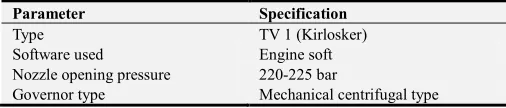
The experimental setup has showed in below Figure 1. The main specifications of engine are enumerated in the Table 2. The engine cooling was maintained by circulating the water. A piezoelectric transducer (Make: PCB Piezotronics, Model: HSM 111A22, Resolution: 0.145 mV/kPa) was utilized for measurement of inline cylinder pressure. The hartridge smoke meter and five-gas analyzers (A DELTA 1600 S-non-dispersive infrared analyzer) are utilized to measure smoke opacity and emissions respectively under steady state condition of engine. The engine rpm is maintained at 1500 rpm with adjusting flow rate of pump. As per investigators evidence about modifications of CRDI biodiesel fueled diesel engine is required to improve performance and reduce
emissions [40 & 42]. The 40% emissions can be reduced and improvement of combustion characteristics by MIS [51]. The main modification in our research engine enumerated here step by step is as follows. The CRDI mode system has developed in house and controlled by electronic control unit (ECU) facility. The ECU system is one of electronic facility attached to CRDI biodiesel fuelled diesel engine and is control the fuel injection, timing and oxygen quantity etc, with help of sensors. The high pressure injection facility is incorporated in the engine powered by POME as alternative fuel biodiesel. The TRCC shape is fabricated using CNC machine keeping constant compression ratio 17.5. The existed HCC shape is replaced by TRCC shape in engine. The existed 6 holes nozzle geometry replaced by 7 holes nozzle geometry. The reason to select 7 holes CRDI nozzle geometry and TRCC shape are optimized in our previous research work at 80% load. As part of research work to optimization of MIS in modified CRDI engine, we selected two combinations of multiple strategies 40-20-40 and 40-30-30. The experiments are conducted on above modified set up operated with POME and diesel fuel with both MIS combinations. In the first phase of work, IT varied from -25o CA to 5o CA at constant 600 bar IOP and optimized MIS combination at constant fuel IT. In second phase of work, the IOP varied from 600 bar to 1000 bar at constant IT and optimized MIS combination at constant IOP.
Figure 1. Schematic diagram of experimental set up of CI engine test rig with CRDI.
T1, T3 - Intake Water Temperature. T2 - Outlet Engine Jacket Water Temperature. T4 - Outlet Calorimeter Water Temperature T5 - Exhaust Gas Temperature before Calorimeter T6 - Exhaust Gas Temperature after Calorimeter F1- Fuel Flow DP (Differential Pressure) unit. N - RPM encoder, EGA - Exhaust Gas Analyzer, SM - Smoke meter.
Table 2. Specifications of the CI engine.
Parameter Specification
Type TV 1 (Kirlosker)
Software used Engine soft
Nozzle opening pressure 220-225 bar
Parameter Specification
Number of cylinder Single cylinder
Number of stroke Four stroke
Fuel H.S. Diesel
Rated power 5.2 kW (7 HP at 1500 rpm)
Bore 0.0875 m
Stroke length 0.11 m
Compression ratio 17.5:1
Air Measurement Manometer
Made MX201
Type U-type
Range 100 -0- 100 mm
Eddy current Dynamometer
Model AG-10
Type Eddy current
Maximum 7.5 kW (at 1500 -3000 RPM)
Flow Water must flow through the
dynamometer during the use
Dynamometer arm length 0.180 m
Fuel measurement unit- range 0-50 ml
2.3. Uncertainty Analysis
The uncertainties parameter are mainly considered due to errors in measurements, hence these parameters are essentially to consider during calculation. The list of uncertainties variable are given in the Table 3.
Table 3. The uncertainties in the calculated parameters.
Measure variable Accuracy (±)
Load 0.1
Engine speed (rpm) 1
Temperature (°C) 1
Fuel consumption (g) 0.1
Measured variable Uncertainty (%)
HC ± 1.2
CO ± 2.5
NOx ± 2.3
Smoke ± 2.0
Calculated parameter Uncertainty (%)
BTE (%) ± 1.2
HRR (J/oCA) ± 1.3
3. Results and Discussion
The experiments are conducted on modified CRDI diesel engine operated with the diesel and POME fuels with two MIS combinations. The performance, combustion and emission characteristics are discussed at 80% load.
3.1. The Optimization of Injection Timing for Multiple Injection Strategy
3.1.1. Effect of BTE with IT on Multiple Injection Strategy
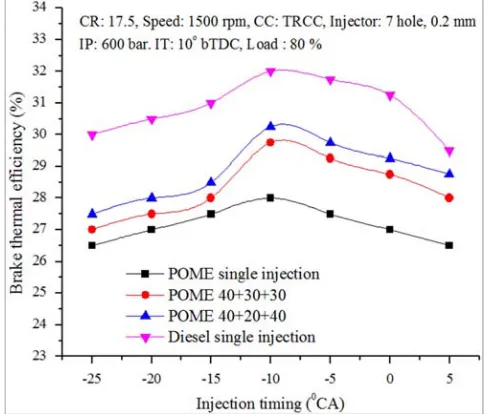
The figure 2 showed that effect of IT on BTE for MIS and SIS for both POME and diesel fuels in modified CRDI engine. The maximum BTE has obtained at 10o BTDC for both fuels and all injection strategies. The maximum BTE obtained at 10o BTDC in modified CRDI diesel engine [40]. This could due to better atomization, enhanced air fuel mixing quality at 600 bar and reduce wall wetting leads to better burning of fuel. The BTE of modified CRDI engine is decreased by advancement or retardation of fuel due to wall
impingement effect. The similar results supported by Avinash Kumar Agarwal et al. [44]. The Pilot injection gave higher thermal efficiency of CRDI biodiesel fuelled engine [47]. However, early injection of pilot injection may leads to higher fuel consumption due to lean mixture formation. This is leads to lower engine performance, but in turn late injection leads to better performance of engine due to active fuel burning involved in presence of oxidation. Hence, MIS is chosen in modified CRDI diesel engine to enhance performance of engine. However, diesel showed higher BTE than POME fuel due to higher calorific value. The POME fuel results for 40-20-40 MIS combination are 27.5%, 28%, 28.5%, 30.25%, 29.75%, 29.25%, 28.75% for-25o, -20o, -15o, -10o, -5o, 0o, 5oCA respectively. Similarly, for 40-30-30 are 27%, 27.5%, 28%, 29.75%, 29.25%, 28.75%, 28% for -25o, -20o, -15o, -10o, -5o, 0o, 5oCA respectively. However, 40-20-40 MIS gave 2% higher BTE than 40-30-30 MIS and SIS at -10o BTDC in modified CRDI diesel engine.
Figure 2. Variation of BTE with IT for multiple and single injection strategies.
3.1.2. Effect of Combustion Characteristics with IT on Multiple Injection Strategy
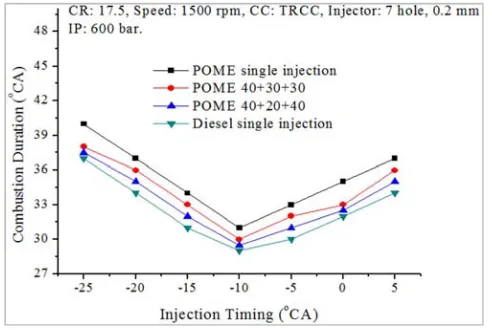
results are 15.8, 15.21, 14.3, 13.9, 14.01, 14.21, 15.01 o CA for -25o, -20o, -15o, -10o, -5o, 0o, 5oCA respectively. The results of CD in engine operated with 40-20-40 MIS combination of POME fuel are 36, 35, 32, 29, 29, 31, 33 o CA for - 25o, -20o, -15o, -10o, -5o, 0o, 5oCA respectively. Similarly, for 40-30-30 MIS combination results are 38, 36, 33, 30, 32, 33, 34 o CA for -25o, -20o, -15o, -10o, -5o, 0o, 5oCA respectively The 40-20-40 MIS combination of POME has showed lower ID and CD as compared to other combination at -10o BTDC. However, results of PP with POME operated 40-20-40 MIS combination are 87, 83, 79, 73, 69, 63, 60 bar for -25o, -20o, -15o, -10o, -5o, 0o, 5oCA respectively. Similarly, for 40-30-30 MIS are 86, 82, 78, 72.5, 68.5, 62, 59 bar for -25o, -20o, -15o, -10o, -5o, 0o, 5oCA respectively. The results of HRR 40-20-40 MIS are 98, 87, 80, 68, 65, 62, 58 J / o CA for -25o, -20o, -15o, -10o, -5o, 0o, 5oCA respectively. Similarly, for 40-30-30 MIS are 96, 86, 78, 66, 63, 60, 56 J / o CA for -25o, -20o, -15o, -10o, -5o, 0o, 5oCA respectively. The 40-20-40 MIS combination of POME showed higher PP and HRR at -10o BTDC and crank angle 359 degree in modified CRDI diesel engine.
Figure 3. Variation of ID with IT for multiple and single injection strategies.
Figure 4. Variation of CD with IT for multiple and single injection strategies.
Figure 5. Variation of PP with IT for multiple and single injection strategies.
Figure 6. Variation of HRR with IT for multiple and single injection strategies.
3.1.3. Effect of Smoke Level with IT on Multiple Injection Strategy
combustion process due to different injection timing of fuel. Because of more utilization of air leads to continuation of combustion in later also, hence reduced smoke level was observed for MIS. The smoke level was reduced by 4% for 40-20-40 than other strategy at -10o BTDC in modified CRDI diesel engine.
Figure 7. Variation of smoke opacity with IT for multiple and single injection strategies.
3.1.4. Effect of CO and HC Emissions with IT on Multiple Injection Strategy
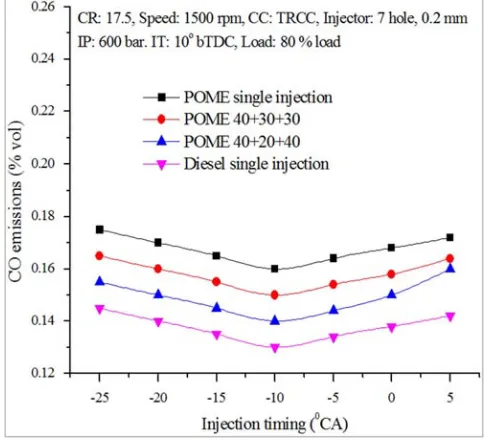
From the figure 8 and 9 revealed that variation of HC and CO emissions with fuel IT’s at 80% load. The lower CO and HC emissions are formed at -10o BTDC for all fuels and injection strategies. This could be attributed that proper combustion process at this fuel at 600 bar and obtained higher BTE at same condition of engine. The Similar results observed by Atul Dhar et al. (47). The combustion chamber wall wetting was occurred at advanced fuel IT and more fuel entering in to crevices of combustion chamber at retarded fuel IT. Hence, more CO and HC emissions are occurred for other fuel IT’s. These both emissions are higher for POME operation than mineral diesel. This could be attributed that presence of higher viscosity in POME fuel leads to bigger size of droplet at same IOP. The oxygen contains in-between 1.80%–2.37% to reduce emissions, when blends used in diesel engine [53]. But in our case, POME (B100) is produced higher emissions than diesel due to higher oxygen content. Hence, comparatively lower density of POME might lead to lowered combustion temperature supports to higher emissions. The results of HC emission in engine operated with 40-20-40 MIS of POME fuel are 51, 48, 45, 42, 45, 47, 50 ppm -25o, -20o, -15o, -10o, -5o, 0o, 5o CA respectively. Similarly, for 40-30-30 MIS results are 53, 50, 47, 44, 47, 49, 52 ppm for -25o, -20o, -15o, -10o, -5o, 0o, 5o CA respectively. The results of CO emission in engine operated with 40-20-40 MIS combination of POME fuel are 0.155, 0.15, 0.145, 0.14, 0.144, 0.15, 0.16% for -25o, -20o, -15o, -10o, -5o, 0o, 5oCA respectively. Similarly, for 40-30-30 MIS results are 0.165, 0.16, 0.155, 0.15, 0.154, 0.158, 0.168% for -25o, -20o, -15o,
-10o, -5o, 0o, 5oCA respectively at 80% load. The MIS could be minimize the emissions with CO and HC emissions for POME operated engine due to complete combustion process in the modified CRDI diesel engineat -10o BTDC and 600 bar. Hence, 5% HC emissions reduced and 7% CO emissions reduced for 40-20-40 MIS.
Figure 8. Variation of HC emission with IT for multiple and single injection strategies.
Figure 9. Variation of CO emission with IT for multiple and single injection strategies.
3.1.5. Effect of NOx Emissions with IT on Multiple
Injection Strategy
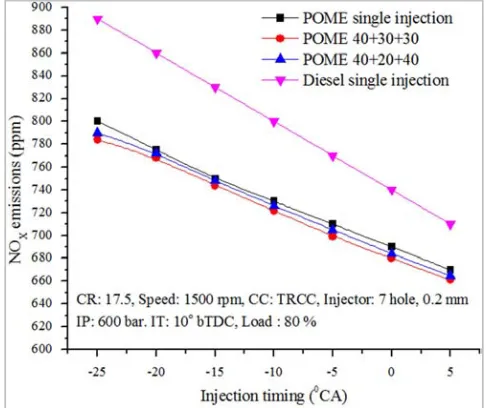
Figure 10 illustrate those variation NOx emissions on fuel
IT’s in modified CRDI diesel engine. The well known fact that increased in NOx emissions at advanced IT with all fuels
due to lower gas temperature and available more oxygen quantity in biodiesel fuels. This could be attributed that lower cetane number for biodiesel fuel as compared to DF. The MIS found minimized NOx emissions as compared to SIS
due to availability of fuel quantity is less and lower exhausts gas temperature. Therefore, net heat HRR was become lower in the cylinder. The pilot injection of fuel started fuel combustion completely leads to higher cylinder pressure and temperature formation inside the cylinder. At same time immediate fuel complete combustion takes place during main injection. This leads to higher curbs of rapid pressure enhancement during premixed combustion. Hence, noise and NOx formation can be reduced by MIS. The results of NOx
emission with 40-20-40 MIS of POME fuel are790, 772, 748,726,705, 684,665 ppm for -25o, -20o, -15o, -10o, -5o, 0o, 5o CA respectively. Similarly, for 40-30-30 MIS results are 784, 768, 744, 722, 699, 680, 661 ppm for -25o, -20o, -15o, -10o, -5o, 0o, 5oCA respectively. The 40-20-40 MIS combination of POME has showed 0.5% higher NOx as
compared to 40-30-30 MIS combination at 10o BTDC due to higher BTE in engine.
Figure 10. Variation of NOx emission with IT for multiple and single injection strategies.
3.2. Optimization of Injection Pressure for Multiple Injection Strategy
In first phase of work we have optimized for 40-20-40 MIS combination at -10o BTDC in modified CRDI diesel engine operating with POME fuel. In the second phase of work we have optimize the injection pressure with considering same MIS combinations at constant -10o BTDC and 80% load in modified CRDI diesel engine.
3.2.1. Effect of BTE with IOP on Multiple Injection Strategy
Figure 11 shows the effect of IOP with BTE in modified CRDI engine. The BTE of engine increases up to 900 bar for all fuel and injection strategies. This is due to improved atomization with formation of homogeneous mixture and
reduced ID up to 900 bar. The similar results showed in CRDI diesel by Srinath Pai [37]. The higher fuel dispersion and penetration could be the reason to improve BTE at 900 bar IOP. The BTE of all fuel and injection strategies showed decreasing trend for 1000 bar IOP. This is due to more fuel wall wetting in crevices. The engine efficiency can enhanced by increasing IOP of fuel, hence decreased droplet size and increased droplet velocity [54]. Amongst all, diesel fuel showed higher BTE as compared to POME fuel due to lower cetane number, higher FFA present in POME fuel. The most of biodiesel fuels have potential to reach performance of diesel fuel when the moderate percentage of biodiesel blend is used [55]. The results are obtained for BTE with POME fuel operated 40-20-40 MIS combination are 29.5, 30, 30.5, 31, 30.75% for 600, 700, 800, 900, 1000 bar respectively. Similarly, for 40-30-30 MIS combination of POME operated fuel are 28.75, 29.25, 29.75, 30.5, 30% for 600, 700, 800, 900, 1000 bar respectively at 80% load. The 40-20-40 MIS combination of POME showed 1.6% increased BTE as compared to other combination at 900 bar in modified CRDI diesel engine.
Figure 11. Variation of BTE with IOP for multiple and single injection strategies.
3.2.2. Effect of Combustion Characteristics with IOP on Multiple Injection Strategy
creates the more friction around the injector needle. Hence, needle movement was slow lift leads to longer injection delay. However, MIS operated with POME fuel exhibited lower ID and CD as compared SIS. This might be due to better utilization air and better mixture formed in the combustion chamber leads to continuation of combustion of unburned fuel in end stage in power stroke of engine at higher IOP. The results of ID in engine operated with 40-20-40 MIS combination of POME fuel are 13, 11.9, 10.8, 9.5, 10.2 oCA for 600, 700, 800, 900, 1000 bar respectively. Similarly, for 40-30-30 MIS are 13.4, 12.1, 10.9, 9.8, 10.5
o
CA for 600, 700, 800, 900, 1000 bar respectively. The results of CD for 40-20-40 MIS are 29, 28, 27, 25, 26.5 oCA for 600, 700, 800, 900, 1000 bar respectively. Similarly,40-30-30 MIS showed 30, 29, 28, 26, 27.5 oCA for 600,700,800,900, 1000 bar respectively. The 40-20-40 MIS combination of POME showed 3.51% lower ID and 4% lower CD as compared to other combination due to better BTE at 900 bar and -10o BTDC in modified CRDI diesel engine. If ID longer, which in turn effect on ignition parameter leads to late ignition in expansion stroke that will cause incomplete combustion process, reduced power output, and poor fuel conversion efficiency [57].
Figure 12. Variation of ID with IOP for multiple and single injection strategies.
Figure 13. Variation of CD with IOP for multiple and single injection strategies.
Figure 14. Variation of PP with IOP for multiple and single injection strategies.
Figure 15. Variation of HRR with IOP for multiple and single injection strategies.
respectively. The results of HRR in engine operated with 40-20-40 MIS combination of POME fuel are 68, 70, 73, 80, 74 J / o CA for 600, 700, 800, 900, 1000 bar respectively. Similarly, for 40-30-30 MIS of POME operated fuel are 66, 68, 72, 78, 73 J / o CA for 600, 700, 800, 900, 1000 bar respectively. The 40-20-40 MIS combination of POME has showed 1.2% higher in PP and 2.5% higher in HRR as compared to other combination at 358 degree crank angle due to better BTE in modified CRDI diesel engine. The similar results are supported by Roy M. M. [16].
3.2.3. Effect of Smoke Opacity with IOP on Multiple Injection Strategy
Figure 16 showed the effect of IOP on smoke level powered with POME and diesel fuels. The smoke level lower for all fuels and injection strategies at 900 bar. This is due to enhanced atomization at higher IOP resulting into completing combustion. However, mineral diesel fuel showed lower smoke emissions as compared to POME fuel. This is due to presence of heavier molecular structure in POME biodiesel leads to improper mixing strength. Mainly, MIS couple with higher IOP ensures improved air utilization leads to combustion charge particles continue their combustion process in power stroke later also. Hence, MIS showed lower smoke than SIS operated with POME. The results of smoke level in engine operated with 40-20-40 combination of POME fuel are 43, 41, 38, 34, 38 HSU for 600, 700, 800, 900, 1000 bar respectively. Similarly, for 40-30-30 combination of POME operated fuel are 45, 43, 40, 36, 40 HSU for 600, 700, 800, 900, 1000 bar respectively. The MIS of 40-20-40 combination of POME has showed 5.5% lower smoke intensity as compared to other combination at 900 bar in modified CRDI diesel engine. Mainly the presence of oxygen component in biodiesel helps to reduce the emission characteristics in engine [15].
Figure 16. Variation of smoke with IOP for multiple and single injection strategies.
3.2.4. Effect of HC, CO Emissions with IOP on Multiple Injection Strategy
Figure 17 and 18 are showed IOP effect on both HC and CO emissions for diesel, POME. The both HC and CO emissions are decreases as increase in IOP for all injection strategies. This may be attributed that, the entire combustion process get enhanced by
increase in IOP. The CO emissions may be significantly affected by cylinder temperature and enhanced IOP. However, both the emissions were minimized by enhancing injection pressure due to proper air fuel mixing in combustion chamber. This is also due to better atomization ensured stoichiometric air and fuel mixture and improved combustion at higher IOP. The association of higher BTE at higher IOP ensured lower HC and CO emissions for MIS than other. This may due to improved fuel consumption during combustion process at higher IOP. Hence, MIS found lower emission particle than other strategy. However, diesel was showing lower emissions as compared with other MIS combinations due to lower viscosity of DF could be the reason. The results of HC emission for 40-20-40 MIS combination of POME fuel were 42, 39, 36, 30, 37 ppm for 600, 700, 800, 900, 1000 bar respectively. Similarly, for 40-30-30 combination of POME operated fuel are 44, 41, 38, 33, 39 ppm for 600, 700, 800, 900, 1000 bar respectively. The results of CO emission for 40-20-40 combination of POME fuel are 0.145, 0.14, 0.135, 0.12, 0.13% for 600, 700, 800, 900, 1000 bar respectively. Similarly, for 40-30-30 combination of POME operated fuel are 0.15, 0.145, 0.14, 0.125, 0.135% for 600, 700, 800, 900, 1000 bar respectively. The MIS 40-20-40 MIS combination of POME showed 10% lower HC and 2.3% lower CO emissions as compared to other combination at 900 bar in modified CRDI diesel engine. The similar results reported by Khandal SV et al. [24].
Figure 17. Variation of HC emission with IOP for multiple and single injection strategies.
3.2.5. Effect of NOx Emissions with IOP on Multiple
Injection Strategy
The NOx emissions are formed in the combustion chamber
due to presence of air during combustion at higher temperature. There are many factors affect for NOx formation like air and
fuel ratio, combustion temperature and excess temperature etc. The NOx levels are increased by enhancing IOP due to speedy
combustion and higher temperature during combustion cycle [39]. The figure 19 showed the variation of NOx emissions on
IOP at 80% load. The higher levels of NOx are formed at IOP
due to reduced fuel droplet particle size leads to improve the combustion process in combustion chamber. However, DF yielded higher NOx levels than POME fuel at 900 bar. This is
due to speedy combustion of mineral diesel fuel leads to higher premixed combustion phase. The biodiesel fuel found lower energy density and higher viscosity could be the reason to reduce in NOx emissions. In case of POME fuel, NOx level
improved at higher IOP due to more free oxygen atoms combined with nitrogen atoms. The NOx levels decreased
trend for both MIS combination as compared to SIS due to better air utilization. The results of NOx emissions for POME
operated 40-20-40 MIS combination are 722, 731, 750, 811,762 ppm for 600, 700, 800, 900, 1000 bar respectively. Similarly, for 40-30-30 combination of POME operated fuel are 726, 735, 754, 825, 768 ppm for 600, 700, 800, 900, 1000 bar respectively. The 40-20-40 MIS combination of POME showed 1.7% lower NOx emissions as compared to other
combination in modified CRDI diesel engine due to better air
utilization. The 40% emissions can be reduced and improvement of combustion characteristics by MIS [51].
Figure 19. Variation of NOx emission with IOP for multiple and single injection strategies.
3.3. Results of Comparisons Between 600 bar IOP and 900 Bar IOP for Multiple Injection Strategies
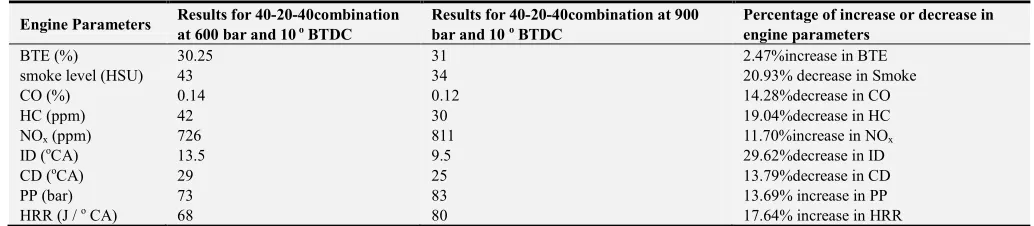
From the below Table 4 showed that, POME operated MIS of 40-20-40 gave improved in performance and combustion characteristics and reduced emissions characteristics except NOx emission at 900 bar and10o BTDC fuel IT.
Table 4. Comparison of multiple injection strategy between 600 bar IOP and 900 bar IOP at -10o BTDC.
Engine Parameters Results for 40-20-40combination at 600 bar and 10 o BTDC
Results for 40-20-40combination at 900 bar and 10 o BTDC
Percentage of increase or decrease in engine parameters
BTE (%) 30.25 31 2.47%increase in BTE
smoke level (HSU) 43 34 20.93% decrease in Smoke
CO (%) 0.14 0.12 14.28%decrease in CO
HC (ppm) 42 30 19.04%decrease in HC
NOx (ppm) 726 811 11.70%increase in NOx
ID (oCA) 13.5 9.5 29.62%decrease in ID
CD (oCA) 29 25 13.79%decrease in CD
PP (bar) 73 83 13.69% increase in PP
HRR (J / o CA) 68 80 17.64% increase in HRR
4. Conclusions
From the exhaustive experimental research work carried with POME and diesel fuels powered in modified CRDI diesel engine the following conclusions enumerated at 80% load:
In the first phase of work, the POME operated MIS of 40-20-40 gave slightly improved in performance and combustion characteristics and reduced emission characteristics except NOx emission as compared to SIS at
-10o BTDC and 600 bar in modified CRDI diesel engine. In the second phase of work, the POME operated MIS of 40-20-40 gave percentage of increase in BTE by 2.47%, PP by 13.69%, HRR by 17.64%, NOx by11.70% and percentage
of decreased in ID by 29.62%, CD by 13.79%, HC by 19.04%, CO by 14.28%, smoke level by 20.93% at -10oBTDC and 900 bar IOP as compared to first phase in
modified CRDI diesel engine. The performance of CRDI diesel engine is improved and reduces the emissions except NOx emission at MIS of 40-20-40 by increasing the IOP from
600 bar to 900 bar due to better atomization and improved mixing quality of air – fuel mixture in the modified combustion chamber. The higher injection pressure reduces viscosity of POME biodiesel could be the reason to improve the performance of engine.
However, diesel fuel showed higher performance than lower emissions except NOx emission as compared to POME
operated multiple and single injection strategies in modified CRDI diesel engine. This is due to higher calorific value and lower viscosity of diesel fuel. The higher BTE may be the reason to increase in the NOx emission.
modified CRDI diesel engine. The huge burden on the foreign exchange can be saved by using alternative fuel as POME to meet the energy requirement of India and become self sustainable in energy production as well.
Nomenclature
ATDC After Top Dead Centre BDF Biodiesel Fuel BP Brake Power
BTDC Before Top Dead Centre BSFC Brake Specific Fuel Cosumption CO Carbon Monoxide
CR Compression Ratio CD Combustion Duration
CCC Cylindrical combustion chamber CRDI Common Rail Direct Injection DF Diesel fuel
ECU Electronic Control Unit
HCC Hemispherical Combustion Chamber HRR Heat Release Rate
IT Injection Timing
IOP Injection Opening Pressure ID Ignition Delay
JOME Jatropha Oil Methyl Ester MIS Multiple Injection Strategy NOx Oxides of Nitrogen
POME Palm oil Methyl Ester PP Peak Pressure
SFC Specific Fuel Consumption
SCC Shallow Depth Combustion Chamber SIS Single Injection Strategy
TCC Toroidal Combustion Chamber
TRCC Toroidal reentrant combustion chamber UBHC Unburnt Hydro Carbon
References
[1] S. Jaichandar, K Annamalai, “Jatropha oil methyl ester as diesel engine fuel - an experimental investigation,” International Journal of Automotive and Mechanical Engineering, 13 (2006) 3248-3261.
[2] F. Sundus, H. H. Masjuki, M. A. Fazal, “Analysis of tribological properties of palm biodiesel and oxidized biodiesel blends,” Tribology Transactions, 60 (2017) 530-536.
[3] Zuhaira Abdullah, HazrulzurinaSuhaimi, Adam Abdullah, MohdFirdausTaufik, G. Anes Mrwan, “Effect of pentanol-diesel fuel blends on thermo-physical properties, combustion characteristics, engine performance and emissions of a diesel engine,” International Journal of Automotive and Mechanical Engineering, 15 (2018) 5435-5450.
[4] S. N. Naik, V. Vaibhav, K. Goud Prashant, Rout Ajay, K. Dalai, “Production of first and second generation biofuels a comprehensive review,” Renewable and Sustainable Energy Reviews, 14 (2010) 578-597.
[5] M. N. Mohiddin, A. A. Saleh, ANR Reddy, S. Hamdan, “A study on chicken fat as an alternative feedstock: biodiesel
production, fuel Characterization and diesel engine performance analysis,” International Journal of Automotive and Mechanical Engineering, 15 (2018) 5535-5546.
[6] M. Mani, G. Nagarajan, S. Sampath, “Characterization and effect of using waste plastic oil and diesel fuel blends in compression ignition engine,” Energy, 36 (2011) 212-219.
[7] A. Atmanli, E. Ileri, B. Yuksel, “Experimental investigation of engine performance and exhaust emissions of a diesel engine fueled with diesel-n-butanol vegetable oil blends,” Energy Conversion Management, 81 (2014) 312-21.
[8] A. T. Hoang, M. M. Noorand, X. D. Pham, “Comparative analysis on performance and emission Characteristic of diesel engine fueled with heated coconut oil and diesel Fuel, ”International Journal of Automotive and Mechanical Engineering, 15 (2018) 5110-5125.
[9] A. Gautam, A. K. Agarwal, “Experimental investigations of comparative performance, emission and combustion characteristics of cotton seed biodiesel-fueled four-stroke locomotive diesel engine,” International Journal of Engine Research, 14 (2013) 354–72.
[10] S. Dixit, A. Rehman, “Linseed oil as a potential resource for bio-diesel: a review,” Renewable Sustainable Energy Reviews, 16 (2012) 4415-21.
[11] D. Kannan, S. Pachamuthu, N. M. Nurun, J. E. Hustad, T. Lovas, “Theoretical and experimental investigation of diesel engine performance, combustion and emissions analysis fuelled with the blends of ethanol, diesel and jatropha methyl ester,” Energy Conversion Management, 53 (2012) 322-331.
[12] G. Venkata Subbaiah, K. Raja Gopal, “An experimental investigation on the performance and emission characteristics of a diesel engine fuelled with rice brain biodiesel and ethanol blends,” Green Energy, 8 (2011) 197-208.
[13] Abhishek Sharma, S. Murugan, “Investigation on the behavior of a DI diesel engine fuelled with jatropha methyl ester (JME) and tyre pyrolysis Oil (TPO) blends,” Fuel, 108 (2013) 699-708.
[14] Aydin, Huseyin, CumaliLlkılıc, “Analysis of combustion, performance and emission characteristics of a diesel engine using low sulfur tire fuel,” Fuel, 143 (2015) 373-82.
[15] K. Bhaskar, S. Sendilvelan, “Experimental studies on the performance and emission characteristics of a compression ignition engine fuelled with jatropha oil methyl ester,” Journal of Mechanical Engineering and Sciences, 12 (2018) 3431-3450.
[16] M. M. Roy, “Effect of fuel injection timing and injection pressure on combustion and odorous emissions in DI diesel engine,” Energy Resources Technology, 131 (2009) 1-8.
[17] S. Bari, C. H. Yu, T. H. Lim, “Effect of fuel injection timing with waste cooking oil as a fuel in direct injection diesel engine,” Proceedings of the Institution of Mechanical Engineers, Part D, Journal of Automobile Engineering, 218 (2004) 93-104.
[19] Abhishek Sharma, S. Murugan, “Combustion, performance and emission characteristics of a DI diesel engine fuelled with non-petroleum fuel: A study on the role of fuel injection timing,” Energy Institute, 88 (2015) 364-75.
[20] G. Suresh, H. C. Kamath, N. R. Banapurmath, "Effect of injection timing, injector opening pressure and nozzle geometry on the performance of cotton seed oil methyl ester fuelled diesel engine,” Sustainable Engineering, 7 (2013) 82-92.
[21] S. Rostami, B. Ghobadian, M. Kiani Deh Kiani, “Effect of the injection timing on the performance of a diesel engine using diesel-biodiesel blends,” International Journal of Automotive and Mechanical Engineering, 10 (2014) 1945-1958.
[22] Karra, K. Prashanth, Song Charng Kong, “Experimental study on effects of nozzle holes geometry on achieving low diesel engine emissions,”Engineering for Gas Turbines and Power, 132 (2010) 022802.
[23] Lahane, Subhash, K. A. Subramanian, “Impact of nozzle holes configuration on fuel spray, wall impingement and NOx emission of a diesel engine for biodiesel–diesel blend (B20),”Applied Thermal Engineering, 64 (2014) 307-314.
[24] S. V. Khandal, N. R. Banapurmath, V. N. Gaitonde, R. S. Hosmath, “Effect of number of injector nozzle holes on the performance, emission and combustion characteristics of honge oil biodiesel (HOME) Operated DI compression Ignition Engine,” Petroleum and Environmental Biotechnology, 6 (2015) 1-18.
[25] S. P. Wategave, M. S. Sawant, M. S. Tandale, G. Suresh, V. S. Yaliwalc, N. R. Banapurmath, P. G. Tewari, “Effect of injection timing, injector opening pressure and nozzle geometry on the performance of a compression ignition engine operated on non-edible oil methyl esters from different sources,” Sustainable Engineering, 1 (2014) 71-81.
[26] S. Jaichandar, K. Annamalai, “Effects of open combustion chamber geometries on the performance of pongamia biodiesel in a DI diesel engine,” Fuel, 98 (2012) 272–279.
[27] S. Jaichandar S, K. Annamalai, “Combined impact of injection pressure and combustion chamber geometry on the performance of a biodiesel fueled diesel engine,” Energy, 55 (2013) 330-339.
[28] N. R. Banapurmath, A. S. Chavan, S. B. Bansode, Sankalp Patil, G. Naveen, Sanketh Tonannavar, N. K. Keerthi, M. S. Tandale, “Effect of combustion chamber shapes on the performance of mahua and neem biodiesel operated diesel engine,” Petroleum and Environmental Biotechnology, 6 (2015) 1-7.
[29] MahanteshM. Shivashimpi, S. A. Alur, S. N. Topannavar, B. M. Dodamani, “Combined effect of cylindrical combustion chamber shape and nozzle geometry on the performance and emission characteristics of C.I. engine operated on pongemia,” Mechanical engineering for sustainable development state of the art research, USA: Apple Academic Press, CRC press, Taylor and Francis Group, (2018) 345-359.
[30] MahanteshM. Shivashimpi, S. A. Alur, S. N. Topannavar, B. M. Dodamani, “Combined effect of combustion chamber shapes and nozzle geometry on the performance and emission characteristics of C.I. engine operated on Pongamia,” Energy, 154 (2018) 17-26.
[31] Mobasheri, Raouf, ZhijunPeng, “CFD investigation of the effects of re-entrant combustion chamber geometry in a HSDI diesel engine,” Scientific Research Innovation, 7 (2013) 770-780.
[32] S. Jaichandar, P. Senthil Kumar, K. Annamalai, “Combined effect of injection timing and combustion chamber geometry on the performance of a biodiesel fueled diesel engine,” Energy, 47.1 (2012) 388-394.
[33] V. S. Yaliwal, N. R. Banapurmath, N. M. Gireesh, R. S. Hosmath, Teresa Donateo, P. G. Tewari, “Effect of nozzle and combustion chamber geometry on the performance of a diesel engine operated on dual fuel mode using renewable fuels,” Renewable Energy, 93 (2016) 483-501.
[34] Venkata Ramesh Mamilla, M. V. Mallikarjun, G. Lakshmi NarayanaRao, “Effect of combustion chamber design on a DI diesel engine fuelled with jatropha methyl esters blends with diesel,” Procedia Engineering, 64 (2013) 479-490.
[35] Vinay Kumar, “Experimental investigation of piston bowl geometry effects on performance and emissions characteristics of diesel engine at variable injection pressure and timings,” Ambient Energy, 39 (2018) 685-693.
[36] M. M. Shivashimpi, N. R. Banapurmath, S. A. Alur, S. V. Khandal, “Effect of combustion chamber shapes, nozzle holes geometries, injection pressures and injection timing on the performance diesel engine fueled with palm oil methyl ester,” European Journal of Sustainable Development Research, 2 (2018) 1-17.
[37] SrinathPai, Abdul Sharief, Shiva Kumar, “Influence of ultra injection pressure with dynamic injection timing on CRDI engine performance using simarouba biodiesel blends,” International Journal of Automotive and Mechanical Engineering, 15 (2018) 5748-5759.
[38] D. H. Qi, K. Yang, D. Zhang, B. Chen, Q. Wei, C. H. Zhang, “Experimental investigation of a turbocharged CRDI diesel engine fueled with tung oil-diesel-ethanol micro emulsion fuel,” Renewable Energy, 113 (2017) 1201-1207.
[39] C. Syed Aalam, C. G. Saravanan, B. Prem Anand, “Impact of high fuel injection pressure on the characteristics of CRDI diesel engine powered by mahua methyl ester blend,” Applied Thermal Engineering, 106 (2016) 702–711.
[40] S. V. Khandal, N. R. Banapurmath, V. N. Gaitonde, V. S. Yaliwal, “Common rail direct injection mode of CI engine operation with different injection strategies - a method to reduce smoke and NOx emissions simultaneously," European Journal of Sustainable Development Research, 2 (2018) 1-18.
[41] S. Karthikeyan, T. Dharma Prabhakaran, A. Prathima, “Environment effect of La2O3 nano-additives on microalgae-biodiesel fueled CRDI engine with conventional diesel,” Energy Sources Part A: Recovery Utilization and Environmental Effects, 40 (2018) 179-185.
[42] D. I. Silvana Iorio, Ezio Mancaruso, M. Bianca Vaglieco, “Characterization of soot particles produced in a transparent research CRDI diesel engine operating with conventional and advanced combustion strategies,” Aerosol Science and Technology, 46 (2012) 272-286.
[44] Avinash Kumar Agarwal, AtulDhar, Jai Gopal Gupta, WoongKim, Kibong Choi, Chang Sik Lee, Sungwook Park, “Effect of fuel injection pressure and injection timing of Karanja biodiesel blends on fuel spray, engine performance, emissions and combustion characteristics,” Energy Conversion and Management, 91 (2015) 302-314.
[45] Avinash Kumar Agarwal, AtulDhar, Jai Gopal Gupta, WoongKim, Chang Sik Lee, SungwookPark, “Effect of fuel injection pressure and injection timing on spray characteristics and particulate size–number distribution in a biodiesel fuelled common rail direct injection diesel engine,” Applied Energy, 130 (2014) 212-221.
[46] D. H. Qi, K. Yang, D. Zhang, B. Chen, “Combustion and emission characteristics of diesel-tung oil-ethanol blended fuels used in a CRDI diesel engine with different injection strategies,” Applied Thermal Engineering, 111 (2017) 927– 935.
[47] AtulDhar, Avinash Kumar Agarwal, “Experimental investigations of the effect of pilot injection on performance, emissions and combustion characteristics of Karanja biodiesel fuelled CRDI engine,” Energy Conversion and Management, 93 (2015) 357-366.
[48] M. Mikulski, K. Duda, S. Wierzbicki, “Performance and emissions of a CRDI diesel engine fuelled with swine lard methyl esters-diesel mixture,” Fuel, 164 (2016) 206-219.
[49] Khairul Azly Zahan, Manabu Kano, “Biodiesel production from palm oil, its by-products, and mill effluent: a review,” Journal of Energies 11 (2018) 1-25.
[50] S. O. Kareem, E. I. Falokun, S. A. Balogun, O. A. Akinloye, S. O. Omeike, “Enzymatic biodiesel production from palm oil
and palm kernel oil using free lipase,” Egyptian Journal of Petroleum, 26 (2017) 635-642.
[51] S. Kevin Chen, “Simultaneous reduction of NOx and particulate emissions by using multiple injections in a small diesel engine,” SAE, 01 (2000) 1-10.
[52] B. P. Pattanaik, J. Jena, R. D. Misra, “The effect of oxygen content in soapnut biodiesel-diesel blends on performance of a diesel engine,” International Journal of Automotive and Mechanical Engineering, 14 (2017) 4574-4588.
[53] M. Mikulski, k. Duda, S. Wierzbicki, “Performance and emissions of a CRDI diesel engine fuelled with swine lard methyl esters-diesel mixture,”Fuel, 164 (2016) 206-219.
[54] C. S. Lee, S. W. Park, “An experimental and numerical study on fuel atomization characteristics of high pressure diesel injection sprays,” Fuel, 81 (2002) 2417-2423.
[55] N. M. Taib, M. S. Zainuddin, MRA. Mansor, Z. Ilham, “Performance and emission opacity of canola and soybean biodiesel fuel in a diesel engine,” Journal of Mechanical Engineering and Sciences, 12 (2018) 3689-369.
[56] V. Khalid, ASA. Tajuddin, N. Jaat, B. Manshoor, I. Zaman, SAA. Hadi, R. S. Nursal, “Performance and emissions of diesel engine fuelled with preheated biodiesel fuel derived from crude palm, jatropha, and waste cooking oils,” International Journal of Automotive and Mechanical Engineering, 14 (2017) 4273-4284.