University of New Hampshire
University of New Hampshire Scholars' Repository
University Library Scholarship University Library
2018
Rightsizing Project Management for Libraries
Valerie L. Harper
University of New Hampshire, Durham, [email protected]
Follow this and additional works at:https://scholars.unh.edu/library_pub
Part of theLibrary and Information Science Commons
This Article is brought to you for free and open access by the University Library at University of New Hampshire Scholars' Repository. It has been accepted for inclusion in University Library Scholarship by an authorized administrator of University of New Hampshire Scholars' Repository. For more information, please [email protected].
Recommended Citation
Rightsizing Project Management for Libraries
Abstract
Project management is a current hot topic in management, and project management offices are springing up in many organizations. Libraries may not need a project management office, but adoption of project management techniques, rightsized for library needs, can focus scope, define and organize tasks, and identify and manage resources for many kinds of projects. The University of New Hampshire Library has implemented selected aspects of project management and is learning where these principles can be applied most effectively for successful projects. This paper describes UNH’s use of selected project management techniques and tools in a major collection integration and relocation project.
Rightsizing Project Management for Libraries
Project management is a current hot topic in management, and project management offices are springing up in many organizations. Libraries may not need a project management office, but adoption of project management techniques, rightsized for library needs, can focus scope, define and organize tasks, and identify and manage resources for many kinds of projects. The University of New Hampshire Library has implemented selected aspects of project management and is learning where these principles can be applied most effectively for successful projects. UNH’s use of selected project management techniques and tools in a major collection
integration and relocation project allow us to resolve many of the issues that in the past contributed to problems and breakdowns in some of our projects.
Most work in libraries falls into two major categories: operational activities and projects. Operational activities are those performed routinely, the normal procedures and workflows by which we perform essential library services. Materials acquisitions, patron checkout,
Librarians and library staff are involved in projects all the time, and surely we have brought many a project to completion without special training, software, or methodologies. However, many libraries have also seen projects deaccelerate, stall, or fail due to lack of planning, bloated or increasing goals, and insufficient resource allocation. Project management is a discipline which provides a framework in which to define, plan, execute, and close projects on time and within budget to prevent exactly these issues. The Project Management Institute (PMI) defines project management as “the application of knowledge, skills, tools, and techniques to project activities to meet the project requirements.”2 Whether creating a makerspace or constructing an entirely new library building, the framework of project management can provides guidance for initiating, planning, executing, and closing the project within a determined schedule and budget. A project plan outlining the scope of the project, deliverables, stakeholders, financial resources, timelines, major tasks, risks, and many other key planning points directs the project, and a project manager oversees the process, ensuring that the project moves forward in accordance with the plan.
Several authors have advocated for the use of specific formalized project management methodologies in academic libraries and consortia. In North America, the PMI’s Project
Management Body of Knowledge (PMBOK) is the leading framework for project management in business and industry. Cervone espoused the use of PMI-based standards for project
management in 2003, the first of a long line of articles on formalized project management. In her 2007 paper, Marrill was a strong advocate for using PMBOK principles and practices in library projects (Marrill is a PMI-certified project planner, credentials which come with the completion of formal coursework and a PMI-administered exam).3 An institutional repository
project at University College Dublin Library illustrated the use of PMBOK frameworks in a multi-phased project and concluded that “use of a structured project management methodology can increase internal stakeholder buy-in, from frontline staff, line managers, middle management, and senior management”.4
Another suggested methodology for library project management has been PRINCE2. Standing for Projects in Controlled Environments, Version 2, PRINCE2 is a set of standards widely used in the public and private sector first in the United Kingdom and now internationally. Lewis was the first to describe the use of the initial version of the PRINCE standard in library projects as a framework for selecting a new integrated library system at the University of Wales Bangor.5 In
2007, Afshari and Jones described an institutional repository project managed by PRINCE2 principles.6 The same year, Kiel presented at EDUCAUSE Australasia on the incorporation of
PRINCE2 standards into projects approved in the University of Western Australia Library’s annual operational plan, a part of its strategic plan. His conclusions were that with the use of formal structures like PRINCE2, “substantial improvements can be made in a very short time.”7 Chief among its benefits were “a more cooperative and collaborative work environment” and “improved project reporting and increased … level of understanding of projects.”8
PRINCE2 but also stress the need to adapt those principles to the library’s own requirements and resources. One of the earliest to champion project management in a library setting, Chambers warned, “although such methodologies offer benefits, small library projects, and project managers, would be overwhelmed by the complexity of many of these methods. It [is] important to find something appropriate to the size and scale of typical library projects. The best option … is therefore to adopt a less formal project management framework which will give guidance without being excessively prescriptive.”9 Fagan and Keach, having surveyed 121 librarians regarding web development projects and project management, concluded that “web project management in libraries has grown organically, out of a “let’s see what works” tradition … Now that libraries have experience, they should learn about standards and practices from the project management profession and modify them to become best practices for web project management within libraries.”10 This is the approach the University of New Hampshire has opted to take not only in its web projects but in other library projects, an approach that we and others in recent years have referred to as “rightsizing”.
Problems with Projects
Projects at the University of New Hampshire (UNH) Library have rarely come to us in the manners so optimistically described in the literature. Atkins describes projects as beginning “with the recognition of a need. After prioritizing all competing needs, the organization decides that this particular need warrants the dedication of resources and people to fulfill it.”11 Projects at UNH might have fit this description if the word “organization” were replaced by
“department,” “department head”, “committee” (of any nature), or “administrator” and the word “prioritizing” were omitted. Some projects bubbled up as some one’s good idea within or between functional units that gained traction without a great deal of thought to resources or handoff (i.e. who would have the deliverable as part of their job at the project’s end). Others started at the top with the Dean or from a governing body such as the library’s faculty and were charged to a committee or working group to implement, many times without statement of scope, budget, or timeline.
While many projects were successfully undertaken and completed, implementing projects that were generated from so many sources often led to a variety of problems and issues. As
previously stated, a project is understood in project management frameworks as an
Commitments were made to one project without knowledge of another project’s inception or imminence so that resources were allocated on a “first-come-first-serve” basis rather than on concerted prioritization; projects that perhaps better met the library’s strategic plan or goals sometimes found themselves waiting until resources were available.
It became clear that with limited resources of all types, a systematic approach to strategic planning, assessment, and project planning could help make us more effective and intentional about our project choices and implementation. One faculty member took on an entirely new position to focus attention on assessment, which would be instrumental in identifying priorities and allocating resources. Another completed a project management certificate program
through the University’s professional development program; others took coursework in the same program. New faculty and staff hires, particularly in library information technology and scholarly communication units, increasingly had project management coursework and
experience in their vita. With administrative encouragement, more formalized project planning techniques were considered.
“Rightsizing” Project Management
Ainsley Lewis, in one of the earliest articles advocating for project management in libraries, warned, “Anyone who has delved into the world of PM methodologies and software soon discovers that adopting PM practices could be as onerous as carrying out the original project.”13 No one at the UNH Library wished to halt everything for everyone to master a new body of
knowledge in its entirety. Instead, the library opted to “rightsize” existing principles of project management. By selecting those aspects of project management methodology that would better define and prioritize projects, identify and allocate needed resources, develop communication channels with stakeholders, and formalize handoff to the right library employee(s) when required, we hoped to meet the end goals of those methodologies: bringing projects in on time and within budget.
No part of formalized project management is unimportant: risk assessment, return on investment, financial controls, and change control are all important to creating the best
environment for project success. Yet Lewis’ statement captures our feeling that we couldn’t do it all at once: to change our habits and behaviors, we would have to tackle those elements of project management practice that could make the most significant changes in our planning and implementation of library projects. We focused our attentions on the some of the major project constraints as defined by PMBOK which we believed we could implement quickly and would have immediate payoffs as the project progressed.
In 2014, a faculty member who had recently received project management training worked with library unit heads, faculty, staff, and administrators to identify those areas where we felt projects tended to bog down or get out of control. The major issues identified were:
projects tended to bloat rather quickly and outgrow their allotted resources as more and more outcomes or deliverables were added to the work in progress.
• Timeline and tasks: projects were sometimes initiated with no particular timeline established. This may have been a function of the lack of planning for resources, an absence of adequate time available from project participants, or a tendency to keep the project going without conclusion or a clear deliverable.
• Resources: With no formal planning for time or money, projects could easily find themselves on hold until individuals were free to work on the project or money was available – or individuals could find themselves overtasked with demands from multiple projects. Little to no thought was sometimes given to who would inherit the deliverable. Often, the handoff wound up with a person whose job was already filled with
responsibilities with nothing removed to make room for the new duties created by the project’s deliverable.
The library chose to apply a rightsized project planning approach to an upcoming project: a collection move in the Dimond Library, relocating volumes over three non-contiguous floors, integrating classified journals into the monographs, and completely changing arrangement, flow, and order of the stacks. Our strategy for managing the project would be to focus on those PMBOK-defined constraints that we felt would best lead to the successful completion of a complex project -- scope, timeline and tasks, and resources. The project team -- library faculty and staff from our Circulation, Collection Management, Cataloging, and Reference units -- was selected for functional expertise and potential to work effectively within these constraints.
Rightsizing Project Scope
The collection move project began in September of 2014 with a series of meetings between the project manager and library administrators, who had already secured funding for the project and the services of a library relocation company. In October, library faculty and staff met with the interim Dean and project manager to discuss the project, and library liaisons were asked to query their academic department representatives for feedback on integrating the classified print journal collection, shelved separately from the circulating collection, into that collection and on rearranging the flow of call numbers between floors as part of stakeholder input. Library staff met with the Interim Dean to provide their thoughts and offer advice on the proposed move.
With feedback from these stakeholders in hand, the Interim Dean charged the project manager with developing a statement of scope: a description of what the project would entail and what would not be included in the project:
This project is limited to the following issues and actions in this phase:
• purchase of online journal titles to allow removal of print copies from Dimond Library [the main library building on UNH’s Durham campus]
• planning the move and integration of materials from Levels 2,4, and 5 and to Level G in Dimond, including redefining stack layout patterns, physical move, editing
location codes in Millennium, and signage and maps for all floors
These issues and actions are not included in this project or phase:
• planning for move of other branch libraries into Dimond beyond measurement and inventory of the Physics Library [a branch library on UNH’s Durham campus]
• planning for faculty carrel modifications
• routine deselection of materials in monographs collections14
Scope is one of the constraints identified in PMBOK, defining what work will be done in the project and what work will not be done. PMBOK is explicit in explaining that the major
constraints of a project are balanced by one another: “The relationship among these factors is such that if any one factor changes, at least one other factor is likely to be affected”.15
As our budget was already set for the project and the timeline dictated by a number of
external factors (academic calendars, agreement with relocation contractor, etc.), we could not afford changes in scope that would change any of those givens. Once project scope was
defined, the project team and Interim Dean agreed nothing more would be added to the project. Projects in the library’s past had, once approved and begun, often ballooned with additional goals and deliverables, and some stakeholders did their best to continue our past practices (“As long as we’re doing this, why don’t we do that at the same time” and “Can’t we move this too as long as the library relocators are here?”), but the project team and its sponsor held firm to the scope statement as written in the project plan.
The scope statement cemented the project team’s focus and allowed it to begin project execution with a better sense of confidence that that we could stay within all the other boundaries of the project’s resources and timeline.
Rightsizing Project Planning – Timeline, Tasks, and Risks
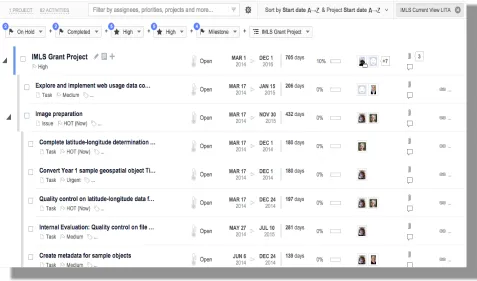
Fig. 1 EasyProjects task lists (work breakdown)
We found it difficult to envision and articulate all the tasks that would be required for the collection move and integration. Having witnessed the breakdown of a similar large relocation project in the past, the team was nervous about risks and desired as “bulletproof” a task list and timeline as it could possibly create – but this seemed monumentally difficult. We chose to conduct a project pre-mortem, a technique described by Gary Klein as the opposite of the post-mortem used at the project’s end to identify what went wrong or failed or was not
considered.16 In the pre-mortem, team members were asked to imagine the project had failed and to produce plausible reasons for the project’s failure. Reasons identified included the project manager retiring early, the library van breaking down, the library relocation company declining the contract, inadequate time allotted to the project, and adverse library user reaction to the stacks being closed during the move. This kind of “prospective hindsight”, as Klein calls it, allowed the group to identify real risks and weaknesses in the project plan before they occurred. Thinking out our risks and discussing ways they might have been prevented allowed us to formulate more concrete tasks and dependencies as well.
The task list on EasyProjects was reviewed at the start of every weekly project team meeting. Team members were encouraged to go into the site and check off the tasks assigned to them; if they had not been able to do so, we cleared those tasks and reviewed the upcoming week’s tasks, identifying issues and problems before the next week’s work began. Dependencies were stressed: if one task was dependent on the successful completion of another, we needed to make sure the right resources were appropriated to the first task to enable us to stay on course. The project team met several times with the library relocators throughout the project, collaborating on timelines, identifying needs, and developing tactics for smooth work between the two; once the collection started moving, the project manager met daily and the project team met weekly with the relocation managers. The project timeline guided the team as it checked off its tasks in EasyProjects; staying on task and on schedule gave team members confidence they had accounted for the risks they could identify throughout the project, and that when they encountered an unexpected issue, they were in control enough of the rest of the project to be able to deal with it.
Rightsizing Project Resources
begin after commencement, we would need to think about how the summer term would be affected by our move, and how to close the stacks at the latest possible opportunity and when to open the stacks again to our users. We mapped out alternate routes for users for the floors that would be open to users and for offices on affected floors that we did not want to close down. Ensuring user access to materials while balancing convenience and safety at all levels and while keeping other library operations constant would require far more human power than resided in one small project team, and use of library employee time and energies had to be carefully considered.
At first blush, there appeared to be no major handoffs after the whole newly-integrated
collection was relocated. Daily operations maintaining the stacks would, we thought, go back to the unit that had previously been responsible for shelving, shelf reading, and shifting. Prior to and during the project timespan, however, some internal reorganization within some units would alter who was responsible for stacks access and maintenance. Although new floor plans, rangefinders, and call number charts would be required after the collection move, it was unclear that those who had been responsible for these finding aids in the past would continue to maintain them in the future. Finally, all library employees would find themselves unfamiliar with a collection layout and flow that had changed on three of the library’s five floors after nearly two decades. Final handoff of various parts of the project needed to be considered as many employees would find their jobs impacted by the deliverable. We were not able to address all handoff issues fully during the early project planning stages, and some were still unresolved by the project’s end – but in our project post-mortem we recognized the need for the discussion to come far earlier in the project’s timeline.
Benefits of rightsizing
Everyone at the UNH Library wanted better projects with better planning and better outcomes, but no one wanted to have to master an entire discipline to be able to accomplish this (except perhaps the project manager). By defining problems we saw in previous projects, we could use the elements of project management that would enable us to manage our projects effectively without immersing ourselves in the entire discipline of project management. Some of the benefits we saw emerge – not to perfection but to a large degree of improvement – included better allocation of resources (particularly time and human workload), better communication, and Improved management of scope creep. We also found that as we were growing into the use of a performance-based evaluation system for library staff, project management techniques allowed us another avenue through which to encourage staff participation in library activities, to note employee growth in performance level and new skill acquisition, and to increase understanding of one another’s role in the library.
was on the project plan, the precise arrangement plan was not, so we had the flexibility of making decisions when it seemed most advantageous. The library relocators sketched out options for stack flow arrangements and were asked by the project team to presented these to library employees at an all-staff meeting. This was a huge opportunity for timely stakeholder input: the project had progressed far enough that change was certain, library employee interest was intense, the majority of library employees and a number of student employees were
available for comment, and the time for project input was right. Library involvement was high and the vote was nearly unanimous for one of the three schemes presented, assuring
stakeholder buy-in. The project benefitted greatly from this decision made by the right people at the right time, made possible by flexibility built into the planning process.
Did everything work? Not even the best project management will eliminate every risk or
problem. A key piece of data – the date the stacks would close for the public – was not mutually understood by both the project manager and the library relocation contractor, and the stacks needed to be closed three days earlier than had been publicized. In a post-project survey, library employees noted improvements in internal communications from the project team but expressed dissatisfaction with the level of communication with our users prior to and during the project. Did the project fail? Not at all – the adherence to those project management techniques that we utilized gave us the flexibility and confidence to reformulate our
communication plan and adjust our tasks; the post-mortem made note of the issue for the next project.
Many parts of project management continue to be rightsized for our library projects. Library administrators, faculty, and staff work in the summer to develop a list of goals for the coming year and assign working groups to bring those goals to fruition. Leaders of those groups develop “miniplans” – smaller plans with a scope statement and timeline, rather than a full project plan. These miniplans provide enough structure to begin a project or discussion of a goal; depending on the size of the goal or project, a more in-depth plan made be written. A decision tree has been adopted to ensure that all stakeholders are brought into each project or goal. Clarity concerning the deliverable is paramount: the working group knows exactly
whether it is being asked to solve an issue, create something new, or make a recommendation for further action. Without implementing a full project management framework, the UNH Library has improved its ability to see projects through to completion by using rightsizing project management techniques that work.
Some final points about “rightsizing”:
• Stay away from project management jargon. In “rightsized” project management, “tasks” and “dependencies” will work every bit as well as “Work Breakdown Structure” and, for the lucky souls not project managers on the team, are more easily understood and applied.
• A complete project plan may look like overkill, but can be useful to reinforce the big picture and all the project’s components, particularly for a large project. A
deliverable is achievable in a short time. Project planning should be in ratio to the complexity of the project.
• Project management software is a tool, and like all tools should be chosen and applied to best do the work. If a sledge hammer is overkill for nailing a picture brad, so may Microsoft Project or similar software be overkill for a small project. Don’t spend more time learning and applying the tool than the project itself takes.
• Depth of knowledge about project management is not required in the project team – but teams using rightsized techniques, and colleagues outside of the team, do often develop an interest in this knowledge after seeing the project team’s work progress.
• Finally, celebrate your completed project, warts and all. The post-mortem may be more easily considered and digested along with a nice lunch with the project team.
Notes
1 Fillippa Marulla Anzelone, “Project Management: A Technique for Coping with Change,” Law
Library Journal, 92 (2000): 55.
2 Project Management Institute. A Guide to the Project Management Body of Knowledge
(PMBOK® Guide) – Fifth Edition (2013) (Kindle Locations 952-953). Kindle Edition.
3 Jennifer L. Marill & Marcella Lesher, “Mile High to Ground Level”, The Serials Librarian, 52
no.3-4 (2007): 317-322.
4 Joseph Greene, “Project Management and Institutional Repositories: A Case Study at University
College Dublin Library", New Review of Academic Librarianship, 16 (2010): 114.
5 Ainsley C. Lewis, “The Use of PRINCE Project Management Methodology in Choosing a New
Library System at the University of Wales Bangor”, Program, 29 no. 3, (1995): 231-240.
6 Fereshteh Afshari and Richard Jones, “Developing an Integrated Institutional Repository at Imperial
College London”, Program, 41 no. 4 (2007): 338-352.
7 Ralph Kiel, "Project Management and Cultural Change: A Case Study at the University of
Western Australia Library", EDUCAUSE Australasia 29 Apr. – 2 May, 2007 (11), accessed 3 February 2017, http://uwa.edu.au/__data/assets/pdf_file/0004/524785/Kiel-137.pdf .
8 Kiel, "Project Management and Cultural Change: A Case Study at the University of Western
Australia Library", 11.
9 Shirley Chambers and David Perrow , “Introducing Project Management Techniques to the
10 Jody Condit Fagan and Jennifer A. Keach, “Managing Web Projects in Academic Libraries”,
Library Leadership and Management, 25 no. 3 (2011): 17.
11 Stephanie Atkins, “Projecting Success: Effective Project Management in Academic Libraries”,
Proceedings of the IATUL Conferences, 14 (2004): [2].
12 Anzelone, “Project Management: A Technique for Coping with Change”, 55.
13 Lewis, “The Use of PRINCE Project Management Methodology in Choosing a New Library
System at the University of Wales Bangor”, 231.
14 University Library, University of New Hampshire, “Collection Arrangement and Integration
Project Plan”, Durham, NH, March 2015.
15 Project Management Institute. A Guide to the Project Management Body of Knowledge
(PMBOK® Guide) (Kindle Locations 968-969)
16 Gary Klein, “Performing a Project Pre-mortem.” Harvard Business Review, 85 no.9 (2007): 18–