Electrocoalescence of Field Crude Oil using
High voltage Direct Current
Akuma Oji†* and Charles C. Opara†
† Department of Chemical Engineering, University of Port Harcourt, PMB 5323 Port Harcourt, Nigeria.
ABSTRACT
In the treatment of crude oil from oil wells, entrained water is removed principally by using chemical demulsifiers or heat treatment. There are, however, emulsions of water in oil which have been stabilized by the presence of surface active agents in the crude and agitation during the extraction process which prove difficult to breakup by conventional methods. High voltage direct current (HVDC) is used in this study to effect the coalescence of water molecules thereby causing separation of the water from the oil. The applied HVDC field was varied from 4 to 16 KV in four steps of 4KV while time of application was increased in 10 minutes steps from 10 minutes to 40 minutes. The spacing of the electrodes (plates) was also varied from 61mm to 244mm. The reduction in base sediment and water (BS&W) of the crude oil which was used to assess the efficacy of the treatment method and varied from zero at 4KV and 61mm plate spacing to 68.18% at 244mm spacing and 8KV when the voltage was applied for 40 minutes.
KEYWORDS
Electrocoalescence, Crude oil, water, emulsion, separation.
INTRODUCTION
An emulsion is a stable mixture of two or more immiscible liquids, in most cases it is water drops dispersed in oil or vice versa resulting in a dispersed phase enveloped by a continuous phase. The emulsion thus has its centre of micelles containing charged species, dissolved ions and particles which generate a balance electrostatic charge that extends into the continuous phase ( Bailes and Larkai, 1984, Taylor, 1988, Sam and Zaouk, 2000, Noik et al 2006)
Reviewing water emulsified in crude oil leads to several costly processes in the petroleum industry; which include surface qualification, increase pumping, eroded pipeline and process equipment due to two phase flow (Lee et al 2000).
Emulsion treatment impact directly on the price of crude oil and a cost effective method has been of research interest (Chatzi and Kiparissides, 1994, Choi, 1990, Graham and Stockwell, 1980, Graham, 1984). Processes used to induce attraction of the droplet are electrostatic, hydrodynamic or Brownian in nature. Chemical and thermal treatment had been used to achieve demulsification. The use of chemical additive has been criticized for its complexity, high chemical requirement, with hazardous effect on the system couple with the fact that it produces “rag” waste that is hard to handle (Obawole, 1999). Heat application is another method that has gained wide acceptance in the past but recently its been noticed that heat causes some thermal reformation of the crude oil and also the highly volatile lower carbon chain component / fractions of the crude oil are affected during the heat treatment process. Settling and plate separation gives low treatment efficiency while settling produces high water content.
Electrostatic coalescence is that most efficient method of emulsion resolution because of its ecological, energy and general economic benefits. The electrostatic demulsification process has show increasing potential to destabilize or coalesce of drop surface charge which results in the droplet breakage and coalescence.
As the water droplet are polarized by the applied voltage, the film of emulsifier surrounding the water droplet is weakened then water droplets come together to form larger drops which can separate out (Urdahl et al, 1996, Chiesa et al, 2005).
In this research the demulsification effect of high voltage direct current (HVDC) pulse field applied on field crude oil emulsion was investigated. This alternative demulsification process reduced the use of consumable chemical. The operating time and electrode plate of the coalescer was also studied.
Materials and Methods
The stabilised crude oil – emulsion simple used for this study was collected from the production facility at Obagi flow station belonging to multinational oil exploration and production firm in the Niger Delta of Nigeria. The sample was collected at the inlet-manifold before the chemical emulsifier dosing plant to avoid the interference of the emulsifier chemicals in subsequent experiment. Crude oil sample was collected from the flow station manifold. The collected sample was left to allow free water to settle out before use.
Table 1: Design data of Electrocoalescer
Electrocoalescer Parameter Used Value Input Voltage 230/240 Volts Electrode Type Zinc
Electrode plate dimension 12mm x 18mm Construction material Transparent Perspex
Coalescer Dimension 150mm x 150mm x 400mm Holding Capacity 15 liters
Plate Spacing 61mm/122mm/244mm Process Voltage 4KV/8KV/12KV/16KV Operating time 10mins/20mins/30mins/40mins Operating Mode Batch
The H V D C unit is designed to obtain a System with variable electrode plate spacing (zinc electrode). See table 1 for the Electrocoalescer design data. It comprises of a crude oil emulsion holding compartment of 15litre. The Emulsion holder(compartment) is made up of a transparent material to help observe the phase difference, a DC voltage regulator with mains 230/240 voltage alternative current to variable 4-16 KV direct current (DC) and Electrode place spacing of 61mm, 122mm and 244mm for each plate spacing at voltage application time of 20mins, 30mins and 40mins. The result of BS & W (%) was analysed and recorded in each case. The Crude Oil Property of BS&W was measured using standard method (ASTM, 2005)
The calculation of the BS & W is as follows;
Percentage
&
( )
%
100
%
A
B
A
W
BS
=
−
( )
%
&
W
BS
A
=
of raw sample( )
%
&
W
BS
B
=
of Treated sampleResults and Discussion
In this research work, four voltage variations were used, 4k volts, 8k volts, 12k volts and 16k volts also plate distances of 61mm, 122mm and 244mm were investigated to obtain the effect on the coalescence parameter (B S& W (%). Raw sample of B S & W (%) of approximately 2.0 (±0.2) was used.
The result obtained is presented in tables 2 to 4 as follows:
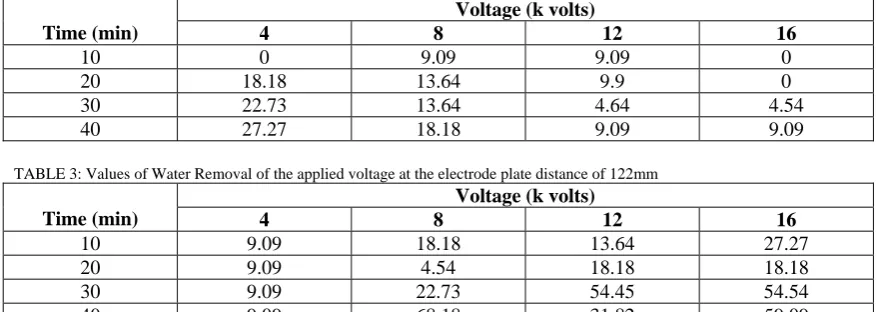
TABLE 2: Values of Water Removal of the applied voltage at the electrode plate distance of 61m
Time (min)
Voltage (k volts)
4 8 12 16
10 0 9.09 9.09 0
20 18.18 13.64 9.9 0
TABLE 4: Values of Water Removal of the applied voltage at the electrode plate distance of 244mm
Time (min)
Voltage (k volts)
4 8 12 16
10 9.09 13.64 13.64 4.54
20 22.72 27.27 31.18 27.27 30 40.91 63.63 40.91 40.91 40 13.64 68.18 68.18 68.18
Effect of voltage on Water removal
As the applied voltage is altered from 4kV to 16kV and time increment of 10mins starting from 10mins result of first volt and time in BS&W remained 2.2. At the second time variation and same 4kV, the BS&W reduced to 1.8. Subsequently at that same volt both a time of 30mins, the BS&W further reduced to 1.7 and at the last time 1.6 was obtained. When the applied voltage is altered from 4 to 16kV, and time from 10mins to 40mins, the 4kV applied for 10mins gives no change in the BS & W, while for same voltage and time of 20mins the BS & W changed from 2.2 to 1.8. Further increase in time at this applied voltage result to 1.7 BS & W at 30mins and 1.6 at 40mins. Also for the 8kV, at the first time of 10mins, the BS & W changed from 2.2 to 2.0 while for 20mins, 30mins, and 40mins the BS & W were 1.9, 1.9 and 18 respectively. For the 12 kV applied voltage, the BS & W was 2.0, 2.0, 1.9 and 2.0 from 10mins and a step of 10mins respectively.
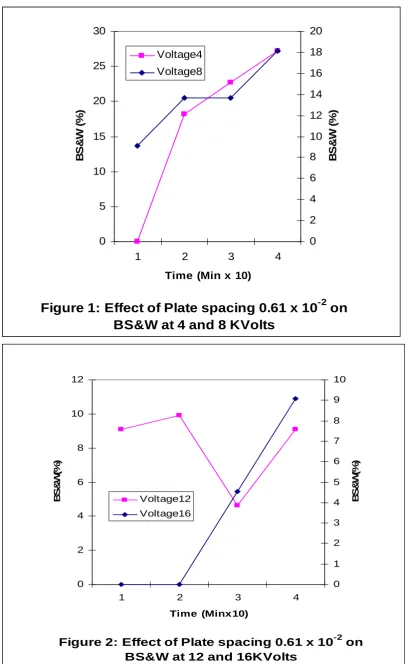
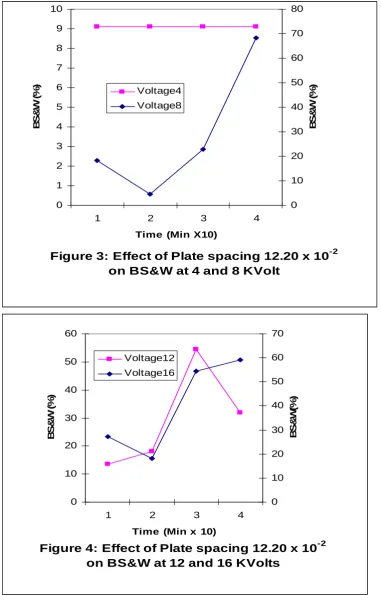
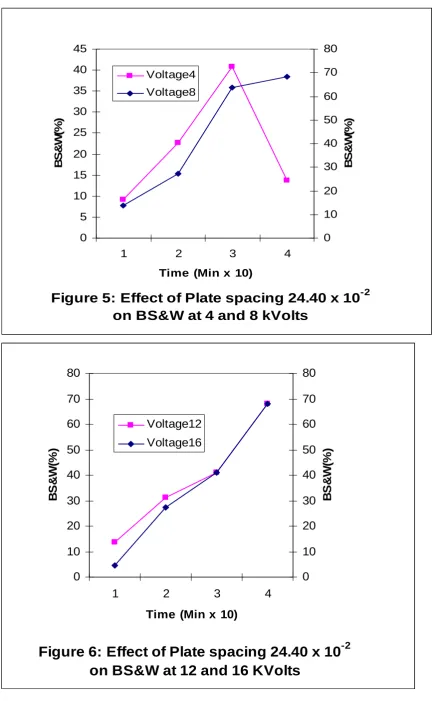
Results of the analysis of the base sediment and water (BS&W) of crude oil –emulsion sample from the manifold of a flow station shows that the sample after treatment with H.V.D.C ranging from 4kV to 16kV at different time between 10 to 40mins of 10mins progression gave result of B S & W as shown in the graphs (figure 1 to 6).
Figure 1: Effect of Plate spacing 0.61 x 10
-2on
BS&W at 4 and 8 KVolts
0 5 10 15 20 25 30
1 2 3 4
Time (Min x 10)
BS
&W
(
%
)
0 2 4 6 8 10 12 14 16 18 20
BS
&W
(
%
)
Voltage4
Voltage8
0 2 4 6 8 10 12
BS
&W
(%
)
0 1 2 3 4 5 6 7 8 9 10
BS
&W
(%
)
Voltage12
Figure 3: Effect of Plate spacing 12.20 x 10⁻² on BS&W at 4 and 8 KVolt
0 1 2 3 4 5 6 7 8 9 10
1 2 3 4
Time (Min X10)
BS
&W
(
%
)
0 10 20 30 40 50 60 70 80
BS
&W
(
%
)
Voltage4
Voltage8
Figure 4: Effect of Plate spacing 12.20 x 10⁻²
on BS&W at 12 and 16 KVolts 0
10 20 30 40 50 60
1 2 3 4
Time (Min x 10)
BS
&W
(
%
)
0 10 20 30 40 50 60 70
BS
&
W
(%
)
Voltage12
Figure 5: Effect of Plate spacing 24.40 x 10
-2on BS&W at 4 and 8 kVolts
0 5 10 15 20 25 30 35 40 45
1 2 3 4
Time (Min x 10)
BS
&W
(%
)
0 10 20 30 40 50 60 70 80
BS
&W
(%
)
Voltage4
Voltage8
0
10
20
30
40
50
60
70
80
BS
&W(
%
)
0
10
20
30
40
50
60
70
80
BS
&W(
%
)
Voltage12
It is clear also that this reduction in entrainment levels in the presence of the electric fields is very important from a practical point of view. However, lower entrainment was observed at certain point (Bailes and Larkai, 1984) noted this also is their work and reported that this is problem facing designers and users of liquid-liquid contacting equipment. Below is the influence of applied voltage and plate spacing on coalescence.
The complexity of emulsion and its behaviour as reported by (Obawole, 1999, Caron, 1997) during resolution is clearing seen in figure 1 and figure 2 as the first electrode plate distance of 61mm with effectiveness ranging from 0 to a maximum of 27.27%. It is believed that the polarisation state which result to interdroplet acceleration and consequently entrainment coalescence is not up to a level to general that maximum electrical field condition that could yield a better emulsion breaking and coalescence.
As the applied voltage is varied, in almost all the cases, they produce an effect on the water removal parameter. Effect of application time
The result was noted to be the same at 9.09% water removed when the voltage of 4kv was applied for 10, 20, 30 and 40mins at plate distance of 122mm as shown in figure 2 and figure 3. While in the case of a plate distance of 61mm gave no change in water content of the crude oil emulsion as the time varied from 10 to 20mins at applied voltage of 16kv and also no reduction in BS & W at an applied voltage of 4kv and time of application of 10mins. The voltage effect is not noticed as the link of the line between the application time lie on the horizontal axis. While for the others the BS & W dropped slightly and then went up after 20mins at this plate spacing of 122mm, while for the first plate spacing of 61mm, the result as represented in the line graph, figure 4.1 saw a climb of the removal of water with time at the applied voltage with a slump at 12kv and time of 30mins. The interdroplet force in favour of entrainment coalesces performance did not change as the time of treatment lasted. In the entire step up in voltage performance increased apart from the fluctuation recorded at the optimum time of 40mins.
Effect of Plate spacing
As in the case of the applied voltage, the place spacing has an increasing water removal as the plate spacing increases. While the effect produce for plate spacing of 61mm was 0 for 16kv at an application time of 10mins this increase to a BS & W of 27.27% at a plate spacing of 122mm. The reduction in water removal as the plate spacing was only noted in the 122mm from 61mm were there is a fall in the removal. The coalescence effect was pronounced between the 122mm and 244mm plate spacing showing that increasing plate spacing give increase removal of water. This is as a result of the intervening dielectric system yielding full polarization resulting to a peak field strength that could break the repulsion between the droplets (Atten, 1993).
CONCLUSION
An investigation into the effect of electrode plate distance and applied voltage on the coalescence parameter of water removal (BS&W) has been made experimentally using a field crude-oil-emulsion sample. The study revealed that in the breaking of stabilised crude-oil-emulsion effectiveness is a function of a combination of electrode plate distance and applied voltage interplay on the droplet interaction force with the developed dielectric system of the HVDC electrical field strength created in between the plates.
Comparison among the voltage range of 4kvolt to 16kvolt and electrode plate at different treatment time reveal an optimum water removal using plate spacing of 122mm or 244mm at a voltage application of 8kvolts. The BS&W of the stabilised crude-oil-emulsion was reduces to 68.18% of its original value.
REFERENCE
[1] ASTM, Reapproved (2005). Manual of Petroleum Measurement Standards (MPMS), West Conshohocken, PA, USA. [2] Atten P., (1993) Electrocoalescence of water droplets in an insulating liquid, Journal of Electrostatics, 30, Pp 259–270.
[3] Bailes, P.J and Larkai, S. K. L., (1984): Influence of phase ratio on Electrostatic coalescence of water-in –oil dispersions” J. Chem. Eng. Res. Des., Vol. 62, PP. 32-38
[4] Caron, M. (1997) “Crude oil treatment - water treatment” Basic petroleum Engineering: oil and gas processing facilities, ENSPM formation industrie, Paris, Ref: PRD00550 72. Pp1-89.
[5] Chatzi, E. G. and Kiparissides, C. (1994): Drop size distributions in high hold up fraction dispersion systems: Effect of the degree of Hydrolysis of PVA stabilize, Chem. Engng. Sci. Vol. 49. No. 24B., pp 5039-5052
[6] Chiesa M., Melheim J A., Pedersen A., Ingebrigtsen S., Berg G., (2005)Forces acting on water droplets falling in oil under the influence of an electric field: Numerical prediction versus experimental observations, European J of Mechanics – B/Fluid, 26 Pp 717-732
[7] Choi, M. S. (1990). “Prediction of separator performance under changing field conditions”, presented at the 65th Annual Technical
conference and exhibition of the SPE, New Orleans, SPE 20703 Pp 829-837.
[8] Graham, D.E. (1984): “Chemical Resolution of crude oil Emulsion” in Emulsion and colloid science: The requirements for successful industrial-application, symposium by institution of chemical Engineers Chester, published in proceedings.
[10] Lee J., Frankiewicz T., Ismail M. Z., Anwar, M. L., Samad M. S. A.,(2006) SPE 102221 In-Field Emulsion Treatability Test with the Electrostatic Susceptability Tester, presentation at the SPE Annual Technical Conference & Exhibition in san Antonio, Texas [11] Noik C., Chen J., and Dalmazzone C., (2006) SPE 103808 Electrostatic Demulsification on Crude Oil: State-of-the-Art Review,
presentation at the SPE International Oil & Gas Conference & Exhibition in Bejing, China.
[12] Obawole, A. B. (1999): “challenges of a centralised crude treating process” Paper presented at Nigerian society of chemical Engineers’ quarterly meeting, Rivers Cross-River, Bayelsa and Akwa Ibom States chapter Nigeria. September, 1999
[13] Sams, G. and Zaouk, M., (2000) Emulsion Resolution in Electrostatic, Processes, Energy & Fuels, 14, Pp 31- 37
[14] Sams, G., and Wallace H. G., (2000) System and method for separating mingled heavier and lighter components of a liquid stream USA Patent No. 6010634
[15] Taylor, S. E. (1988): “Investigations into the Electrical and coalescence behaviour of water-in crude oil emulsion in High voltage Electrical Fields”, Colloids & Surface, 93, Pp 29 - 51.