Open Access
Study protocol
Rationales, design and recruitment for the Elfe longitudinal study
Stéphanie Vandentorren*
1, Corinne Bois
2, Claudine Pirus
2, Hélène Sarter
1,
Georges Salines
1, Henri Leridon
2,3and the Elfe team
Address: 1Département santé environnement, Institut de veille sanitaire, Saint Maurice, France, 2Institut National des études démographiques, Paris, France and 3U822 'Epidémiologie, Démographie et Sciences Sociales', INSERM, Le Kremlin-Bicêtre, France
Email: Stéphanie Vandentorren* - [email protected]; Corinne Bois - [email protected]; Claudine Pirus - [email protected]; Hélène Sarter - [email protected]; Georges Salines - [email protected]; Henri Leridon - [email protected]; the Elfe team - [email protected]
* Corresponding author
Abstract
Background: Many factors act simultaneously in childhood to influence health status, life chances and well being, including pre-birth influences, the environmental pollutants of early life, health status but also the social influences of family and school. A cohort study is needed to disentangle these influences and explore attribution.
Methods: Elfe will be a nationally representative cohort of 20 000 children followed from birth to adulthood using a multidisciplinary approach. The cohort will be based on the INSEE Permanent Demographic Panel (EDP) established using census data and civil records. The sample size has been defined in order to match the representativeness criteria and to obtain some prevalence estimation, but also to address the research area of low exposure/rare effects. The cohort will be based on repeated surveys by face to face or phone interview (at birth and each year) as well as medical interview (at 2 years) and examination (at 6 years). Furthermore, biological samples will be taken at birth to evaluate the foetal exposition to toxic substances, environmental sensors will be placed in the child's homes. Pilot studies have been initiated in 2007 (500 children) with an overall acceptance rate of 55% and are currently under progress, the 2-year survey being carried out in October this year.
Discussion: The longitudinal study will provide a unique source of data to analyse the development of children in their environment, to study the various factors interacting throughout the life course up to adulthood and to determine the impact of childhood experience on the individual's physical, psychological, social and professional development.
Background
Many factors act simultaneously in childhood to influ-ence health status, life chances and well being, including pre-birth influences, the environmental pollutants of early life, health status but also the social influences of family and school.
Nevertheless, scientific knowledge concerning the critical ages when health effects are triggered or concerning the etiological fraction of several risk factors in the morbidity and the mortality of children remain incomplete. Increased efforts in research and surveillance are necessary if we want to have more efficient prevention programs.
Published: 21 September 2009
BMC Pediatrics 2009, 9:58 doi:10.1186/1471-2431-9-58
Received: 25 July 2009 Accepted: 21 September 2009
This article is available from: http://www.biomedcentral.com/1471-2431/9/58 © 2009 Vandentorren et al; licensee BioMed Central Ltd.
The protocol of the "Etude Longitudinale Française depuis l'Enfance" (ELFE) (French longitudinal study of children) was the final result of several projects, promoted by differ-ent research and governmdiffer-ent institutions. In 2005 these projects converged towards a unique multidisciplinary national study called the "Etude Longitudinale Française depuis l'Enfance" (ELFE) (French longitudinal study of children).
Before building this final protocol, and because of the inherent complexity in its elaboration, this study under-went many planning and development stages before reaching its current objectives and design.
In the late 1990s, many public institutions and govern-ment authorities, including the National Institute of Demographic Studies (INED, Institut national d'études démographiques), the Statistical Office (INSEE), the Min-istry of Health (Ministère de la santé), the MinMin-istry of Social Affairs (Ministère des affaires sociales) and the Council for Employment, Income and Social Cohesion (Conseil de l'emploi, des revenus et de la cohésion sociale) expressed their concerns about the lack of French longitudinal studies, notably on child development. In 2002, the idea arose of setting up an extensive cohort of 20,000 children in France, to be followed from birth to adulthood.
In parallel, in June 2004, France adopted a national health and environment action plan (Plan national santé envi-ronment, PNSE) which addressed questions raised by the French civil society regarding the short- and medium-term health impacts of exposure to environmental pollutants. Among its priorities was the creation of a large-scale epi-demiological cohort of children, contributing to both research and surveillance in the field of environmental health. The main objectives of this project were twofold: first, to measure exposures to pollutants (chemical, bio-logical agents, and physical factors), and contamination levels in biological samples during pregnancy and early childhood; second, to describe the health status of chil-dren and analyze the links between health and pollutant exposures at critical periods in child development and identify which periods are the most critical. The design and implementation of this project was entrusted to the French Institute for Public Health Surveillance (Institut de Veille Sanitaire, InVS).
In June 2005, the institutions involved in these projects decided to merge their efforts into a single national project entitled Etude Longitudinale Française depuis l'Enfance (ELFE) (French longitudinal study of child-hood). It is currently managed by a consortium (Groupe d'interêt scientifique, GIS) which liaises with the main project partners: INED, InVS, INSERM, INSEE, and
gov-ernment bodies such as DGS, DREES (Ministry of health), DEPP (Ministry of education) and CNAF (National Fam-ily Allowance Office). The GIS includes a strategic steering committee in charge of project governance composed of representatives of GIS institutions, a scientific council including national and intenational scientists and a project team composed of coordinators, scientific, techni-cal and administrative staff as well as scientists from other institutions.
National and International partnerships have been devel-oped through collaboration with existing national cohorts (EDEN [1], PELAGIE [2], TIMOUN), foreign cohorts (INMA [3], MoBa [4] Millenium Cohort Study [5]...) and networks (EUCCONET, I4C [6], Enrieco).
Two pilot studies were carried out to validate the data col-lection methods to be used for the first year of the study when it commences. The first took place in April 2007 in Bourgogne and Picardie regions and the second in Octo-ber 2007 in Seine Saint Denis county and Rhône Alpes region, except Rhône department. These studies provided an opportunity to estimate not only the study's participa-tion acceptance rate but also to assess its field feasibility. Moreover the second pilot study has been useful to test procedures of collection and bio-banking of biological samples that are scheduled at the end of 2010.
The official starting date for enrolments in the cohort is planned for the beginning of 2011.
Methods
Study objectives
The purpose of the ELFE project is to build a nationally representative cohort of 20,000 children to be followed from birth to adulthood using a multidisciplinary approach in order to characterise the relationship between environmental exposures and the socio-economic context on health and behaviours more thoroughly.
The rationale of this cohort arises from the consideration that from conception to teenage years, children pass through various stages of development where their envi-ronment whether characterised at the social, economic or familial level, by exposure to environmental pollutants, by nutritional aspects not only play individual roles in determining their future health and behaviours but also interact to produce certain unforeseen health events. To date, these various dimensions have been given only scant attention in epidemiologic research and most available studies in the field simply focus on a single subset of these factors.
Among specific objectives, the project will assess the con-sequences of contamination during pregnancy and early childhood by well-known pollutants (lead, mercury, PCB, pesticides) as well as emerging pollutants (phthalate, etc.) on a child's neuro-cognitive and reproductive develop-ment. The study will also explore the adverse conse-quences of exposure to outdoor air pollution on pregnancy outcomes and on child growth and respiratory diseases.
In the field of social sciences, for example, the study will address the consequences of the family situation (blended families, etc.), life events (divorces and second marriages, etc.), as well as the effects of poverty and social policies on families and interactions with the educational system.
In the field of health, the Elfe project will give a central place to the growth, by examining all the relationships between growth, social, environment's exposures and health events. The results from the ELFE cohort will con-tribute to update data presented by the WHO child growth standards published in 2006 [7,8]
It will also focus on the development of children in their environment, to study the various factors interacting throughout one's lifetime (family structure, social and physical environment, schooling, health, diet and eating behaviour, etc.) to determine the impact of childhood experience on individuals' social and occupational trajec-tories.
The major hypotheses
Although all the research areas can not be foreseen in a study planned for a long follow-up, in the planning phase several major domains have been delineated.
1. Environmental exposure and health
Increased susceptibility to a particular chemical substance may occur in children and depend on the specific physi-cal, toxicological and age-related pharmacokinetic charac-teristics of the substance as well as the stage of child development [9-11].
The study will thus investigate the effects of environmen-tal conditions and exposures on child health using various innovative approaches. Models will allow us to character-ize child exposure to emerging pollutants (phthalates, biocides, etc.) and to evaluate the risk factors using math-ematical models, adjusted and re-weighted with respect to the France's population of children. Emphasis will be put on the combined interactions and effects of several neuro-toxic products (lead, mercury, PCB, pesticides) and vari-ous endocrinal disturbers. We will develop new biomark-ers for exposure, effects and sensitivity in order to determine the associated neurological risks and
endo-crinal disturbances. The possible implication of various chemicals (lead, mercury, PCBs: polychlorinated biphe-nyls, pesticides) in endocrine dysfunctions and neurobe-havioral changes will be studied, taking into account the result of socioeconomic and lifestyle choices. The impact of long-term exposure to low levels of lead will also be investigated to verify that there no minimum threshold cumulative effect exists which could be responsible for the possible impairment in children's intellectual abilities. Both indoor and outdoor air quality appear to be related to asthma and chronic childhood respiratory diseases [12]. The ELFE study will provide an opportunity to study relationships between outdoor air pollutants (ozone, NO2, SO2, PM10...) and children's respiratory health sta-tus.
Exposure to radiation from all sources including UV, radon and medical radiation is a hazard to children's health [13-15]. Individual cumulative exposure to UV rays will be also evaluated in the cohort, in order to study childhood sunburn and the ophthalmologic effects of UV exposure, as well as precancerous lesions (naevi) and melanoma. The health effects (especially leukaemia in childhood) of therapeutic and diagnostic radiation expo-sure will be explored. For this purpose, the data will be pooled with those of other cohorts through the I4C project [6].
2. Social and nutritional aspects of child's feeding and its relation with development and health
The study will investigate the question of how eating hab-its are acquired and passed on, along with the link between food, health and child and teenage weight status. Special attention will be given to the analysis of eating behaviour and its effects on development and health. Impact of pre- and post-natal nutrition on obesity and overweight in childhood will be studied, taking into account various other factors such as socio-economic sta-tus or physical activity.
The study will also focus on physical growth (obesity), puberty, bone mineralization and insulin resistance syn-drome. The cohort will allow us to study the long term consequences of overweight on health status (in particu-lar: respiratory, metabolic, cardiovascular diseases or orthopaedic and fertility disorders) as well as social and school trajectories.
3. Development of updated growth reference curves
reli-able child growth standards. Such values will be com-pared to the WHO child growth standards published in 2006 that report international growth reference curves of children living in optimal conditions.
4 The child's cognitive development
The emphasis will be placed on gross motor, fine motor, cognitive development and language. The objective will be to explore child's development in relation with his/her family, social, economic environment but also exposure to environmental pollutants. The effect of nutrition, espe-cially early nutrition (between 0 and 2 years old) and the impact of health-related characteristics (such as perinatal characteristics) on child development will also be assessed. Emphasis will be put on the relation between early cognitive and language development and school abilities.
5. Asthma and allergies: incidence, early determinants
Another research topic concerns asthma and allergies, which have become increasingly frequent in industrial-ized countries over recent years [16]. In France, with a cumulative prevalence of more than 10% in children, asthma remains a major public health problem [17]. We will collect data to estimate the incidence and prevalence of asthma and its different degrees of severity at different ages during childhood and according to socio-economic group. Early determinants of asthma and allergies in childhood will be evaluated, such as environmental fac-tors, socio-economic facfac-tors, lifestyle and nutrition. The "hygiene hypothesis" [18] whereby early exposure not only to allergens but also to infectious diseases, immuni-zation and other environmental stimuli appears to reduce the risk of asthma and atopic diseases will also be tested in the ELFE study.
6. Family environment and events and social outcomes Children's Living Conditions
A large number of studies carried out in the United States, Canada, the United Kingdom and in countries in north-ern Europe have highlighted the importance of living con-ditions and care of young children on their state of health, cognitive development and scholastic results [19-21]. Beyond the aspects linked to household income, we will study to what degree the familial situation also plays a role: the number of children living with a single parent, situations of multiple residence (which has seen a dra-matic increase in recent years), and also how child care duties are divided between the parents [22].
Generational relations and first experiences
Confirming results from other studies [23], the longitudi-nal study SHARE (Survey of Health, Ageing and Retire-ment in Europe) has recently pointed out that one third of grandparents help out in the care of their grandchildren.
The ELFE study will evaluate this assistance and will meas-ure its effect in the context of the transformation of the family structure (see above) as well as geographic distance from relatives [24]. We shall also test the theory of attach-ment [25], which constitutes the principal theoretical framework used to understand/explore the importance of first relations in the development of a child. According to longitudinal studies carried out in the United States and in Europe [26], individual characteristics and a child's physical and social environments play an important role in the construction of these first relations.
The construction of children's sexual identities
Sexual identities are initially developed according to parental behaviour. All studies have shown that the gen-der division between household and parental work is only slowly changing [27]. We shall investigate activities con-nected with health, hygiene and the body in reference to work of anthropologists and psychologists [28]. The immediate surroundings of the child, in the form of toys or children's literature which the child may be exposed to, may also play a role in gender identity [29]. Finally, the role of child professionals [30] will also be taken into account.
Study design
The design of the cohort is based on an initial enrolment interview of mothers at the child's birth in order to obtain retrospective data about exposures during pregnancy then a prospective up of the child (figure 1). The follow-up of the children is based on data retrieval and record linkage from existing databases (INSEE demographic data, school follow-up, Health Insurance records, National environment database etc.) as well as on several waves of cross-sectional surveys to be carried out at differ-ent ages: 6 weeks, 1, 2, 3, 5, 6, 8, 10, 11, 14 years old. These surveys may include biological sampling and will be based on face-to-face interview surveys or telephone interviews, clinical examinations and psychomotor devel-opment tests, self-administered questionnaires, measures of the environment, etc.
With respect to active data collection, the first survey, con-sidered as the baseline survey, will take place at maternity hospitals to obtain information about pregnancy, the perinatal period and the mother's and newborn's health at delivery. This early data collection includes a face-to-face interview with the associated midwife and the collection of medical data using the newborn's and mother's medi-cal files as well as a self-administered questionnaire for the mother.
ELFE Follow-up Figure 1
ELFE Follow-up.
(Pregnancy)
Birth
6 weeks old
3/5 months 6/8 months 9/12 months
1 year old
2 years old
3 years old (nursery school entrance)
5 years old
6 years old (primary school entrance)
8 years old
10 years old
11 years old (secondary school entrance)
14 years old
Through repeated surveys
Interview survey + medical filemidwives biological sample midwives
Self-A. questionnaire on Nutrition
Face to face interview, environmental sensors
}
Nutrition records + anthropometric dataTelephone interview
Telephone interview and medical interview
Face to face interview, Psychological tests, environmental sensors, biological sample
Telephone interview
Face to face interview
Medical examination(school medicine or Health Medical Centre)
Psychological, assessment tests
Telephone interview
Telephone interview, Interview survey
Medical exam, School medicine
Interview survey,
Medical exam, School medicine
Longitudinal data recovering
The Insee demographic Panel (EDP) Medical data from the Health Insurance System
SNIR-AM
will be crucial with regard to the final recruitment of chil-dren since it is during the stay at the maternity hospital that the parents will decide whether or not to remain in the study. The names and addresses of the children will be collected in order to interview the mother (or a legal guardian) a few weeks later.
The second survey will be conducted by the National Institute for Statistics and Economic Studies (INSEE) and will take place at the infants' homes, 6-8 weeks after birth. It will comprise a one-hour face-to-face interview with the mother (or the legal guardian) and will be completed by a 20-minute telephone interview with the father. Environ-mental sensors will be placed in some of the infants' homes.
The following repeated surveys will be based on phone interviews. The first of these, at age 1, will focus on health and social topics and the second, at age 2, will detail envi-ronmental factors. A face-to-face interview will be con-ducted at their home when the children are 3 years old and will focus on their development using psychomotor tests. Environmental sensors will also be placed in some children's homes to measure exposure to indoor pollut-ants. Anthropometrics measures will be taken by health professionnal specially turned out, on a undersample of 2000 children, each year since age one. At age 6, the chil-dren will undergo a medical examination and psychomo-tor tests. Further follow-ups after age 6 have not yet been established.
Study recruitment
The cohort will be based on the INSEE Permanent Demo-graphic Sample (échantillon démographique permanent, EDP) established using census data and civil records ("Etat Civil" which lists all births, marriages and deaths). Since 1968, all French citizens born on specific days of the year (until now, 4 days in October and, in the future, 16 days throughout the year) have been included in this sam-ple. The EDP is considered a representative sample of the population of metropolitan France with a sampling rate equivalent to 1/100 (4/365) of the population residing in metropolitan France. About 900 000 individual life histo-ries are currently being tracked, offering significant oppor-tunities for social and demographic studies [31].
Our base panel will thus include all children born in hos-pital maternity units on a total of 16 days, 4 days in each of the 4 different quarters of the inclusion year. This will enable us to constitute a representative sample of births in a particular year so that these children can be easily iden-tified in other data sources.
For practical reasons, the base panel will be restricted to single or twin births. Mothers of children in this base
panel will be invited to sign a consent form presenting the general aim of the study and the purpose of the biological samples. Consent for biological sampling and consent for the remaining of the data collection will be dissociated. The participants will be able to withdraw at any time.
An information campaign will be conducted in all mater-nity units before the beginning of the study. A postal invi-tation to participate will be sent to all mothers during the 7th month of pregnancy via the newsletter sent by CNAF.
Fathers will also be invited to participate. The protocol of the study has been approved by four different ethical approvals for the first steps of the pilots surveys: one from the CNIL (that is the board enforcinglaws on data protec-tion); one from the CNIS (that is the National Council on Statistics Information); one from the CPP (that is the Committee of Persons Protection) and one from the CCTIRS (that is a government comitee consulted on issues on information concerning health research).
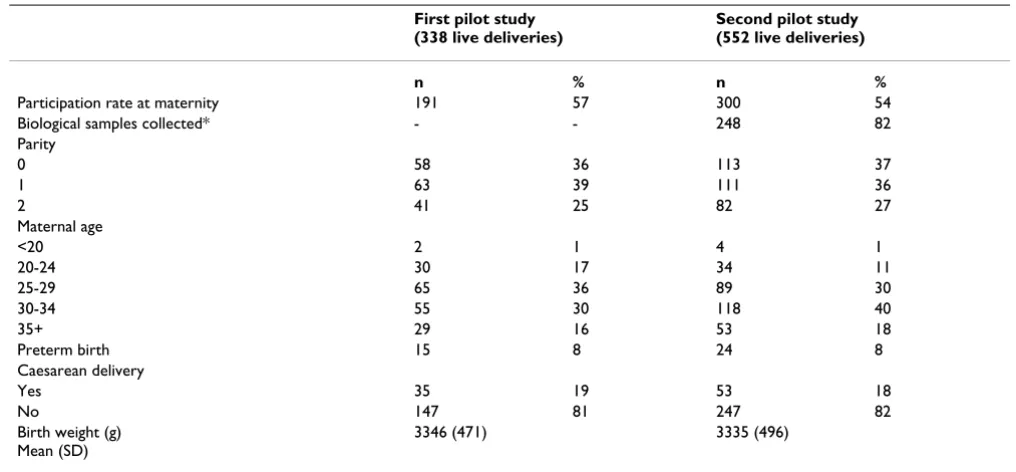
The participation acceptance rates in the pilot surveys were respectively 57% (n = 191 deliveries enrolled) in April 2007 (participation of 32/35 maternity units) and 54% (n = 300) in October 2007 (participation of 30/40 maternity units). We expect to improve these rates through better organization and information in the maternity units. Biological sample collection was tested in October 2007 and showed an excellent acceptance rate (90%). Finally biological samples were collected for 80% of the population enrolled in the pilot study (table 1).
Sample size and anticipated attrition rate
The two pilot studies have already provided us with some results on participation, two months and one year after enrolment in the study respectively. The response rate to the individual parent questionnaire at two months after birth was 86% for mothers and 79% fathers. Major rea-sons for non response of non-responses were refusals (55%), 31% were impossibility to contact the women, 12% were due to other reasons, and 6% were for unknown reasons. After the two months interview, 7% of the sample expressed a final refusal to continue participa-tion. First results for participation at one year are also available: amongst the parents still in the cohort at this point 82% of mothers (corresponding to 77% of mothers contacted at 2 months) and 70% of fathers (correspond-ing to 65% of fathers contacted at 2 months) responded to the questionnaire.
Attrition rates may also depend on unwillingness to answer the questionnaire or interview. Non-response can lead to selection bias, and if added to the attrition process [32] can contribute to increasing missing data over time. Consequently, procedures limiting non-response have been planned, including prevention tools (communica-tion based, tracking, incentives etc.) and methods of deal-ing with non-response through statistical analysis (e.g. reweighting methods [33]).
Sample collection
1. Environmental and social exposures Demographic and socio-economic data
Most of these data will be available thanks to data retrieval from national databases such as INSEE demographic records (EDP), health insurance data and school records.
The different surveys (including data from interviews with parents or children) will provide additional socio-demo-graphic and contextual information on family, socializa-tion, education and income in order to better identify and quantify the exposure to particular socio-economic condi-tions (i.e. degree of poverty) and life events (i.e. divorces, change in economic conditions, school insertion etc.)
Major environmental exposures
Biological samples will include cord-blood, breast milk, mother's urine and hair and mother's venous blood. Planned measurements concern environmental pollut-ants in cord blood (lead, selenium), milk (POPs), hair (mercury) and in mother's urine (pesticides, phthalates). Biological samples will be appropriately fractioned and stored so that further analyses will be possible during fol-low-up.
To evaluate exposure to certain pollutants, environmental sensors will be placed in the children's homes. Further-more, it will be possible to use data from environmental databases thanks to geo-coding of the addresses. The mother's answers to questions on various environmental exposures included in the different questionnaires will complement these quantitative data.
Table 1: Distribution of main characteristics of deliveries of infants enrolled in the two pilot studies
First pilot study (338 live deliveries)
Second pilot study (552 live deliveries)
n % n %
Participation rate at maternity 191 57 300 54
Biological samples collected* - - 248 82
Parity
0 58 36 113 37
1 63 39 111 36
2 41 25 82 27
Maternal age
<20 2 1 4 1
20-24 30 17 34 11
25-29 65 36 89 30
30-34 55 30 118 40
35+ 29 16 53 18
Preterm birth 15 8 24 8
Caesarean delivery
Yes 35 19 53 18
No 147 81 247 82
Birth weight (g) Mean (SD)
3346 (471) 3335 (496)
Dietary data
A dietary questionnaire will be filled up by the mothers during the stay in the maternity wards. It is designed to assess food intake under the nutritional, sensorial and social perspective. In addition, stored blood and milk samples will be available for the measurements of nutri-tional markers.
During follow-up, detailed questionnaires on infant feed-ing, introduction of solid foods will be sent every three months to a sub-sample of the cohort while a summary of information about feeding will be obtained for the rest of the cohort at the six-week and one year interviews. Addi-tional follow-up assessments of child's food intake and eating behavior will rely on questionnaires administered to the mother.
2. Outcomes Health outcomes
First, questionnaires and data from medical files will focus on the health of newborns at the maternity hospital, childhood disorders and mother's health, notably the course of pregnancy, perinatal period, health status of women at birth and postnatal depression. Self-adminis-tered questionnaires at the maternity unit will provide data on dietary habits and exposure to environmental pol-lutants during pregnancy.
Subsequent follow-up will focus on height and weight growth, sexual development, respiratory and allergy symptoms, occurrence of diseases and vaccinations, A medical questionnaire and examination of the child by a medical doctor at age 6 will provide anthropometric data (weight, height), information on visual and hearing acu-ity, functional respiratory capacity.
Child's cognitive and motor development
Information will be collected by interviewing parents using published developmental tools. For example, gen-eral child's development will be explored using the Child Development Inventories (CDI) [34] at 1 year. At 2 years, the emphasis will be put on early language development using the MacArthur Communicative Inventories. At 3 years, a cognitive abilities tool will be passed by the child during the home interview. Different scales are considered eligible for the 3 years interview such as the Bracken or the British Ability Scales (BAS [35]). At 6-7 years, it is project to use the Wechsler Intelligence scale [36] during the med-ical examination in order to have a health professional evaluation of the child's development.
Social outcomes
Face-to-face and phone interviews will cover topics such as the changes in family structure (divorce, reconstituted family, stepfamily, death, etc), the different factors
involved in the socialization of the individual: the roles played by parents, institutions (schools, etc.), social rela-tionships outside school and inter-generational relations. They will focus on the children's lifestyles through their living conditions, school attendance and careers, parents' incomes and profession and the transmission of cultural practices, before moving on to study social inequalities. They will also describe the living conditions of underpriv-ileged children from a dynamic viewpoint by understand-ing how parents enter or leave a state of poverty or are maintained in it.
Discussion
The main weakness lies in the absence of data collection before birth and during pregnancy, especially since the prenatal period has been highlighted as a sensitive period for various exposures [37]. Another weakness for any life course cohort is the difficulty of maintaining representa-tiveness throughout the follow-up [38,39], but employing special methods such as a joint parameter-dependent selection model to account for non-ignorable dropout will allow us to control for the attrition process while studying the impact of determinants of children's life events and evolution [40].
One of the main strengths of the study is the statistical power and the large size of the cohort which should allow us to test a wide variety of hypotheses. The creation of this large-scale cohort will provide a representative sample of the general population. Other study strengths also include the prospective collection of data from different sources, which can facilitate cross-validation of specific informa-tion, the use of objective measures (biological samples, biomedical data from physical examinations, etc.) and standardized tools which allow international compari-sons.
Properly conducted and interpreted, the study will pro-duce invaluable information, not only to the proposing scientists, but also to countless researchers who will be able to interrogate the resulting data with a wide variety of research questions reflecting a range of hypotheses. From an international perspective, the comparative analyses that would ensue would be of immense public health interest.
Competing interests
The authors declare that they have no competing interests.
Authors' contributions
HL and GS designed the study, HL is the director of the project. HS analyzed the data, SV drafted the manuscript. SV, CB, CP organized and participated in the field investi-gation and were involved the study design and contrib-uted as supervisor and provided all scientific and technical supports with the Elfe team. All authors approved the final manuscript.
Acknowledgements
ELFE is a joint study between The National institute for demographic stud-ies (INED), The National Institute for Health and Medical Research (INSERM), the Institute for Public Health Surveillance (InVS), the National Institute for statistics and economic studies (INSEE), the Ministry of Health, the Ministry of Employment, the National Family Allowance Office (Cnaf), the Ministry of Research, the Ministry of Environment, the National Social Science Data Committee (CCDSHS), the Complementary Insurance Organization for Educators (MGEN) and the Ministry of Culture.
We would like to acknowledge all the members of the Elfe team: Pascal Arduin (project administrator), Marie Noelle Dufourg and Jean Louis Lanoe (themas coordinators in health and social sciences), Nathalia Baltzinger (communication), Amivi Oleko and Ruxandra Popa (studies management), Marie Cheminat (studies technician), Sorya Som, Christine Gonzales and Mathieu Boivin (secretary) and all the members of the project, in particular the themes managers. We are grateful to the following people for their help in our epidemiological survey: Catherine Delaunay and Sophie Seurin and Patrizia Carrieri for her careful reading. We also thank the participants for their contribution to the study.
References
1. Drouillet P, Kaminski M, uzon-Guillain B, Forhan A, Ducimetiere P, Schweitzer M, Magnin G, Goua V, Thiebaugeorges O, Charles MA:
Association between maternal seafood consumption before pregnancy and fetal growth: evidence for an association in overweight women. The EDEN mother-child cohort. Paediatr Perinat Epidemiol 2009, 23:76-86.
2. Guldner L, Monfort C, Rouget F, Garlantezec R, Cordier S: Maternal fish and shellfish intake and pregnancy outcomes: a prospec-tive cohort study in Brittany, France. Environ Health 2007, 6:33. 3. Ribas-Fito N, Ramon R, Ballester F, Grimalt J, Marco A, Olea N, Posada M, Rebagliato M, Tardon A, Torrent M, Sunyer J: Child health and the environment: the INMA Spanish Study. Paedi-atr Perinat Epidemiol 2006, 20:403-10.
4. Magnus P, Irgens LM, Haug K, Nystad W, Skjaerven R, Stoltenberg C:
Cohort profile: the Norwegian Mother and Child Cohort Study (MoBa). Int J Epidemiol 2006, 35:1146-50.
5. Walton S, Bedford H, Dezateux C: Use of personal child health records in the UK: findings from the millennium cohort study. BMJ 2006, 332:269-70.
6. Brown RC, Dwyer T, Kasten C, Krotoski D, Li Z, Linet MS, Olsen J, Scheidt P, Winn DM: Cohort Profile: The International Child-hood Cancer Cohort Consortium (I4C). Int J Epidemiol 2007. 7. de Onis M, Garza C, Onyango AW: WHO Child Groth
Stand-ards. Acta Paediatr 2006, 450:1-101.
8. WHO Multicentre Growth Reference Study Group: WHO Child Growth Standarts: Length/height-for-age, weight-for-age, weight-for-lengh, weight-for-height and body mass index-for-age: methods and development. World Health Organi-zation. Geneva 2006.
9. Ball TM, Castro-Rodriguez JA, Griffith KA, Holberg CJ, Martinez FD, Wright AL: Siblings, day-care attendance, and the risk of asthma and wheezing during childhood. N Engl J Med 2000,
343:538-43.
10. de MG, Janssen NA, Brunekreef B: Early childhood environment related to microbial exposure and the occurrence of atopic disease at school age. Allergy 2005, 60:619-25.
11. Ronningen KS, Paltiel L, Meltzer HM, Nordhagen R, Lie KK, Hovengen R, Haugen M, Nystad W, Magnus P, Hoppin JA: The biobank of the Norwegian mother and child cohort Study: A resource for the next 100 years. Eur J Epidemiol 2006, 21:619-25.
12. Schwartz J: Air pollution and children's health. Pediatrics 2004,
113:1037-43.
13. Oliveria SA, Saraiya M, Geller AC, Heneghan MK, Jorgensen C: Sun exposure and risk of melanoma. Arch Dis Child 2006, 91:131-8. 14. Raaschou-Nielsen O, Andersen CE, Andersen HP, Gravesen P, Lind
M, Schuz J, Ulbak K: Domestic radon and childhood cancer in Denmark. Epidemiology 2008, 19:536-43.
15. Sigurdson AJ, Bhatti P, Chang SC, Rajaraman P, Doody MM, Bowen L, Simon SL, Weinstock RM, Linet MS, Rosenstein M, Stovall M, Alexan-der BH, Preston DL, Struewing JP: Polymorphisms in estrogen biosynthesis and metabolism-related genes, ionizing radia-tion exposure, and risk of breast cancer among US radio-logic technologists. Breast Cancer Res Treat 2009.
16. Pearce N, it-Khaled N, Beasley R, Mallol J, Keil U, Mitchell E, Robert-son C: Worldwide trends in the prevalence of asthma symp-toms: phase III of the International Study of Asthma and Allergies in Childhood (ISAAC). Thorax 2007, 62:758-66. 17. Delmas Marie-Christine, Guignon Nathalie, Leynaert Bénédicte,
Com-Ruelle Laure, Annesi-Maesano Isabella, Herbet Jean-Baptiste, Fuhrman Claire: Prévalence de l'asthme chez l'enfant en France. Archives de pédiatrie 2009, 16(9):1261-1269.
18. Illi S, von ME, Lau S, Bergmann R, Niggemann B, Sommerfeld C, Wahn U: Early childhood infectious diseases and the development of asthma up to school age: a birth cohort study. BMJ 2001,
322:390-5.
19. Esping-Andersen G: A Child-Centred Social Investment Strat-egy. In Why we need a new Welfare State Edited by: Esping-Andersen G, et al. Oxford, Oxford University Press:26-67.
20. Heckman JJ, Masterov DV: The productivity argument for investing in young children. In Working Paper 13016 National Bureau of Economic Research (NBER), Cambridge, Mass; 2007. 21. Letablier MTh, Thévenon O: "The effectiveness of policies for
family work-life balance and child well-being". The costs of rais-ing children and the effectiveness of policies to support parenthood in Euro-pean countries: a Literature Review, Report for the EU Commission 2008. 22. Heuveline P, Timberlake JM, Furstenberg FF: Shifting Child
Rear-ing to SRear-ingle Mothers: Results from 17 Western Nations. Population and Development Review 2003, 29:47-71.
23. Grundy E: « Les échanges intergénérationnels des populations âgées ». In Age, Générations et contrat social (dir.) Edited by: Véron J, Pennec S, Légaré J. Paris, INED; 2004.
24. Blöss T: Les liens de famille. Paris, PUF; 1997.
25. Thalineau A: L'individu, la famille et l'emploi. Paris, L'Harmattan; 2004.
26. Grossmann KE, Grossmann K, Waters E: Attachment from Infancy to Adulthood. Guilford Press. New York; 2005. 27. Brousse Cécile: La répartition de travail domestique entre
conjoints reste très largement spécialisée et inégale. In Por-trait social Paris, INSEE; 1999:135-151.
28. Bonnet D, et Pourchez L: Du soin au rite dans l'enfance IRD, Erès; 2007. 29. Brougère Gilles: Jouets et compagnie Paris, Ed Stock; 2003.
Publish with BioMed Central and every scientist can read your work free of charge "BioMed Central will be the most significant development for disseminating the results of biomedical researc h in our lifetime."
Sir Paul Nurse, Cancer Research UK
Your research papers will be:
available free of charge to the entire biomedical community
peer reviewed and published immediately upon acceptance
cited in PubMed and archived on PubMed Central
yours — you keep the copyright
Submit your manuscript here:
http://www.biomedcentral.com/info/publishing_adv.asp
BioMedcentral sexe et genre (sous la dir) Edited by: de Coulon N, et Cresson G. Paris,
L'Harmattan; 2007:167-224.
31. Christine Couet: INSEE's Permanent Demographic Sample. Courrier des statistiques 2006:117-119. 5-12
32. Groves RM, Peytcheva E: The impact of nonresponse rates on nonresponse bias. Pub Opin Q 2008, 72(2):167-189.
33. Little RJA: Survey Nonresponse Adjustments for Estimates of Means. International Statistical 1986, 54(2):139-157.
34. Ireton H, Glascoe FP: Assessing children's development using parents'reports. The Child Development Inventory. Clinical Pediatrics 1995, 34(5):248-255.
35. Hill V: Through the past darkly: a review of the British Ability Scales Second Edition. Child and Adolescent Mental Health 2005,
10(2):87-98.
36. Wechsler D: Wechsler Intelligence Scale for Children (WISC-IV UK). 4th edition. Harcourt Assessment. London; 2004. 37. Olsen J: Prenatal exposures and long-term health effects.
Epi-demiol Rev 2000, 22:76-81.
38. Alonso A, Segui-Gomez M, de IJ, Sanchez-Villegas A, Beunza JJ, Mar-tinez-Gonzalez MA: Predictors of follow-up and assessment of selection bias from dropouts using inverse probability weighting in a cohort of university graduates. Eur J Epidemiol
2006, 21:351-8.
39. Atherton K, Fuller E, Shepherd P, Strachan DP, Power C: Loss and representativeness in a biomedical survey at age 45 years: 1958 British birth cohort. J Epidemiol Community Health 2008,
62:216-23.
40. Guo X, Carlin BP: Separate and joint modeling of longitudinal and event time data using standrad computer packages. The american statistician :58. 1-9. 20
Pre-publication history
The pre-publication history for this paper can be accessed here: