INCOME TAX
Rev. Rul. 97–16, page 4.
Low-income housing credit; satisfactory bond; ‘‘bond factor’’ amounts for the period January through March 1997. This ruling announces the monthly bond factor amounts to be used by taxpayers who dispose of qualified low-income buildings or interests therein during the period Januar y through March 1997.
T.D. 8710, page 4.
Final regulations relate to the consistency rules under section 338 of the Code that apply to cer tain cases involving controlled foreign corporations.
REG–209709–94, page 12.
Proposed regulations under sections 167 and 197 of the Code relate to the amor tization of cer tain intangible proper ty. A public hearing will be held on May 15, 1997.
EXEMPT ORGANIZATIONS
Announcement 97–27, page 30.
A list is given of organizations now classified as private foundations.
EXCISE TAXES
Notice 97–22, page 9.
A determination has been made to add diglycidyl ether of bisphenol-A to the list of taxable substances in section 4672(a)(3) of the Code.
ADMINISTRATIVE
Rev. Proc. 97–22, page 9.
Books and records; electronic storage; imaging. Guid-ance is provided for taxpayers that use an electronic storage system (such as an imaging system) to maintain books and records for purposes of section 6001 of the Code.
Page 32.
Scenarios of disciplinary actions. The Office of Direc-tor of Practice sets for th scenarios of disciplinar y actions involving individuals who represent taxpayers before the Internal Revenue Ser vice. The Ser vice invites comments.
Finding Lists begin on page 35.
Announcement of Disbarments and Suspensions begins on page 33.
Bulletin No. 1997–13
March 31, 1997
HIGHLIGHTS
OF THIS ISSUE
These synopses are intended only as aids to the reader in identifying the subject matter covered. They may not be relied upon as authoritative interpretations.
Mission of the Service
The purpose of the Internal Revenue Ser vice is to collect the proper amount of tax revenue at the least cost; ser ve the public by continually improving the
quality of our products and ser vices; and per form in a manner warranting the highest degree of public confidence in our integrity, efficiency and fairness.
Statement of Principles
of Internal Revenue
Tax Administration
The function of the Internal Revenue Ser vice is to administer the Internal Revenue Code. Tax policy for raising revenue is determined by Congress.
With this in mind, it is the duty of the Ser vice to carr y out that policy by correctly applying the laws enacted by Congress; to determine the reasonable meaning of various Code provisions in light of the Congressional purpose in enacting them; and to per form this work in a fair and impar tial manner, with neither a government nor a taxpayer point of view. At the hear t of administration is interpretation of the Code. It is the responsibility of each person in the Ser vice, charged with the duty of interpreting the law, to tr y to find the true meaning of the statutor y provision and not to adopt a strained construction in the belief that he or she is ‘‘protecting the revenue.’’ The revenue is properly protected only when we as-cer tain and apply the true meaning of the statute.
The Ser vice also has the responsibility of applying and administering the law in a reasonable, practical manner. Issues should only be raised by examining of ficers when they have merit, never arbitrarily or for trading purposes. At the same time, the examining officer should never hesitate to raise a meritorious issue. It is also impor tant that care be exercised not to raise an issue or to ask a cour t to adopt a position inconsistent with an established Ser vice position.
Administration should be both reasonable and vigorous. It should be conducted with as little delay as possible and with great cour tesy and considerateness. It should never tr y to overreach, and should be reasonable within the bounds of law and sound administration. It should, however, be vigorous in requiring compliance with law and it should be relentless in its attack on unreal tax devices and fraud.
Introduction
The Internal Revenue Bulletin is the authoritative instru-ment of the Commissioner of Internal Revenue for announcing official rulings and procedures of the Inter-nal Revenue Ser vice and for publishing Treasur y Deci-sions, Executive Orders, Tax Conventions, legislation, cour t decisions, and other items of general interest. It is published weekly and may be obtained from the Superin-tendent of Documents on a subscription basis. Bulletin contents of a permanent nature are consolidated semi-annually into Cumulative Bulletins, which are sold on a single-copy basis.
It is the policy of the Ser vice to publish in the Bulletin all substantive rulings necessar y to promote a uniform application of the tax laws, including all rulings that supersede, revoke, modify, or amend any of those previously published in the Bulletin. All published rulings apply retroactively unless other wise indicated. Proce-dures relating solely to matters of internal management are not published; however, statements of internal practices and procedures that affect the rights and duties of taxpayers are published.
Revenue rulings represent the conclusions of the Ser-vice on the application of the law to the pivotal facts stated in the revenue ruling. In those based on positions taken in rulings to taxpayers or technical advice to Ser vice field offices, identifying details and information of a confidential nature are deleted to prevent unwar-ranted invasions of privacy and to comply with statutor y requirements.
Rulings and procedures repor ted in the Bulletin do not have the force and effect of Treasur y Depar tment Regulations, but they may be used as precedents. Unpublished rulings will not be relied on, used, or cited as precedents by Ser vice personnel in the disposition of other cases. In applying published rulings and proce-dures, the effect of subsequent legislation, regulations,
cour t decisions, rulings, and procedures must be consid-ered, and Ser vice personnel and others concerned are cautioned against reaching the same conclusions in other cases unless the facts and circumstances are substantially the same.
The Bulletin is divided into four par ts as follows:
Part I.—1986 Code.
This par t includes rulings and decisions based on provisions of the Internal Revenue Code of 1986.
Part II.—Treaties and Tax Legislation.
This par t is divided into two subpar ts as follows: Subpar t A, Tax Conventions, and Subpar t B, Legislation and Related Committee Repor ts.
Part III.—Administrative, Procedural, and Miscellaneous.
To the extent practicable, per tinent cross references to these subjects are contained in the other Par ts and Subpar ts. Also included in this par t are Bank Secrecy Act Administrative Rulings. Bank Secrecy Act Administra-tive Rulings are issued by the Depar tment of the Treasur y’s Office of the Assistant Secretar y (Enforce-ment).
Part IV.—Items of General Interest.
With the exception of the Notice of Proposed Rulemak-ing and the disbarment and suspension list included in this par t, none of these announcements are consoli-dated in the Cumulative Bulletins.
The first Bulletin for each month includes an index for the matters published during the preceding month. These monthly indexes are cumulated on a quar terly and semiannual basis, and are published in the first Bulletin of the succeeding quar terly and semi-annual period, respectively.
The contents of this publication are not copyrighted and may be reprinted freely. A citation of the Internal Revenue Bulletin as the source would be appropriate. For sale by the Superintendent of Documents U.S. Government Printing Office, Washington, D.C. 20402.
Part I. Rulings and Decisions Under the Internal Revenue Code of 1986
Section 42.—Low-Income HousingCredit
Low-income housing credit; satis-factory bond; ‘‘bond factor’’ amount for the period January through March 1997. This ruling announces the
monthly bond factor amounts to be used by taxpayers who dispose of qualified low-income buildings or interests therein during the period January through March 1997.
Rev. Rul. 97–16
In Rev. Rul. 90–60, 1990–2 C.B. 3, the Internal Revenue Service provided guidance to taxpayers concerning the general methodology used by the Trea-sury Department in computing the bond factor amounts used in calculating the amount of bond considered satisfactory by the Secretary under § 42(j)(6) of the Internal Revenue Code. It further an-nounced that the Secretary would
pub-lish in the Internal Revenue Bulletin a table of ‘‘bond factor’’ amounts for dispositions occurring during each cal-endar month.
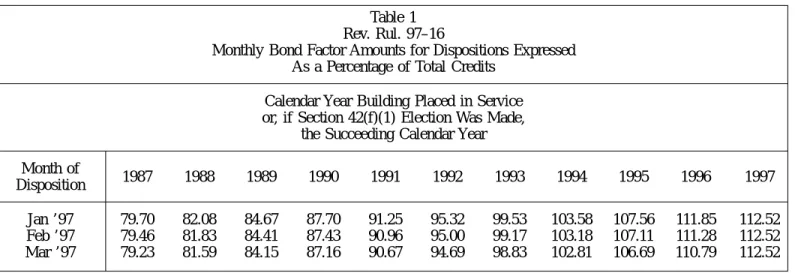
This revenue ruling provides in Table 1 the bond factor amounts for calculat-ing the amount of bond considered satisfactory under § 42(j)(6) for disposi-tions of qualified low-income buildings or interests therein during the period January through March 1997.
Table 1 Rev. Rul. 97–16
Monthly Bond Factor Amounts for Dispositions Expressed As a Percentage of Total Credits
Calendar Year Building Placed in Service or, if Section 42(f)(1) Election Was Made,
the Succeeding Calendar Year Month of
Disposition 1987 1988 1989 1990 1991 1992 1993 1994 1995 1996 1997
Jan ’97 79.70 82.08 84.67 87.70 91.25 95.32 99.53 103.58 107.56 111.85 112.52
Feb ’97 79.46 81.83 84.41 87.43 90.96 95.00 99.17 103.18 107.11 111.28 112.52
Mar ’97 79.23 81.59 84.15 87.16 90.67 94.69 98.83 102.81 106.69 110.79 112.52
For a list of bond factor amounts applicable to dispositions occurring dur-ing other calendar years, see the follow-ing revenue rulfollow-ings: Rev. Rul. 90–60, 1990–2 C.B. 3, for dispositions occur-ring duoccur-ring calendar years 1987, 1988, and 1989; Rev. Rul. 90–88, 1990–2 C.B. 7, for dispositions occurring during cal-endar year 1990; Rev. Rul. 91–67, 1991–2 C.B. 13, for dispositions occur-ring duoccur-ring calendar year 1991; Rev. Rul. 92–101, 1992–2 C.B. 9, for dispo-sitions occurring during calendar year 1992; Rev. Rul 93–83, 1993–2 C.B. 6, for dispositions occurring during calen-dar year 1993; Rev. Rul. 94–71, 1994–2 C.B. 4, for dispositions occurring during calendar year 1994; Rev. Rul. 95–83, 1995–2 C.B. 8, for dispositions occur-ring duoccur-ring calendar year 1995; Rev. Rul. 96–16, 1996–1 C.B. 3, for disposi-tions occurring during the period Janu-ary through March 1996; Rev. Rul. 96–33, 1996–27 I.R.B. 4, for disposi-tions occurring during the period April through June 1996; Rev. Rul. 96–45, 1996–39 I.R.B. 5, for dispositions oc-curring during the period July through September 1996; and Rev. Rul. 96–59, 1996–50 I.R.B. 4, for dispositions oc-curring during the period October through December 1996.
DRAFTING INFORMATION
The principal author of this revenue ruling is Jack Malgeri of the Office of Assistant Chief Counsel (Passthroughs and Special Industries). For further in-formation regarding this revenue ruling, contact Mr. Malgeri at (202) 622–3040 (not a toll-free call).
Section 338.—Certain Stock Purchase Treated as Asset Acquisitions
26 CFR 1.338–4: Asset and stock consistency. T.D. 8710
DEPARTMENT OF THE TREASURY Internal Revenue Service
26 CFR Part 1
Revisions of the Section 338 Consistency Rules With Respect to Target Affiliates That Are Controlled Foreign Corporations
AGENCY: Internal Revenue Service (IRS), Treasury.
ACTION: Final regulations.
SUMMARY: This document contains final regulations relating to the
consis-tency rules under section 338 of the Internal Revenue Code of 1986 that are applicable to certain cases involving controlled foreign corporations. The fi-nal regulations substantially revise and simplify the stock and asset consistency rules. The final regulations include the provisions of the consistency rules ap-plicable to controlled foreign corpora-tions contained in recent proposed and temporary regulations. The final regula-tions would affect taxpayers that own controlled foreign corporations.
EFFECTIVE DATE: These regulations are effective January 20, 1997.
FOR FURTHER INFORMATION CON-TACT: Kenneth D. Allison at (202) 622–3860 (not a toll-free number). SUPPLEMENTARY
INFORMATION:
Background
This document contains final Income Tax Regulations (26 CFR part 1) under section 338 of the Internal Revenue Code.
On January 20, 1994, temporary regu-lations (T.D. 8516) were published in the Federal Register (59 FR 2956) under section 338 of the Internal
Rev-enue Code. See 1994–1 C.B. 119. A notice of proposed rulemaking (INTL– 0177–90) cross-referencing the tempo-rary regulations was published in the
Federal Register for the same day (59
FR 3045). See 1994–1 C.B. 818. The temporary regulations provided rules to replace the asset and stock consistency rules of §§ 1.338–4T and 1.338–5T. The temporary regulations included con-sistency rules applicable to certain cases involving controlled foreign corporations (CFCs).
No written comments responding to the notice were received. No public hearing was requested or held. The proposed regulations under section 338 are adopted as revised by this Treasury decision, and the corresponding tempo-rary regulations are removed.
Explanation of Provisions
The preamble to the temporary and proposed regulations (1994–1 C.B. 119) contains a discussion of the provisions. Changes to the temporary and proposed regulations are noted below.
Section 1.338–4T(h)(3) of the tempo-rary regulations is clarified by stating that the basis of the stock of a con-trolled foreign corporate target affiliate is not increased by section 1248 earn-ings attributable to the disposition of an asset in which a carryover basis is taken under this section.
Section 1.338–4T(h)(4) of the tempo-rary regulations addresses a situation in which the income or gain from the disposition of a controlled foreign cor-poration target affiliate (CFC T affiliate) asset is not subject to the consistency rules of paragraph (h)(2). The regulation states that if a CFC T affiliate pays a dividend to a target (T) or a domestic T affiliate wholly or partially out of the earnings generated by the disposition of that asset, and the dividend increases the basis of the T stock under § 1.1502–32, then the basis of the stock of the CFC T affiliate is reduced by the amount of the dividend that was paid from the earn-ings and profits resulting from the asset disposition. This rule applies to any actual dividend, amount treated as a dividend under section 1248 (or that would have been so treated but for section 1291) or amount included in income under section 951(a)(1)(B).
The final regulations retain this rule. The final regulations also add a special ordering rule, in § 1.338–4(h)(4)(ii), clarifying that any such dividend is first
considered attributable to earnings and profits resulting from the disposition of the asset.
Section 1.338–4(h)(4)(ii) is clarified to state that the basis of the stock of a controlled foreign corporation may not be reduced below zero under the car-ryover basis rules of § 1.338–4.
Section 1.338–4(h)(2)(iv)(A) and
§ 1.338–4(h)(4)(iii)(A) are added to al-low the purchasing group in certain instances to increase the basis of the CFC T stock by the amount of either the basis increase denied under § 1.338– 4(h)(2)(ii) or the basis reduction re-quired under § 1.338–4(h)(4)(ii). The rule applies when the purchasing group disposes of an asset acquired from CFC T that is subject to the consistency rules to an unrelated party in a taxable trans-action and includes in U.S. gross in-come the greater of (i) the inin-come or gain equal to the basis amount denied to the asset under either § 1.338–4(h)(2)(i) or § 1.338–4(g) and § 1.338–4(h)(4)(i), respectively, or (ii) the gain recognized on the asset.
Similarly, § 1.338–4(h)(2)(iv)(B) and § 1.338–4(h)(4)(iii)(B) are added to al-low the purchasing group to increase the basis of an asset acquired from CFC T that is subject to the consistency rules by the basis amount denied to the asset
under either § 1.338–4(h)(2)(i) or
§ 1.338–4(g) and § 1.338–4(h)(4)(i). The rule applies when the purchasing group disposes of the stock of CFC T to an unrelated party in a taxable transac-tion and includes in U.S. gross income the greater of (i) the gain equal to the basis increase denied under § 1.338– 4(h)(2)(ii) or the basis reduction re-quired under § 1.338–4(h)(4)(ii), respec-tively, or (ii) the gain recognized in the stock.
Special Analyses
It has been determined that this final regulation is not a significant regulatory action as defined in EO 12866. There-fore, a regulatory assessment is not required. It also has been determined that section 553(b) of the Administrative Procedure Act (5 U.S.C. chapter 5) does not apply to these regulations, and be-cause the notice of proposed rulemaking preceding the regulations was issued prior to March 29, 1996 the Regulatory Flexibility Act (5 U.S.C. chapter 6) does not apply. Therefore, a regulatory flex-ibility analysis is not required. Pursuant to section 7805(f) of the Internal Rev-enue Code, the notice of proposed
rulemaking preceding these regulations was submitted to the Small Business Administration for comment on its im-pact on small businesses.
Drafting Information
The principal author of these regula-tions is Kenneth D. Allison of the Office of Associate Chief Counsel (Interna-tional), IRS. However, other personnel from the IRS and Treasury Department participated in their development.
* * * * *
Adoption of Amendments to the Regula-tions
Accordingly, 26 CFR part 1 is amended as follows: PART 1—IN-COME TAXES
Paragraph 1. The authority citation for part 1 is amended by removing the entry for Section 1.338–4T(h) to read as fol-lows:
Authority: 26 U.S.C. 7805 * * * Par. 2. In § 1.338–0, the outline of topics is amended by revising the entry for § 1.338–4(h) and removing the entry for § 1.338–4T to read as follows:
§ 1.338–0 Outline of topics.
* * * * *
§ 1.338–4 Asset and stock consistency.
* * * * *
(h) Consistency for target affiliates that are controlled foreign corporations.
(1) In general.
(2) Income or gain resulting from asset dispositions.
(i) General rule.
(ii) Basis of controlled foreign corpo-ration stock.
(iii) Operating rule.
(iv) Increase in asset or stock basis. (3) Stock issued by target affiliate that is a controlled foreign corporation.
(4) Certain distributions. (i) General rule.
(ii) Basis of controlled foreign corpo-ration stock.
(iii) Increase in asset or stock basis. (5) Examples.
* * * * *
Par. 3. Section 1.338–4 is amended as follows:
1. Paragraph (a)(5) is amended by removing the language ‘‘Section 1.338– 4T(h)’’ and adding ‘‘Paragraph (h) of this section’’ in its place.
2. Paragraph (c)(4) is amended by
removing the language ‘‘§ 1.338–
4T(h)(2)’’ and adding ‘‘paragraph (h)(2) of this section’’ in its place.
3. Paragraph (d)(2)(iii) is amended by
removing the language ‘‘§ 1.338–
4T(h)(3)’’ and adding ‘‘paragraph (h)(3) of this section’’ in its place.
4. Paragraph (g)(2) is amended by
removing the language ‘‘§ 1.338–
4T(h)(4)’’ and adding ‘‘paragraph (h)(4) of this section’’ in its place.
5. Paragraph (h) is revised.
6. Paragraph (j)(3)9i)(A)(2) is
amended by removing the language ‘‘§ 1.338–4T(h)’’ and adding ‘‘para-graph (h) of this section’’ in its place.
The revision reads as follows:
§ 1.338–4 Asset and stock consistency.
* * * * *
(h) Consistency for target affiliates
that are controlled foreign corpora-tions—(1) In general. This paragraph
(h) applies only if target is a domestic corporation. For additional rules that may apply with respect to controlled foreign corporations, see paragraph (g) of this section. The definitions and no-menclature of § 1.338–1(b) and (c) and paragraph (e) of this section apply for purposes of this section.
(2) Income or gain resulting from
asset dispositions—(i) General rule.
In-come or gain of a target affiliate that is a controlled foreign corporation from the disposition of an asset is not re-flected in the basis of target stock under paragraph (c) of this section unless the income or gain results in an inclusion under section 951(a)(1)(A), 951(a)(1)-(C), 1291 or 1293.
(ii) Basis of controlled foreign
corpo-ration stock. If, by reason of paragraph
(h)(2)(i) of this section, the carryover basis rules of this section apply to an asset, no increase in basis in the stock of a controlled foreign corporation under section 961(a) or 1293(d)(1), or under regulations issued pursuant to section 1297(b)(5), is allowed to target or a target affiliate to the extent the increase is attributable to income or gain de-scribed in paragraph (h)(2)(i) of this section. A similar rule applies to the basis of any property by reason of which the stock of the controlled foreign corporation is considered owned under section 958(a)(2) or 1297(a).
(iii) Operating rule. For purposes of this paragraph (h)(2)—
(A) If there is an income inclusion under section 951 (a)(1)(A) or (C), the shareholder’s income inclusion is first attributed to the income or gain of the controlled foreign corporation from the
disposition of the asset to the extent of the shareholder’s pro rata share of such income or gain; and
(B) Any income or gain under sec-tion 1293 is first attributed to the in-come or gain from the disposition of the asset to the extent of the shareholder’s pro rata share of the income or gain. (iv) Increase in asset or stock basis— (A) If the carryover basis rules under paragraph (h)(2)(i) of this section apply to an asset, and the purchasing corpora-tion disposes of the asset to an unrelated party in a taxable transaction and recog-nizes and includes in its U.S. gross income or the U.S. gross income of its shareholders the greater of the income or gain from the disposition of the asset by the selling controlled foreign corpo-ration that was reflected in the basis of the target stock under paragraph (c) of this section, or the gain recognized on the asset by the purchasing corporation on the disposition of the asset, then the purchasing corporation or the target or a target affiliate, as appropriate, shall in-crease the basis of the selling controlled foreign corporation stock subject to paragraph (h)(2)(ii) of this section, as of the date of the disposition of the asset by the purchasing corporation, by the amount of the basis increase that was denied under paragraph (h)(2)(ii) of this section. The preceding sentence shall apply only to the extent that the con-trolled foreign corporation stock is owned (within the meaning of section 958(a)) by a member of the purchasing corporation’s affiliated group.
(B) If the carryover basis rules under paragraph (h)(2)(i) of this section apply to an asset, and the purchasing corpora-tion or the target or a target affiliate, as appropriate, disposes of the stock of the selling controlled foreign corporation to an unrelated party in a taxable transac-tion and recognizes and includes in its U.S. gross income or the U.S. gross income of its shareholders the greater of the gain equal to the basis increase that was denied under paragraph (h)(2)(ii) of this section, or the gain recognized in the stock by the purchasing corporation or by the target or a target affiliate, as appropriate, on the disposition of the stock, then the purchasing corporation shall increase the basis of the asset, as of the date of the disposition of the stock of the selling controlled foreign corporation by the purchasing corpora-tion or by the target or a target affiliate, as appropriate, by the amount of the basis increase that was denied pursuant to paragraph (h)(2)(i) of this section.
The preceding sentence shall apply only to the extent that the asset is owned (within the meaning of section 958(a)) by a member of the purchasing corpora-tion’s affiliated group.
(3) Stock issued by target affiliate
that is a controlled foreign corporation.
The exception to the carryover basis rules of this section provided in para-graph (d)(2)(iii) of this section does not apply to stock issued by a target affiliate that is a controlled foreign corporation. After applying the carryover basis rules of this section to the stock, the basis in the stock is increased by the amount treated as a dividend under section 1248 on the disposition of the stock (or that would have been so treated but for section 1291), except to the extent the basis increase is attributable to the dis-position of an asset in which a carryover basis is taken under this section.
(4) Certain distributions—(i) General
rule. In the case of a target affiliate that
is a controlled foreign corporation, para-graph (g) of this section applies with respect to the target affiliate by treating any reference to a dividend to which section 243(a)(3) applies as a reference to any amount taken into account under § 1.1502–32 in determining the basis of target stock that is—
(A) A dividend;
(B) An amount treated as a dividend under section 1248 (or that would have been so treated but for section 1291); or (C) An amount included in income under section 951(a)(1)(B).
(ii) Basis of controlled foreign
corpo-ration stock. If the carryover basis rules
of this section apply to an asset, the basis in the stock of the controlled foreign corporation (or any property by reason of which the stock is considered owned under section 958(a)(2)) is re-duced (but not below zero) by the sum of any amounts that are treated, solely by reason of the disposition of the asset, as a dividend, amount treated as a dividend under section 1248 (or that would have been so treated but for section 1291), or amount included in income under section 951(a)(1)(B). For this purpose, any dividend, amount treated as a dividend under section 1248 (or that would have been so treated but for section 1291), or amount included in income under section 951(a)(1)(B) is considered attributable first to earnings and profits resulting from the disposition of the asset.
(iii) Increase in asset or stock
ba-sis—(A) If the carryover basis rules
this section apply to an asset, and the purchasing corporation disposes of the asset to an unrelated party in a taxable transaction and recognizes and includes in its U.S. gross income or the U.S. gross income of its shareholders the greater of the gain equal to the basis increase denied in the asset pursuant to paragraphs (g) and (h)(4)(i) of this sec-tion, or the gain recognized on the asset by the purchasing corporation on the disposition of the asset, then the pur-chasing corporation or the target or a target affiliate, as appropriate, shall in-crease the basis of the selling controlled foreign corporation stock subject to paragraph (h)(4)(ii) of this section, as of the date of the disposition of the asset by the purchasing corporation, by the amount of the basis reduction under paragraph (h)(4)(ii) of this section. The preceding sentence shall apply only to the extent that the controlled foreign corporation stock is owned (within the meaning of section 958(a)) by a member of the purchasing corporation’s affiliated group.
(B) If the carryover basis rules under paragraphs (g) and (h)(4)(i) of this sec-tion apply to an asset, and the purchas-ing corporation or the target or a target affiliate, as appropriate, disposes of the stock of the selling controlled foreign corporation to an unrelated party in a taxable transaction and recognizes and includes in its U.S. gross income or the U.S. gross income of its shareholders the greater of the amount of the basis reduction under paragraph (h)(4)(ii) of this section, or the gain recognized in the stock by the purchasing corporation or by the target or a target affiliate, as appropriate, on the disposition of the stock, then the purchasing corporation shall increase the basis of the asset, as of the date of the disposition of the stock of the selling controlled foreign corporation by the purchasing corpora-tion or by the target or a target affiliate, as appropriate, by the amount of the basis increase that was denied pursuant to paragraphs (g) and (h)(4)(i) of this section. The preceding sentence shall apply only to the extent that the asset is owned (within the meaning of section 958(a)) by a member of the purchasing corporation’s affiliated group.
(5) Examples. This paragraph (h) may be illustrated by the following examples:
Example 1. Stock of target affiliate that is a CFC. (a) The S group files a consolidated return;
however, T2 is a controlled foreign corporation. On December 1 of Year 1, T1 sells the T2 stock to P and recognizes gain. On January 2 of Year 2, P
makes a qualified stock purchase of T from S. No section 338 election is made for T.
(b) Under paragraph (b)(1) of this section, paragraph (d) of this section applies to the T2 stock. Under paragraph (h)(3) of this section, paragraph (d)(2)(iii) of this section does not apply to the T2 stock. Consequently, paragraph (d)(1) of this section applies to the T2 stock. However, after applying paragraph (d)(1) of this section, P’s basis in the T2 stock is increased by the amount of T1’s gain on the sale of the T2 stock that is treated as a dividend under section 1248. Because P has a carryover basis in the T2 stock, the T2 stock is not considered purchased within the meaning of sec-tion 338(h)(3) and no secsec-tion 338 elecsec-tion may be made for T2.
Example 2. Stock of target affiliate CFC; inclu-sion under subpart F. (a) The S group files a
consolidated return; however, T2 is a controlled foreign corporation. On December 1 of Year 1, T2 sells an asset to P and recognizes subpart F income that results in an inclusion in T1’s gross income under section 951(a)(1)(A). On January 2 of Year 2, P makes a qualified stock purchase of T from S. No section 338 election is made for T. (b) Because gain from the disposition of the asset results in an inclusion under section 951(a)(1)(A), the gain is reflected in the basis of the T stock as of T’s acquisition date. See paragraph (h)(2)(i) of this section. Consequently, under paragraph (b)(1) of this section, paragraph (d)(1) of this section applies to the asset. In addition, under paragraph (h)(2)(ii) of this section, T1’s basis in the T2 stock is not increased under section 961(a) by the amount of the inclusion that is attributable to the sale of the asset.
(c) If, in addition to making a qualified stock purchase of T, P acquires the T2 stock from T1 on January 1 of Year 2, the results are the same for the asset sold by T2. In addition, under paragraph (h)(2)(ii) of this section, T1’s basis in the T2 stock is not increased by the amount of the inclusion that is attributable to the gain on the sale of the asset. Further, under paragraph (h)(3) of this section, paragraph (d)(1) of this section applies to the T2 stock. However, after applying paragraph (d)(1) of this section, P’s basis in the T2 stock is increased by the amount of T1’s gain on the sale of the T2 stock that is treated as a dividend under section 1248. Finally, because P has a carryover basis in the T2 stock, the T2 stock is not considered purchased within the meaning of sec-tion 338(h)(3) and no secsec-tion 338 elecsec-tion may be made for T2.
(d) If P makes a qualified stock purchase of T2 from T1, rather than of T from S, and T1’s gain on the sale of T2 is treated as a dividend under section 1248, under paragraph (h)(1) of this sec-tion, paragraphs (h)(2) and (3) of this section do not apply because there is no target that is a domestic corporation. Consequently, the carryover basis rules of paragraph do not apply to the asset sold by T2 or the T2 stock.
Example 3. Gain reflected by reason of section 1248 dividend; gain from non-subpart F asset. (a)
The S group files a consolidated return; however, T2 is a controlled foreign corporation. In Years 1 through 4, T2 does not pay any dividends to T1 and no amount is included in T1’s income under section 951(a)(1)(B). On December 1 of Year 4, T2 sells an asset with a basis of $400,000 to P for $900,000. T2’s gain of $500,000 is not subpart F income. On December 15 of Year 4, T1 sells T2, in which it has a basis of $600,000, to P for $1,600,000. Under section 1248, $800,000 of T1’s gain of $1,000,000 is treated as a dividend. However, in the absence of the sale of the asset by T2 to P, only $300,000 would have been treated as
a dividend under section 1248. On December 30 of Year 4, P makes a qualified stock purchase of T1 from T. No section 338 election is made for T1. (b) Under paragraph (h)(4) of this section, paragraph (g)(2) of this section applies by refer-ence to the amount treated as a dividend under section 1248 on the disposition of the T2 stock. Because the amount treated as a dividend is taken into account in determining T’s basis in the T1 stock under § 1.1502–32, the sale of the T2 stock and the deemed dividend have the effect of a transaction described in paragraph (g)(1) of this section. Consequently, paragraph (d)(1) of this section applies to the asset sold by T2 to P and P’s basis in the asset is $400,000 as of December 1 of Year 4.
(c) Under paragraph (h)(3) of this section, para-graph (d)(1) of this section applies to the T2 stock and P’s basis in the T2 stock is $600,000 as of December 15 of Year 4. Under paragraphs (h)(3) and (4)(ii) of this section, however, P’s basis in the T2 stock is increased by $300,000 (the amount of T1’s gain treated as a dividend under section 1248 ($800,000), other than the amount treated as a dividend solely as a result of the sale of the asset by T2 to P ($500,000)) to $900,000.
* * * * *
§ 1.338–4T [Removed]
Par. 4. Section 1.338–4T is removed. Par. 5. In § 1.338(i)–1, paragraphs (a) and (b) are revised to read as follows:
§ 1.338(i)–1 Effective dates.
(a) In general. Sections 1.338–1 through 1.338–5 (except § 1.338–4(h)), 1.338(b)–1, and 1.338(h)(10)–1 gener-ally are applicable for targets with ac-quisition dates on or after January 20, 1994. Section 1.338–4(h) is applicable for targets with acquisition dates on or after January 20, 1997. Section 1.338– 4T(h) (as contained in 26 CFR part 1 as revised April 1, 1996) is generally appli-cable for targets with acquisition dates on or after January 20, 1994, and before January 20, 1997.
(b) Elective retroactive application. A target with an acquisition date on or after January 14, 1992 and before Janu-ary 20, 1994 may apply §§ 1.338–1 through 1.338–5, 1.338–4T(h) (as con-tained in 26 CFR part 1 as revised April 1, 1996), 1.338(b)–1, and 1.338(h)-(10)–1 by including a statement with its return (including a timely filed amended return) for the period that includes the acquisition date to the effect that it is applying all of these sections pursuant to this paragraph (b). A target with an acquisition date on or after January 14, 1992, and before January 20, 1997, may choose to apply § 1.338–4(h) for the period that includes the acquisition date pursuant to paragraph (b) of this section.
Margaret Milner Richardson,
Commissioner of Internal Revenue.
Approved January 13, 1997.
Donald C. Lubick,
Assistant Secretary of the Treasury.
(Filed by the Office of the Federal Register on January 22, 1997, 8:45 a.m., and published in the
issue of the Federal Register for January 23, 1997, 62 F.R. 3458)
Part III. Administrative, Procedural, and Miscellaneous
Tax on Certain ImportedSubstances; Notice of Determination
Notice 97–22
This notice announces a determina-tion, under Notice 89–61, 1989–1 C.B. 717, that the list of taxable substances in § 4672(a)(3) will be modified to include diglycidyl ether of bisphenol-A. This modification is effective April 1, 1992.
Background
Under § 4672(a), an importer or ex-porter of any substance may request that the Secretary determine whether that substance should be listed as a taxable substance. The Secretary shall add the substance to the list of taxable sub-stances in § 4672(a)(3) if the Secretary determines that taxable chemicals con-stitute more than 50 percent of the weight, or more than 50 percent of the value, of the materials used to produce the substance. This determination is to be made on the basis of the predominant method of production. Notice 89–61 sets forth the rules relating to the determina-tion process.
Determination
On February 24, 1997, the Secretary determined that diglycidyl ether of bisphenol-A should be added to the list of taxable substances in § 4672(a)(3), effective April 1, 1992.
The rate of tax prescribed for
diglycidyl ether of bisphenol-A, under § 4671(b)(3), is $7.08 per ton. This is based upon a conversion factor for ben-zene of 0.459, a conversion factor for propylene of 0.494, a conversion factor for chlorine of 0.833, and a conversion factor for sodium hydroxide of 0.705. The petitioner is Dow Chemical Com-pany, a manufacturer and exporter of this substance. No material comments were received on this petition. The fol-lowing information is the basis for the determination.
HTS number: 3907.3 CAS number: 025085–99–8
Diglycidyl ether of bisphenol-A
(DGEBA) is derived from the taxable chemicals benzene, propylene, chlorine, and sodium hydroxide and produced predominantly from epichlorohydrin and bisphenol-A via a two-step reaction. The stoichiometric material consump-tion formula for this substance is:
2 C6H6 (benzene) + 4 C3H6 (propylene) + 4 Cl2
(chlorine) + 6 NaOH (sodium hydroxide) + 2 O22
(oxygen) ---. (CH3)2C(C6H4OC3H50)2
(DGEBA) + CH3COCH3 (acetone) + 2 HCl
(hydrogen chloride) + 6 NaCl (sodium chloride) + 5 H2O (water)
Diglycidyl ether of bisphenol-A has been determined to be a taxable
sub-stance because a review of its
stoichiometric material consumption for-mula shows that, based on the predomi-nant method of production, taxable chemicals constitute 92.95 percent by weight of the materials used in its production.
The principal author of this notice is Ruth Hoffman, Office of Assistant Chief Counsel (Passthroughs and Special In-dustries). For further information regard-ing this notice contact Ruth Hoffman on (202) 622–3130 (not a toll-free number).
26 CFR 601.105 Examination of returns and claims for refund, credits or abatement; determi-nation of correct tax liability.
(Also Part I, Section 6001; 1.6001–1.) Rev. Proc. 97–22
SECTION 1. PURPOSE
This revenue procedure provides guidance to taxpayers that maintain books and records by using an elec-tronic storage system that either images
their hardcopy (paper) books and
records, or transfers their computerized books and records, to an electronic storage media, such as an optical disk. Records maintained in an electronic storage system that complies with the requirements of this revenue procedure will constitute records within the mean-ing of § 6001 of the Internal Revenue Code.
SECTION 2. BACKGROUND
.01 Section 6001 provides that every person liable for any tax imposed by the Code, or for the collection thereof, must keep such records, render such state-ments, make such returns, and comply with such rules and regulations as the Secretary may from time to time pre-scribe. Whenever necessary, the Secre-tary may require any person, by notice served upon that person or by regula-tions, to make such returns, render such statements, or keep such records, as the Secretary deems sufficient to show whether or not that person is liable for tax.
.02 Section 1.6001–1(a) of the In-come Tax Regulations provides that,
except for farmers and wage-earners, any person subject to income tax, or any person required to file a return of infor-mation with respect to income, must keep such books and records, including inventories, as are sufficient to establish the amount of gross income, deductions, credits, or other matters required to be shown by that person in any return of such tax or information.
.03 Section 1.6001–1(e) provides that the books or records required by § 6001 must be kept available at all times for inspection by authorized internal rev-enue officers or employees, and must be retained so long as the contents thereof may become material in the administra-tion of any internal revenue law. SECTION 3. SCOPE
.01 This revenue procedure applies to taxpayers who maintain books and records using an ‘‘electronic storage system.’’ An electronic storage system is a system to prepare, record, transfer, index, store, preserve, retrieve, and re-produce books and records by either: (1) electronically imaging hardcopy documents to an electronic storage me-dia; or
(2) transferring computerized
books and records to an electronic stor-age media using a technique such as ‘‘COLD’’ (computer output to laser disk), which allows books and records to be viewed or reproduced without the use of the original program.
.02 The requirements of this revenue procedure pertain to all matters under the jurisdiction of the Commissioner of Internal Revenue including, but not lim-ited to, income, excise, employment, and estate and gift taxes, as well as employee plans and exempt organiza-tions.
.03 A taxpayer’s use of a third party (such as a service bureau or time-sharing service) to provide the taxpayer with an electronic storage system for its books and records does not relieve the taxpayer of the responsibilities described in this revenue procedure.
.04 Except as otherwise provided in this revenue procedure, all requirements of § 6001 that apply to hardcopy books and records apply as well to books and records that are stored electronically pursuant to this revenue procedure.
SECTION 4. ELECTRONIC STORAGE SYSTEM REQUIREMENTS
.01 General Requirements.
(1) An electronic storage system must ensure an accurate and complete transfer of the hardcopy or computerized books and records to an electronic stor-age media. The electronic storstor-age sys-tem must also index, store, preserve, retrieve, and reproduce the electronically stored books and records.
(2) An electronic storage system must include:
(a) reasonable controls to ensure the integrity, accuracy, and reliability of the electronic storage system;
(b) reasonable controls to pre-vent and detect the unauthorized cre-ation of, addition to, altercre-ation of, dele-tion of, or deterioradele-tion of electronically stored books and records;
(c) an inspection and quality as-surance program evidenced by regular evaluations of the electronic storage sys-tem including periodic checks of elec-tronically stored books and records;
(d) a retrieval system that in-cludes an indexing system (within the meaning of section 4.02 of this revenue procedure); and
(e) the ability to reproduce leg-ible and readable hardcopies (within the meaning of section 4.01(3) of this rev-enue procedure) of electronically stored books and records.
(3) All books and records repro-duced by the electronic storage system must exhibit a high degree of legibility and readability when displayed on a video display terminal and when repro-duced in hardcopy. The term ‘‘legibil-ity’’ means the observer must be able to identify all letters and numerals posi-tively and quickly to the exclusion of all other letters or numerals. The term ‘‘readability’’ means that the observer must be able to recognize a group of letters or numerals as words or complete numbers. The taxpayer must ensure that the reproduction process maintains the legibility and readability of the elec-tronically stored document.
(4) The information maintained in an electronic storage system must pro-vide support for the taxpayer’s books
and records (including books and
records in an automated data processing system). For example, the information maintained in an electronic storage sys-tem and the taxpayer’s books and records must be cross-referenced in a
manner that provides an audit trail be-tween the general ledger and the source document(s).
(5) For each electronic storage sys-tem used, the taxpayer must maintain, and make available to the Service upon request, complete descriptions of:
(a) the electronic storage system, including all procedures relating to its use; and
(b) the indexing system (see sec-tion 4.02 of this revenue procedure). (6) At the time of an examination, or for the tests described in section 5 of this revenue procedure, the taxpayer must:
(a) retrieve and reproduce (in-cluding hardcopies if requested) elec-tronically stored books and records; and (b) provide the Service with the resources (e.g., appropriate hardware and software, personnel, documentation, etc.) necessary to locate, retrieve, read, and reproduce (including hardcopies) any electronically stored books and records.
(7) An electronic storage system must not be subject, in whole or in part, to any agreement (such as a contract or license) that would limit or restrict the Service’s access to and use of the electronic storage system on the taxpay-er’s premises (or any other place where the electronic storage system is main-tained), including personnel, hardware, software, files, indexes, and software documentation.
(8) The taxpayer must retain elec-tronically stored books and records so long as their contents may become ma-terial in the administration of the Inter-nal Revenue laws under § 1.6001–1(e). (9) The taxpayer may use more than one electronic storage system. In that event, each electronic storage sys-tem must meet the requirements of this revenue procedure. Electronically stored books and records that are contained in an electronic storage system with re-spect to which the taxpayer ceases to maintain the hardware and the software necessary to satisfy the conditions of this revenue procedure will be deemed destroyed by the taxpayer, unless the electronically stored books and records remain available to the Service in con-formity with this revenue procedure. (10) Taxpayers may use reasonable data compression or formatting tech-nologies as part of their electronic stor-age system so long as the requirements of this revenue procedure are satisfied.
.02 Requirements of an Indexing
Sys-tem.
(1) For purposes of this revenue procedure, an ‘‘indexing system’’ is a system that permits the identification and retrieval for viewing or reproducing of relevant books and records main-tained in an electronic storage system. For example, an indexing system might consist of assigning each electronically stored document a unique identification number and maintaining a separate data-base that contains descriptions of all electronically stored books and records along with their identification numbers. In addition, any system used to main-tain, organize, or coordinate multiple electronic storage systems is treated as an indexing system under this revenue procedure. The requirement to maintain an indexing system will be satisfied if the indexing system is functionally com-parable to a reasonable hardcopy filing system. The requirement to maintain an indexing system does not require that a separate electronically stored books and records description database be main-tained if comparable results can be achieved without a separate description database.
(2) Reasonable controls must be undertaken to protect the indexing sys-tem against the unauthorized creation of, addition to, alteration of, deletion of, or deterioration of any entries.
.03 Recommended Practices. The
implementation of records management practices is a business decision that is solely within the discretion of the tax-payer. Records management practices may include the labeling of electroni-cally stored books and records, provid-ing a secure storage environment, creat-ing back-up copies, selectcreat-ing an off-site storage location, retaining hardcopies of books or records that are illegible or that cannot be accurately or completely transferred to an electronic storage sys-tem, and testing to confirm records integrity.
SECTION 5. DISTRICT DIRECTOR TESTING
.01 The District Director may peri-odically initiate tests of a taxpayer’s electronic storage system. These tests may include an evaluation (by actual use) of a taxpayer’s equipment and software, as well as the procedures used by a taxpayer to prepare, record, trans-fer, index, store, preserve, retrieve, and reproduce electronically stored docu-ments. In some instances, the District
Director may choose to review the inter-nal controls, security procedures, and documentation associated with the tax-payer’s electronic storage system.
.02 The tests described in section 5.01 of this revenue procedure are not an ‘‘examination,’’ ‘‘investigation,’’ or ‘‘inspection’’ of the books and records within the meaning of § 7605(b), or a prior audit for purposes of § 530 of the Revenue Act of 1978, 1978–3 (Vol.1) C.B. 119, as amended by § 1122 of the Small Business Job Protection Act of 1996, because these tests are not directly related to the determination of the tax liability of a taxpayer for a particular taxable period.
.03 The District Director must inform the taxpayer of the results of any tests under this section.
SECTION 6. COMPLIANCE
.01 A taxpayer’s electronic storage system that meets the requirements of this revenue procedure will be treated as
being in compliance with the
recordkeeping requirements of § 6001 and the regulations thereunder.
.02 A taxpayer’s electronic storage system that fails to meet the require-ments of this revenue procedure may be treated as not being in compliance with
the recordkeeping requirements of
§ 6001 and the regulations thereunder. See section 9 of this revenue procedure for applicable penalties. However, even though a taxpayer’s electronic storage system fails to meet the requirements of this revenue procedure, the penalties described in section 9 of this revenue procedure may not apply if the taxpayer maintains its original books and records, or maintains its books and records in micrographic form in conformity with Rev. Proc. 81–46, 1981–2 C.B. 621. SECTION 7. DESTRUCTION AND DELETION OF ORIGINAL BOOKS AND RECORDS
This revenue procedure permits the destruction of the original hardcopy books and records and the deletion of the original computerized records (other than ‘‘machine-sensible’’ records re-quired to be retained by Rev. Proc. 91–59, 1991–2 C.B. 841), after the taxpayer:
(1) has completed its own testing of the electronic storage system that establishes that hardcopy or computer-ized books and records are being repro-duced in compliance with all the provi-sions of this revenue procedure; and (2) has instituted procedures that ensure its continued compliance with all the provisions of this revenue procedure. SECTION 8. IMPACT ON
MACHINE-SENSIBLE RECORDS The provisions of this revenue proce-dure regarding electronically stored books and records do not relieve taxpay-ers of the responsibility of retaining any other books and records required to be retained under § 6001. Such other
books and records may include
‘‘machine-sensible’’ records required to be retained by Rev. Proc. 91–59 in connection with the taxpayer’s use of an automatic data processing (ADP) sys-tem.
SECTION 9. PENALTIES
The District Director may issue a Notice of Inadequate Records pursuant to § 1.6001–1(d) if the taxpayer’s books and records are available only as elec-tronically stored books and records and the taxpayer’s electronic storage system fails to meet the requirements of this revenue procedure. Taxpayers whose electronic storage system fails to meet the requirements of this revenue proce-dure may also be subject to applicable penalties under subtitle F of the Code, including the § 6662(a) accuracy-related civil penalty and the § 7203 willful failure criminal penalty.
SECTION 10. INTERNAL REVENUE SERVICE OFFICE CONTACT
.01 Questions regarding this revenue procedure should be directed to the Office of the Assistant Commissioner (Examination). The telephone number for this office is (202) 622–5480 (not a toll-free number). Written questions should be addressed to: Assistant Com-missioner (Examination)
Attention: CP:EX Internal Revenue Service 1111 Constitution Ave., NW Washington, DC 20224
.02 Questions regarding the applica-tion of this revenue procedure to a specific factual situation should be di-rected to the appropriate District Direc-tor.
SECTION 11. PAPERWORK REDUCTION ACT
The collections of information con-tained in this revenue procedure have been reviewed and approved by the Office of Management and Budget in accordance with the Paperwork Reduc-tion Act (44 U.S.C. 3507) under control number 1545–1533.
An agency may not conduct or spon-sor, and a person is not required to respond to, a collection of information unless the collection of information dis-plays a valid control number.
The collections of information are in sections 4 and 5 of this revenue proce-dure. This information is required to ensure that records maintained in an electronic storage system will constitute records within the meaning of § 6001. The collections of information are man-datory for a taxpayer who chooses to
electronically store its books and
records. The likely respondents are indi-viduals, state or local governments, farms, business or other for-profit insti-tutions, federal agencies or employees, nonprofit institutions, and small busi-nesses or organizations.
The estimated total annual record-keeping burden is 1,000,400 hours.
The estimated annual burden per recordkeeper will vary from 20 hours to 22 hours, depending on individual cir-cumstances, with an estimated average of 20 hours. The estimated number of recordkeepers is 50,000.
Books or records relating to a collec-tion of informacollec-tion must be retained as long as their contents may become ma-terial in the administration of any inter-nal revenue law. Generally tax returns and tax return information are confiden-tial, as required by 26 U.S.C. 6103.
Part IV. Items of General Interest
Notice of Proposed Rulemakingand Notice of Public Hearing Amortization of Intangible Property REG–209709–94
AGENCY: Internal Revenue Service (IRS), Treasury.
ACTION: Notice of proposed rulemak-ing and notice of public hearrulemak-ing. SUMMARY: This document contains proposed regulations relating to the am-ortization of certain intangible property. The proposed regulations reflect changes to the law made by the Omnibus Budget Reconciliation Act of 1993 (OBRA ’93), and affect taxpayers who acquired intan-gible property after August 10, 1993, or made a retroactive election to apply OBRA ’93 to intangibles acquired after July 25, 1991. This document also pro-vides notice of a public hearing on the proposed regulations.
DATES: Comments must be received by April 16, 1997. Requests to appear and outlines of oral comments to be presented at the public hearing sched-uled for May 15, 1997, must be re-ceived by April 24, 1997.
ADDRESSES: Send submissions to: CC:DOM:CORP:R (REG–209709–94), room 5228, Internal Revenue Service, POB 7604, Ben Franklin Station, Wash-ington, DC 20044. Submissions may be hand delivered between the hours of 8 a.m. and 5 p.m. to: CC:DOM:CORP:R (REG–209709–94), Courier’s Desk, In-ternal Revenue Service, 1111 Constitu-tion Avenue NW, Washington, DC.
Al-ternatively, taxpayers may submit
comments electronically via the Internet by selecting the ‘‘Tax Regs’’ option of the IRS Home Page, or by submitting comments directly to the IRS Internet site at http:\\www.irs.ustreas.gov\prod\ tax_regs\comments.html. The public hearing will be held in the Commission-er’s Conference Room (Room 3313), Internal Revenue Building, 1111 Consti-tution Avenue NW, Washington, DC 20224.
FOR FURTHER INFORMATION
CONTACT: Concerning the regulations, John Huffman at (202) 622–3110; con-cerning submissions and the hearing, Michael Slaughter at (202) 622–8452 (not toll-free numbers).
SUPPLEMENTARY INFORMATION:
Background
This document contains proposed regulations under sections 167(f) and 197. These provisions were added to the Internal Revenue Code of 1986 (the Code) by section 13261 of OBRA ’93, and apply to intangible property ac-quired after August 10, 1993 (or after July 25, 1991, if a valid retroactive election to apply OBRA ’93 to intan-gibles has been made pursuant to § 1.197–1T).
The proposed regulations provide definitions and rules for amortization of intangible property subject to sections 197 and 167(f). On June 24, 1994, the IRS published Announcement 94–92 (1994–28 I.R.B. 139) in the Federal
Register (59 FR 32670) inviting
com-ments under section 197 relating to the amortization of goodwill and certain other intangibles that should be ad-dressed in proposed regulations. The IRS has reviewed these comments and has addressed certain issues raised in the comments in the proposed regulations. However, because these comments were received in anticipation of the issuance of these proposed regulations, and be-cause these regulations are subject to further comment and a public hearing, no attempt has been made to describe all of the principal comments that are not reflected in these regulations or the reasons therefor.
Explanation of Provisions
1. General overview
Sections 167(f) and 197 provide com-prehensive rules for the depreciation and amortization of many intangible assets. Intangible assets subject to section 197 are broadly defined to include most intangible assets acquired in connection with the acquisition of a trade or busi-ness and certain other separately ac-quired intangible assets. The adjusted basis of an amortizable section 197 intangible must be amortized over a 15-year period. Certain other intangible assets are excluded from section 197 for various reasons. In some cases, such as stock and partnership interests, the asset is property of a character that is not subject to an allowance for depreciation because it represents a permanent in-vestment that can only be recovered through disposition of the asset
(includ-ing worthlessness). In other cases, such as computer software, purchased mort-gage servicing rights, service and supply contracts, and certain other contracts or rights with a fixed duration, other cost recovery methods were prescribed by the OBRA ’93 amendments. In still other cases, such as motion picture films, television series, books, and sound recordings, other cost recovery methods that were in effect prior to OBRA ’93 are more appropriate under the circumstances. Section 167(f) pro-vides alternative methods of deprecia-tion for certain of the intangibles ex-cluded from the application of section 197.
The proposed regulations provide guidance for certain intangible property subject to sections 167(f) and 197. The section 167(f) proposed regulations pro-vide rules for intangible property subject to the allowance for depreciation under section 167 and specifically excluded from section 197. These intangible as-sets include certain computer software, rights to receive tangible property or services, rights of fixed duration, pat-ents, copyrights, and mortgage servicing rights. These proposed regulations re-serve guidance on the method of depre-ciating the cost of separately acquired rights to receive tangible property or services where the amount of the prop-erty or services to be received is not specified. The IRS invites comments on possible methods of depreciation in these cases.
Because section 197 provides a method of amortization and, except in the case of certain covenants not to compete, governmental licenses, permits and other rights, and contracts for the use of section 197 intangibles, does not alter the rules for determining the basis of an asset, section 197 generally does not apply to amounts that would other-wise be deductible. For example, section 197 does not generally apply to the costs of advertising because, in most cases, these costs are deductible under other provisions of the Code. See Rev. Rul. 92–80 (1992–2 C.B. 57). In addi-tion, section 197 does not apply to costs that would not, under general principles of Federal income tax law, be included in the basis of a section 197 intangible. For example, if a taxpayer borrows money to purchase the assets of a trade or business (including amortizable sec-tion 197 intangibles) and incurs fees in connection with the loan, these costs are
generally amortized over the term of the loan rather than under the rules of sections 167(f) and 197. As a further example, if the amortizable section 197 intangibles acquired in the transaction include a favorable supply contract, the amortizable basis in the contract does not include amounts required to be paid for goods to be received pursuant to the contract.
In addition, section 197 does not apply to any amount for which a deduc-tion would be disallowed under other provisions of the Code, such as section 162(k) (relating to amounts paid or incurred by a corporation in connection with the acquisition of its stock or the stock of a related person).
No inference should be drawn from any provision in the proposed regula-tions concerning the classification of any section 197 intangible as property, or whether any section 197 intangible is treated as tangible or intangible prop-erty, for other purposes of the Code. Furthermore, no inference should be drawn from any provision in the pro-posed regulations regarding (a) whether any section 197 intangible that is not an amortizable section 197 intangible may be amortized or depreciated under any provision of the Code other than section 197, or (b) the proper method for deter-mining any allowance therefor. Finally, no inference should be drawn from any provision in the proposed regulations concerning whether any section 197 in-tangible (or any interest therein) has been purchased, leased, or licensed for Federal income tax purposes.
2. Section 197 intangibles
The proposed regulations define sec-tion 197 intangibles (subject to certain exceptions) as goodwill, going concern value, workforce in place, information base, know-how, customer- and supplier-based intangibles, governmental licenses and permits, covenants not to compete and other similar arrangements, fran-chises, trademarks, trade names, and contracts for the use of the foregoing assets.
A. Covenants not to Compete
Some commentators in response to Announcement 94–92 suggested that a covenant not to compete relating to the redemption of stock or a partnership interest from a departing stockholder or partner should be excluded from section 197 because this situation does not involve the acquisition of a trade or
business. The legislative history pro-vides, however, that section 197 applies to a covenant not to compete acquired with the assets of a trade or business, the stock in a corporation, or an interest in a partnership engaged in a trade or business. Consequently, the proposed regulations do not provide for this ex-ception. In this regard, the proposed regulations provide that for purposes of section 197(f)(1)(B), the disposition or cancellation of redeemed stock of a corporation will not cause the covenant to be written off faster than over the 15-year amortization period provided for under section 197 (in the case of a covenant to which section 162(k) does not apply).
B. Contracts for the Use of Section 197 Intangibles
Some commentators also requested guidance on the extent to which con-tracts for the use of section 197 intan-gibles would be subject to section 197, in some cases suggesting that an intan-gible was not subject to section 197 unless the taxpayer obtained ownership of property for Federal income tax pur-poses. However, it is sometimes difficult to determine whether the terms of an agreement confer ownership, for Federal income tax purposes, of property, and the IRS and Treasury believe that the purposes of section 197 could be cir-cumvented through the use of such agreements. Accordingly, the proposed regulations provide that contracts for the use of section 197 intangibles will also be treated as section 197 intangibles. Contracts that are so treated may, how-ever, be excluded under either section 197(e)(4)(B) or (D) on the basis that they are contracts for the receipt of property or services, contracts having a fixed duration, or contracts having a fixed amount and recovered on a unit-of-production method or other similar method.
3. Intangibles excluded from section
197
A. Computer Software
Section 197 intangibles do not include computer software that is readily avail-able for purchase by the general public, is subject to a nonexclusive license, and has not been substantially modified. The proposed regulations provide a safe har-bor for purposes of determining whether computer software has been substan-tially modified. Under the safe harbor,
computer software has not been substan-tially modified if its capitalized cost does not exceed the greater of $2,000 or 125 percent of the price at which the unmodified version of the software is readily available to the general public. The proposed regulations incorporate some of the provisions of Revenue Procedure 69–21 (1969–2 C.B. 303), involving the treatment of costs of com-puter software, and modify other provi-sions to the extent necessary to conform to the amortization rules provided under sections 197 and 167(f). Consequently, if costs for developing computer soft-ware that the taxpayer has elected to treat as deferred expenses under section 174(b) result in the development of a self-created intangible excluded under section 197(c)(2) and subject to the allowance for depreciation under section 167(a), deductions for the unrecovered expenditures are subject to section 167(f)(1). Computer software costs in-cluded, without being separately stated, in the cost of the computer hardware (bundled software) continue to be capi-talized and depreciated as part of the computer hardware. The proposed regu-lations also continue to treat as currently deductible software costs properly and consistently treated as deductible (not capitalized) under § 1.162–11.
B. Certain Separately Acquired Intangibles
Certain intangibles are excepted from section 197 if they are not acquired as part of a purchase of a trade or business. The proposed regulations clarify that, for purposes of section 197, a group of assets constitutes a trade or business if their use would constitute a trade or business under section 1060; that is, if goodwill or going concern value could under any circumstances attach to the assets. Temporary and proposed regula-tions under section 1060, in turn, pro-vide that a group of assets constitutes a trade or business for purposes of section 1060 if the use of such assets would constitute an active trade or business for purposes of section 355. However, in appropriate cases, even if the use of a group of assets would not constitute an active trade or business for purposes of section 355, such assets may never-theless constitute a trade or business for purposes of section 1060. See § 1.1060–1T(b)(2).
The IRS intends to provide additional guidance as to the circumstances under which the acquisition of a group of
assets constitutes a trade or business for purposes of section 1060 in regulations under that section. Accordingly, the pro-posed regulations do not provide sub-stantive guidance on this question, ex-cept to the extent that the considerations are unique to the application of section 197. The IRS invites comments on the extent to which additional rules under section 197 may be necessary.
C. Certain Contracts and Governmental Rights
While section 197 intangibles include licenses, permits, and other rights granted by a governmental unit or an agency or instrumentality thereof (sec-tion 197(d)(1)(D)), certain rights granted by these governmental entities are ex-cluded from section 197 pursuant to section 197(e)(4)(B) and (D), subject to the conditions and limitations therein. Because a particular right may be de-scribed in two or more of these provi-sions, the proposed regulations provide guidance regarding the potential conflict between, or overlap with, these provi-sions. Thus, a right that would be subject to section 197 pursuant to sec-tion 197(d)(1)(D) may nevertheless be excluded if it is also described in sec-tion 197(e)(4) and meets all of the requirements for exclusion. Furthermore, a right that meets the requirements of either section 197(e)(4)(B) or section 197(e)(4)(D) is excluded from section 197 even if it fails to meet one of the requirements for the other exclusion. In addition, any license, permit, or other right granted by a governmental unit that otherwise meets the definition of a franchise under section 197(d)(1)(F), such as an FCC broadcast license or cable television franchise, is treated as a franchise under the regulations. Accord-ingly, these licenses do not qualify for any of the exceptions from section 197 provided under section 197(e)(4). 4. Special rules of application A. Loss Disallowance Provisions
The proposed regulations contain rules for the loss disallowance provi-sions set forth in section 197(f)(1). In particular, the proposed regulations pro-vide that a taxpayer may not circumvent the loss disallowance rules, for example, by transferring some intangibles, whose adjusted basis is greater than their fair market value, to a corporation in ex-change for stock in the corporation in a transaction described in section 351,
while retaining other intangibles ac-quired in the same or related transaction, and then selling the stock. Special rules are also provided for the application of the loss disallowance provisions in cases where a taxpayer has disposed of all of the amortizable section 197 intangibles acquired in a single transaction but is treated as having retained other amortiz-able section 197 intangibles solely by virtue of the retention of amortizable section 197 intangibles by a related person.
B. Transactions Involving Partnerships The proposed regulations provide rules and examples relating to the treat-ment of section 197 intangibles acquired or transferred in certain partnership transactions, including terminations un-der section 708(b)(1), and the applica-tion of secapplica-tion 197 to the special basis adjustments of partnership property for which a section 754 or section 732(d) election is in effect. Guidance is also provided regarding the effect of curative and remedial allocations and the appli-cation of the anti-churning rules to cer-tain partnership transactions.
In the case of the termination of a partnership under section 708(b)(1)(B) (relating to a sale or exchange of an interest), the rules contained in the pro-posed regulations are based on recently proposed regulations under that section, pursuant to which the new partnership is treated as having directly acquired the assets of the old partnership in exchange for the assumption of its liabilities and the issuance of interests in the new partnership. Accordingly, for purposes of section 197, the consequences of the termination of a partnership under sec-tion 708(b)(1)(B) may not be the same as the consequences of such a termina-tion under the rules in effect at the time section 197 was enacted.
C. Treatment of Contingent Payments The proposed regulations clarify that, except in the case of contingent pay-ments, amounts paid for section 197 intangibles are treated as amounts chargeable to capital account, and the entire principal amount is amortized ratably over the 15-year amortization period beginning with the later of the month in which the intangible is ac-quired or the date on which the active conduct of a trade or business begins. Contingent payments for section 197 intangibles paid or incurred after the taxable year in which the intangible is
acquired are added to basis at such time and generally amortized ratably over the remaining months in the 15-year period as of the beginning of the month the amount is paid or incurred. However, in order to reduce the administrative bur-den that may result from a requirement to maintain separate amortization sched-ules for each month during the 15-year period, taxpayers are permitted to use certain simplifying conventions. In addi-tion, any amount that is not properly included in the basis of an amortizable section 197 intangible until after the expiration of the 15-year period is amor-tized in full immediately upon the inclu-sion of the amount in the basis of the intangible. The proposed regulations re-fer to § 1.461–1(a)(1) for rules govern-ing the time at which an amount may be taken into account by a taxpayer using the cash receipts and disbursements method. They refer to § 1.461–1(a)(2) for rules governing the time at which a liability is incurred and generally taken into account (for example, by treating the amount of the liability as a capital expenditure) by an accrual basis tax-payer.
5. Anti-churning Rules
To be eligible for amortization, sec-tion 197 intangibles must qualify as amortizable section 197 intangibles. Generally, amortizable section 197 in-tangibles are section 197 inin-tangibles that are acquired after August 10, 1993 (or acquired after July 25, 1991, and for which the taxpayer made a proper elec-tion under § 1.197–1T) and held in connection with the conduct of a trade or business or an activity described in section 212.
The proposed regulations provide anti-churning rules to prevent taxpayers from converting into amortizable section 197 intangibles existing goodwill, going concern value, and any other section 197 intangible for which amortization would not have been allowable prior to OBRA ’93 through the use of related persons and certain other transactions. The proposed regulations define the term related person for purposes of these rules.
The proposed regulations also contain provisions for the exception to the anti-churning rules in situations where the seller elects to recognize gain and agrees to pay a specified amount of tax. The regulations reserve guidance on the manner of making this election. The IRS intends to issue a revenue procedure in